REVIEW 5 major objections 6 minor 42 references
FastFace: Tuning Identity Preservation in Distilled Diffusion via Guidance and Attention
T0 review · 5 major / 6 minor · reviewed 2026-08-07 · deepseek-v4-flash
Pith's one-line read Two training-free transforms restore face identity in 4-step SDXL.
desk verdict A practical training-free recipe for ID adapters on distilled SDXL, with a clear overclaim in the universal framing and one counterexample in its own Table 1. read the letter →
The pith
A machine-rendered reading of the paper's core claim, the machinery that carries it, and where it could break.
The reading
What carries the argument
Decoupled classifier-free guidance is the identity: $\hat{\epsilon} = \epsilon(\emptyset,\emptyset) + \alpha(\epsilon(c_{\mathrm{id}},\emptyset)-\epsilon(\emptyset,\emptyset)) + \beta(\epsilon(c_{\text{text}},c_{\mathrm{id}})-\epsilon(c_{\mathrm{id}},\emptyset))$, with a rescaling interpolation controlled by $\phi$. Attention manipulation is a transform on decoupled attention maps $A$: $f_{sp}(A)=s \cdot A^{p}$ for local identity sharpening, and $f_{ss}(A)=w \cdot s \cdot \mathrm{softmask}(A,d,p)+(1-w)\cdot \mathrm{AdaIN}(A,s\cdot \mathrm{softmask}(A,d,p))$ to steer structure toward large stable faces. The softmask uses a quantile-shifted normalized sigmoid, with quantile $p=0.65$ and steepness $d$ scheduled to $7.5$ at the first step. These transforms do the work of keeping identity while suppressing background leakage in the adapter's attention.
What would settle it
Apply the reported AM1/AM2 constants (p=1.3, s=1.45/1.55; s=1.55, d=7.5/5.0, p=0.65, w=0.7) to a 4-step distilled SDXL checkpoint from outside the paper's set, or to the paper's set with a different prompt distribution, and measure face similarity and FFC against the unmodified adapter; if ID similarity does not beat baseline or FFC grows substantially (as in the paper's own Turbo lora_scale=0.5 row, where FFC goes from 242 to 431), the claimed universality is contradicted.
Extended reading notes
Core claim
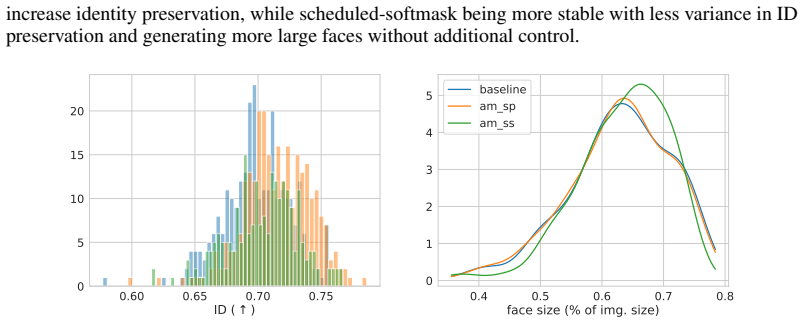
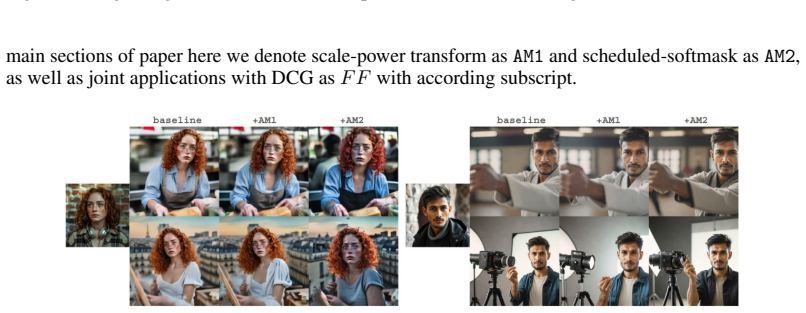
The central claim is that two training-free mechanisms — decoupled classifier-free guidance (DCG) and attention manipulation (AM) — fix the drop in identity preservation that occurs when a pretrained ID-adapter meets a distilled few-step sampler. DCG replaces the single guidance scale with two strengths, α for identity and β for text, and adds a rescaling step that keeps the two-term update stable in the 4-step regime. AM operates on the decoupled attention blocks introduced by IP-Adapter: the scale-power transform f_sp(A)=s·A^p sharpens attention on the face, while the scheduled-softmask transform f_ss biases generation toward stable portrait-like images with larger faces. On the paper's evaluation protocol, the joint FastFace setup improves ID similarity and aesthetic quality over baseline on all four checkpoints and on both LoRA scales tested.
Load-bearing premise
The fixed attention-manipulation hyperparameters and the first-token inversion rule were tuned on the authors' synthetic evaluation set and are assumed to transfer to any distilled checkpoint and identity without per-model tuning.
Editorial extensions
If this is right
- With fixed hyperparameters, FastFace improves ID similarity, CLIP score, and aesthetic quality over the unmodified IP-Adapter baseline across Turbo, LCM, Lightning, and Hyper in 4-step sampling.
- When the adapter's LoRA scale is lowered to 0.5 to increase creative variability, FastFace recovers much of the identity drop: for Hyper, ID rises from 0.381 to 0.450 with AM2+DCG.
- AM2 reduces failed-face counts more than AM1, at a small cost in prompt alignment, making it the safer default when face detection already fails often.
- The proposed evaluation protocol separates stylistic from realistic generation and contributes a public dataset, allowing future ID-adapters to be tuned for the two use cases separately.
Reading between the lines
- If universality holds, FastFace should also improve other ID-adapter families on the same distilled checkpoints, since it acts on the shared decoupled-attention pattern rather than on IP-Adapter-specific weights; this is not tested in the paper.
- The scheduled-softmask transform is a generic attention-focusing tool: a similar quantile-softmask could steer attention toward selected regions for other conditioning modules (e.g., ControlNet-style adapters) on distilled models, which the paper does not explore.
- A practical consequence the paper leaves implicit is that FastFace is deployable in real-time pipelines as-is, but a user should re-validate the fixed constants when a new distillation checkpoint appears, since robustness beyond the four tested checkpoints is not established.
Editorial analysis
A structured set of objections, weighed in public.
Referee Report
Summary. The paper proposes FastFace, a training-free framework for adapting pretrained identity-preserving adapters to distilled diffusion models. It introduces decoupled classifier-free guidance (DCG) with step scheduling and rescaling, and two attention-manipulation transforms (AM1 scale-power and AM2 scheduled-softmask) applied to decoupled attention blocks. It also proposes a synthetic evaluation dataset and protocol that separates realistic and stylistic generation. Experiments apply FaceID-Plus-v2 with SDXL-Turbo, LCM, Lightning, and Hyper at four sampling steps and report identity similarity, CLIP score, aesthetic score, ImageReward, face-style score, and face-fail count, claiming consistent improvements across most settings.
Significance. If established, the framework would be practically useful: it requires no retraining, is simple to implement, and the proposed evaluation protocol addresses a real gap in the literature. The DCG decomposition in Appendix A.4 and the explicit attention transforms are well specified, and the paper ships a clear set of ablation-style tables that allow the reader to see per-checkpoint behavior. However, the evidence does not support the universal claim as stated: Table 1 contains a clear counterexample, and the evaluation lacks uncertainty quantification and independent validation. These issues are fixable by reframing the claims and adding statistical and held-out analysis.
major comments (5)
- [§5.2, Table 1 (Turbo row, lora_scale=0.5)] The advertised default configuration increases face-fail count (FFC) from 242 to 431 with FAM1 and to 271 with FAM2, while aesthetic score (AE) drops from 5.791 to 5.757 for FAM1. Since §5.2 states that mechanisms are not tuned per checkpoint, this is a failure of the default setting rather than a per-model adaptation. The claim of universal fidelity improvement is therefore contradicted, and the paper should either restrict the claim or investigate and address this case.
- [§5.1 and Tables 1 and 3] No error bars, confidence intervals, or significance tests are reported. All metrics are point estimates over a fixed evaluation set, and FFC is a count over thousands of realistic examples; a change from 242 to 431 is substantial, but without repeated seeds or bootstrap intervals the smaller differences in other rows cannot be assessed. The paper's averaging claims need statistical support before they can support universal conclusions.
- [§4.3 and Appendix A.7] The hyperparameters for DCG and AM, including AM1 p=1.3, s=1.45/1.55 and the AM2 scheduled-softmask parameters, were tuned on the same synthetic evaluation set used for all reported numbers. There is no held-out split, no separate checkpoint-selection procedure, and no external validation set. This makes the generalization claim vulnerable to selection bias; an independent or at least cross-checkpoint validation scheme is needed.
- [Appendix A.5] The first-token inversion rule is asserted as an empirical finding ('we found that attention values for the first token ... are inverted'), but no quantitative evidence or ablation is provided. Since this rule is an actual component of AM2, and since the method is advertised as universal, this undocumented assumption should be justified with data or removed from the description.
- [§2 and §5] No experimental comparison is made against the adaptation methods cited in related work, such as per-model ControlNet finetuning ([18], [19]) or adapter projection ([20]). The paper claims superior qualities, but the only baseline is the unmodified FaceID-Plus-v2 on each distilled checkpoint. The relative contribution of FastFace against existing adaptation strategies is therefore unmeasured, and the related-work positioning is not supported by the experiments.
minor comments (6)
- [Appendix A.4, Eq. (16)] The expression contains a typo: 'ϵ(ϵ(ctext, ∅))' should likely be 'ϵ(ctext, ∅)' or 'ϵ(∅, ctext)' depending on the intended term.
- [Table 2] The column header uses 'FCS' while the main text and metric definitions use 'FSC' (face_style_score); the notation should be consistent.
- [Abstract and Appendix A.1] The paper claims to develop a 'public' and 'open' evaluation protocol, but no dataset URL, code release, or availability statement is provided. Please add a reproducibility section with links or state clearly how the dataset can be obtained.
- [§4.2, Eqs. (9)-(10)] The transform definitions would be easier to check if every symbol (norm, Qp, s, w, d, AdaIN) were explicitly defined in one place; currently some parameters are introduced only in Appendix A.7.
- [Figure 3] The caption says 'from right to left' but the figure layout is not self-explanatory; please clarify the direction of the scheduling effect and label the panels accordingly.
- [§7] The limitations section mentions the single-step regime but does not acknowledge the Turbo lora_scale=0.5 face-fail regression shown in Table 1; this should be listed as a known limitation if the claim is not restricted.
Circularity Check
No derivation-level circularity; the DCG and AM equations are explicit transforms. The main circular element is empirical: default hyperparameters were tuned on the same synthetic evaluation set used to report the headline gains, so the 'universal' claim is partly a fit to that set.
-
fitted input called prediction
[Section 1 (Introduction), Section 5.2, and Appendix A.7; results in Tables 1 and 3]
"Additionally, we construct our case-specific dataset of identity images and prompts, allowing tuning each setting separately. In the end, we evaluate both proposed methods across joint setting of stylistic and realistic generation as a general framework and demonstrate its superior qualities in terms of metrics scaling."
The same 54-identity, 120-prompt synthetic set used to tune the DCG schedules and AM1/AM2 hyperparameters (Appendix A.7: p=1.3, s=1.45/1.55; s=1.55, d=7.5/5.0, p=0.65, w=0.7) is the set on which Tables 1 and 3 report FastFace's improvements over baseline. The reported 'superior qualities' are therefore measured on the tuning distribution, so the headline 'universal' claim is statistically forced by the tuning procedure rather than independently confirmed. Section 5.2 states 'we do not tune mechanisms per checkpoint, all setups share default parameters,' presenting these tuned values as a universal configuration, but that universality is asserted, not tested on a held-out set.
full rationale
The derivation chain is not circular at the equation level: DCG follows from the score-function product rule (Eqs. 4-6, Appendix A.4), and AM transforms are explicit functions of the attention map (Eqs. 7-10), with the admitted equivalence of the scale component to increasing lambda (Appendix A.5) disclosed rather than hidden. The only circular element is empirical: the default hyperparameters for DCG and both AM variants were tuned on the authors' own synthetic evaluation set (54 identities x 120 prompts), and the headline comparisons in Tables 1 and 3 are computed on that same set. The 'universal, training-free' claim is thus partly a report of fit to the tuning set. The self-citation [36] (Titov et al.) is related-work support for attention-based editing, not load-bearing for FastFace's derivation, so it does not raise the score. Overall score 4 reflects this partial evaluation circularity while recognizing that the guidance and attention formulations have independent algorithmic content.
Assumptions & free parameters
free parameters (5)
- DCG strength schedules =
alpha(t) in {1.0,1.5,1.5,1.0}, beta(t) in {1.0,3.0,3.0,1.0}, phi=0.75
- AM1 scale-power parameters =
p=1.3, s=1.45 (down), s=1.55 (up)
- AM2 scheduled-softmask parameters =
s=1.55, p=0.65, d=7.5 (first step), d=5.0 (other steps), w=0.7
- ip_adapter_scale lambda =
Varied over {0.1,0.35,0.5,0.65,0.8,0.95} for Pareto fronts; fixed 0.8 for Tables 2-3
- Dataset identity cleaning threshold =
0.3 mean face similarity within group
assumptions (4)
- domain assumption Independence of identity and text conditions: p(cid, ctext) = p(cid)p(ctext)
- domain assumption Distilled models preserve the base architecture of the diffusion model
- ad hoc to paper First token of decoupled attention maps encodes background with inverted attention
- standard math Score-function product-rule derivation applies to noise-prediction networks in few-step sampling
Cite this review
Pith. "Pith review of FastFace: Tuning Identity Preservation in Distilled Diffusion via Guidance and Attention." pith.science (2026). https://pith.science/paper/D6Q46FZ6
@misc{pith2026250521144,
  author       = {Pith},
  title        = {Pith review of: FastFace: Tuning Identity Preservation in Distilled Diffusion via Guidance and Attention},
  year         = {2026},
  howpublished = {\url{https://pith.science/paper/D6Q46FZ6}},
  note         = {Machine review of arXiv:2505.21144}
}
read the original abstract
In latest years plethora of identity-preserving adapters for a personalized generation with diffusion models have been released. Their main disadvantage is that they are dominantly trained jointly with base diffusion models, which suffer from slow multi-step inference. This work aims to tackle the challenge of training-free adaptation of pretrained ID-adapters to diffusion models accelerated via distillation - through careful re-design of classifier-free guidance for few-step stylistic generation and attention manipulation mechanisms in decoupled blocks to improve identity similarity and fidelity, we propose universal FastFace framework. Additionally, we develop a disentangled public evaluation protocol for id-preserving adapters.
Figures


Figures from the paper (25 more)






Reference graph
Works this paper leans on
-
[18]
CCM: Adding Conditional Controls to Text-to-Image Consistency Models
Jie Xiao, Kai Zhu, Han Zhang, Zhiheng Liu, Yujun Shen, Yu Liu, Xueyang Fu, and Zheng-Jun Zha. Ccm: Adding conditional controls to text-to-image consistency models. arXiv preprint arXiv:2312.06971, 2023
work page Pith review arXiv 2023
-
[19]
One-step image translation with text-to-image models
Gaurav Parmar, Taesung Park, Srinivasa Narasimhan, and Jun-Yan Zhu. One-step image translation with text-to-image models. arXiv preprint arXiv:2403.12036, 2024
arXiv 2024
-
[20]
Han Lin, Jaemin Cho, Abhay Zala, and Mohit Bansal. Ctrl-adapter: An efficient and versatile framework for adapting diverse controls to any diffusion model. arXiv preprint arXiv:2404.09967, 2024
arXiv 2024
-
[1]
Denoising diffusion probabilistic models
Jonathan Ho, Ajay Jain, and Pieter Abbeel. Denoising diffusion probabilistic models. NeurIPS, 2020
2020
-
[2]
Diffusion models beat gans on image synthesis
Prafulla Dhariwal and Alexander Nichol. Diffusion models beat gans on image synthesis. Advances in neural information processing systems, 34:8780–8794, 2021
2021
-
[3]
High- resolution image synthesis with latent diffusion models
Robin Rombach, Andreas Blattmann, Dominik Lorenz, Patrick Esser, and Björn Ommer. High- resolution image synthesis with latent diffusion models. In Proceedings of the IEEE/CVF conference on computer vision and pattern recognition, pages 10684–10695, 2022
2022
-
[4]
Sdxl: Improving latent diffusion models for high-resolution image synthesis
Dustin Podell, Zion English, Kyle Lacey, Andreas Blattmann, Tim Dockhorn, Jonas Müller, Joe Penna, and Robin Rombach. Sdxl: Improving latent diffusion models for high-resolution image synthesis. arXiv preprint arXiv:2307.01952, 2023
arXiv 2023
-
[5]
Scaling rectified flow trans- formers for high-resolution image synthesis
Patrick Esser, Sumith Kulal, Andreas Blattmann, Rahim Entezari, Jonas Müller, Harry Saini, Yam Levi, Dominik Lorenz, Axel Sauer, Frederic Boesel, et al. Scaling rectified flow trans- formers for high-resolution image synthesis. In Forty-first international conference on machine learning, 2024
2024
Show all 42 references
-
[6]
Black Forest Labs. Flux. https://github.com/black-forest-labs/flux , 2024
2024
-
[7]
Latent consistency models: Synthesizing high-resolution images with few-step inference
Simian Luo, Yiqin Tan, Longbo Huang, Jian Li, and Hang Zhao. Latent consistency models: Synthesizing high-resolution images with few-step inference. arXiv preprint arXiv:2310.04378, 2023
2023 arXiv
-
[8]
Fast high-resolution image synthesis with latent adversarial diffusion distillation
Axel Sauer, Frederic Boesel, Tim Dockhorn, Andreas Blattmann, Patrick Esser, and Robin Rombach. Fast high-resolution image synthesis with latent adversarial diffusion distillation. In SIGGRAPH Asia 2024 Conference Papers, pages 1–11, 2024
2024
-
[9]
Sdxl-lightning: Progressive adversarial diffusion distillation
Shanchuan Lin, Anran Wang, and Xiao Yang. Sdxl-lightning: Progressive adversarial diffusion distillation. arXiv preprint arXiv:2402.13929, 2024
2024 arXiv
-
[10]
Hyper-sd: Trajectory segmented consistency model for efficient image synthesis
Yuxi Ren, Xin Xia, Yanzuo Lu, Jiacheng Zhang, Jie Wu, Pan Xie, Xing Wang, and Xuefeng Xiao. Hyper-sd: Trajectory segmented consistency model for efficient image synthesis. arXiv preprint arXiv:2404.13686, 2024
2024 arXiv
-
[11]
Adversarial diffusion distillation
Axel Sauer, Dominik Lorenz, Andreas Blattmann, and Robin Rombach. Adversarial diffusion distillation. In European Conference on Computer Vision, pages 87–103. Springer, 2024
2024
-
[12]
Ip-adapter: Text compatible image prompt adapter for text-to-image diffusion models
Hu Ye, Jun Zhang, Sibo Liu, Xiao Han, and Wei Yang. Ip-adapter: Text compatible image prompt adapter for text-to-image diffusion models. arXiv preprint arXiv:2308.06721, 2023
2023 arXiv
-
[13]
Photomaker: Customizing realistic human photos via stacked id embedding
Zhen Li, Mingdeng Cao, Xintao Wang, Zhongang Qi, Ming-Ming Cheng, and Ying Shan. Photomaker: Customizing realistic human photos via stacked id embedding. In Proceedings of the IEEE/CVF conference on computer vision and pattern recognition, pages 8640–8650, 2024
2024
-
[14]
Instantid: Zero-shot identity-preserving generation in seconds.arXiv preprint arXiv:2401.07519, 2024
Qixun Wang, Xu Bai, Haofan Wang, Zekui Qin, Anthony Chen, Huaxia Li, Xu Tang, and Yao Hu. Instantid: Zero-shot identity-preserving generation in seconds.arXiv preprint arXiv:2401.07519, 2024
2024 arXiv
-
[15]
Pulid: Pure and lightning id customization via contrastive alignment
Zinan Guo, Yanze Wu, Chen Zhuowei, Peng Zhang, Qian He, et al. Pulid: Pure and lightning id customization via contrastive alignment. Advances in neural information processing systems, 37:36777–36804, 2024
2024
-
[16]
Infiniteyou: Flexible photo recrafting while preserving your identity
Liming Jiang, Qing Yan, Yumin Jia, Zichuan Liu, Hao Kang, and Xin Lu. Infiniteyou: Flexible photo recrafting while preserving your identity. arXiv preprint arXiv:2503.16418, 2025
2025 arXiv
-
[17]
Adding conditional control to text-to-image diffusion models
Lvmin Zhang, Anyi Rao, and Maneesh Agrawala. Adding conditional control to text-to-image diffusion models. In Proceedings of the IEEE/CVF international conference on computer vision, pages 3836–3847, 2023. 11
2023
-
[21]
Kolors: Effective training of diffusion model for photorealistic text-to-image synthesis
Kolors Team. Kolors: Effective training of diffusion model for photorealistic text-to-image synthesis. arXiv preprint, 2024
2024
-
[22]
Dreambooth: Fine tuning text-to-image diffusion models for subject-driven generation
Nataniel Ruiz, Yuanzhen Li, Varun Jampani, Yael Pritch, Michael Rubinstein, and Kfir Aberman. Dreambooth: Fine tuning text-to-image diffusion models for subject-driven generation. In Proceedings of the IEEE/CVF conference on computer vision and pattern recognition, pages 22500...
2023
-
[23]
Progressive distillation for fast sampling of diffusion models
Tim Salimans and Jonathan Ho. Progressive distillation for fast sampling of diffusion models. arXiv preprint arXiv:2202.00512, 2022
2022 arXiv
-
[24]
Consistency models
Yang Song, Prafulla Dhariwal, Mark Chen, and Ilya Sutskever. Consistency models. 2023
2023
-
[25]
One-step diffusion with distribution matching distillation
Tianwei Yin, Michaël Gharbi, Richard Zhang, Eli Shechtman, Fredo Durand, William T Freeman, and Taesung Park. One-step diffusion with distribution matching distillation. In Proceedings of the IEEE/CVF conference on computer vision and pattern recognition, pages 6613–6623, 2024
2024
-
[26]
Repurposing diffusion-based image generators for monocular depth estimation
Bingxin Ke, Anton Obukhov, Shengyu Huang, Nando Metzger, Rodrigo Caye Daudt, and Kon- rad Schindler. Repurposing diffusion-based image generators for monocular depth estimation. In Proceedings of the IEEE/CVF Conference on Computer Vision and Pattern Recognition (CVPR), 2024
2024
-
[27]
Pixart- {\delta}: Fast and controllable image generation with latent consistency models
Junsong Chen, Yue Wu, Simian Luo, Enze Xie, Sayak Paul, Ping Luo, Hang Zhao, and Zhenguo Li. Pixart- {\delta}: Fast and controllable image generation with latent consistency models. arXiv preprint arXiv:2401.05252, 2024
2024 arXiv
-
[28]
Ctrlora: An extensible and efficient framework for controllable image generation
Yifeng Xu, Zhenliang He, Shiguang Shan, and Xilin Chen. Ctrlora: An extensible and efficient framework for controllable image generation. arXiv preprint arXiv:2410.09400, 2024
2024 arXiv
-
[29]
Instructpix2pix: Learning to follow image editing instructions
Tim Brooks, Aleksander Holynski, and Alexei A Efros. Instructpix2pix: Learning to follow image editing instructions. In Proceedings of the IEEE/CVF conference on computer vision and pattern recognition, pages 18392–18402, 2023
2023
-
[30]
Analysis of classifier-free guidance weight schedulers
Xi Wang, Nicolas Dufour, Nefeli Andreou, Marie-Paule Cani, Victoria Fernández Abrevaya, David Picard, and Vicky Kalogeiton. Analysis of classifier-free guidance weight schedulers. arXiv preprint arXiv:2404.13040, 2024
2024 arXiv
-
[31]
Invert- ible consistency distillation for text-guided image editing in around 7 steps
Nikita Starodubcev, Mikhail Khoroshikh, Artem Babenko, and Dmitry Baranchuk. Invert- ible consistency distillation for text-guided image editing in around 7 steps. arXiv preprint arXiv:2406.14539, 2024
2024 arXiv
-
[32]
Common diffusion noise schedules and sample steps are flawed
Shanchuan Lin, Bingchen Liu, Jiashi Li, and Xiao Yang. Common diffusion noise schedules and sample steps are flawed. In Proceedings of the IEEE/CVF winter conference on applications of computer vision, pages 5404–5411, 2024
2024
-
[33]
Prompt-to-prompt image editing with cross attention control
Amir Hertz, Ron Mokady, Jay Tenenbaum, Kfir Aberman, Yael Pritch, and Daniel Cohen-Or. Prompt-to-prompt image editing with cross attention control. arXiv preprint arXiv:2208.01626, 2022
2022 arXiv
-
[34]
Masactrl: Tuning-free mutual self-attention control for consistent image synthesis and editing
Mingdeng Cao, Xintao Wang, Zhongang Qi, Ying Shan, Xiaohu Qie, and Yinqiang Zheng. Masactrl: Tuning-free mutual self-attention control for consistent image synthesis and editing. In Proceedings of the IEEE/CVF international conference on computer vision, pages 22560–22570, 2023. 12
2023
-
[35]
Diffusion self-guidance for controllable image generation
Dave Epstein, Allan Jabri, Ben Poole, Alexei Efros, and Aleksander Holynski. Diffusion self-guidance for controllable image generation. Advances in Neural Information Processing Systems, 36:16222–16239, 2023
2023
-
[36]
Guide-and-rescale: Self-guidance mechanism for effective tuning-free real image editing
Vadim Titov, Madina Khalmatova, Alexandra Ivanova, Dmitry Vetrov, and Aibek Alanov. Guide-and-rescale: Self-guidance mechanism for effective tuning-free real image editing. In European Conference on Computer Vision, pages 235–251. Springer, 2024
2024
-
[37]
Arbitrary style transfer in real-time with adaptive instance normalization
Xun Huang and Serge Belongie. Arbitrary style transfer in real-time with adaptive instance normalization. In Proceedings of the IEEE international conference on computer vision, pages 1501–1510, 2017
2017
-
[38]
Aesthetic model predictor - GitHub repository
LAION. Aesthetic model predictor - GitHub repository. https://github.com/LAION-AI/ aesthetic-predictor, 2022
2022
-
[39]
Imagereward: Learning and evaluating human preferences for text-to-image generation
Jiazheng Xu, Xiao Liu, Yuchen Wu, Yuxuan Tong, Qinkai Li, Ming Ding, Jie Tang, and Yuxiao Dong. Imagereward: Learning and evaluating human preferences for text-to-image generation. Advances in Neural Information Processing Systems, 36:15903–15935, 2023
2023
-
[40]
Insightface: 2d and 3d face analysis project
Deep Insight. Insightface: 2d and 3d face analysis project. https://github.com/ deepinsight/insightface, 2023
2023
-
[41]
realistic
Yang Song, Jascha Sohl-Dickstein, Diederik P Kingma, Abhishek Kumar, Stefano Ermon, and Ben Poole. Score-based generative modeling through stochastic differential equations. arXiv preprint arXiv:2011.13456, 2020. 13 A Technical Appendices and Supplementary Material A.1 Details...
2011 arXiv
-
[42]
up" and
Scaling increases similarity, but alters image background, resulting in prompt following degra- dation. This is expected, as plugging scaling transform into Eq. 7 instead of f () we can see that it 16 is same as increasing λ. When raising attention values to some power, we ach...
Reviewed August 7, 2026 · model on record in the stance chip above.
Discussion (0). Sign in to comment.