REVIEW 5 major objections 5 minor 1 cited by
Rank three representations of Painlev\'e systems: I. Wild character varieties
T0 review · 5 major / 5 minor · reviewed 2026-08-07 · deepseek-v4-flash
Pith's one-line read Under suitable parameter choices, the rank 3 Joshi–Kitaev–Treharne wild character varieties are affine cubic surfaces isomorphic to the rank 2 Painlevé wild character varieties.
desk verdict Useful first computation of rank-3 JKT wild character varieties, but the main table rests on unshown eliminations and two concrete algebraic slips; needs a careful revision before I'd trust Theorem 1.1 as stated. read the letter →
The pith
A machine-rendered reading of the paper's core claim, the machinery that carries it, and where it could break.
The reading
What carries the argument
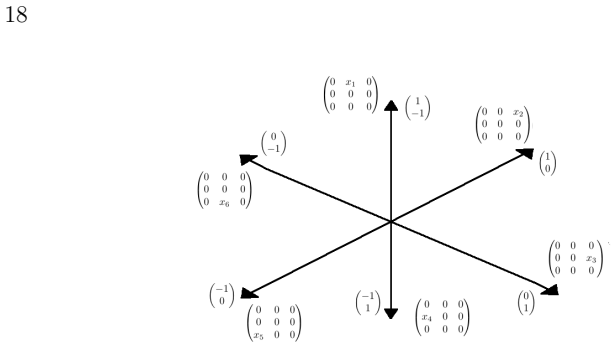
The machinery is the Stokes local system attached to each JKT connection. For each case one fixes the irregular type, computes the Stokes directions from the phase condition $\operatorname{Arg}(\lambda_l-\lambda_l')-l\varphi/N\in(2\mathbb{Z}+1)\pi/2$, arranges the corresponding unipotent Stokes matrices $S_i$, and builds the monodromy product $M_\infty=H\prod_i S_i$ using the formal monodromy $H$. The exponential torus, the centralizer of the leading irregular coefficient, acts on the Stokes coefficients, and its invariants are the monomials $U,V,W,R,T$ subject to the single relation $UVW=RT$. The trace equations plus this relation are then simplified by elimination; the structural outcome is that each resulting surface is cubic with only one degree-three term, $XYZ$.
What would settle it
Recompute the Stokes directions for the JKT I case from formula (15): the phase equation for the branch differences should give exactly $\varphi=k\pi/5$, $k=1,\dots,10$, in the order used in Section 4.7. A symbolic check of $\operatorname{Arg}(\lambda_5(\varepsilon^i-\varepsilon^j))-5\varphi/3$ that yields any additional direction or a different cyclic order would alter the product $M_\infty=H_3\prod_{i=1}^{10} S_i$, and the elimination that produces $XYZ+X+Y+1=0$ would fail.
Extended reading notes
Core claim
The central claim, Theorem 1.1, is that under suitable choices of parameters the affine cubic surfaces describing the JKT wild character varieties are isomorphic to the affine cubic surfaces describing the corresponding rank 2 Painlevé wild character varieties. The proof is by explicit computation: for each JKT case the Stokes matrices are ordered, the monodromy product $M_\infty=H\prod_i S_i$ is formed, and the conditions $M_\infty=I$ or fixed traces $\operatorname{Tr}(M_\infty)=p$, $\operatorname{Tr}(M_\infty^2)=q$ are imposed together with the invariant-monomial relation $UVW=RT$; eliminating variables yields the cubic equations collected in Table 2. For example, JKT VI gives $\gamma XYZ+\alpha X^2+\beta Y^2+\gamma Z^2+c_1X+c_2Y+c_3Z+c_4=0$, JKT II gives $XYZ-X-\alpha^{-1}Y-Z+1+\alpha^{-1}=0$, and JKT I gives $XYZ+X+Y+1=0$. The paper identifies Fourier–Laplace transformation as the underlying reason for the coincidence, with the proof deferred to a sequel.
Load-bearing premise
The load-bearing premise is that the paper's case-by-case lists of Stokes directions and the order of the Stokes matrices are correct; the computations from formula (15) are not shown in detail, and even a single missed or reordered direction would change the monodromy product and hence every final cubic equation.
Editorial extensions
If this is right
- The JKT I wild character variety is literally the parameter-free cubic $XYZ+X+Y+1=0$, matching the Painlevé I case.
- The six JKT Betti moduli spaces form families of affine cubic surfaces over parameter spaces of dimensions 4, 3, 2, 2, 1, and 0, exactly the dimensions of the corresponding rank 2 Painlevé isomonodromy families.
- Since the Riemann–Hilbert–Birkhoff correspondence identifies the de Rham and Betti moduli spaces of these connections, the same cubic equations describe the moduli spaces of the rank 3 irregular connections themselves.
- In the wild cases the compactifying divisor is a chain of three rational curves, in contrast to the logarithmic rank 3 case where the compactifying curve is a single nodal rational curve.
- The Stokes-matrix coefficients $x_1,\dots,x_{12}$ provide effective coordinates on these moduli spaces, so one can write the Painlevé cubic surfaces without introducing trace coordinates.
Reading between the lines
- If the Fourier–Laplace isometry promised in the sequel is established, Theorem 1.1 is the Betti-side shadow of an isomorphism of de Rham moduli spaces; a direct check would be that the Fourier–Laplace transform sends the ordered JKT Stokes matrices to the rank 2 monodromy data in exactly the way the cubic equations predict.
- The same elimination strategy may give normal forms for other rank $n$ twisted connections; the parameter-dimension pattern $(4,3,2,2,1,0)$ could serve as a diagnostic for which higher-rank systems reduce to known Painlevé surfaces.
- The surface-level coincidence suggests that each Painlevé equation with a JKT Lax pair has two distinct isomonodromy interpretations sharing one wild character variety, which may be connected to known Lax-pair dualities and could be probed by comparing quantities like tau functions in the two descriptions.
- One could test the parameter correspondence explicitly by specializing the cubic equations and comparing their singular loci or boundary divisors with the rank 2 families; the paper does not carry out this comparison.
Editorial analysis
A structured set of objections, weighed in public.
Referee Report
Summary. The paper studies the rank 3 irregular connections of Joshi–Kitaev–Treharne (JKT) associated with the six Painlevé equations. For each of the six cases JKT VI, V, IVa, IVb, II, and I, the authors assemble the ordered Stokes matrices, impose the global monodromy condition (identity at the irregular singularity, or fixed trace data with the logarithmic singularity), pass to invariants under the exponential torus, and eliminate variables to obtain an explicit affine cubic equation for the corresponding wild character variety. These equations are collected in Table 2 and compared with the rank 2 Painlevé wild character varieties of van der Put and Saito [23], yielding Theorem 1.1 that, under suitable parameter choices, the JKT varieties are isomorphic to the rank 2 Painlevé ones. The paper also gives the explicit Stokes matrices, formal monodromies, and parameter identifications in Remarks 4.6–4.10.
Significance. If correct, the main result is valuable: it provides the first explicit rank 3 Betti moduli spaces for all six JKT Lax representations and exhibits their isomorphism with the known rank 2 Painlevé character varieties. The approach is concrete and mostly constructive: Stokes data are written down explicitly, invariant-theoretic reductions are described, and the final equations are simple and falsifiable. The paper's use of the quasi-Hamiltonian framework and the comparison with [23] makes the claims checkable. However, the verification burden is high because the central elimination computations are not displayed; the specific algebraic inconsistencies discussed below mean that the result is not yet fully supported as written.
major comments (5)
- [§4.2, Eqs. (19)–(21)] The statement that elimination of U and R followed by the linear rescaling W=-X-(β+γ), V=-Y-(α+γ), S=-Z-(-α-β) yields the surface γXYZ+αX²+βY²+γZ²+c1X+c2Y+c3Z+c4=0 is not correct for generic parameters. Substituting these expressions into the displayed leading term γVWS and quadratic part -αW²-βV²-γS²+(α+γ)SW+(β+γ)SV+(-α-β)VW gives a cubic term -γXYZ and a quadratic part -αX²-βY²-γZ²+(α+γ)XZ+(β+γ)YZ-(α+β)XY; the cross terms XZ, YZ, and XY do not vanish for generic α, β, γ. Thus the displayed normal form in Table 2 for JKT VI is not obtained by the stated change of variables, and Remark 4.6 rests on this. The authors should either exhibit a correct linear change that simultaneously normalizes the cubic and quadratic parts, or state the parameter restrictions under which the displayed equation holds.
- [Remark 4.8] The variable identification x'_1↦x3, x'_2↦x2, x'_3↦x4 is inconsistent with the signs in Eq. (27). After the authors' own rescaling of the van der Put–Saito PIV equation, the linear terms are -x'_2 - x'_3, which become -x2 - x4 under the stated identification, whereas Eq. (27) has +x2 + x4. The correspondence can be repaired by taking x'_2↦-x2 and x'_3↦-x4, but as printed the parameter identification in this remark is incorrect.
- [§4.5–4.6 and Lemma 4.3(iii)] The central table is presented as the outcome of elimination computations that are not shown. Phrases such as 'eliminating two variables ... we receive' (§4.2), 'One can easily see' (§4.5), and 'we can express the variables' (§4.6) replace the actual algebra, and the proof of Lemma 4.3(iii) in the D=3{∞} case is left to the reader. Since Theorem 1.1 is a claim about six explicit cubic surfaces, each equation is only as secure as these computations; the discrepancies in §4.2 and Remark 4.8 show that the omitted algebra cannot be taken on faith. The revised manuscript should include the eliminations in full, or at minimum provide for each case the eliminated equation before the final rescaling and a reproducible computation.
- [Definition 3.2] The existence of the de Rham moduli spaces M^{JKT*}_{dR} in the twisted cases is attributed to [3] together with 'a suitable extension [10] to the twisted case', where [10] is an in-preparation sequel. The Riemann–Hilbert–Birkhoff correspondence and the hyperkähler structure are used in the paper's framing, so deferring the twisted-case existence proof to a sequel leaves a gap in the stated context. This is not fatal for the Betti-side equations, which are computed directly from Stokes data, but it should be flagged explicitly in the revised text, for instance by stating which results are conditional on [10].
- [§4, Stokes directions] The ordered Stokes data are load-bearing, since any missed direction or incorrect ordering changes the monodromy products and hence every equation. The directions are asserted for each case (e.g., φ=kπ/3 for JKT VI, φ=kπ/2 for JKT IVa, φ=kπ/5 for JKT I) from formula (15), but the case-by-case computation of Arg(λ_l-λ'_l) and the resulting ordering of the matrices is not shown. The authors should provide a short table or paragraph per case verifying the phase computations, especially in the twisted cases where the directions in the t-plane do not come in opposite pairs.
minor comments (5)
- [§4.3] The sentence 'the same conditions apply as in Section 4.3' should refer to Section 4.2.
- [Remark 4.8] The expression '(s2² +s1s3 2)' appears to contain a typo; presumably one of the parameters is s2 or s3, and the notation should be clarified.
- [Table 2] The constants c_i for the JKT VI row are not explicitly computed; since Remarks 4.6–4.10 are said to give the concrete parameter correspondence, the missing c_i should be supplied or references given.
- [Lemma 4.3] The notation for the Stokes variables in the D=3{∞} cases (x7,...,x12) is only implicit; a table analogous to the D=2{∞} case would improve readability.
- [§4.4] Eq. (27) follows from substituting x1 from (25) into (26); the sentence could state this explicitly, and the resulting identification of c_i as functions of p and q should be written out.
Circularity Check
No circularity: the cubic equations are computed from Stokes data and only afterwards compared with the rank two Painlevé surfaces.
full rationale
The paper's derivation chain is self-contained on the Betti side. In Section 4 the authors specify the local irregular types from the JKT systems, list the Stokes directions via equation (15), write down ordered Stokes matrices, form the topological monodromy products, impose the trace conditions Tr(M)=p and Tr(M^2)=q (or M=I), and eliminate variables to obtain each cubic surface. The target equations of van der Put and Saito [23] enter only after these computations, as a point-by-point comparison in Remarks 4.6–4.11 and Table 2. No parameter is fitted to the [23] equations, and no displayed cubic is defined in terms of the rank two result. The theorem is therefore not equivalent to its inputs by construction. The self-references present are not load-bearing for the central claim: [9] concerns the logarithmic case in the authors' prior work and is used only as background, while the forthcoming sequel [10] is cited for the Fourier–Laplace interpretation and for existence of hyperkähler structures in twisted cases, neither of which is needed to derive the affine cubic equations. Lemma 4.3(iii) is left to the reader and much of the elimination algebra is summarized rather than shown, and the skeptic's examples suggest possible algebraic sign or rescaling errors, but those are correctness risks, not circularity: the computations are independent of the [23] target surfaces. Accordingly, the circularity score is 0.
Assumptions & free parameters
assumptions (5)
- standard math Hukuhara-Levelt-Turrittin theorem: a meromorphic connection decomposes formally into irregular and regular-singular parts over a finite ramified extension
- domain assumption Riemann-Hilbert-Birkhoff correspondence (Boalch, Theorem 2.2 / [5, Cor. A.4]) gives a bijection between meromorphic connections and Stokes representations
- standard math Kempf-Ness theorem identifies the GIT quotient and the symplectic quotient (Theorem 2.3)
- domain assumption Normal form equivalence Lemma 3.1, citing Keane-Szabó [17, Theorem 2.1], that eigenvalue expansions (8)-(13) are realized by polynomial gauge transformations
- ad hoc to paper Existence of the de Rham moduli spaces M^{JKT*}_{dR} as hyperkähler manifolds, from Biquard-Boalch [3] together with an extension to the twisted case attributed to the authors' sequel [10] (in preparation)
Cite this review
Pith. "Pith review of Rank three representations of Painlev\'e systems: I. Wild character varieties." pith.science (2026). https://pith.science/paper/XT4QNDOJ
@misc{pith2026250521186,
  author       = {Pith},
  title        = {Pith review of: Rank three representations of Painlev\'e systems: I. Wild character varieties},
  year         = {2026},
  howpublished = {\url{https://pith.science/paper/XT4QNDOJ}},
  note         = {Machine review of arXiv:2505.21186}
}
read the original abstract
We give explicit cubic equations for the wild character varieties corresponding to the rank 3 representations of Painlev\'e equations, and compare them to the ones of their classical rank 2 representations.
Figures
Forward citations
Cited by 1 Pith paper
-
Rank three representations of Painleve systems: III. Dolbeault structure, spectral correspondence
Algebraic Nahm transformation gives a holomorphic symplectic isomorphism between the rank-2 and rank-3 (JKT) Dolbeault moduli spaces for all six Painleve systems, realized by explicit elliptic fibrations of types I*_0...
Reference graph
Works this paper leans on
- [10]
-
[23]
M. van der Put, M. Saito: Moduli spaces for linear differential equations and the Painlev\'e equations, Annales de l institut Fourier 59 , 7 (2009), 2611--2667
work page 2009
-
[3]
O. Biquard, P. Boalch: Wild non-abelian H odge theory on curves, Compos. Math. 140 , 1 (2004), 179--204
work page 2004
-
[1]
A. Alekseev, A. Malkin, and E. Meinrenken: Lie group valued moment maps, J. Differential Geom. 48 , 3 (1998), 445--495
work page 1998
- [2]
-
[4]
P. Boalch: Wild character varieties, meromorphic Hitchin systems and Dynkin diagrams, Geometry and Physics: Volume II: A Festschrift in honour of Nigel Hitchin, Oxford University Press (2018)
work page 2018
-
[5]
P. Boalch: Geometry and braiding of Stokes data; Fission and wild character varieties, Annals of Mathematics 179 , 1 (2014), 301--365
work page 2014
-
[6]
P. Boalch: Global Weyl groups and a new theory of multiplicative quiver varieties, Geometry and Topology 19 , (2015), 3467--3536
work page 2015
Show all 26 references
- [7]
-
[8]
Dou c ot: Basic representations of genus zero nonabelian Hodge spaces, arXiv:2409.12864
J. Dou c ot: Basic representations of genus zero nonabelian Hodge spaces, arXiv:2409.12864
-
[9]
Eper, Sz
M. Eper, Sz. Szab\'o: Asymptotic geometry of non-abelian Hodge theory and Riemann--Hilbert correspondence, rank three E _6 case, arXiv:2407.20638
-
[11]
Flaschka, A
H. Flaschka, A. C. Newell: Monodromy- and spectrum-preserving deformations I, Commun. Math. Phys., 76 (1980) 65--116
1980
-
[12]
Harnad: Dual Isomonodromic Deformations and Moment Maps to Loop Algebras, Commun
J. Harnad: Dual Isomonodromic Deformations and Moment Maps to Loop Algebras, Commun. Math. Phys. 166 (1994) 337-365
1994
-
[13]
Hukuhara: Sur les points singuliers des \'e quations diff \'e rentielles lin \'e aires, III Memoirs of the Faculty of Science, Kyushu University
M. Hukuhara: Sur les points singuliers des \'e quations diff \'e rentielles lin \'e aires, III Memoirs of the Faculty of Science, Kyushu University. Series A, Mathematics, 2 , 2 (1942) 125--137
1942
-
[14]
Jimbo, T
M. Jimbo, T. Miwa: Monodromy preserving deformation of linear ordinary differential equations with rational coefficients. II, Physica D: Nonlinear Phenomena, 2 (1981), 407--448
1981
-
[15]
Joshi, A
N. Joshi, A. Kitaev, P. Treharne: On the Linearization of the Painlev\'e III-VI Equations and Reductions of the Three-Wave Resonant System, Journal of Mathematical Physics 48 , 10 (2007)
2007
-
[16]
Joshi, A
N. Joshi, A. Kitaev, P. Treharne: On the Linearization of the First and Second Painlev\'e Equations, Journal of Physics A: Mathematical and Theoretical 42 , 5 (2009)
2009
-
[17]
Keane, Sz
C. Keane, Sz. Szab\'o: Normal forms of endomorphism-valued power series, Involve: a Journal of Mathematics 11 , 1 (2018), 81--94
2018
-
[18]
Lawton: Minimal affine coordinates for SL (3, C ) character varieties of free groups, J
S. Lawton: Minimal affine coordinates for SL (3, C ) character varieties of free groups, J. Algebra 320 , 10 (2008), 3773--3810
2008
-
[19]
A. H. M. Levelt: Jordan decomposition for a class of singular differential operators, Arkiv f \"o r matematik 13 (1975), 1--27
1975
-
[20]
Mazzocco: Painlev\'e sixth equation as isomonodromic deformations equation of an irregular system, CRM Proc
M. Mazzocco: Painlev\'e sixth equation as isomonodromic deformations equation of an irregular system, CRM Proc. Lec. Notes 32 , Amer. Math. Soc., Providence, RI, (2002) 219--238
2002
-
[21]
Mumford, J
D. Mumford, J. Fogarty F. K. Kirwan: Geometric Invariant Theory, Ergebnisse der Mathematik und ihrer Grenzgebiete 34 3rd enlarged edition, Springer
-
[22]
Procesi The invariant theory of n n matrices, Advances in Mathematics 19 3 (1976), 306--381
C. Procesi The invariant theory of n n matrices, Advances in Mathematics 19 3 (1976), 306--381
1976
-
[24]
van der Put, M
M. van der Put, M. F. Singer: Galois Theory of Linear Differential Equations, Springer 1666 , (1997)
1997
-
[25]
H. L. Turrittin: Convergent solutions of ordinary linear homogeneous differential equations in the neighborhood of an irregular singular point, Acta Mathematica 93 (1955) 27--66
1955
-
[26]
Wasow: Asymptotic expansions for ordinary differential equations, Wiley & Sons (1965)
W. Wasow: Asymptotic expansions for ordinary differential equations, Wiley & Sons (1965)
1965
Reviewed August 7, 2026 · model on record in the stance chip above.
Discussion (0). Continue with ORCID to comment.