REVIEW 3 major objections 5 minor 54 references
Making Every Event Count: Balancing Data Efficiency and Accuracy in Event Camera Subsampling
T0 review · 3 major / 5 minor · reviewed 2026-08-07 · deepseek-v4-flash
Pith's one-line read Events from dense spatiotemporal regions carry the information that matters, and a causal density-based subsampler that keeps them improves event-video classification accuracy in sparse regimes.
desk verdict A careful, useful empirical comparison of event-camera subsampling methods whose sparse-regime claim is real but dataset-conditional; the N-Cars failure is the paper's own strongest caveat. read the letter →
The pith
A machine-rendered reading of the paper's core claim, the machinery that carries it, and where it could break.
The reading
What carries the argument
The central object is the causal spatiotemporal density filter of Eq. (2): each event's density is the sum over past same-polarity events of a Gaussian spatial kernel times an exponential decay in time, computed recursively per polarity. A random threshold f^(thresh) with u ~ U(0,1) decides whether to keep each event, preventing greedy selection from only the densest region. The paper's case rests on comparing this filter against spatial, temporal, random, event-count, and Harris corner-based subsampling, all tuned so the average number of events per video matches across methods.
What would settle it
Run the causal density-based method on a dataset with deliberately high per-video event-count variance while holding a fixed threshold: if many videos drop below a small event count and classification accuracy falls toward chance while random subsampling holds up, the fixed-threshold assumption is the decisive factor. Conversely, on a dataset where every video has similar total event counts, the density-based advantage should persist; measuring the accuracy gap as a function of event-count variance would settle whether the claim is about density or about threshold calibration.
Extended reading notes
Core claim
The paper introduces a causal density-based subsampling method that scores each incoming event via a recursive spatiotemporal density filter—a Gaussian spatial kernel combined with an exponential temporal decay—and retains events whose density exceeds a randomly jittered threshold. Evaluated with an EST voxel representation and ResNet34 on N-Caltech101, DVS-Gesture, and N-Cars, this method achieves the highest normalized area-under-curve accuracy-versus-event-count on N-Caltech101 and ties with corner-based Harris selection on DVS-Gesture, beating random, spatial, temporal, and event-count baselines in the sparse regime. The evidence is read as supporting the hypothesis that dense regions carry more task-relevant information. On N-Cars, fixed-threshold density selection collapses many videos to near-zero events, and accuracy drops; normalizing density values or using an adaptive threshold restores performance at the cost of strict causality.
Load-bearing premise
The method assumes one fixed density threshold and one set of kernel sizes chosen before seeing any video can serve every video in a dataset; N-Cars shows this assumption fails when per-video event counts vary widely, starving sparse videos of events.
Editorial extensions
If this is right
- When an event budget is fixed, keeping events from dense spatiotemporal regions preserves more class-relevant information than keeping a random subset, at least for CNN classification on N-Caltech101 and DVS-Gesture.
- Simple input-independent methods (spatial, temporal, random) outperform the event-count downscaling baseline, so hardware comparisons should include these trivial baselines before adopting more complex subsamplers.
- Spatial subsampling is highly sensitive to row/column offset choice, while temporal subsampling is more robust, making temporal subsampling the safer naive hardware option.
- A fixed density threshold cannot handle datasets with large per-video event-count variance; normalization or adaptive thresholding is required, but strict causality is then lost.
- Corner-based subsampling matches density-based accuracy on DVS-Gesture, so corners are also a competitive informative-event prior for gesture data.
Reading between the lines
- The density hypothesis could extend beyond classification to detection or optical flow, since dense event regions often correspond to moving foreground; the paper only tests classification.
- A testable extension is to replace the fixed threshold with a causal, adaptive threshold based on a running event-rate estimate and measure whether the N-Cars accuracy benefit survives without losing causality.
- The random-threshold trick is not independently ablated; separating the diversity benefit of random thresholding from the density benefit itself would clarify the mechanism behind the accuracy gain.
- The accuracy–event-count curves may understate the density method's value at very high subsampling rates because the fixed threshold creates a floor of near-empty videos; per-video normalization in the training loop would be a more realistic deployment recipe.
Editorial analysis
A structured set of objections, weighed in public.
Referee Report
Summary. The paper systematically compares six hardware-friendly event-camera subsampling methods—spatial, temporal, random, event count, corner-based, and a newly proposed causal density-based method—on three event-video classification benchmarks (N-Caltech101, DVS-Gesture, and N-Cars) using an EST representation with a ResNet34 classifier. The central claim is that the causal density-based method, which retains events from spatiotemporally dense regions via Eq. (2) and a random threshold in Eq. (3), achieves improved classification accuracy in sparse regimes. The paper also analyzes factors such as spatial-subsampling offset sensitivity and the failure of density-based subsampling on high-variance event-count datasets such as N-Cars.
Significance. If the central claim holds, the paper provides a useful practical guide for hardware-level event-rate reduction and supports the hypothesis that high-density events carry more task-relevant information. The strengths include a systematic comparison across six methods, 18 independent runs (6 for N-Cars) with reported standard deviations, control of average event counts across methods, an informative offset-sensitivity analysis, and a commitment to release code. The paper is also honest about the N-Cars failure case. However, the abstract's unqualified sparse-regime claim is contradicted by the paper's own N-Cars results, and the density method's hyperparameter dependence is under-examined; these issues should be addressed before publication.
major comments (3)
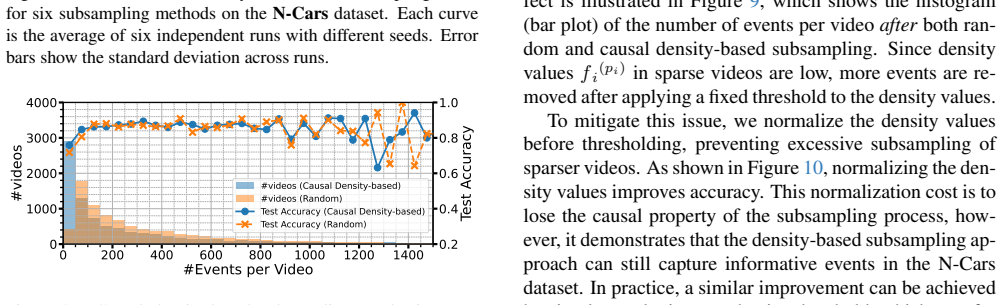
- [Abstract; §4.1, §4.3, Fig. 9, Table 1] The abstract and §4.1 state that the causal density-based method demonstrates improved classification accuracy in sparse regimes, but the N-Cars experiment in §4.3 and Table 1 contradicts this unqualified claim: with the fixed threshold of Eq. (3), the causal density method achieves nAUC = 0.789 ± 0.011 versus 0.825 ± 0.003 for random subsampling, and Fig. 9 shows that many videos are reduced to near-zero events. The claim is therefore supported only for datasets with relatively narrow per-video event-count distributions, not as a general property of causal density-based subsampling. Please either qualify the abstract and §4.1 accordingly, or add and evaluate a causal adaptive-threshold variant (e.g., based on a running event-rate estimate) that does not forfeit causality.
- [§3.2.4, Table 3] The density method's advantage depends on several dataset-specific choices: the threshold f^(thresh) is set separately for each dataset and each subsampling level, and the kernel parameters wd = 7 and tau = 30 ms are chosen per dataset based on 'scene dynamics and camera resolution.' Because random subsampling is also tuned to match the average event count, the comparison may partly reflect matching the event-count distribution rather than the intrinsic informativeness of dense-region events. Please report a sensitivity analysis of the sparse-regime accuracy with respect to f^(thresh) (e.g., a sweep or transfer across datasets), or otherwise justify that the advantage is not an artifact of per-level threshold tuning.
- [§4.4, Eq. (4)–(5), Table 1] The headline comparisons are based on nAUC values and standard deviations, but no significance tests are reported. For example, in DVS-Gesture the causal density method (0.883 ± 0.009) and corner-based method (0.886 ± 0.008) are separated by 0.003, within one standard deviation, yet are described as achieving 'similarly high performance'; in N-Caltech101 the density-over-random gap is 0.015 with small standard deviations, which may be significant but is not tested. In addition, the N-Cars nAUC is computed only for runs with ⟨N⟩ > 50, a post hoc filter that removes the very sparse regime where the density method collapses. Please provide paired significance tests across the shared seeds and justify the ⟨N⟩ > 50 exclusion, or show that the conclusions are unchanged without it.
minor comments (5)
- [§3.2.4, Eq. (2)] The statement that 'the exponential temporal filtering enables recursive computation of the density value f^i(p_i) using the previous value of f^{i-1}(p_{i-1})' is not directly justified by Eq. (2), because the spatial kernel s(x_i - x_j, y_i - y_j) depends on the coordinates of the current event. Please clarify the recursion (e.g., a per-pixel density map with exponential decay, consistent with the O(HW) memory in Table 2) or revise the memory-efficiency explanation.
- [Table 3] The corner threshold h^(thresh) for DVS-Gesture is listed as 0.077, 0.17, 0.5, 16.7, 3.33, 7.70 for levels 1–6. The value 16.7 at level 4 breaks the monotonic increase expected for decreasing event counts and is likely a typo; please correct it.
- [§4.1, §3.2.4, Supplementary §7] There are several typographical errors: 'casual density-based' in §4.1 should be 'causal density-based'; 'of of spatial filtering' in §3.2.4 should read 'of spatial filtering'; and 'appyling' in the supplementary material should be 'applying.'
- [Fig. 9] The figure would be clearer if the histogram bars were labeled as a histogram rather than a 'bar plot,' and if the accuracy lines included confidence intervals or individual run markers, since the N-Cars averages use only six runs and are highly variable in the sparse regime.
- [§4.4, Eq. (4)] The integral in Eq. (4) is written as ∫ acc(#events) d(log10 #events), but the x-axis of the figures is the average number of events per video. Please clarify whether the nAUC is computed per run on the per-video event counts or on the averaged curve, as this affects the interpretation of the reported standard deviations.
Circularity Check
No circularity: the density-based accuracy ranking is measured empirically, not derived from the density definition, and thresholds are chosen to match average event counts rather than to force accuracy.
full rationale
The paper contains no derivation chain that reduces to its own inputs. The central claim, that causal density-based subsampling improves classification accuracy in sparse regimes, is supported by measured accuracy curves (Figs. 4, 5, 8) obtained by training CNNs on subsampled event videos. Equation (2) and the random-threshold rule in Equation (3) define a subsampling procedure; they do not define or predict classification accuracy. The density threshold and kernel parameters are selected before training: 'For each subsampling level, the parameters of the subsampling methods are selected to ensure that the average number of events per video remains similar between the methods,' and 'These values were selected based on the scene dynamics and the camera resolution in the datasets.' Thus, the density method's accuracy is not fitted by construction. The paper explicitly reports and analyzes its failure on N-Cars (Fig. 9) and states that 'normalizing the density values improves accuracy,' which is inconsistent with a claim that the fixed-threshold method is automatically best. The only self-citation, [3], appears for the motivation that accuracy can remain high under subsampling and for experimental setup: 'For the batch size and learning rate, we follow the suggested parameters in [3].' This is not load-bearing for the paper's hypothesis test, so it does not constitute circularity. No equation is equivalent to another by construction, no fitted parameter is renamed as a prediction, and no uniqueness theorem or ansatz is imported from the authors' prior work. Honest finding: no significant circularity.
Assumptions & free parameters
free parameters (5)
- Density threshold f_thresh =
varies by dataset and level: 3.33 to 400.0 (N-Caltech101/N-Cars), 4.63 to 555.56 (DVS-Gesture)
- Density kernel size wd and temporal decay tau =
wd=7, tau=30 ms
- Corner threshold h_thresh =
0.067 to 9.10, per dataset and level
- Event Count threshold p_thresh_EC =
0.75, 0.75, 1.0, 1.0, 1.0, 1.0
- Subsampling ratios per level =
(rx,ry)=(2,2)...(25,16); rt=4...400; rho=1/4...1/400
assumptions (3)
- domain assumption High-density event regions correspond to motion and task-relevant structure, while isolated events are mostly noise.
- domain assumption Classification accuracy of a ResNet34 on EST voxel representations is a faithful proxy for the information retained by a subsampling method.
- domain assumption The chosen hardware-friendly constraints (causality, O(1) or O(HW) memory, simple operations) correctly define the space of practical subsampling methods.
Cite this review
Pith. "Pith review of Making Every Event Count: Balancing Data Efficiency and Accuracy in Event Camera Subsampling." pith.science (2026). https://pith.science/paper/3S5RXGD4
@misc{pith2026250521187,
  author       = {Pith},
  title        = {Pith review of: Making Every Event Count: Balancing Data Efficiency and Accuracy in Event Camera Subsampling},
  year         = {2026},
  howpublished = {\url{https://pith.science/paper/3S5RXGD4}},
  note         = {Machine review of arXiv:2505.21187}
}
read the original abstract
Event cameras offer high temporal resolution and power efficiency, making them well-suited for edge AI applications. However, their high event rates present challenges for data transmission and processing. Subsampling methods provide a practical solution, but their effect on downstream visual tasks remains underexplored. In this work, we systematically evaluate six hardware-friendly subsampling methods using convolutional neural networks for event video classification on various benchmark datasets. We hypothesize that events from high-density regions carry more task-relevant information and are therefore better suited for subsampling. To test this, we introduce a simple causal density-based subsampling method, demonstrating improved classification accuracy in sparse regimes. Our analysis further highlights key factors affecting subsampling performance, including sensitivity to hyperparameters and failure cases in scenarios with large event count variance. These findings provide insights for utilization of hardware-efficient subsampling strategies that balance data efficiency and task accuracy. The code for this paper will be released at: https://github.com/hesamaraghi/event-camera-subsampling-methods.
Figures


Figures from the paper (6 more)




Reference graph
Works this paper leans on
-
[3]
Pushing the boundaries of event subsampling in event-based video classification using CNNs
Hesam Araghi, Jan van Gemert, and Nergis Tomen. Pushing the boundaries of event subsampling in event-based video classification using CNNs, 2024. arXiv:2409.08953 [cs]. 1, 2, 5
work page Pith review arXiv 2024
-
[1]
Asynchronous Cor- ner Detection and Tracking for Event Cameras in Real Time
Ignacio Alzugaray and Margarita Chli. Asynchronous Cor- ner Detection and Tracking for Event Cameras in Real Time. IEEE Robotics and Automation Letters , 3(4):3177–3184,
-
[2]
A Low Power, Fully Event-Based Gesture Recognition System
Arnon Amir, Brian Taba, David Berg, Timothy Melano, Jef- frey McKinstry, Carmelo Di Nolfo, Tapan Nayak, Alexan- der Andreopoulos, Guillaume Garreau, Marcela Mendoza, Jeff Kusnitz, Michael Debole, Steve Esser, Tobi Delbruck, Myron Flickner, and Dharmendra Modha. A Low Power, Fully Event-Based Gesture Recognition System. In 2017 IEEE Conference on Computer ...
work page 2017
-
[4]
Wes Baldwin, Ruixu Liu, Mohammed Almatrafi, Vijayan Asari, and Keigo Hirakawa
R. Wes Baldwin, Ruixu Liu, Mohammed Almatrafi, Vijayan Asari, and Keigo Hirakawa. Time-Ordered Recent Event (TORE) V olumes for Event Cameras. IEEE Transactions on Pattern Analysis and Machine Intelligence , 45(2):2519– 2532, 2023. Conference Name: IEEE Transactions on Pat- tern Analysis and Machine Intelligence. 2, 3
work page 2023
-
[5]
G. Bradski. The OpenCV Library. Dr. Dobb’s Journal of Software Tools, 2000. 5
2000
-
[6]
A Differentiable Recurrent Surface for Asynchronous Event-Based Data
Marco Cannici, Marco Ciccone, Andrea Romanoni, and Matteo Matteucci. A Differentiable Recurrent Surface for Asynchronous Event-Based Data, 2020. arXiv:2001.03455 [cs]. 2, 3
work page Pith review arXiv 2020
-
[7]
Andrea Censi, Erich Mueller, Emilio Frazzoli, and Stefano Soatto. A Power-Performance Approach to Comparing Sen- sor Families, with application to comparing neuromorphic to traditional vision sensors. In 2015 IEEE International Con- ference on Robotics and Automation (ICRA) , pages 3319– 3326, Seattle, W A, USA, 2015. IEEE. 1
work page 2015
-
[8]
Spatial and Temporal Downsampling in Event-Based Visual Classifica- tion
Gregory Cohen, Saeed Afshar, Garrick Orchard, Jonathan Tapson, Ryad Benosman, and Andr´e van Schaik. Spatial and Temporal Downsampling in Event-Based Visual Classifica- tion. IEEE Transactions on Neural Networks and Learning Systems, 29(10):5030–5044, 2018. Conference Name: IEEE Transactions on Neural Networks and Learning Systems. 2
work page 2018
Show all 54 references
-
[9]
Feedback control of event cameras
Tobi Delbruck, Rui Graca, and Marcin Paluch. Feedback control of event cameras. In 2021 IEEE/CVF Conference on Computer Vision and Pattern Recognition Workshops (CVPRW), pages 1324–1332, Nashville, TN, USA, 2021. IEEE. 2
2021
-
[10]
Incorporating learnable membrane time constant to enhance learning of spiking neu- ral networks
Wei Fang, Zhaofei Yu, Yanqi Chen, Timoth ´ee Masquelier, Tiejun Huang, and Yonghong Tian. Incorporating learnable membrane time constant to enhance learning of spiking neu- ral networks. In Proceedings of the IEEE/CVF international conference on computer vision, pages 2661–267...
2021
-
[11]
Learning gen- erative visual models from few training examples: An incre- mental Bayesian approach tested on 101 object categories
Li Fei-Fei, Rob Fergus, and Pietro Perona. Learning gen- erative visual models from few training examples: An incre- mental Bayesian approach tested on 101 object categories. In 2004 conference on computer vision and pattern recognition workshop, pages 178–178. IEEE, 2004. 5
2004
-
[12]
Event Density Based Denois- ing Method for Dynamic Vision Sensor
Yang Feng, Hengyi Lv, Hailong Liu, Yisa Zhang, Yuyao Xiao, and Chengshan Han. Event Density Based Denois- ing Method for Dynamic Vision Sensor. Applied Sciences, 10(6):2024, 2020. Number: 6 Publisher: Multidisciplinary Digital Publishing Institute. 2
2024
-
[13]
Thomas Finateu, Atsumi Niwa, Daniel Matolin, Koya Tsuchimoto, Andrea Mascheroni, Etienne Reynaud, Poo- ria Mostafalu, Frederick Brady, Ludovic Chotard, Florian LeGoff, Hirotsugu Takahashi, Hayato Wakabayashi, Yusuke Oike, and Christoph Posch. A 1280 ×720 back-illuminated stack...
2020
-
[14]
Davison, Jorg Conradt, Kostas Daniilidis, and Da- vide Scaramuzza
Guillermo Gallego, Tobi Delbruck, Garrick Orchard, Chiara Bartolozzi, Brian Taba, Andrea Censi, Stefan Leutenegger, Andrew J. Davison, Jorg Conradt, Kostas Daniilidis, and Da- vide Scaramuzza. Event-Based Vision: A Survey. IEEE Transactions on Pattern Analysis and Machine Inte...
2022
-
[15]
End-to-End Learning of Repre- sentations for Asynchronous Event-Based Data
Daniel Gehrig, Antonio Loquercio, Konstantinos Derpanis, and Davide Scaramuzza. End-to-End Learning of Repre- sentations for Asynchronous Event-Based Data. In 2019 IEEE/CVF International Conference on Computer Vision (ICCV), pages 5632–5642, Seoul, Korea (South), 2019. IEEE. 2, 3
2019
-
[16]
Dense Continuous-Time Optical Flow from Events and Frames
Mathias Gehrig, Manasi Muglikar, and Davide Scara- muzza. Dense Continuous-Time Optical Flow from Events and Frames. IEEE Transactions on Pattern Anal- ysis and Machine Intelligence , 46(7):4736–4746, 2024. arXiv:2203.13674 [cs]. 2
2024 arXiv
-
[17]
Ev- Downsampling: a robust method for downsampling event camera data
Anindya Ghosh, Thomas Nowotny, and James Knight. Ev- Downsampling: a robust method for downsampling event camera data. In ECCV workshop, 2024. 2
2024
-
[18]
luvHarris: A Practical Corner Detector for Event-Cameras
Arren Glover, Aiko Dinale, Leandro De Souza Rosa, Simeon Bamford, and Chiara Bartolozzi. luvHarris: A Practical Corner Detector for Event-Cameras. IEEE Transactions on Pattern Analysis and Machine Intelligence , 44(12):10087– 10098, 2022. Conference Name: IEEE Transactions on ...
2022
-
[19]
Event Data Downscaling for Embedded Computer Vision:
Am ´elie Gruel, Jean Martinet, Teresa Serrano-Gotarredona, and Bernab´e Linares-Barranco. Event Data Downscaling for Embedded Computer Vision:. In Proceedings of the 17th International Joint Conference on Computer Vision, Imag- ing and Computer Graphics Theory and Applications...
2022
-
[20]
Performance comparison of DVS data spatial downscaling methods using Spiking Neural Networks
Amelie Gruel, Jean Martinet, Bernabe Linares-Barranco, and Teresa Serrano-Gotarredona. Performance comparison of DVS data spatial downscaling methods using Spiking Neural Networks. In 2023 IEEE/CVF Winter Conference on Applications of Computer Vision (WACV), pages 6483–6491, W...
2023
-
[21]
EventDrop: data augmentation for event-based learning,
Fuqiang Gu, Weicong Sng, Xuke Hu, and Fangwen Yu. EventDrop: data augmentation for event-based learning,
-
[22]
Low Cost and Latency Event Camera Background Activity Denoising
Shasha Guo and Tobi Delbruck. Low Cost and Latency Event Camera Background Activity Denoising. IEEE Trans- actions on Pattern Analysis and Machine Intelligence, 45(1): 785–795, 2023. Conference Name: IEEE Transactions on Pattern Analysis and Machine Intelligence. 2, 8, 1
2023
-
[23]
Au- tonomous Drone Racing: A Survey, 2023
Drew Hanover, Antonio Loquercio, Leonard Bauersfeld, Angel Romero, Robert Penicka, Yunlong Song, Giovanni Cioffi, Elia Kaufmann, and Davide Scaramuzza. Au- tonomous Drone Racing: A Survey, 2023. arXiv:2301.01755 [cs]. 1
2023 arXiv
-
[24]
Harris and M
C. Harris and M. Stephens. A combined corner and edge de- tector. In Proceedings of the Alvey Vision Conference, pages 23.1–23.6, 1988. 2
1988
-
[25]
Deep Residual Learning for Image Recognition, 2015
Kaiming He, Xiangyu Zhang, Shaoqing Ren, and Jian Sun. Deep Residual Learning for Image Recognition, 2015. arXiv:1512.03385 [cs]. 3
2015 arXiv
-
[26]
O(N)O(N)-Space Spatiotemporal Filter for Reducing Noise in Neuromorphic Vision Sensors
Alireza Khodamoradi and Ryan Kastner. O(N)O(N)-Space Spatiotemporal Filter for Reducing Noise in Neuromorphic Vision Sensors. IEEE Transactions on Emerging Topics in Computing, 9(1):15–23, 2021. Conference Name: IEEE Transactions on Emerging Topics in Computing. 2, 8, 1
2021
-
[27]
Ev-TTA: Test-Time Adaptation for Event-Based Object Recognition
Junho Kim, Inwoo Hwang, and Young Min Kim. Ev-TTA: Test-Time Adaptation for Event-Based Object Recognition. In 2022 IEEE/CVF Conference on Computer Vision and Pattern Recognition (CVPR), pages 17724–17733, New Or- leans, LA, USA, 2022. IEEE. 2
2022
-
[28]
Kingma and Jimmy Ba
Diederik P. Kingma and Jimmy Ba. Adam: A Method for Stochastic Optimization, 2017. arXiv:1412.6980 [cs]. 5
2017 arXiv
-
[29]
Masked Event Modeling: Self-Supervised Pre- training for Event Cameras, 2022
Simon Klenk, David Bonello, Lukas Koestler, and Daniel Cremers. Masked Event Modeling: Self-Supervised Pre- training for Event Cameras, 2022. arXiv:2212.10368 [cs]. 2
2022 arXiv
-
[30]
Bio-inspired stereo vision system with silicon retina imagers
J ¨urgen Kogler, Christoph Sulzbachner, and Wilfried Kub- inger. Bio-inspired stereo vision system with silicon retina imagers. In International Conference on Computer Vision Systems, pages 174–183. Springer, 2009. 3
2009
-
[31]
Shi, and Ryad B
Xavier Lagorce, Garrick Orchard, Francesco Galluppi, Bertram E. Shi, and Ryad B. Benosman. HOTS: A Hierar- chy of Event-Based Time-Surfaces for Pattern Recognition. IEEE Transactions on Pattern Analysis and Machine Intel- ligence, 39(7):1346–1359, 2017. Conference Name: IEEE T...
2017
-
[32]
FA-Harris: A Fast and Asynchronous Corner De- tector for Event Cameras
Ruoxiang Li, Dianxi Shi, Yongjun Zhang, Kaiyue Li, and Ruihao Li. FA-Harris: A Fast and Asynchronous Corner De- tector for Event Cameras. In 2019 IEEE/RSJ International Conference on Intelligent Robots and Systems (IROS), pages 6223–6229, 2019. ISSN: 2153-0866. 2
2019
-
[33]
Design of a spatiotemporal correlation filter for event-based sensors
Hongjie Liu, Christian Brandli, Chenghan Li, Shih-Chii Liu, and Tobi Delbruck. Design of a spatiotemporal correlation filter for event-based sensors. In 2015 IEEE International Symposium on Circuits and Systems (ISCAS) , pages 722– 725, 2015. 2, 8, 1
2015
-
[34]
Information theoretic preattentive saliency: A closed-form solution
Marco Loog. Information theoretic preattentive saliency: A closed-form solution. In 2011 IEEE International Con- ference on Computer Vision Workshops (ICCV Workshops), pages 1418–1424, 2011. 2, 5
2011
-
[35]
The Improbability of Har- ris Interest Points
Marco Loog and Francois Lauze. The Improbability of Har- ris Interest Points. IEEE Transactions on Pattern Analysis and Machine Intelligence, 32(6):1141–1147, 2010. Confer- ence Name: IEEE Transactions on Pattern Analysis and Ma- chine Intelligence. 2, 5
2010
-
[36]
VLSI analogs of neuronal visual process- ing: a synthesis of form and function
Misha Mahowald. VLSI analogs of neuronal visual process- ing: a synthesis of form and function. PhD thesis, California Institute of Technology Pasadena, 1992. 2
1992
-
[37]
Maqueda, Antonio Loquercio, Guillermo Gallego, Narciso Garcia, and Davide Scaramuzza
Ana I. Maqueda, Antonio Loquercio, Guillermo Gallego, Narciso Garcia, and Davide Scaramuzza. Event-Based Vi- sion Meets Deep Learning on Steering Prediction for Self- Driving Cars. In 2018 IEEE/CVF Conference on Computer Vision and Pattern Recognition, pages 5419–5427, Salt La...
2018
-
[38]
Fast Event-based Corner Detection
Elias Mueggler, Chiara Bartolozzi, and Davide Scaramuzza. Fast Event-based Corner Detection. In Procedings of the British Machine Vision Conference 2017, page 33, London, UK, 2017. British Machine Vision Association. 2
2017
-
[39]
Cohen, and Nitish Thakor
Garrick Orchard, Ajinkya Jayawant, Gregory K. Cohen, and Nitish Thakor. Converting Static Image Datasets to Spiking Neuromorphic Datasets Using Saccades. Frontiers in Neu- roscience, 9, 2015. 5
2015
-
[40]
HFirst: A Temporal Approach to Object Recognition
Garrick Orchard, Cedric Meyer, Ralph Etienne-Cummings, Christoph Posch, Nitish Thakor, and Ryad Benosman. HFirst: A Temporal Approach to Object Recognition. IEEE Transactions on Pattern Analysis and Machine Intelligence, 37(10):2028–2040, 2015. arXiv:1508.01176 [cs]. 2
2015 arXiv
-
[41]
GET: Group Event Transformer for Event- Based Vision, 2023
Yansong Peng, Yueyi Zhang, Zhiwei Xiong, Xiaoyan Sun, and Feng Wu. GET: Group Event Transformer for Event- Based Vision, 2023. arXiv:2310.02642 [cs]. 2
2023 arXiv
-
[42]
A qvga 143 db dynamic range frame-free pwm image sensor with lossless pixel-level video compression and time-domain cds
Christoph Posch, Daniel Matolin, and Rainer Wohlgenannt. A qvga 143 db dynamic range frame-free pwm image sensor with lossless pixel-level video compression and time-domain cds. IEEE Journal of Solid-State Circuits , 46(1):259–275,
-
[43]
Event- Net: Asynchronous Recursive Event Processing
Yusuke Sekikawa, Kosuke Hara, and Hideo Saito. Event- Net: Asynchronous Recursive Event Processing. In 2019 IEEE/CVF Conference on Computer Vision and Pattern Recognition (CVPR), pages 3882–3891, Long Beach, CA, USA, 2019. IEEE. 2
2019
-
[44]
HATS: Histograms of Aver- aged Time Surfaces for Robust Event-Based Object Classifi- cation
Amos Sironi, Manuele Brambilla, Nicolas Bourdis, Xavier Lagorce, and Ryad Benosman. HATS: Histograms of Aver- aged Time Surfaces for Robust Event-Based Object Classifi- cation. In 2018 IEEE/CVF Conference on Computer Vision and Pattern Recognition, pages 1731–1740, Salt Lake C...
2018
-
[45]
Fast event-based Harris corner detection exploiting the advan- tages of event-driven cameras
Valentina Vasco, Arren Glover, and Chiara Bartolozzi. Fast event-based Harris corner detection exploiting the advan- tages of event-driven cameras. In 2016 IEEE/RSJ Interna- tional Conference on Intelligent Robots and Systems (IROS), pages 4144–4149, 2016. ISSN: 2153-0866. 2
2016
-
[46]
Manna, Paul Kirkland, Gae- tano Di Caterina, and Trevor Bihl
Alex Vicente-Sola, Davide L. Manna, Paul Kirkland, Gae- tano Di Caterina, and Trevor Bihl. Spiking Neural Networks for event-based action recognition: A new task to understand their advantage, 2023. arXiv:2209.14915 [cs]. 2
2023 arXiv
-
[47]
Deep Learn- ing for Event-based Vision: A Comprehensive Survey and Benchmarks, 2023
Xu Zheng, Yexin Liu, Yunfan Lu, Tongyan Hua, Tianbo Pan, Weiming Zhang, Dacheng Tao, and Lin Wang. Deep Learn- ing for Event-based Vision: A Comprehensive Survey and Benchmarks, 2023. arXiv:2302.08890 [cs]. 2
2023 arXiv
-
[48]
Unsupervised Event-Based Learning of Optical Flow, Depth, and Egomotion
Alex Zihao Zhu, Liangzhe Yuan, Kenneth Chaney, and Kostas Daniilidis. Unsupervised Event-Based Learning of Optical Flow, Depth, and Egomotion. In 2019 IEEE/CVF Conference on Computer Vision and Pattern Recognition (CVPR), pages 989–997, Long Beach, CA, USA, 2019. IEEE. 3
2019
-
[49]
From Chaos Comes Order: Ordering Event Representations for Object Recognition and Detection, 2023
Nikola Zubi ´c, Daniel Gehrig, Mathias Gehrig, and Davide Scaramuzza. From Chaos Comes Order: Ordering Event Representations for Object Recognition and Detection, 2023. arXiv:2304.13455 [cs]. 2 Making Every Event Count: Balancing Data Efficiency and Accuracy in Event Camera Su...
2023 arXiv
-
[52]
The parameters are chosen to ensure that the average number of events ⟨N ⟩ remains similar across different subsampling methods at each subsampling level for each dataset
Details of Subsampling Parameters Table 3 presents the specific parameters used for each sub- sampling method across various subsampling levels. The parameters are chosen to ensure that the average number of events ⟨N ⟩ remains similar across different subsampling methods at e...
-
[53]
Memory Usage and Computational Com- plexity In Table 2, we compare the memory usage and computa- tional complexity across six different subsampling meth- ods. We report the total memory units required for an event camera of sizeH ×W , and computational complexity in terms of m...
-
[54]
In the first row, we show the original event data without any subsampling
Visualization of subsampling methods Figure 11 provides a visualization of the effect of differ- ent subsampling methods on event data. In the first row, we show the original event data without any subsampling. Starting from the second row, the figure illustrates the re- sults...
-
[2018]
Conference Name: IEEE Robotics and Automation Letters. 2
-
[2021]
arXiv:2106.05836 [cs]. 2
Reviewed August 7, 2026 · model on record in the stance chip above.
Discussion (0). Sign in to comment.