Functional renormalization group approach to phonon modified criticality: anomalous dimension of strain and non-analytic corrections to Hooke's law
Pith reviewed 2026-05-19 13:10 UTC · model grok-4.3
The pith
Fixed points R and S have a finite negative anomalous dimension of strain fluctuations that produces non-analytic phonon dispersion and corrections to Hooke's law.
A machine-rendered reading of the paper's core claim, the machinery that carries it, and where it could break.
Core claim
The fixed points R and S are characterized by a finite anomalous dimension y_* < 0 of strain fluctuations, implying that the energy dispersion of longitudinal acoustic phonons exhibits a non-analytic momentum dependence proportional to k^{1 - y_*/2} and that the stress-strain relation acquires non-analytic corrections to Hooke's law.
What carries the argument
Functional renormalization group flow equations for the free energy at constant strain, truncated to recover the constrained Ising fixed points.
If this is right
- Longitudinal acoustic phonons acquire a non-analytic dispersion proportional to k^{1 - y_*/2} near fixed points R and S.
- The stress-strain relation remains linear to leading order but develops non-analytic corrections from the finite y_* when strain-Ising coupling is weak.
- Ising criticality controlled by fixed point I is preempted by a bulk instability.
- These non-analytic effects emerge at the renormalized Ising and spherical fixed points in dimensions slightly below four.
Where Pith is reading between the lines
- Elastic response measurements in materials near Ising-like transitions could detect the predicted non-analytic corrections if strain couples weakly to the order parameter.
- The same FRG setup could be used to examine whether other order-parameter critical points coupled to elasticity produce similar anomalous strain dimensions.
- Lattice simulations with explicit strain degrees of freedom and Ising spins could numerically extract the exponent 1 - y_*/2 to test the truncation.
Load-bearing premise
A simple truncation of the FRG flow equations suffices to recover the known fixed points of the constrained Ising model in dimensions slightly below four.
What would settle it
Precise measurement of the longitudinal acoustic phonon dispersion near a critical point showing analytic k dependence or a stress-strain curve lacking non-analytic corrections would falsify the claim of finite negative y_* at R or S.
Figures




read the original abstract
We study the interplay between critical isotropic elasticity and classical Ising criticality using a functional renormalization group (FRG) approach which is implemented such that the volume is fixed during the entire renormalization group flow. For dimensions slightly smaller than four we use a simple truncation of the FRG flow equations to recover the fixed points of the constrained Ising model: the Gaussian fixed point G, the Ising fixed point I, the renormalized Ising fixed point R, and the spherical fixed point S. We show that the fixed points R and S are both characterized by a finite anomalous dimension $y_{\ast}<0$ of strain fluctuations, implying that the energy dispersion of longitudinal acoustic phonons exhibits a non-analytic momentum dependence proportional to $k^{1-y_{\ast}/2}$ for small momentum $k$. We also derive and solve flow equations for the free energy at constant strain and compute stress-strain relations in the vicinity of the fixed points. As a result, we reaffirm that Ising criticality, controlled by the fixed point I, is preempted by a bulk instability. Beyond that, we find that the stress-strain relation at R and S remains linear to leading order (Hooke's law), as long as the interaction between strain and Ising fluctuations is sufficiently weak. However, the finite anomalous dimension of strain fluctuations $y_{\ast}$ gives rise to non-analytic corrections to Hooke's law.
Editorial analysis
A structured set of objections, weighed in public.
Referee Report
Summary. The manuscript develops a functional renormalization group (FRG) approach to the interplay between critical isotropic elasticity and classical Ising criticality, implemented with a fixed-volume constraint throughout the flow. In d = 4 − ε it employs a simple truncation to recover the Gaussian (G), Ising (I), renormalized Ising (R) and spherical (S) fixed points of the constrained Ising model. At the R and S fixed points a finite negative anomalous dimension y_* < 0 of strain fluctuations is obtained, which is used to infer a non-analytic phonon dispersion ω(k) ∼ k^{1−y_*/2} for longitudinal acoustic modes and non-analytic corrections to the stress–strain relation beyond linear Hooke’s law. At the Ising fixed point I, criticality is shown to be preempted by a bulk instability.
Significance. If the truncation proves reliable, the work supplies a controlled field-theoretic route to strain-induced non-analyticities in phonon spectra and elastic response functions near the R and S fixed points. The recovery of the known constrained-Ising fixed points and the fixed-volume implementation are concrete technical strengths that lend credibility to the setup. The results are potentially relevant for systems where elasticity and criticality coexist, such as certain structural phase transitions or soft-matter systems.
major comments (2)
- [§III] §III (truncation of the FRG flow equations): the same low-order truncation that reproduces the known fixed points G, I, R, S is directly inserted into the flow equations for the strain self-energy and the constant-strain free energy to extract y_*. Because y_* enters the leading non-analytic term of the phonon dispersion (proportional to k^{1−y_*/2}) and the stress–strain corrections, any truncation-induced correction that drives y_* to zero or positive would remove the claimed non-analyticities. No explicit check (larger derivative expansion, Ward-identity verification, or comparison with a different regulator) is provided for the strain sector itself.
- [§V] §V (flow equations for the free energy at constant strain): the step that converts the finite y_* into explicit non-analytic corrections to Hooke’s law contains derivation gaps. The manuscript states that the interaction between strain and Ising fluctuations must be “sufficiently weak,” yet the quantitative regime in which the non-analytic term dominates the linear response is not delimited by an explicit inequality or scaling argument.
minor comments (2)
- A compact table summarizing the values of y_* and the stability eigenvalues at G, I, R and S would improve readability.
- [§III] The precise order of the ε-expansion (e.g., O(ε) or O(ε²)) used for the strain anomalous dimension should be stated explicitly when the flow equations are first written down.
Simulated Author's Rebuttal
We thank the referee for the careful reading and constructive comments. Below we respond point by point to the major remarks, indicating where the manuscript will be revised.
read point-by-point responses
-
Referee: [§III] §III (truncation of the FRG flow equations): the same low-order truncation that reproduces the known fixed points G, I, R, S is directly inserted into the flow equations for the strain self-energy and the constant-strain free energy to extract y_*. Because y_* enters the leading non-analytic term of the phonon dispersion (proportional to k^{1−y_*/2}) and the stress–strain corrections, any truncation-induced correction that drives y_* to zero or positive would remove the claimed non-analyticities. No explicit check (larger derivative expansion, Ward-identity verification, or comparison with a different regulator) is provided for the strain sector itself.
Authors: The truncation is the lowest-order ansatz that recovers the established fixed points G, I, R and S of the constrained Ising model. The value y_* < 0 at R and S follows directly from the structure of the beta functions once these fixed points are inserted; its sign is therefore tied to the same approximation that reproduces known results in the literature. We agree that an explicit check with a larger derivative expansion or an alternative regulator would further test the strain sector. Such an extension, however, requires a substantially enlarged computation that lies outside the scope of the present work. In the revised manuscript we will add a dedicated paragraph discussing the truncation’s limitations and the reasons we expect the qualitative sign of y_* to persist. revision: partial
-
Referee: [§V] §V (flow equations for the free energy at constant strain): the step that converts the finite y_* into explicit non-analytic corrections to Hooke’s law contains derivation gaps. The manuscript states that the interaction between strain and Ising fluctuations must be “sufficiently weak,” yet the quantitative regime in which the non-analytic term dominates the linear response is not delimited by an explicit inequality or scaling argument.
Authors: We will expand the derivation in the revised manuscript by inserting the intermediate steps that relate the flow of the constant-strain free energy to the stress–strain relation, making explicit how the anomalous dimension y_* generates the leading non-analytic correction. The phrase “sufficiently weak” refers to the perturbative regime in which the strain–Ising coupling remains small throughout the flow and does not destabilize the fixed point. We will supplement this with a scaling estimate: the non-analytic term becomes visible for momenta k ≪ ξ^{-1} (where ξ is the correlation length) provided the bare coupling lies below a threshold fixed by the values of the relevant couplings at R and S. revision: yes
Circularity Check
FRG truncation derives anomalous dimension y_* and non-analytic corrections directly from flow equations without reduction to inputs or self-citations
full rationale
The paper implements a functional renormalization group flow with fixed volume and applies a simple truncation that recovers the known constrained-Ising fixed points G, I, R, S in d=4-ε. Within the same truncation it computes the strain anomalous dimension y_* at R and S, then solves separate flow equations for the constant-strain free energy to obtain the stress-strain relation. These steps constitute an approximate but self-contained calculation: y_* emerges as an output of the truncated beta functions rather than being fitted to data or defined in terms of the target non-analyticities; the phonon dispersion k^{1-y_*/2} and corrections to Hooke's law are direct consequences of that computed y_*. No load-bearing self-citation, ansatz smuggling, or renaming of known results is required for the central claims, and the truncation is explicitly presented as an approximation whose validity can be checked by higher-order extensions.
Axiom & Free-Parameter Ledger
axioms (2)
- domain assumption A simple truncation of the FRG flow equations is sufficient to recover the fixed points of the constrained Ising model.
- domain assumption The interaction between strain and Ising fluctuations is sufficiently weak at the R and S fixed points.
Lean theorems connected to this paper
-
IndisputableMonolith/Foundation/AlexanderDuality.leanalexander_duality_circle_linking unclear?
unclearRelation between the paper passage and the cited Recognition theorem.
We show that the fixed points R and S are both characterized by a finite anomalous dimension y_*<0 of strain fluctuations, implying that the energy dispersion of longitudinal acoustic phonons exhibits a non-analytic momentum dependence proportional to k^{1-y_*/2}
-
IndisputableMonolith/Cost/FunctionalEquation.leanwashburn_uniqueness_aczel unclear?
unclearRelation between the paper passage and the cited Recognition theorem.
simple truncation of the FRG flow equations to recover the fixed points of the constrained Ising model
What do these tags mean?
- matches
- The paper's claim is directly supported by a theorem in the formal canon.
- supports
- The theorem supports part of the paper's argument, but the paper may add assumptions or extra steps.
- extends
- The paper goes beyond the formal theorem; the theorem is a base layer rather than the whole result.
- uses
- The paper appears to rely on the theorem as machinery.
- contradicts
- The paper's claim conflicts with a theorem or certificate in the canon.
- unclear
- Pith found a possible connection, but the passage is too broad, indirect, or ambiguous to say the theorem truly supports the claim.
Reference graph
Works this paper leans on
-
[1]
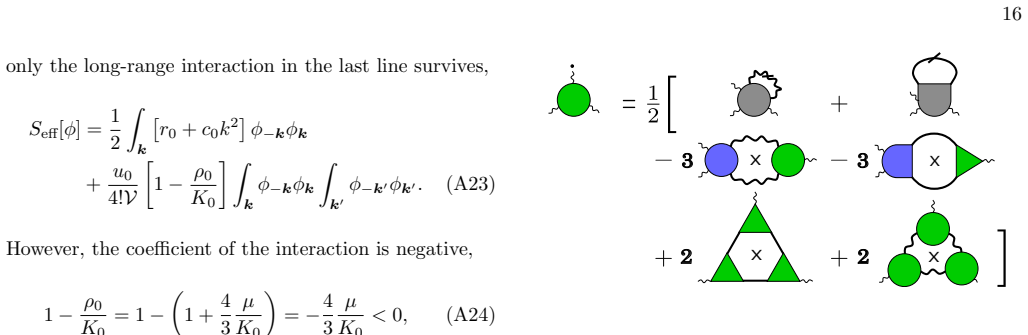
we now derive formally exact flow equations for the scale-dependent irreducible vertices of our model. There- fore we first introduce the generating functionalG Λ[J, σ] of the connected correlation functions of our model, eGΛ[J,σ] = Z D[ϕ, E]−SΛ[ϕ,ϵ]+ R k[J−kϕk+σ−kEk].(3.2) A functional Taylor expansion in powers of the sources J(r) andσ(r) generates the ...
-
[2]
Flow equations If we fix the homogeneous strain, the flow of the conju- gate stressσ Λ is determined by the flow equation shown in Fig. 1. In Sec. III we have dropped the contribu- tions from all vertices which vanish at the initial scale. Here we take these vertices into account, but still neglect their momentum dependence. In this approximation, the sca...
-
[3]
Within our truncation where vertices with more than four external legs are neglected, the flow equations reduce to ∂ΛvΛ =−3v 2 Λ Z q ˙FΛ(q)FΛ(q)−3w 2 Λ Z q ˙GΛ(q)GΛ(q) + 6vΛh2 Λ Z q [F 3 Λ(q)]• + 6wΛg2 Λ Z q [G3 Λ(q)]• −6h 4 Λ Z q [F 4 Λ(q)]• −6g 4 Λ Z q [G4 Λ(q)]•,(B8) 18 X X 2 4 4 2 22 X X XX X X X XX X X X FIG. 9. Diagrammatic representation of the exa...
-
[4]
Apart from the rescaled couplingsr l andu l previously defined in Eqs
Flow of rescaled couplings To find the fixed points of the above system of flow equations we should properly rescale the couplings. Apart from the rescaled couplingsr l andu l previously defined in Eqs. (4.1a) and (4.1c), we introduce gl = Zl c0 s KDΛD−4 ρΛ gΛ,(B10a) hl = s KDΛD ρ3 Λ hΛ,(B10b) vl = KDΛD ρ2 Λ vΛ,(B10c) wl = KDZlΛD−2 c0ρΛ wΛ,(B10d) Neglecti...
- [5]
-
[6]
0.25 0.5 0.75 1. -1. -0.8 -0.6 -0.4 -0.2 0. ϵ y* FIG. 10. Evolution of the fixed point valuesr ∗ andy ∗ at the renormalized Ising fixed point R (blue) and the spherical fixed point S (red) traced fromD= 4 (ε= 0) toD= 3 (ε= 1). The dashed line represents the truncation used in Sec. III, while the solid lines represent the more sophisticated truncation incl...
-
[7]
0.25 0.5 0.75 1. 1. 2. 3. ϵ u* S R
-
[8]
0.25 0.5 0.75 1. 0.2 0.4 0.6 0.8 1. ϵ f* FIG. 11. Evolution of the fixed point valuesu ∗ andf ∗ ≡g 2 ∗ at the renormalized Ising fixed point R (blue) and the spherical fixed point S (red) traced fromD= 4 (ε= 0) toD= 3 (ε= 1). The dashed line represents the truncation used in Sec. III, while the solid lines represent the more sophisticated truncation inclu...
-
[9]
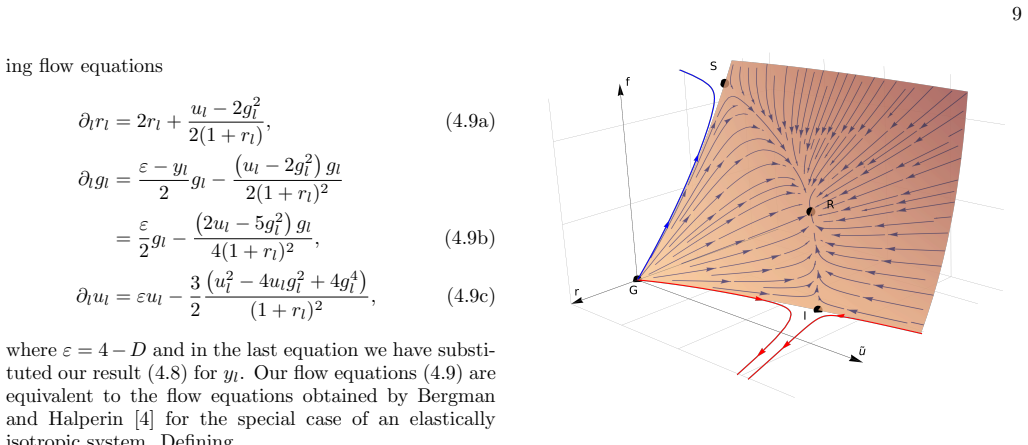
Evolution of fixed points By demanding that the right-hand sides of the above flow equations forr l, gl, hl, ul, vl, andw l vanish we obtain six coupled non-linear equations. Those equations have to be solved simultaneously to obtain the fixed points r∗, g∗, h∗, u∗, v∗,andw ∗ of the RG flow within our trun- cation. The number of solutions of this system o...
- [10]
- [11]
-
[12]
0.25 0.5 0.75 1.0.0 0.05 0.1 0.15 0.2 ϵ w* FIG. 12. Fixed point values ofh ∗,v ∗,w ∗ traced formε= 0 (four dimensions) toε= 1 (three dimensions). the inclusion of the couplingsh l, vl, wl, let us focus here on the evolution of the renormalized Ising fixed point R and the spherical fixed point S. Our numerical results for the evolution of the fixed point v...
-
[13]
Specific heat exponent By linearizing the flow equations (B11–B17) around the fixed points, we have determined the scaling vari- ables and the corresponding eigenvalues. We find that the scaling behavior close to G, I, and R remains essen- tially the same as found in Sec. III because the number of relevant scaling directions is not affected by the ad- dit...
-
[14]
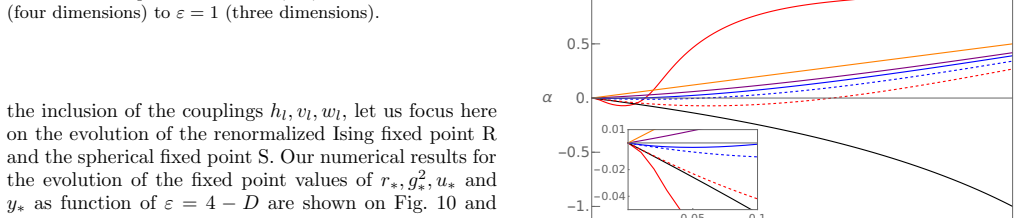
0.25 0.5 0.75 1. -1. -0.5 0. 0.5 1. ϵ α 0.05 0.1 -0.04 -0.02 0.01 FIG. 13. Plot of the specific heat exponentαas a function of ε= 4−Dfor each of the fixed points G, I, R, and S. The solid blue line depictsα R within the truncation described in this appendix, while the the dashed blue line representsα R using the simpler truncation of Sec. III. Similarly, ...
-
[15]
M. E. Fisher,Renormalization of critical exponents by hidden variables, Phys. Rev.176, 257 (1968)
work page 1968
-
[16]
A. I. Larkin and S. A. Pikin,Phase transitions of the first order but nearly of the second, Sov. Phys. JETP29, 891 (1969)
work page 1969
-
[17]
Aharony,Critical Behavior of Magnets with Lattice Coupling, Phys
A. Aharony,Critical Behavior of Magnets with Lattice Coupling, Phys. Rev. B8, 4314 (1973)
work page 1973
-
[18]
D. J. Bergman and B. I. Halperin,Critical behavior of an Ising model on a cubic compressible lattice, Phys. Rev. B 13, 2145 (1976)
work page 1976
-
[19]
M. Zacharias, L. Bartosch, and M. Garst,Mott Metal- Insulator Transition on Compressible Lattices, Phys. Rev. Lett109, 176401 (2012)
work page 2012
-
[20]
M. Zacharias, I. Paul, and M. Garst,Quantum Critical ElasticityPhys. Rev. Lett.115, 025703 (2015)
work page 2015
-
[21]
M. Zacharias, A. Rosch, and M. Garst,Critical Elastic- ity at zero and finite temperature, Eur. Phys. J. Special Topics224, 1021 (2015)
work page 2015
-
[22]
P. Chandra, P. Coleman, M. A. Continentino, and G. G. Lonzarich,Quantum annealed criticality: A scaling description, Phys. Rev. Res.2, 043449 (2020)
work page 2020
-
[23]
A. Samanta, E. Shimshoni, and D. Podolsky,Phonon- induced modification of quantum criticality, Phys. Rev. B106, 035154 (2022)
work page 2022
- [24]
-
[25]
Wetterich,Exact evolution equation for the effective potential, Phys
C. Wetterich,Exact evolution equation for the effective potential, Phys. Lett. B301, 90 (1993)
work page 1993
- [26]
-
[27]
P. Kopietz, L. Bartosch, and F. Sch¨ utz,Introduction to the Functional Renormalization Group, (Springer, Berlin, 2010)
work page 2010
-
[28]
J. M. Pawlowski,Aspects of the functional renormaliza- tion group, Ann. Phys.322, 2831 (2007)
work page 2007
- [29]
-
[30]
See, for example, S. K. Ma,Modern Theory of Critical Phenomena, (Benjamin/Cummings, Reading, 1976)
work page 1976
-
[31]
J. Rudnick, D. J. Bergman, and Y. Imry,Renormaliza- tion group analysis of a constrained Ising model, Phys. Lett.46 A, 449 (1974)
work page 1974
-
[32]
L. Landau and E. M. Lifschitz,Lehrbuch der Theo- retischen Physik VII: Elastizit¨ atstheorie, (Harry Deutsch, Frankfurt, 7. Auflage, 1991)
work page 1991
-
[33]
P. M. Chaikin and T. C. Lubensky,Principles of con- densed matter physics, (Cambridge University Press, Cambridge, 1995)
work page 1995
-
[34]
For a system with cubic symmetry, the elastic tensor has three independent elements which are convention- ally denoted byC 11 =C xx,xx 0 =C yy,yy 0 =C zz,zz 0 , C12 =C xx,yy 0 =C yy,zz 0 =C zz,xx 0 andC 44 =C xy,xy 0 = C yz,yz 0 =C zx,zx 0 . For an isotropic system the two princi- pal shear moduli are equal,µ=C 44 = (C11 −C 12)/2 and the bulk modulus can ...
-
[35]
N. Chichutek, M. Hansen, and P. Kopietz,Phonon renor- malization and Pomeranchuk instability in the Holstein model, Phys. Rev. B105, 205148 (2022)
work page 2022
-
[36]
F. Sch¨ utz and P. Kopietz,Functional renormalization group with vacuum expectation values and spontaneous symmetry breaking, J. Phys. A: Math. Gen.39, 8205 (2006)
work page 2006
-
[37]
T. R. Morris,The exact renormalization group and ap- proximate solutions, Int. J. Mod. Phys. A9, 2411 (1994)
work page 1994
-
[38]
T. H. Berlin and M. Kac,The Spherical Model of a Fer- romagnet, Phys. Rev.86, 821 (1952)
work page 1952
-
[39]
H. E. Stanley,Spherical Model as the Limit of Infinite Spin Dimensionality, Phys. Rev.176, 718 (1968)
work page 1968
-
[40]
S. Yabunaka and B. Delamotte,Surprises inO(N)Mod- els: Nonperturbative Fixed Points, LargeNLimits, and Multicriticality, Phys. Rev. Lett.119, 191602 (2017)
work page 2017
-
[41]
A. Pelisseto and E. Vicari,Critical phenomena and renormalization group theory, Phys. Rep.368, 549 (2002)
work page 2002
discussion (0)
Sign in with ORCID, Apple, or X to comment. Anyone can read and Pith papers without signing in.