REVIEW 2 major objections 4 minor 52 references
Solving a linear program via a single unconstrained minimization
T0 review · 2 major / 4 minor · reviewed 2026-08-07 · deepseek-v4-flash
Pith's one-line read The paper proves that a primal-dual linear program is equivalent to a single unconstrained minimization of a smooth convex merit function, with a regularized Newton method reaching ε-accuracy in O(ε^{−3/2}) iterations.
desk verdict The central equivalence and the global-rate theorem hold up, but a noncentral Hessian claim in Section 4.2 is false, and the practical claims outrun the evidence. read the letter →
The pith
A machine-rendered reading of the paper's core claim, the machinery that carries it, and where it could break.
The reading
What carries the argument
The load-bearing object is the merit function $f_q$ in (MF): a sum of squared residual terms for the primal-dual optimality conditions, with complementary slackness replaced by the duality gap $c^Tx-b^T\lambda$ and with nonnegativity enforced by $\max\{-x_j,0\}^q$ and $\max\{-s_j,0\}^q$ for $q>2$. Its convexity and twice continuous differentiability make unconstrained second-order minimization possible, while its zero-level set encodes exactly the LP solutions. The singular Hessian at optimal points is handled by adding $\mu_k I$ (Levenberg-Marquardt regularization), and the Lipschitz continuity of the Hessian at $q=3$ plugs into an existing regularized-Newton convergence theorem to yield the global rate. A second mechanism is the modified function $h_{q,\nu}=f_q+\nu\|\lambda\|_2^2+\frac{\nu}{q(q-1)}\sum_j(\max\{x_j,0\}^q+\max\{s_j,0\}^q)$, whose Hessian is positive definite for $\nu>0$, so the heuristic can take Newton steps while $\nu$ decays to zero.
What would settle it
Run Algorithm 1 on a linear program whose optimal set is provably nonempty and bounded, starting from a point with large norm, and record how many iterations are needed to push the residuals below a decreasing sequence of tolerances $\epsilon$. If the count grows faster than a constant times $\epsilon^{-3/2}$, or if the iterates escape to infinity, Theorem 3.2's claim fails for that instance. A direct check of the proof mechanism is to test whether the sublevel set $\{(x,\lambda,s): f_3(x,\lambda,s)\le f_3(x_0,\lambda_0,s_0)\}$ is bounded for a family of LPs with bounded optimal sets.
Extended reading notes
Core claim
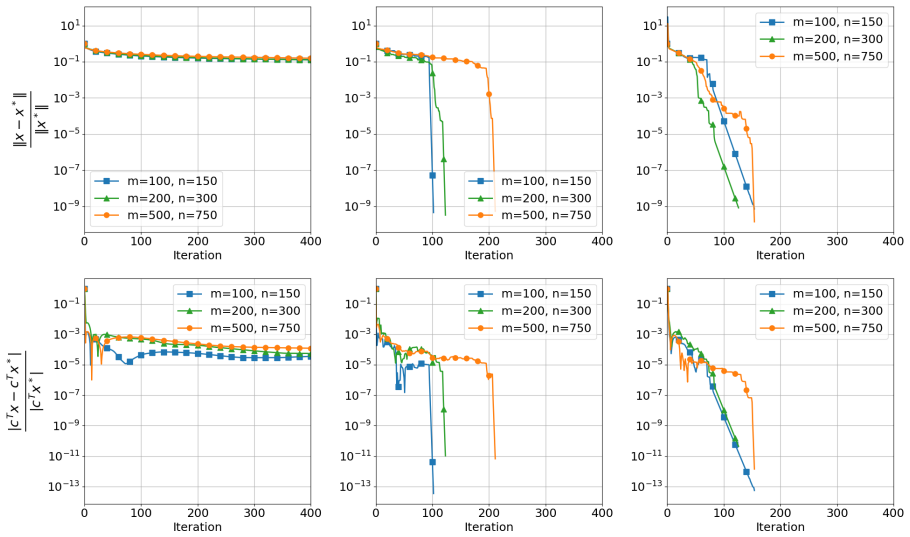
The central claim is Theorem 2.1: for any fixed $q>2$, $(x^*,\lambda^*,s^*)$ is optimal for the primal-dual LP pair if and only if it minimizes $f_q$ defined in (MF) and $f_q(x^*,\lambda^*,s^*)=0$, where $f_q$ sums half the squared duality gap $(c^Tx-b^T\lambda)^2$, half the squared primal and dual feasibility violations $\|Ax-b\|_2^2$ and $\|A^T\lambda+s-c\|_2^2$, and order-$q$ penalty terms $\max\{-x_j,0\}^q + \max\{-s_j,0\}^q$ scaled by $1/(q(q-1))$. Since $f_q\ge0$, the LP optimal set is exactly the zero-level set of $f_q$, making (MF) a zero-residual problem. Theorem 3.2 then states that Algorithm 1, i.e. Newton's method with Levenberg-Marquardt regularization using $\mu_k=\sqrt{\|\nabla f(x_k,\lambda_k,s_k)\|/2}$ and $\alpha_k=1$, drives the residuals $\|c^Tx_k-b^T\lambda_k\|$, $\|Ax_k-b\|$, $\|A^T\lambda_k+s_k-c\|$ and the violations $x_k,s_k\ge-\epsilon$ all below $\epsilon$ within $O(\epsilon^{-3/2})$ iterations, under the assumption that the primal-dual optimal set is nonempty and bounded. The paper also introduces a modified merit function $h_{q,\nu}$ whose Hessian is nonsingular for every $\nu>0$ and which equals $f_q$ at $\nu=0$; Algorithm 2 decreases $\nu$ geometrically while taking Newton steps and is offered as a heuristic that performed faster in the reported experiments, especially in higher dimensions.
Load-bearing premise
The proof of the fast global rate assumes that the set of all points where the merit function is no higher than at the starting point is bounded, and it takes as given that boundedness of the LP optimal set guarantees this; that implication is asserted but not demonstrated, so if it fails the $O(\epsilon^{-3/2})$ bound has no support.
Editorial extensions
If this is right
- Any linear program with a nonempty bounded optimal set can be solved by driving one smooth unconstrained merit function to zero, starting from any point in $\mathbb{R}^{2n+m}$.
- The value of $\min f_q$ acts as a certificate: if the computed minimum stays strictly above zero, the primal-dual pair has no optimal solution (it is infeasible or unbounded), and the simplified homogeneous formulation can then identify which case holds.
- The iteration complexity $O(\epsilon^{-3/2})$ does not depend on the problem dimension, and with the factored linear-system solve each iteration costs $O(m^3+n^3)$ rather than $O((2n+m)^3)$.
- For $q=3$ the Hessian is 1-Lipschitz, giving a concrete regularization choice $\mu_k=\sqrt{\|\nabla f_k\|/2}$ that satisfies the conditions of the convergence theorem.
Reading between the lines
- The same template could be applied to other KKT systems: replacing complementarity by a squared bilinear term such as $(x^T\lambda)^2$ yields an exact unconstrained reformulation, though the resulting merit function is nonconvex for nonlinear programs.
- Adaptive schedules for $\nu$ rather than the fixed geometric factor $\theta$ might remove the stalling observed for large-dimensional problems; the paper lists adaptive $\nu$ updates as future work.
- The zero-residual structure suggests that local error bound conditions, if they hold for $f_q$, would upgrade the observed fast practical convergence into a proof of local quadratic convergence, an avenue the paper mentions but does not carry out.
Editorial analysis
A structured set of objections, weighed in public.
Referee Report
Summary. The paper proposes an exact unconstrained reformulation of a primal-dual linear program in standard form, using a convex twice continuously differentiable merit function f_q (Eq. (MF)) that combines a squared duality gap, squared constraint residuals, and smoothed penalties for nonnegativity. Theorem 2.1 establishes that, when the LP has an optimal solution, the minimizers of f_q coincide with the LP optimal solutions and f_q attains zero there; Corollary 2.3 characterizes infeasible or unbounded cases by min f_q > 0. For q = 3 the Hessian is shown to be 1-Lipschitz (Lemma 2.7) but singular at optimal solutions. The main theoretical result (Theorem 3.2) applies Mishchenko's regularized Newton theorem to obtain an O(epsilon^{-3/2}) global iteration bound for reaching approximate primal-dual optimality conditions under the assumption that the LP optimal set is bounded. The paper further introduces a modified merit function h_{q,nu} (Eq. (HMF)) and a homotopy heuristic (Algorithm 2), supported by numerical experiments on random LPs.
Significance. The reformulation is elegant, and the main convergence theorem is a plausible and nontrivial corollary of existing regularized Newton theory, giving a smooth exact unconstrained formulation of LP with a provable global rate for a second-order method. The paper is careful in stating the zero-residual structure and provides a reproducible numerical study with available code. If the missing level-set lemma is supplied and the HMF Hessian claim is corrected, the contribution would be a useful addition to the literature on penalty and smoothing reformulations of LP. The worst-case rate O(epsilon^{-3/2}) is nonstandard and worth highlighting; the numerical experiments honestly show that the adaptive-mu variant is slow while the heuristic variants are faster, which is a useful empirical observation.
major comments (2)
- [Section 3.2, proof of Theorem 3.2] The proof asserts without proof that the boundedness of the LP optimal set implies boundedness of the initial sublevel set {f_3 <= f_3(x0, lambda0, s0)} and cites [39]. This implication is load-bearing because it is exactly Theorem 3.1's Assumption 2, and the manuscript does not state or prove the underlying lemma. Please add an explicit lemma: if f is convex and its argmin is nonempty and bounded, then every sublevel set {f <= a} is bounded; provide the proof (e.g., by showing that an unbounded sublevel set contains a nonzero recession direction along which convexity forces f to be constant, contradicting boundedness of the argmin). This will make the proof of Theorem 3.2 self-contained and verify the applicability of [39].
- [Section 4.2, Eq. (HMF)] The claim that the Hessian of h_{q,nu} is positive definite for all (x, lambda, s) when nu > 0 is false. At x = s = 0, the added terms nu ||lambda||^2 and nu/(q(q-1)) sum(max{x_j,0}^q + max{s_j,0}^q) contribute zero curvature in the x and s blocks. For example, with n = 2, m = 1, A = [1 1], c = [1 1]^T, b = 1, the direction d = (1, -1, 0, 0) at (0,0,0) satisfies A d = 0 and c^T d = 0, so d^T nabla^2 h_{q,nu}(0,0,0) d = 0. Thus the Hessian is singular for every nu > 0. This affects the abstract's claim of nonsingular Hessians and the motivation for Algorithm 2. Please correct the claim (for example, by adding a strong convexity term involving x and s, or by stating the actual positive semidefiniteness and singularity properties) and adjust the discussion of Algorithm 2 accordingly.
minor comments (4)
- [Section 3.2, Theorem 3.2] The proof uses the same symbol epsilon for the tolerance on f_3 (3.7) and for the tolerances on the optimality constraints (3.2)-(3.6). The iteration counts O(epsilon^{-1}) and O(epsilon^{-3/2}) are derived correctly, but the statement would be clearer if the target accuracy in the merit function were written as a separate parameter, say delta = O(epsilon^2) or O(epsilon^3), to avoid the appearance that O(epsilon^{-1/2}) directly yields all bounds.
- [Table 1 and Section 4.3] Algorithms 1b and 2 use q = 2.1, but Lemma 2.7 and Theorem 3.2 are stated only for q = 3. The text should state explicitly that the experiments with q = 2.1 are heuristic and not covered by the theoretical rate.
- [Section 4.4] The conclusion that the problem is unbounded from the observed behavior (gradient approaching zero, f_q bounded away from zero, and ||Ax_k - b|| approaching zero) is a heuristic inference from the limit behavior of the iterates; a rigorous certificate would require the homogeneous formulation described in Section 2.1. Please soften the wording or add a remark that this is an empirical observation.
- [Section 2.2, proof of Lemma 2.7] The display in the proof of Lemma 2.7 has a small typographical error with double parentheses and a missing closing brace; please clean up the typesetting.
Circularity Check
No significant circularity is found; Theorem 3.2 rests on an external convergence theorem and no fitted or self-cited inputs.
full rationale
The central equivalence in Theorem 2.1 is built directly into the definition of the merit function fq in (MF), which sums squares of the residual expressions from (OC); calling this an equivalence is the intended reformulation, not a hidden circular derivation. The main convergence result, Theorem 3.2, is obtained by importing Mishchenko's Theorem 3.1 as an external result, verifying the L-Lipschitz Hessian in Lemma 2.7, and using boundedness of the LP optimal set to obtain bounded sublevel sets; the bounded-sublevel-set inference is cited to [39] and does not depend on the authors' own work. No parameter is fitted and then relabeled a prediction: Algorithm 1's only free design choice is the standard Levenberg-Marquardt regularization, and Algorithm 2 is explicitly described as heuristic, with its theta acknowledged in Section 6 as tuned by trial and error. There are no self-citations at all in the reference list, so no load-bearing self-citation chain exists. The separate mathematical error in Section 4.2 concerning positive definiteness of the Hessian of h_{q,nu} is a correctness issue, not circularity, and does not enter the proof of Theorem 3.2.
Assumptions & free parameters
free parameters (2)
- Merit exponent q =
3 in theory, 2.1 in experiments
- Homotopy schedule nu0, theta =
theta = 0.8, nu0 not stated in text
assumptions (6)
- standard math Optimality conditions (OC) are necessary and sufficient for optimality of a primal-dual LP triple.
- standard math max{-x,0}^q is convex and twice continuously differentiable for q > 2.
- standard math For q = 3, the Hessian of fq is 1-Lipschitz.
- standard math Mishchenko's Theorem 3.1 gives O(epsilon^{-1/2}) global convergence for regularized Newton under Lipschitz Hessian and bounded level set.
- domain assumption Boundedness of the LP optimal set implies boundedness of every sublevel set of f3.
- standard math The simplified homogeneous model has a strictly complementary solution whose tau/kappa certificates identify primal and dual infeasibility.
Cite this review
Pith. "Pith review of Solving a linear program via a single unconstrained minimization." pith.science (2026). https://pith.science/paper/PTBFKEUU
@misc{pith2026250521232,
  author       = {Pith},
  title        = {Pith review of: Solving a linear program via a single unconstrained minimization},
  year         = {2026},
  howpublished = {\url{https://pith.science/paper/PTBFKEUU}},
  note         = {Machine review of arXiv:2505.21232}
}
abstract
This paper proposes a novel approach for solving linear programs. We reformulate a primal-dual linear program as an unconstrained minimization of a convex and twice continuously differentiable merit function. When the optimal set of the primal-dual pair is nonempty, its optimal set is equal to the optimal set of the proposed merit function. Minimizing this merit function poses some challenges due to its Hessian being singular at some points in the domain, including the optimal solutions. We handle singular Hessians using the Newton method with Levenberg-Marquardt regularization. We show that the Newton method with Levenberg-Marquardt regularization yields global convergence to a solution of the primal-dual linear program in at most $O(\epsilon^{-3/2})$ iterations requiring only the assumption that the optimal set of the primal-dual linear program is bounded. Testing on random synthetic problems demonstrates convergence to optimal solutions to very high accuracy significantly faster than the derived worst-case bound. We further introduce a modified merit function that depends on a scalar parameter $\nu > 0$, whose Hessian is nonsingular for all $\nu > 0$ and which reduces exactly to the original merit function when $\nu = 0$. Based on this formulation, we propose a heuristic scheme that performs Newton steps while gradually decreasing $\nu$ toward zero. Numerical experiments indicate that this approach achieves faster convergence, particularly on higher-dimensional problems.
Figures


Figures from the paper (1 more)

Reference graph
Works this paper leans on
-
[39]
Roman A. Polyak. Regularized newton method for unconstrained convex optimization. Mathematical Programming, 120(1):125–145, 2009
work page 2009
-
[1]
Erling D. Andersen and Knud D. Andersen. The Mosek Interior Point Optimizer for Linear Programming: An Implementation of the Homogeneous Algorithm , pages 197–232. Springer US, Boston, MA, 2000
work page 2000
-
[2]
Optimization iii: Convex optimization, 2023
Aharon Ben-Tal and Arkadi Nemirovski. Optimization iii: Convex optimization, 2023. Lecture notes, Georgia Institute of Technology
work page 2023
- [3]
-
[4]
Convex Optimization
Stephen Boyd and Lieven Vandenberghe. Convex Optimization . Cambridge University Press, 2004
2004
- [5]
-
[6]
Coralia Cartis, Nicholas I. M. Gould, and Philippe L. Toint. Adaptive cubic regularisation methods for unconstrained optimization. part i: motivation, convergence and numerical results. Mathematical Programming, 127(2):245–295, 2011
work page 2011
-
[7]
Coralia Cartis, Nicholas I. M. Gould, and Philippe L. Toint. Adaptive cubic regularisa- tion methods for unconstrained optimization. part ii: worst-case function- and derivative- evaluation complexity. Mathematical Programming, 130(2):295–319, 2011
work page 2011
Show all 52 references
-
[8]
Edwin K. P. Chong and Stanislaw H. Zak. An Introduction to Optimization . Wiley- Interscience, New York, 2 edition, 2001
2001
-
[9]
Faster randomized interior point methods for tall/wide linear programs.Journal of Machine Learning Research, 23:336:1–336:48, 2022
Agniva Chowdhury, Gregory Dexter, Palma London, Haim Avron, and Petros Drineas. Faster randomized interior point methods for tall/wide linear programs.Journal of Machine Learning Research, 23:336:1–336:48, 2022
2022
-
[10]
Conn, Nicholas I
Andrew R. Conn, Nicholas I. M. Gould, and Philippe L. Toint. Trust Region Methods. MPS- SIAM Series on Optimization. Society for Industrial and Applied Mathematics, Philadel- phia, PA, 2000
2000
-
[11]
Convergence properties of the inexact levenberg-marquardt method under local error bound conditions
Hiroshige Dan, Nobuo Yamashita, and Masao Fukushima. Convergence properties of the inexact levenberg-marquardt method under local error bound conditions. Optimization Methods and Software , 17(4):605–626, 2002
2002
-
[12]
George B. Dantzig. Application of the simplex method to a transportation problem. Activity Analysis of Production and Allocation , pages 359–373, 1951
1951
-
[13]
George B. Dantzig. A proof of the equivalence of the programming problem and the game problem. Activity Analysis of Production and Allocation , pages 330–335, 1951
1951
-
[14]
Dolgopolik
M.V. Dolgopolik. A unifying theory of exactness of linear penalty functions. Optimization, 65(6):1167–1202, 2016
2016
-
[15]
Y. G. Evtushenko, A. I. Golikov, and N. Mollaverdy. Augmented lagrangian method for large-scale linear programming problems. Optimization Methods and Software, 20(4–5):515– 524, 2005. 20
2005
-
[16]
A regularized newton method for monotone nonlinear equations and its application
Jinyan Fan and Yaxiang Yuan. A regularized newton method for monotone nonlinear equations and its application. Optimization Methods and Software , 29(1):102–119, 2014
2014
-
[17]
coin-or/clp: Release releases/1.17.10, August 2024
John Forrest, Stefan Vigerske, Ted Ralphs, John Forrest, Lou Hafer, jpfasano, Haroldo Gambini Santos, Jan-Willem, Matthew Saltzman, a andre, Bjarni Kristjansson, h-i gassmann, Alan King, Arevall, Bohdan Mart, Pierre Bonami, Ruan Luies, Samuel Brito, and to st. coin-or/clp: Rel...
2024
-
[18]
I. L. Galabova and J. A. J. Hall. The ‘idiot’ crash quadratic penalty algorithm for lin- ear programming and its application to linearizations of quadratic assignment problems. Optimization Methods and Software , 35(3):488–501, 2020
2020
-
[19]
P. E. Gill, G. H. Golub, W. Murray, and M. A. Saunders. Methods for modifying matrix factorizations. Mathematics of Computation , 28(126):505–535, 1974
1974
-
[20]
O. G¨ uler. Augmented lagrangian algorithms for linear programming. Journal of Optimiza- tion Theory and Applications , 75(3):445–470, 1992
1992
-
[21]
Stochastic subspace cubic newton method
Filip Hanzely, Nikita Doikov, Peter Richt´ arik, and Yurii Nesterov. Stochastic subspace cubic newton method. In Proceedings of the 37th International Conference on Machine Learning, ICML’20. JMLR.org, 2020
2020
-
[22]
Hillier and Gerald J
Frederick S. Hillier and Gerald J. Lieberman. Introduction to Operations Research. McGraw- Hill Education, 10 edition, 2014
2014
-
[23]
Qi Huangfu, Irina Galabova, Matthias Feldmeier, and Julian A. J. Hall. HiGHS – high performance software for linear optimization. INFORMS Journal on Computing , 35(1):1– 20, 2023
2023
-
[24]
A new polynomial-time algorithm for linear programming
Narendra Karmarkar. A new polynomial-time algorithm for linear programming. Combi- natorica, 4(4):373–395, 1984
1984
-
[25]
L. G. Khachiyan. A polynomial algorithm in linear programming. Soviet Mathematics Doklady, 20:191–194, 1979. Originally published in Russian in Doklady Akademii Nauk SSSR, 244 (1979), 1093–1096
1979
-
[26]
Victor Klee and George J. Minty. How good is the simplex algorithm? Inequalities III , pages 159–175, 1972
1972
-
[27]
Levenberg
K. Levenberg. A method for the solution of certain nonlinear problems in least squares. Quarterly of Applied Mathematics , 2:164–168, 1944
1944
-
[28]
Regularized newton methods for convex minimization problems with singular solutions
Dong-Hui Li, Masao Fukushima, Liqun Qi, and Nobuo Yamashita. Regularized newton methods for convex minimization problems with singular solutions. Computational Opti- mization and Applications , 28(2):131–147, 2004
2004
-
[29]
Truncated regularized newton method for convex minimiza- tions
Ying-Jie Li and Dong-Hui Li. Truncated regularized newton method for convex minimiza- tions. Computational Optimization and Applications , 43(1):119–131, 2009
2009
-
[30]
O. L. Mangasarian. A newton method for linear programming. Journal of Optimization Theory and Applications , 121(1):1–18, 2004
2004
-
[31]
Marquardt
D. Marquardt. An algorithm for least-squares estimation of nonlinear parameters. Journal of the Society for Industrial and Applied Mathematics , 11:431–441, 1963. 21
1963
-
[32]
Regularized newton method with global ≀(1/k2) convergence
Konstantin Mishchenko. Regularized newton method with global ≀(1/k2) convergence. SIAM Journal on Optimization , 33(3):1440–1462, 2023
2023
-
[33]
Mor´ e, D
Jorge J. Mor´ e, D. C. Sorensen, and G. H. Golub. Newton’s method. In Studies in Nu- merical Analysis, volume 24 of MAA Studies in Mathematics , pages 29–82. Mathematical Association of America, Washington, DC, 1984
1984
-
[34]
J. L. Nazareth. Homotopy techniques in linear programming. Algorithmica, 1(1):529–535, 1986
1986
-
[35]
J. L. Nazareth. The homotopy principle and algorithms for linear programming. SIAM Journal on Optimization , 1(3):316–332, 1991
1991
-
[36]
Interior-Point Polynomial Algorithms in Convex Programming
Yurii Nesterov and Arkadii Nemirovskii. Interior-Point Polynomial Algorithms in Convex Programming. SIAM Studies in Applied Mathematics. Society for Industrial and Applied Mathematics, Philadelphia, PA, 1994
1994
-
[37]
Yurii Nesterov and B. T. Polyak. Cubic regularization of newton method and its global performance. Mathematical Programming, 108(1):177–205, 2006
2006
-
[38]
Jorge Nocedal and Stephen J. Wright. Numerical Optimization. Springer Series in Opera- tions Research and Financial Engineering. Springer New York, NY, 2 edition, 2006. eBook ISBN: 978-0-387-40065-5; Softcover ISBN: 978-1-4939-3711-0
2006
-
[40]
H. H. Rosenbrock. An automatic method for finding the greatest or least value of a function. The Computer Journal , 3(3):175–184, 01 1960
1960
-
[41]
Convergence properties of the regularized newton method for the unconstrained nonconvex optimization
Kenji Ueda and Nobuo Yamashita. Convergence properties of the regularized newton method for the unconstrained nonconvex optimization. Applied Mathematics and Opti- mization, 62(1):27–46, 2010
2010
-
[42]
A regularized newton method without line search for unconstrained optimization
Kenji Ueda and Nobuo Yamashita. A regularized newton method without line search for unconstrained optimization. Computational Optimization and Applications , 59(1):321–351, 2014
2014
-
[43]
Vanderbei
Robert J. Vanderbei. Linear Programming: Foundations and Extensions . International Series in Operations Research & Management Science. Springer, 5 edition, 2020
2020
-
[44]
Random projections for linear programming
Ky Vu, Pierre-Louis Poirion, and Leo Liberti. Random projections for linear programming. Mathematics of Operations Research, 43(4):1051–1071, 2018
2018
-
[45]
A new newton method for convex optimization problems with singular hessian matrices
Tianji Wang and Qingdao Huang. A new newton method for convex optimization problems with singular hessian matrices. AIMS Mathematics , 8(9):21161–21175, 2023
2023
-
[46]
Laurence A. Wolsey. Integer Programming. John Wiley & Sons, 2 edition, 2020
2020
-
[47]
Stephen J. Wright. Primal-dual interior-point methods. Society for Industrial and Applied Mathematics, USA, 1997
1997
-
[48]
A deep learning approach for solving linear programming problems
Dawen Wu and Abdel Lisser. A deep learning approach for solving linear programming problems. Neurocomputing, 520:15–24, 2023. 22
2023
-
[49]
A simplified homogeneous and self-dual linear programming algorithm and its implementation
Xiaojie Xu, Pi-Fang Hung, and Yinyu Ye. A simplified homogeneous and self-dual linear programming algorithm and its implementation. Annals of Operations Research, 62(1):151– 171, 1996
1996
-
[50]
Yamashita and M
N. Yamashita and M. Fukushima. On the rate of convergence of the levenberg-marquardt method. In Goetz Alefeld and Xiaojun Chen, editors, Topics in Numerical Analysis , pages 239–249, Vienna, 2001. Springer Vienna
2001
-
[51]
Todd, and Shinji Mizuno
Yinyu Ye, Michael J. Todd, and Shinji Mizuno. An o(√nl)-iteration homogeneous and self-dual linear programming algorithm. Mathematics of Operations Research, 19(1):53–67, 1994
1994
-
[52]
On the quadratic convergence of the cubic regularization method under a local error bound condition
Man-Chung Yue, Zirui Zhou, and Anthony Man-Cho So. On the quadratic convergence of the cubic regularization method under a local error bound condition. SIAM Journal on Optimization, 29(1):904–932, 2019. 23
2019
Reviewed August 7, 2026 · model on record in the stance chip above.
Discussion (0). Sign in to comment.