REVIEW 5 major objections 5 minor 2 cited by
JavaSith: A Client-Side Framework for Analyzing Potentially Malicious Extensions in Browsers, VS Code, and NPM Packages
T0 review · 5 major / 5 minor · reviewed 2026-08-07 · deepseek-v4-flash
Pith's one-line read A client-side sandbox with a time machine catches malicious browser, VS Code, and npm code that official store scans miss, as shown on the Cyberhaven compromise and cryptominer extensions.
desk verdict A credible prototype with a new synthesis, but the evaluation is circular and the central detection claim is not supported by the evidence. read the letter →
The pith
A machine-rendered reading of the paper's core claim, the machinery that carries it, and where it could break.
The reading
What carries the argument
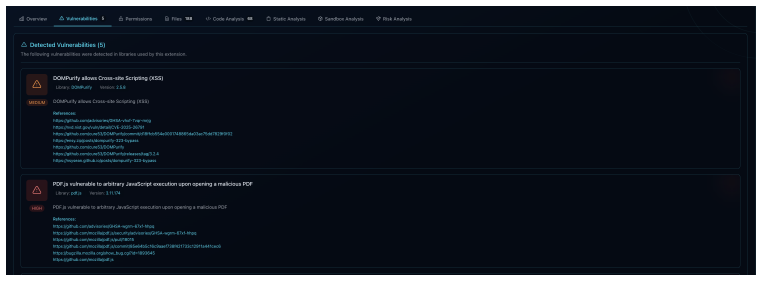
The load-bearing mechanism is the emulated runtime sandbox: an isolated JavaScript compartment in which JavaSith installs stubs for the Chrome extension API, a mock VS Code extension host, and hooked Node built-ins, so that extension code executes normally while every interesting action is logged or blocked. Attached to the sandbox is the Time Machine, which intercepts setTimeout, setInterval, and Date reads and fast-forwards scheduled tasks, making time-delayed or date-gated logic fire on demand. Around this core sit a static analysis pipeline that scans for suspicious patterns and known vulnerable libraries, and an on-device language model that converts the collected evidence into a plain-language risk report. The sandbox is what makes the dynamic claims possible, and the time machine is what makes stealthy delayed payloads observable.
What would settle it
Take a set of known malicious extensions whose payloads fire only through APIs or page interactions the sandbox does not implement (for example, a real page's DOM state or a less-common Chrome API), run them in JavaSith and in a genuine Chrome or VS Code host, and compare detections; if any sample executes its malicious logic only in the real host while JavaSith reports no high-severity finding, the claim that the tool catches stealthy behavior collapses for that class.
Extended reading notes
Core claim
The central claim is that extension and package code can be vetted safely on the user's own machine by emulating the host environment rather than by signature matching. For browser extensions the sandbox stubs the Chrome API and simulates page navigations to sensitive sites; for VS Code it provides a mock extension host; for npm it runs install and post-install scripts in an isolated Node-like context. Every API call, network request, file operation, and process spawn is logged or redirected, and the Time Machine accelerates timers and overrides the clock so that payloads gated on dates or delays execute during the analysis window. Static analysis then flags obfuscation, hardcoded webhook URLs, dangerous API use, and known vulnerable libraries, while the on-device LLM synthesizes code, metadata, and privacy policy into a risk judgment. The paper claims this combination would have caught the Cyberhaven malicious update as soon as it was analyzed and would have exposed the VS Code cryptominer's PowerShell download and hidden miner installation.
Load-bearing premise
The framework's accuracy rests on the fidelity of its emulated runtimes: the stubbed Chrome and VS Code APIs and simulated events must make real malicious code behave exactly as it would in a genuine host, and the paper concedes the browser simulation is not a full Chrome browser and covers only APIs seen in past attacks.
Editorial extensions
If this is right
- An organization that runs JavaSith on extension updates before deployment would have flagged the Cyberhaven-style malicious update at analysis time, not after days of data exfiltration.
- Delayed and date-gated payloads stop being a reliable evasion strategy, because the time machine forces scheduled callbacks to execute during the scan.
- Client-side execution means proprietary or sensitive extension code can be vetted without uploading it to a cloud scanner, preserving privacy while still getting an LLM-generated risk narrative.
- The combination of static findings, dynamic logs, and LLM reasoning can expose contradictions between a privacy policy's promises and observed behavior, such as claimed no-data-collection alongside cookie exfiltration.
Reading between the lines
- Extending beyond the paper, the sandbox's per-call logs could be turned into a behavioral baseline for each vetted extension; a runtime monitor could then block any action outside that baseline, moving from pre-install vetting to continuous protection.
- If emulation fidelity holds, the same architecture should transfer to other package ecosystems whose install scripts run with user privileges, since the npm sandbox already exercises exactly that class of behavior; the paper does not test this.
- The time machine suggests an untried differential-testing strategy: run the same extension under many simulated dates and event sequences and treat any divergence in behavior as suspicious, on the grounds that benign code should be temporally stable.
Editorial analysis
A structured set of objections, weighed in public.
Referee Report
Summary. The paper presents JavaSith, a client-side framework for analyzing browser extensions, VS Code extensions, and NPM packages for malicious behavior. The system combines an emulated runtime sandbox built on SES with a time-acceleration module, static analysis heuristics, Retire.js dependency scanning, and a locally executed WebLLM-based risk analyzer, all exposed through a GUI. The authors demonstrate the framework on four case studies inspired by real incidents—the Cyberhaven Chrome extension compromise, VS Code cryptominer and information-stealer extensions, and a Unicode-obfuscated NPM package—and report a 20-sample evaluation in which all malicious samples were flagged with high severity while benign samples produced no high-severity alerts. The paper claims that JavaSith can catch stealthy malicious behaviors that evade traditional detection.
Significance. If the central claim were established, JavaSith would be a valuable client-side complement to marketplace vetting, with attractive properties: local execution for privacy, a time machine for time-triggered payloads, and a modular design separating static, dynamic, and LLM-based analysis. The paper's strengths are its concrete architecture, the use of SES for isolation, and the detailed case-study narratives. However, the current evidence does not support the claim of detecting stealthy, previously unseen malicious behavior. The evaluation is largely circular, lacks quantitative detection and false-positive metrics, and relies on an emulated runtime whose fidelity is explicitly limited. Because these points are load-bearing for the paper's central claim, the manuscript requires substantial revision before it can be accepted.
major comments (5)
- [§6.1, §7.1] The evaluation is circular in a way that undermines the central detection claim. In the Cyberhaven case, the static analyzer flags the C2 domain cyberhavenext.pro 'because it was on our known-malicious list from OSINT' (§6.1). The 20-sample test set in §7.1 is composed of samples 'from public sources or recreated from descriptions'—the same public reports from which the static rules in §4.3 (Discord webhooks, uncommon domains, child_process, obfuscation) were derived. Success on this set therefore measures whether the rules cover the training corpus, not whether JavaSith detects novel malware. To support the abstract's claim of catching 'stealthy malicious behaviors that evade traditional detection,' the authors need a holdout evaluation with rules frozen before seeing the test samples, ideally using samples disclosed after the rules were written, and an explicit statement of which indicators are in the rule set versus discovered by the framework.
- [§7.1] The paper reports no quantitative detection or false-positive metrics. Section 7.1 states that all 20 samples were 'flagged with high severity' and that no false negatives occurred, but it does not give a confusion matrix, a definition of the severity threshold, per-sample results, or a comparison against existing tools (e.g., CRXcavator, npm audit, Socket.dev, or a simple string-matching baseline). Without these numbers, the claim in §7.3 that JavaSith is 'effective in identifying malicious behavior' is not supported. The authors should report precision/recall (or TP/FP/FN/TN) on the 20-sample set, define how 'high severity' is determined, and include a baseline comparison.
- [§5.1, §9] The central mechanism—the emulated runtime sandbox—is validated only by assertion. Section 5.1 says the authors implemented 'enough of the Chrome API surface to satisfy typical extensions' and focused on APIs 'commonly used by malicious extensions in past cases.' Section 9 concedes the browser simulation 'is not a full Chrome browser.' No experiment shows that malicious code executes its payload identically in JavaSith and in a real Chrome or VS Code host. Consequently, the claimed ability to 'coerce malicious code into revealing itself' (Conclusion) is not established. The authors should compare execution traces from JavaSith against traces from real instrumented hosts (e.g., headless Chrome with DevTools) on a set of extensions and report what fraction of behaviors were reproduced.
- [§6.1, §6.4] Two of the four case studies attribute detection to modules that did not actually contribute. In the Cyberhaven case, the paper explicitly notes that 'time of year was not a coded trigger' (§6.1), so the Time Machine did not trigger detection. In the NPM case, the Unicode steganography was caught by static analysis flagging non-printable characters (§6.4), not by the sandbox. Since the paper's novelty claim includes the time machine and the handling of time-triggered or stealthy logic, the authors should provide at least one controlled sample where a time-delayed or Unicode-obfuscated payload is detected only through the corresponding module, with the static rules not already containing the C2 string. Without such a demonstration, the time machine and Unicode handling remain untested features rather than validated contributions.
- [§4.4, §7] The LLM component is presented as a key contribution, but its contribution is not evaluated. Section 4.4 states the LLM's output is 'not taken as ground truth,' and §7 gives only anecdotal quotes (e.g., the Cyberhaven and VS Code miner summaries). There is no measurement of the LLM's precision, recall, or agreement with the rule-based detectors, and no ablation showing that the LLM adds value beyond the static and dynamic signals. The authors should include a quantitative or structured qualitative evaluation (e.g., LLM risk ratings against ground truth, or a user study comparing decisions with and without LLM summaries).
minor comments (5)
- [§2.1] The manifest permission is written as '¡all urls¿', which should be '<all_urls>'; the encoding appears corrupted.
- [Listing 1 (Section 4.2)] The constant MAXWAITMS is not defined in the text, and the comment 'Immediately (or after a shortened delay)' is ambiguous. Please specify the default threshold and whether callbacks are executed synchronously or scheduled.
- [§1] Typo: 'researches/organizations' should be 'researchers/organizations'.
- [References [1]–[3]] The first three references are bare URLs with no title, author, or date. If these point to the project or companion material, please cite the artifacts properly and clarify whether they are publicly available.
- [§7.1] The paper states 'we did not encounter any false negatives in this set' but does not list the 20 samples or the severity per sample. An appendix table with sample names, origin (real or recreated), and findings would make the evaluation reproducible.
Circularity Check
Evaluation is partly circular: several 'would have caught' demonstrations fire on known indicators that were inputs to the detector, so they show rule coverage rather than detection of unseen malware.
-
self definitional
[Section 6.1 (Cyberhaven case study)]
"The static analysis immediately flagged the presence of code accessing browser cookies and the use of an XMLHttpRequest posting data to a suspicious URL (the domain cyberhavenext.pro was on our known-malicious list from OSINT)."
The test sample was constructed from public reports of the Cyberhaven incident, and the domain that triggers the alarm was already in the tool's known-malicious OSINT list. The detection is therefore a lookup of a pre-loaded indicator, not an independent discovery. The paper's follow-on claim that 'JavaSith would have caught this malicious update as soon as it was analyzed' reduces to the fact that the sample contains an IoC already known to the tool; any sample with a listed domain is flagged by construction. This does not demonstrate catching stealthy or previously unseen behavior.
-
fitted input called prediction
[Section 6.3 (VSCode info-stealer case study) and Section 4.3 (static rules)]
"JavaSith's static scan immediately spotted the Discord webhook URL string embedded in the code. This triggered one of our high-severity rules."
The sample is 'a simplified reimplementation of clipboard-helper-vscode (as per ReversingLabs description)', and the rule that fired was engineered around the same indicator: Section 4.3 states 'We also check for Discord webhook URLs (discord.com/api/webhooks) since, as noted, that is strongly correlated with data-stealing extensions.' The malicious label and the detector rule share the same defining string, so the positive result is forced by construction. It is a coverage test of the rule against its own source, not a prediction about an unknown sample.
1 more flagged steps
-
other
[Section 6 (introduction) and Section 7.1]
"In each case, we either reproduced the malicious code from reports (when available) or created a lightweight approximation based on descriptions in the literature, and then ran our tool to see if it would catch the malicious behavior. ... JavaSith successfully flagged all malicious samples with high severity."
The evaluation set is assembled from the same public reports that supplied the static rules and OSINT indicators, so 'no false negatives' on this set measures whether the detectors cover their own construction inputs. The paper acknowledges the set is small and not exhaustive, but the central detection claim is supported by a self-constructed benchmark. This makes the headline result of 20/20 detection an internal consistency check rather than an independent validation against unseen or stealthy malware.
full rationale
JavaSith contains genuinely non-circular components: a runtime sandbox that logs actual network calls, file access, and process spawns, plus a time-acceleration mechanism. Those parts are not invalidated by the circularity found here. However, the paper's central claim of catching stealthy behaviors is demonstrated through case studies in which the detector fires on indicators that were inputs to the test. The Cyberhaven case is the clearest instance: the suspicious domain was already on the tool's known-malicious OSINT list, so the flag is a lookup, not a discovery. The VSCode info-stealer case similarly relies on a high-severity Discord-webhook rule defined by the same indicator used to construct the sample. The 20-sample evaluation is built from public reports and recreated approximations, so its perfect detection rate is unsurprising. These are partial, not total, circularity: the sandbox observations (e.g., a logged POST or PowerShell spawn) are independent evidence, and the framework's architecture has content beyond the rules. Score 6 reflects that one or more of the central evaluation claims reduce by construction to the paper's own inputs, while the overall framework is not entirely circular.
Assumptions & free parameters
free parameters (1)
- Timer fast-forward threshold (MAXWAITMS)
assumptions (4)
- domain assumption SES compartments provide strong enough isolation to safely run untrusted extension and package code inside a browser tab.
- domain assumption The implemented Chrome and VS Code API stubs cover the surfaces used by real malicious extensions.
- domain assumption Fast-forwarding timers and overriding Date preserves the triggering semantics of time-based logic bombs.
- ad hoc to paper Heuristic indicators like Discord webhook URLs and uncommon hardcoded domains are reliable signatures of malicious intent.
Cite this review
Pith. "Pith review of JavaSith: A Client-Side Framework for Analyzing Potentially Malicious Extensions in Browsers, VS Code, and NPM Packages." pith.science (2026). https://pith.science/paper/MYZYSLIU
@misc{pith2026250521263,
  author       = {Pith},
  title        = {Pith review of: JavaSith: A Client-Side Framework for Analyzing Potentially Malicious Extensions in Browsers, VS Code, and NPM Packages},
  year         = {2026},
  howpublished = {\url{https://pith.science/paper/MYZYSLIU}},
  note         = {Machine review of arXiv:2505.21263}
}
read the original abstract
Modern software supply chains face an increasing threat from malicious code hidden in trusted components such as browser extensions, IDE extensions, and open-source packages. This paper introduces JavaSith, a novel client-side framework for analyzing potentially malicious extensions in web browsers, Visual Studio Code (VSCode), and Node's NPM packages. JavaSith combines a runtime sandbox that emulates browser/Node.js extension APIs (with a ``time machine'' to accelerate time-based triggers) with static analysis and a local large language model (LLM) to assess risk from code and metadata. We present the design and architecture of JavaSith, including techniques for intercepting extension behavior over simulated time and extracting suspicious patterns. Through case studies on real-world attacks (such as a supply-chain compromise of a Chrome extension and malicious VSCode extensions installing cryptominers), we demonstrate how JavaSith can catch stealthy malicious behaviors that evade traditional detection. We evaluate the framework's effectiveness and discuss its limitations and future enhancements. JavaSith's client-side approach empowers end-users/organizations to vet extensions and packages before trustingly integrating them into their environments.
Figures


Figures from the paper (7 more)


Forward citations
Cited by 2 Pith papers
-
Client-Side Zero-Shot LLM Inference for Comprehensive In-Browser URL Analysis
A browser-based LLM that analyzes a webpage's code, runtime behavior, and text can classify malicious URLs with around 92% accuracy using zero-shot inference.
-
An Evaluation of Large Language Models for Detection of Malicious Python Packages
LLMs detect malicious PyPI packages reasonably at package level but identify specific malicious code indicators poorly, a 'granularity gap' that limits them to triage.
Reference graph
Works this paper leans on
-
[1]
JavaSith Browser Extensions: https://extensions.security
-
[2]
JavaSith IDE Extensions: https://ide.security
-
[3]
JavaSith Code: https://code.security
-
[4]
Hunters: Understanding The Chrome Extension Threat Cam- paign - Beyond Cyberhaven https://www.hunters.security/en/blog/ chrome-extension-threat-campaign
-
[5]
Cyberhaven Supply Chain Attack Exploiting Browser Ex- tensions
Darktrace. “Cyberhaven Supply Chain Attack Exploiting Browser Ex- tensions.” 2024. [Online]. Available: https://www.darktrace.com/blog/ cyberhaven-supply-chain-attack-exploiting-browser-extensions
work page 2024
-
[6]
cyberhaven. “Cyberhaven’s preliminary analysis of the recent malicious Chrome extension : https://www.cyberhaven.com/engineering-blog/ cyberhavens-preliminary-analysis-of-the-recent-malicious-chrome-extension? ref=31337infosec.com 27
-
[7]
Insurance Business. “Supply chain cyber attacks surge over 400%, expected to continue rising – Cowbell report : https://www.insurancebusinessmag.com/us/news/cyber/ supply-chain-cyber-attacks-surge-over-400-expected-to-continue-rising--cowbell-report-525369. aspx#:~:text=Between%202021%20and%202023%2C%20supply,cyber%20risk% 20report%20by%20Cowbell
-
[8]
Malicious VSCode Extensions Infecting Users with Cryp- tominer
Broadcom. “Malicious VSCode Extensions Infecting Users with Cryp- tominer.” Security Bulletin, 2025. [Online]. Available: https:// www.broadcom.com/support/security-center/protection-bulletin/ malicious-vscode-extensions-infecing-users-with-cryptominer
work page 2025
Show all 17 references
-
[9]
Extension Runtime Security
Microsoft. “Extension Runtime Security.” Visual Studio Code Documentation. [On- line]. Available: https://code.visualstudio.com/docs/configure/extensions/ extension-runtime-security
-
[10]
Malicious Helpers: VSCode Extensions Observed Stealing Sensitive Information
ReversingLabs. “Malicious Helpers: VSCode Extensions Observed Stealing Sensitive Information.” 2025. [Online]. Available: https://www.reversinglabs.com/blog/ malicious-helpers-vs-code-extensions-observed-stealing-sensitive-information
2025
-
[11]
Malicious npm Package Leverages Unicode Steganography, Google Calendar as C2 Dropper
TheHackerNews. “Malicious npm Package Leverages Unicode Steganography, Google Calendar as C2 Dropper” 2025. [Online]. Available: https://thehackernews.com/ 2025/05/malicious-npm-package-leverages-unicode.html
2025
-
[12]
SES stands for fear- less cooperation
SES is a shim for Hardened JavaScript as proposed to ECMA TC39. SES stands for fear- less cooperation. Hardened JavaScript is highly compatible with ordinary JavaScript. Most existing JavaScript libraries can run on Hardened JavaScript. https://github. com/endojs/endo
-
[13]
Web-LLM: Run large language models in your browser
MLC-AI. “Web-LLM: Run large language models in your browser.” GitHub Repository,
-
[14]
RetireJS - Scanner detecting the use of JavaScript libraries with known vul- nerabilities
Retire.js. “RetireJS - Scanner detecting the use of JavaScript libraries with known vul- nerabilities.” [Online]. Available: https://retirejs.github.io/
-
[15]
Content Security Policy (CSP)
MDN Web Docs. “Content Security Policy (CSP).” [Online]. Available: https:// developer.mozilla.org/en-US/docs/Web/HTTP/Guides/CSP. Accessed: May 2024
2024
-
[16]
¡iframe¿: The Inline Frame element
MDN Web Docs. “¡iframe¿: The Inline Frame element.” [Online]. Available: https:// developer.mozilla.org/en-US/docs/Web/HTML/Reference/Elements/iframe. Ac- cessed: May 2024. 28
2024
-
[2023]
Available: https://github.com/mlc-ai/web-llm
[Online]. Available: https://github.com/mlc-ai/web-llm
Reviewed August 7, 2026 · model on record in the stance chip above.
Discussion (0). Sign in to comment.