REVIEW 3 major objections 3 minor 1 cited by
Spectrum instability and greybody factor stability for parabolic approximation of Regge-Wheeler potential
T0 review · 3 major / 3 minor · reviewed 2026-08-07 · deepseek-v4-flash
Pith's one-line read A piecewise parabolic potential that converges to the Regge-Wheeler potential still fails to reproduce the Schwarzschild quasinormal spectrum, while the greybody factor converges.
desk verdict Solid greybody transfer-matrix work; the QNM instability claim needs a careful look at finite-support artefacts. read the letter →
The pith
A machine-rendered reading of the paper's core claim, the machinery that carries it, and where it could break.
The reading
What carries the argument
The central object is the $\mathcal{C}^0$ piecewise parabolic interpolant of the Regge-Wheeler potential, built by Lagrange interpolation over triples of equally spaced points in the tortoise coordinate, with spacing $\delta x = 10/\ln(N+1)$. On each segment the frequency-domain wave equation reduces to Weber's equation, so solutions are parabolic cylinder functions $D_\nu$ with parameters fixed by the local quadratic coefficients. Continuity of the wavefunction and its derivative at the interfaces supplies a banded matrix $M(\omega)$ whose vanishing determinant selects quasinormal frequencies, and for real frequencies the same interface matching is iterated as a transfer matrix to produce analytic expressions for the greybody factor and reflection coefficient.
What would settle it
Take the same construction with $N=21$, $N=35$, or higher and compute the first several quasinormal frequencies with the same multi-domain spectral method, or locate zeros of $A_{\mathrm{in}}(\omega)$ from the transfer matrix; if the imaginary parts move toward the Schwarzschild continued-fraction values as $N$ grows, the claimed non-convergence under small perturbations would be falsified. A direct check of the perturbation norm $\|V_{\mathrm{R-W}} - V\|$ showing it is not small for $N \le 7$ would also undercut the small-perturbation framing.
Extended reading notes
Core claim
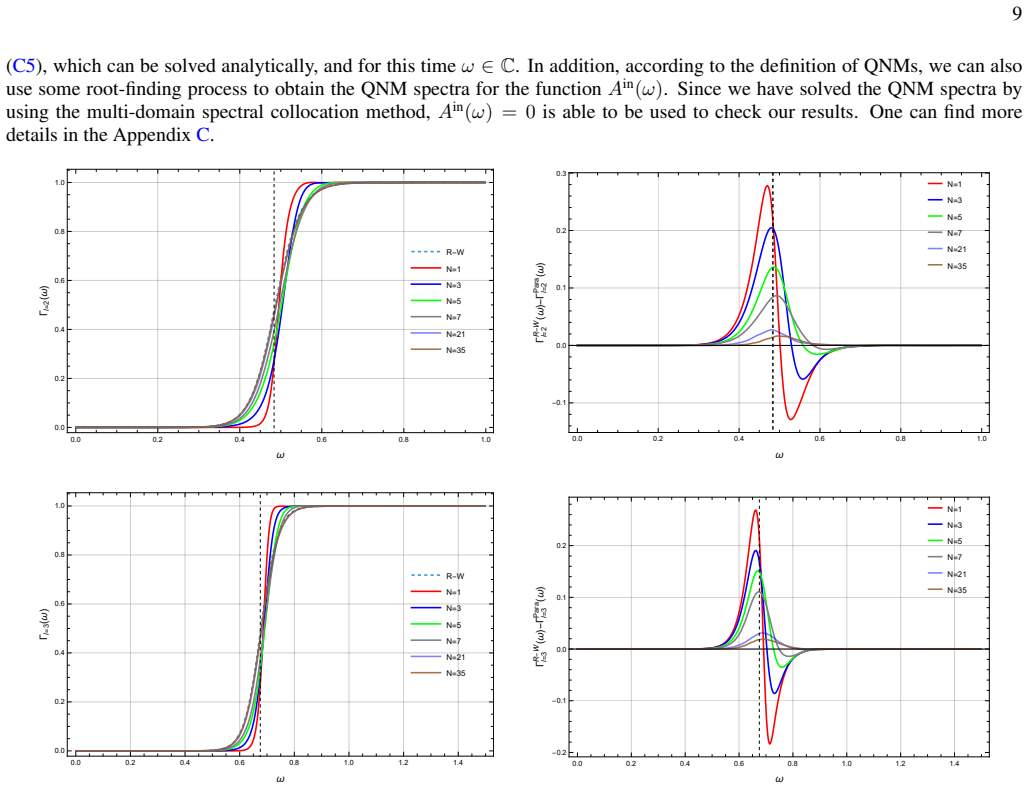
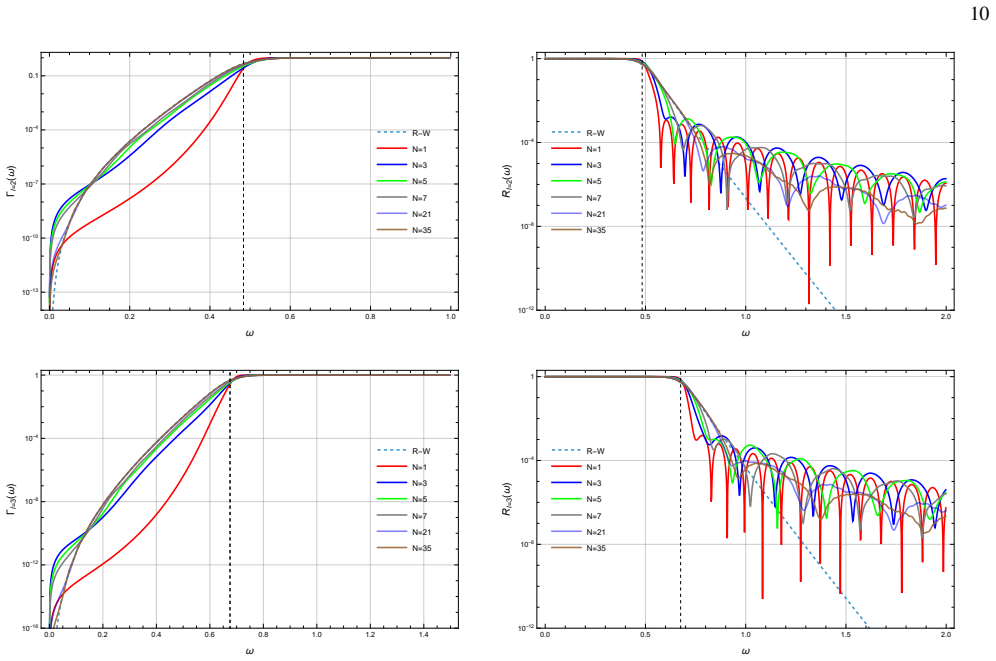
The central claim is that a $\mathcal{C}^0$ piecewise parabolic approximation to the Regge-Wheeler potential produces quasinormal-mode spectra that do not converge to the original Schwarzschild spectra as the approximation improves, while greybody factors do converge. For $l=2$ and $N=1,3,5,7$, the fundamental mode and overtones have imaginary parts that decrease only slowly with overtone number, remaining close to zero, in sharp contrast to the rapidly damping overtones of the exact Regge-Wheeler case. The paper verifies these numerically obtained frequencies by checking that they make the analytically constructed determinant $\det(M(\omega))$ vanish to high precision. For greybody factors, the same matching conditions are organized into a transfer matrix, giving closed-form expressions for the amplitudes $A_{\mathrm{in}}(\omega)$ and $A_{\mathrm{out}}(\omega)$; the resulting transmission coefficients approach the Regge-Wheeler greybody factor as $N$ increases. The reflection coefficient, however, develops high-frequency resonances absent in the original case, which the paper attributes to the long-lived modes.
Load-bearing premise
The load-bearing premise is that the piecewise parabolic deviation is genuinely a small perturbation of the Regge-Wheeler potential, and that the behavior found up to $N=7$ already represents the large-$N$ regime; if larger $N$ would restore convergence, the paper's conclusion about small-perturbation spectrum instability would not be established.
Editorial extensions
If this is right
- Low-lying and high-overtone quasinormal frequencies of the Schwarzschild scalar channel cannot be reliably inferred from a merely $\mathcal{C}^0$ parabolic approximation, because the spectra do not converge as the potential converges.
- Greybody factors for non-smooth effective potentials can still be computed analytically via the transfer-matrix formula, without relying on WKB or purely numerical integration.
- The WKB-based correspondence linking the fundamental quasinormal mode to the greybody factor's inflection point fails for the piecewise parabolic potential, since stable greybody factors coexist with a shifted fundamental mode.
- High-frequency reflection coefficients acquire resonances tied to long-lived modes even when the potential is arbitrarily close to Regge-Wheeler, so reflectivity features alone do not uniquely identify the underlying spacetime potential.
Reading between the lines
- A consequence the paper leaves implicit is that observables built from transmission through the potential, such as absorption cross sections or echo amplitudes, are more promising targets for model-independent gravitational-wave tests than overtone spectra.
- If this non-convergence persists in the continuum limit, any spectral code that approximates a smooth potential with piecewise polynomials having $\mathcal{C}^0$ junctions may manufacture artificial long-lived modes; enforcing $\mathcal{C}^1$ or $\mathcal{C}^2$ smoothness at the joints would be a cheap check.
- Replacing the Lagrange parabolic pieces with smooth splined approximations in the same code would distinguish whether the long-lived modes come from the derivative discontinuity or from the parabolic shape itself.
- For rotating black holes, the same transfer-matrix strategy could be applied to the Sasaki-Nakamura equation to test whether the instability-stability pattern persists with nonzero angular momentum.
Editorial analysis
A structured set of objections, weighed in public.
Referee Report
Summary. This paper studies the response of quasinormal-mode (QNM) spectra and greybody factors to a piecewise parabolic approximation of the Regge-Wheeler (RW) potential. The authors construct a C^0 approximation with N segments, spacing δx = 10/ln(N+1), and set the potential to zero outside a finite interval. They compute QNM frequencies for N = 1, 3, 5, 7 using a multi-domain spectral collocation method, validate the roots with determinant conditions, and report that as N increases the QNM frequencies do not approach the RW values; instead the imaginary parts remain small, producing long-lived modes. For greybody factors, they derive a transfer-matrix analytic formula, compare with Runge-Kutta results for the original RW potential, and find convergence for N up to 35. The paper concludes that QNM spectra are unstable while greybody factors are stable under this non-smooth perturbation, and proposes the transfer-matrix method as a tool for other non-smooth effective potentials.
Significance. If established, the paper would add a new explicit example of QNM spectral instability under a C^0 (but not C^1) approximation that converges to the RW potential, while demonstrating that greybody factors remain robust. The manuscript has genuine strengths: the transfer-matrix expression for the scattering amplitudes is analytic and clearly presented; the QNM roots are checked against determinant conditions with impressively small moduli; resolution-convergence studies are included; and the greybody factors are compared against independent RK4 integration for the original RW potential. These validations give confidence in the numerical machinery. However, the central QNM instability claim is not yet established because the QNM results are limited to N = 7 and the finite-support truncation of the potential introduces a confounding effect that has not been isolated. The greybody-factor stability result is much better supported and the transfer-matrix method is a useful contribution in its own right.
major comments (3)
- [Sec. III, Tab. I] The claim that the QNM spectra do not converge to the RW spectra as N increases is based entirely on N = 1, 3, 5, 7. For N = 7, Eqs. (2.4)-(2.5) give δx = 10/ln(8) ≈ 4.8 and support half-width L = Nδx ≈ 34, with the potential truncated to zero beyond |x| = L. At this value of N the approximation is still coarse: the interpolation error near the peak is of order 10^-2 as seen in Fig. 2, and the tail truncation introduces a uniform-norm error V_RW(L) ≈ 6/L^2 ≈ 5 × 10^-3. These are not demonstrably 'small deviations' in any norm relevant to the spectral problem. Please extend the QNM computation to substantially larger N (for example, 15, 21, 35) and report whether the same non-convergence persists. Without such data, the non-convergence observed in Tab. I could reflect the large residual approximation error or the finite support rather than the claimed small-perturbation instability.
- [Sec. IV, Fig. 6] The high-frequency oscillations of the reflection coefficient have a period that grows with N, which is the expected signature of reflections from the artificial boundaries at x = ±L introduced by setting V = 0 outside the finite support in Eq. (2.4). To attribute these resonances to the small-perturbation instability of the RW QNM spectrum, please provide a control calculation in which the potential is not truncated at x = ±L, for example by matching the parabolic approximation to the exact RW tail beyond L, and show that the resonance structure persists. Alternatively, demonstrate analytically that the mode spacing is controlled by the potential parameters rather than by the support length L.
- [Sec. III, Tab. II] The determinant moduli in Tab. II are very small, but they verify only that the reported ω are roots of det(M(ω)) = 0 for the piecewise-parabolic, compactly supported potential. They do not test whether that finite potential is close to the RW potential in the operator norm that controls the QNM spectrum. The comparison with Leaver's continued-fraction values is useful, but the manuscript would be considerably stronger if the authors also computed the QNM spectrum of an untruncated or smoothly continued approximation with the same solver, thereby isolating the effect of the finite support from the effect of the piecewise-parabolic interpolation.
minor comments (3)
- [Appendix B] There are index typos in the displayed matching conditions and matrix. For example, the second matching equation at x2 should involve C1,2 and C2,2 on the right-hand side, not C2,1 and C2,2; the last two rows of M use P1(ω,x4) and P2(ω,x6) where both entries should be evaluated at x6. Please correct these to make the construction unambiguous.
- [Sec. III, Eq. (3.6)] The Chebyshev-Lobatto grid formula appears to have a typo: the interval endpoints are written as x_{2k−2} and x_{2k+2}, but the interval is [x_{2k−2}, x_{2k}]. The indices in the formula should be x_{2k−2} and x_{2k}.
- [Sec. IV, Fig. 5] The text says the vertical dashed line in Fig. 5 corresponds to ω^{R-W}_0 and also says the main differences are near the real part of the fundamental mode. Please clarify whether the dashed line marks the full complex fundamental frequency or only its real part.
Circularity Check
No significant circularity: the parabolic approximation and its QNM/greybody computations are self-contained and independently benchmarked.
full rationale
The paper's derivation chain is not circular. The piecewise parabolic potential V(x) is constructed directly from point values of the Regge-Wheeler potential through Eq. (2.4), with no parameter fitted to quasinormal-mode or greybody-factor data; the discretization delta x = 10/ln(N+1) in Eq. (2.5) is a stated approximation schedule, not a fit. The QNM spectra are computed independently for the approximate potential and compared with R-W spectra from Leaver's continued fraction method in Tab. I, so the instability claim is not forced by the construction. The greybody factors are obtained analytically from the transfer-matrix solution of the same approximate problem and compared with a Runge-Kutta integration of the original R-W equation; again, no fitted quantity enters. The determinant check in Tab. II and the A_in(omega)=0 consistency check are internal validations rather than circular predictions. Self-citations appear only in contextual or consistency statements and are not load-bearing for the central derivation. The skeptic's concern that the compactly supported V_N, with QNM data only up to N=7, may produce truncation artifacts is a substantive physical and robustness challenge to the claimed small-perturbation instability, but it is not an instance of a result reducing to its inputs by construction. The Appendix B index typos in the displayed matrix are typographical, not circularity. Therefore no circular step meets the required evidentiary standard.
Assumptions & free parameters
free parameters (2)
- Support and grid spacing constant in delta x = 10 / ln(N+1) =
10
- Number of parabolic segments N used for QNM spectra =
1, 3, 5, 7
assumptions (3)
- standard math The Weber equation solutions D_nu(z) and D_{-nu-1}(iz) are linearly independent and cover all solutions of Eq. (3.2) on each interval.
- domain assumption For a C0 potential with bounded derivative discontinuities, Psi and Psi' are continuous across each node, so the matching conditions (3.4) are valid.
- ad hoc to paper The finite-support approximation with V_R-W(x0) = V_R-W(x2N) = 0 and delta x = 10 / ln(N+1) is a small perturbation of the R-W potential for N=5 and N=7.
Cite this review
Pith. "Pith review of Spectrum instability and greybody factor stability for parabolic approximation of Regge-Wheeler potential." pith.science (2026). https://pith.science/paper/BLVOT6BZ
@misc{pith2026250521303,
  author       = {Pith},
  title        = {Pith review of: Spectrum instability and greybody factor stability for parabolic approximation of Regge-Wheeler potential},
  year         = {2026},
  howpublished = {\url{https://pith.science/paper/BLVOT6BZ}},
  note         = {Machine review of arXiv:2505.21303}
}
read the original abstract
We investigate the stability of QNM spectra and greybody factors in the Schwarzschild black hole by approximating the Regge-Wheeler potential with a piecewise parabolic form and treating the deviation as a perturbation. We find that QNM spectra are sensitive to small perturbations, while greybody factors remain stable. This piecewise parabolic approximated potential gives rise to the long-lived modes whose imaginary parts remain close to zero and decrease slowly with overtone number increasing. The reflection coefficient shows distinct resonance feature in the high-frequency regime that are absent in the original R-W case. For the calculation of greybody factors, we employ an analytic method based on transfer matrix technique, and this approach can also be effectively used in other effective potential cases.
Figures


Figures from the paper (4 more)


Forward citations
Cited by 1 Pith paper
-
Waveform stability of black hole ringdown with stochastic horizon structure
Ringdown waveforms are robust against small-scale stochastic horizon fluctuations; only coherent, macroscopic horizon structure with ε≳10^-4 and L_c∼M could produce observable deviations.
Reference graph
Works this paper leans on
-
[1]
Despite the frequency-domain instability of QNMs, the prompt time-domain ringdown waveform is stable [13, 26, 67, 68]. Recently, it is demonstrated that the prompt ringdown waveform remains stable by considering a modified boundary condition and computing the QNM excitation factors [68, 69], where the QNM excitation factors are used to reconstruct the wav...
-
[2]
For the Kerr case, one can also study the influences of non-smoothness on QNM spectra and greybody factors, where the carrier of research can be the Sasaki-Nakamura equation [71] or Teukolsky equation [72]. Acknowledgement We are grateful to Yu-Sen Zhou for helpful discussions. This work is supported in part by the National Key Research and Development Pr...
- [3]
-
[4]
R. A. Konoplya and A. Zhidenko, Rev. Mod. Phys. 83, 793 (2011), arXiv:1102.4014 [gr-qc]
arXiv 2011
-
[5]
S. V . Bolokhov and M. Skvortsova, (2025), arXiv:2504.05014 [gr-qc]
arXiv 2025
- [6]
-
[7]
R. A. Konoplya and A. Zhidenko, JHEAp 44, 419 (2024), arXiv:2209.00679 [gr-qc]
arXiv 2024
-
[8]
J. L. Jaramillo, R. Panosso Macedo, and L. Al Sheikh, Phys. Rev. X 11, 031003 (2021), arXiv:2004.06434 [gr-qc]
arXiv 2021
Show all 75 references
- [9]
-
[10]
Nollert and R
H.-P. Nollert and R. H. Price, J. Math. Phys. 40, 980 (1999), arXiv:gr-qc/9810074
1999 arXiv
-
[11]
W.-L. Qian, K. Lin, C.-Y . Shao, B. Wang, and R.-H. Yue, Phys. Rev. D103, 024019 (2021), arXiv:2009.11627 [gr-qc]
2021 arXiv
-
[12]
R. G. Daghigh, M. D. Green, and J. C. Morey, Phys. Rev. D 101, 104009 (2020), arXiv:2002.07251 [gr-qc]
2020 arXiv
-
[13]
Liu, W.-L
H. Liu, W.-L. Qian, Y . Liu, J.-P. Wu, B. Wang, and R.-H. Yue, Phys. Rev. D104, 044012 (2021), arXiv:2104.11912 [gr-qc]
2021 arXiv
-
[14]
Li, W.-L
G.-R. Li, W.-L. Qian, and R. G. Daghigh, Phys. Rev. D 110, 064076 (2024), arXiv:2406.10782 [gr-qc]
2024 arXiv
-
[15]
Berti, V
E. Berti, V . Cardoso, M. H.-Y . Cheung, F. Di Filippo, F. Duque, P. Martens, and S. Mukohyama, Phys. Rev. D 106, 084011 (2022), arXiv:2205.08547 [gr-qc]
2022 arXiv
-
[16]
M. H.-Y . Cheung, K. Destounis, R. P. Macedo, E. Berti, and V . Cardoso, Phys. Rev. Lett.128, 111103 (2022), arXiv:2111.05415 [gr-qc]
2022 arXiv
-
[17]
Yang, Z.-F
Y . Yang, Z.-F. Mai, R.-Q. Yang, L. Shao, and E. Berti, Phys. Rev. D110, 084018 (2024), arXiv:2407.20131 [gr-qc]
2024 arXiv
-
[18]
Courty, K
A. Courty, K. Destounis, and P. Pani, Phys. Rev. D 108, 104027 (2023), arXiv:2307.11155 [gr-qc]
2023 arXiv
-
[19]
Cardoso, S
V . Cardoso, S. Kastha, and R. Panosso Macedo, Phys. Rev. D 110, 024016 (2024), arXiv:2404.01374 [gr-qc]
2024 arXiv
-
[20]
Ianniccari, A
A. Ianniccari, A. J. Iovino, A. Kehagias, P. Pani, G. Perna, D. Perrone, and A. Riotto, Phys. Rev. Lett. 133, 211401 (2024), arXiv:2407.20144 [gr-qc]
2024 arXiv
-
[21]
Malato Corr ˆea, C
M. Malato Corr ˆea, C. F. B. Macedo, R. Panosso Macedo, and L. A. Oliveira, (2025), arXiv:2504.00107 [gr-qc]
2025 arXiv
-
[22]
Trefethen and M
L. Trefethen and M. Embree, Spectra and Pseudospectra: The Behavior of Nonnormal Matrices and Operators (Princeton university press, 2005)
2005
- [23]
- [24]
-
[25]
J. L. Jaramillo, R. Panosso Macedo, and L. A. Sheikh, Phys. Rev. Lett. 128, 211102 (2022), arXiv:2105.03451 [gr-qc]
2022 arXiv
-
[26]
Destounis, R
K. Destounis, R. P. Macedo, E. Berti, V . Cardoso, and J. L. Jaramillo, Phys. Rev. D 104, 084091 (2021), arXiv:2107.09673 [gr-qc]
2021 arXiv
-
[27]
Cao, J.-N
L.-M. Cao, J.-N. Chen, L.-B. Wu, L. Xie, and Y .-S. Zhou, Sci. China Phys. Mech. Astron. 67, 100412 (2024), arXiv:2401.09907 [gr-qc] 15
2024 arXiv
- [28]
-
[29]
Arean, D
D. Arean, D. Garcia-Fari ˜na, and K. Landsteiner, Front. in Phys. 12, 1460268 (2024), arXiv:2407.04372 [hep-th]
2024 arXiv
-
[30]
Garcia-Fari ˜na, K
D. Garcia-Fari ˜na, K. Landsteiner, P. G. Romeu, and P. Saura-Bastida, JHEP 01, 185 (2025), arXiv:2407.06104 [hep-th]
2025 arXiv
-
[31]
Are ´an, D
D. Are ´an, D. G. Fari˜na, and K. Landsteiner, JHEP 12, 187 (2023), arXiv:2307.08751 [hep-th]
2023 arXiv
-
[32]
Boyanov, V
V . Boyanov, V . Cardoso, K. Destounis, J. L. Jaramillo, and R. Panosso Macedo, Phys. Rev. D 109, 064068 (2024), arXiv:2312.11998 [gr-qc]
2024 arXiv
-
[33]
Cownden, C
B. Cownden, C. Pantelidou, and M. Zilh ˜ao, JHEP 05, 202 (2024), arXiv:2312.08352 [gr-qc]
2024 arXiv
- [34]
-
[35]
Sarkar, M
S. Sarkar, M. Rahman, and S. Chakraborty, Phys. Rev. D 108, 104002 (2023), arXiv:2304.06829 [gr-qc]
2023 arXiv
-
[36]
Destounis, V
K. Destounis, V . Boyanov, and R. Panosso Macedo, Phys. Rev. D 109, 044023 (2024), arXiv:2312.11630 [gr-qc]
2024 arXiv
-
[37]
Luo, Phys
S. Luo, Phys. Rev. D 110, 084071 (2024), arXiv:2408.08139 [gr-qc]
2024
- [38]
-
[39]
Boyanov, K
V . Boyanov, K. Destounis, R. Panosso Macedo, V . Cardoso, and J. L. Jaramillo, Phys. Rev. D 107, 064012 (2023), arXiv:2209.12950 [gr-qc]
2023 arXiv
-
[40]
P. H. C. Siqueira, L. T. de Paula, R. Panosso Macedo, and M. Richartz, (2025), arXiv:2501.13815 [gr-qc]
2025 arXiv
-
[41]
Carballo and B
J. Carballo and B. Withers, JHEP 10, 084 (2024), arXiv:2406.06685 [hep-th]
2024 arXiv
-
[42]
J. L. Jaramillo, Class. Quant. Grav. 39, 217002 (2022), arXiv:2206.08025 [gr-qc]
2022 arXiv
-
[43]
Chen, L.-B
J.-N. Chen, L.-B. Wu, and Z.-K. Guo, Class. Quant. Grav. 41, 235015 (2024), arXiv:2407.03907 [gr-qc]
2024 arXiv
-
[44]
L. T. de Paula, P. H. C. Siqueira, R. Panosso Macedo, and M. Richartz, (2025), arXiv:2504.00106 [gr-qc]
2025 arXiv
-
[45]
Cai, L.-M
R.-G. Cai, L.-M. Cao, J.-N. Chen, Z.-K. Guo, L.-B. Wu, and Y .-S. Zhou, Phys. Rev. D 111, 084011 (2025), arXiv:2501.02522 [gr-qc]
2025 arXiv
- [46]
-
[47]
R. F. Rosato, K. Destounis, and P. Pani, Phys. Rev. D 110, L121501 (2024), arXiv:2406.01692 [gr-qc]
2024 arXiv
-
[48]
Oshita, K
N. Oshita, K. Takahashi, and S. Mukohyama, Phys. Rev. D 110, 084070 (2024), arXiv:2406.04525 [gr-qc]
2024 arXiv
-
[49]
Wu, R.-G
L.-B. Wu, R.-G. Cai, and L. Xie, Phys. Rev. D 111, 044066 (2025), arXiv:2411.07734 [gr-qc]
2025 arXiv
-
[50]
R. A. Konoplya and A. Zhidenko, JCAP 09, 068 (2024), arXiv:2406.11694 [gr-qc]
2024 arXiv
-
[51]
R. A. Konoplya and A. Zhidenko, Phys. Lett. B 861, 139288 (2025), arXiv:2408.11162 [gr-qc]
2025 arXiv
-
[52]
S. V . Bolokhov and M. Skvortsova, JCAP04, 025 (2025), arXiv:2412.11166 [gr-qc]
2025 arXiv
-
[53]
Skvortsova, (2024), arXiv:2411.06007 [gr-qc]
M. Skvortsova, (2024), arXiv:2411.06007 [gr-qc]
2024 arXiv
-
[54]
Malik, JCAP 04, 042 (2025), arXiv:2412.19443 [gr-qc]
Z. Malik, JCAP 04, 042 (2025), arXiv:2412.19443 [gr-qc]
2025 arXiv
-
[55]
B. C. L ¨utf¨uo˘glu, (2025), arXiv:2505.06966 [gr-qc]
2025
- [56]
- [57]
-
[58]
Li, W.-L
G.-R. Li, W.-L. Qian, Q. Pan, R. G. Daghigh, J. C. Morey, and R.-H. Yue, (2025), arXiv:2504.13265 [gr-qc]
2025 arXiv
-
[59]
R. F. Rosato, S. Biswas, S. Chakraborty, and P. Pani, Phys. Rev. D 111, 084051 (2025), arXiv:2501.16433 [gr-qc]
2025 arXiv
-
[60]
Shen, W.-L
S.-F. Shen, W.-L. Qian, K. Lin, C.-G. Shao, and Y . Pan, Class. Quant. Grav.39, 225004 (2022), arXiv:2203.14320 [gr-qc]
2022 arXiv
-
[61]
Panosso Macedo, P
R. Panosso Macedo, P. Bourg, A. Pound, and S. D. Upton, Phys. Rev. D 110, 084008 (2024), arXiv:2404.10083 [gr-qc]
2024 arXiv
-
[62]
L. N. Trefethen, Spectral Methods in MATLAB (Society for Industrial and Applied Mathematics, 2000)
2000
- [63]
-
[64]
E. W. Leaver, Proc. Roy. Soc. Lond. A 402, 285 (1985)
1985
-
[65]
Panosso Macedo, Phil
R. Panosso Macedo, Phil. Trans. Roy. Soc. Lond. A 382, 20230046 (2024), arXiv:2307.15735 [gr-qc]
2024 arXiv
-
[66]
Panosso Macedo and A
R. Panosso Macedo and A. Zenginoglu, Front. in Phys. 12, 1497601 (2024), arXiv:2409.11478 [gr-qc]
2024 arXiv
-
[67]
Berti, V
E. Berti, V . Cardoso, and P. Pani, Phys. Rev. D79, 101501 (2009), arXiv:0903.5311 [gr-qc]
2009 arXiv
-
[68]
S.-F. Shen, K. Lin, T. Zhu, Y .-P. Yan, C.-G. Shao, and W.-L. Qian, Phys. Rev. D110, 084022 (2024), arXiv:2408.00971 [gr-qc]
2024 arXiv
-
[69]
T. F. M. Spieksma, V . Cardoso, G. Carullo, M. Della Rocca, and F. Duque, Phys. Rev. Lett. 134, 081402 (2025), arXiv:2409.05950 [gr-qc]
2025 arXiv
- [70]
-
[71]
Glampedakis and N
K. Glampedakis and N. Andersson, Class. Quant. Grav. 20, 3441 (2003), arXiv:gr-qc/0304030
2003 arXiv
-
[72]
Oshita and V
N. Oshita and V . Cardoso, Phys. Rev. D111, 104043 (2025), arXiv:2407.02563 [gr-qc]
2025 arXiv
-
[73]
Sasaki and T
M. Sasaki and T. Nakamura, Prog. Theor. Phys. 67, 1788 (1982)
1982
-
[74]
S. A. Teukolsky, Phys. Rev. Lett. 29, 1114 (1972)
1972
-
[75]
Wang and D
Z. Wang and D. Guo, Special Functions, EBL-Schweitzer (World Scientific, 1989)
1989
Reviewed August 7, 2026 · model on record in the stance chip above.
Discussion (0). Continue with ORCID to comment.