REVIEW 4 major objections 5 minor 34 references
PEDANTIC: A Dataset for the Automatic Examination of Definiteness in Patent Claims
T0 review · 4 major / 5 minor · reviewed 2026-08-07 · deepseek-v4-flash
Pith's one-line read PEDANTIC is the first public dataset of 14,536 US patent claims annotated with examiner-cited reasons for indefiniteness, and on it, LLM agents fail to beat logistic regression on the binary decision despite often naming the correct…
desk verdict A genuinely useful first dataset for patent definiteness, but the negative-class construction needs direct validation before benchmark conclusions are trusted. read the letter →
The pith
A machine-rendered reading of the paper's core claim, the machinery that carries it, and where it could break.
The reading
What carries the argument
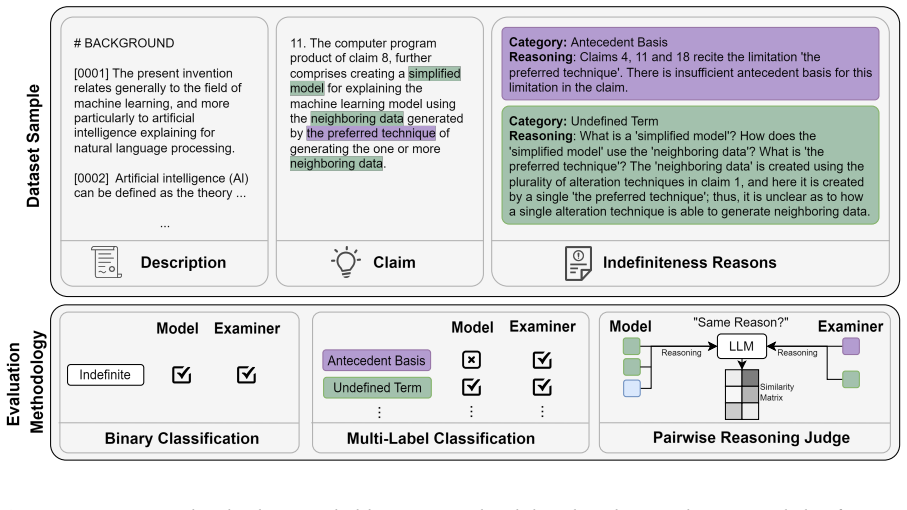
The load-bearing object is the PEDANTIC dataset itself, and the mechanism that carries the argument is its construction-and-evaluation pipeline. On the construction side, the pipeline takes first office actions from the US patent office's public file-wrapper records, selects sections whose headings contain '112', and prompts an LLM to extract each rejection reason as a JSON record with a category from the eight-class schema (antecedent basis, undefined term, relative term, exemplary phrasing, functional claiming, contradicting limitations, omission of essential elements or steps, other), a verbatim free-text explanation, and the recited claim spans, which are fuzzy-matched back into the claim text. The definite class is populated by claims from applications whose first office action never contains the literal '112(b)' string, sampled to match the count of indefinite claims. On the evaluation side, an LLM-as-Judge component scores every model-cited reason against every examiner-cited reason on a 1–5 similarity scale, with the probability-weighted mean (following recent work on judgment distributions) converted to a score, from which thresholded and soft precision/recall/F1 are computed; the agents themselves use verbalized probability expressions mapped to numbers via empirically calibrated perception values.
What would settle it
Sample a few hundred PEDANTIC claims labelled definite, pull their complete prosecution histories (not just the first office action) from the patent office's file-wrapper records, and search for any §112(b) rejection phrased without the literal string '112(b)'—for instance, '112, second paragraph' or a definiteness rejection raised in a later action; if a non-negligible share of those claims were rejected as indefinite, the definite class is contaminated and the reported AUROC and F1 comparisons would need to be recomputed on the cleaned sample.
Extended reading notes
Core claim
PEDANTIC is claimed to be the first public corpus that annotates patent definiteness at the level of the examiner's reasons rather than as a bare label. The corpus contains 14,536 claims from 3,710 G06F40 applications filed after 2014, evenly split between definite and indefinite; the 9,215 indefiniteness reasons fall into eight categories dominated by antecedent-basis errors and undefined terms (together 73% of reasons). The construction pipeline retrieves the first office action for each application, filters for sections headed with '112', prompts a large language model to output rejection reasons in a fixed JSON schema with verbatim reasoning and recited phrases, and fuzzy-matches those phrases into the claim text; a human validation of 50 claims found every binary label correct, all but one free-text reasoning correct, and 19 of 27 category assignments correct. The paper's experimental claim is that current LLM agents—given tools to fetch parent claims and search the description—achieve at best an AUROC of 60.3 when ensembled with logistic regression, and individually do not outperform the linguistic-feature logistic regression baseline on the binary decision, despite the 32B agent matching 35.4% of examiner-cited reasons at threshold 75 in the LLM-as-Judge evaluation. The authors read this as a disconnect between reason identification and calibrated decision-making: LLMs often know why a claim is indefinite but cannot reliably turn that knowledge into the correct verdict.
Load-bearing premise
Every 'definite' label in PEDANTIC rests on the assumption that an application whose first office action never contains the literal string '112(b)' has no indefinite claims, so a rejection phrased as '112, second paragraph' or raised only in a later office action would silently mislabel that claim as definite and inject noise into every reported comparison.
Editorial extensions
If this is right
- PEDANTIC provides the first public benchmark on which future definiteness-examination models can be compared reproducibly, including the fine-grained reason annotations needed for explainable predictions.
- The result that LLM agents recover many examiner reasons but still lag logistic regression on the binary label implies that improving claim-level calibration—rather than better reason extraction—is the immediate target for LLM-based examiners.
- The pipeline is domain-agnostic over USPTO CPC classes, so the same automatic construction can be rerun to produce definiteness datasets for other technical fields without manual annotation.
- The pairwise LLM-as-Judge protocol generalizes to other rejection grounds (novelty, non-obviousness) and other explanation-evaluation tasks where free-text reasons must be compared.
- Because the best model is an ensemble of a linear model and an LLM, the paper's numbers suggest that hybrid systems may be the practical route until LLM calibration improves.
Reading between the lines
- The definite class is defined by the absence of the literal string '112(b)' in the first office action, so label noise is a real risk: examiners may write '112, second paragraph' or issue the rejection only in a later action. A quick robustness check would be to re-annotate a sample of definite claims from the full prosecution history and measure how much the benchmark numbers shift.
- The paper's feature analysis shows that higher readability scores correlate with indefiniteness while higher complexity correlates with definiteness—consistent with the idea that terse, under-specified claims are more likely to be rejected. One could test whether this sign pattern holds across CPC classes and whether it became stronger after the 2014 legal standard change.
- The LLM-as-Judge has been validated only indirectly against human annotations for the binary label; a direct validation would compare judge scores on reason pairs to human (examiner or attorney) pairwise judgments, which would establish whether the reason-level conclusions hold up.
- Since reason-level confidence was moderately correlated with correctness while claim-level confidence was not, a natural next step is to build a decision rule that aggregates reason-level confidences into the binary verdict; the paper does not propose such a rule, but its data would support testing one.
Editorial analysis
A structured set of objections, weighed in public.
Referee Report
Summary. The paper introduces PEDANTIC, a dataset of 14,536 US patent claims from 3,710 NLP-related applications, with binary definite/indefinite labels, indefiniteness categories, free-text reasons, and affected claim spans extracted automatically from first office actions using Gemma 3 27B. The authors validate the extraction on 50 manually inspected claims, finding all binary labels correct, reasoning text correct except for one formatting issue, and categories correct in 19/27 cases. They then benchmark logistic regression and Qwen 2.5 32B/72B agents on binary classification, multi-label category prediction, and an LLM-as-Judge comparison of examiner-cited versus model-cited reasons. The headline empirical finding is that LLM agents barely match or slightly trail logistic regression on binary AUROC (best 60.3), despite identifying many examiner-cited reasons for indefiniteness.
Significance. If the label-construction issues are resolved, PEDANTIC would be a valuable first public resource for automatic definiteness examination, a task with no prior public annotated dataset. The paper deserves credit for grounding labels in external examiner-produced office actions rather than in the evaluated models, for using application-level splits to avoid leakage, for checking time-based and claim-characteristic confounds, and for releasing dataset and code. The human validation, although small, covers the core binary and reasoning annotations. The main significance depends on the reliability of the negative labels and on the validation of the LLM-as-Judge, both of which need strengthening before the benchmark conclusions can be taken at face value.
major comments (4)
- [Section 3.4 / Appendix A] The negative class is constructed from the absence of the literal string '112(b)' in the first office action, but the paper's own parsing prompt in Appendix A (line 3) instructs the model to extract rejections under '35 U.S.C. 112(b) or pre-AIA 35 U.S.C. 112, second paragraph'. Since office actions frequently phrase the rejection as '112, second paragraph' or '112(b) / pre-AIA 112, second paragraph', and Section 3.2 downloads only the first office action, an unknown fraction of the 7,268 'definite' claims may actually be indefinite. This is not uniform label noise: mislabeled negatives are likely to resemble genuine indefiniteness cases, which can depress AUROC for models that detect real issues, distort the feature weights in Figure 3, and weaken the headline comparison in Table 4. I request a direct audit: for a random sample of 'definite' applications, search all office actions for all 112 formulations, manually verify the resulting labels, report the noise rate, and if material, re-estimate the benchmarks.
- [Section 3.6] The human validation checked only 24 definite claims, too few to detect a systematic miss in the definite filter. If the filter misses 5% of definite applications, the probability of seeing zero errors in 24 samples is above 29%; for a 2% miss rate it is above 61%. The statement that 'all binary labels are correct' should therefore be restricted to the validation sample or supported by a larger, stratified audit of definite labels. Without such an audit, the binary benchmark results in Table 4 rest on an unquantified negative-label assumption.
- [Section 3.6 / Table 4] The validation study reports only 19/27 correct indefiniteness categories (70%), yet the multi-label F1 scores in Table 4 and the category distribution in Table 2 are presented as dataset outcomes, and the abstract claims 'high-quality annotations'. Since fine-grained categories are a central advertised component of PEDANTIC, the paper should either improve category extraction (for example, by enforcing the 'other' fallback already present in the Appendix A prompt) or report per-category reliability and clearly mark the multi-label benchmark as preliminary. As written, the claim of high-quality annotations overstates the reliability of the category layer.
- [Section 5.2] The LLM-as-Judge evaluation drives the conclusion that the Qwen 32B model identifies examiner-cited reasons better than the 72B model, but the judge itself is not validated against human judgments on this patent-specific task. A small human-annotated set of reason pairs would establish whether the 75-point threshold and the probability-weighted mean behave as intended. Without such validation, the differences in Table 5 may reflect judge bias rather than model capability, and the claimed disconnect between binary classification and reason identification remains uncertain.
minor comments (5)
- [Figure 3] The feature label 'IOU Claim Description' is not defined in the text; please define the intersection-over-union measure (likely over word sets) and explain how it is computed.
- [Table 3] The header layout with 'Independent ✓+ ✗ ✓ ✗' is ambiguous; please add explicit column labels or a caption explaining the four columns under 'Definite' and 'Indefinite'.
- [Appendix B] In Guideline 8 of the examination prompt, 'the claim begin rejected' should read 'the claim being rejected'.
- [References] Reference [11] appears to have a formatting error in the bibliography entry; the closing parenthesis for the workshop proceedings is missing.
- [Section 5.1] The threshold balancing procedure is described in words only; please state explicitly that the threshold is chosen on the validation set and applied to the test set, and clarify whether the percentages in Table 4 reflect this procedure.
Circularity Check
No significant circularity; the dataset labels come from external USPTO office actions, and the model evaluations use held-out test data with independently tuned thresholds.
full rationale
PEDANTIC's labels are grounded in external USPTO examiner documents, not in the outputs of the models being evaluated. The positive class is drawn from examiner-cited 112(b) rejections parsed into structured reasons, and the negative class is drawn from applications whose first office action does not contain the literal string '112(b)'. Although this negative-class construction is a plausible source of label noise and deserves an audit, it is a data-quality concern rather than a circularity: the model inputs (claim and description) do not contain the office-action string that defines the labels, so the prediction task is not equivalent to its own training signal. The evaluation uses application-level splits into train, validation, and test sets, with confidence thresholds tuned on validation and metrics reported on test, so the headline comparisons are not fitted on the evaluation data. The only mild overlap is that Gemma 3 27B is used both to parse the examiner-cited reasons and as the LLM-as-Judge for reason similarity, but the judge compares model-generated reasons against examiner-written text rather than against the parser's own output, and the evaluated models are Qwen agents, not Gemma. The one self-citation (Pap2pat, reference [4]) is used only as a pointer to automatic drafting systems in related work and is not load-bearing for any central claim. No equation or construction step reduces a predicted quantity to an input parameter or to a definitional variant of the target label, so the paper's derivation chain is self-contained.
Assumptions & free parameters
assumptions (6)
- domain assumption The first office action contains the core grounds for rejection; later office actions are ignored.
- ad hoc to paper An application whose office action lacks the literal string '112(b)' has no indefiniteness rejections.
- domain assumption The eight category labels in Table 1 (plus 'other') cover the indefiniteness reasons present in the data.
- domain assumption Gemma 3 27B extracts reasons verbatim and accurately from office actions.
- ad hoc to paper The 50-claim human validation sample is representative of the full 14k dataset.
- ad hoc to paper The LLM-as-Judge similarity scores (Gemma 3 27B) reflect human judgments of reason equivalence.
Cite this review
Pith. "Pith review of PEDANTIC: A Dataset for the Automatic Examination of Definiteness in Patent Claims." pith.science (2026). https://pith.science/paper/PBY7Z5ZU
@misc{pith2026250521342,
  author       = {Pith},
  title        = {Pith review of: PEDANTIC: A Dataset for the Automatic Examination of Definiteness in Patent Claims},
  year         = {2026},
  howpublished = {\url{https://pith.science/paper/PBY7Z5ZU}},
  note         = {Machine review of arXiv:2505.21342}
}
read the original abstract
Patent claims define the scope of protection for an invention. If there are ambiguities in a claim, it is rejected by the patent office. In the US, this is referred to as indefiniteness (35 U.S.C {\S} 112(b)) and is among the most frequent reasons for patent application rejection. The development of automatic methods for patent definiteness examination has the potential to make patent drafting and examination more efficient, but no annotated dataset has been published to date. We introduce PEDANTIC (Patent Definiteness Examination Corpus), a novel dataset of 14k US patent claims from patent applications relating to Natural Language Processing (NLP), annotated with reasons for indefiniteness. We construct PEDANTIC using a fully automatic pipeline that retrieves office action documents from the USPTO and uses Large Language Models (LLMs) to extract the reasons for indefiniteness. A human validation study confirms the pipeline's accuracy in generating high-quality annotations. To gain insight beyond binary classification metrics, we implement an LLM-as-Judge evaluation that compares the free-form reasoning of every model-cited reason with every examiner-cited reason. We show that LLM agents based on Qwen 2.5 32B and 72B struggle to outperform logistic regression baselines on definiteness prediction, even though they often correctly identify the underlying reasons. PEDANTIC provides a valuable resource for patent AI researchers, enabling the development of advanced examination models. We will publicly release the dataset and code.
Figures


Figures from the paper (1 more)

Reference graph
Works this paper leans on
-
[1]
URL: https://www.uspto.gov/web/ offices/pac/mpep/index.html
USPTO, Manual of Patent Examining Procedure (MPEP), 2024. URL: https://www.uspto.gov/web/ offices/pac/mpep/index.html
work page 2024
-
[2]
USPTO, Pendency | Patents Dashboard | USPTO,
-
[3]
World Intellectual Property Organization, World Intel- lectual Property Indicators 2024, World Intellectual Property Organization, 2024. doi: 10.34667/TIND. 50133
-
[4]
Pap2Pat: Benchmarking Outline-Guided Long-Text Patent Generation with Patent-Paper Pairs
V. Knappich, S. Razniewski, A. Hätty, A. Friedrich, Pap2pat: Towards automated paper-to-patent drafting using chunk-based outline-guided generation, arXiv preprint arXiv:2410.07009 (2024)
work page Pith review arXiv 2024
-
[5]
Q. Lu, A. Myers, S. Beliveau, USPTO Patent Prosecution Research Data: Unlocking Office Ac- tion Traits, 2017. doi: 10.2139/ssrn.3024621. arXiv:3024621
-
[6]
URL: https://blog.juristat.com/ most-common-rejections
The Most Common Rejections: 102, 103, and 112(b), 2019. URL: https://blog.juristat.com/ most-common-rejections
work page 2019
- [7]
-
[8]
L. Zheng, W.-L. Chiang, Y. Sheng, S. Zhuang, Z. Wu, Y. Zhuang, Z. Lin, Z. Li, D. Li, E. P. Xing, H. Zhang, J. E. Gonzalez, I. Stoica, Judging llm-as-a-judge with mt-bench and chatbot arena, in: Proceedings of the 37th International Conference on Neural Information Processing Systems, NIPS ’23, 2023
work page 2023
Show all 34 references
- [9]
-
[10]
Vowinckel, V
K. Vowinckel, V. D. Hähnke, SEARCHFORMER: Se- mantic patent embeddings by siamese transformers for prior art search, World Patent Information 73 (2023) 102192. doi:10.1016/j.wpi.2023.102192
2023
-
[11]
Blume, G
M. Blume, G. Heidari, C. Hewel, Comparing com- plex concepts with transformers: Matching patent claims against natural language text, in: 5th Workshop on Patent Text Mining and Semantic Technologies 5https://ceur-ws.org/GenAI/Taxonomy.html (PatentSemTech, volume 3775, CEUR-WS....
2024
-
[12]
Parikh, S
A. Parikh, S. Dori-Hacohen, ClaimCompare: A data pipeline for evaluation of novelty destroying patent pairs, in: 5th Workshop on Patent Text Mining and Semantic Technologies (PatentSemTech, volume 3775 of CEUR Workshop Proceedings, CEUR-WS.org, 2024, pp. 61–66
2024
-
[13]
Stamatis, M
V. Stamatis, M. Salampasis, K. Diamantaras, A novel re- ranking architecture for patent search, World Patent Information 78 (2024) 102282. doi: 10.1016/j.wpi. 2024.102282
2024
-
[14]
J. Shan, Q. Zhang, C. Shi, M. Gui, S. Wang, U. Naseem, Structural Representation Learning and Disentangle- ment for Evidential Chinese Patent Approval Predic- tion, in: Proceedings of the 33rd ACM International Conference on Information and Knowledge Man- agement, ACM, 2024, p...
2024
-
[15]
Y. Shen, Z. Lin, PatentGrapher: A PLM-GNNs Hybrid Model for Comprehensive Patent Plagiarism Detection Across Full Claim Texts, IEEE Access 12 (2024) 182717– 182725. doi:10.1109/ACCESS.2024.3508762
2024
-
[16]
T. Wei, D. Feng, S. Song, C. Zhang, An extraction and novelty evaluation framework for technology knowledge elements of patents, Scientometrics (2024). doi:10.1007/s11192-024-04990-9
2024 doi
- [17]
-
[18]
R. Lee, A. Spangher, X. Ma, PatentEdits: Fram- ing Patent Novelty as Textual Entailment, 2024. arXiv:2411.13477
2024 arXiv
-
[19]
S. Hido, S. Suzuki, R. Nishiyama, T. Imamichi, R. Taka- hashi, T. Nasukawa, T. Id^|^eacute;, Y. Kanehira, R. Yohda, T. Ueno, A. Tajima, T. Watanabe, Modeling Patent Quality: A System for Large-scale Patentability Analysis using Text Mining, Journal of Information Processing 20...
2012 doi
-
[20]
N. Kong, U. Dulleck, A. B. Jaffe, S. Sun, S. Vajjala, Lin- guistic metrics for patent disclosure: Evidence from university versus corporate patents, Research Pol- icy 52 (2023) 104670. doi:10.1016/j.respol.2022. 104670
2023 doi
-
[21]
J. H. Ashtor, Modeling patent clarity, Research Pol- icy 51 (2022) 104415. doi:10.1016/j.respol.2021. 104415
2022 doi
-
[22]
Mersha, K
M. Mersha, K. Lam, J. Wood, A. K. AlShami, J. Kalita, Explainable artificial intelligence: A survey of needs, techniques, applications, and fu- ture direction, Neurocomputing 599 (2024) 128111. URL: https://www.sciencedirect.com/science/article/ pii/S0925231224008828. doi: htt...
2024
-
[23]
Huang, S
S. Huang, S. Mamidanna, S. Jangam, Y. Zhou, L. H. Gilpin, Can large language models ex- plain themselves? a study of llm-generated self- explanations, 2023. URL: https://arxiv.org/abs/2310. 11207. arXiv:2310.11207
2023 arXiv
-
[24]
Madsen, S
A. Madsen, S. Chandar, S. Reddy, Are self-explanations from Large Language Models faithful?, in: L.-W. Ku, A. Martins, V. Srikumar (Eds.), Findings of the Associa- tion for Computational Linguistics: ACL 2024, Associ- ation for Computational Linguistics, 2024, pp. 295–337. doi...
2024 doi
-
[25]
Agarwal, S
C. Agarwal, S. H. Tanneru, H. Lakkaraju, Faithfulness vs. plausibility: On the (un)reliability of explanations from large language models, 2024. URL: https://arxiv. org/abs/2402.04614. arXiv:2402.04614
2024 arXiv
-
[26]
Nautilus, Inc. v. Biosig Instru- ments, Inc, 572 U.S. 898 (2014), https://supreme.justia.com/cases/federal/us/572/898/, 2014
2014
-
[27]
A. K. et al., Gemma 3 technical report, 2025. URL: https: //arxiv.org/abs/2503.19786. arXiv:2503.19786
2025 arXiv
-
[28]
Fagen-Ulmschneider, Per- ception of Probability Words, https://waf.cs.illinois.edu/visualizations/Perception- of-Probability-Words/, 2025
W. Fagen-Ulmschneider, Per- ception of Probability Words, https://waf.cs.illinois.edu/visualizations/Perception- of-Probability-Words/, 2025
2025
-
[29]
K. Tian, E. Mitchell, A. Zhou, A. Sharma, R. Rafailov, H. Yao, C. Finn, C. Manning, Just ask for calibration: Strategies for eliciting calibrated confidence scores from language models fine-tuned with human feed- back, in: Proceedings of the 2023 Conference on Em- pirical Meth...
2023
-
[30]
Xiong, Z
M. Xiong, Z. Hu, X. Lu, Y. LI, J. Fu, J. He, B. Hooi, Can LLMs express their uncertainty? an empirical evaluation of confidence elicitation in LLMs, in: The Twelfth International Conference on Learning Repre- sentations, 2024. URL: https://openreview.net/forum? id=gjeQKFxFpZ
2024
-
[31]
V. Wang, M. J. Q. Zhang, E. Choi, Improving llm-as-a-judge inference with the judgment distri- bution, 2025. URL: https://arxiv.org/abs/2503.03064. arXiv:2503.03064
2025
-
[32]
rejectedClaims
M. Yasunaga, L. Shamis, C. Zhou, A. Cohen, J. Weston, L. Zettlemoyer, M. Ghazvininejad, Alma: Alignment with minimal annotation, 2024. URL: https://arxiv.org/ abs/2412.04305. arXiv:2412.04305. A. Office Action Parsing Prompt 1 ### TASK 2 3 Your task is to extract data related ...
2024 arXiv
-
[2025]
URL: https://www.uspto.gov/dashboard/patents/ pendency.html
-
[5442]
URL: https://aclanthology.org/2023.emnlp-main. 330/. doi:10.18653/v1/2023.emnlp-main.330
2023 doi
Reviewed August 7, 2026 · model on record in the stance chip above.
Discussion (0). Sign in to comment.