REVIEW 3 major objections 4 minor 45 references
WiCAL: Accurate Wi-Fi-Based 3D Localization Enabled by Collaborative Antenna Arrays
T0 review · 3 major / 4 minor · reviewed 2026-08-07 · deepseek-v4-flash
Pith's one-line read WiCAL claims that two synchronized commercial Wi-Fi arrays can act as one virtual array and locate a transmitter in 3D with a 15.6 cm median error.
desk verdict Clever switched-array engineering and a plausible AoA pipeline, but the headline 15.6 cm DPD result rests on a circular, target-dependent phase alignment that needs a fix before it can be believed. read the letter →
The pith
A machine-rendered reading of the paper's core claim, the machinery that carries it, and where it could break.
The reading
What carries the argument
The load-bearing mechanism is the virtual large-scale array: after separating the phase offsets into intra-group, inter-group, and inter-array components, WiCAL measures the inter-array phase difference and applies it to the second URA's received matrix, so the two arrays can be stacked into one joint model whose MUSIC pseudo-spectrum is computed over spatial grid points rather than angles. The second component is I-SSMUSIC, a forward-backward two-dimensional spatial smoothing MUSIC that restores rank to the covariance matrix and lets coherent multipath sources be resolved with a small 3x4 aperture. A progressive local traversal then re-centers a 0.1 m search sphere with 0.005 m voxels around each refined estimate, giving the DPD2URA algorithm its reported convergence within about three iterations.
What would settle it
Set up two URAs at known fixed positions, calibrate the inter-array phase offset once using a reference transmitter at a known location, then localize a second transmitter moved around the room with that same stored offset; if the median error jumps well above 15.6 cm, the phase offset depends on the target position and the virtual-array model is circular.
Extended reading notes
Core claim
The paper's central claim is that inter-array phase alignment turns two distributed, RF-switched commercial Wi-Fi URAs into a coherent virtual aperture whose spatial resolution exceeds what either array can achieve alone. The system applies a three-stage phase alignment (intra-group, inter-group, and inter-array) and then fuses the phase-aligned CSI directly into a joint MUSIC spectrum, bypassing intermediate AoA estimation in a direct position determination step. In the reported experiments at 5.2 GHz with 12 antennas per array, WiCAL achieves a median 3D localization error of 15.6 cm with the DPD2URA algorithm, compared with 17 cm for geometric closest-point fusion of I-SSMUSIC AoAs, and axis-wise median errors of 6 cm, 7.5 cm, and 7 cm. The authors state this is the first system to achieve state-of-the-art 3D localization using only commercial Wi-Fi devices, while noting that the comparison with prior platforms relies on published numbers because those platforms were not available for direct testing.
Load-bearing premise
The load-bearing premise is that the phase difference measured between the two arrays using the target's own signal can be treated as a fixed, position-independent calibration constant when combining the arrays into a virtual aperture; the paper does not describe an independent reference source or calibration step that would make it so.
Editorial extensions
If this is right
- A three-RF-chain NIC can extend to 3N antennas with SPNT switches, a higher ceiling than the 2N+1 antennas allowed by keeping one chain on a reference antenna.
- Array size strongly drives accuracy: median error drops from 97.5 cm with a 2x3 array to 26 cm with 3x3 and 15.6 cm with 3x4, so cascaded switch designs have a clear scaling path to better localization.
- Direct position determination outperforms geometric AoA triangulation by 7.7% in this setup, which suggests that coherent data fusion, not just angle estimation, is where much of the inter-array gain comes from.
- The full DPD2URA fix takes about 0.7 s, and the tracking experiment reports 0.11 m raw and 0.075 m median-filtered trajectory errors, so near-real-time 3D tracking is within reach.
Reading between the lines
- A deployment implication the paper leaves open: the inter-array phase offset is measured from the target itself, so it likely must be obtained from an independent reference transmitter or a wired calibration path before the virtual-array model can be used for unknown targets.
- If the virtual-array model generalizes, the same joint MUSIC spectrum could be mined for coherent multipath structure, effectively turning the synchronized Wi-Fi arrays into a coarse imaging aperture rather than a point localizer.
- A natural next experiment would vary the distance and orientation between the two URAs to map how the 15.6 cm error scales with baseline length; the paper tests a single geometry, so the geometric dependence of the inter-array gain is not established.
Editorial analysis
A structured set of objections, weighed in public.
Referee Report
Summary. WiCAL is a Wi-Fi 3D localization system built around two switched 3×4 uniform rectangular arrays (URAs) driven by three RF chains. The paper proposes a three-stage phase calibration (intra-group, inter-group, inter-array), an I-SSMUSIC algorithm for 3D AoA estimation with forward-backward spatial smoothing, a geometric closest-point positioning (GP) step, and a direct position determination (DPD) algorithm that treats the two synchronized URAs as a virtual large-scale array. The experimental section reports median AoA errors around 1°–1.5° and a median 3D localization error of 15.6 cm for DPD2URA versus 17 cm for I-SSMUSIC+GP, and compares with existing Wi-Fi localization systems. The central claim is that inter-array synchronization creates a coherent virtual array and yields state-of-the-art accuracy from commercial Wi-Fi devices.
Significance. The paper has real engineering merit: it demonstrates a working switched-array prototype, reports extensive measured data over many source positions, and the intra-array I-SSMUSIC/GP pipeline is plausible and clearly described. The paper also includes a candid footnote qualifying the fairness of the comparison with iArk and SWAN. However, the manuscript's most important contribution—the inter-array virtual-array DPD—is not sound as written. The inter-array alignment in Eq. (3)/Eq. (25) is target-dependent, and Eq. (21) contains a sign error in the closest-point equations. These are not cosmetic issues: they directly affect the DPD result and the GP initialization. If the DPD claim were corrected, the contribution could be significant; as published, the evidence for the virtual-array cooperative gain is not established.
major comments (3)
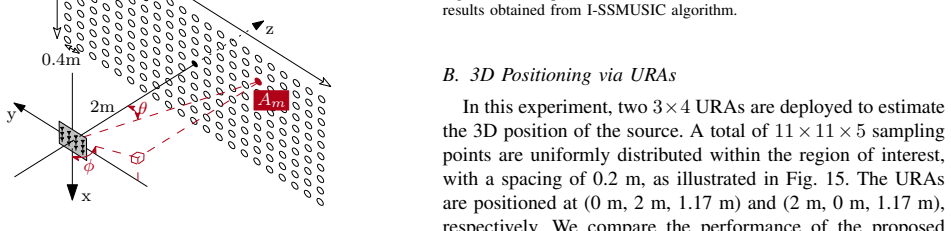
- [§II.B.3 and §IV (Eqs. (3), (25))] The inter-array phase alignment is circular. Eq. (3) defines Δγ(c) as the phase difference caused by the path-length difference between the source at unknown position c and the two URAs, and the text says the CSI of antennas {1,6,20} is used to measure Δγ̂. If Δγ̂ is measured from the target signal, it depends on the very position the DPD algorithm estimates. Applying this scalar to Y_URA2 in Eq. (25) aligns the second array only at the true source position, so the MUSIC pseudo-spectrum is biased toward c and the claimed 15.6 cm DPD result is not an independent validation of a virtual large-scale array. The paper must specify an independent reference source, a wired calibration signal, or another position-independent synchronization mechanism; none is described.
- [§IV (Eq. (25))] The model in Eq. (25) is internally inconsistent. The prose says the received signal matrix is adjusted as Ŷ_URAi = Δγ̂_i · Y_URAi, i.e., a single scalar multiplication, whereas Eq. (25) inserts a per-grid-point diagonal matrix ΔΓ = diag{Δγ_1, ..., Δγ_K} into the dictionary A_URA2 · ΔΓ. These are different operations. If Δγ_k is a geometric phase computed for each candidate grid point, no inter-array measurement is needed and the alignment step is vacuous; if Δγ̂ is a measured scalar, the dictionary correction should be a scalar identity, not a diagonal matrix. The manuscript does not reconcile these formulations, making the DPD algorithm irreproducible as written.
- [§III.D (Eq. (21))] The two RHS inner products in the closest-point system are swapped. The correct least-squares conditions read (c_h − c_i)·d_h in the first component and (c_h − c_i)·d_i in the second once the matrix is written as in Eq. (21); as printed, the first component is (c_h − c_i)·d_i and the second is (c_h − c_i)·d_h. For example, with c_h = (0,0,0), d_h = (1,0,0), c_i = (0,1,0), d_i = (0,1,0), Eq. (21) yields t_h = 1, t_i = 0 instead of t_h = 0, t_i = −1. This error propagates into the GP estimate and the center of the LSoI used by DPD2URA.
minor comments (4)
- [Abstract vs §VI.A] The abstract and introduction state median AoA errors of 1° in elevation and 1.5° in azimuth, while §VI.A reports median errors of 1° in azimuth and 1.5° in elevation; the axis ordering should be corrected for consistency.
- [§II.C] With the stated maximum scan angle θ_L = 60°, Eq. (4) gives d_max ≈ 0.536λ, which is slightly below the chosen spacing d = 0.54λ; the authors should clarify whether θ_L is defined differently or adjust the spacing.
- [Algorithm 1, line 13] The pseudo-spectrum in line 13 is written with a single steering vector a(·), but for the virtual array formed by two URAs the MUSIC search should use the concatenated joint steering vector; the notation should be made explicit.
- [§VI.B, footnote 1] The footnote acknowledging that the comparison with iArk and SWAN may be limited in fairness because their hardware was unavailable should be moved into the main text or reflected directly in the abstract's 'state-of-the-art' claim.
Circularity Check
Inter-array phase alignment in Eq. (3)/(25) makes the DPD virtual-array localization target-defined: the phase used to synchronize the two URAs is measured from the same unknown source whose position the DPD claims to output.
-
self definitional
[Section II.B.3 (Inter-array phase alignment), Eq. (3); Section IV, Eq. (25)]
"Let the positions of the two URAs be denoted by c1 = (x1, y1, z1) and c2 = (x2, y2, z2), respectively. For a signal source located at c = (x, y, z), the phase difference between the signals received by the two URAs can be expressed as △γ(c) = 2π(∥c − c1∥2 − ∥c − c2∥2)/λ. ... The CSI of antennas {1, 6, 20}, highlighted in red, is captured to measure the inter-array phase difference △ˆγ between the two URAs. ... The received signal matrix for URA i is then adjusted as ˆY URAi = △ˆγi · Y URAi. Consequently, the joint received signal model across two URAs can be expressed as ... (25)."
Eq. (3) defines the inter-array phase as a function of the unknown source position c. The paper then says this phase is measured from the CSI of antennas {1, 6, 20} — i.e., from the target itself — and used as the synchronization gain in Eq. (25). No independent reference source, wired calibration tone, or known-position anchor is specified, so △ˆγ is not a fixed hardware constant. Applying a target-dependent phase to align Y_URA2 makes the two array manifolds coherent exactly at the true position c_true, while any other grid point p retains a residual phase error exp(j(△γ(c_true)−△γ(p))). The DPD pseudo-spectrum peak, and hence the reported 15.6 cm virtual-array localization result, is therefore forced by the measured input rather than predicted by the model.
full rationale
The intra-array phase calibration and I-SSMUSIC processing are internally consistent and independent of the DPD claim, and I found no load-bearing self-citation chain. The central inter-array contribution, however, is circular as written: the inter-array synchronization parameter is defined in Eq. (3) through the target position c, and Algorithm 1 feeds the target-derived phase into the joint model of Eq. (25). Because the paper does not state that △ˆγ is obtained from a known reference, the virtual large-scale array is aligned using the very position it is supposed to estimate, making the DPD spectrum peak at the calibration position by construction. That is a definitional reduction of the headline 15.6 cm result, so the paper gets a high circularity score despite its substantial independent intra-array components.
Assumptions & free parameters
free parameters (3)
- LSoI radius R =
0.1 m
- voxel size q =
0.005 m
- default number of DPD iterations =
3
assumptions (5)
- domain assumption Far-field plane-wave condition with equal propagation delay across all array elements during intra-group calibration.
- domain assumption Number of significant indoor multipath components is fewer than five.
- standard math Forward-backward spatial smoothing restores full rank of the source covariance matrix for URA subarrays.
- ad hoc to paper Inter-array phase offset between two URAs can be measured as a constant and applied as a scalar alignment to all grid points.
- domain assumption Phase-calibrated CSI from switched antennas is equivalent to simultaneous multi-channel CSI.
invented entities (1)
-
Virtual large-scale array formed by two inter-array synchronized URAs
Cite this review
Pith. "Pith review of WiCAL: Accurate Wi-Fi-Based 3D Localization Enabled by Collaborative Antenna Arrays." pith.science (2026). https://pith.science/paper/Z67GWIR4
@misc{pith2026250521408,
  author       = {Pith},
  title        = {Pith review of: WiCAL: Accurate Wi-Fi-Based 3D Localization Enabled by Collaborative Antenna Arrays},
  year         = {2026},
  howpublished = {\url{https://pith.science/paper/Z67GWIR4}},
  note         = {Machine review of arXiv:2505.21408}
}
read the original abstract
Accurate 3D localization is essential for realizing advanced sensing functionalities in next-generation Wi-Fi communication systems. This study investigates the potential of multistatic localization in Wi-Fi networks through the deployment of multiple cooperative antenna arrays. The collaborative gain offered by these arrays is twofold: (i) intra-array coherent gain at the wavelength scale among antenna elements, and (ii) inter-array cooperative gain across arrays. To evaluate the feasibility and performance of this approach, we develop WiCAL (Wi-Fi Collaborative Antenna Localization), a system built upon commercial Wi-Fi infrastructure equipped with uniform rectangular arrays. These arrays are driven by multiplexing embedded radio frequency chains available in standard access points or user devices, thereby eliminating the need for sophisticated, costly, and power-hungry multi-transceiver modules typically required in multiple-input and multiple-output systems. To address phase offsets introduced by RF chain multiplexing, we propose a three-stage, fine-grained phase alignment scheme to synchronize signals across antenna elements within each array. A bidirectional spatial smoothing MUSIC algorithm is employed to estimate angles of arrival (AoAs) and mitigate performance degradation caused by correlated interference. To further exploit inter-array cooperative gain, we elaborate on the synchronization mechanism among distributed URAs, which enables direct position determination by bypassing intermediate angle estimation. Once synchronized, the distributed URAs effectively form a virtual large-scale array, significantly enhancing spatial resolution and localization accuracy.
Figures


Figures from the paper (14 more)





Reference graph
Works this paper leans on
-
[1]
Efficient indoor localization via switched- beam antennas,
Y . Zhang and K. Psounis, “Efficient indoor localization via switched- beam antennas,” IEEE. Trans. Mob. Comput. , vol. 19, no. 9, pp. 2101– 2115, Jun. 2019
work page 2019
-
[2]
Positioning using wireless networks: Applications, recent progress, and future challenges,
Y . Yang et al., “Positioning using wireless networks: Applications, recent progress, and future challenges,” IEEE J. Sel. Areas Commun. , vol. 42, no. 9, pp. 2149–2178, Jul. 2024
work page 2024
-
[3]
Inte- grating terrestrial and non-terrestrial networks: 3D opportunities and challenges,
G. Geraci, D. L ´opez-P´erez, M. Benzaghta, and S. Chatzinotas, “Inte- grating terrestrial and non-terrestrial networks: 3D opportunities and challenges,” IEEE Commun. Mag. , vol. 61, no. 4, pp. 42–48, Dec. 2022
work page 2022
-
[4]
Random signal design for joint communication and SAR imaging towards low-altitude economy,
B. Zheng and F. Liu, “Random signal design for joint communication and SAR imaging towards low-altitude economy,”IEEE Wirel. Commun. Lett., vol. 13, no. 10, pp. 2662–2666, Jul. 2024
work page 2024
-
[5]
Deep learning based wireless localiza- tion for indoor navigation,
R. Ayyalasomayajula, A. Arun, C. Wu, S. Sharma, A. R. Sethi, D. Vasisht, and D. Bharadia, “Deep learning based wireless localiza- tion for indoor navigation,” in Proc. Annu. Int. Conf. Mob. Comput. Netw.(MobiCom), Apr. 2020, pp. 1–14
work page 2020
-
[6]
W AIS: Leveraging Wi-Fi for resource-efficient SLAM,
A. Arun, W. Hunter, R. Ayyalasomayajula, and D. Bharadia, “W AIS: Leveraging Wi-Fi for resource-efficient SLAM,” in Proc. Annu. Int. Conf. Mobile Syst. Appl. Service.(MobiSys) , Jun. 2024, pp. 561–574
work page 2024
-
[7]
Real-time bayesian neural networks for 6G cooperative positioning and tracking,
B. C. Tedeschini, G. Kwon, M. Nicoli, and M. Z. Win, “Real-time bayesian neural networks for 6G cooperative positioning and tracking,” IEEE J. Sel. Areas Commun. , vol. 42, no. 9, pp. 2322–2338, Aug. 2024
work page 2024
-
[8]
MIMO integrated sensing and communication exploiting prior information,
C. Xu and S. Zhang, “MIMO integrated sensing and communication exploiting prior information,” IEEE J. Sel. Areas Commun. , vol. 42, no. 9, pp. 2306–2321, Jul. 2024
work page 2024
Show all 45 references
-
[9]
Position tracking for virtual reality using commodity Wi-Fi,
M. Kotaru and S. Katti, “Position tracking for virtual reality using commodity Wi-Fi,” in Proc. IEEE Conf. Comput. Vis. Pattern Recognit. , Jul. 2017, pp. 68–78
2017
-
[10]
Role of sensing and computer vision in 6G wireless communications,
S. Kim et al. , “Role of sensing and computer vision in 6G wireless communications,” IEEE Wirel. Commun. , vol. 31, no. 5, pp. 264–271, Jul. 2024
2024
-
[11]
ArrayTrack: A fine-grained indoor location system,
J. Xiong and K. Jamieson, “ArrayTrack: A fine-grained indoor location system,” in Proc. 10th USENIX Symp. Networked Syst. Des. Implement. (NSDI 13) , Apr. 2013, pp. 71–84
2013
-
[12]
Spectral efficiency of distributed MIMO systems,
D. Wang, J. Wang, X. You, Y . Wang, M. Chen, and X. Hou, “Spectral efficiency of distributed MIMO systems,” IEEE J. Sel. Areas Commun. , vol. 31, no. 10, pp. 2112–2127, Oct. 2013
2013
-
[13]
Phaser: Enabling phased array signal processing on commodity Wi-Fi access points,
J. Gjengset, J. Xiong, G. McPhillips, and K. Jamieson, “Phaser: Enabling phased array signal processing on commodity Wi-Fi access points,” in Proc. Annu. Int. Conf. Mob. Comput. Netw.(MobiCom) , Sep. 2014, pp. 153–164
2014
-
[14]
SW AN: Stitched Wi-Fi antennas,
Y . Xie, Y . Zhang, J. C. Liando, and M. Li, “SW AN: Stitched Wi-Fi antennas,” in Proc. Annu. Int. Conf. Mob. Comput. Netw.(MobiCom) , Oct. 2018, pp. 51–66
2018
-
[15]
Tyrloc: A low-cost multi- technology MIMO localization system with a single RF chain,
Z. Gu, T. He, J. Yin, Y . Xu, and J. Wu, “Tyrloc: A low-cost multi- technology MIMO localization system with a single RF chain,” in Proc. Annu. Int. Conf. Mobile Syst. Appl. Service.(MobiSys) , Jun. 2021, pp. 228–240
2021
-
[16]
General-purpose deep tracking platform across protocols for the internet of things,
Z. An, Q. Lin, P. Li, and L. Yang, “General-purpose deep tracking platform across protocols for the internet of things,” in Proc. Annu. Int. Conf. Mobile Syst. Appl. Service.(MobiSys) , Jun. 2020, pp. 94–106
2020
-
[17]
Spotfi: Decimeter level localization using Wi-Fi,
M. Kotaru, K. Joshi, D. Bharadia, and S. Katti, “Spotfi: Decimeter level localization using Wi-Fi,” in Proc. ACM SIGCOMM , Aug. 2015, pp. 269–282
2015
-
[18]
Multi-BS spatial spectrum fusion for 2-D DOA estimation and localization using UCA in massive MIMO system,
D. He, X. Chen, L. Pei, F. Zhu, L. Jiang, and W. Yu, “Multi-BS spatial spectrum fusion for 2-D DOA estimation and localization using UCA in massive MIMO system,” IEEE Commun. Mag. , vol. 70, pp. 1–13, Oct. 2020
2020
-
[19]
RF-URL: Unsupervised representation learning for RF sensing,
R. Song et al. , “RF-URL: Unsupervised representation learning for RF sensing,” in Proc. Annu. Int. Conf. Mob. Comput. Netw.(MobiCom) , Oct. 2022, pp. 282–295
2022
-
[20]
Multipath triangulation: Decimeter-level Wi-Fi localization and orientation with a single unaided receiver,
E. Soltanaghaei, A. Kalyanaraman, and K. Whitehouse, “Multipath triangulation: Decimeter-level Wi-Fi localization and orientation with a single unaided receiver,” in Proc. Annu. Int. Conf. Mobile Syst. Appl. Service.(MobiSys), Jun. 2018, pp. 376–388
2018
-
[21]
Widar2.0: Passive human tracking with a single Wi-Fi link,
K. Qian, C. Wu, Y . Zhang, G. Zhang, Z. Yang, and Y . Liu, “Widar2.0: Passive human tracking with a single Wi-Fi link,” in Proc. Annu. Int. Conf. Mobile Syst. Appl. Service.(MobiSys) , Jun. 2018, pp. 350–361
2018
-
[22]
Cross-domain Wi-Fi sensing with channel state information: A survey,
C. Chen, G. Zhou, and Y . Lin, “Cross-domain Wi-Fi sensing with channel state information: A survey,” ACM Comput. Surv. , vol. 55, no. 11, pp. 1–37, Feb. 2023
2023
-
[23]
A survey of 3D indoor localization systems and technologies,
A. Sesyuk, S. Ioannou, and M. Raspopoulos, “A survey of 3D indoor localization systems and technologies,” Sensors, vol. 22, no. 23, p. 9380, Dec. 2022
2022
-
[24]
A survey on indoor positioning systems for IoT-based applications,
P. S. Farahsari, A. Farahzadi, J. Rezazadeh, and A. Bagheri, “A survey on indoor positioning systems for IoT-based applications,”IEEE Internet Things J., vol. 9, no. 10, pp. 7680–7699, Feb. 2022
2022
-
[25]
Accurate Wi-Fi based localization for smartphones using peer assistance,
H. Liu, J. Yang, S. Sidhom, Y . Wang, Y . Chen, and F. Ye, “Accurate Wi-Fi based localization for smartphones using peer assistance,” IEEE. Trans. Mob. Comput. , vol. 13, no. 10, pp. 2199–2214, Oct. 2013
2013
-
[26]
Fair beam allocations through reconfigurable intelligent surfaces,
R. Xiong, K. Yin, T. Mi, J. Lu, K. Wan, and R. C. Qiu, “Fair beam allocations through reconfigurable intelligent surfaces,” IEEE J. Sel. Areas Commun., vol. 42, no. 11, pp. 3095–3109, Jul. 2024
2024
-
[27]
Toward reliable localization by unequal AoA tracking,
T.-C. Tai, K. C.-J. Lin, and Y .-C. Tseng, “Toward reliable localization by unequal AoA tracking,” in Proc. Annu. Int. Conf. Mobile Syst. Appl. Service.(MobiSys), Jun. 2019, pp. 444–456
2019
-
[28]
Nerf2: Neural radio-frequency ra- diance fields,
X. Zhao, Z. An, Q. Pan, and L. Yang, “Nerf2: Neural radio-frequency ra- diance fields,” in Proc. Annu. Int. Conf. Mob. Comput. Netw.(MobiCom) , Oct. 2023, pp. 1–15
2023
-
[29]
3D-WiFi: 3D localization with commodityWi- Fi,
L. Zhang and H. Wang, “3D-WiFi: 3D localization with commodityWi- Fi,” IEEE Sensors Journal , vol. 19, no. 13, pp. 5141–5152, Feb. 2019
2019
-
[30]
Enabling phased array signal processing for mobile Wi-Fi devices,
K. Qian, C. Wu, Z. Yang, Z. Zhou, X. Wang, and Y . Liu, “Enabling phased array signal processing for mobile Wi-Fi devices,” IEEE. Trans. Mob. Comput., vol. 17, no. 8, pp. 1820–1833, Nov. 2017
2017
-
[31]
WiTraj: Robust indoor motion tracking with Wi-Fi signals,
D. Wu et al. , “WiTraj: Robust indoor motion tracking with Wi-Fi signals,” IEEE. Trans. Mob. Comput. , vol. 22, no. 5, pp. 3062–3078, Dec. 2021
2021
-
[32]
Stoica et al
P. Stoica et al. , Spectral analysis of signals . Pearson Prentice Hall Upper Saddle River, NJ, 2005
2005
-
[33]
Distributed phased arrays: Challenges and recent advances,
J. A. Nanzer, S. R. Mghabghab, S. M. Ellison, and A. Schlegel, “Distributed phased arrays: Challenges and recent advances,” IEEE Trans. Microw. Theory Tech., vol. 69, no. 11, pp. 4893–4907, Jul. 2021
2021
-
[34]
Multiple Wi-Fi access points co-localization through joint AoA estimation,
S. Yang, D. Zhang, R. Song, P. Yin, and Y . Chen, “Multiple Wi-Fi access points co-localization through joint AoA estimation,” IEEE. Trans. Mob. Comput., vol. 23, no. 2, pp. 1488–1502, Jan. 2023
2023
-
[35]
L. V . Blake and M. W. Long, Antennas: Fundamentals, design, mea- surement. SciTech Publishing, Raleigh, 2009
2009
-
[36]
W. L. Stutzman and G. A. Thiele, Antenna theory and design . John Wiley & Sons, 2012
2012
-
[37]
H. L. Van Trees, Optimum array processing: Part IV of detection, estimation, and modulation theory . John Wiley & Sons, 2002
2002
-
[38]
High resolution direct position determination of radio frequency sources,
T. Tirer and A. J. Weiss, “High resolution direct position determination of radio frequency sources,” IEEE Signal Process. Lett. , vol. 23, no. 2, pp. 192–196, Nov. 2015
2015
-
[39]
A computationally effi- cient direct position determination algorithm based on OFDM system,
Z. Wang, K. Hao, Y . Sun, L. Xie, and Q. Wan, “A computationally effi- cient direct position determination algorithm based on OFDM system,” IEEE Commun. Lett. , vol. 27, no. 3, pp. 841–845, Dec. 2022
2022
-
[40]
Tool release: Gath- ering 802.11n traces with channel state information,
D. Halperin, W. Hu, A. Sheth, and D. Wetherall, “Tool release: Gath- ering 802.11n traces with channel state information,” ACM SIGCOMM Comput. Commun. Rev. , vol. 41, no. 1, p. 53, Jan. 2011
2011
-
[41]
On spatial smoothing for direction- of-arrival estimation of coherent signals,
T.-J. Shan, M. Wax, and T. Kailath, “On spatial smoothing for direction- of-arrival estimation of coherent signals,” IEEE Trans. Acoust. Speech Signal Process., vol. 33, no. 4, pp. 806–811, Aug. 1985
1985
-
[42]
SPICE: A sparse covariance-based estimation method for array processing,
P. Stoica, P. Babu, and J. Li, “SPICE: A sparse covariance-based estimation method for array processing,” IEEE Trans. Signal Process. , vol. 59, no. 2, pp. 629–638, Nov. 2010
2010
-
[43]
RIScan: RIS-aided multi-user indoor localization using cots Wi-Fi,
C. Li et al., “RIScan: RIS-aided multi-user indoor localization using cots Wi-Fi,” in Proc. ACM SenSys , Apr. 2023, pp. 445–458
2023
-
[44]
RAPID: Retrofitting IEEE 802.11ay access points for indoor human detection and sensing,
J. Pegoraro, J. O. Lacruz, F. Meneghello, E. Bashirov, M. Rossi, and J. Widmer, “RAPID: Retrofitting IEEE 802.11ay access points for indoor human detection and sensing,” IEEE. Trans. Mob. Comput. , vol. 23, no. 5, pp. 4501–4519, Jul. 2023. Fuhai Wang (Graduate Student Member, ...
2023
-
[2012]
He has authored over 100 journal articles/book chapters and 120 conference papers
and Cognitive Networked Sensing: A Big Data Way (Springer, 2013) and authored Big Data and Smart Grid (John Wiley, 2015). He has authored over 100 journal articles/book chapters and 120 conference papers. He was a Guest Book Editor of Ultra-Wideband (UWB) Wireless Communicatio...
2013
Reviewed August 7, 2026 · model on record in the stance chip above.
Discussion (0). Sign in to comment.