REVIEW 4 major objections 5 minor 33 references
Visual Product Graph: Bridging Visual Products And Composite Images For End-to-End Style Recommendations
T0 review · 4 major / 5 minor · reviewed 2026-08-07 · deepseek-v4-flash
Pith's one-line read A production system connects product photos to styled scenes and back to shoppable items.
desk verdict Solid deployed-systems paper whose headline relevance number is mislabeled in the abstract; Table 1 contradicts the abstract by more than a factor of two. read the letter →
The pith
A machine-rendered reading of the paper's core claim, the machinery that carries it, and where it could break.
The reading
What carries the argument
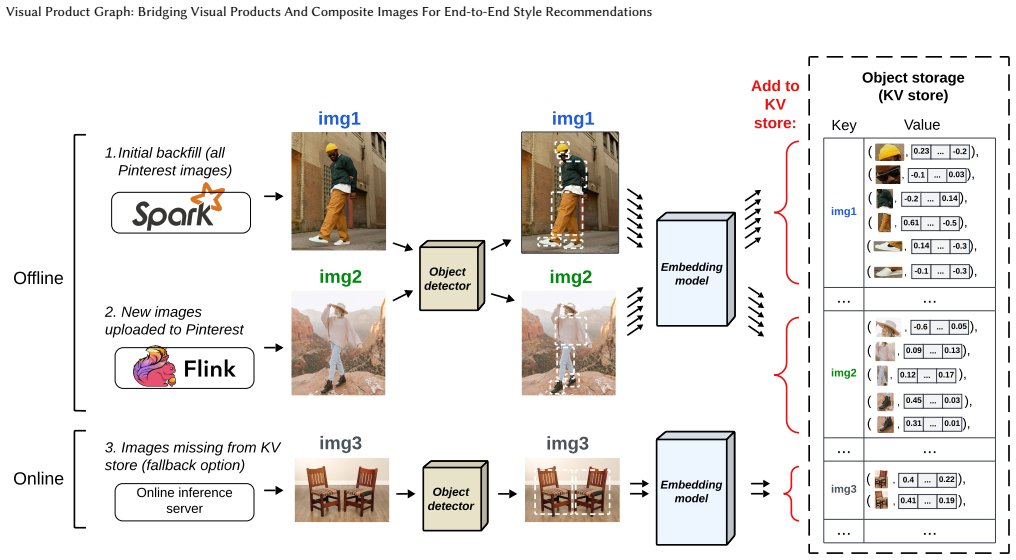
The load-bearing object is the Visual Product Graph itself: a distributed key-value store holding, for each image, a list of detected objects with their coordinates, categories, and unified embeddings, plus an offline object index that maps each detected object back to its original composite image. The 'unified visual embedding' is a single neural embedding that maps both full product images and object crops into a common vector space. Retrieval in the Reverse-STL direction relies on the assumption that the Euclidean distance between the embedding of a full query product image and the embedding of an object crop in a scene indicates whether the scene contains the same or a visually equivalent product; the hard-triplet training (built from engagement logs) and the index filters are designed to make that distance reliable. The Forward-STL direction then runs the existing Shop The Look pipeline per detected object, with a round-robin selection of top products across objects.
What would settle it
Take a set of product images, run the Reverse-STL retrieval, and have human raters label whether the exact query product appears in each retrieved scene (not merely a similar item). If the exact-match precision at rank 1 is substantially below the 'extremely similar' rating (around 32% for fashion), then embedding distance does not reliably signal scene containment, and the system's core assumption is falsified.
Extended reading notes
Core claim
The central discovery is that a single graph over products, detected objects, and composite scenes can support both product-to-scene and scene-to-product retrieval, and that this bidirectional structure enables a new kind of style recommendation: instead of showing users a list of standalone complementary items, the system shows the query product worn or placed in a full scene, then identifies the other objects in that scene as shoppable complements. The paper's claim is that this works because a unified visual embedding model, trained with hard triplets and scaled to 1B parameters, makes Euclidean distances between a full product image and a detected object crop indicate visual equivalence well enough for retrieval, while an upgraded YOLOv8 detector (with a target-collected training dataset and class-agnostic NMS) provides accurate object localization and index coverage. The authors present the system's production deployment and its retrieval quality, which they report as comparable to the established Shop The Look pathway, as evidence that the loop is practical and that the 'social proof' of real contexts improves user engagement.
Load-bearing premise
The entire system depends on the idea that when the embedding of a full product photo is close to the embedding of an object found inside a scene image, the scene actually contains that same product or a visually equivalent one; the paper never measures this product-to-scene match accuracy on its own.
Editorial extensions
If this is right
- Users on a product page can immediately see that product styled in real-world outfits or room settings, which gives contextual and social proof before purchase.
- The same scene retrieval supplies complementary recommendations without a separate 'complete the look' model: the other objects in the scene are the complements, so recommendations are visually cohesive by construction.
- The system supports both directions, so a scene-to-product visual search (the traditional direction) is also available; the Reverse-STL direction is the new capability that closes the loop.
- The infrastructure upgrades are reusable: the KV-store and ANN index make embedding-based retrieval fast enough for production (P99 latency reduced 20.5x, model serving cost 8x lower).
- The evaluation framework (human relevance ratings for both directions, plus module engagement) can serve as a template for other bidirectional product-scene shopping systems.
Reading between the lines
- The 78.8% figure cited in the abstract as 'extremely similar@1' is actually the 'similar@1' rate from Table 1; the extremely-similar rate is 31.8% for fashion. Readers should accordingly interpret the end-to-end quality as 'highly similar but not identical.'
- The system's reliance on a single unified embedding for both full product images and detected object crops means the Reverse-STL quality rests on the embedding's invariance to background and scale; a direct product-to-scene containment metric would isolate this and is not reported.
- The filters that build the inspirational corpus (full outfit, shoppable categories, at least three categories per image) are tuned to fashion and home decor; extending the graph to other product domains would require redefining 'inspirational' and may not transfer directly.
- The hard-triplet training set is constructed from engagement logs where a more-clicked candidate is treated as the positive; this ties the embedding to popularity signals, so a future comparison against human-labeled hard negatives could reveal whether engagement bias affects relevance.
Editorial analysis
A structured set of objections, weighed in public.
Referee Report
Summary. The paper describes Pinterest's Visual Product Graph (VPG), a bidirectional retrieval system that maps individual product images to composite 'inspirational' scene images (Reverse-STL) and back from scene images to shoppable complementary products (Forward-STL). The authors present the underlying infrastructure (an online KV store for objects and embeddings, an offline object index, and an HNSW-based serving pipeline), and two model-improvement efforts: a YOLOv8-based object detector trained on an augmented, target-collected dataset, and a scaled-up unified visual embedding (1B-parameter transformer) fine-tuned with hard triplets and switched to float representations. Evaluations include human relevance studies for both pathways, offline retrieval/detection metrics, and production engagement statistics. The abstract claims a 78.8% 'extremely similar@1' result in end-to-end human relevance evaluations and a 6% module engagement rate. The paper is a systems-oriented contribution from an industrial lab, and the VPG feature is deployed in Pinterest's 'Ways to Style It' module.
Significance. If the results hold, VPG is a notable industrial-scale demonstration of reverse product-to-scene retrieval, a direction that the paper correctly identifies as less explored than scene-to-product lookup. The strengths of the manuscript are its real production deployment, the detailed description of large-scale infrastructure (billion-scale KV store, online/offline indexing, near-real-time updates), and the clear ablation tables showing the incremental contribution of the detection dataset, architecture change, pretraining scale, triplet training, and embedding representation. The paper is honest about one major limitation in Section 7, namely the absence of quantitative comparison with competing complementary-product recommendation methods. However, the headline quantitative claim is misreported (the abstract's 78.8% is 'similar@1', not 'extremely similar@1'), and key aspects of the product-to-scene evaluation protocol are underspecified. These issues are load-bearing for the paper's central claims and need to be addressed before the manuscript can be recommended for publication.
major comments (4)
- [Abstract; Section 4, Table 1] The abstract states 'Our system achieves a 78.8% extremely similar@1 in end-to-end human relevance evaluations,' but Table 1 in Section 4 reports Fashion Extremely Similar@1 = 31.8% and Similar@1 = 78.8% (Home Decor: 18.7% and 61.1%). Since Section 4 defines 'extremely similar' as 'almost exactly the same' and 'similar' as 'not exactly the same, but a very good substitute,' the abstract's number corresponds to the relaxed metric for the best-performing domain, not the strict metric that is claimed. This is a factual inconsistency in the paper's principal headline result and must be corrected (e.g., by stating 'similar@1' and citing Table 1, or by reporting the actual 'extremely similar@1' values).
- [Section 4 (End-to-End Evaluation); Section 6.2] The evaluation protocol for the product-to-inspiration pathway is underspecified. The text states that 'for each product, the system retrieves a scene image that may include the product object, subsequently verified by human raters to confirm the presence of the query product in the scene image,' but it does not state whether the reported 'Extremely Similar@1' rating applies to the detected object within the scene, to the entire composite image, or only to images that already passed the presence-confirmation step. The paper also never reports a standalone product-to-scene match accuracy: the reader cannot tell how often a retrieved scene actually contains a visually equivalent product, as opposed to the end-to-end relevance judgment. Please clarify the annotation instructions and provide separate match/recall numbers for the Reverse-STL link.
- [Section 7] Complementary product recommendation is one of the three contributions claimed in the Abstract and Section 1, but Section 7 explicitly states that 'comparing its quality quantitatively with state-of-the-art complementary product recommendations is challenging' and offers only qualitative examples (Figure 7). Without any quantitative comparison against an existing method (e.g., the triplet-based approach of [11] or a visual-compatibility baseline), the claimed advantage for this component is unsupported. A small human evaluation or offline pairwise comparison would be needed to substantiate the claimed improvement.
- [Section 4 (Module engagement rate); Section 5.2] The paper reports a '6% module engagement rate' (Abstract and Section 4) and states in Section 5.2 that the detection improvements 'boosted our user engagements in STL by more than 20%.' Neither claim is accompanied by A/B test configuration, sample sizes, confidence intervals, or significance tests. As these numbers are used as evidence of real-world impact, the authors should either provide the statistical context or clearly label the numbers as directional internal measurements that cannot be independently verified from the paper.
minor comments (5)
- [Table 2 caption] The caption reads 'Visual Shopping end-to-end retrieval performance using the latest object detection model,' but the table reports detection metrics (mAP, R@P90, inference speed), not end-to-end retrieval performance; please correct the caption to describe detection evaluation.
- [Section 4] The definition of rating level (3) contains the typo 'commalities'; it should be 'commonalities.'
- [Appendix A.1, Algorithm 1] The comment 'Human label the triplet as match or no match' and the variable name 'potential positve' contain typos; please revise them.
- [Abstract; Table 1] The header '78.8%' in the abstract should specify that this is the fashion-domain Similar@1 number; Home Decor Similar@1 is substantially lower (61.1%), and the extremely-similar numbers are below 32% in both domains.
- [Section 5.2] The sentence 'These combined improvements boosted our user engagements in STL by more than 20%' lacks a pointer to any table or appendix supporting this claim; please add the supporting data or clearly label it as an unpublished internal result.
Circularity Check
No equation-level circularity; the abstract's metric misstatement is a correctness issue, not a circular reduction.
full rationale
VPG is an empirical systems paper: the central quantitative claims are measured outcomes (human relevance ratings, engagement rate, offline mAP/R@P90), not quantities derived from the paper's own assumptions. The embedding is trained on hard triplets generated from STL logs with binary human match labels; the advertised end-to-end Extremely Similar@1 is computed by a separate human rating protocol on 5,000 popular products, so the metric is not the training objective by construction. The paper's use of prior work is as an engineering baseline: [26] supplies the STL path and rating criteria, [2] supplies the 250M-parameter embedding baseline, and [11] is the qualitative comparator. None of these citations is invoked as an unverified uniqueness or derivation premise; each is an independent published system or evaluation convention. The abstract's '78.8% extremely similar@1' conflicts with Table 1's '31.8% Extremely Similar@1' (with 78.8% belonging to Similar@1); this is a factual misstatement that materially overstates the headline result, but it is a correctness/QA issue, not a circular reduction. The qualitative-only comparison to Complete the Look in Section 7 is a stated limitation, not a circular step. No equation-level, definitional, or fitted-parameter circularity was found.
Assumptions & free parameters
free parameters (5)
- Reverse-STL relevance threshold =
75th percentile of top-5 candidate score distribution
- Minimum object area =
1% of full image
- Minimum number of unique shoppable categories =
3
- Number of objects used per scene in Forward-STL =
4
- Top-k serving limits =
top 5 scenes, top 3 products
assumptions (4)
- domain assumption Euclidean distance between full product image embeddings and detected object crop embeddings reflects visual similarity.
- domain assumption Human relevance ratings using Pinterest's STL criteria are a reliable ground truth for product-to-scene retrieval quality.
- domain assumption The target-collected detection dataset and hard-triplet dataset are representative and label-correct.
- domain assumption RocksDB-based KV store and Manas ANN infrastructure provide correct and consistent lookup at the stated scale.
Cite this review
Pith. "Pith review of Visual Product Graph: Bridging Visual Products And Composite Images For End-to-End Style Recommendations." pith.science (2026). https://pith.science/paper/TIXZC7IB
@misc{pith2026250521454,
  author       = {Pith},
  title        = {Pith review of: Visual Product Graph: Bridging Visual Products And Composite Images For End-to-End Style Recommendations},
  year         = {2026},
  howpublished = {\url{https://pith.science/paper/TIXZC7IB}},
  note         = {Machine review of arXiv:2505.21454}
}
read the original abstract
Retrieving semantically similar but visually distinct contents has been a critical capability in visual search systems. In this work, we aim to tackle this problem with Visual Product Graph (VPG), leveraging high-performance infrastructure for storage and state-of-the-art computer vision models for image understanding. VPG is built to be an online real-time retrieval system that enables navigation from individual products to composite scenes containing those products, along with complementary recommendations. Our system not only offers contextual insights by showcasing how products can be styled in a context, but also provides recommendations for complementary products drawn from these inspirations. We discuss the essential components for building the Visual Product Graph, along with the core computer vision model improvements across object detection, foundational visual embeddings, and other visual signals. Our system achieves a 78.8% extremely similar@1 in end-to-end human relevance evaluations, and a 6% module engagement rate. The "Ways to Style It" module, powered by the Visual Product Graph technology, is deployed in production at Pinterest.
Figures


Figures from the paper (6 more)


Reference graph
Works this paper leans on
-
[11]
Eileen Li, Eric Kim, Andrew Zhai, Josh Beal, and Kunlong Gu. 2020. Bootstrap- ping Complete The Look at Pinterest. In Proceedings of the 26th ACM SIGKDD International Conference on Knowledge Discovery and Data Mining (KDD ’20) . ACM. https://doi.org/10.1145/3394486.3403382
arXiv 2020
-
[1]
Paul Baltescu, Haoyu Chen, Nikil Pancha, Andrew Zhai, Jure Leskovec, and Charles Rosenberg. 2022. Itemsage: Learning product embeddings for shopping recommendations at pinterest. InProceedings of the 28th ACM SIGKDD Conference on Knowledge Discovery and Data Mining . 2703–2711
work page 2022
-
[2]
Josh Beal, Hao-Yu Wu, Dong Huk Park, Andrew Zhai, and Dmitry Kislyuk
-
[3]
Nicolas Carion, Francisco Massa, Gabriel Synnaeve, Nicolas Usunier, Alexan- der Kirillov, and Sergey Zagoruyko. 2020. End-to-End Object Detection with Transformers. arXiv:2005.12872 [cs.CV] https://arxiv.org/abs/2005.12872
arXiv 2020
-
[4]
Tri Dao, Dan Fu, Stefano Ermon, Atri Rudra, and Christopher Ré. 2022. Flashat- tention: Fast and memory-efficient exact attention with io-awareness. Advances in Neural Information Processing Systems 35 (2022), 16344–16359
2022
-
[5]
Alexey Dosovitskiy. 2020. An image is worth 16x16 words: Transformers for image recognition at scale. arXiv preprint arXiv:2010.11929 (2020)
arXiv 2020
-
[6]
Andrey Gusev and Jiajing Xu. 2020. Evolution of a Web-Scale Near Duplicate Image Detection System. In Proceedings of The Web Conference 2020 (WWW ’20) . ACM, 2733–2739. https://doi.org/10.1145/3366423.3380031
arXiv 2020
-
[7]
Geoffrey E Hinton and Ruslan R Salakhutdinov. 2006. Reducing the dimension- ality of data with neural networks. science 313, 5786 (2006), 504–507
2006
Show all 33 references
-
[8]
Elad Hoffer and Nir Ailon. 2015. Deep metric learning using triplet network. In Similarity-based pattern recognition: third international workshop, SIMBAD 2015, Copenhagen, Denmark, October 12-14, 2015. Proceedings 3 . Springer, 84–92
2015
-
[9]
Alex Krizhevsky, Ilya Sutskever, and Geoffrey E Hinton. 2017. ImageNet classifi- cation with deep convolutional neural networks. Commun. ACM 60, 6 (2017), Visual Product Graph: Bridging Visual Products And Composite Images For End-to-End Style Recommendations 84–90
2017
-
[10]
Yann LeCun, Léon Bottou, Yoshua Bengio, and Patrick Haffner. 1998. Gradient- based learning applied to document recognition. Proc. IEEE 86, 11 (1998), 2278– 2324
1998
-
[12]
Sen Li, Fuyu Lv, Taiwei Jin, Guli Lin, Keping Yang, Xiaoyi Zeng, Xiao-Ming Wu, and Qianli Ma. 2021. Embedding-based product retrieval in taobao search. In Proceedings of the 27th ACM SIGKDD Conference on Knowledge Discovery and Data Mining. 3181–3189
2021
-
[13]
Girshick, Kaiming He, Bharath Hariharan, and Serge J
Tsung-Yi Lin, Piotr Dollár, Ross B. Girshick, Kaiming He, Bharath Hariharan, and Serge J. Belongie. 2016. Feature Pyramid Networks for Object Detection. CoRR abs/1612.03144 (2016). arXiv:1612.03144 http://arxiv.org/abs/1612.03144
2016 arXiv
-
[14]
Hantian Liu. 2020. The Visual Complements Model (ViCs): Complementary Prod- uct Recommendations From Visual Cues. https://www.aboutwayfair.com/tech- innovation/the-visual-complements-model-vics-complementary-product- recommendations-from-visual-cues
2020
-
[15]
Zheng Liu. 2017. Manas: A high performing customized search sys- tem. https://medium.com/pinterest-engineering/manas-a-high-performing- customized-search-system-cf189f6ca40f
2017
-
[16]
David G Lowe. 2004. Distinctive image features from scale-invariant keypoints. International journal of computer vision 60 (2004), 91–110
2004
-
[17]
Alessandro Magnani, Feng Liu, Suthee Chaidaroon, Sachin Yadav, Praveen Reddy Suram, Ajit Puthenputhussery, Sijie Chen, Min Xie, Anirudh Kashi, Tony Lee, et al. 2022. Semantic retrieval at walmart. In Proceedings of the 28th ACM SIGKDD Conference on Knowledge Discovery and Data...
2022
-
[18]
Dhruv Mahajan, Ross Girshick, Vignesh Ramanathan, Kaiming He, Manohar Paluri, Yixuan Li, Ashwin Bharambe, and Laurens Van Der Maaten. 2018. Explor- ing the limits of weakly supervised pretraining. In Proceedings of the European conference on computer vision (ECCV) . 181–196
2018
-
[19]
Yu. A. Malkov and D. A. Yashunin. 2018. Efficient and robust approximate nearest neighbor search using Hierarchical Navigable Small World graphs. arXiv:1603.09320 [cs.DS] https://arxiv.org/abs/1603.09320
2018 arXiv
-
[20]
Priyanka Nigam, Yiwei Song, Vijai Mohan, Vihan Lakshman, Weitian Ding, Ankit Shingavi, Choon Hui Teo, Hao Gu, and Bing Yin. 2019. Semantic product search. In Proceedings of the 25th ACM SIGKDD International Conference on Knowledge Discovery and Data Mining . 2876–2885
2019
-
[21]
Rajath Prasad. 2024. Building Pinterest’s new wide column database using RocksDB. https://medium.com/pinterest-engineering/building-pinterests-new- wide-column-database-using-rocksdb-f5277ee4e3d2
2024
-
[22]
Samyam Rajbhandari, Jeff Rasley, Olatunji Ruwase, and Yuxiong He. 2020. Zero: Memory optimizations toward training trillion parameter models. In SC20: Inter- national Conference for High Performance Computing, Networking, Storage and Analysis. IEEE, 1–16
2020
-
[23]
Joseph Redmon, Santosh Divvala, Ross Girshick, and Ali Farhadi. 2016. You Only Look Once: Unified, Real-Time Object Detection. arXiv:1506.02640 [cs.CV] https://arxiv.org/abs/1506.02640
2016 arXiv
-
[24]
Girshick, and Jian Sun
Shaoqing Ren, Kaiming He, Ross B. Girshick, and Jian Sun. 2015. Faster R-CNN: Towards Real-Time Object Detection with Region Proposal Networks. CoRR abs/1506.01497 (2015). arXiv:1506.01497 http://arxiv.org/abs/1506.01497
2015 arXiv
-
[25]
Matthew Schultz and Thorsten Joachims. 2003. Learning a distance metric from relative comparisons. Advances in neural information processing systems 16 (2003)
2003
-
[26]
Raymond Shiau, Hao-Yu Wu, Eric Kim, Yue Li Du, Anqi Guo, Zhiyuan Zhang, Eileen Li, Kunlong Gu, Charles Rosenberg, and Andrew Zhai. 2020. Shop The Look: Building a Large Scale Visual Shopping System at Pinterest. In Proceedings of the 26th ACM SIGKDD International Conference on...
2020 doi
-
[27]
Andreas Veit, Balazs Kovacs, Sean Bell, Julian McAuley, Kavita Bala, and Serge Belongie. 2015. Learning Visual Clothing Style with Heterogeneous Dyadic Co-occurrences. arXiv:1509.07473 [cs.CV] https://arxiv.org/abs/1509.07473
2015 arXiv
-
[28]
Saining Xie, Ross Girshick, Piotr Dollár, Zhuowen Tu, and Kaiming He. 2017. Aggregated residual transformations for deep neural networks. In Proceedings of the IEEE conference on computer vision and pattern recognition . 1492–1500
2017
-
[29]
Andrew Zhai, Hao-Yu Wu, Eric Tzeng, Dong Huk Park, and Charles Rosenberg
-
[30]
Xiaohua Zhai, Alexander Kolesnikov, Neil Houlsby, and Lucas Beyer. 2022. Scal- ing vision transformers. In Proceedings of the IEEE/CVF conference on computer vision and pattern recognition . 12104–12113
2022
-
[31]
match” and match (negative) = “no match
Yu Liu Zhuofan Zong, Guanglu Song. 2023. DETRs with Collaborative Hybrid Assignments Training. ICCV (2023). https://arxiv.org/pdf/2211.12860 A APPENDIX A.1 Hard triplets dataset generation Algorithm 1 Hard triplets dataset generation Require: stl_log_data from the last 30 days...
2023 arXiv
-
[2019]
In Proceedings of the 25th ACM SIGKDD International Conference on Knowledge Discovery and Data Mining
Learning a unified embedding for visual search at pinterest. In Proceedings of the 25th ACM SIGKDD International Conference on Knowledge Discovery and Data Mining. 2412–2420
-
[2021]
arXiv:2108.05887 [cs.CV] https://arxiv.org/abs/2108.05887
Billion-Scale Pretraining with Vision Transformers for Multi-Task Visual Representations. arXiv:2108.05887 [cs.CV] https://arxiv.org/abs/2108.05887
Reviewed August 7, 2026 · model on record in the stance chip above.
Discussion (0). Sign in to comment.