REVIEW 4 major objections 6 minor 36 references
Do LLMs Need to Think in One Language? Correlation between Latent Language and Task Performance
T0 review · 4 major / 6 minor · reviewed 2026-08-07 · deepseek-v4-flash
Pith's one-line read The paper claims that consistent latent language is not required for LLM task performance, because models adapt their internal representations in the final layers to the target language.
desk verdict Honest negative result undermined by an ill-defined metric: the LLC Score in Eq. (1) mishandles exactly the consistent-language case it is meant to measure. read the letter →
The pith
A machine-rendered reading of the paper's core claim, the machinery that carries it, and where it could break.
The reading
What carries the argument
The central object is the Latent Language Consistency (LLC) Score. For each candidate language in a small set (English, Japanese, Chinese), it averages the KL divergence between adjacent transformer layers, weighted by the model's probability of using that language, but only at transitions where the most probable language moves away from the candidate; the final LLC Score is the minimum over candidate languages. LogitLens is used to read out per-layer token probabilities, and an automatic language detector labels the resulting tokens. The score is meant to quantify how stably the model internally stays in one language, and the paper's evidence consists of correlations between this score and accuracy on the constructed datasets under varying ratios of adversarial prompts.
What would settle it
Ask a model to verbalize its reasoning in each candidate language while running the LLC measurement on the same inputs; if the LogitLens-detected latent language and the verbalized reasoning language disagree on many items, the score is not measuring thinking in one language.
Extended reading notes
Core claim
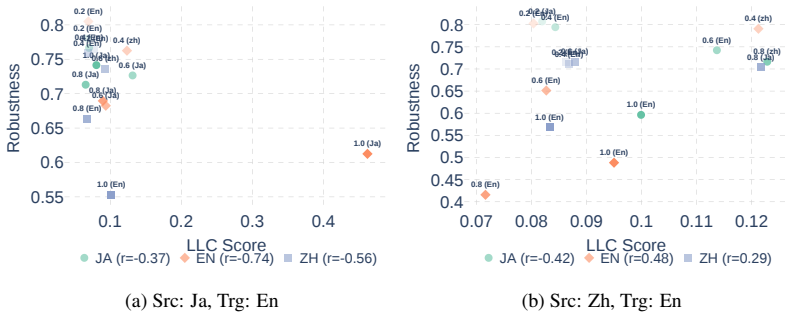
The paper's central finding is that the hypothesis 'thinking in a consistent latent language improves downstream accuracy' fails in controlled tests across three multilingual models (Gemma3, Qwen2.5, and LLM-jp-3) on translation and geo-culture cloze tasks. LLC Score and accuracy do not move in lockstep: some conditions show the expected negative correlation (for instance, one LLM-jp-3 English-to-Chinese translation condition gives $r = -1.0$), while other conditions show positive correlations (for instance, a Gemma3 geo-culture condition gives $r = 0.98$), and many conditions show near-zero correlation. The paper interprets this as evidence that models can keep a stable latent language and still lose accuracy, or lose consistency without losing accuracy, because the final layers adapt representations to the target language. The stated conclusion is that maintaining consistency in latent language is not always necessary for optimal downstream task performance, and that translation-like tasks requiring precise linguistic alignment are especially sensitive to adversarial language mismatch.
Load-bearing premise
The load-bearing premise is that the LLC Score actually measures whether the model is thinking in one language, which requires that the tokens read out layer-by-layer and automatically labeled by language reflect the language used for reasoning rather than just the most likely surface word.
Editorial extensions
If this is right
- Latent-language consistency, as measured by LLC Score, should not be treated as a proxy for accuracy in multilingual LLM evaluation, since the sign of the correlation varies across models and tasks.
- Translation quality degrades most when adversarial prompts come from a language different from the source or target language, so input-language alignment matters even when the latent language stays stable.
- Models that keep a stable latent language despite mixed-language inputs can still lose accuracy, which points to final-layer representation adaptation as the main compensatory mechanism.
- The constructed cloze-style datasets (2,000 items per language and task) provide a reusable protocol for measuring how internal language consistency and adversarial language mixture interact.
Reading between the lines
- Editorial inference: If final-layer adaptation is the real mechanism, then truncating the network before those final layers (early exiting) should reveal the consistency effect that the full model hides; that is a direct test the paper does not run.
- Editorial inference: The LLC Score may actually measure representational stability in token identity rather than the language of reasoning; applying it to tasks where reasoning is verbalized (chain-of-thought in different languages) would separate these two interpretations.
- Editorial inference: The same ratio-sweep design could be applied to monolingual adversarial noise, such as scrambled text or inserted unrelated sentences, to test whether the observed effect is language-specific or a general robustness phenomenon.
Editorial analysis
A structured set of objections, weighed in public.
Referee Report
Summary. The paper investigates whether consistency of an LLM's internal 'latent language' across layers correlates with downstream task accuracy. The authors introduce a Latent Language Consistency Score (LLC Score) computed from LogitLens token probabilities and langid.py language identifications, inject adversarial multilingual prompts at varying ratios, and measure robustness (accuracy) on GPT-4o-generated cloze-style translation and geo-culture datasets for three small multilingual models (LLM-jp-3, Qwen2.5, Gemma3). The reported correlations between LLC Score and robustness are inconsistent in sign across models and conditions, leading the authors to conclude that maintaining a consistent latent language is not always necessary for optimal task performance.
Significance. If the central claim were supported, the paper would offer a useful negative result about latent-language consistency as a predictor of robustness, and the proposed LLC Score could serve as a diagnostic tool for multilingual LLMs. The dataset-construction pipeline with Self-BLEU diversity checks and the systematic variation of adversarial-prompt ratios are reasonable first steps. However, the significance is substantially weakened by the lack of external validation of the LLC Score, the use of a model-generated benchmark, and the absence of statistical testing; the contribution is therefore conditional on a corrected and re-analyzed metric.
major comments (4)
- [Sec. 3.2, Eq. (1)-(2)] The indicator function in Eq. (1) is 1(v*_{l+1} != v) with no condition that v*_l = v, so the score for a language v accumulates KL-weighted mass from transitions in which v is not the current layer's dominant language; the prose in Sec. 3.2 defines a disruption as a switch from v at layer l to a different language at l+1. Additionally, if the model uses the same language v at every analyzed layer, both numerator and denominator of Score(v) are zero, leaving 0/0 undefined with no stated convention. Since the LLC Score is the minimum over v of Score(v), the reported correlations in Tables 2, 6-8 and Figures 2-5 are computed from a quantity that is either mis-specified or undefined in exactly the regime of interest (perfectly consistent latent language). The headline conclusion is therefore not supported by the numbers as written; the metric must be redefined and the analysis recomputed.
- [Sec. 5-6, Tables 2, 6-8] The correlations r are computed from only five points (adversarial ratios 0.2, 0.4, 0.6, 0.8, 1.0) with no significance tests, confidence intervals, or error bars; the checklist (item 7) explicitly answers 'No' to statistical significance. Several rows of Table 2 have constant robustness (e.g., Qwen2.5 with accuracy 0.00 across all ratios) and yet report r = 0.21 or 0.83, which are meaningless for a constant dependent variable. The sign of r is inconsistent across near-identical conditions (e.g., Table 2: r = -0.97 vs r = +0.90 for Gemma3 geo-culture with question in Japanese and adversarial Ja), so the qualitative conclusion that 'consistency is not always necessary' rests on noise-level differences. The authors should report scatter plots with all points, compute a proper test (e.g., Spearman with p-values or bootstrap CIs), and state how undefined r values are treated.
- [Appendix A] Appendix A states that the LLC Score was selected because it showed the strongest correlation with other potential methods (e.g., averaging KL scores). This selection of the metric based on its correlation with alternatives, in a study whose central claim is about the correlation between this metric and task performance, is a form of circularity: the metric is not independently validated as a measure of 'thinking in one language.' To support the construct validity of the LLC Score, the paper should provide an external check (e.g., agreement with human-annotated or dictionary-based language labels of LogitLens tokens, or a controlled setting where the latent language is known by construction) before using the score to draw conclusions about latent-language consistency.
- [Sec. 3.1 / Sec. 4] The pipeline relies on langid.py classifying individual tokens extracted by LogitLens, but single-token language identification is known to be noisy, and the paper does not report accuracy of langid on the actual token distribution (e.g., tokens like 'Washington' or 'Kishida' may be classified inconsistently). In addition, the evaluation datasets are generated and filtered by GPT-4o (Sec. 4.1-4.2), so the robustness numbers are measured on a model-generated benchmark rather than an external one; the conclusions should be scoped accordingly. Without a validation of the token-level language labels or a human-checked dataset, the measured LLC Score may reflect token-level classification artifacts rather than the model's internal reasoning language.
minor comments (6)
- [Author list] The author name 'Hirki Ouchi' appears to be a typo for 'Hiroki Ouchi'; please correct it.
- [Appendix B heading] 'Appnendix' should read 'Appendix', and 'Mathmetical Approach' in B.2 should read 'Mathematical Approach'.
- [Figure 5 caption] The caption contains 'Chinse' instead of 'Chinese'; also, 'Figure 5' is referenced as 'Figures 3 and 5' in Section 6, which is inconsistent because Figure 5 is not described in the main text.
- [Tables 2, 6-8] The notation 'N.A.' in correlation columns is not defined; the paper should state whether these rows were excluded from the analysis or treated as undefined, and why.
- [Sec. 7.4, Figure 6] The claim that 'inserting adversarial prompts reduces model confidence' is based on a visual comparison of two scatter plots; the paper should report a quantitative summary (e.g., mean/median shift in output probability or KL divergence) to support this claim.
- [Sec. 5.2] The exclusion of {Ja}-{Zh} and {Zh}-{Ja} translation pairs because 'the token language cannot be clearly identified' is an ad hoc decision that removes the most interesting mismatched-language conditions; this exclusion should be justified and its impact on the conclusions discussed.
Circularity Check
The LLC Score is undefined for a perfectly consistent latent language, so the reported 'latent language' labels and correlations are partly forced by Eqs. (1)-(2) rather than measured from the data.
-
self definitional
[Section 3.2, Eqs. (1)-(2); interpretation in Section 7.1 and Figures 2-5]
"“When the model prefers a latent language v at layer l but switches to the different dominant language at layer l+1, i.e., v∗(θ)l+1 ̸=v, such a transition suggests a disruption in consistency for v.” ... “LLC Score(θ) = min v∈V Score(v;θ)”"
The indicator in Eq. (1) is 1(v*_{l+1} != v), with no condition that v*_l = v. If the model is perfectly consistent in v, then v*_{l+1}=v for every analyzed layer, so every indicator is 0 and the denominator of Score(v) is 0. Score(v) is therefore undefined and cannot be the argmin in Eq. (2). The LLC Score is thus forced to be the minimum over languages that are not consistently dominant. This makes the paper's own observation in Section 7.1 that under English questions and English adversarial prompts 'the latent language is Japanese instead' an artifact of the metric definition rather than an empirical finding.
full rationale
The paper is not a classic fitted-parameter-called-prediction case: no parameter is tuned to the reported accuracies, and robustness is measured independently as task accuracy. Self-citations [6] and [7] are used only for dataset-generation methodology and are not load-bearing for the main claim. However, the central instrument of the paper, the LLC Score, is internally ill-defined in exactly the regime the analysis is about. Because Eq. (1) counts a disruption for v based solely on v*_{l+1} != v, a model that uses v consistently at every layer gives Score(v)=0/0. The min in Eq. (2) then selects some other language, so the 'latent language' labels in Figures 2-5 can be forced by the definition. This is a self-definitional reduction of a central observation, e.g., the paper's statement that models think in Japanese despite English inputs. The limitation in Appendix A that the metric was chosen for its correlation with alternative internal measures does not by itself make the work circular, but it further shows the metric is not independently grounded. Overall, the headline conclusion is partially circular because the observed latent-language consistency and its alleged irrelevance to performance are partly produced by Eqs. (1)-(2) rather than by the data.
Assumptions & free parameters
free parameters (2)
- LLC Score minimum aggregation and layer-restriction window =
LLC Score = min_v Score(v; theta); layers restricted to latter half
- Adversarial prompt ratio grid =
{0.2, 0.4, 0.6, 0.8, 1.0}
assumptions (5)
- domain assumption LogitLens projections of intermediate hidden states reveal the language the model is 'thinking in.'
- domain assumption langid.py correctly identifies the language of single tokens produced by LogitLens at each layer.
- ad hoc to paper The LLC Score in Eq. (1)-(2) is a valid measure of latent-language consistency.
- domain assumption GPT-4o-generated questions filtered by GPT-4o answers constitute unbiased cloze test items for the target models.
- domain assumption Pearson correlation across five adversarial-ratio points is a meaningful summary of the consistency-performance relationship.
invented entities (1)
-
LLC Score
Cite this review
Pith. "Pith review of Do LLMs Need to Think in One Language? Correlation between Latent Language and Task Performance." pith.science (2026). https://pith.science/paper/QB2IQWIC
@misc{pith2026250521458,
  author       = {Pith},
  title        = {Pith review of: Do LLMs Need to Think in One Language? Correlation between Latent Language and Task Performance},
  year         = {2026},
  howpublished = {\url{https://pith.science/paper/QB2IQWIC}},
  note         = {Machine review of arXiv:2505.21458}
}
read the original abstract
Large Language Models (LLMs) are known to process information using a proficient internal language consistently, referred to as latent language, which may differ from the input or output languages. However, how the discrepancy between the latent language and the input and output language affects downstream task performance remains largely unexplored. While many studies research the latent language of LLMs, few address its importance in influencing task performance. In our study, we hypothesize that thinking in latent language consistently enhances downstream task performance. To validate this, our work varies the input prompt languages across multiple downstream tasks and analyzes the correlation between consistency in latent language and task performance. We create datasets consisting of questions from diverse domains such as translation and geo-culture, which are influenced by the choice of latent language. Experimental results across multiple LLMs on translation and geo-culture tasks, which are sensitive to the choice of language, indicate that maintaining consistency in latent language is not always necessary for optimal downstream task performance. This is because these models adapt their internal representations near the final layers to match the target language, reducing the impact of consistency on overall performance.
Figures


Figures from the paper (6 more)


Reference graph
Works this paper leans on
-
[1]
Do llamas work in English? on the latent language of multilingual transformers
Chris Wendler, Veniamin Veselovsky, Giovanni Monea, and Robert West. Do llamas work in English? on the latent language of multilingual transformers. In Lun-Wei Ku, Andre Martins, and Vivek Srikumar, editors,Proceedings of the 62nd Annual Meeting of the Association for Computational Linguistics (V olume 1: Long Papers), pages 15366–15394, Bangkok, Thailand...
work page 2024
-
[2]
Chengzhi Zhong, Fei Cheng, Qianying Liu, Junfeng Jiang, Zhen Wan, Chenhui Chu, Yugo Murawaki, and Sadao Kurohashi. Beyond english-centric llms: What language do multilingual language models think in?arXiv preprint arXiv:2408.10811, 2024
arXiv 2024
-
[3]
Llama 2: Open foundation and fine-tuned chat models.arXiv preprint arXiv:2307.09288, 2023
Hugo Touvron, Louis Martin, Kevin Stone, Peter Albert, Amjad Almahairi, Yasmine Babaei, Nikolay Bashlykov, Soumya Batra, Prajjwal Bhargava, Shruti Bhosale, et al. Llama 2: Open foundation and fine-tuned chat models.arXiv preprint arXiv:2307.09288, 2023
arXiv 2023
-
[4]
Akiko Aizawa, Eiji Aramaki, Bowen Chen, Fei Cheng, Hiroyuki Deguchi, Rintaro Enomoto, Kazuki Fujii, Kensuke Fukumoto, Takuya Fukushima, Namgi Han, et al. Llm-jp: A cross- organizational project for the research and development of fully open japanese llms.arXiv preprint arXiv:2407.03963, 2024
arXiv 2024
-
[5]
Zheng-Xin Yong, M. Farid Adilazuarda, Jonibek Mansurov, Ruochen Zhang, Niklas Muen- nighoff, Carsten Eickhoff, Genta Indra Winata, Julia Kreutzer, Stephen H. Bach, and Alham Fikri Aji. Crosslingual reasoning through test-time scaling, 2025
work page 2025
-
[6]
Yusuke Sakai, Hidetaka Kamigaito, and Taro Watanabe. mCSQA: Multilingual commonsense reasoning dataset with unified creation strategy by language models and humans. In Lun-Wei Ku, Andre Martins, and Vivek Srikumar, editors,Findings of the Association for Computational Linguistics: ACL 2024, pages 14182–14214, Bangkok, Thailand, August 2024. Association fo...
work page 2024
-
[7]
BQA: Body Language Question Answering Dataset for Video Large Language Models
Shintaro Ozaki, Kazuki Hayashi, Miyu Oba, Yusuke Sakai, Hidetaka Kamigaito, and Taro Watanabe. Bqa: Body language question answering dataset for video large language models. arXiv preprint arXiv:2410.13206, 2024
work page Pith review arXiv 2024
-
[8]
Do multilingual llms think in english?arXiv preprint arXiv:2502.15603, 2025
Lisa Schut, Yarin Gal, and Sebastian Farquhar. Do multilingual llms think in english?arXiv preprint arXiv:2502.15603, 2025
arXiv 2025
Show all 36 references
-
[9]
Speaking multiple languages affects the moral bias of language models
Katharina Hämmerl, Bjoern Deiseroth, Patrick Schramowski, Jindˇrich Libovický, Constantin Rothkopf, Alexander Fraser, and Kristian Kersting. Speaking multiple languages affects the moral bias of language models. In Anna Rogers, Jordan Boyd-Graber, and Naoaki Okazaki, editors,F...
2023
-
[10]
Bias and fairness in large language models: A survey
IO Gallegos, RA Rossi, J Barrow, MM Tanjim, S Kim, F Dernoncourt, T Yu, R Zhang, and NK Ahmed. Bias and fairness in large language models: A survey. arxiv, 2023
2023
-
[11]
Not all languages are created equal in LLMs: Improving multilingual capability by cross- lingual-thought prompting
Haoyang Huang, Tianyi Tang, Dongdong Zhang, Xin Zhao, Ting Song, Yan Xia, and Furu Wei. Not all languages are created equal in LLMs: Improving multilingual capability by cross- lingual-thought prompting. In Houda Bouamor, Juan Pino, and Kalika Bali, editors,Findings of the Ass...
2023
-
[12]
Language models are multilingual chain-of-thought reasoners.arXiv preprint arXiv:2210.03057, 2022
Freda Shi, Mirac Suzgun, Markus Freitag, Xuezhi Wang, Suraj Srivats, Soroush V osoughi, Hyung Won Chung, Yi Tay, Sebastian Ruder, Denny Zhou, et al. Language models are multilingual chain-of-thought reasoners.arXiv preprint arXiv:2210.03057, 2022
-
[13]
mCoT: Multilingual instruction tuning for reasoning con- sistency in language models
Huiyuan Lai and Malvina Nissim. mCoT: Multilingual instruction tuning for reasoning con- sistency in language models. In Lun-Wei Ku, Andre Martins, and Vivek Srikumar, editors, Proceedings of the 62nd Annual Meeting of the Association for Computational Linguistics (V olume 1: ...
2024
-
[14]
Chain-of-thought prompting elicits reasoning in large language models
Jason Wei, Xuezhi Wang, Dale Schuurmans, Maarten Bosma, Fei Xia, Ed Chi, Quoc V Le, Denny Zhou, et al. Chain-of-thought prompting elicits reasoning in large language models. Advances in neural information processing systems, 35:24824–24837, 2022
2022
-
[15]
mT5: A massively multilingual pre-trained text-to-text transformer
Linting Xue, Noah Constant, Adam Roberts, Mihir Kale, Rami Al-Rfou, Aditya Siddhant, Aditya Barua, and Colin Raffel. mT5: A massively multilingual pre-trained text-to-text transformer. In Kristina Toutanova, Anna Rumshisky, Luke Zettlemoyer, Dilek Hakkani-Tur, Iz Beltagy, Stev...
2021
-
[16]
Robustness gym: Unifying the NLP evaluation landscape
Karan Goel, Nazneen Fatema Rajani, Jesse Vig, Zachary Taschdjian, Mohit Bansal, and Christo- pher Ré. Robustness gym: Unifying the NLP evaluation landscape. In Avi Sil and Xi Victoria Lin, editors,Proceedings of the 2021 Conference of the North American Chapter of the Associa-...
2021
-
[17]
More bang for your buck: Natural perturbation for robust question answering
Daniel Khashabi, Tushar Khot, and Ashish Sabharwal. More bang for your buck: Natural perturbation for robust question answering. In Bonnie Webber, Trevor Cohn, Yulan He, and Yang Liu, editors,Proceedings of the 2020 Conference on Empirical Methods in Natural Language Processin...
2020
-
[18]
Interpreting gpt: the logit lens
nostalgebraist. Interpreting gpt: the logit lens. https://www.lesswrong.com/posts/ AcKRB8wDpdaN6v6ru/interpreting-gpt-the-logit-lens, August 2020. LessWrong
2020
-
[19]
Eliciting latent predictions from transformers with the tuned lens, 2023
Nora Belrose, Zach Furman, Logan Smith, Danny Halawi, Igor Ostrovsky, Lev McKinney, Stella Biderman, and Jacob Steinhardt. Eliciting latent predictions from transformers with the tuned lens, 2023
2023
-
[20]
Attention is all you need.Advances in neural information processing systems, 30, 2017
Ashish Vaswani, Noam Shazeer, Niki Parmar, Jakob Uszkoreit, Llion Jones, Aidan N Gomez, Łukasz Kaiser, and Illia Polosukhin. Attention is all you need.Advances in neural information processing systems, 30, 2017
2017
-
[21]
Eliciting latent predictions from transformers with the tuned lens.arXiv preprint arXiv:2303.08112, 2023
Nora Belrose, Zach Furman, Logan Smith, Danny Halawi, Igor Ostrovsky, Lev McKinney, Stella Biderman, and Jacob Steinhardt. Eliciting latent predictions from transformers with the tuned lens.arXiv preprint arXiv:2303.08112, 2023
2023 arXiv
-
[22]
Fabio Petroni, Tim Rocktäschel, Sebastian Riedel, Patrick Lewis, Anton Bakhtin, Yuxiang Wu, and Alexander Miller. Language models as knowledge bases? In Kentaro Inui, Jing Jiang, Vincent Ng, and Xiaojun Wan, editors,Proceedings of the 2019 Conference on Empirical Methods in Na...
2019
-
[23]
cloze procedure
Wilson L Taylor. “cloze procedure”: A new tool for measuring readability.Journalism quarterly, 30(4):415–433, 1953
1953
-
[24]
Personagym: Evaluating persona agents and llms.arXiv preprint arXiv:2407.18416, 2024
Vinay Samuel, Henry Peng Zou, Yue Zhou, Shreyas Chaudhari, Ashwin Kalyan, Tanmay Rajpurohit, Ameet Deshpande, Karthik Narasimhan, and Vishvak Murahari. Personagym: Evaluating persona agents and llms.arXiv preprint arXiv:2407.18416, 2024
2024 arXiv
-
[25]
Texygen: A benchmarking platform for text generation models
Yaoming Zhu, Sidi Lu, Lei Zheng, Jiaxian Guo, Weinan Zhang, Jun Wang, and Yong Yu. Texygen: A benchmarking platform for text generation models. InThe 41st international ACM SIGIR conference on research & development in information retrieval, pages 1097–1100, 2018
2018
-
[26]
Gpt-4o system card.arXiv preprint arXiv:2410.21276, 2024
Aaron Hurst, Adam Lerer, Adam P Goucher, Adam Perelman, Aditya Ramesh, Aidan Clark, AJ Ostrow, Akila Welihinda, Alan Hayes, Alec Radford, et al. Gpt-4o system card.arXiv preprint arXiv:2410.21276, 2024
2024 arXiv
-
[27]
Gemma 3 technical report.arXiv preprint arXiv:2503.19786, 2025
Gemma Team, Aishwarya Kamath, Johan Ferret, Shreya Pathak, Nino Vieillard, Ramona Merhej, Sarah Perrin, Tatiana Matejovicova, Alexandre Ramé, Morgane Rivière, et al. Gemma 3 technical report.arXiv preprint arXiv:2503.19786, 2025. 12
2025 arXiv
-
[28]
An Yang, Baosong Yang, Beichen Zhang, Binyuan Hui, Bo Zheng, Bowen Yu, Chengyuan Li, Dayiheng Liu, Fei Huang, Haoran Wei, et al. Qwen2. 5 technical report.arXiv preprint arXiv:2412.15115, 2024
2024 arXiv
-
[29]
Language models are few-shot learners.Advances in neural information processing systems, 33:1877–1901, 2020
Tom Brown, Benjamin Mann, Nick Ryder, Melanie Subbiah, Jared D Kaplan, Prafulla Dhariwal, Arvind Neelakantan, Pranav Shyam, Girish Sastry, Amanda Askell, et al. Language models are few-shot learners.Advances in neural information processing systems, 33:1877–1901, 2020
1901
-
[30]
Palm: Scaling language modeling with pathways
Aakanksha Chowdhery, Sharan Narang, Jacob Devlin, Maarten Bosma, Gaurav Mishra, Adam Roberts, Paul Barham, Hyung Won Chung, Charles Sutton, Sebastian Gehrmann, et al. Palm: Scaling language modeling with pathways. arxiv 2022.arXiv preprint arXiv:2204.02311, 10:1, 2022
2022 arXiv
-
[31]
Haspelmath, M.S
M. Haspelmath, M.S. Dryer, D. Gil, and B. Comrie.The World Atlas of Language Structures. Number v. 1 in Oxford linguistics. OUP Oxford, 2005
2005
-
[32]
Softmatcha: A soft and fast pattern matcher for billion-scale corpus searches
Hiroyuki Deguchi, Go Kamoda, Yusuke Matsushita, Chihiro Taguchi, Masaki Waga, Kohei Suenaga, and Sho Yokoi. Softmatcha: A soft and fast pattern matcher for billion-scale corpus searches. InThe Thirteenth International Conference on Learning Representations (ICLR 2025), 2025
2025
-
[33]
Transformers: State-of-the-art natural language processing
Thomas Wolf, Lysandre Debut, Victor Sanh, Julien Chaumond, Clement Delangue, Anthony Moi, Pierric Cistac, Tim Rault, Remi Louf, Morgan Funtowicz, Joe Davison, Sam Shleifer, Patrick von Platen, Clara Ma, Yacine Jernite, Julien Plu, Canwen Xu, Teven Le Scao, Sylvain Gugger, Mari...
2020
-
[34]
Limitations
Tim Dettmers, Mike Lewis, Younes Belkada, and Luke Zettlemoyer. Gpt3. int8 (): 8-bit matrix multiplication for transformers at scale.Advances in Neural Information Processing Systems, 35:30318–30332, 2022. 13 NeurIPS Paper Checklist 1.Claims Question: Do the main claims made i...
2022
-
[36]
# Example
Institutional review board (IRB) approvals or equivalent for research with human subjects Question: Does the paper describe potential risks incurred by study participants, whether such risks were disclosed to the subjects, and whether Institutional Review Board (IRB) approvals...
2025
-
[2019]
Association for Computational Linguistics
Reviewed August 7, 2026 · model on record in the stance chip above.
Discussion (0). Sign in to comment.