REVIEW 3 major objections 8 minor 53 references
MV-CoLight: Efficient Object Compositing with Consistent Lighting and Shadow Generation
T0 review · 3 major / 8 minor · reviewed 2026-08-07 · deepseek-v4-flash
Pith's one-line read MV-CoLight claims that compositing an object with scene-matched lighting and shadows can be done feed-forward in 0.07 seconds per frame, without diffusion sampling.
desk verdict A solid, fast feed-forward compositing pipeline with a genuinely useful dataset, but the headline generalization claim depends on clean background and depth inputs that casual capture rarely provides. read the letter →
The pith
A machine-rendered reading of the paper's core claim, the machinery that carries it, and where it could break.
The reading
What carries the argument
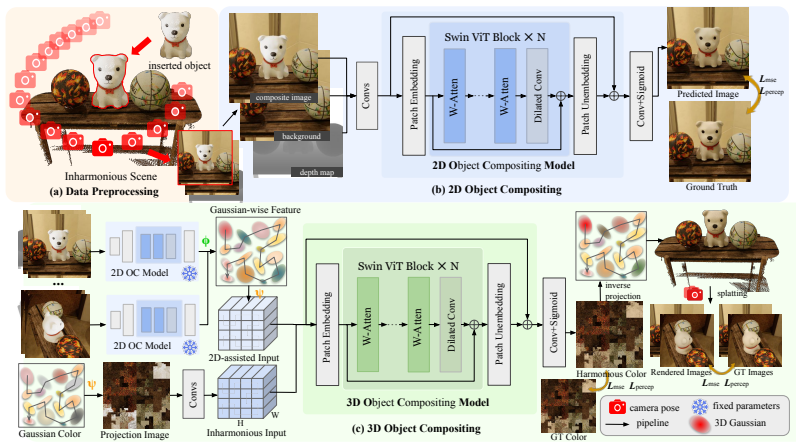
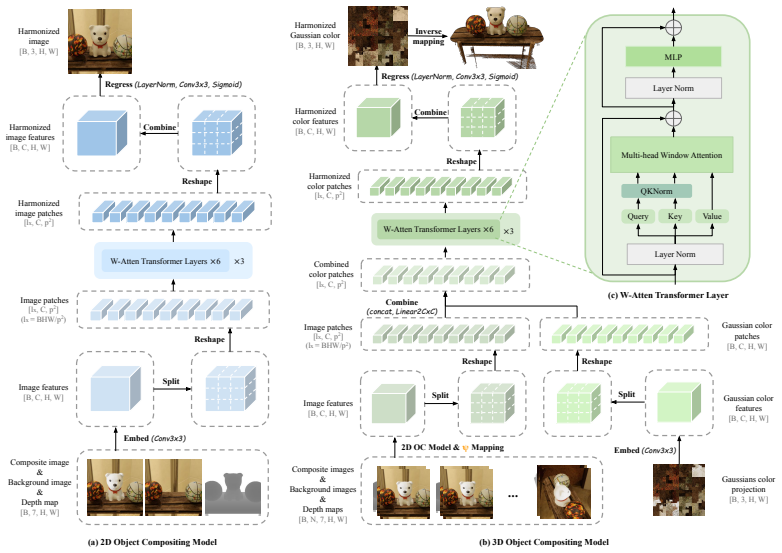
The load-bearing mechanism is the Hilbert curve ordering, which converts sparse 3D Gaussian primitives into a dense, locality-preserving 2D grid (the paper calls this mapping Φ for feature maps and Ψ for Gaussian colors). This lets an image-based transformer operate directly on 3D scene colors: nearby Gaussians stay nearby in the 2D grid, preserving spatial coherence and enabling multi-view-consistent shadow and highlight prediction. The other essential pieces are the per-view 2D Swin-transformer compositing network and the 3D refinement stage, which freezes all Gaussian geometry and updates only color attributes.
What would settle it
Render a synthetic scene with a known single light source, insert an object, run MV-CoLight, and compare the predicted cast shadow's direction and penumbra against a ray-traced ground-truth composite. If the network's shadows diverge systematically under complex lighting, or if removing the background-only reference degrades the result substantially, the claimed lighting consistency would be falsified for those settings.
Extended reading notes
Core claim
The paper's central claim is that illumination-consistent object compositing in both single images and multi-view scenes reduces to a learned per-pixel color transformation, not a generative reconstruction problem. Its two-stage framework first runs a per-view 2D network on the composite image, a background-only reference, and a depth map to produce a harmonized image and dense features; then a 3D stage projects those features onto a 3D Gaussian scene model, orders the Gaussians along a Hilbert curve, and predicts new Gaussian colors that keep lighting and shadows consistent across viewpoints. The authors assert that this design exceeds the harmonization quality of diffusion-based inserters and Gaussian-based inverse-rendering baselines while being orders of magnitude faster at inference, and that it generalizes to casually captured real-world scenes.
Load-bearing premise
The load-bearing premise is that every input view comes with a clean background-only image and an accurate depth map, along with known camera poses; the paper's own unposed-input experiments show that quality drops sharply when poses and depths are estimated instead of captured.
Editorial extensions
If this is right
- If correct, AR and robotics applications could re-render an inserted object with consistent lighting in real time, since the per-frame cost is about 0.07 seconds without diffusion sampling.
- Repositioning or replacing inserted objects would not require re-optimizing the Gaussian scene, because geometry stays frozen and only colors are predicted, so repeated edits remain cheap.
- The 2D feature stage is not optional: ablations show that removing the 2D compositing model sharply degrades shadows and highlights, so the 3D color-only stage alone cannot enforce illumination consistency.
- The introduced multi-light dataset provides a common physically rendered benchmark with paired views, depth, and ground-truth composites for training and comparing future multi-view compositing methods.
- Because the pipeline predicts Gaussian colors rather than material intrinsics, it can also insert emissive objects and let their light illuminate the surrounding scene, a capability the paper demonstrates for luminous objects.
Reading between the lines
- The strongest practical constraint is hidden in the input requirements: at inference the method expects a background-only image and depth map for every view, but real-world compositing usually starts from footage where the object is already present, so the deployed setting may often lack the clean reference the method was trained on.
- The paper's own unposed-input experiments show that when camera poses and depths are estimated rather than captured, harmonization quality drops sharply; this suggests the advertised robustness to casual captures applies mainly when geometry and poses are reliable.
- The same Hilbert-grid trick could be extended to predict other per-Gaussian attributes, such as normals, albedo, or specular coefficients, potentially moving the framework toward material-aware relighting without changing its architecture.
- A sharper test of the lighting claim would be to measure predicted shadow directions and penumbrae against ray-traced ground truth under known light positions, rather than relying only on pixel-similarity metrics that can favor color-matched but physically wrong shadows.
Editorial analysis
A structured set of objections, weighed in public.
Referee Report
Summary. MV-CoLight proposes a two-stage feed-forward pipeline for object compositing with lighting and shadow consistency. In the 2D stage, a Swin-transformer network maps the composite image, a background-only image, and a depth map to a harmonized image. In the 3D stage, per-view 2D features and original Gaussian colors are reordered along a Hilbert curve and processed by a second transformer to predict updated Gaussian colors while geometry is frozen; the updated Gaussians are rendered for multi-view consistency. The paper also introduces DTC-MultiLight, a 480k-scene Blender dataset, and evaluates on FOSCom, OWL, the new dataset, and two real captured scenes. Reported results show large PSNR/SSIM/LPIPS margins over diffusion-based and inverse-rendering baselines, with 0.07 seconds per-frame 2D inference.
Significance. If the reported results are representative, the paper makes a useful practical contribution: a fast feed-forward alternative to per-scene inverse rendering that handles multi-view consistency and shadow generation, backed by a large new dataset and extensive comparisons. The paper is honest enough to include VGGT-based unposed experiments (Sec. A.7) and ablation variants without depth and background inputs (Ours-dagger), both of which reveal the sensitivity of the method to its auxiliary inputs. The main significance is therefore conditional: the method is strong in the setup where clean background images and accurate poses and depth are available, but the abstract's 'casually captured real-world' and 'wide generalization' claims exceed the evidence. The central color-only Gaussian-update idea is simple and appears sound. I do not see evidence of circularity: the losses are supervised against ground-truth renderings and external benchmarks are included.
major comments (3)
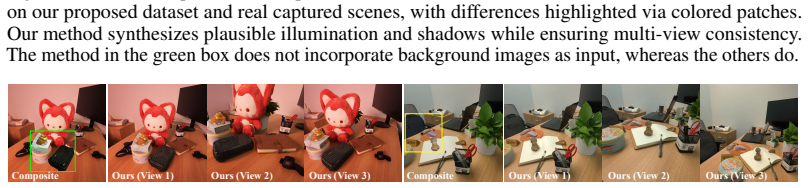
- [Sec. 3.2, Eq. (1); Sec. 3.1; Sec. A.7; Sec. A.8] The headline generalization claim is conditioned on inputs that are not available in the advertised casual-capture regime. Eq. (1) requires a background-only image G and a depth map D for every view, and Sec. 3.1 requires camera poses and depth to build the 3D Gaussian model. In a real scene where the object is already present, no clean background-only image exists, and when poses and depths are estimated automatically the authors' own VGGT experiments (Sec. A.7) show blurred harmonization and the need for Gaussian position optimization to recover sharpness. The limitation list in Sec. A.8 does not mention the background-only dependency. The claims of robustness and wide generalization in the abstract and Sec. 4.2 should be re-scoped to settings with available background references and poses, or supplemented with quantitative experiments where G and D are estimated, for example via inpainting-based background removal and a pose and depth estimator on real scenes.
- [Sec. 3.3, Fig. 3] The Hilbert-curve mapping is under-specified and is a stated contribution. The text says that a 3D Hilbert curve is constructed through the Gaussian centers and each primitive is assigned to its nearest curve point, but it does not specify the grid resolution or quantization used to evaluate the curve, how the fixed number M of sampled points is ordered when coordinates are unevenly distributed, or how the 1D sequence is folded into a 2D Hilbert-ordered grid with a well-defined inverse mapping Psi. Without this procedure, the 3D model's input representation and the bijectivity of the projection cannot be reproduced. Please provide the exact mapping algorithm, including normalization, padding, and inverse mapping, in the supplement.
- [Tables 1-2; Sec. A.4] All quantitative results are point estimates. The OWL test set has 72 scenes, the own 2D test set has 57 scenes, the 3D test sets have 50 and 7 scenes, and the real-capture evaluation uses two scenes; Tables 1 and 2 report single PSNR/SSIM/LPIPS numbers without error bars, per-scene standard deviations, or significance tests. The user study in Fig. 10 reports percentages without stating the number of participants, questions, or statistical comparisons. Since the central claim is state-of-the-art performance, please add confidence intervals or per-scene distributions and report the user-study protocol.
minor comments (8)
- [Abstract; Sec. 4.3] The abstract's '0.07 seconds per frame' refers only to the 2D stage; the 3D stage requires about 1.08 seconds of inference after about 1.08 minutes of scene-specific Gaussian representation learning. Please state this 2D/3D distinction explicitly in the abstract and conclusion.
- [Sec. 3.4, Eq. (4)] The notation in Eq. (4) mixes the predicted harmonized Gaussian color map I_hat_C with the rendered images H_hat_i; please define the rendering function that links them and clarify the dimensions and indexing.
- [Sec. A.2] The paragraph describing Poly Haven material diversification is duplicated verbatim; please remove the repeated text.
- [Sec. A.4] The sentence 'Our method surpasses all baseline methods under objective criteria' should say 'subjective user study', and the sample size should be reported.
- [Fig. 16] The LPIPS values in Fig. 16 are difficult to parse; please use a table or clearly annotated labels for each variant.
- [Tables 1-2; Fig. 11] Minor typos: 'purposed dataset' should be 'proposed dataset', and 'Foscom' in Fig. 11 should be 'FOSCom'.
- [Sec. 4.1] The phrase 'For trainig time' is a typo; also state how many of the 480k generated scenes are used for training and confirm that the 57-scene test set is disjoint from the training split.
- [Sec. 4.1, OWL evaluation] The OWL evaluation should clarify how composite inputs are generated, since OWL is a relighting dataset and the compositing protocol affects comparability with methods trained for standard image compositing.
Circularity Check
No significant circularity: outputs are trained against ground-truth renderings and evaluated on external benchmarks; the background/depth dependence is a scoping limitation, not a circular reduction.
full rationale
MV-CoLight's derivation is self-contained against external evidence. The 2D network (Eq. 1) maps {I, G, D} to a harmonized image, and the 3D network maps 2D features plus inharmonious Gaussian colors to harmonized colors; both are optimized with MSE and perceptual losses against ground-truth renderings (Eqs. 3-4), so no reported quantity is fitted and then renamed as a prediction. The method is benchmarked on external FOSCom and OWL datasets (Tables 1-2), and the ablations in Table 3 quantify the contribution of the background and depth inputs rather than defining the output in terms of them. The Hilbert-curve ordering and Gaussian color mapping are architectural devices, not assertions that a target result follows from a premise that already contains it. The paper's dependence on background-only images and depth at inference, and the degraded VGGT-based results reported in A.7, are generalization and scoping limitations for real-world use; they do not make the central claim equivalent to its inputs by construction. No load-bearing self-citation or imported uniqueness theorem is present.
Assumptions & free parameters
free parameters (3)
- perceptual loss weight lambda =
0.05
- 3D loss mixing weight beta =
0.5
- Gaussian point sampling count M =
not specified
assumptions (4)
- standard math Hilbert curve ordering preserves spatial locality so that image transformers can process Gaussian colors coherently.
- domain assumption Accurate depth maps, camera poses, and background-only images are available at inference for every view.
- ad hoc to paper A color-only update of frozen Gaussian geometry is sufficient to produce harmonized, view-consistent compositing results.
- domain assumption A model trained on synthetic Blender tabletop scenes with Poly Haven environment maps generalizes to casually captured real scenes.
Cite this review
Pith. "Pith review of MV-CoLight: Efficient Object Compositing with Consistent Lighting and Shadow Generation." pith.science (2026). https://pith.science/paper/ZBN2DT5S
@misc{pith2026250521483,
  author       = {Pith},
  title        = {Pith review of: MV-CoLight: Efficient Object Compositing with Consistent Lighting and Shadow Generation},
  year         = {2026},
  howpublished = {\url{https://pith.science/paper/ZBN2DT5S}},
  note         = {Machine review of arXiv:2505.21483}
}
read the original abstract
Object compositing offers significant promise for augmented reality (AR) and embodied intelligence applications. Existing approaches predominantly focus on single-image scenarios or intrinsic decomposition techniques, facing challenges with multi-view consistency, complex scenes, and diverse lighting conditions. Recent inverse rendering advancements, such as 3D Gaussian and diffusion-based methods, have enhanced consistency but are limited by scalability, heavy data requirements, or prolonged reconstruction time per scene. To broaden its applicability, we introduce MV-CoLight, a two-stage framework for illumination-consistent object compositing in both 2D images and 3D scenes. Our novel feed-forward architecture models lighting and shadows directly, avoiding the iterative biases of diffusion-based methods. We employ a Hilbert curve-based mapping to align 2D image inputs with 3D Gaussian scene representations seamlessly. To facilitate training and evaluation, we further introduce a large-scale 3D compositing dataset. Experiments demonstrate state-of-the-art harmonized results across standard benchmarks and our dataset, as well as casually captured real-world scenes demonstrate the framework's robustness and wide generalization.
Figures


Figures from the paper (13 more)






Reference graph
Works this paper leans on
-
[1]
Recovering intrinsic scene characteris- tics
Harry Barrow, J Tenenbaum, A Hanson, and E Riseman. Recovering intrinsic scene characteris- tics. Comput. vis. syst, 2(3-26):2, 1978
work page 1978
-
[2]
Gi-gs: Global illumination decomposition on gaussian splatting for inverse rendering
Hongze Chen, Zehong Lin, and Jun Zhang. Gi-gs: Global illumination decomposition on gaussian splatting for inverse rendering. arXiv preprint arXiv:2410.02619, 2024
arXiv 2024
-
[3]
Mureobjectstitch: Multi-reference image composition
Jiaxuan Chen, Bo Zhang, and Li Niu. Mureobjectstitch: Multi-reference image composition. arXiv preprint arXiv:2411.07462, 2024
arXiv 2024
-
[4]
An empirical study of gpt-4o image generation capabilities
Sixiang Chen, Jinbin Bai, Zhuoran Zhao, Tian Ye, Qingyu Shi, Donghao Zhou, Wenhao Chai, Xin Lin, Jianzong Wu, Chao Tang, et al. An empirical study of gpt-4o image generation capabilities. arXiv preprint arXiv:2504.05979, 2025
arXiv 2025
-
[5]
High-resolution image harmonization via collaborative dual transformations
Wenyan Cong, Xinhao Tao, Li Niu, Jing Liang, Xuesong Gao, Qihao Sun, and Liqing Zhang. High-resolution image harmonization via collaborative dual transformations. In Proceedings of the IEEE/CVF Conference on Computer Vision and Pattern Recognition , pages 18470–18479, 2022
work page 2022
-
[6]
Dovenet: Deep image harmonization via domain verification
Wenyan Cong, Jianfu Zhang, Li Niu, Liu Liu, Zhixin Ling, Weiyuan Li, and Liqing Zhang. Dovenet: Deep image harmonization via domain verification. In Proceedings of the IEEE/CVF conference on computer vision and pattern recognition , pages 8394–8403, 2020
work page 2020
-
[7]
Objaverse-xl: A universe of 10m+ 3d objects
Matt Deitke, Ruoshi Liu, Matthew Wallingford, Huong Ngo, Oscar Michel, Aditya Kusupati, Alan Fan, Christian Laforte, Vikram V oleti, Samir Yitzhak Gadre, et al. Objaverse-xl: A universe of 10m+ 3d objects. Advances in Neural Information Processing Systems , 36:35799–35813, 2023
2023
-
[8]
Digital twin catalog: A large-scale photorealistic 3d object digital twin dataset
Zhao Dong, Ka Chen, Zhaoyang Lv, Hong-Xing Yu, Yunzhi Zhang, Cheng Zhang, Yufeng Zhu, Stephen Tian, Zhengqin Li, Geordie Moffatt, et al. Digital twin catalog: A large-scale photorealistic 3d object digital twin dataset. arXiv preprint arXiv:2504.08541, 2025
arXiv 2025
Show all 53 references
-
[9]
Relightable 3d gaussians: Realistic point cloud relighting with brdf decomposition and ray tracing
Jian Gao, Chun Gu, Youtian Lin, Zhihao Li, Hao Zhu, Xun Cao, Li Zhang, and Yao Yao. Relightable 3d gaussians: Realistic point cloud relighting with brdf decomposition and ray tracing. In European Conference on Computer Vision, pages 73–89. Springer, 2024
2024
-
[10]
Outcast: Outdoor single-image relighting with cast shadows
David Griffiths, Tobias Ritschel, and Julien Philip. Outcast: Outdoor single-image relighting with cast shadows. In Computer Graphics F orum, volume 41, pages 179–193. Wiley Online Library, 2022
2022
-
[11]
Irgs: Inter-reflective gaussian splatting with 2d gaussian ray tracing
Chun Gu, Xiaofei Wei, Zixuan Zeng, Yuxuan Yao, and Li Zhang. Irgs: Inter-reflective gaussian splatting with 2d gaussian ray tracing. arXiv preprint arXiv:2412.15867, 2024
2024 arXiv
-
[12]
Pct-net: Full resolution image harmonization using pixel-wise color transformations
Julian Jorge Andrade Guerreiro, Mitsuru Nakazawa, and Björn Stenger. Pct-net: Full resolution image harmonization using pixel-wise color transformations. In Proceedings of the IEEE/CVF Conference on Computer Vision and Pattern Recognition, pages 5917–5926, 2023. 10
2023
-
[13]
Im- age harmonization with transformer
Zonghui Guo, Dongsheng Guo, Haiyong Zheng, Zhaorui Gu, Bing Zheng, and Junyu Dong. Im- age harmonization with transformer. In Proceedings of the IEEE/CVF international conference on computer vision, pages 14870–14879, 2021
2021
-
[14]
Intrinsic image harmonization
Zonghui Guo, Haiyong Zheng, Yufeng Jiang, Zhaorui Gu, and Bing Zheng. Intrinsic image harmonization. In Proceedings of the IEEE/CVF Conference on Computer Vision and Pattern Recognition (CVPR), pages 16367–16376, June 2021
2021
-
[15]
Dritter Band: Analysis · Grundlagen der Mathematik · Physik V erschiedenes: Nebst Einer Lebensgeschichte
David Hilbert. Dritter Band: Analysis · Grundlagen der Mathematik · Physik V erschiedenes: Nebst Einer Lebensgeschichte. Springer-Verlag, 2013
2013
-
[16]
Geometry-aware single-image full-body human relighting
Chaonan Ji, Tao Yu, Kaiwen Guo, Jingxin Liu, and Yebin Liu. Geometry-aware single-image full-body human relighting. In European Conference on Computer Vision , pages 388–405. Springer, 2022
2022
-
[17]
Neural gaffer: Relighting any object via diffusion
Haian Jin, Yuan Li, Fujun Luan, Yuanbo Xiangli, Sai Bi, Kai Zhang, Zexiang Xu, Jin Sun, and Noah Snavely. Neural gaffer: Relighting any object via diffusion. Advances in Neural Information Processing Systems, 37:141129–141152, 2025
2025
-
[18]
Tensoir: Tensorial inverse rendering
Haian Jin, Isabella Liu, Peijia Xu, Xiaoshuai Zhang, Songfang Han, Sai Bi, Xiaowei Zhou, Zexiang Xu, and Hao Su. Tensoir: Tensorial inverse rendering. InProceedings of the IEEE/CVF Conference on Computer Vision and Pattern Recognition, pages 165–174, 2023
2023
-
[19]
3d gaussian splatting for real-time radiance field rendering
Bernhard Kerbl, Georgios Kopanas, Thomas Leimkühler, and George Drettakis. 3d gaussian splatting for real-time radiance field rendering. ACM Transactions on Graphics, 42(4), July 2023
2023
-
[20]
Using color compatibility for assessing image realism
Jean-Francois Lalonde and Alexei A Efros. Using color compatibility for assessing image realism. In 2007 IEEE 11th International Conference on Computer Vision , pages 1–8. IEEE, 2007
2007
-
[21]
Diffusionrenderer: Neural inverse and forward rendering with video diffusion models
Ruofan Liang, Zan Gojcic, Huan Ling, Jacob Munkberg, Jon Hasselgren, Zhi-Hao Lin, Jun Gao, Alexander Keller, Nandita Vijaykumar, Sanja Fidler, et al. Diffusionrenderer: Neural inverse and forward rendering with video diffusion models. arXiv preprint arXiv:2501.18590, 2025
2025 arXiv
-
[22]
Photorealistic object insertion with diffusion-guided inverse rendering
Ruofan Liang, Zan Gojcic, Merlin Nimier-David, David Acuna, Nandita Vijaykumar, Sanja Fidler, and Zian Wang. Photorealistic object insertion with diffusion-guided inverse rendering. In European Conference on Computer Vision, pages 446–465. Springer, 2024
2024
-
[23]
Gs-ir: 3d gaussian splatting for inverse rendering
Zhihao Liang, Qi Zhang, Ying Feng, Ying Shan, and Kui Jia. Gs-ir: 3d gaussian splatting for inverse rendering. In Proceedings of the IEEE/CVF Conference on Computer Vision and Pattern Recognition, pages 21644–21653, 2024
2024
-
[24]
Arshadowgan: Shadow generative adversarial network for augmented reality in single light scenes
Daquan Liu, Chengjiang Long, Hongpan Zhang, Hanning Yu, Xinzhi Dong, and Chunxia Xiao. Arshadowgan: Shadow generative adversarial network for augmented reality in single light scenes. In Proceedings of the IEEE/CVF conference on computer vision and pattern recognition, pages 8...
2020
-
[25]
Shadow generation for composite image using diffusion model
Qingyang Liu, Junqi You, Jianting Wang, Xinhao Tao, Bo Zhang, and Li Niu. Shadow generation for composite image using diffusion model. In Proceedings of the IEEE/CVF Conference on Computer Vision and Pattern Recognition, pages 8121–8130, 2024
2024
-
[26]
Swin transformer: Hierarchical vision transformer using shifted windows
Ze Liu, Yutong Lin, Yue Cao, Han Hu, Yixuan Wei, Zheng Zhang, Stephen Lin, and Baining Guo. Swin transformer: Hierarchical vision transformer using shifted windows. In Proceedings of the IEEE/CVF International Conference on Computer Vision , pages 10012–10022, 2021
2021
-
[27]
High-resolution image harmonization with adaptive-interval color transformation
Quanling Meng, Liu Qinglin, Zonglin Li, Xiangyuan Lan, Shengping Zhang, and Liqiang Nie. High-resolution image harmonization with adaptive-interval color transformation. Advances in Neural Information Processing Systems, 37:13769–13793, 2025
2025
-
[28]
Nerf: Representing scenes as neural radiance fields for view synthesis
Ben Mildenhall, Pratul P Srinivasan, Matthew Tancik, Jonathan T Barron, Ravi Ramamoor- thi, and Ren Ng. Nerf: Representing scenes as neural radiance fields for view synthesis. Communications of the ACM, 65(1):99–106, 2021. 11
2021
-
[29]
Poly haven
Poly Haven. Poly haven. https://polyhaven.com/
-
[30]
Lite2relight: 3d-aware single image portrait relighting
Pramod Rao, Gereon Fox, Abhimitra Meka, Mallikarjun BR, Fangneng Zhan, Tim Weyrich, Bernd Bickel, Hanspeter Pfister, Wojciech Matusik, Mohamed Elgharib, et al. Lite2relight: 3d-aware single image portrait relighting. In ACM SIGGRAPH 2024 Conference Papers, pages 1–12, 2024
2024
-
[31]
Color transfer between images
Erik Reinhard, Michael Adhikhmin, Bruce Gooch, and Peter Shirley. Color transfer between images. IEEE Computer graphics and applications , 21(5):34–41, 2001
2001
-
[32]
Structure-from-motion revisited
Johannes Lutz Schönberger and Jan-Michael Frahm. Structure-from-motion revisited. In Conference on Computer Vision and Pattern Recognition (CVPR) , 2016
2016
-
[33]
Controllable shadow generation using pixel height maps
Yichen Sheng, Yifan Liu, Jianming Zhang, Wei Yin, A Cengiz Oztireli, He Zhang, Zhe Lin, Eli Shechtman, and Bedrich Benes. Controllable shadow generation using pixel height maps. In European Conference on Computer Vision, pages 240–256. Springer, 2022
2022
-
[34]
Ssn: Soft shadow network for image compositing
Yichen Sheng, Jianming Zhang, and Bedrich Benes. Ssn: Soft shadow network for image compositing. In Proceedings of the IEEE/CVF Conference on Computer Vision and Pattern Recognition, pages 4380–4390, 2021
2021
-
[35]
Foreground-aware semantic rep- resentations for image harmonization
Konstantin Sofiiuk, Polina Popenova, and Anton Konushin. Foreground-aware semantic rep- resentations for image harmonization. In Proceedings of the IEEE/CVF winter conference on applications of computer vision , pages 1620–1629, 2021
2021
-
[36]
Objectstitch: Object compositing with diffusion model
Yizhi Song, Zhifei Zhang, Zhe Lin, Scott Cohen, Brian Price, Jianming Zhang, Soo Ye Kim, and Daniel Aliaga. Objectstitch: Object compositing with diffusion model. In Proceedings of the IEEE/CVF Conference on Computer Vision and Pattern Recognition , pages 18310–18319, 2023
2023
-
[37]
Multi-scale image harmonization
Kalyan Sunkavalli, Micah K Johnson, Wojciech Matusik, and Hanspeter Pfister. Multi-scale image harmonization. ACM Transactions on Graphics (TOG), 29(4):1–10, 2010
2010
-
[38]
Thinking outside the bbox: Unconstrained generative object compositing
Gemma Canet Tarrés, Zhe Lin, Zhifei Zhang, Jianming Zhang, Yizhi Song, Dan Ruta, Andrew Gilbert, John Collomosse, and Soo Ye Kim. Thinking outside the bbox: Unconstrained generative object compositing. arXiv preprint arXiv:2409.04559, 2024
2024 arXiv
-
[39]
Objects with lighting: A real-world dataset for evaluating reconstruction and rendering for object relighting
Benjamin Ummenhofer, Sanskar Agrawal, Rene Sepulveda, Yixing Lao, Kai Zhang, Tianhang Cheng, Stephan Richter, Shenlong Wang, and German Ros. Objects with lighting: A real-world dataset for evaluating reconstruction and rendering for object relighting. In 2024 International Con...
2024
-
[40]
Shadow harmonization for realistic compositing
Lucas Valença, Jinsong Zhang, Michaël Gharbi, Yannick Hold-Geoffroy, and Jean-François Lalonde. Shadow harmonization for realistic compositing. In SIGGRAPH Asia 2023 Conference Papers, pages 1–12, 2023
2023
-
[41]
Vggt: Visual geometry grounded transformer
Jianyuan Wang, Minghao Chen, Nikita Karaev, Andrea Vedaldi, Christian Rupprecht, and David Novotny. Vggt: Visual geometry grounded transformer. In Proceedings of the IEEE/CVF Conference on Computer Vision and Pattern Recognition, 2025
2025
-
[42]
Semi-supervised parametric real-world image harmonization
Ke Wang, Michaël Gharbi, He Zhang, Zhihao Xia, and Eli Shechtman. Semi-supervised parametric real-world image harmonization. In Proceedings of the IEEE/CVF Conference on Computer Vision and Pattern Recognition, pages 5927–5936, 2023
2023
-
[43]
Metashadow: Object-centered shadow detection, removal, and synthesis, 2024
Tianyu Wang, Jianming Zhang, Haitian Zheng, Zhihong Ding, Scott Cohen, Zhe Lin, Wei Xiong, Chi-Wing Fu, Luis Figueroa, and Soo Ye Kim. Metashadow: Object-centered shadow detection, removal, and synthesis, 2024
2024
-
[44]
Image quality assessment: from error visibility to structural similarity
Zhou Wang, Alan C Bovik, Hamid R Sheikh, and Eero P Simoncelli. Image quality assessment: from error visibility to structural similarity. IEEE transactions on image processing , 13(4):600– 612, 2004
2004
-
[45]
Lu- minet: Latent intrinsics meets diffusion models for indoor scene relighting
Xiaoyan Xing, Konrad Groh, Sezer Karaoglu, Theo Gevers, and Anand Bhattad. Lu- minet: Latent intrinsics meets diffusion models for indoor scene relighting. arXiv preprint arXiv:2412.00177, 2024. 12
2024 arXiv
-
[46]
Dccf: Deep comprehensible color filter learning framework for high-resolution image harmonization
Ben Xue, Shenghui Ran, Quan Chen, Rongfei Jia, Binqiang Zhao, and Xing Tang. Dccf: Deep comprehensible color filter learning framework for high-resolution image harmonization. In European conference on computer vision, pages 300–316. Springer, 2022
2022
-
[47]
Relighting humans: occlusion-aware inverse rendering for full-body human images
Kanamori Yoshihiro. Relighting humans: occlusion-aware inverse rendering for full-body human images. ACM Trans. Graph., 37:270–1, 2018
2018
-
[48]
Self-supervised outdoor scene relighting
Ye Yu, Abhimitra Meka, Mohamed Elgharib, Hans-Peter Seidel, Christian Theobalt, and William AP Smith. Self-supervised outdoor scene relighting. In Computer Vision–ECCV 2020: 16th European Conference, Glasgow, UK, August 23–28, 2020, Proceedings, Part XXII 16 , pages 84–101. Sp...
2020
-
[49]
Rgb-x: Image decomposition and synthesis using material- and lighting-aware diffusion models
Zheng Zeng, Valentin Deschaintre, Iliyan Georgiev, Yannick Hold-Geoffroy, Yiwei Hu, Fujun Luan, Ling-Qi Yan, and Miloš Hašan. Rgb-x: Image decomposition and synthesis using material- and lighting-aware diffusion models. In Special Interest Group on Computer Graphics and Intera...
2024
-
[50]
Control- com: Controllable image composition using diffusion model
Bo Zhang, Yuxuan Duan, Jun Lan, Yan Hong, Huijia Zhu, Weiqiang Wang, and Li Niu. Control- com: Controllable image composition using diffusion model. arXiv preprint arXiv:2308.10040, 2023
2023 arXiv
-
[51]
Scaling in-the-wild training for diffusion- based illumination harmonization and editing by imposing consistent light transport
Lvmin Zhang, Anyi Rao, and Maneesh Agrawala. Scaling in-the-wild training for diffusion- based illumination harmonization and editing by imposing consistent light transport. In The Thirteenth International Conference on Learning Representations
-
[52]
The unrea- sonable effectiveness of deep features as a perceptual metric
Richard Zhang, Phillip Isola, Alexei A Efros, Eli Shechtman, and Oliver Wang. The unrea- sonable effectiveness of deep features as a perceptual metric. In Proceedings of the IEEE conference on computer vision and pattern recognition , pages 586–595, 2018
2018
-
[53]
Shadowgan: Shadow synthesis for virtual objects with conditional adversarial networks
Shuyang Zhang, Runze Liang, and Miao Wang. Shadowgan: Shadow synthesis for virtual objects with conditional adversarial networks. Computational Visual Media, 5:105–115, 2019. 13 A Supplementary Material In the supplementary material, we first present a brief overview of the co...
2019
Reviewed August 7, 2026 · model on record in the stance chip above.
Discussion (0). Sign in to comment.