REVIEW 2 major objections 3 minor 1 cited by
Chiral Anomaly Induced Transverse Planar Transport Phenomena in Three Dimensional Spin-Orbit Coupled Metals
T0 review · 2 major / 3 minor · reviewed 2026-08-07 · deepseek-v4-flash
Pith's one-line read This paper aims to establish that the chiral anomaly, not the Lorentz force or the usual anomalous velocity, generates measurable transverse planar Hall, Nernst, and mixed electrothermal responses in three-dimensional spin-orbit coupled…
desk verdict The paper has a new and testable chiral-anomaly planar transport calculation, but it drops a same-order term from its own first-order solution, so the central coefficients are incomplete until that is fixed. read the letter →
The pith
A machine-rendered reading of the paper's core claim, the machinery that carries it, and where it could break.
The reading
What carries the argument
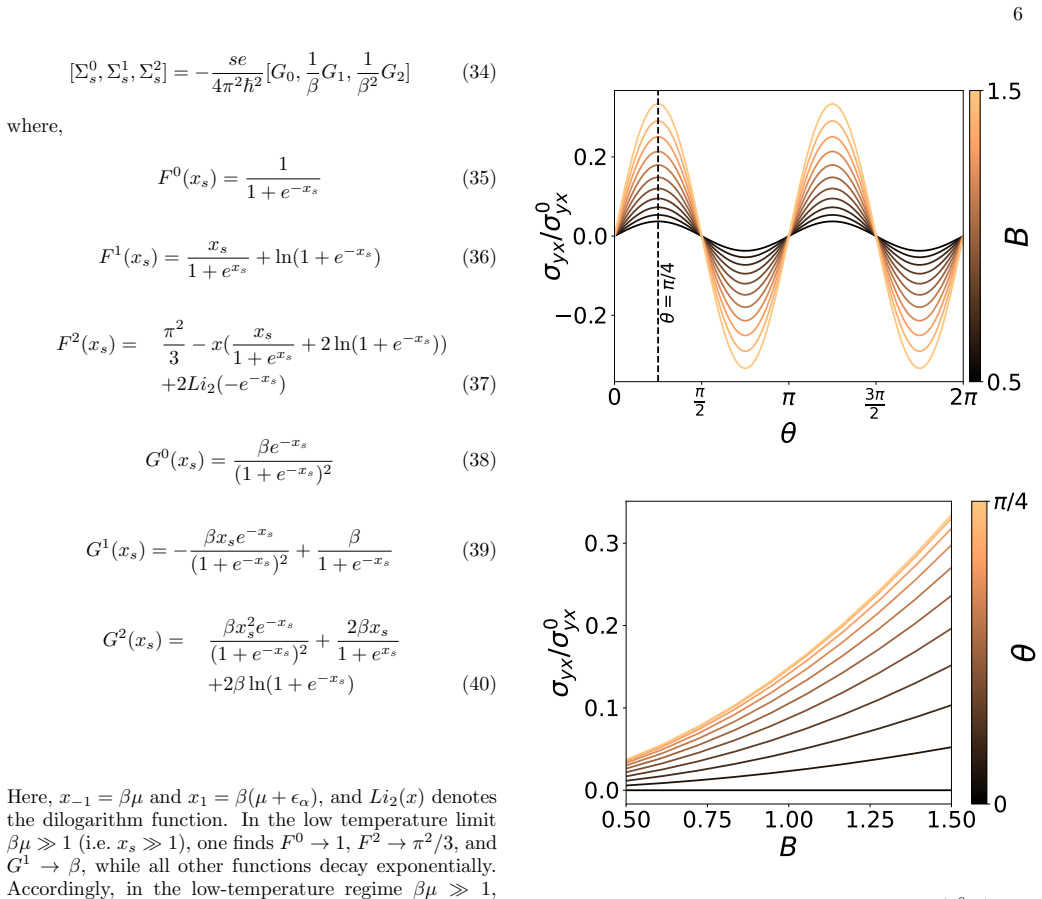
The argument is carried by the Berry-flux moments $C_s^\nu=\int [dk](-\partial f_{\rm eq}/\partial\epsilon_s)(e/\hbar)(\mathbf v_s\cdot\boldsymbol\Omega_s)(\epsilon_s-\mu)^\nu$ and their second-derivative counterparts $\Sigma_s^\nu$, together with the anomaly-induced imbalances $\delta\mu_s$ and $\delta T_s$ between the two chiral centers. These moments convert the component of $\mathbf E$ or $\nabla T$ parallel to $\mathbf B$ into a transverse current through the chiral magnetic velocity term $(\mathbf v_s\cdot\boldsymbol\Omega_s)\mathbf B$. Their low-temperature limits are dominated by the constants $F_0\to 1$, $F_2\to\pi^2/3$, and $G_1\to\beta$, while all other pieces decay exponentially, and that exponential structure is what generates the $B^2$ and $B^3$ field scalings, the $\sin\theta\cos\theta$ and $\cos^2\theta\sin\theta$ angular laws, and the early breakdown of the Mott relations. The chiral limit $\tau_\nu\gg\tau_0\simeq\tau_*$ ensures that only the anomaly-pumping terms contribute at leading order.
What would settle it
Measure the angular and field dependence of the transverse planar conductivity and thermopower in a clean 3D spin-orbit coupled metal at fixed temperature; the anomaly-only scenario predicts a peak at $\theta=\pi/4$ with $B^2$ scaling for the linear coefficients and a peak at $\theta=\arctan(1/\sqrt{2})$ with $B^3$ scaling for the quadratic coefficients, and a Mott number $\alpha_{yx}/(T\,\partial_\mu\sigma_{yx})$ that departs from unity by about 10% near 20 K. Observing a different peak angle, a different field exponent, or Mott-relation validity to high temperature would falsify the chiral-limit truncation.
Extended reading notes
Core claim
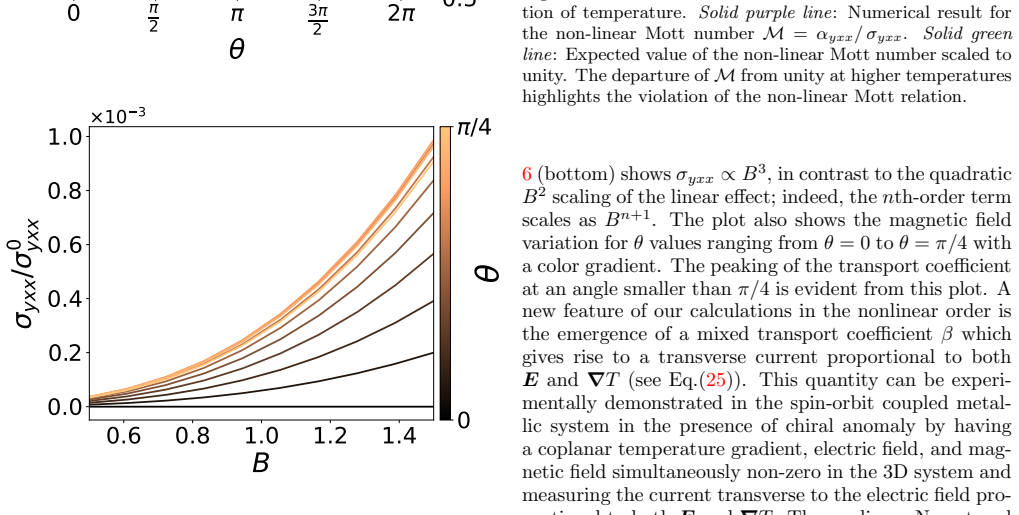
The central claim is that in a 3D spin-orbit coupled metal described by $H=\sum_{\mathbf k} c^\dagger_{\mathbf k}(\hbar^2 k^2/2m\,\sigma_0+\alpha\,\boldsymbol\sigma\cdot\mathbf k)c_{\mathbf k}$, the chiral anomaly, rather than the Lorentz force or anomalous velocity, dominates transverse planar transport. Each band has a Fermi surface carrying a nonvanishing Berry flux, opposite for the two chiralities, and with $\mathbf E$ or $nabla T$ parallel to an in-plane $\mathbf B$, the anomaly pumps charge and energy between these chiral centers. The resulting first-order transverse coefficients obey $\sigma_{yx}\propto B^2\sin\theta\cos\theta$ and $\alpha_{yx}\propto B^2\sin\theta\cos\theta$, while the second-order coefficients obey $\sigma_{yxx},\alpha_{yxx},\beta_{yxx}\propto B^3\cos^2\theta\sin\theta$. The paper also gives closed low-temperature forms, for example $\sigma^{\rm LT}_{yx}\propto (2+\tilde\mu)\sqrt{1+\tilde\mu}\,\tilde\mu^{-2}\,B^2\cos\theta\sin\theta$. Because the fundamental moments contain exponentially decaying temperature pieces, the linear and nonlinear Mott relations hold only at very low temperatures and are violated at relatively modest temperatures, which the authors identify as the key observable signature.
Load-bearing premise
Everything depends on the assumption that electrons scatter much more slowly between the two chirality centers than within a center, so that the only important correction is the anomaly-induced pumping of charge and heat between the centers.
Editorial extensions
If this is right
- At linear order, the planar Hall and planar Nernst coefficients vanish when $\mathbf B\parallel\mathbf E$ and when $\mathbf B\perp\mathbf E$, peak at $\theta=\pi/4$, and grow as $B^2$, so measuring those dependencies tests whether the anomaly channel dominates.
- At second order, the coefficients peak at $\theta=\arctan(1/\sqrt{2})$, are $2\pi$-periodic in $\theta$, and grow as $B^3$; the paper notes that an $n$th-order coefficient would vary as $\cos^n\theta\sin\theta$ with its maximum at $\arctan(1/\sqrt{n})$.
- The mixed coefficient $\beta_{yxx}$ produces a transverse current only when an electric field and a thermal gradient act together, offering an independent probe of anomaly-driven response.
- Both the linear and nonlinear Mott relations fail at relatively low temperatures, with the paper's numerical estimates showing roughly 10% deviations by about 20 K for the linear response and 40 K for the nonlinear response.
- At very low temperature the nonlinear Mott relation is recovered in the form $\alpha_{yxx}=(\pi^2 k_B^2/3e^2)\sigma_{yxx}$.
Reading between the lines
- The predicted angular shift from $\pi/4$ to $\arctan(1/\sqrt{2})$ is a sharp fingerprint that future experiments could check against conventional Fermi-liquid planar Hall effects, which would not share the same field-scaling exponents.
- The early Mott-relation breakdown could serve as a discriminator: a candidate material that satisfies the Mott relation up to high temperature would be evidence against anomaly-dominated transverse transport, while the predicted departure near 20-40 K would support it.
- Measuring $\beta_{yxx}$ in a simultaneous electric-field and thermal-gradient experiment may offer a route to extract the inter-chirality relaxation time $\tau_\nu$, since the coefficient is proportional to $\tau_*\tau_\nu$.
- If the spin-orbit coupling is anisotropic, the extremal angles will likely shift, but the general $n$th-order $\cos^n\theta\sin\theta$ form and the $B^{n+1}$ scaling should survive as long as the chiral-limit mechanism remains dominant.
Editorial analysis
A structured set of objections, weighed in public.
Referee Report
Summary. This paper studies linear and second-order transverse planar transport in three-dimensional spin-orbit coupled metals using semiclassical Boltzmann transport with chiral kinetic theory. For the model H = ℏ²k²/2m + α σ·k, the authors derive anomaly-induced planar Hall and Nernst coefficients at linear order (σ_yx, α_yx) and second order (σ_yxx, α_yxx, β_yxx), reporting sinθcosθ B² and cos²θ sinθ B³ dependencies, extrema at θ = π/4 and θ = arctan(1/√2), and explicit low-temperature forms in Eqs. (42)-(46). They further show that the energy moments have exponential temperature dependence, causing violation of the (non)linear Mott relation at relatively low temperatures. The derivation is analytic and is supplemented by an appendix with the perturbative solution of the Boltzmann equation.
Significance. If the results hold, the paper extends chiral-anomaly transport beyond Weyl semimetals to systems with paired Fermi surfaces of opposite Berry flux, and the predicted angular/field scalings and the mixed electrothermal coefficient β_yxx are experimentally testable. The manuscript is strong in providing analytic closed forms, explicit low-T asymptotics, and numerical maps of the validity of the low-T expansion. However, the first-order current calculation omits a driving term of the same order as the retained anomaly contribution, so the reported linear coefficients and the Mott-relation analysis built on them need revision before the quantitative predictions can be accepted.
major comments (2)
- [III.A, Eq. (16); Appendix A, Eq. (A11)] The linear current is computed from the inter-chirality part of f^(1) only. However, the complete first-order solution derived in Appendix A, Eq. (A11), contains the additional explicit term -τ* D [v_s + (e/ℏ)(v_s·Ω_s)B]·[eE + ((ϵ−µ)/T)∇T](-∂f/∂ϵ). For the Hamiltonian in Eq. (29), v_s and Ω_s are both radial, so after angular integration the v_s part of this term does not contribute to j_y, but the chiral-magnetic-velocity part contributes δj_y^(1) = -τ*(e³/ℏ²) B² cosθ sinθ E_x Σ_s ∫[dk] (v_s·Ω_s)² (-∂f/∂ϵ), with an analogous contribution from ∇T. This has exactly the same sinθcosθ and B² structure as the retained term in Eq. (17) and is of the same order in τ*; the chiral limit τν≫τ0≃τ* does not suppress it, because the retained anomaly term is also of order τ* after δµ∼τν. Thus Eqs. (42)-(43) and the Mott-relation analysis built on them are incomplete unless the authors explicitly restrict their claim to the inter-chirality (imbalance) contribution and show that the omitted term is negligible or include it in the final coefficients.
- [Section II, after Eq. (4)] The decision to omit the E×Ω_s and v_s×B terms from the equations of motion is justified for isolating the chiral-anomaly mechanism, but the paper does not estimate their contributions to the planar transverse response for the model in Eq. (29). Since the abstract presents σ_yx, α_yx and the nonlinear coefficients as the planar transport coefficients of the system, a statement of the relative magnitude, or a symmetry argument that they vanish identically for this isotropic model, is needed to make the predicted angular and field scalings falsifiable in experiments.
minor comments (3)
- [Eq. (32)] The Berry curvature Ω_s = -s/(2k³) k is equivalent to -s/(2k²) k̂; please write it in the latter form to avoid ambiguity about the vector in the numerator and to make the dimension clearer.
- [Section IV.B, Figs. 4, 5, 7, 8] The numerical heatmaps and Mott-number plots would be more useful for experimental comparison if the authors stated representative values of the model parameters (e.g., ϵα, µ, τ0, τν, carrier density) used to generate the temperature and chemical-potential scales.
- [Section V] The sentence beginning "A new feature of our calculations in the nonlinear order is the emergence of a mixed transport coefficient" appears nearly verbatim in both the main text and the conclusion; consider keeping only one occurrence and editing the repeated phrasing.
Circularity Check
No circularity: coefficients follow from a model Hamiltonian and Boltzmann equation with no fitted inputs; self-citations provide background but are not load-bearing.
full rationale
The derivation is self-contained. The linear coefficients (17)-(18) and nonlinear coefficients (26)-(28) are obtained by inserting the model Hamiltonian (29) and its Berry curvature (32) into the Boltzmann-equation moments (8), (9), (21), and (23); no parameter is fitted to the predicted quantities and no target angular or field dependence is assumed. The sinθcosθ and cos²θsinθ forms and the B²/B³ scalings follow algebraically from (B·E) and (v_s·Ω_s)B contractions, and the low-temperature expressions (42)-(46) are controlled limits of the exact Fermi integrals (35)-(40). The Mott-relation violation is a numerical consequence of those integrals, not an input. Self-citations to earlier work (refs [85], [89]-[92], [100], [101]) supply the Boltzmann collision form and prior comparisons, but the cited results are published derivations, partly by non-overlapping groups ([85], [89]-[91]), and are not used as an unverified premise; even the overlapping [92] is corroborated by [89]-[91]. The skeptical concern about the explicit driving term in Eq. (A11) being dropped from Eq. (11)/(16) is an internal-completeness issue, not circularity: inclusion would alter the predicted coefficients rather than reproduce them by construction.
Assumptions & free parameters
free parameters (2)
- τ0 (intra-chirality relaxation time)
- τν (inter-chirality relaxation time)
assumptions (4)
- domain assumption Semiclassical Boltzmann equations with Berry curvature corrections (Eqs. 1-4) accurately describe transport in the 3D SOC metal.
- domain assumption The two Fermi surfaces s=±1 act as independent chiral centers with well-defined chemical potentials and temperatures, and the chiral limit τν≫τ0 applies.
- ad hoc to paper Cross-product terms E×Ω_s and v_s×B in the equations of motion can be omitted because they do not contribute to chiral anomaly.
- domain assumption The 3D SOC metal is described by the isotropic Hamiltonian H=ℏ²k²/(2m)σ0+ασ·k with μ≥0.
Cite this review
Pith. "Pith review of Chiral Anomaly Induced Transverse Planar Transport Phenomena in Three Dimensional Spin-Orbit Coupled Metals." pith.science (2026). https://pith.science/paper/HFPIP5Y7
@misc{pith2026250521498,
  author       = {Pith},
  title        = {Pith review of: Chiral Anomaly Induced Transverse Planar Transport Phenomena in Three Dimensional Spin-Orbit Coupled Metals},
  year         = {2026},
  howpublished = {\url{https://pith.science/paper/HFPIP5Y7}},
  note         = {Machine review of arXiv:2505.21498}
}
read the original abstract
We investigate linear and nonlinear transverse planar transport phenomena (viz. linear and nonlinear Hall and Nernst coefficients) induced by chiral anomaly in three-dimensional spin-orbit coupled metallic systems. Unlike Weyl semimetals, these systems do not possess multiple Weyl nodes located at isolated points in the momentum space but instead host a pair of Fermi surfaces characterized by opposite Berry curvature fluxes enclosing the same band-degeneracy point. Using semiclassical Boltzmann transport formalism within the relaxation time approximation, we derive first- and second-order transverse planar transport coefficients induced by electrical and thermal gradients in the presence of an in-plane magnetic field. Our analysis reveals distinctive angular dependencies of the transport coefficients, along with characteristic scaling behavior with the magnetic field strength. Furthermore, we demonstrate that the anomaly-induced transport coefficients exhibit an exponential temperature dependence. This unconventional behavior leads to the violations of the Mott relation at comparatively low temperatures, highlighting unique thermoelectric signatures that can be probed experimentally in 3D spin-orbit coupled metallic systems.
Figures


Figures from the paper (4 more)



Forward citations
Cited by 1 Pith paper
-
Chiral anomaly and planar Hall conductance in pseudospin-$1$ Fermions
Boltzmann transport calculation finds sign-reversing planar Hall conductance and anisotropic angular responses in tilted pseudospin-1 fermions arising from chiral anomaly effects.
Reference graph
Works this paper leans on
-
[1]
M. Z. Hasan and C. L. Kane, Rev. Mod. Phys.82, 3045 (2010)
2010
-
[2]
12(1 + ˜µ) 1 2 + 40(1 + ˜µ) 3 2 + 12(1 + ˜µ) 5 2 ˜µ5 # (44) αLT yxx = (τ ∗τν) e4kB 96m3ϵα ! B3 cos2(θ) sin(θ) ×
[Fig.(6)]. This angle is smaller than ex- tremum angle for the linear order case. This indicates that higher-order corrections—inEand∇T—tto the transport coefficients reach their maximum at angles closer to the configuration whereEand∇Tare alligned withB. 5 IV. THREE-DIMENSIONAL SPIN-ORBIT COUPLED SYSTEMS In this section, we illustrate the general theoret...
2023
-
[3]
Qi and S.-C
X.-L. Qi and S.-C. Zhang, Rev. Mod. Phys.83, 1057 (2011)
2011
-
[4]
N. P. Armitage, E. J. Mele, and A. Vishwanath, Rev. Mod. Phys.90, 015001 (2018)
2018
-
[5]
Jia, S.-Y
S. Jia, S.-Y. Xu, and M. Z. Hasan, Nat. Mater.15, 1140 (2016)
2016
-
[6]
X. Wan, A. M. Turner, A. Vishwanath, and S. Y. Savrasov, Phys. Rev. B83, 205101 (2011)
2011
-
[7]
A. A. Burkov, Phys. Rev. Lett.113, 247203 (2014)
2014
-
[8]
T. Bauer, F. Buccheri, A. De Martino, and R. Eg- ger, Phys. Rev. Research6, 10.1103/physrevre- search.6.043201 (2024)
Show all 106 references
-
[9]
M. E. Peskin and D. V. Schroeder,An Introduction to quantum field theory(Addison-Wesley, Reading, USA, 1995)
1995
-
[11]
A. A. Burkov, M. D. Hook, and L. Balents, Phys. Rev. B84, 235126 (2011)
2011
-
[12]
A. A. Burkov and L. Balents, Phys. Rev. Lett.107, 12 127205 (2011)
2011
-
[13]
C. Fang, M. J. Gilbert, X. Dai, and B. A. Bernevig, Phys. Rev. Lett.108, 266802 (2012)
2012
-
[14]
Hosur, S
P. Hosur, S. A. Parameswaran, and A. Vishwanath, Phys. Rev. Lett.108, 046602 (2012)
2012
-
[15]
Saha and S
S. Saha and S. Tewari, The Eur. Phys. J. B91, 4 (2018)
2018
-
[16]
S. M. Young, S. Zaheer, J. C. Y. Teo, C. L. Kane, E. J. Mele, and A. M. Rappe, Phys. Rev. Lett.108, 140405 (2012)
2012
-
[17]
Z. Wang, Y. Sun, X.-Q. Chen, C. Franchini, G. Xu, H. Weng, X. Dai, and Z. Fang, Phys. Rev. B85, 195320 (2012)
2012
-
[18]
Yang and N
B. Yang and N. Nagaosa, Nat. Commun..5, https://doi.org/10.1038/ncomms5898 (2014)
2014 doi
-
[19]
Le Mardel´ e, J
F. Le Mardel´ e, J. Wyzula, I. Mohelsky, S. Nasrallah, M. Loh, S. Ben David, O. Toledano, D. Tolj, M. Novak, G. Eguchi, S. Paschen, N. Bariˇ si´ c, J. Chen, A. Kimura, M. Orlita, Z. Rukelj, A. Akrap, and D. Santos-Cottin, Phys. Rev. B107, L241101 (2023)
2023
-
[20]
B. J. Wieder, Z. Wang, J. Cano, X. Dai, L. M. Schoop, B. Bradlyn, and B. A. Bernevig, Nat. Commun..11, 627 (2020)
2020
-
[21]
A. H. Castro Neto, F. Guinea, N. M. R. Peres, K. S. Novoselov, and A. K. Geim, Rev. Mod. Phys.81, 109 (2009)
2009
-
[22]
T. Sato, K. Segawa, K. Kosaka, S. Souma, K. Nakayama, K. Eto, T. Minami, Y. Ando, and T. Takahashi, Nat. Phys.7, 840 (2011)
2011
-
[23]
Z. K. Liu, B. Zhou, Y. Zhang, Z. J. Wang, H. M. Weng, D. Prabhakaran, S.-K. Mo, Z. X. Shen, Z. Fang, X. Dai, Z. Hussain, and Y. L. Chen, Science343, 864–867 (2014)
2014
-
[24]
S. Jeon, B. B. Zhou, A. Gyenis, B. E. Feldman, I. Kim- chi, A. C. Potter, Q. D. Gibson, R. J. Cava, A. Vish- wanath, and A. Yazdani, Nature Materials13, 851–856 (2014)
2014
-
[25]
Morimoto and A
T. Morimoto and A. Furusaki, Phys. Rev. B89, 235127 (2014)
2014
-
[27]
Fu and C
L. Fu and C. L. Kane, Phys. Rev. Lett.100, 096407 (2008)
2008
-
[28]
Sato and Y
M. Sato and Y. Ando, Reports on Progress in Physics 80, 076501 (2017)
2017
-
[29]
B. B. Roy, R. Jaiswal, T. D. Stanescu, and S. Tewari, Phys. Rev. B110, 115436 (2024)
2024
-
[30]
A. Y. Kitaev, Annals. Phys.303, 2 (2003)
2003
-
[31]
Nayak, S
C. Nayak, S. H. Simon, A. Stern, M. Freedman, and S. Das Sarma, Rev. Mod. Phys.80, 1083 (2008)
2008
-
[32]
J. D. Sau, R. M. Lutchyn, S. Tewari, and S. Das Sarma, Phys. Rev. Lett.104, 040502 (2010)
2010
-
[33]
Sau and S
J. Sau and S. Tewari, inSemiconductors and Semimet- als, Vol. 108 (Elsevier, 2021) pp. 125–194
2021
-
[34]
A. D. Dolgov, Surveys in High Energy Physics13, 83 (1998), https://doi.org/10.1080/01422419808240874
1998 doi
-
[35]
Schober, I
J. Schober, I. Rogachevskii, and A. Brandenburg, Phys. Rev. Lett.132, 10.1103/physrevlett.132.065101 (2024)
2024 doi
-
[36]
Vilenkin, Phys
A. Vilenkin, Phys. Rev. D22, 3080 (1980)
1980
-
[37]
R. W. Jackiw, Scholarpedia3, 7302 (2008)
2008
-
[38]
Claude and Z
I. Claude and Z. J. Bernard, Quantum field theory (1980)
1980
-
[39]
Huang, L
X. Huang, L. Zhao, Y. Long, P. Wang, D. Chen, Z. Yang, H. Liang, M. Xue, H. Weng, Z. Fang,et al., Phys. Rev. X5, 031023 (2015)
2015
-
[40]
Y. Wang, E. Liu, H. Liu, Y. Pan, L. Zhang, J. Zeng, Y. Fu, M. Wang, K. Xu, Z. Huang,et al., Nat. Com- mun..7, 13142 (2016)
2016
-
[41]
Dos Reis, M
R. Dos Reis, M. Ajeesh, N. Kumar, F. Arnold, C. Shekhar, M. Naumann, M. Schmidt, M. Nicklas, and E. Hassinger, New J. Phys.18, 085006 (2016)
2016
-
[42]
Arnold, C
F. Arnold, C. Shekhar, S.-C. Wu, Y. Sun, R. D. Dos Reis, N. Kumar, M. Naumann, M. O. Ajeesh, M. Schmidt, A. G. Grushin,et al., Nat. Commun..7, 11615 (2016)
2016
-
[43]
M. Wu, G. Zheng, W. Chu, Y. Liu, W. Gao, H. Zhang, J. Lu, Y. Han, J. Zhou, W. Ning,et al., Phys. Rev. B 98, 161110 (2018)
2018
-
[44]
M.-X. Deng, G. Qi, R. Ma, R. Shen, R.-Q. Wang, L. Sheng, and D. Xing, Phys. Rev. Lett.122, 036601 (2019)
2019
-
[45]
H. B. Nielsen and M. Ninomiya, Phys. Lett. B130, 389 (1983)
1983
-
[46]
Aji, Phys
V. Aji, Phys. Rev. B—Condensed Matter and Materials Physics85, 241101 (2012)
2012
-
[47]
Son and B
D. Son and B. Spivak, Phys. Rev. B88, 104412 (2013)
2013
-
[48]
Parameswaran, T
S. Parameswaran, T. Grover, D. Abanin, D. Pesin, and A. Vishwanath, Phys. Rev. X4, 031035 (2014)
2014
-
[49]
Burkov, Phys
A. Burkov, Phys. Rev. B91, 245157 (2015)
2015
-
[50]
Ong and S
N. Ong and S. Liang, Nat. Rev. Phys.3, 394 (2021)
2021
-
[51]
G. E. Volovik,The universe in a helium droplet, Vol. 117 (Oxford University Press on Demand, 2003)
2003
-
[52]
G. Xu, H. Weng, Z. Wang, X. Dai, and Z. Fang, Phys. Rev. Lett.107, 186806 (2011)
2011
-
[53]
Zyuzin, S
A. Zyuzin, S. Wu, and A. Burkov, Phys. Rev. B85, 165110 (2012)
2012
-
[54]
Goswami and S
P. Goswami and S. Tewari, Phys. Rev. B88, 245107 (2013)
2013
-
[55]
Goswami, J
P. Goswami, J. Pixley, and S. D. Sarma, Phys. Rev. B 92, 075205 (2015)
2015
-
[56]
Zhong, J
S. Zhong, J. Orenstein, and J. E. Moore, Phys. Rev. Lett.115, 117403 (2015)
2015
-
[57]
Kim, H.-J
K.-S. Kim, H.-J. Kim, and M. Sasaki, Phys. Rev. B89, 195137 (2014)
2014
-
[58]
Lundgren, P
R. Lundgren, P. Laurell, and G. A. Fiete, Phys. Rev. B 90, 165115 (2014)
2014
-
[59]
Cortijo, Phys
A. Cortijo, Phys. Rev. B94, 241105 (2016)
2016
-
[60]
V. A. Zyuzin, Phys. Rev. B95, 245128 (2017)
2017
-
[61]
Kundu, Z
A. Kundu, Z. B. Siu, H. Yang, and M. B. Jalil, New J. Phys.22, 083081 (2020)
2020
-
[62]
Knoll, C
A. Knoll, C. Timm, and T. Meng, Phys. Rev. B101, 201402 (2020)
2020
-
[63]
Bednik, K
G. Bednik, K. Tikhonov, and S. Syzranov, Phys. Rev. Research2, 023124 (2020)
2020
-
[64]
L. He, X. Hong, J. Dong, J. Pan, Z. Zhang, J. Zhang, and S. Li, Phys. Rev. Lett.113, 246402 (2014)
2014
-
[65]
Liang, Q
T. Liang, Q. Gibson, M. N. Ali, M. Liu, R. J. Cava, and N. P. Ong, Nat. Mater.14, 280 (2015)
2015
-
[66]
Zhang, S.-Y
C.-L. Zhang, S.-Y. Xu, I. Belopolski, Z. Yuan, Z. Lin, B. Tong, G. Bian, N. Alidoust, C.-C. Lee, S.-M. Huang, et al., Nat. Commun..7, 1 (2016)
2016
-
[67]
Q. Li, D. E. Kharzeev, C. Zhang, Y. Huang, I. Pletikosi´ c, A. Fedorov, R. Zhong, J. Schneeloch, G. Gu, and T. Valla, Nat. Phys.12, 550 (2016)
2016
-
[68]
Xiong, S
J. Xiong, S. K. Kushwaha, T. Liang, J. W. Krizan, M. Hirschberger, W. Wang, R. J. Cava, and N. P. Ong, Science350, 413 (2015)
2015
-
[69]
Hirschberger, S
M. Hirschberger, S. Kushwaha, Z. Wang, Q. Gibson, S. Liang, C. A. Belvin, B. A. Bernevig, R. J. Cava, and 13 N. P. Ong, Nat. Mater.15, 1161 (2016)
2016
-
[70]
Sharma and S
G. Sharma and S. Tewari, Phys. Rev. B100, 195113 (2019)
2019
-
[71]
M. Wang, Q. Ma, S. Liu, R.-Y. Zhang, L. Zhang, M. Ke, Z. Liu, and C. T. Chan, Nat. Commun..13, 5916 (2022)
2022
-
[72]
Arouca, A
R. Arouca, A. Cappelli, and H. Hansson, SciPost Physics Lecture Notes 10.21468/scipostphyslectnotes.62 (2022)
2022 doi
-
[73]
P. K. Tanwar, M. Ahmad, M. S. Alam, X. Yao, F. Tafti, and M. Matusiak, Phys. Rev. B108, L161106 (2023)
2023
-
[74]
N. P. Ong and S. Liang, Nat. Rev. Phys.3, 394–404 (2021)
2021
-
[75]
Li and D
Q. Li and D. E. Kharzeev, Nucl. Phys. A956, 107 (2016), the XXV International Conference on Ultrarela- tivistic Nucleus-Nucleus Collisions: Quark Matter 2015
2016
-
[76]
Nandy, G
S. Nandy, G. Sharma, A. Taraphder, and S. Tewari, Phys. Rev. Letters119, 176804 (2017)
2017
-
[77]
Sharma, P
G. Sharma, P. Goswami, and S. Tewari, Phys. Rev. B 93, 035116 (2016)
2016
-
[78]
Sharma, C
G. Sharma, C. Moore, S. Saha, and S. Tewari, Phys. Rev. B96, 195119 (2017)
2017
-
[79]
Sharma, S
G. Sharma, S. Nandy, K. V. Raman, and S. Tewari, Phys. Rev. B107, 115161 (2023)
2023
-
[80]
Ahmad and G
A. Ahmad and G. Sharma, Phys. Rev. B103, 115146 (2021)
2021
-
[81]
Ahmad, K
A. Ahmad, K. V. Raman, S. Tewari, and G. Sharma, Phys. Rev. B107, 144206 (2023)
2023
-
[82]
K. Das, S. K. Singh, and A. Agarwal, Phys. Rev. Res. 2, 033511 (2020)
2020
-
[83]
Sharma, P
G. Sharma, P. Goswami, and S. Tewari, Phys. Rev. B 96, 045112 (2017)
2017
-
[84]
Sharma, S
G. Sharma, S. Nandy, and S. Tewari, Phys. Rev. B102, 205107 (2020)
2020
-
[85]
Goswami, G
P. Goswami, G. Sharma, and S. Tewari, Phys. Rev. B 92, 161110 (2015)
2015
-
[86]
Das and A
K. Das and A. Agarwal, Phys. Rev. Res.2, 013088 (2020)
2020
-
[87]
Ahmad, G
A. Ahmad, G. Varma, and G. Sharma, Journal of Physics: Condensed Matter37, 043001 (2024)
2024
-
[88]
Ahmad, G
A. Ahmad, G. V. K, and G. Sharma, Phys. Rev. B111, 035138 (2025)
2025
-
[89]
Huang, L
X. Huang, L. Zhao, Y. Long, P. Wang, D. Chen, Z. Yang, H. Liang, M. Xue, H. Weng, Z. Fang, X. Dai, and G. Chen, Phys. Rev. X5, 031023 (2015)
2015
-
[90]
Gao and X.-G
L.-L. Gao and X.-G. Huang, Chin. Phys. Lett.39, 021101 (2022)
2022
-
[91]
Cheon, G
S. Cheon, G. Y. Cho, K.-S. Kim, and H.-W. Lee, Phys. Rev. B105, L180303 (2022)
2022
-
[92]
S. Das, K. Das, and A. Agarwal, Phys. Rev. B108, 045405 (2023)
2023
-
[93]
Varma, A
G. Varma, A. Ahmad, S. Tewari, and G. Sharma, Phys. Rev. B109, 165114 (2024)
2024
-
[94]
Ahmad, G
A. Ahmad, G. V. K., and G. Sharma, Nonlinear anoma- lous hall effect in three-dimensional chiral fermions (2024), arXiv:2409.02985 [cond-mat.mes-hall]
2024 arXiv
-
[95]
Nielsen and M
H. Nielsen and M. Ninomiya, Phys. Lett. B105, 219 (1981)
1981
-
[96]
Nielsen and M
H. Nielsen and M. Ninomiya, Phys. Lett. B130, 389 (1983)
1983
-
[97]
Ashcroft, Thomson Learning39(1976)
N. Ashcroft, Thomson Learning39(1976)
1976
-
[98]
de Groot and P
S. de Groot and P. Mazur,Non-equilibrium Thermody- namics, Dover Books on Physics (Dover Publications, 1984)
1984
-
[99]
R. J. DiPerna and P. L. Lions, Annals of Mathematics 130, 321 (1989)
1989
-
[100]
S. M. Girvin and K. Yang,Modern Condensed Matter Physics(Cambridge University Press, 2019)
2019
-
[101]
C. Zeng, S. Nandy, and S. Tewari, Phys. Rev. Res.2, 032066 (2020)
2020
-
[102]
C. Zeng, S. Nandy, and S. Tewari, Phys. Rev. B105, 125131 (2022)
2022
-
[103]
Xiao, M.-C
D. Xiao, M.-C. Chang, and Q. Niu, Rev. Mod. Phys. 82, 1959 (2010)
2010
-
[104]
R.-H. Li, O. G. Heinonen, A. A. Burkov, and S. S.-L. Zhang, Phys. Rev. B103, 045105 (2021)
2021
-
[105]
Nandy, C
S. Nandy, C. Zeng, and S. Tewari, Phys. Rev. B104, 205124 (2021)
2021
-
[106]
W.-Y. He, X. Y. Xu, and K. T. Law, Commun.. Phys. 4, 10.1038/s42005-021-00564-w (2021)
2021 doi
-
[107]
Kang and J
J. Kang and J. Zang, Phys. Rev. B91, 134401 (2015)
2015
-
[108]
K. V. Samokhin, Phys. Rev. B78, 144511 (2008)
2008
Reviewed August 7, 2026 · model on record in the stance chip above.
Discussion (0). Sign in to comment.