REVIEW 3 major objections 4 minor 3 cited by
DAWN JWST Archive: Morphology from profile fitting of over 340 000 galaxies in major fields
T0 review · 3 major / 4 minor · reviewed 2026-08-07 · deepseek-v4-flash
Pith's one-line read The paper builds a uniform JWST morphology catalog for over 340,000 galaxies and shows that bulge-dominated galaxies are predominantly quiescent and increasingly compact at high redshift.
desk verdict A large and useful JWST morphology catalog, but the field-dependent wavelength baseline from the shared-shape constraint needs quantifying before I would call it uniform. read the letter →
The pith
A machine-rendered reading of the paper's core claim, the machinery that carries it, and where it could break.
The reading
What carries the argument
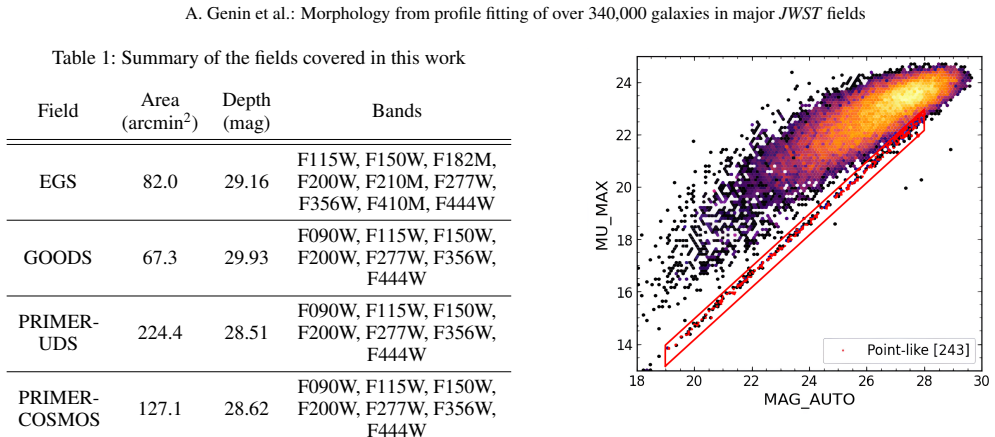
The carrying mechanism is dual-model surface brightness fitting inside SourceXtractor++: every galaxy is modeled both as a single Sérsic profile and as a bulge-plus-disk composite, with all shape parameters forced to be identical across NIRCam bands so that the fitted values are a weighted average over wavelength. Accurate fits depend on empirical point-spread functions built with PSFEx from point sources selected along the 'starline' in the magnitude-versus-peak-surface-brightness plane, and the resulting catalogs are cross-matched to the archive's SExtractor and eazy catalogs to attach photometric redshifts, stellar masses, and rest-frame colors. The consistency between the independently fitted Sérsic index and bulge-to-total ratio is what lets the paper classify galaxies as bulge- or disk-dominated and connect morphology to the $UVJ$ diagram.
What would settle it
Inject synthetic galaxies with known Sérsic parameters and realistic fluxes into the DJA mosaics, run the same SourceXtractor++ pipeline, and compare recovered $R_e$ and $n_S$ with the inputs; a systematic offset larger than the quoted uncertainties at S/N>10 would disprove the catalog's stated accuracy.
Extended reading notes
Core claim
The central claim is that a uniform, flux-limited sample of over 340,000 JWST-detected galaxies in CEERS, PRIMER-UDS, PRIMER-COSMOS, and GOODS can be reliably characterized by two-dimensional profile fitting, yielding consistent structural parameters across two independent models. For each source, SourceXtractor++ fits both a single Sérsic profile and a bulge-plus-disk decomposition in which the bulge follows a de Vaucouleurs profile and the disk is exponential; the effective radii, Sérsic index, axis ratio, and position angle are constrained to be identical across all NIRCam bands, so the reported values represent a wavelength-averaged morphology over roughly 0.8--5\,µm. Using these measurements together with the archive's photometric redshifts and physical parameters, the paper reports that bulge-dominated galaxies (high $n_S$ and $B/T$) occupy the quiescent $UVJ$ region, that a minority population of quiescent disks and star-forming bulge-dominated galaxies persists beyond $z\sim3$, and that quiescent galaxies are markedly more compact, with $\Sigma_e$ roughly an order of magnitude higher at $z\sim4$ than at $z\sim1$. The paper interprets these trends as evidence that bulge growth and quenching are closely connected, with compact star-forming phases preceding quiescence.
Load-bearing premise
The load-bearing premise is that the empirical PSF models built from starline-selected point sources are accurate and that each galaxy's morphology is the same in every NIRCam band; if either fails, the fitted effective radii and Sérsic indices shift systematically and every Section 4 trend inherits that shift.
Editorial extensions
If this is right
- Users of the archive can now select galaxies by $R_e$, $n_S$, $B/T$, or axis ratio across four major fields without reprocessing the images, enabling statistical studies of rare populations such as quiescent galaxies at $z>3$.
- The observed bimodality, with quiescent disks and compact star-forming bulge-dominated galaxies coexisting beyond $z\sim3$, implies that morphology alone does not determine star formation state at early times.
- The order-of-magnitude increase in stellar mass surface density of quiescent galaxies from $z\sim1$ to $z\sim4$ constrains models in which high-redshift quenching happens in very dense stellar cores.
- The size evolution fits $r_e = R(1+z)^a$ for disk-, bulge-, and all-dominated samples provide direct quantitative targets for simulations of galaxy growth.
- Because the catalog supplies both total and component sizes, it allows separate evolution of bulges and disks to be tracked, showing bulge sizes are established early while disks keep growing.
Reading between the lines
- Editorial inference: forcing morphology to be identical across all NIRCam bands suppresses genuine color gradients; a band-by-band release of the same fits would show how much of the reported size evolution is a wavelength-averaging artifact.
- Editorial inference: the pipeline could be run on mock galaxies with known input profiles to map the bias and scatter of $R_e$ and $n_S$ as a function of signal-to-noise, providing corrections the current catalog does not include.
- Editorial inference: applying the same fitting to separate bands, or to rest-frame-optical-selected samples, could test whether the claimed quiescent disk population at $z>3$ is genuinely gas-poor or merely dust-reddened.
Editorial analysis
A structured set of objections, weighed in public.
Referee Report
Summary. The manuscript presents a JWST/NIRCam morphological catalog for over 340,000 galaxies spanning 0<z<12 in the CEERS/EGS, GOODS, and PRIMER fields, built from DJA v7 mosaics. SourceXtractor++ is used to fit both a single-Sérsic model and a bulge+disk (B+D) model, with morphological parameters constrained to be identical across all NIRCam bands. Completeness is quantified relative to the DJA catalogs (80.4% of S/N>3, magnitude-limited sources have both fits), and the Sérsic effective radii are validated against van der Wel et al. (2012) for 3,263 early-type galaxies. The science demonstrations link Sérsic index and B/T to UVJ colors, present size-redshift trends for bulge/disk and quiescent/star-forming galaxies, and show that quiescent galaxies have higher stellar mass surface densities at high redshift.
Significance. If the catalog is as uniform as claimed, it is a valuable community resource: it is one of the largest JWST morphology catalogs to date, with public code and catalog release, dual model fits, quantified completeness, and an external HST-based validation. The paper also makes testable claims about the morphology-star formation bimodality out to z>3 and about the high compactness of early quiescent galaxies. However, the headline uniformity claim is not yet fully supported: the band-averaging construction and the limited external validation leave open the possibility of field-dependent and wavelength-dependent systematics in the published sizes and Sérsic indices.
major comments (3)
- [Section 3.2, Table 1] The shared-shape constraint (R_eff, n_S, (a/b), and theta identical across all NIRCam bands) turns the published morphology into a weighted average over 0.8-5 micron whose effective rest-frame wavelength depends on the field's filter set and on each source's SED. EGS includes F182M, F210M, and F410M while GOODS and PRIMER do not, so a given galaxy type is not measured at the same rest-frame wavelength in all fields; this can create field-dependent offsets in R_eff and n_S that propagate into every comparison in Sect. 4. The external check in Sect. 3.5 is restricted to 3,263 early-type galaxies and rescales with a fixed slope (Eq. 1), so it does not test the wavelength-independence assumption for star-forming galaxies, for B+D parameters, or across fields. The paper should quantify this, for example by fitting short- and long-wavelength bands as separate groups and showing parameter stability, or by reporting a per-source effective wavelength and demonstrating that the science results are unchanged when the filter-dependent averaging is accounted for.
- [Section 3.2 and Sect. 4.1] The Bulge+Disk results are used as a primary morphology indicator (B/T) for the bulge/disk classification and for the UVJ bimodality claims, but they are not validated against any external two-component measurements. The B/T prior is described only as a 'bell curve' with a wavelength-dependent mean and spread, which is not enough to judge whether the recovered B/T values are prior-dominated for faint or low-surface-brightness galaxies. The internal consistency between n_S and B/T (Figs. 4-6) is expected from the same imaging and is not an independent check. Please add an external or simulated validation of B/T, or at minimum a prior-sensitivity analysis demonstrating that the classifications and the z>3 star-forming bulge population do not depend on the adopted prior.
- [Section 4.1, Eq. (2)] The redshift-independent UVJ cut is applied out to z=6 although the authors note that the criteria change with redshift. Because this selection defines the quiescent and star-forming samples used for the size evolution (Sect. 4.2) and Sigma_e trends (Sect. 4.3), the paper should show how many sources move across the boundary when a redshift-dependent UVJ criterion is used, particularly at z>3 where the quiescent sample is small. If the conclusions are robust to this choice, state that explicitly; if not, soften the wording of the claims.
minor comments (4)
- [Section 3.5, Fig. 3] The comparison with van der Wel et al. (2012) is reported only qualitatively; please provide median offset, scatter, and outlier fraction for R_eff and n_S, and state whether the comparison changes if the more complex redshift- and mass-dependent scaling from van der Wel et al. is used.
- [Sections 3.3.1 and 3.4] The 0.3 arcsec cross-match radius and the flag thresholds are set manually; a brief test showing that nearby alternative choices do not change the completeness or parameter distributions would strengthen the catalog description.
- [Fig. 7 caption] The phrase 'There evolution is modeled' should read 'Their evolution is modeled'.
- [Appendix B, Fig. B.1] The priors should be described numerically in the text or with explicit axis labels and values, since the current description does not allow the reader to reproduce the adopted priors.
Circularity Check
No significant circularity: the morphological catalog is measured directly from JWST imaging, and the science analysis is descriptive rather than predictive.
full rationale
The paper's central product, the morphological catalog, is derived by fitting Sersic and Bulge+Disk models directly to the JWST NIRCam images with SourceXtractor++. The morphological parameters are not obtained from the DJA photometric redshifts, masses, or rest-frame colors; those DJA products are used only afterward for the science analysis in Sect. 4. The size evolution fit r_e = R(1+z)^a in Sect. 4.2 is a descriptive least-squares fit to the authors' own measurements, not a prediction, and it is explicitly compared against external JWST-based studies. External validation in Sect. 3.5 uses van der Wel et al. (2012), an independent HST-based catalog, so that validation does not reduce to the paper's own inputs. Self-citations to DJA/DAWN papers and to co-authored JWST morphology studies are present but not load-bearing: the morphological measurements themselves do not depend on those cited results being true. The shared-shape constraint across bands (Sect. 3.2) and the empirical PSF reconstruction are potential sources of systematic error, and the wavelength-averaging caveat is acknowledged in Sect. 4.2, but these are accuracy concerns rather than circular reasoning. No step in the derivation chain equates a prediction to an input by construction, and no self-citation chain is invoked to force a conclusion. The paper is therefore self-contained against external benchmarks for its main deliverable.
Assumptions & free parameters
free parameters (5)
- Size evolution fit normalization R =
3.66±0.04 kpc (all galaxies); 4.02±0.04 (disk-dominated); 3.34±0.10 (bulge-dominated)
- Size evolution slope alpha =
-0.59±0.01 (all); -0.61±0.01 (disk); -0.87±0.04 (bulge)
- B/T prior mean and width =
not given numerically; mean and spread increase with wavelength
- PSF starline selection threshold and width =
not specified
- Cross-match radius and flag artifact thresholds =
0.3 arcsec; n_S>8.35, a/b>0.99, etc.
assumptions (6)
- standard math Lambda CDM cosmology with H0=67.4, Omega_m=0.315
- domain assumption Sérsic and Bulge+Disk profiles adequately model galaxy light distributions
- ad hoc to paper Morphological parameters are identical across all NIRCam bands (0.8-5 micron)
- domain assumption PSFEx accurately models the NIRCam PSF
- domain assumption The DJA eazy photometric redshifts and stellar masses are reliable
- ad hoc to paper The redshift-independent UVJ selection remains valid at z up to 6
Cite this review
Pith. "Pith review of DAWN JWST Archive: Morphology from profile fitting of over 340 000 galaxies in major fields." pith.science (2026). https://pith.science/paper/TZWXQ6JE
@misc{pith2026250521622,
  author       = {Pith},
  title        = {Pith review of: DAWN JWST Archive: Morphology from profile fitting of over 340 000 galaxies in major fields},
  year         = {2026},
  howpublished = {\url{https://pith.science/paper/TZWXQ6JE}},
  note         = {Machine review of arXiv:2505.21622}
}
abstract
To better understand how galaxies assemble their structure and evolve over cosmic time, we present a new catalog of morphological measurements for over 340,000 sources spanning $0 < z < 12$, derived from deep JWST NIRCam imaging across four major extragalactic fields (CEERS, PRIMER-UDS, PRIMER-COSMOS, GOODS) compiled in the DAWN JWST Archive (DJA). We perform two-dimensional surface brightness fitting for all galaxies in a uniform, flux-limited sample. Each galaxy is modeled with both a S\'ersic profile and a two-component (bulge and disk) decomposition, yielding consistent structural parameters - including effective radius, S\'ersic index, axis ratio, and bulge-to-total ratio ($B/T$). To demonstrate the scientific application of our morphology catalogs, we combined these measurements with DJA photometric redshifts, physical parameters and rest-frame colors, and investigated the relation between total, bulge and disk sizes, S\'ersic index ($n_S$), star formation activity, and redshift. Bulge-dominated galaxies (high $n_S$ and $B/T$) predominantly occupy the quiescent region of the $UVJ$ diagram, while disk-dominated galaxies are mostly star-forming. A significant bimodality persists, with quiescent disks and compact, bulge-dominated star-forming galaxies observed out to $z > 3$. Quiescent galaxies also show significantly higher stellar mass surface densities, nearly an order of magnitude greater at $z \sim 4$ than at $z \sim 1$. Our results confirm a strong and evolving link between morphology and star formation activity, and support a scenario in which bulge growth and quenching are closely connected. This work is a highly valuable addition to the DJA, adding a morphological dimension to this rich dataset and thus enabling a wider scientific application.
Figures


Figures from the paper (6 more)


Forward citations
Cited by 3 Pith papers
-
Spatial decomposition of Little Red Dots with JWST/NIRSpec IFU into broad-line red cores and narrow-line blue host galaxies
Spatially resolved JWST/NIRSpec IFU spectroscopy of five z~5 Little Red Dots shows blue continuum and narrow lines from extended hosts and red continuum plus broad Balmer features from compact cores.
-
Enhancing Galaxy Classification with U-Net Variational Autoencoders for Image Denoising
Applying a U-Net VAE denoising step to galaxy images before classification is reported to improve accuracy, reaching 97.45% with a GCNN on Galaxy10 DECaLS, although no direct noisy baseline is presented.
-
Morphologies of SAGAbg low-mass galaxies in Legacy Survey multi-band imaging: dependence on stellar masses, star-formation rates and low-redshift evolution
Low-mass star-forming galaxies are disk-dominated; their light concentration increases with stellar mass and decreases with sSFR, with bulges emerging near log(M*/M_sun) ~ 9.
Reference graph
Works this paper leans on
-
[1]
, " * write output.state after.block = add.period write newline
ENTRY address archiveprefix author booktitle chapter edition editor howpublished institution eprint journal key month note number organization pages publisher school series title type volume year label extra.label sort.label short.list INTEGERS output.state before.all mid.sentence after.sentence after.block FUNCTION init.state.consts #0 'before.all := #1 ...
-
[2]
write newline
" write newline "" before.all 'output.state := FUNCTION n.dashify 't := "" t empty not t #1 #1 substring "-" = t #1 #2 substring "--" = not "--" * t #2 global.max substring 't := t #1 #1 substring "-" = "-" * t #2 global.max substring 't := while if t #1 #1 substring * t #2 global.max substring 't := if while FUNCTION word.in bbl.in " " * FUNCTION format....
-
[3]
A., Toft , S., et al
Allen , N., Oesch , P. A., Toft , S., et al. 2025, , 698, A30
2025
-
[4]
M., Koo , D
Barro , G., Faber , S. M., Koo , D. C., et al. 2017, , 840, 47
2017
-
[5]
M., P \'e rez-Gonz \'a lez , P
Barro , G., Faber , S. M., P \'e rez-Gonz \'a lez , P. G., et al. 2013, , 765, 104
work page 2013
-
[6]
M., P \'e rez-Gonz \'a lez , P
Barro , G., Faber , S. M., P \'e rez-Gonz \'a lez , P. G., et al. 2014, , 791, 52
work page 2014
- [7]
-
[8]
B., & Ellis , R
Belli , S., Newman , A. B., & Ellis , R. S. 2019, , 874, 17
2019
Show all 84 references
-
[9]
M., McCleary, J
Berman, E. M., McCleary, J. E., Koekemoer, A. M., et al. 2024, The Astronomical Journal, 168, 174
2024
-
[10]
2011, in Astronomical Society of the Pacific Conference Series, Vol
Bertin , E. 2011, in Astronomical Society of the Pacific Conference Series, Vol. 442, Astronomical Data Analysis Software and Systems XX, ed. I. N. Evans , A. Accomazzi , D. J. Mink , & A. H. Rots , 435
2011
-
[11]
& Arnouts , S
Bertin , E. & Arnouts , S. 1996, Astronomy & Astrophysics Supplement Series, 117, 393
1996
-
[12]
2020, in Astronomical Society of the Pacific Conference Series, Vol
Bertin , E., Schefer , M., Apostolakos , N., et al. 2020, in Astronomical Society of the Pacific Conference Series, Vol. 527, Astronomical Data Analysis Software and Systems XXIX, ed. R. Pizzo , E. R. Deul , J. D. Mol , J. de Plaa , & H. Verkouter , 461
2020
-
[13]
V., & Coppi, P
Brammer, G., van Dokkum, P. V., & Coppi, P. 2008, The Astrophysical Journal, 686, 1503
2008
-
[14]
C., McLure , R
Carnall , A. C., McLure , R. J., Dunlop , J. S., et al. 2023, , 619, 716
2023
-
[15]
M., Bschorr , T
Carollo , C. M., Bschorr , T. J., Renzini , A., et al. 2013, , 773, 112
2013
-
[16]
Conselice , C. J. 2003, , 147, 1
2003
-
[17]
Conselice , C. J. 2014, , 52, 291
2014
-
[18]
2021, , 38, e035
Cortese , L., Catinella , B., & Smith , R. 2021, , 38, e035
2021
-
[19]
2005, , 626, 680
Daddi , E., Renzini , A., Pirzkal , N., et al. 2005, , 626, 680
2005
-
[20]
J., Abraham , R
Damjanov , I., McCarthy , P. J., Abraham , R. G., et al. 2009, , 695, 101
2009
-
[21]
J., Brammer , G., et al
de Graaff , A., Setton , D. J., Brammer , G., et al. 2024, Nature Astronomy [ [arXiv] 2404.05683 ]
2024 arXiv
-
[22]
1959, Handbuch der Physik, 53, 275
de Vaucouleurs , G. 1959, Handbuch der Physik, 53, 275
1959
-
[23]
& Burkert , A
Dekel , A. & Burkert , A. 2014, , 438, 1870
2014
-
[24]
G., Maiolino , R., et al
D'Eugenio , F., P \'e rez-Gonz \'a lez , P. G., Maiolino , R., et al. 2024, Nature Astronomy, 8, 1443
2024
-
[25]
T., McLure , R
Donnan , C. T., McLure , R. J., Dunlop , J. S., et al. 2024, [ [arXiv] 2403.03171 ]
2024 arXiv
-
[26]
J., Willott , C., Alberts , S., et al
Eisenstein , D. J., Willott , C., Alberts , S., et al. 2023, arXiv e-prints, arXiv:2306.02465
2023 arXiv
-
[27]
1996, in Second International Conference on Knowledge Discovery and Data Mining (KDD'96)
Ester , M., Kriegel , H.-P., Sander , J., & Xu , X. 1996, in Second International Conference on Knowledge Discovery and Data Mining (KDD'96). Proceedings of a conference held August 2-4, 226--331
1996
-
[28]
Fall , S. M. & Efstathiou , G. 1980, , 193, 189
1980
-
[29]
L., Bagley , M
Finkelstein , S. L., Bagley , M. B., Ferguson , H. C., et al. 2023, , 946, L13
2023
-
[30]
& Bolles, R
Fischler, M. & Bolles, R. 1981, Communications of the ACM, 24, 381
1981
-
[31]
A., Kocevski , D
Grogin , N. A., Kocevski , D. D., Faber , S. M., et al. 2011, , 197, 35
2011
-
[32]
Gunn , J. E. & Gott , III, J. R. 1972, , 176, 1
1972
-
[33]
E., Brammer , G
Heintz , K. E., Brammer , G. B., Watson , D., et al. 2025, , 693, A60
2025
-
[34]
Hubble , E. P. 1936, Realm of the Nebulae
1936
-
[35]
2024, , 964, 192
Ito , K., Valentino , F., Brammer , G., et al. 2024, , 964, 192
2024
-
[36]
D., Ding , X., et al
Kawinwanichakij , L., Silverman , J. D., Ding , X., et al. 2021, , 921, 38
2021
-
[37]
M., Aussel , H., Calzetti , D., et al
Koekemoer , A. M., Aussel , H., Calzetti , D., et al. 2007, , 172, 196
2007
-
[38]
M., Faber , S
Koekemoer , A. M., Faber , S. M., Ferguson , H. C., et al. 2011, , 197, 36
2011
-
[39]
2020, in Astronomical Society of the Pacific Conference Series, Vol
K \"u mmel , M., Bertin , E., Schefer , M., et al. 2020, in Astronomical Society of the Pacific Conference Series, Vol. 527, Astronomical Data Analysis Software and Systems XXIX, ed. R. Pizzo , E. R. Deul , J. D. Mol , J. de Plaa , & H. Verkouter , 29
2020
-
[40]
B., Tinsley , B
Larson , R. B., Tinsley , B. M., & Caldwell , C. N. 1980, , 237, 692
1980
-
[41]
2007, The Astrophysical Journal Supplement Series, 172, 219
Leauthaud , A., Massey , R., Kneib , J.-P., et al. 2007, The Astrophysical Journal Supplement Series, 172, 219
2007
-
[42]
J., Schawinski , K., Slosar , A., et al
Lintott , C. J., Schawinski , K., Slosar , A., et al. 2008, , 389, 1179
2008
-
[43]
M., Primack , J., & Madau , P
Lotz , J. M., Primack , J., & Madau , P. 2004, , 128, 163
2004
-
[44]
J., Brammer , G., et al
Matharu , J., Nelson , E. J., Brammer , G., et al. 2024, , 690, A64
2024
-
[45]
J., Mao , S., & White , S
Mo , H. J., Mao , S., & White , S. D. M. 1998, , 295, 319
1998
-
[46]
1996, , 379, 613
Moore , B., Katz , N., Lake , G., Dressler , A., & Oemler , A. 1996, , 379, 613
1996
-
[47]
1998, , 495, 139
Moore , B., Lake , G., & Katz , N. 1998, , 495, 139
1998
-
[48]
M., Ellis , R
Moran , S. M., Ellis , R. S., Treu , T., et al. 2007, , 671, 1503
2007
-
[49]
2014, , 785, 18
Morishita , T., Ichikawa , T., & Kajisawa , M. 2014, , 785, 18
2014
-
[50]
2018, , 479, 2147
Moutard , T., Sawicki , M., Arnouts , S., et al. 2018, , 479, 2147
2018
-
[51]
B., Ellis , R
Newman , A. B., Ellis , R. S., Bundy , K., & Treu , T. 2012, , 746, 162
2012
-
[52]
Oke, J. B. 1974, ApJS, 27, 21
1974
-
[53]
Omand , C. M. B., Balogh , M. L., & Poggianti , B. M. 2014, , 440, 843
2014
-
[54]
J., Adams , N
Ormerod , K., Conselice , C. J., Adams , N. J., et al. 2024, MNRAS, 527, 6110
2024
-
[55]
G., Holden , B
Patel , S. G., Holden , B. P., Kelson , D. D., et al. 2012, , 748, L27
2012
-
[56]
J., Kovac, K., et al
Peng, Y., Lilly, S. J., Kovac, K., et al. 2010, , 721, 193, arXiv: 1003.4747
2010 arXiv
-
[57]
2020, , 641, A6
Planck Collaboration , Aghanim , N., Akrami , Y., et al. 2020, , 641, A6
2020
-
[58]
& de Lapparent , V
Quilley , L. & de Lapparent , V. 2022, , 666, A170
2022
-
[59]
2005, in SPIE Optics + Photonics, Vol
Rieke, M., Kelly, D., & Horner, S. 2005, in SPIE Optics + Photonics, Vol. 5904
2005
-
[60]
Rix , H.-W., Barden , M., Beckwith , S. V. W., et al. 2004, , 152, 163
2004
-
[61]
2018, reproject: astronomical image reprojection in Python
Robitaille , T. 2018, reproject: astronomical image reprojection in Python
2018
-
[62]
M., Simmons, B
Schawinski, K., Urry, C. M., Simmons, B. D., et al. 2014, Monthly Notices of the Royal Astronomical Society, 440, 889, arXiv: 1402.4814
2014 arXiv
-
[63]
2016, , 589, A35
Schreiber , C., Elbaz , D., Pannella , M., et al. 2016, , 589, A35
2016
-
[64]
S \'e rsic , J. L. 1963, Boletin de la Asociacion Argentina de Astronomia La Plata Argentina, 6, 41
1963
-
[65]
J., White , S
Shen , S., Mo , H. J., White , S. D. M., et al. 2003, , 343, 978
2003
-
[66]
2015, , 219, 15
Shibuya , T., Ouchi , M., & Harikane , Y. 2015, , 219, 15
2015
-
[67]
S., Behroozi , P., Pandya , V., et al
Somerville , R. S., Behroozi , P., Pandya , V., et al. 2018, , 473, 2714
2018
-
[68]
M., F \"o rster Schreiber , N
Tacchella , S., Carollo , C. M., F \"o rster Schreiber , N. M., et al. 2018, , 859, 56
2018
-
[69]
M., Renzini , A., et al
Tacchella , S., Carollo , C. M., Renzini , A., et al. 2015, Science, 348, 314
2015
-
[70]
M., et al
Tacchella , S., Dekel , A., Carollo , C. M., et al. 2016, , 458, 242
2016
-
[71]
2017, , 546, 510
Toft , S., Zabl , J., Richard , J., et al. 2017, , 546, 510
2017
-
[72]
J., Bundy , K., et al
Trujillo , I., Conselice , C. J., Bundy , K., et al. 2007, , 382, 109
2007
-
[73]
Valentino , F., Brammer , G., Gould , K. M. L., et al. 2023, , 947, 20
2023
-
[74]
F., H \"a ussler , B., et al
van der Wel , A., Bell , E. F., H \"a ussler , B., et al. 2012, , 203, 24
2012
-
[75]
G., et al
van der Wel , A., Franx , M., van Dokkum , P. G., et al. 2014, , 788, 28
2014
-
[76]
G., Nelson , E
van Dokkum , P. G., Nelson , E. J., Franx , M., et al. 2015, , 813, 23
2015
-
[77]
G., Bowler , R
Varadaraj , R. G., Bowler , R. A. A., Jarvis , M. J., et al. 2024, , 533, 3724
2024
-
[78]
A., Barrufet , L., et al
Weibel , A., Oesch , P. A., Barrufet , L., et al. 2024, , 533, 1808
2024
-
[79]
E., Bezanson , R., van Dokkum , P
Whitaker , K. E., Bezanson , R., van Dokkum , P. G., et al. 2017, , 838, 19
2017
-
[80]
J., Quadri , R
Williams , R. J., Quadri , R. F., Franx , M., van Dokkum , P., & Labb \'e , I. 2009, , 691, 1879
2009
-
[81]
E., Weaver , J
Wright , L., Whitaker , K. E., Weaver , J. R., et al. 2024, , 964, L10
2024
-
[82]
S., Franco, M., et al
Yang, L., Kartaltepe, J. S., Franco, M., et al. 2025, COSMOS-Web: Unraveling the Evolution of Galaxy Size and Related Properties at 2<z<10
2025
-
[83]
G., Adelman , J., Anderson , John E., J., et al
York , D. G., Adelman , J., Anderson , John E., J., et al. 2000, , 120, 1579
2000
-
[84]
2015, , 450, 2327
Zolotov , A., Dekel , A., Mandelker , N., et al. 2015, , 450, 2327
2015
Reviewed August 7, 2026 · model on record in the stance chip above.
Discussion (0). Sign in to comment.