REVIEW 4 major objections 5 minor 2 cited by
BaryIR: Learning Multi-Source Unified Representation in Continuous Barycenter Space for Generalizable All-in-One Image Restoration
T0 review · 4 major / 5 minor · reviewed 2026-08-07 · deepseek-v4-flash
Pith's one-line read BaryIR claims that writing latent codes as a continuous optimal-transport barycenter plus source-specific residuals yields a single all-in-one restoration model that generalizes to unseen degradations and real images.
desk verdict BaryIR's empirical claim is credible and its barycenter decomposition idea is fresh; read it with the 'unseen degradations' phrasing discounted to 'unseen levels and real-domain variants.' read the letter →
The pith
A machine-rendered reading of the paper's core claim, the machinery that carries it, and where it could break.
The reading
What carries the argument
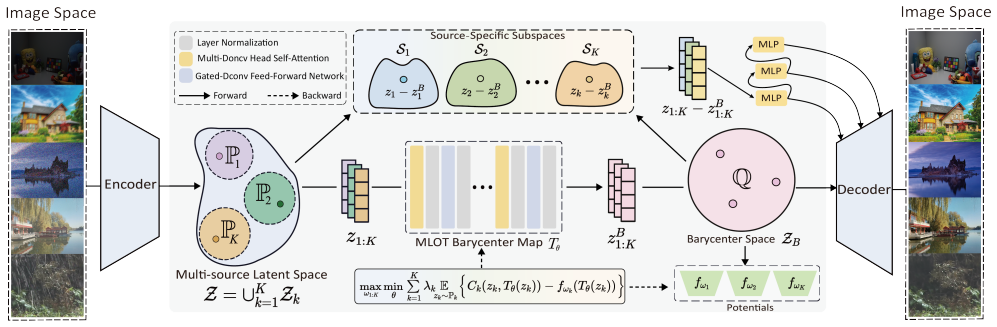
The load-bearing object is the continuous barycenter map $T:\mathcal{Z}\to\mathcal{Z}_B$ obtained from the multi-source latent optimal transport (MLOT) barycenter problem. Instead of aligning sources to discrete codes, BaryIR trains a neural map that transports each source's latent distribution to a common barycenter distribution, with transport costs that (i) contrast source-specific residuals across sources and (ii) keep residuals orthogonal to barycenter codes. The dual formulation in Theorem 4.1 permits a maximin training objective, and Theorem 4.2 gives a bound on the Wasserstein-2 distance between the recovered pushforwards and the true barycenter pushforwards; this bound is what the paper cites as the approximation guarantee for the map.
What would settle it
Train BaryIR on the three- or five-degradation sets and test on an out-of-distribution degradation with no visual overlap with training, such as snow, spatially varying dense fog, or structured noise. If the barycenter codes of such inputs do not cluster by image content rather than by degradation in a t-SNE plot, or if BaryIR's PSNR on that out-of-distribution set is no better than a model decoding only original features, the central claim is falsified.
Extended reading notes
Core claim
On its own terms, the paper's discovery is that a unified representation for multi-source degraded images can be learned as a continuous optimal-transport barycenter rather than as a discrete codebook or prompt. BaryIR instantiates this by solving a multi-source latent optimal transport (MLOT) barycenter problem: given source distributions $P_k$ over latent codes $z_k$, it learns a map $T:\mathcal{Z}\to\mathcal{Z}_B$ pushing each $z_k$ to a barycenter code $z_k^B$, with transport cost $C_k(z_k,z_k^B)=\|z_k-z_k^B\|+\gamma(\mathcal{L}^{\mathrm{ctr}}_k+\mathcal{L}^{\mathrm{ort}}_k)$, where $\mathcal{L}^{\mathrm{ctr}}_k$ contrasts source-specific residuals across degradations and $\mathcal{L}^{\mathrm{ort}}_k$ enforces orthogonality between residuals and barycenters. A dual reformulation turns the barycenter problem into a maximin game over potential functions $f_k$ and the map $T$, which is trained end-to-end as neural networks. The paper further proves an error bound on the recovered map in terms of duality gaps under a $\beta$-strong-convexity condition, and presents experiments showing that the barycenter representation alone already improves generalization, while adding source-specific residuals gives the best in-distribution and out-of-distribution results.
Load-bearing premise
The whole transfer story depends on the learned barycenter map being genuinely degradation-agnostic for inputs whose degradation type or level was unseen in training, and on the source-specific subspaces staying informative for those inputs; the paper's error bound does not establish this because its strong-convexity assumption and duality gaps are never verified.
Editorial extensions
If this is right
- On the three-degradation and five-degradation all-in-one benchmarks, the paper's tables report BaryIR ahead of previous all-in-one models on average PSNR, SSIM, LPIPS, and FID, with average gains over InstructIR of 0.42 dB and 1.11 dB respectively.
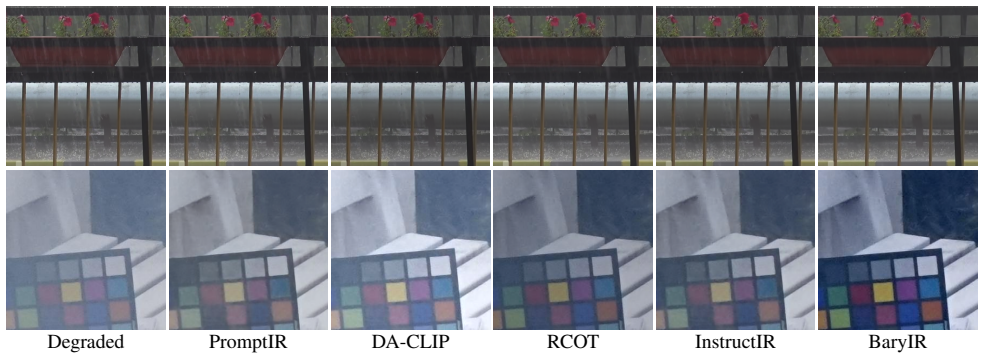
- On unseen real-world datasets O-HAZE and SPANet, BaryIR reports PSNR gains of 3.81 dB and 2.73 dB over the second-best method, and lower no-reference scores on mixed-degradation images.
- For unseen degradation levels, BaryIR reports a 2.80 dB gain over InstructIR on Rain100L deraining and a 3.30 dB gain at $\sigma=75$ denoising.
- The ablation study shows that the barycenter representation alone already improves generalization, and that adding source-specific residuals yields the full model's best results.
- Because the method is agnostic to degradation type beyond the transport cost design, the same barycenter-decomposition scheme can be applied to other multi-source restoration settings.
Reading between the lines
- If the barycenter is truly degradation-agnostic, then removing the source-specific branch at inference should degrade in-distribution performance only mildly but should dominate on out-of-distribution inputs; the paper's Table 7 partly supports this, and a broader sweep over out-of-distribution types would sharpen the claim.
- The MLOT objective's contrastive and orthogonality terms are generic representation-learning devices; they could be transplanted to other unified-representation problems, such as multi-modal retrieval, where one wants shared content separated from source identity.
- The theoretical guarantee in Theorem 4.2 is conditional on quantities the paper does not compute; computing the duality gaps $E_1,E_2$ and checking $\beta$-strong-convexity on the learned costs would turn the heuristic justification into a quantitative one.
- Using cosine similarity for both the contrastive loss and orthogonality suggests that scale invariance may be important; a natural next experiment is testing BaryIR with feature normalization removed to see whether the gains come from the geometry or from normalization.
Editorial analysis
A structured set of objections, weighed in public.
Referee Report
Summary. The paper proposes BaryIR, an all-in-one image restoration method that decomposes the latent space of degraded images into a continuous optimal transport barycenter space and source-specific subspaces. The barycenter map is learned via a multi-source latent OT (MLOT) objective with source-level contrastive and barycenter-anchored orthogonality losses, and the paper provides a theoretical error bound (Theorem 4.2) for the recovered barycenter map. Experiments on three-degradation and five-degradation benchmarks show competitive or superior PSNR/SSIM/LPIPS/FID relative to existing all-in-one methods, and additional experiments on real-world datasets and unseen degradation levels are reported. The central claim is that BaryIR 'exhibits superior generalization ability to real-world data and unseen degradations.'
Significance. If the generalization claim holds, the paper makes a useful contribution to all-in-one image restoration by introducing a continuous barycenter representation with an explicit geometric interpretation, along with strong empirical results on standard benchmarks. The paper includes a clear ablation study showing the contribution of the barycenter representation and the two loss terms, and it promises code release, which would support reproducibility. However, the headline generalization claim is currently supported only for unseen levels and real-domain variants of the degradation families seen in training, not for genuinely unseen degradation types. The theoretical error bound is not connected to the experiments because its key assumptions and duality gaps are never verified or computed, and the proof is deferred to an absent supplementary. These issues are fixable, but they are load-bearing for the paper's central claim.
major comments (4)
- [§5.2-5.3, Tables 3-6] The abstract's claim that BaryIR 'exhibits superior generalization ability to ... unseen degradations' is not supported by the experimental design: every out-of-distribution evaluation is either a real-domain instance of a degradation family seen in training (O-HAZE for haze, SPANet for rain), a mixture whose components are all trained degradation types (Table 4), or an unseen level of a trained type (sigma=60/75 in Table 6, Rain100L in Table 5). No experiment holds out an entire degradation type, so the empirical evidence only supports generalization to unseen levels and unseen real-domain instances of known degradation families. Please add a held-out-type experiment (for example, train without low-light or snow and test on that type) or amend the abstract and conclusion to match the evidence.
- [§4.2, Theorem 4.2, Eq. (4)] The error bound in Theorem 4.2 rests on (i) a uniform beta-strong-convexity assumption on the maps z_B -> C_k(z_k, z_B) - \hat{f}_k(z_B), (ii) duality gaps E1 and E2, and (iii) a proof deferred to an unavailable supplementary. None of these is verified in the paper: the base cost ||z_k - z_B|| is convex but not strongly convex, and the losses L_ctr_k and L_ort_k in Eq. (4) are defined over mini-batch samples, so C_k is not a function of the single pair (z_k, z_B) as the theorem notation requires. Since the bound is proportional to (E1 + E2)/beta, and E1/E2 are never reported, the theorem currently has no empirical content. Please provide the proof, verify the strong-convexity assumption for the actual implemented cost (or weaken the theorem accordingly), and report the duality gaps in the experiments.
- [§4.3, Fig. 2, §3.2] The source-specific subspaces S_k and the representation s_k = z_k - z_B are defined relative to the K training degradation types. For an input whose degradation type was not among the training sources, the component z - T(z) has no learned degradation-specific semantics, because there is no source index k and the contrastive/orthogonal losses never constrain that input's subspace. Consequently, the architecture does not itself provide a mechanism for transferring source-specific information to genuinely new degradation types. The generalization results in Tables 3-6 concern inputs that remain inside the training source types (in level or domain, but not in type), so they do not establish the broader claim.
- [§5.4, Table 7, Fig. 6] The ablation shows that the barycenter representation alone improves generalization on O-HAZE and SPANet, but those datasets are real-domain variants of the trained haze and rain sources. The t-SNE visualization in Fig. 6 uses only the training degradation types (noise, rain, haze), so it cannot demonstrate that the barycenter space is degradation-agnostic for an unseen type. Please add an analysis with a held-out degradation type, or explicitly limit the interpretation of the ablation and visualization to the trained source types.
minor comments (5)
- [§5.1, five-degradation paragraph] The sentence 'BaryIR also proceeds InstructIR with 4.11 dB PSNR gain' should read 'BaryIR also surpasses InstructIR' (or 'outperforms InstructIR').
- [§5.1, five-degradation paragraph] The sentence 'BaryIR excels InstructIR with an average PSNR gain of 1.11 dB' is grammatically awkward; consider 'BaryIR excels over InstructIR' or 'BaryIR outperforms InstructIR'.
- [§5.2, Table 4] The mixed-degradation evaluation in Table 4 uses no-reference metrics (NIQE, PIQE), while all other tables use reference-based metrics; please state explicitly why no-reference metrics are appropriate here and, if possible, report at least one reference-based metric on the real-world mixed images.
- [§5.3] Section 5.3 says three-degradation models are trained for dehazing, deraining, and denoising, but only deraining and denoising out-of-distribution results are reported; if dehazing generalization was evaluated, the results should be included, otherwise the omission should be noted.
- [Throughout] Many implementation details, the proof of Theorem 4.2, and the ablation for the weights lambda_{1:K} are deferred to a supplementary that is not included with the manuscript; please provide the supplementary or move the most important details into the main text so the submission is self-contained.
Circularity Check
No significant circularity: BaryIR's central claims are empirically evaluated, and its theoretical bounds, while unverified in assumptions, are not restatements of the inputs.
full rationale
BaryIR's derivation chain is self-contained rather than circular. The barycenter map T is trained with the MLOT objective; the decomposition z_k = T(z_k) + (z_k - T(z_k)) is tautological, but the paper's substantive claims (that the barycenter representation is degradation-agnostic and useful for restoration, and that it transfers to unseen levels and real-world variants) are not entailed by that definition and are tested on held-out benchmarks (Tables 1-6, O-HAZE, SPANet, unseen sigma). The self-citations (e.g., RCOT [42], degradation-aware RCOT [43]) are used as baselines or related work, not as load-bearing justification. Theorem 4.2 is a conditional error bound depending on beta-strong convexity and duality gaps E1, E2 that are not computed; this is an unverified assumption, not a circular step, because the bound does not assume the conclusion it is used to support. The only notable gap is that 'unseen degradations' in the abstract is broader than the experimental protocol, which varies degradation levels and real-domain instances within the five trained families; that is an overclaim relative to the evidence, not a circularity.
Assumptions & free parameters
free parameters (3)
- gamma (loss weight for L_ctr and L_ort in transport cost) =
not reported
- tau (temperature in source-level contrastive loss) =
not reported
- lambda_k (barycenter weights) =
set to sample proportions per source
assumptions (6)
- standard math Compactness of X, Y, Z_B and integrability conditions for OT dual
- standard math Rockafellar interchange theorem for exchanging infimum and integral in Eq. (8)
- ad hoc to paper Beta-strong convexity of C_k(z_k, y) - f_k(y) uniformly over z_k
- domain assumption The latent representations of K degradation types form well-separated source distributions with a meaningful common barycenter
- domain assumption Barycenter plus source-specific representations are sufficient for decoding clean images
- domain assumption The adversarial maximin training converges to a useful solution of the MLOT barycenter problem
Cite this review
Pith. "Pith review of BaryIR: Learning Multi-Source Unified Representation in Continuous Barycenter Space for Generalizable All-in-One Image Restoration." pith.science (2026). https://pith.science/paper/F4VZBTER
@misc{pith2026250521637,
  author       = {Pith},
  title        = {Pith review of: BaryIR: Learning Multi-Source Unified Representation in Continuous Barycenter Space for Generalizable All-in-One Image Restoration},
  year         = {2026},
  howpublished = {\url{https://pith.science/paper/F4VZBTER}},
  note         = {Machine review of arXiv:2505.21637}
}
read the original abstract
Despite remarkable advances made in all-in-one image restoration (AIR) for handling different types of degradations simultaneously, existing methods remain vulnerable to out-of-distribution degradations and images, limiting their real-world applicability. In this paper, we propose a multi-source representation learning framework BaryIR, which decomposes the latent space of multi-source degraded images into a continuous barycenter space for unified feature encoding and source-specific subspaces for specific semantic encoding. Specifically, we seek the multi-source unified representation by introducing a multi-source latent optimal transport barycenter problem, in which a continuous barycenter map is learned to transport the latent representations to the barycenter space. The transport cost is designed such that the representations from source-specific subspaces are contrasted with each other while maintaining orthogonality to those from the barycenter space. This enables BaryIR to learn compact representations with unified degradation-agnostic information from the barycenter space, as well as degradation-specific semantics from source-specific subspaces, capturing the inherent geometry of multi-source data manifold for generalizable AIR. Extensive experiments demonstrate that BaryIR achieves competitive performance compared to state-of-the-art all-in-one methods. Particularly, BaryIR exhibits superior generalization ability to real-world data and unseen degradations. The code will be publicly available at https://github.com/xl-tang3/BaryIR.
Figures


Figures from the paper (3 more)


Forward citations
Cited by 2 Pith papers
-
MoCRA: Mixture of Compositional Rank-1 Atoms for 4K All-in-One Video Restoration
A single 3.6M-parameter model, MoCRA, restores haze, rain, noise, and low light at native 4K in 0.48 seconds per frame, besting eleven retrained baselines on the mean PSNR of the authors' new UHV-4K-AIO benchmark.
-
ClusIR: Towards Cluster-Guided All-in-One Image Restoration
A cluster-guided mixture-of-experts network with frequency modulation reports competitive all-in-one image restoration results, with uneven gains and no public code.
Reference graph
Works this paper leans on
-
[1]
Yuang Ai, Huaibo Huang, and Ran He. Lora-ir: Taming low- rank experts for efficient all-in-one image restoration.arXiv preprint arXiv:2410.15385, 2024. 1
arXiv 2024
-
[2]
O-haze: a dehazing bench- mark with real hazy and haze-free outdoor images
Codruta Ancuti, Cosmin Ancuti, Radu Timofte, and Christophe De Vleeschouwer. O-haze: a dehazing bench- mark with real hazy and haze-free outdoor images. In CVPRW, pages 754–762, 2018. 5, 7
work page 2018
-
[3]
Robust cross-modal representation learning with progressive self- distillation
Alex Andonian, Shixing Chen, and Raffay Hamid. Robust cross-modal representation learning with progressive self- distillation. InCVPR, pages 16430–16441, 2022. 2
work page 2022
-
[4]
Speecht5: Unified-modal encoder-decoder pre-training for spoken language processing
Junyi Ao, Rui Wang, Long Zhou, Chengyi Wang, Shuo Ren, Yu Wu, Shujie Liu, Tom Ko, Qing Li, Yu Zhang, et al. Speecht5: Unified-modal encoder-decoder pre-training for spoken language processing. InACL, pages 5723–5738,
-
[5]
Contour detection and hierarchical image seg- mentation.IEEE TPAMI, 33(5):898–916, 2010
Pablo Arbelaez, Michael Maire, Charless Fowlkes, and Ji- tendra Malik. Contour detection and hierarchical image seg- mentation.IEEE TPAMI, 33(5):898–916, 2010. 7
work page 2010
-
[6]
Simple baselines for image restoration
Liangyu Chen, Xiaojie Chu, Xiangyu Zhang, and Jian Sun. Simple baselines for image restoration. InECCV, pages 17– 33, 2022. 1
work page 2022
-
[7]
Learning a low- level vision generalist via visual task prompt
Xiangyu Chen, Yihao Liu, Yuandong Pu, Wenlong Zhang, Jiantao Zhou, Yu Qiao, and Chao Dong. Learning a low- level vision generalist via visual task prompt. InACMMM, pages 2671–2680, 2024. 2
work page 2024
-
[8]
Uniter: Universal image-text representation learning
Yen-Chun Chen, Linjie Li, Licheng Yu, Ahmed El Kholy, Faisal Ahmed, Zhe Gan, Yu Cheng, and Jingjing Liu. Uniter: Universal image-text representation learning. InECCV, pages 104–120. Springer, 2020. 2
work page 2020
Show all 59 references
-
[9]
Variational wasserstein barycenters with c- cyclical monotonicity regularization
Jinjin Chi, Zhiyao Yang, Ximing Li, Jihong Ouyang, and Renchu Guan. Variational wasserstein barycenters with c- cyclical monotonicity regularization. InAAAI, pages 7157– 7165, 2023. 3
2023
-
[10]
Instruc- tir: High-quality image restoration following human instruc- tions
Marcos V Conde, Gregor Geigle, and Radu Timofte. Instruc- tir: High-quality image restoration following human instruc- tions. InECCV, pages 1–21. Springer, 2024. 1, 2, 5, 6, 7
2024
-
[11]
Adair: Adaptive all-in-one image restoration via frequency mining and mod- ulation
Yuning Cui, Syed Waqas Zamir, Salman Khan, Alois Knoll, Mubarak Shah, and Fahad Shahbaz Khan. Adair: Adaptive all-in-one image restoration via frequency mining and mod- ulation. InICLR, 2025. 1, 2
2025
-
[12]
An image is worth 16x16 words: Transformers for image recognition at scale
Alexey Dosovitskiy, Lucas Beyer, Alexander Kolesnikov, Dirk Weissenborn, Xiaohua Zhai, Thomas Unterthiner, Mostafa Dehghani, Matthias Minderer, Georg Heigold, Syl- vain Gelly, Jakob Uszkoreit, and Neil Houlsby. An image is worth 16x16 words: Transformers for image recognition ...
2021
-
[13]
Multi-modal alignment us- ing representation codebook
Jiali Duan, Liqun Chen, Son Tran, Jinyu Yang, Yi Xu, Be- linda Zeng, and Trishul Chilimbi. Multi-modal alignment us- ing representation codebook. InCVPR, pages 15651–15660,
-
[14]
Deep residual learning for image recognition
Kaiming He, Xiangyu Zhang, Shaoqing Ren, and Jian Sun. Deep residual learning for image recognition. InCVPR, pages 770–778, 2016. 1
2016
-
[15]
A survey on all-in-one image restoration: Taxonomy, evaluation and future trends.arXiv preprint arXiv:2410.15067, 2024
Junjun Jiang, Zengyuan Zuo, Gang Wu, Kui Jiang, and Xianming Liu. A survey on all-in-one image restoration: Taxonomy, evaluation and future trends.arXiv preprint arXiv:2410.15067, 2024. 1
2024 arXiv
-
[16]
On the translocation of masses
Leonid V Kantorovich. On the translocation of masses. In Dokl. Akad. Nauk. USSR (NS), pages 199–201, 1942. 3
1942
-
[17]
Continuous wasserstein-2 barycenter es- timation without minimax optimization
Alexander Korotin, Lingxiao Li, Justin Solomon, and Evgeny Burnaev. Continuous wasserstein-2 barycenter es- timation without minimax optimization. InICLR, 2021. 3
2021
-
[18]
A comparative study for single im- age blind deblurring
Wei-Sheng Lai, Jia-Bin Huang, Zhe Hu, Narendra Ahuja, and Ming-Hsuan Yang. A comparative study for single im- age blind deblurring. InCVPR, pages 1701–1709, 2016. 7
2016
-
[19]
Deep laplacian pyramid networks for fast and accurate super-resolution
Wei-Sheng Lai, Jia-Bin Huang, Narendra Ahuja, and Ming- Hsuan Yang. Deep laplacian pyramid networks for fast and accurate super-resolution. InCVPR, pages 624–632, 2017. 1
2017
-
[20]
Fast and accurate image super-resolution with deep laplacian pyramid networks.IEEE TPAMI, 41(11): 2599–2613, 2018
Wei-Sheng Lai, Jia-Bin Huang, Narendra Ahuja, and Ming- Hsuan Yang. Fast and accurate image super-resolution with deep laplacian pyramid networks.IEEE TPAMI, 41(11): 2599–2613, 2018. 1
2018
-
[21]
Towards fully autonomous driving: Systems and algorithms
Jesse Levinson, Jake Askeland, Jan Becker, Jennifer Dolson, David Held, Soeren Kammel, J Zico Kolter, Dirk Langer, Oliver Pink, Vaughan Pratt, et al. Towards fully autonomous driving: Systems and algorithms. In2011 IEEE Intelligent Vehicles Symposium (IV), pages 163–168. IEEE, 2011. 1
2011
-
[22]
Benchmarking single- image dehazing and beyond.IEEE TIP, 28(1):492–505,
Boyi Li, Wenqi Ren, Dengpan Fu, Dacheng Tao, Dan Feng, Wenjun Zeng, and Zhangyang Wang. Benchmarking single- image dehazing and beyond.IEEE TIP, 28(1):492–505,
-
[23]
All-in-one image restoration for unknown cor- ruption
Boyun Li, Xiao Liu, Peng Hu, Zhongqin Wu, Jiancheng Lv, and Xi Peng. All-in-one image restoration for unknown cor- ruption. InCVPR, pages 17452–17462, 2022. 1, 2
2022
-
[24]
Continuous regularized wasserstein barycenters
Lingxiao Li, Aude Genevay, Mikhail Yurochkin, and Justin M Solomon. Continuous regularized wasserstein barycenters. InNeurIPS, pages 17755–17765, 2020. 3
2020
-
[25]
Swinir: Image restoration us- ing swin transformer
Jingyun Liang, Jiezhang Cao, Guolei Sun, Kai Zhang, Luc Van Gool, and Radu Timofte. Swinir: Image restoration us- ing swin transformer. InICCV, pages 1833–1844, 2021. 1
2021
-
[26]
Deep continuous fusion for multi-sensor 3d object detection
Ming Liang, Bin Yang, Shenlong Wang, and Raquel Urtasun. Deep continuous fusion for multi-sensor 3d object detection. InECCV, pages 641–656, 2018. 1
2018
-
[27]
Cross-modal dis- crete representation learning
Alexander Liu, SouYoung Jin, Cheng-I Lai, Andrew Rou- ditchenko, Aude Oliva, and James Glass. Cross-modal dis- crete representation learning. InACL, pages 3013–3035. 2
-
[28]
Unifying image pro- cessing as visual prompting question answering
Yihao Liu, Xiangyu Chen, Xianzheng Ma, Xintao Wang, Jiantao Zhou, Yu Qiao, and Chao Dong. Unifying image pro- cessing as visual prompting question answering. InICML, pages 30873–30891. PMLR, 2024. 1
2024
-
[29]
Swin transformer: Hierarchical vision transformer using shifted windows
Ze Liu, Yutong Lin, Yue Cao, Han Hu, Yixuan Wei, Zheng Zhang, Stephen Lin, and Baining Guo. Swin transformer: Hierarchical vision transformer using shifted windows. In CVPR, pages 10012–10022, 2021. 1
2021
-
[30]
UNIFIED-IO: A unified model for vision, language, and multi-modal tasks
Jiasen Lu, Christopher Clark, Rowan Zellers, Roozbeh Mot- taghi, and Aniruddha Kembhavi. UNIFIED-IO: A unified model for vision, language, and multi-modal tasks. InICLR,
-
[31]
Image restoration with mean-reverting stochastic differential equations
Ziwei Luo, Fredrik K Gustafsson, Zheng Zhao, Jens Sj¨olund, and Thomas B Sch¨on. Image restoration with mean-reverting stochastic differential equations. InICML, pages 23045– 23066. PMLR, 2023. 1, 5, 6, 7 9
2023
-
[32]
Controlling vision-language models for multi-task image restoration
Ziwei Luo, Fredrik K Gustafsson, Zheng Zhao, Jens Sj¨olund, and Thomas B Sch ¨on. Controlling vision-language models for multi-task image restoration. InThe Twelfth ICLR, 2024. 1, 2, 5, 6, 7
2024
-
[33]
Waterloo ex- ploration database: New challenges for image quality assess- ment models.IEEE TIP, 26(2):1004–1016, 2016
Kede Ma, Zhengfang Duanmu, Qingbo Wu, Zhou Wang, Hongwei Yong, Hongliang Li, and Lei Zhang. Waterloo ex- ploration database: New challenges for image quality assess- ment models.IEEE TIP, 26(2):1004–1016, 2016. 7
2016
-
[34]
completely blind
Anish Mittal, Rajiv Soundararajan, and Alan C Bovik. Mak- ing a “completely blind” image quality analyzer.IEEE Sig- nal Processing Letters (SPL), 20(3):209–212, 2012. 7
2012
-
[35]
Promptir: Prompting for all-in-one blind image restoration.NeurIPS, 2023
Vaishnav Potlapalli, Syed Waqas Zamir, Salman Khan, and Fahad Shahbaz Khan. Promptir: Prompting for all-in-one blind image restoration.NeurIPS, 2023. 1, 2, 5, 6, 7
2023
-
[36]
Multi- modal fusion transformer for end-to-end autonomous driv- ing
Aditya Prakash, Kashyap Chitta, and Andreas Geiger. Multi- modal fusion transformer for end-to-end autonomous driv- ing. InCVPR, pages 7077–7087, 2021. 1
2021
-
[37]
Learn- ing transferable visual models from natural language super- vision
Alec Radford, Jong Wook Kim, Chris Hallacy, Aditya Ramesh, Gabriel Goh, Sandhini Agarwal, Girish Sastry, Amanda Askell, Pamela Mishkin, Jack Clark, et al. Learn- ing transferable visual models from natural language super- vision. InICML, pages 8748–8763. PMLR, 2021. 2
2021
-
[38]
Integral functionals, normal integrands and measurable selections.Nonlinear Operators and the Calcu- lus of Variations, pages 157–207, 1976
R Rockafellar. Integral functionals, normal integrands and measurable selections.Nonlinear Operators and the Calcu- lus of Variations, pages 157–207, 1976. 4
1976
-
[39]
Xkd: Cross-modal knowl- edge distillation with domain alignment for video represen- tation learning
Pritam Sarkar and Ali Etemad. Xkd: Cross-modal knowl- edge distillation with domain alignment for video represen- tation learning. InAAAI, pages 14875–14885, 2024. 2
2024
-
[40]
Restoring images in adverse weather condi- tions via histogram transformer
Shangquan Sun, Wenqi Ren, Xinwei Gao, Rui Wang, and Xiaochun Cao. Restoring images in adverse weather condi- tions via histogram transformer. InECCV, pages 111–129,
-
[41]
Uncertainty-aware unsupervised image deblurring with deep residual prior
Xiaole Tang, Xile Zhao, Jun Liu, Jianli Wang, Yuchun Miao, and Tieyong Zeng. Uncertainty-aware unsupervised image deblurring with deep residual prior. InCVPR, pages 9883– 9892, 2023. 1
2023
-
[42]
Residual- conditioned optimal transport: Towards structure-preserving unpaired and paired image restoration
Xiaole Tang, Xin Hu, Xiang Gu, and Jian Sun. Residual- conditioned optimal transport: Towards structure-preserving unpaired and paired image restoration. InICML, 2024. 1, 2, 5, 6, 7
2024
-
[43]
Degradation-aware residual-conditioned optimal trans- port for unified image restoration.IEEE TPAMI, pages 1–16,
Xiaole Tang, Xiang Gu, Xiaoyi He, Xin Hu, and Jian Sun. Degradation-aware residual-conditioned optimal trans- port for unified image restoration.IEEE TPAMI, pages 1–16,
-
[44]
Transweather: Transformer-based restoration of im- ages degraded by adverse weather conditions
Jeya Maria Jose Valanarasu, Rajeev Yasarla, and Vishal M Patel. Transweather: Transformer-based restoration of im- ages degraded by adverse weather conditions. InCVPR, pages 2353–2363, 2022. 1
2022
-
[45]
Attention is all you need.NeurIPS, 30, 2017
Ashish Vaswani, Noam Shazeer, Niki Parmar, Jakob Uszko- reit, Llion Jones, Aidan N Gomez, Łukasz Kaiser, and Illia Polosukhin. Attention is all you need.NeurIPS, 30, 2017. 1
2017
-
[46]
Blind image quality evaluation using perception based features
Narasimhan Venkatanath, D Praneeth, Maruthi Chan- drasekhar Bh, Sumohana S Channappayya, and Swarup S Medasani. Blind image quality evaluation using perception based features. In2015 Twenty First National Conference on Communications (NCC), pages 1–6. IEEE, 2015. 7
2015
-
[47]
Springer, 2009
C ´edric Villani et al.Optimal transport: old and new. Springer, 2009. 3
2009
-
[48]
Tianyu Wang, Xin Yang, Ke Xu, Shaozhe Chen, Qiang Zhang, and Rynson W.H. Lau. Spatial attentive single-image deraining with a high quality real rain dataset. InCVPR,
-
[49]
Vlmixer: Unpaired vision-language pre-training via cross-modal cutmix
Teng Wang, Wenhao Jiang, Zhichao Lu, Feng Zheng, Ran Cheng, Chengguo Yin, and Ping Luo. Vlmixer: Unpaired vision-language pre-training via cross-modal cutmix. In ICML, pages 22680–22690. PMLR, 2022. 2
2022
-
[50]
Ulip: Learning a unified representation of language, images, and point clouds for 3d understanding
Le Xue, Mingfei Gao, Chen Xing, Roberto Mart ´ın-Mart´ın, Jiajun Wu, Caiming Xiong, Ran Xu, Juan Carlos Niebles, and Silvio Savarese. Ulip: Learning a unified representation of language, images, and point clouds for 3d understanding. InCVPR, pages 1179–1189, 2023. 2
2023
-
[51]
Deep joint rain detection and removal from a single image
Wenhan Yang, Robby T Tan, Jiashi Feng, Jiaying Liu, Zong- ming Guo, and Shuicheng Yan. Deep joint rain detection and removal from a single image. InCVPR, pages 1357–1366,
-
[52]
Prototypical partial optimal transport for universal domain adaptation
Yucheng Yang, Xiang Gu, and Jian Sun. Prototypical partial optimal transport for universal domain adaptation. InAAAI, pages 10852–10860, 2023. 2
2023
-
[53]
Efficient degradation-aware any image restoration.arXiv preprint arXiv:2405.15475, 2024
Eduard Zamfir, Zongwei Wu, Nancy Mehta, Danda Dani Paudel, Yulun Zhang, and Radu Timofte. Efficient degradation-aware any image restoration.arXiv preprint arXiv:2405.15475, 2024. 1, 2
2024 arXiv
-
[54]
Multi-stage progressive image restoration
Syed Waqas Zamir, Aditya Arora, Salman Khan, Munawar Hayat, Fahad Shahbaz Khan, Ming-Hsuan Yang, and Ling Shao. Multi-stage progressive image restoration. InCVPR,
-
[55]
Restormer: Efficient transformer for high-resolution image restoration
Syed Waqas Zamir, Aditya Arora, Salman Khan, Mu- nawar Hayat, Fahad Shahbaz Khan, and Ming-Hsuan Yang. Restormer: Efficient transformer for high-resolution image restoration. InCVPR, 2022. 1, 3, 5, 6, 7
2022
-
[56]
Ingredient-oriented multi- degradation learning for image restoration
Jinghao Zhang, Jie Huang, Mingde Yao, Zizheng Yang, Hu Yu, Man Zhou, and Feng Zhao. Ingredient-oriented multi- degradation learning for image restoration. InCVPR, pages 5825–5835, 2023. 1
2023
-
[57]
Ffdnet: Toward a fast and flexible solution for cnn-based image denoising
Kai Zhang, Wangmeng Zuo, and Lei Zhang. Ffdnet: Toward a fast and flexible solution for cnn-based image denoising. IEEE TIP, 27(9):4608–4622, 2018. 1
2018
-
[58]
Selective hourglass mapping for universal image restoration based on diffusion model
Dian Zheng, Xiao-Ming Wu, Shuzhou Yang, Jian Zhang, Jian-Fang Hu, and Wei-Shi Zheng. Selective hourglass mapping for universal image restoration based on diffusion model. InCVPR, 2024. 5, 6
2024
-
[59]
Fourmer: an efficient global modeling paradigm for image restoration
Man Zhou, Jie Huang, Chun-Le Guo, and Chongyi Li. Fourmer: an efficient global modeling paradigm for image restoration. InICML, 2023. 1 10
2023
Reviewed August 7, 2026 · model on record in the stance chip above.
Discussion (0). Sign in to comment.