REVIEW 3 major objections 4 minor 1 cited by
Lecturers' perspectives on the integration of research data management into teacher training programmes
T0 review · 3 major / 4 minor · reviewed 2026-08-07 · deepseek-v4-flash
Pith's one-line read Data management belongs in teacher training, lecturers say
desk verdict A transparent but overclaimed qualitative study: the abstract says 'extremely relevant' while the paper's own results say lecturers rated RDM importance low, so it needs revision before it should be published. read the letter →
The pith
A machine-rendered reading of the paper's core claim, the machinery that carries it, and where it could break.
The reading
What carries the argument
The analytic machinery is a two-part interview protocol: (1) qualitative content analysis of transcribed semi-structured interviews, with categories derived inductively from the transcripts and reviewed by both authors through an auditing procedure; and (2) a structured rating task in which lecturers marked fifteen predefined RDM topics as relevant or not for students and for lecturers. The rating task supplies the paper's only quantitative evidence, while the qualitative coding supplies the categories—supervision practices, knowledge levels, training needs, preferred formats—that ground the recommendations. The authors also used an existing learning-objective matrix and a train-the-trainer concept as the didactic basis for the course design that motivated the study.
What would settle it
Interview a broader, non-self-selected sample of lecturers from the same faculty—especially ones without third-party funded RDM experience—and compare their confidence, relevance ratings, and preferred formats. If their answers diverge substantially from the three interviewees, the proposed integration formats and needs assessment would not transfer; if they converge, the exploratory findings are strengthened.
Extended reading notes
Core claim
The central claim is that research data management should be deliberately integrated into teacher training, with the Master's phase as the natural anchor point. Based on interviews with three lecturers, the paper argues that students encounter data collection, consent, anonymization, and data quality mainly when writing theses, yet receive little or no systematic RDM instruction; lecturers themselves report low and heterogeneous RDM knowledge and little experience with data publication, so they tend to refer students to central support services rather than teach the content. The lecturers nevertheless rated most of fifteen listed RDM topics as relevant for themselves, while seeing fewer as relevant for students, and they asked for short awareness-raising inputs, short workshops, and sample data management plans and other templates. The authors conclude that feasible integration routes are research workshops, the large introductory educational-science lecture, free electives, and further training for lecturers, with handouts and cooperation with the local RDM centre as supporting measures.
Load-bearing premise
The load-bearing premise is that three lecturers who had already gained experience with research data management through third-party funded projects and in teaching can represent the range of perspectives in the Faculty of Education well enough to support the paper's recommendations.
Editorial extensions
If this is right
- If RDM is integrated mainly at Master's level, Bachelor's courses can limit themselves to basic data-awareness content, freeing space in crowded curricula.
- Short inputs embedded in existing lectures and research workshops are more acceptable to lecturers than stand-alone compulsory courses, so curriculum designers should prioritize modular micro-units.
- Lecturers need RDM training before they can teach it; providing templates and handouts is a low-threshold way to compensate for low confidence.
- The low perceived relevance of infrastructure, FAIR principles, and access security for students suggests these topics need explicit justification when included in student-facing materials.
- Because the relevance ratings diverge sharply across the three interviewees, any implementation should be piloted with a wider set of lecturers before being rolled out.
Reading between the lines
- Editorial inference: if lecturers' low confidence is the main barrier, then the success of any curriculum integration should be measured by growth in lecturers' RDM self-efficacy, not just by student course attendance.
- Editorial inference: the preference for short inputs points toward 'just-in-time' teaching—placing RDM content immediately before thesis-related data collection—rather than a standalone semester course.
- Editorial inference: the fact that one lecturer rated RDM relevance low until confronted with concrete topics suggests that label-driven surveys may underestimate genuine need; future studies could compare open questions with checklists.
- Editorial inference: transferring these findings to other faculties would require testing whether subject-specific data practices, such as qualitative school studies versus lab sciences, change the preferred formats and topics.
Editorial analysis
A structured set of objections, weighed in public.
Referee Report
Summary. This paper presents an exploratory qualitative study of three lecturers at the University of Hamburg's Faculty of Education, with the aim of understanding how research data management (RDM) content can be integrated into teacher training programmes. The authors conducted semi-structured interviews, analyzed them using Mayring's qualitative content analysis in MaxQDA, and supplemented the qualitative analysis with a rating exercise in which lecturers marked the relevance of various RDM topics for students and lecturers. The paper reports that lecturers feel under-confident in their own RDM knowledge, tend to refer students to central services, prefer short inputs and ready-to-use templates, and see a growing relevance of RDM at the Master's level. The paper closes with recommendations for curriculum design and for collaboration with local RDM centres.
Significance. If its claims were fully supported, the paper would provide a useful local, interview-based account of the needs and preferred formats for integrating RDM into teacher education, complementing existing literature on data literacy education. The manuscript has notable strengths: the interview guide is included in the appendix, the coding procedure is described with an audit method, the data set is referenced in a repository, and the limitations section candidly acknowledges the small sample and the exploratory nature of the study. However, the central claim in the abstract that lecturers describe RDM as 'extremely relevant' is in direct tension with the paper's own Discussion and with the quantitative ratings, which show that for students most RDM topics were marked relevant by only one or two of the three interviewees. The significance of the paper therefore depends on correcting this overstatement and on uniformly carrying the caveats about the small, purposive sample through all generalizations.
major comments (3)
- [Abstract; Discussion and Conclusion] The abstract's claim that 'The lecturers describe the topic of research data management as extremely relevant for students, especially in the Master's program' is directly contradicted by the Discussion, which states that 'Overall, the lecturers in the interviews rate the importance of RDM for students as low, although its relevance for Master's degree courses is increasing.' This inconsistency is reinforced in the Quantitative Results, where Figure 12 shows that for students most RDM topics are rated as relevant by only one or two of the three interview partners. Because the abstract states the paper's central claim, this contradiction is load-bearing and must be resolved, for example by rewording the abstract and the concluding sections to say that the lecturers' views are mixed, with an increasing perceived relevance at the Master's level.
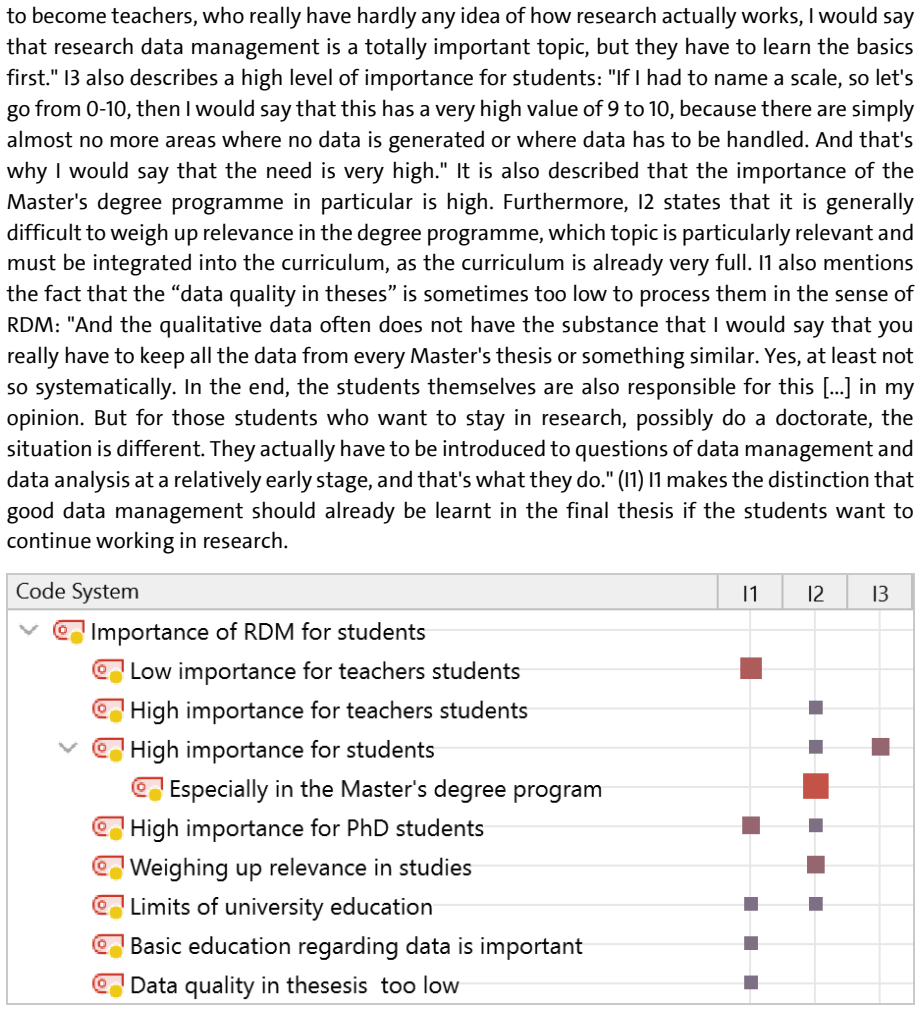
- [Methodology, 'Composition and justification of the cohort'] The sample consists of three lecturers who, as stated in this section, 'had already gained experience with RDM through third-party funded projects and in teaching.' This is a purposive, self-selected group that is likely more favorable to RDM than the broader population of lecturers. Even within this favorable sample, the responses are split: interviewee I1 rates the importance of RDM for students as low, while I2 and I3 rate it high, as shown in Figure 13. The paper's more general statements about 'lecturers' in the abstract and in the recommendations section therefore exceed what the data can support. The limitations paragraph acknowledges the small sample, but the overstatements appear in the abstract and recommendations; these should be revised to carry the same caveat and to present the findings as exploratory and local.
- [Quantitative Results (Figures 12 and 13)] The 'quantitative' analysis is based on only three respondents and reports counts on a 0-to-3 scale, with no measure of inter-rater reliability, variance, or statistical significance. The text makes comparative statements such as 'the relevance of the different topics is clearer for teaching staff, with interviewees estimating that almost all topics are important for this group,' which go beyond what descriptive counts from three participants can support. The paper should present these counts as illustrative descriptive data and add explicit caveats, or use language that clearly distinguishes between a descriptive illustration and a quantitative comparison.
minor comments (4)
- [Appendix, Interview guide] In the objectives of the interview guide, the phrase 'determine the level of knowledge of RDM among lecturers (department-specific?)' contains a stray question mark that should be removed.
- [References] The reference to Biernacka and Schulz (2022) contains an extra period after the initial 'S.' ('Schulz, S. . (2022)'), and the entry should be formatted consistently with the other references.
- [Introduction] In the first paragraph, 'the four University of Hamburg cluster of excellence' should be 'clusters of excellence,' and the sentence beginning 'whereby the aspects of research data management (RDM) data literacy in the sense of ...' is grammatically awkward and should be rephrased.
- [Introduction and throughout] The project names 'E2D2' and 'E 2D2 adapted' are written with inconsistent spacing; please use a single consistent notation throughout the manuscript.
Circularity Check
No circularity: the paper's claims are interview-based and do not reduce to their inputs or to load-bearing self-citations.
full rationale
This paper is a qualitative interview study of three lecturers; it does not derive quantitative predictions from fitted parameters or prove a theorem. The central claims—that lecturers see RDM as relevant especially at Master's level, that they lack confidence, and that short inputs and templates are preferred—come directly from coded interview data. The self-citations (Petersen et al., 2023; Biernacka and Schulz, 2022; Schulz and Jacob, 2025) are used to point to existing learning-objective matrices, prior course implementations, and the location of the anonymized transcript data. They are contextual or resource citations, not load-bearing premises that force the interview findings. The paper explicitly acknowledges limitations: the small purposive sample, the possible influence of the provided RDM topic list on interviewees, and the dependence on the chosen categorization matrix. There is an internal inconsistency between the Abstract's 'extremely relevant' and the Discussion's 'low' overall importance rating, and the quantitative figures show only two of three interviewees rating most topics relevant for students; however, this is a reporting or interpretive inconsistency, not a circularity. No equation or definition reduces a claimed result to an input, and no fitted value is renamed as a prediction. The derivation chain, such as it is, is transparently empirical and self-contained.
Assumptions & free parameters
assumptions (3)
- domain assumption The three interviewed lecturers' self-reports accurately reflect their actual RDM knowledge and teaching practices.
- domain assumption Three interviewees with prior RDM project experience provide a sufficiently varied range of perspectives for the study's exploratory purpose.
- domain assumption Inductive coding categories derived by the two authors capture the content without systematic bias.
Cite this review
Pith. "Pith review of Lecturers' perspectives on the integration of research data management into teacher training programmes." pith.science (2026). https://pith.science/paper/ZKZHOCMZ
@misc{pith2026250521704,
  author       = {Pith},
  title        = {Pith review of: Lecturers' perspectives on the integration of research data management into teacher training programmes},
  year         = {2026},
  howpublished = {\url{https://pith.science/paper/ZKZHOCMZ}},
  note         = {Machine review of arXiv:2505.21704}
}
read the original abstract
This article focuses on how data literacy education such as research data management skills can be integrated into teacher training programmes in order to adequately train the teachers of tomorrow. To this end, interviews were conducted with three lecturers from the Faculty of Education and analysed both qualitatively and quantitatively. The lecturers describe the topic of research data management as extremely relevant for students, especially in the Master's program. Even as future teachers, for example in computer science and the natural sciences, students will have a lot to do with data and need to be able to handle it competently. The article also discusses how research data management skills can be integrated into the teacher training program.
Figures


Figures from the paper (6 more)


Forward citations
Cited by 1 Pith paper
-
The Data Dilemma: Authors' Intentions and Recognition of Research Data in Educational Technology Research
Many DELFI 2024 authors did not recognize software and qualitative materials in their own papers as research data, leading to under-publication.
Reference graph
Works this paper leans on
-
[1]
How long have you been teaching at the University of Hamburg?
-
[2]
Please describe the process of supervising bachelor and master theses in your department
-
[3]
Please describe the level of knowledge of lecturers regarding RDM in your department
-
[4]
Please describe the need you see for training measures for teacher students in your department regarding RDM
-
[5]
Please describe the importance of training for teacher students regarding RDM
-
[6]
Please explain what the lecturers in your department are doing specifically for the RDM education of teacher students
-
[7]
(With regard to lecturers and teacher students)
Please describe the educational activities you would like to see from the CRDM. (With regard to lecturers and teacher students)
-
[8]
Short input (presentation of CRDM) approx
Can you describe any specific wishes regarding the didactic implementation? a. Short input (presentation of CRDM) approx. 15 min. b. Lecture/ seminar (1.5 hours) c. Workshop (3 hours to 2 days)
Show all 24 references
-
[9]
Relevance for teacher students in your department in relation to the following topics b
Do you have specific events/ series of events or other frameworks for such CRDM programmes? I have brought a list of RDM topics with me and would like to know your views on the following two points a. Relevance for teacher students in your department in relation to the followi...
-
[10]
access security (encryption, password protection, rights management)
-
[11]
https://doi.org/10.1021/ed500099h Ridsdale, C., Rothwell, J., Smit, M., Bliemel, M., Irvine, D., Kelley, D., Matwin, S., Wuetherick, B., & Ali-Hassan, H. (2015). Strategies and Best Practices for Data Literacy Education Knowledge Synthesis Report. SSHRC. https://doi.org/10.131...
2015
-
[12]
definition of RDM (research data lifecycle)
-
[13]
institutional infrastructure (support for RDM, tools)
-
[14]
FAIR principles (Findable, Accessible, Interoperable, Reusable)
-
[15]
data management plan (contents of the DMP)
-
[16]
ethical aspects (CARE principles - Collective Benefit, Authority Control, Responsibility, Ethics)
-
[17]
data protection (personal data, informed consent)
-
[18]
organisation and structure (directory structures, naming convention, versioning)
-
[19]
documentation and metadata (content and forms of documentation, standards)
-
[20]
publication of research data (data selection, publication options)
-
[21]
copyright and licensing
-
[22]
other legal aspects (patent law, contractual agreements)
-
[23]
long-term archiving (definition of the term, sustainable file formats, requirements for long-term archiving)
-
[24]
reuse (finding research data, terms of use, access rights)
Reviewed August 7, 2026 · model on record in the stance chip above.
Discussion (0). Continue with ORCID to comment.