REVIEW 4 major objections 5 minor 50 references
Ambient-aware continuous aid for mountain rescue activities
T0 review · 4 major / 5 minor · reviewed 2026-08-07 · deepseek-v4-flash
Pith's one-line read A context-aware middleware service fed by weather stations and tourist geolocations can model massive heterogeneous mountain data, recognise hiker threats and behaviours, and support rescue operations effectively, the paper claims.
desk verdict Implementation follow-up that deserves review, but its effectiveness claims rest on a simulator whose two admitted simplifications drive the measured threats. read the letter →
The pith
A machine-rendered reading of the paper's core claim, the machinery that carries it, and where it could break.
The reading
What carries the argument
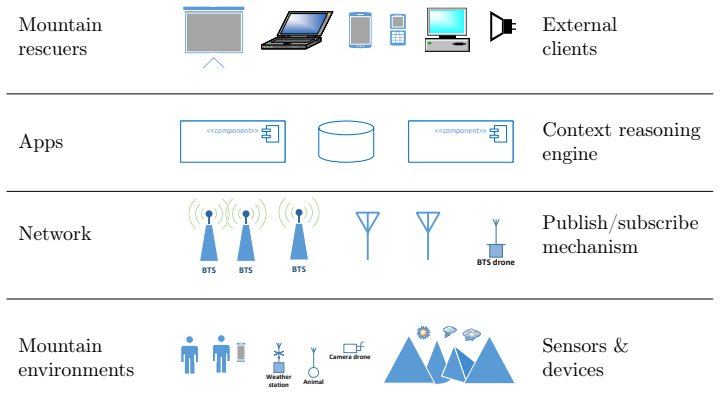
The central mechanism is the context life cycle embedded in a middleware CAaaS layer, with a workflow that transforms raw sensor data into smart decisions. The load-bearing components are a message streaming broker transporting massive raw data, low-level algorithms A1 and A2 for geolocation and weather pre-processing, high-level algorithms A3 to A5 plus a SAT solver for logical threat reasoning via the deduction theorem and modus ponens, and repositories of context data and alerts. The formal core that carries the argument is the encoding of threats as a regular expression $E \equiv N \mid S \mid W \mid S\cdot W$, where $S \equiv E6a \mid E6g \mid E6m \mid E6r$ and $W \equiv E2 \mid E3 \mid E4 \mid E5$, making individual threat traces $L_i(t_i)$ regular languages accepted by a finite automaton. Behavioural traces $B_{i,j} = \langle id(t_i), th, geo, ts, h, d\rangle$ extend each threat point and also form regular languages. This regularity lets the entire monitoring logic be represented and analysed as a single minimised automaton, connecting the data-processing design to a precise formal object.
What would settle it
Run the same system on a season of real BTS and GPS traces and weather records from a national park, or on a simulator with empirically measured walking-speed distributions and structured animal avoidance behaviour, and compare reported threats and response times with park incident logs; material degradation in detection timing or accuracy would refute the claim that the system supports rescue activities effectively in real conditions.
Extended reading notes
Core claim
The central claim is that a sensor-based context-aware aiding system can effectively model and use massive, heterogeneous contextual data in a demanding mountain environment when it receives weather data streams and tourist geolocations from multiple sources. The paper argues that the proposed context life cycle — gathering, modelling, repositoring, reasoning, distribution, and visualisation — executed in a middleware layer as CAaaS, detects threats to hikers on-line and supports rescue activities. A notable formal result is that the detected threats form a regular language generated by a type-3 grammar, so the system's monitoring behaviour can be captured by a finite automaton; behavioural traces extend each threat point with identity, geolocation, timestamp, trail, and difficulty. The five weather scenarios, grounded in Babia Góra National Park data, yield simulation results in which the system responds within acceptable times and exhibits context-aware properties such as redundancy, spatial proximity, context transition, and context sharing. The paper concludes feasibility, reliability, and vitality of the system, with capacity tests showing full efficiency up to 7,000 to 8,000 tourists.
Load-bearing premise
The load-bearing premise is that the paper's mountain environment simulator faithfully reproduces real mountain conditions and hiker behaviour, including walking speeds and animal movement, so simulation results transfer to actual rescue operations.
Editorial extensions
If this is right
- If the central claim is correct, a rescue centre could receive refreshed threat status for every monitored hiker every half minute to a minute, with high-priority weather threats from E5 down to E2 resolved first.
- The SAT-based reasoning allows rescuers to inject or redefine alert levels per trail difficulty, day or night, or season, so operational policies can be changed without redesigning the system.
- Because threat and behaviour languages are regular, threat traces and behavioural traces can be stored, compared, and clustered across seasons, enabling park managers to calibrate tourism models.
- Capacity tests indicate the system stays fully efficient with 7,000 to 8,000 tourists, well above the roughly 1,000-per-day peak of the reference national park, with performance dropping around 10,000 and becoming inefficient above 12,000.
- The CAaaS packaging means the middleware could be leased as a cloud service, letting different mountain areas configure their own routes, stations, and alert policies.
Reading between the lines
- The paper tests the system in simulation but not against live incident data; a direct testable extension is a pilot deployment in a real national park comparing system warnings with actual rescue interventions and BTS or GPS traces.
- Because threat and behaviour languages are regular, streaming queries such as 'did this hiker ever receive an E6m warning followed by an E5 within ten minutes' could be answered by finite-state transducers at streaming speed without storing full histories, a consequence the paper leaves implicit.
- The reliance on uniform walking speeds and randomized animal motion means the quantitative threat counts are plausible but not calibrated; replacing those with measured speed distributions and animal avoidance models would turn the simulator from a demonstration into a predictive tool.
- The weakly coupled context categories and replaceable alert sets suggest the design could be adapted to other hazard-monitoring domains such as wildfire risk, urban noise, or health crises, an application the paper sketches but does not develop.
Editorial analysis
A structured set of objections, weighed in public.
Referee Report
Summary. The paper presents a context-aware middleware system (CAaaS) for mountain rescue. It introduces a context life cycle, a hierarchy of weather and non-weather threats (E1–E5, E6g/E6r/E6m/E6a), a formal treatment of individual threat traces as a regular language, and an implementation using RabbitMQ, a repository, and a SAT solver. The system is evaluated by feeding it data from MoSim, a mountain-environment simulator built by the same group, under five predefined weather scenarios calibrated to Babia Góra National Park. The paper claims that the system can effectively model massive heterogeneous contextual data, recognize threats and behaviors, and support rescue operations, with the simulation results said to demonstrate feasibility, reliability, and naturalness of operation.
Significance. If the central claim were established, the paper would provide a useful reference architecture for context-aware emergency-response middleware, combining streaming ingestion, context modeling, logical reasoning, and service-oriented delivery. Its strengths are the explicit end-to-end system design, the decomposition of the context life cycle into concrete workflow stages, the use of standard components (RabbitMQ, Sat4j), and the load test up to 7,000–8,000 simulated tourists. The regular-language treatment of individual threat traces is a conceptually clean way to describe per-tourist monitoring. However, the empirical validation is not yet at the level required to support the effectiveness claims: the evaluation is closed-loop, the simulator's realism is acknowledged to be limited in load-bearing respects, and no comparison with independent ground truth or alternative approaches is provided.
major comments (4)
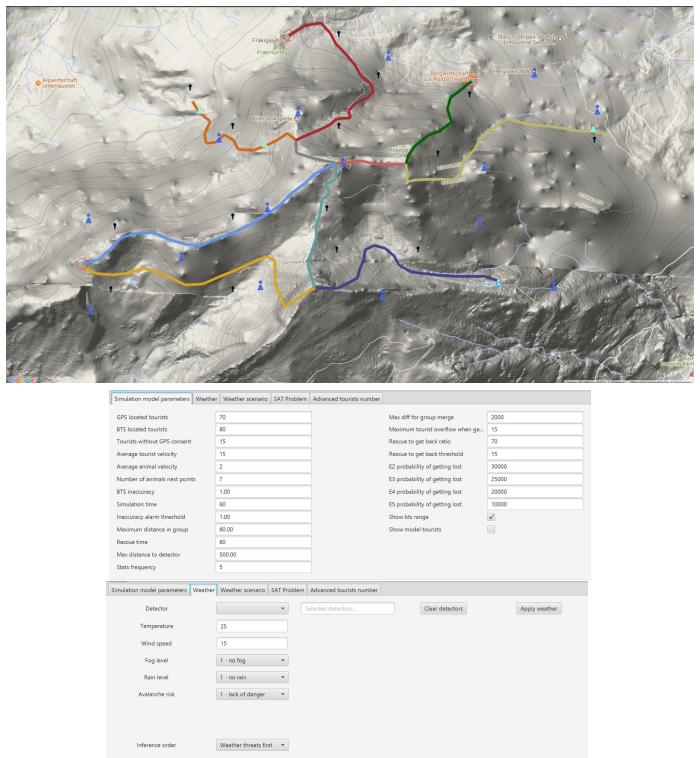
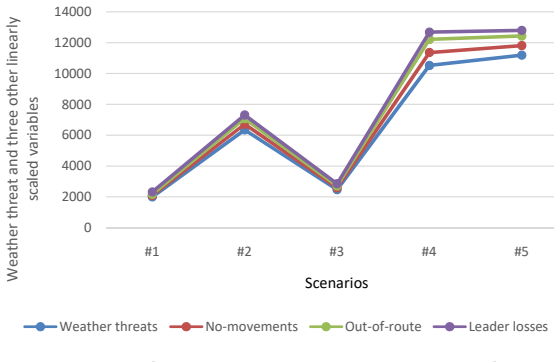
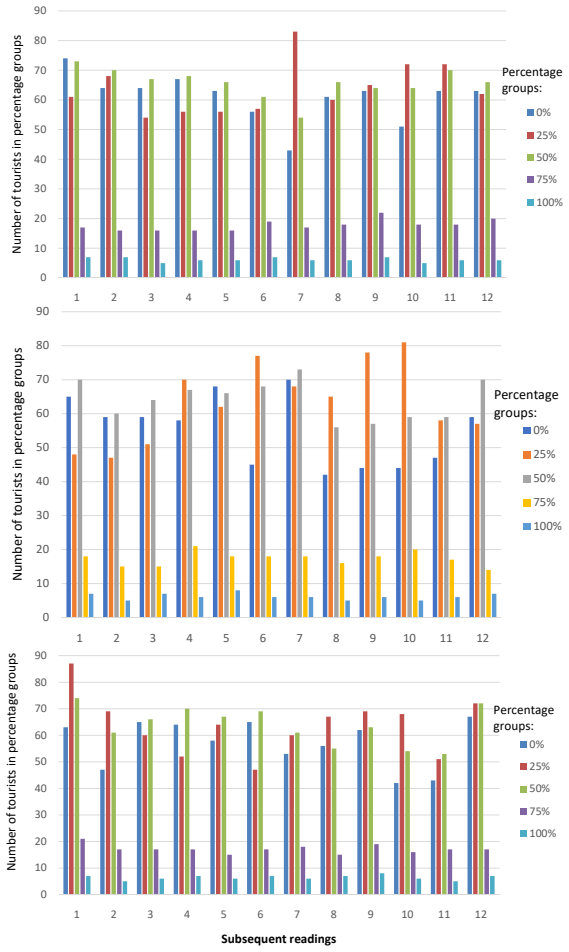
- [Sections 4.1.1, 4.2, 7; Tables 4 and 6] The central effectiveness claim is validated only in a closed loop: MoSim (Section 4.1.1, Figure 12) generates the data streams, and the article then interprets the resulting threat counts and 'naturalness' plots as evidence of correctness (Section 5). This would be acceptable only if the simulator's behavior were shown to be representative, but Section 7 states that all tourists move at the same speed and that animal motion is randomized. Because the threat E6m is defined as the absence of geolocation change over time and E6a as proximity to a dangerous animal (Table 2), the counts in Tables 4 and 6 and the curves in Figures 16–21 are directly sensitive to these two simplifications. No sensitivity analysis, no independent ground-truth labels, and no comparison with real GPS/BTS traces are provided. At minimum, the authors should test whether the main threat-rate conclusions are stable under realistic distributions of walking speed and animal motion, or they should restrict the claims to 'system behavior under the simulator's assumptions.'
- [Section 1.2, Section 4.1.1] The last paragraph of Section 1.2 states that 'the experiments carried out were based on reliable data discussed and explained with domain experts or based on acquired in situ real data' and that a 'meta-analysis provides a comprehensive overview of the state of knowledge.' No in situ real data set or meta-analysis is presented anywhere in the manuscript; Section 4.1.1 describes the MoSim simulator as the data source, and the weather scenarios in Section 4.1.2 are constructed from climate averages, not from live sensor streams. These sentences overstate the empirical basis and should be rewritten to describe the actual evidence.
- [Section 3.2.2, Equations (2)–(5)] The four semantic preservation properties (causation, velocity, time-order, value-evaluation) are asserted rather than proven. The bullet list after Equation (5) gives informal arguments, but items such as 'velocity is the same and the increase or decrease in the rate of specific events occurrence is reflected instantly' do not constitute a formal demonstration that the relations in the source domain are preserved under the concrete data transformations in Figure 7 or Formula (1). If the semantic transformation is a contribution, a formal mapping between the two domains and the transformation pipeline is needed; otherwise the properties should be presented as design desiderata.
- [Section 3.2.3] The claim that the entire threat language L = L1 ∪ ... ∪ Ln is regular is only valid for a fixed finite n. Regular languages are closed under finite union, but the number of tourists n grows without bound over the lifetime of the system, and an arbitrary union of regular languages need not be regular. The regularity proof is complete for each individual Li, and the automaton in Figure 9 accepts a single Li, so the paper should either fix the finiteness assumption or restrict the regularity claim to individual threat traces.
minor comments (5)
- [Abstract] The abstract contains unresolved track-change artifacts (e.g., '\newrrr{which we} obtained' and '\erarrr{following a proposed workflow for a demanding}') that should be cleaned before publication.
- [Figure 20] The caption contains the typo 'of comtext transition per tourist'; it should read 'context transition.'
- [Section 7] The phrase 'And lot least at all' should be corrected to 'Last but not least,' and the surrounding sentence about BTS data is informal for a journal article.
- [Section 4.2.1] The sentence 'Table 4 provides a good picture of the course of the simulation, which was carried out with great care and attention to the realism of behaviours' is subjective; please replace it with a reproducibility statement or a table of simulator parameters.
- [Section 5] The statement 'The supporting system reacted correctly and on time' needs a definition of 'correctly' or a measurable pass/fail criterion; as written, it is not verifiable from the presented data.
Circularity Check
Regular-language 'proof' is true by definition, and the effectiveness claim is validated only against the authors' own simulator, whose admitted simplifications directly generate the counted threats.
-
self definitional
[Section 3.2.3, Threats as a language (definition of Li and E)]
"The individual threat trace of tourist ti is expressed by formal language Li(ti) ≡ {(E; )+}, defined by a regular expression [21], ... E is defined by other regular expression E ≡ N |S|W |S·W ... To sum up, every Li is a regular language, and L is also a regular language."
The language Li is defined as {(E; )+} where E is itself given by the regular expression N|S|W|S·W. The 'proof' that Li and L are regular is therefore a restatement of the definition: regularity is built into the formalism by choosing regular-expression syntax for E. The same holds for behavioural traces in Section 3.2.4, which are defined as finite sequences and then asserted to be regular languages.
-
other
[Section 4.2.1, Simulation results / Overview, referring to Section 3.3 Preliminary simulation]
"Comparing Figures 11 and 16, we can see the convergence of both simulations, that is the preliminary one and the primary one. This confirms that our simulator, see Figure 13, gives realistic and reliable results."
The preliminary simulation was, in the paper's own words, 'based on our idea of how the threat generations should look like without any detailed analysis of contextual data' (Section 3.3), i.e. on the authors' own probability assumptions. The primary simulation is produced by MoSim, a simulator built by the same research group. The agreement between these two author-generated pipelines is then used as evidence that the simulator is 'realistic and reliable'. No independent field data, external benchmark, or ground-truth threat labels are involved, so the confirmation is a self-consistency check rather than a validation against the real mountain environment.
1 more flagged steps
-
other
[Section 7 Conclusions (limitations), with threat definitions from Table 2]
"E6m – prolonged time without any motion ... E6a – too close to a dangerous animal ... Currently, all tourists move at the same speed, which does not reflect real-life scenarios accurately ... Animal motions data is currently randomized but it may reflect more realistic behavioural patterns in the future works."
The effectiveness evidence (threat counts in Table 4 and Figures 16–21) is produced by a simulator whose own limitations the paper admits: uniform tourist walking speed and randomized animal motion. The E6m threat is defined as prolonged absence of motion, and E6a as proximity to a dangerous animal, so these detections are direct outputs of the injected movement model rather than discoveries about real hiker and animal behaviour. The central claim of effective threat recognition in real mountain rescue therefore rests on a self-generated data source whose realism is explicitly disclaimed; the observed 'naturalness of system operations' is not independent of the simulator's construction.
full rationale
The paper contains two load-bearing circular steps. First, the claimed formal contribution that the threat language and behaviour language are regular is true by construction: Li is defined as {(E; )+} with E := N|S|W|S·W, a regular expression, so the subsequent 'proof' of regularity merely restates the definition. Second, the central effectiveness claim (Section 1.2) is supported only by experiments in which the authors' own simulator MoSim feeds the supporting system; the agreement between the preliminary simulation (based on the authors' 'idea of how threat generations should look') and the primary simulation is then used to 'confirm' that the simulator is realistic. No external ground truth or benchmark is used. The paper's own Section 7 disclaims the two simulator features that directly produce the counted non-weather threats: uniform tourist speed (E6m depends on absence of movement) and randomized animal motion (E6a depends on animal proximity). The threat numbers in Tables 4 and 6 and the 'naturalness' plots are therefore not independent evidence of effectiveness in real rescue operations. The weather data from Babia Góra is real climate data, which is a genuine external input, but it does not validate the behavioural threat model. The self-citation to the supervised thesis [22] is supporting, not the primary reduction. Overall partial circularity: score 7.
Assumptions & free parameters
free parameters (6)
- Preliminary simulation attendance parameters =
peak 200 tourists at 14:00, normal distribution, std dev 4h
- Preliminary weather threat probabilities =
20%, 40%, 100% for the three time intervals
- Preliminary non-weather threat probabilities =
E6g 5%, E6m 5%, E6a 5%, E6r 10%; 30% in groups
- Simulator behavioral parameters =
not specified in the paper
- Weather scenario definitions =
five hand-defined scenarios (summer/winter, good/bad weather)
- Memory dump interval =
5 minutes
assumptions (6)
- domain assumption The context model with two groups (weather W and non-weather S) and five categories (Individuality, Time, Location, Activity, Relations) is an appropriate representation of the mountain rescue domain.
- domain assumption The threat levels E1-E5 and E6g/E6r/E6m/E6a, and the mapping from sensor readings to these levels, are correct domain knowledge supplied by rescuers.
- ad hoc to paper The simulator MoSim faithfully reproduces the relevant aspects of a real mountain environment.
- ad hoc to paper Threats can be represented as a regular language, meaning each threat assessment is an independent symbol with no long-range dependencies.
- domain assumption The SAT-based logical reasoning correctly encodes the rescuers' alert rules and weather-threat inference.
- standard math Standard logic (deduction theorem, modus ponens) is applied correctly.
invented entities (2)
-
Threat language L
-
Behaviour language B
Cite this review
Pith. "Pith review of Ambient-aware continuous aid for mountain rescue activities." pith.science (2026). https://pith.science/paper/RNOYMKPE
@misc{pith2026250521751,
  author       = {Pith},
  title        = {Pith review of: Ambient-aware continuous aid for mountain rescue activities},
  year         = {2026},
  howpublished = {\url{https://pith.science/paper/RNOYMKPE}},
  note         = {Machine review of arXiv:2505.21751}
}
read the original abstract
Ambient-awareness in conjunction with pervasive computing is a significant challenge for system designers. It follows the necessity of gathering raw, massive and heterogeneous environmental data \newrrr{which we} obtained, while middleware processes must merge context modelling and reasoning seamlessly. We proposed a system supporting mountain rescuers which is demanding due to the large number of environmental objects interacting, as well as high data variability. We presented complex context processing embedded in the proposed context life cycle and implemented it \erarrr{following a proposed workflow for a demanding}\newrrr{in a difficult} mountain environment. We introduced five weather scenarios which are a basis for contextual and perceptual processing during the validation of our model. The system \erarrr{binds together} \newrrr{merges} a message streaming broker for massive data transport, low and high-level processing algorithms, repositories and a logical SAT solver. It constitutes a Context-Aware-as-a-Service (CAaaS) system, offering advanced support for mountain rescue operations. The provided software model defines middleware components which act on a predicted context and transform in situ sensor data into smart decisions, and which could operate as a platform-based cloud computing model. It is an enabler yielding a synergy effect with different software components orchestration when providing pro-activeness and non-intrusiveness concerning smart decisions.
Figures


Figures from the paper (19 more)







Reference graph
Works this paper leans on
-
[25]
Radosław Klimek. Exploration of human activities using message stream- ing brokers and automated logical reasoning for ambient-assisted services. IEEE Access, 6:27127–27155, 2018
work page 2018
-
[1]
Default in- ferences in metaphor interpretation
Rodrigo Agerri, John Barnden, Mark Lee, and Alan Wallington. Default in- ferences in metaphor interpretation. In Boicho Kokinov, Daniel C. Richard- son, ThomasR.Roth-Berghofer, andLaureVieu, editors, Proceedings of the 6th International and Interdisciplinary Conference on Modeling and Using Context, CONTEXT’07, Roskilde, Denmark, volume 4635 ofLecture Not...
work page 2007
-
[2]
Engineering context- aware systems and applications
Unai Alegre, Juan Carlos Augusto, and Tony Clark. Engineering context- aware systems and applications. Journal of Systems and Software , 117(C):55–83, 2016
work page 2016
-
[3]
Christos Anagnostopoulos and Kostas Kolomvatsos. A delay-resilient and quality-aware mechanism over incomplete contextual data streams.Infor- mation Sciences, 355-356:90–109, 2016. 50
work page 2016
-
[4]
An agent-based system for maritime search and rescue operations
Salvatore Aronica, Francesco Benvegna, Massimo Cossentino, Salvatore Gaglio, Alessio Langiu, Carmelo Lodato, Salvatore Lopes, Umberto Manis- calco, and Pierluca Sangiorgi. An agent-based system for maritime search and rescue operations. In Andrea Omicini and Mirko Viroli, editors,Pro- ceedings of the 11th WOA 2010 Workshop, Dagli Oggetti Agli Agenti, Ri- ...
work page 2010
-
[5]
A survey on the evolution of the notion of context-awareness
Juan Carlos Augusto, Asier Aztiria, Dean Kramer, and Unai Alegre Ibarra. A survey on the evolution of the notion of context-awareness. Applied Artificial Intelligence, 31(7-8):613–642, 2017
work page 2017
-
[6]
Juan Carlos Augusto, Vic Callaghan, Diane Cook, Achilles Kameas, and Ichiro Satoh. Intelligent Environments: a manifesto.Human-centric Com- puting and Information Sciences, 3(1):12, Jun 2013
work page 2013
-
[7]
The significance of context in information systems and organizational change
Chrisanthi Avgerou. The significance of context in information systems and organizational change. Information Systems Journal, 11(1):43–63, 2008
work page 2008
Show all 50 references
-
[8]
A survey on context-aware systems.International Journal of Ad Hoc and Ubiquitous Computing, 2(4):263–277, jun 2007
Matthias Baldauf, Schahram Dustdar, and Florian Rosenberg. A survey on context-aware systems.International Journal of Ad Hoc and Ubiquitous Computing, 2(4):263–277, jun 2007
2007
-
[9]
Understanding context before using it
Mary Bazire and Patrick Brézillon. Understanding context before using it. In Anind Dey, Boicho Kokinov, David Leake, and Roy Turner, editors, Proceedings of the 5th International and Interdisciplinary Conference on Modeling and Using Context, CONTEXT’05, Paris, France, July 5–...
2005
-
[10]
The manage- ment of organizational ambidexterity through alliances in a new context of analysis: Internet of Things (IoT) smart city projects
Stefano Bresciani, Alberto Ferraris, and Manlio Del Giudice. The manage- ment of organizational ambidexterity through alliances in a new context of analysis: Internet of Things (IoT) smart city projects. Technological Forecasting and Social Change, 136(C):331–338, 2018
2018
-
[11]
Goscinski.Cloud Com- puting Principles and Paradigms
Rajkumar Buyya, James Broberg, and Andrzej M. Goscinski.Cloud Com- puting Principles and Paradigms. Wiley Publishing, 2011
2011
-
[12]
Semi-parametric contextual bandits with graph-laplacian regularization
Young-Geun Choi, Gi-Soo Kim, Seunghoon Paik, and Myunghee Cho Paik. Semi-parametric contextual bandits with graph-laplacian regularization. Information Sciences, 645, Oct 2023
2023
-
[13]
James L. Crowley. Context driven observation of human activity. In Emile Aarts, René W. Collier, Evert van Loenen, and Boris de Ruyter, editors, Ambient Intelligence, pages 101–118, Berlin, Heidelberg, 2003. Springer Berlin Heidelberg
2003
-
[14]
Dey and Gregory D
Anind K. Dey and Gregory D. Abowd. Towards a better understanding of context and context-awareness. InProceedings of the 1st international sym- posium on Handheld and Ubiquitous Computing (HUC 1999). Karlsruhe, Germany, pages 304–307. Springer-Verlag, 1999. 51
1999
-
[15]
Ef- fective rating prediction based on selective contextual information.Infor- mation Sciences, 510:218–242, 2020
Rim Dridi, Saloua Zammali, Tagreed Alsulimani, and Khedija Arour. Ef- fective rating prediction based on selective contextual information.Infor- mation Sciences, 510:218–242, 2020
2020
-
[16]
Spatial-temporal analysis of safety risks in trajectories of construction workers based on complex network theory
Pinsheng Duan, Jianliang Zhou, and Yang Miang Goh. Spatial-temporal analysis of safety risks in trajectories of construction workers based on complex network theory. Advanced Engineering Informatics, 56:101990, 2023
2023
-
[17]
The Gator Tech Smart House: a pro- grammable pervasive space.Computer, 38(3):50–60, 2005
Sumi Helal, William Mann, Hicham El-Zabadani, Jeffrey King, Youssef Kaddoura, and Erwin Jansen. The Gator Tech Smart House: a pro- grammable pervasive space.Computer, 38(3):50–60, 2005
2005
-
[18]
Developing context-aware perva- sive computing applications: Models and approach.Pervasive and Mobile Computing, 2(1):37–64, 2006
Karen Henricksen and Jadwiga Indulska. Developing context-aware perva- sive computing applications: Models and approach.Pervasive and Mobile Computing, 2(1):37–64, 2006
2006
-
[19]
Middleware for distributed context-aware systems
Karen Henricksen, Jadwiga Indulska, Ted McFadden, and Sasitharan Bal- asubramaniam. Middleware for distributed context-aware systems. InPro- ceedings of the Confederated International Conference on On the Move to Meaningful Internet Systems (OTM’05), October 31 – November 04, ...
2005
-
[20]
Context-aware systems: A literature review and classification
Jong-yi Hong, Eui-ho Suh, and Sung-Jin Kim. Context-aware systems: A literature review and classification. Expert Systems with Applications, 36(4):8509–8522, 2009
2009
-
[21]
Hopcroft, Rajeev Motwani, and Jeffrey D
John E. Hopcroft, Rajeev Motwani, and Jeffrey D. Ullman.Introduction to Automata Theory, Languages, and Computation. Addison-Wesley, 2006
2006
-
[22]
Development of the system for tourist activities in mountain environments, Engineering diploma thesis, supervisor: Radosław Klimek, AGH University of Science and Technology, 2022
Przemysław Indyka. Development of the system for tourist activities in mountain environments, Engineering diploma thesis, supervisor: Radosław Klimek, AGH University of Science and Technology, 2022
2022
-
[23]
Lgcnet: A local-to-global context-aware feature augmen- tation network for salient object detection.Information Sciences, 584:399– 416, 2022
Yuzhu Ji, Haijun Zhang, Feng Gao, Haofei Sun, Haokun Wei, Nan Wang, and Biao Yang. Lgcnet: A local-to-global context-aware feature augmen- tation network for salient object detection.Information Sciences, 584:399– 416, 2022
2022
-
[24]
Dover Publications, 2002
Stephen Cole Kleene.Mathematical Logic. Dover Publications, 2002
2002
-
[26]
Modelling contextual data for smart environments
Radosław Klimek. Modelling contextual data for smart environments. Case study of a system to support mountain rescuers. In Valeria V. Krzhizhanovskaya, Gábor Závodszky, Michael H. Less, Jack J. Dongarra, and Peter M.A. Sloot, editors,Proceedings of 20th International Conferenc...
2020
-
[27]
Sensor-enabled context-aware and pro-active queue management systems in intelligent environments
Radosław Klimek. Sensor-enabled context-aware and pro-active queue management systems in intelligent environments. Sensors, 20(20):1–29, 2020
2020
-
[28]
Metaphors we Live by
George Lakoff and Mark Johnson. Metaphors we Live by. University of Chicago Press, 1980
1980
-
[29]
Con- text aware middleware architectures: Survey and challenges
Xin Li, Martina Eckert, José-Fernán Martínez, and Gregorio Rubio. Con- text aware middleware architectures: Survey and challenges. Sensors, 15(8):20570–20607, 2015
2015
-
[30]
Kleiner, Vincenzo Lippiello, Alberto Finzi, Bruno Siciliano, A
Lorenzo Marconi, Claudio Melchiorri, Michael Beetz, Dejan Pangercic, Roland Siegwart, Stefan Leutenegger, Raffaella Carloni, Stefano Stramigi- oli, Herman Bruyninckx, Patrick Doherty, A. Kleiner, Vincenzo Lippiello, Alberto Finzi, Bruno Siciliano, A. Sala, and Nicola Tomatis. ...
2012
-
[31]
An IoT-aware approach for elderly-friendly cities
Rubén Mulero, Aitor Almeida, Gorka Azkune, Patricia Abril-Jiménez, María Teresa Arredondo Waldmeyer, Miguel Páramo del Castrillo, Luigi Patrono, Piercosimo Rametta, and Ilaria Sergi. An IoT-aware approach for elderly-friendly cities. IEEE Access, 6:7941–7957, 2018
2018
-
[32]
Jason Pascoe
Mr. Jason Pascoe. Adding generic contextual capabilities to wearable computers. In Proceedings of the 2nd IEEE International Symposium on Wearable Computers (ISWC ’98), October 19–20, 1998, pages 92–99. IEEE Computer Society, 1998
1998
-
[33]
John Wiley & Sons, 2003
Tom Pender.UML Bible. John Wiley & Sons, 2003
2003
-
[34]
Zaslavsky, Peter Christen, and Dimitrios Geor- gakopoulos
Charith Perera, Arkady B. Zaslavsky, Peter Christen, and Dimitrios Geor- gakopoulos. Context aware computing for the internet of things: A survey. IEEE Communications Surveys and Tutorials, 16(1):414–454, 2014
2014
-
[35]
Palmes, Jian Zhu, Wen Long Ng, Chee Weng Tang, and Nguyen Hoang Chung
Hung Keng Pung, Tao Gu, Wenwei Xue, Paulito P. Palmes, Jian Zhu, Wen Long Ng, Chee Weng Tang, and Nguyen Hoang Chung. Context-aware middleware for pervasive elderly homecare.IEEE Journal on Selected Areas in Communications, 27(4):510–524, 2009
2009
-
[36]
Context-awareness in indus- trial applications: definition, classification and use case
Patrick Rosenberger and Detlef Gerhard. Context-awareness in indus- trial applications: definition, classification and use case. Procedia CIRP, 72:1172–1177, 2018. 51st CIRP Conference on Manufacturing Systems. 53
2018
-
[37]
Schilit, Norman Adams, and Roy Want
Bill N. Schilit, Norman Adams, and Roy Want. Context-aware comput- ing applications. In Proceedings of the 1994 First Workshop on Mobile Computing Systems and Applications (WMCSA 1994), pages 85–90. IEEE Computer Society, 1994
1994
-
[38]
A survey of context-aware middleware designs for human activity recognition.WIREs Data Mining Knowledge Discovery, 8, 2018
Mohammad Sharif and Ali Asghar Alesheikh. A survey of context-aware middleware designs for human activity recognition.WIREs Data Mining Knowledge Discovery, 8, 2018
2018
-
[39]
Stock and Mechtild Stock.Handbook of Information Science
Wolfgang G. Stock and Mechtild Stock.Handbook of Information Science. De Gruyter Saur, Berlin, Boston, 2013
2013
-
[40]
A survey on context-aware web service systems
Hong-Linh Truong and Schahram Dustdar. A survey on context-aware web service systems. International Journal of Web Information Systems, 5(1):5–31, 2009
2009
-
[41]
Context-aware middleware: A review
Hamed Vahdat-Nejad. Context-aware middleware: A review. In Patrick Brézillon and Avelino J. Gonzalez, editors, Context in Computing - A Cross-Disciplinary Approach for Modeling the Real World, pages 83–96. Springer, 2014
2014
-
[42]
van Bunningen, Ling Feng, and Peter M.G
Arthur H. van Bunningen, Ling Feng, and Peter M.G. Apers. Context for ubiquitous data management. In International Workshop on Ubiquitous Data Management, pages 17–24, 2005
2005
-
[43]
Designing context-sensitive systems: An integrated approach
Vaninha Vieira, Patricia Tedesco, and Ana Carolina Salgado. Designing context-sensitive systems: An integrated approach. Expert Systems with Applications, 38(2):1119–1138, 2011. Intelligent Collaboration and Design
2011
-
[44]
Stephen A. White. Process modeling notations and workflow patterns. BPTrends, pages 1–24, 2004
2004
-
[45]
A computational experiment-based evaluation method for context-aware services in compli- cated environment.Information Sciences, 373:269–286, 2016
Xiao Xue, Shufang Wang, Bin Gui, and Zhanwei Hou. A computational experiment-based evaluation method for context-aware services in compli- cated environment.Information Sciences, 373:269–286, 2016
2016
-
[46]
A survey of context-aware middleware designs for human activity recognition.IEEE Communications Magazine, 52(6):24–31, June 2014
Özgur Yürür, Chi Harold Liu, and Wilfrido Alejandro Moreno. A survey of context-aware middleware designs for human activity recognition.IEEE Communications Magazine, 52(6):24–31, June 2014
2014
-
[47]
Csdm: A context-sensitive deep matching model for medical dialogue in- formation extraction
Daojian Zeng, Ruoyao Peng, Chao Jiang, Yangding Li, and Jianhua Dai. Csdm: A context-sensitive deep matching model for medical dialogue in- formation extraction. Information Sciences, 607:727–738, 2022
2022
-
[48]
Improv- ing document-level event detection with event relation graph.Information Sciences, 645, Oct 2023
JiZhou, KaiShuang, ZhenzhouAn, JinyuGuo, andJonathanLoo. Improv- ing document-level event detection with event relation graph.Information Sciences, 645, Oct 2023
2023
-
[49]
Shtykh, and Qun Jin
Yishui Zhu, Roman Y. Shtykh, and Qun Jin. A human-centric framework for context-aware flowable services in cloud computing environments.In- formation Sciences, 257:231–247, 2014. 54
2014
-
[50]
An operational definition of context
Andreas Zimmermann, Andreas Lorenz, and Reinhard Oppermann. An operational definition of context. In Proceedings of the 6th International and Interdisciplinary Conference on Modeling and Using Context, CON- TEXT’07, Roskilde, Denmark, volume 4635 ofLecture Notes in Artificial ...
2007
Reviewed August 7, 2026 · model on record in the stance chip above.
Discussion (0). Sign in to comment.