REVIEW 3 major objections 6 minor 42 references
Visual Loop Closure Detection Through Deep Graph Consensus
T0 review · 3 major / 6 minor · reviewed 2026-08-07 · deepseek-v4-flash
Pith's one-line read The paper claims that loop closure detection is improved by scoring a clique of VLAD-retrieved keyframes with a graph neural network, reaching 94.39% average precision and 79.10% maximum recall on TartanDrive 2.0 when combined with RANSAC.
desk verdict Graph consensus over VLAD cliques is a credible idea, but the headline recall numbers are conditional on retrieval and need an end-to-end caveat. read the letter →
The pith
A machine-rendered reading of the paper's core claim, the machinery that carries it, and where it could break.
The reading
What carries the argument
The core mechanism is the maximum-similarity clique together with graph attention message passing. For a query keyframe, the top k% of VLAD-retrieved keyframes are fully connected into an undirected graph; each node carries a NetVLAD embedding of that frame's keypoint descriptors, and several graph attention layers update the node features using learned attention weights. The updated endpoint features of each query edge are concatenated and regressed to a binary loop-closure score. Because each candidate edge is scored in the context of all other retrieved frames, the clique provides a consensus signal that suppresses perceptual aliases which fool pair-only methods.
What would settle it
Count ground-truth loop closures on a TartanDrive 2.0 test sequence (relative pose within 4 meters and 30 degrees) that fall outside the top-1% VLAD cosine-similarity neighborhood of their query; if this missing fraction approaches or exceeds the gap between LoopGNN's 79.10% maximum recall and 100%, then the retrieval stage, not the GNN, is the binding constraint on recall.
Extended reading notes
Core claim
On the authors' own terms, the central discovery is that loop closure verification benefits from treating the retrieved neighborhood as a graph rather than scoring candidate pairs independently. LoopGNN builds a maximum-similarity clique from the top-k VLAD-retrieved frames, converts each image's keypoint descriptors into a NetVLAD node embedding, and runs several graph attention layers so that each node's features are refined by its neighbors. At inference only the edges incident to the query keyframe are scored, and the paper reports that this deep graph consensus markedly improves both average precision and recall over pairwise deep loop closure baselines. After geometrically verifying the top 0.5% of scored candidates with RANSAC, the method reaches 94.39% AP and 79.10% MR on TartanDrive 2.0, versus 85.94% AP and 28.91% MR for XFeat matching followed by RANSAC, while maintaining comparable relative pose and absolute trajectory errors. The paper also shows the benefit generalizes across deep keypoint extractors (SuperPoint, ALIKED, XFeat) and is sensitive to the retrieved neighborhood size.
Load-bearing premise
The load-bearing premise is that all true loop closures appear among the top-1% (or top-2%) of keyframes retrieved by VLAD similarity; if the retrieval stage misses a true loop, the network never sees it, so the reported maximum recall is an upper bound set by retrieval recall rather than a measure of end-to-end detection.
Editorial extensions
If this is right
- LoopGNN cuts the number of pairs that need RANSAC verification: verifying only the top 0.5% of LoopGNN scores achieves higher average precision and maximum recall than verifying all XFeat matches.
- The graph consensus benefit is independent of the specific deep keypoint extractor, since SuperPoint, ALIKED, and XFeat all show large AP and MR gains over the pair-only NetVLAD baseline in the ablation.
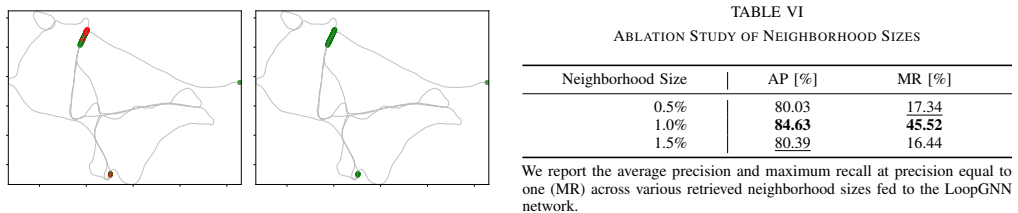
- Retrieval neighborhood size is a critical hyperparameter: on TartanDrive 2.0, moving from 1.0% to 1.5% of keyframes drops maximum recall from 45.52% to 16.44%, so the graph scale must be tuned per dataset.
- The method transfers across datasets: on NCLT it reaches 71.69% AP and 20.82% MR with a 2% retrieval neighborhood, outperforming Calc and LoopCNN.
Reading between the lines
- The reported maximum recalls are upper bounds set by the VLAD retrieval stage, so end-to-end recall on TartanDrive 2.0 could be improved more by a better retrieval mechanism than by further GNN tuning; the paper's own observation that top-1% neighborhoods miss many true loops points to this.
- The graph-consensus idea could be applied to other verification tasks that receive a batch of retrieval candidates, such as multi-view correspondence or re-ranking for visual localization, wherever context can distinguish true matches from look-alikes.
- A testable extension is to train the retrieval stage jointly with the GNN, or to use the GNN's confidence to adaptively decide how many candidates to retrieve per query, which would directly address the retrieval bottleneck.
- At reported inference speeds up to 20 Hz and with fewer RANSAC calls, LoopGNN is positioned for online SLAM integration; the unresolved test is whether the loop constraints it produces keep the downstream pose graph consistent over long trajectories.
Editorial analysis
A structured set of objections, weighed in public.
Referee Report
Summary. The paper introduces LoopGNN, a graph neural network for visual loop closure detection. Given a query keyframe, VLAD retrieval selects a top-k% neighborhood; LoopGNN constructs a clique over query and retrieved frames, uses NetVLAD-aggregated keypoint descriptors as node features, propagates them through GAT layers, and scores query edges as loop candidates. The highest-scoring edges are then validated with RANSAC under an epipolar constraint to produce loop decisions and relative poses. The method is evaluated on TartanDrive 2.0 and NCLT, reporting AP, MR, RPE, ATE, ablations over keypoint extractors and neighborhood sizes, and an efficiency analysis. The authors release code, data, and a dataset split.
Significance. The idea of exploiting neighborhood context through graph consensus is timely and could reduce RANSAC verification costs in practical SLAM systems. The paper provides public code and data, a useful TartanDrive 2.0 split, and ablations across multiple deep keypoint extractors. However, the headline recall numbers are conditional on the VLAD retrieval neighborhood, so the end-to-end recall gain over baselines is not established; the pose accuracy is slightly worse than the geometric baseline; and the efficiency claim is only partially supported. These issues are important but fixable through re-framing and additional reporting.
major comments (3)
- [Sec. IV-E and Sec. IV-C] The reported maximum recall values (Table III: 79.10% for LoopGNN+RANSAC on TD2; Table IV: 20.82% on NCLT) are computed only within the VLAD-retrieved top-1%/top-2% neighborhoods, as explicitly stated in Sec. IV-E: 'we report the predictive performance only among the retrieved neighboring frames, not against all possible loops.' The paper also states in Sec. IV-C that the top-1% neighborhoods may retrieve only a fraction of true loops. Because LoopGNN only scores edges in the retrieved clique, its end-to-end recall is bounded by the retrieval recall. The abstract's claim of 'high recall' and the conclusion's 'higher recall of detected loop closures' are therefore not supported unless retrieval-level recall is quantified. Please report the absolute end-to-end recall (retrieval recall times the conditional MR) or prominently qualify all recall claims as retrieval-conditional. In addition, the statement in Sec. IV-C that 'retrieval rates of at least 94.5% within the top 1% of keyframes' is ambiguous: specify whether this is the fraction of ground-truth loop pairs that appear in the retrieved set, the fraction of retrieved pairs that are true loops, or something else.
- [Tables III and IV] All numbers are averages across only three TD2 test sequences and four NCLT test sequences, with no per-sequence details, standard deviations, or confidence intervals. Given the large inter-sequence variability that is typical in loop closure data, the 'drastic' improvement claim (e.g., MR from 28.91% to 79.10% on TD2) could be dominated by a single sequence. Please provide a per-sequence breakdown and error bars or at least the per-sequence values. Relatedly, the pose accuracy reported in Table III is slightly worse for LoopGNN+RANSAC than for XFeat+RANSAC (RPE 10.42 vs. 9.566 deg; ATE 2.461 vs. 2.459); the text should acknowledge this rather than imply equivalence, or discuss why the precision gain justifies the small pose error increase.
- [Sec. IV-G] The abstract states that LoopGNN 'exhibits higher computational efficiency compared to classical geometric verification baselines.' The evidence in Fig. 6 shows the number of evaluated keyframe pairs versus AP, but it does not measure actual runtime of the full pipeline (VLAD retrieval, GNN inference, and the top-0.5% RANSAC verification) against the XFeat+RANSAC baseline under the same conditions. The 20 Hz figure mentioned in Sec. IV-G is not tied to a full end-to-end comparison. Please either provide a wall-clock runtime comparison for the complete loop closure pipeline on the same hardware, or narrow the efficiency claim to the number of RANSAC verifications avoided.
minor comments (6)
- [Table II caption] All NLCT sequences should be All NCLT sequences.
- [Eq. (1)] Di,,j contains a double comma; should be D_{i,j}.
- [Sec. III-E] Given that a particular projection threshold of 50% is exceeded is unclear; this likely refers to the inlier ratio threshold used in RANSAC, and should be renamed accordingly.
- [Table V] ALIKED is cited as [26] (which is RoMa), but the correct reference is [42]; please fix the citation.
- [Fig. 2] The notation for node features and edge scores is dense; adding a short legend would improve readability.
- [Sec. III-C] The term maximum-similarity clique is misleading, since the graph is a k-nearest-neighbor clique rather than a maximum clique; consider renaming it to similarity clique or k-NN clique for clarity.
Circularity Check
No significant circularity: LoopGNN is trained on ground-truth loop labels and evaluated on held-out sequences; the retrieval-conditional recall is an explicit evaluation-scope limitation, not a derivation that reduces to its inputs.
full rationale
The paper's central claim is that a graph neural network operating on VLAD-retrieved keyframe cliques improves loop closure precision/recall relative to pairwise baselines. The network is supervised with binary cross-entropy against ground-truth relative-pose labels (Section III-D) and tested on sequences not used for training (Sections IV-A and IV-C), so no reported AP/MR value is a fitted parameter renamed as a prediction. The keypoint descriptors feeding both the VLAD retriever and the NetVLAD node features create a shared representation, but this is a design coupling rather than an equation-level equivalence: the GNN's edge scores are not algebraically determined by the VLAD retrieval scores. The explicit statement in Section IV-E that performance is reported 'only among the retrieved neighboring frames, not against all possible loops' and the admission that 'the top-1% VLAD neighborhoods retrieve only a fraction of the true loop closures' are honest scope limitations; they bound end-to-end recall but do not make the GNN's predictions definitionally equivalent to its retrieval input. Existing self-citations (e.g., [7], [16]) support background or component choices and are not load-bearing for the central empirical comparison. No circular step satisfying the quoted-equation standard was found.
Assumptions & free parameters
free parameters (5)
- Retrieval neighborhood ratio =
1% (TD2), 2% (NCLT)
- RANSAC candidate fraction =
top 0.5% of LoopGNN edge scores
- Inlier ratio threshold for geometric verification =
50%
- Ground-truth loop distance threshold =
4 m and 30 degrees
- Message passing steps and dropout =
6 steps, dropout 0.2
assumptions (5)
- domain assumption Similar locations are retrieved as groups of frames during place recognition
- domain assumption The top-k% VLAD retrieval contains a large fraction of true loop closures
- domain assumption Keyframe sampling at 0.5 m cumulative distance preserves loop closure structure
- standard math Epipolar geometry with RANSAC is a valid and sufficient geometric verification model
- domain assumption NetVLAD aggregation of keypoint descriptors provides node features sufficient for consensus learning
Cite this review
Pith. "Pith review of Visual Loop Closure Detection Through Deep Graph Consensus." pith.science (2026). https://pith.science/paper/EFY3RKBP
@misc{pith2026250521754,
  author       = {Pith},
  title        = {Pith review of: Visual Loop Closure Detection Through Deep Graph Consensus},
  year         = {2026},
  howpublished = {\url{https://pith.science/paper/EFY3RKBP}},
  note         = {Machine review of arXiv:2505.21754}
}
read the original abstract
Visual loop closure detection traditionally relies on place recognition methods to retrieve candidate loops that are validated using computationally expensive RANSAC-based geometric verification. As false positive loop closures significantly degrade downstream pose graph estimates, verifying a large number of candidates in online simultaneous localization and mapping scenarios is constrained by limited time and compute resources. While most deep loop closure detection approaches only operate on pairs of keyframes, we relax this constraint by considering neighborhoods of multiple keyframes when detecting loops. In this work, we introduce LoopGNN, a graph neural network architecture that estimates loop closure consensus by leveraging cliques of visually similar keyframes retrieved through place recognition. By propagating deep feature encodings among nodes of the clique, our method yields high-precision estimates while maintaining high recall. Extensive experimental evaluations on the TartanDrive 2.0 and NCLT datasets demonstrate that LoopGNN outperforms traditional baselines. Additionally, an ablation study across various keypoint extractors demonstrates that our method is robust, regardless of the type of deep feature encodings used, and exhibits higher computational efficiency compared to classical geometric verification baselines. We release our code, supplementary material, and keyframe data at https://loopgnn.cs.uni-freiburg.de.
Figures


Figures from the paper (3 more)


Reference graph
Works this paper leans on
-
[1]
Hierarchical Open-V ocabulary 3D Scene Graphs for Language-Grounded Robot Navigation,
A. Werby, C. Huang, M. Büchner, A. Valada, and W. Burgard, “Hierarchical Open-V ocabulary 3D Scene Graphs for Language-Grounded Robot Navigation,” inRobotics: Science and Systems, 2024
work page 2024
-
[2]
D. Honerkamp, T. Welschehold, and A. Valada, “N 2 m2: Learning navigation for arbitrary mobile manipulation motions in unseen and dynamic environments,”IEEE Transactions on Robotics, vol. 39, no. 5, pp. 3601–3619, 2023
work page 2023
-
[3]
Language-grounded dynamic scene graphs for interactive object search with mobile manipulation,
D. Honerkamp, M. Büchner, F. Despinoy, T. Welschehold, and A. Valada, “Language-grounded dynamic scene graphs for interactive object search with mobile manipulation,”IEEE Robotics and Automation Letters, 2024
work page 2024
-
[4]
Tartanvo: A generalizable learning- based vo,
W. Wang, Y . Hu, and S. Scherer, “Tartanvo: A generalizable learning- based vo,” inProc. of the Conf. on Rob. Learning, 2021, pp. 1761–1772
work page 2021
-
[5]
Covio: Online continual learning for visual-inertial odometry,
N. Vödisch, D. Cattaneo, W. Burgard, and A. Valada, “Covio: Online continual learning for visual-inertial odometry,” inProc. of the IEEE Conf. on Comp. Vision and Pattern Recognition, 2023, pp. 2464–2473
work page 2023
-
[6]
R. Arandjelovic and A. Zisserman, “All about vlad,” inProc. of the IEEE Conf. on Comp. Vision and Pattern Recognition, 2013, pp. 1578–1585
work page 2013
-
[7]
F. Schmidt, C. Blessing, M. Enzweiler, and A. Valada, “Visual- inertial slam for agricultural robotics: Benchmarking the benefits and computational costs of loop closing,”arXiv preprint arXiv:2408.01716, 2024
arXiv 2024
-
[8]
Bags of binary words for fast place recognition in image sequences,
D. Gálvez-López and J. D. Tardos, “Bags of binary words for fast place recognition in image sequences,”IEEE Transactions on Robotics, vol. 28, no. 5, pp. 1188–1197, 2012
work page 2012
Show all 42 references
-
[9]
Netvlad: Cnn architecture for weakly supervised place recognition,
R. Arandjelovic, P. Gronat, A. Torii, T. Pajdla, and J. Sivic, “Netvlad: Cnn architecture for weakly supervised place recognition,” inProc. of the IEEE Conf. on Comp. Vision and Pattern Recognition, 2016, pp. 5297–5307
2016
-
[10]
Random sample consensus: a paradigm for model fitting with applications to image analysis and automated cartography,
M. A. Fischler and R. C. Bolles, “Random sample consensus: a paradigm for model fitting with applications to image analysis and automated cartography,”Commun. ACM, vol. 24, no. 6, p. 381–395, 1981
1981
-
[11]
Hartley and A
R. Hartley and A. Zisserman,Multiple view geometry in computer vision. Cambridge university press, 2003
2003
-
[12]
Gv-bench: Benchmarking local feature matching for geometric verification of long-term loop closure detection,
J. Yu, H. Ye, J. Jiao, P. Tan, and H. Zhang, “Gv-bench: Benchmarking local feature matching for geometric verification of long-term loop closure detection,” inInt. Conf. on Intelligent Robots and Systems, 2024, pp. 7922–7928
2024
-
[13]
The revisiting problem in simultaneous localization and mapping: A survey on visual loop closure detection,
K. A. Tsintotas, L. Bampis, and A. Gasteratos, “The revisiting problem in simultaneous localization and mapping: A survey on visual loop closure detection,”IEEE Transactions on Intelligent Transportation Systems, vol. 23, no. 11, pp. 19 929–19 953, 2022
2022
-
[14]
Loop closure detection for visual slam systems using convolutional neural network,
X. Zhang, Y . Su, and X. Zhu, “Loop closure detection for visual slam systems using convolutional neural network,” inInternational Conference on Automation and Computing (ICAC), 2017, pp. 1–6
2017
-
[15]
Lightweight unsupervised deep loop closure,
N. Merrill and G. Huang, “Lightweight unsupervised deep loop closure,” Robotics: Science and Systems, 2018
2018
-
[16]
3d multi-object tracking using graph neural networks with cross-edge modality attention,
M. Büchner and A. Valada, “3d multi-object tracking using graph neural networks with cross-edge modality attention,”IEEE Robotics and Automation Letters, vol. 7, no. 4, pp. 9707–9714, 2022
2022
-
[17]
Tartandrive 2.0: More modalities and better infrastructure to further self-supervised learning research in off-road driving tasks,
M. Sivaprakasam, P. Maheshwari, M. G. Castro, S. Triest, M. Nye, S. Willits, A. Saba, W. Wang, and S. Scherer, “Tartandrive 2.0: More modalities and better infrastructure to further self-supervised learning research in off-road driving tasks,” inInt. Conf. on Robotics & Automa...
2024
-
[18]
University of michigan north campus long-term vision and lidar dataset,
N. Carlevaris-Bianco, A. K. Ushani, and R. M. Eustice, “University of michigan north campus long-term vision and lidar dataset,”The International Journal of Robotics Research, vol. 35, no. 9, pp. 1023– 1035, 2016
2016
-
[19]
Orb: An efficient alternative to sift or surf,
E. Rublee, V . Rabaud, K. Konolige, and G. Bradski, “Orb: An efficient alternative to sift or surf,” inInt. Conf. on Computer Vision, 2011, pp. 2564–2571
2011
-
[20]
Distinctive image features from scale-invariant keypoints,
D. G. Lowe, “Distinctive image features from scale-invariant keypoints,” Int. Journal of Computer Vision, vol. 60, pp. 91–110, 2004
2004
-
[21]
Surf: Speeded up robust features,
H. Bay, T. Tuytelaars, and L. Van Gool, “Surf: Speeded up robust features,” inProc. of the Europ. Conf. on Computer Vision, 2006, pp. 404–417
2006
-
[22]
Lift: Learned invariant feature transform,
K. M. Yi, E. Trulls, V . Lepetit, and P. Fua, “Lift: Learned invariant feature transform,” inProc. of the Europ. Conf. on Computer Vision, 2016, pp. 467–483
2016
-
[23]
Superpoint: Self- supervised interest point detection and description,
D. DeTone, T. Malisiewicz, and A. Rabinovich, “Superpoint: Self- supervised interest point detection and description,” inIEEE/CVF Conf. on Comp. Vision and Pattern Recognition Workshops, 2018, pp. 224–236
2018
-
[24]
Superglue: Learning feature matching with graph neural networks,
P.-E. Sarlin, D. DeTone, T. Malisiewicz, and A. Rabinovich, “Superglue: Learning feature matching with graph neural networks,” inProc. of the IEEE Conf. on Comp. Vision and Pattern Recognition, 2020, pp. 4938–4947
2020
-
[25]
Xfeat: Accelerated features for lightweight image matching,
G. Potje, F. Cadar, A. Araujo, R. Martins, and E. R. Nascimento, “Xfeat: Accelerated features for lightweight image matching,” inProc. of the IEEE Conf. on Comp. Vision and Pattern Recognition, 2024, pp. 2682–2691
2024
-
[26]
RoMa: Robust Dense Feature Matching,
J. Edstedt, Q. Sun, G. Bökman, M. Wadenbäck, and M. Felsberg, “RoMa: Robust Dense Feature Matching,”Proc. of the IEEE Conf. on Comp. Vision and Pattern Recognition, 2024
2024
-
[27]
Dinov2: Learning robust visual features without supervision,
M. Oquab, T. Darcet, T. Moutakanni, H. V o, M. Szafraniec, V . Khalidov, P. Fernandez, D. Haziza, F. Massa, A. El-Noubyet al., “Dinov2: Learning robust visual features without supervision,”arXiv preprint arXiv:2304.07193, 2023
2023 arXiv
-
[28]
Rethinking visual geo- localization for large-scale applications,
G. Berton, C. Masone, and B. Caputo, “Rethinking visual geo- localization for large-scale applications,” inProc. of the IEEE Conf. on Comp. Vision and Pattern Recognition, 2022, pp. 4878–4888
2022
-
[29]
Anyloc: Towards universal visual place recognition,
N. Keetha, A. Mishra, J. Karhade, K. M. Jatavallabhula, S. Scherer, M. Krishna, and S. Garg, “Anyloc: Towards universal visual place recognition,”IEEE Robotics and Automation Letters, 2023
2023
-
[30]
Calc2.0: Combining appearance, semantic and geometric information for robust and efficient visual loop closure,
N. Merrill and G. Huang, “Calc2.0: Combining appearance, semantic and geometric information for robust and efficient visual loop closure,” inInt. Conf. on Intelligent Robots and Systems, 2019, pp. 4554–4561
2019
-
[31]
Siamese-resnet: implementing loop closure detection based on siamese network,
K. Qiu, Y . Ai, B. Tian, B. Wang, and D. Cao, “Siamese-resnet: implementing loop closure detection based on siamese network,” in IEEE Intelligent Vehicles Symposium, 2018, pp. 716–721
2018
-
[32]
Semanticloop: Loop closure with 3d semantic graph matching,
J. Yu and S. Shen, “Semanticloop: Loop closure with 3d semantic graph matching,”IEEE Robotics and Automation Letters, vol. 8, no. 2, pp. 568–575, 2022
2022
-
[33]
Fast and incremental loop closure detection using proximity graphs,
S. An, G. Che, F. Zhou, X. Liu, X. Ma, and Y . Chen, “Fast and incremental loop closure detection using proximity graphs,” in Int. Conf. on Intelligent Robots and Systems, 2019, pp. 378–385
2019
-
[34]
Towards accurate loop closure detection in semantic slam with 3d semantic covisibility graphs,
Z. Qian, J. Fu, and J. Xiao, “Towards accurate loop closure detection in semantic slam with 3d semantic covisibility graphs,”IEEE Robotics and Automation Letters, vol. 7, no. 2, pp. 2455–2462, 2022
2022
-
[35]
Deep pose graph-matching-based loop closure detection for semantic visual slam,
R. Duan, Y . Feng, and C.-Y . Wen, “Deep pose graph-matching-based loop closure detection for semantic visual slam,”Sustainability, vol. 14, no. 19, p. 11864, 2022
2022
-
[36]
Closing the loop: Graph networks to unify semantic objects and visual features for multi-object scenes,
J. J. Kim, M. Urschler, P. J. Riddle, and J. S. Wicker, “Closing the loop: Graph networks to unify semantic objects and visual features for multi-object scenes,” inInt. Conf. on Intelligent Robots and Systems, 2022, pp. 4352–4358
2022
-
[37]
Switchable constraints for robust pose graph slam,
N. Sünderhauf and P. Protzel, “Switchable constraints for robust pose graph slam,” inInt. Conf. on Intelligent Robots and Systems, 2012, pp. 1879–1884
2012
-
[38]
Modeling perceptual aliasing in slam via discrete–continuous graphical models,
P.-Y . Lajoie, S. Hu, G. Beltrame, and L. Carlone, “Modeling perceptual aliasing in slam via discrete–continuous graphical models,”IEEE Robotics and Automation Letters, vol. 4, no. 2, pp. 1232–1239, 2019
2019
-
[39]
A general optimization-based framework for global pose estimation with multiple sensors,
T. Qin, S. Cao, J. Pan, and S. Shen, “A general optimization-based framework for global pose estimation with multiple sensors,”arXiv preprint arXiv:1901.03642, 2019
1901 arXiv
-
[40]
Graph Attention Networks,
P. Veliˇckovi´c, G. Cucurull, A. Casanova, A. Romero, P. Liò, and Y . Bengio, “Graph Attention Networks,”Int. Conf. on Learn. Repr., 2018
2018
-
[41]
Lisa: Lidar localization with semantic awareness,
B. Yang, Z. Li, W. Li, Z. Cai, C. Wen, Y . Zang, M. Muller, and C. Wang, “Lisa: Lidar localization with semantic awareness,” inProc. of the IEEE Conf. on Comp. Vision and Pattern Recognition, June 2024, pp. 15 271–15 280
2024
-
[42]
Aliked: A lighter keypoint and descriptor extraction network via deformable transformation,
X. Zhao, X. Wu, W. Chen, P. C. Y . Chen, Q. Xu, and Z. Li, “Aliked: A lighter keypoint and descriptor extraction network via deformable transformation,”IEEE Transactions on Instrumentation & Measurement, vol. 72, pp. 1–16, 2023
2023
Reviewed August 7, 2026 · model on record in the stance chip above.
Discussion (0). Sign in to comment.