REVIEW 2 major objections 3 minor 54 references
Magnetic $2\pi$ domain walls for tunable Majorana devices
T0 review · 2 major / 3 minor · reviewed 2026-08-07 · deepseek-v4-flash
Pith's one-line read A 2π domain wall in a ferromagnetic ribbon on a Rashba superconductor produces localized Majorana bound states at the two ribbon edges where the wall terminates.
desk verdict A clean, reproducible numerical proposal for Majorana bound states at 2π domain walls; the central claim holds within the stated model, but the authors do not quantify how a suppressed pairing gap under the magnetic ribbon would shift or close their phase diagram. read the letter →
The pith
A machine-rendered reading of the paper's core claim, the machinery that carries it, and where it could break.
The reading
What carries the argument
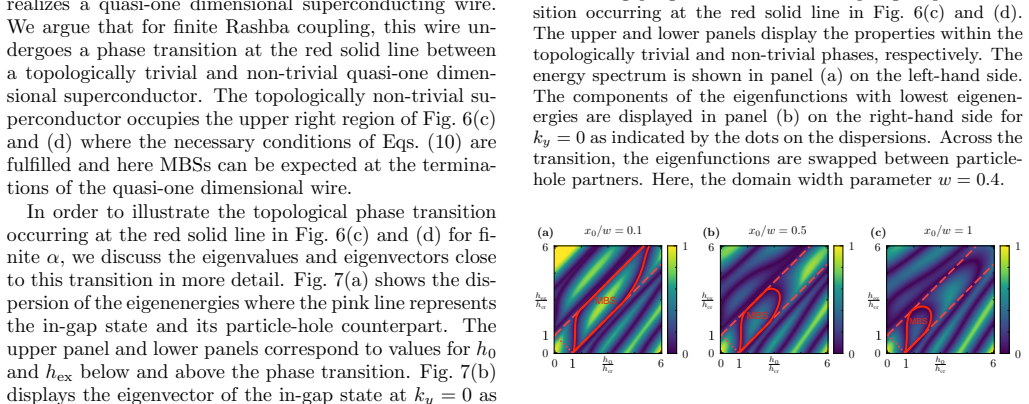
The load-bearing object is the exchange field profile of the 2π wall, $\theta(x)=2\arctan(\sinh(x/x_0)/\sinh(w/x_0))-\pi$, with exchange field $\vec{h}_{\mathrm{ex}}(x)=-h_{\mathrm{ex}}(\sin\theta,\cos\theta,0)$. This profile raises the total in-plane field to $h_0+h_{\mathrm{ex}}$ at the wall center and lowers it to $h_0-h_{\mathrm{ex}}$ away from the wall, so the local field crosses the critical value $h_{\mathrm{cr}}=\sqrt{\Delta^2+\mu^2}$ and creates the alternating trivial and topological regions that confine the quasi-one-dimensional wire. The phase diagram in the $(h_0,h_{\mathrm{ex}})$ plane is the central diagnostic: Majorana bound states appear only where the necessary inequalities hold and the wire is gapped.
What would settle it
Measure the local tunneling spectrum at the two ribbon-edge terminations of a 2π domain wall while sweeping the applied field $h_0$: the claim predicts a zero-bias conductance peak localized at those edges only inside $|h_0-h_{\mathrm{ex}}|<h_{\mathrm{cr}}<h_0+h_{\mathrm{ex}}$, with no peak immediately outside that window. A micromagnetic measurement showing that the wall profile deviates strongly from the assumed double-sine-Gordon form under the antiferromagnetic coupling would also falsify the field profile.
Extended reading notes
Core claim
The central claim is that a 2π domain wall confines a quasi-one-dimensional superconducting wire whose two ends support localized Majorana bound states. In the parameter window $|h_0-h_{\mathrm{ex}}|<h_{\mathrm{cr}}<h_0+h_{\mathrm{ex}}$, the in-gap eigenstate bound to the wall crosses zero energy at a topological transition, and the finite-size calculation finds $\varepsilon_1\approx 10^{-5}\Delta$ at the ribbon edges, a topological gap $\varepsilon_2-\varepsilon_1>0$, and a Majorana polarization that integrates to unity. Finite Rashba spin-orbit coupling is essential: at $\alpha=0$ the gap closes and the Majorana states disappear. The same physics appears for a sharp double Ising wall and for smooth 2π walls, with the Majorana phase shrinking as the wall becomes narrower, i.e. as $x_0/w$ grows.
Load-bearing premise
The proposal assumes the magnetization follows the ideal double-sine-Gordon profile, that the superconducting gap stays uniform and real beneath the ribbon, and that the in-plane field does not cause orbital pair-breaking; if any of these fails, the predicted Majorana window can shift or close.
Editorial extensions
If this is right
- If the claim is right, creating a 2π wall with standard spintronics techniques is enough to make a topological superconducting wire, without special nanowire growth or fine-tuned spin-orbit materials.
- Because 2π walls are mobile under spin currents, the Majorana states can be moved along the ribbon in the adiabatic limit, which is a step toward braiding operations.
- A sequence of domain walls would realize a tunable Kitaev chain: changing the wall spacing changes the Majorana overlap and hence the coupling between neighboring Majorana states.
- For a ribbon shaped as an annulus, moving a topological wall around the ring is topologically equivalent to braiding the inner and outer Majorana states, offering a concrete geometry for non-Abelian operations.
- The Majorana phase survives for walls of different smoothness, from a sharp double Ising wall to a wide 2π wall, with the phase region shrinking as $x_0/w$ increases.
Reading between the lines
- A testable extension the paper leaves implicit is that the exact wall profile matters mainly through where the local field crosses $h_{\mathrm{cr}}$; other magnetic textures with a single sign change of the in-plane field component should also produce Majorana states, and comparing profiles would isolate the geometric condition.
- If the Majorana states are confirmed, the same ribbon could act as a field-tunable Majorana switch: modulating $h_0$ by a small amount should toggle between trivial and nontrivial wire behavior, a faster operation than moving the wall.
- The paper's superconducting-environment results suggest that an extended substrate weakens the Majorana localization; this predicts that experiments will need to match the superconductor to the ribbon width to keep the states well confined.
- A quantitative prediction worth testing is that the topological gap should close linearly with $h_0+h_{\mathrm{ex}}-h_{\mathrm{cr}}$ near the phase boundary, so sweeping the applied field across the boundary and measuring the gap would directly probe the model.
Editorial analysis
A structured set of objections, weighed in public.
Referee Report
Summary. The paper proposes that a 2π magnetic domain wall in a ferromagnetic ribbon placed on a Rashba-coupled superconducting film can locally drive the superconductor across the critical field h_cr = sqrt(Δ^2 + μ^2), thereby creating a quasi-one-dimensional topological superconducting wire whose terminations at the ribbon edges host Majorana bound states. The authors model the system with a BdG Hamiltonian in which the pairing amplitude Δ is fixed and real, and the exchange field of the wall follows the double-sine-Gordon profile of Eq. (7). They derive necessary conditions, h0 - hex < h_cr < h0 + hex, and support the proposal with numerical phase diagrams for the in-gap bound-state dispersion (Figs. 6 and 8) and with full finite-size diagonalizations showing zero-energy states, near-unity integrated Majorana polarization, and edge-localized densities (Figs. 9 and 10). The paper closes with perspectives for tunable Kitaev chains and braiding by moving domain walls.
Significance. If the central claim holds, this is a simple and experimentally relevant platform for Majorana bound states: 2π domain walls are routinely created and moved in spintronics, and the proposal gives a concrete, falsifiable parameter window, Eqs. (10)-(11), together with explicit finite-size signatures. The paper is strengthened by reproducible numerical data (Ref. [45]), by the use of independent diagnostics (zero energy, Majorana polarization, real-space localization), and by the comparison between sharp double-Ising-wall and proper 2π-wall limits. The main caveat is that the model freezes the superconducting pairing amplitude Δ, which is a physical assumption that needs quantitative support before the predicted MBS window can be considered robust; this is the main reason the present assessment is conditional.
major comments (2)
- [§II.B.1, Eq. (1); Figs. 6 and 10] The load-bearing assumption of the entire phase diagram is that the pairing amplitude Δ in Eq. (1) remains a fixed, spatially uniform real constant even where the local magnetic field is large. The proposed MBS window uses fields h0 + hex that reach several times Δ: for example, h0 = hex = 1.5 in Fig. 10(c) and (g) gives a central-region field hI ≈ 3Δ. For a conventional spin-singlet superconductor, such fields exceed the Chandrasekhar-Clogston limit, so a self-consistent treatment of the pairing would suppress or render inhomogeneous Δ(r) precisely in the region that is supposed to be topological. Since the local critical field h_cr(r) = sqrt(Δ(r)^2 + μ^2) enters the necessary conditions (10) and (11), the red transition line in Fig. 6(c) and the finite-size zero modes in Fig. 9 would shift or could close. The manuscript states that the magnetization is treated in mean field and fluctuations are neglected, but it does not quantify the inverse proximity effect on Δ; a self-consistent BdG calculation or an explicit estimate of the pairing suppression is required to support the central claim.
- [§II.C.1, Fig. 6] The identification of the topologically non-trivial phase is based primarily on the vanishing of the lowest in-gap eigenenergy at ky = 0 and on the appearance of zero-energy states in finite-size diagonalization. Because the same eigenenergy can vanish for α = 0 without producing Majorana bound states (Fig. 6(a) versus Fig. 6(c)), the gap-closing condition by itself does not establish the topological invariant of the effective quasi-1D wire. I recommend computing the winding number or Pfaffian invariant of the effective 1D Hamiltonian H(ky), or equivalently demonstrating explicitly that the zero mode is protected against local perturbations, to confirm that the red line in Fig. 6(c) indeed separates sectors with different topological invariants.
minor comments (3)
- [§II.A, just above Eq. (4)] The text reads 'For a vanishing wavevector k_x = 0 along the ribbon', but Eq. (4) is a function of k_y and the subsequent analysis uses momentum along y; the symbol should presumably be k_y = 0.
- [§II.D] The phrase 'confirming and verifing' should be 'confirming and verifying'.
- [§II.C.2 and Fig. 8] The finite-size MBS diagnostics in Figs. 9 and 10 are presented only for the double-Ising-wall limit; for the proper 2π-wall limit, the evidence is limited to the effective-wire spectrum in Fig. 8. A sentence stating explicitly that the finite-size zero-mode wavefunction is expected to behave similarly for the proper wall, or a small finite-size check for one point in Fig. 8(b), would strengthen the connection to the proposed experimental geometry.
Circularity Check
No significant circularity: the MBS phase is a numerical output corroborated by independent diagnostics.
full rationale
The derivation chain is not circular. The model Hamiltonian (1), the exchange-field profile (6)-(9) (supported by standard micromagnetics and the independent Ref. [44]), and the analytical critical field h_cr of Eq. (3) are inputs; the central result is the computed spectrum of the domain-wall-bound in-gap state and the finite-size eigenstates. The MBS window in Figs. 6, 8, and 9 is read off from the vanishing of the computed eigenvalue and corroborated by zero energy, spatial localization, and the Majorana-polarization integral (Figs. 9(d), 10). Equations (10)-(11) only define necessary search regions using the same h_cr; the actual transition line is computed inside that region, not imposed by construction. The only self-citation, Ref. [43] for the double-sine-Gordon wall parameters, is backed by the independent Ref. [44] and concerns a classical micromagnetic profile, not the Majorana claim. The acknowledged idealizations (mean-field magnetization, uniform real pairing amplitude, neglected orbital pair-breaking in Section II.B) are physical assumptions and correctness risks, not circular reductions. No fitted parameter is renamed as a prediction, and no uniqueness theorem is imported from the authors' prior work. The numerical implementation and data are made available in Ref. [45], making the computation self-contained against external benchmarks.
Assumptions & free parameters
free parameters (4)
- Rashba spin-orbit coupling α =
0.3
- Chemical potential µ =
0
- Domain wall width w and steepness x0 =
w = 0.2-0.8, x0/w = 0.02-1.0 (units Δ=1, m=1)
- Effective mass m and pairing Δ =
m=1, Δ=1
assumptions (5)
- domain assumption The Bogoliubov-de Gennes Hamiltonian (Eq. 1) with a real, spatially uniform pairing amplitude Δ describes the superconducting substrate.
- domain assumption The magnetization is confined to the plane by strong easy-plane anisotropy and is described in mean-field, with exchange field h_ex(r) = -J M(r) following the double-sine-Gordon profile of Eqns. (6)-(7).
- domain assumption The coupling between magnet and superconductor is antiferromagnetic (J > 0), so the far-field regions are topologically trivial.
- domain assumption The in-plane field does not cause orbital pair-breaking, and the partially gapped 2D superconductor at |h| > h_cr is a weak topological phase with edge Majorana modes (Fu-Kane-Mele class).
- standard math The kx=0 slice Hamiltonian (Eq. 4) is in the BDI class with an integer winding number, so gap closings at ky=0 signal topological transitions of the effective wire.
Cite this review
Pith. "Pith review of Magnetic $2\pi$ domain walls for tunable Majorana devices." pith.science (2026). https://pith.science/paper/BMMKZIXE
@misc{pith2026250521779,
  author       = {Pith},
  title        = {Pith review of: Magnetic $2\pi$ domain walls for tunable Majorana devices},
  year         = {2026},
  howpublished = {\url{https://pith.science/paper/BMMKZIXE}},
  note         = {Machine review of arXiv:2505.21779}
}
abstract
Identifying realistic platforms capable of controlled operations with Majorana bound states is a key challenge in the study of topological superconductivity. Among the most promising proposals are magnet-superconductor hybrid devices, which employ magnetic textures to engineer regions of non-trivial topology. Here, we consider the remarkably simple case of $2\pi$ domain walls in a magnetic ribbon placed on a superconducting substrate. We show that for properly chosen parameters, such domain walls generate topological quasi-one dimensional superconducting wires and give rise to localized Majorana bound states at the ribbon edges. Magnetic $2\pi$ domain walls are easily created and controlled with existing experimental techniques, thus providing a versatile platform for Majorana manipulations.
Figures


Figures from the paper (8 more)




Reference graph
Works this paper leans on
- [45]
-
[1]
Exchange field of a2πdomain wall In order to generate an effective field⃗h(x) that depends on thex-coordinate in such a manner that it gives rise to the scenario depicted in Fig. 2(f), we assume that it is composed of an external fieldHapplied along they- direction and an exchange field, ⃗h(x) =h 0ˆey + ⃗hex(x),(5) withh 0 = g 2 µBµ0H >0 wheregis the g-fa...
-
[2]
Boundary condition on the ribbon edges For the ribbon edges, we consider two types of bound- ary conditions. For the first type, we assume that the hybrid structure housing the domain wall is surrounded by vacuum corresponding to no environment (ne), see Fig. 4(a). For the second type, we assume that the su- perconducting substrate extends beyond the widt...
-
[3]
4, the field ⃗his ba- sically constant and pointing iny-direction with values FIG
Necessary conditions for the realization of MBSs Far away from the domain wall in region II as well as in region III within the superconducting environment for (se) boundary conditions, see Fig. 4, the field ⃗his ba- sically constant and pointing iny-direction with values FIG. 5. Necessary conditions for the appearance of MBSs are fulfilled in the region ...
-
[4]
Numerical implementation and parameters In the following, we will use units of energy and length where ∆ = 1 and the massm= 1 (with reduced Planck constantℏ= 1). Moreover, we will limit ourselves to a chemical potentialµ= 0 [36], and for the Rashba 5 coupling we will useα= 0.3 and sometimes compare withα= 0. For the numerical implementation, we dis- creti...
-
[5]
Quasi 1d superconducting wire along a double Ising wall In the following, we present the numerical solution of the eigenvalue problem obtained after discretizing the system along thex-direction. We use the parameters specified in section II B 4 and start with a discussion of the double Ising wall limit. Discretizing thex-direction with lattice constanta= ...
-
[6]
Quasi 1d superconducting wire along a2πdomain wall We now turn to the situation of a proper 2πdomain wall. Here, we discretize the Hamiltonian (13) inx- direction with lattice constanta= 0.01 usingN x = 500 lattice points corresponding to a system sizeaN x = 5. The width of the wall is chosen to bew= 0.4 and three values for the steepness are consideredx ...
-
[7]
Qi and S.-C
X.-L. Qi and S.-C. Zhang, Topological insulators and su- perconductors, Rev. Mod. Phys.83, 1057 (2011)
2011
Show all 54 references
-
[8]
A. Y. Kitaev, Unpaired Majorana fermions in quantum wires, Phys.-Usp.44, 131 (2001)
2001
-
[9]
D. A. Ivanov, Non-Abelian statistics of half-quantum vor- tices in p-Wave superconductors, Phys. Rev. Lett.86, 268 (2001)
2001
-
[10]
Nayak, S
C. Nayak, S. H. Simon, A. Stern, M. Freedman, and S. Das Sarma, Non-Abelian anyons and topological quan- tum computation, Rev. Mod. Phys.80, 1083 (2008)
2008
-
[11]
R¨ ontynen and T
J. R¨ ontynen and T. Ojanen, Topological superconduc- tivity and high chern numbers in 2D ferromagnetic shiba lattices, Phys. Rev. Lett.114, 236803 (2015)
2015
-
[12]
J. Li, T. Neupert, Z. Wang, A. H. MacDonald, A. Yaz- dani, and B. A. Bernevig, Two-dimensional chiral topo- logical superconductivity in Shiba lattices, Nat. Com- mun.7, 12297 (2016)
2016
-
[13]
G. C. M´ enard, S. Guissart, C. Brun, R. T. Leriche, M. Trif, F. Debontridder, D. Demaille, D. Roditchev, P. Simon, and T. Cren, Two-dimensional topological superconductivity in Pb/Co/Si(111), Nat. Commun.8, 2040 (2017)
2017
-
[14]
Palacio-Morales, E
A. Palacio-Morales, E. Mascot, S. Cocklin, H. Kim, S. Rachel, D. K. Morr, and R. Wiesendanger, Atomic- scale interface engineering of Majorana edge modes in a 2D magnet-superconductor hybrid system, Sci. Adv.5, eaav6600 (2019)
2019
-
[15]
Braunecker, G
B. Braunecker, G. I. Japaridze, J. Klinovaja, and D. Loss, Spin-selective Peierls transition in interacting one-dimensional conductors with spin-orbit interaction, Phys. Rev. B82, 045127 (2010)
2010
-
[16]
T.-P. Choy, J. M. Edge, A. R. Akhmerov, and C. W. J. Beenakker, Majorana fermions emerging from magnetic nanoparticles on a superconductor without spin-orbit coupling, Phys. Rev. B84, 195442 (2011)
2011
-
[17]
Kjaergaard, K
M. Kjaergaard, K. W¨ olms, and K. Flensberg, Majorana fermions in superconducting nanowires without spin- orbit coupling, Phys. Rev. B85, 020503 (2012)
2012
-
[18]
Mascot, Topological superconductivity in skyrmion lattices, npj Quantum Materials , 6 (2021)
E. Mascot, Topological superconductivity in skyrmion lattices, npj Quantum Materials , 6 (2021)
2021
-
[19]
S. Rex, I. V. Gornyi, and A. D. Mirlin, Majorana modes in emergent-wire phases of helical and cycloidal magnet- superconductor hybrids, Phys. Rev. B102, 224501 (2020)
2020
-
[20]
Bedow, E
J. Bedow, E. Mascot, T. Posske, G. S. Uhrig, R. Wiesen- danger, S. Rachel, and D. K. Morr, Topological super- conductivity induced by a triple-qmagnetic structure, Phys. Rev. B102, 180504 (2020)
2020
-
[21]
G. Yang, P. Stano, J. Klinovaja, and D. Loss, Majorana bound states in magnetic skyrmions, Phys. Rev. B93, 224505 (2016)
2016
-
[22]
Garnier, A
M. Garnier, A. Mesaros, and P. Simon, Topological su- perconductivity with orbital effects in magnetic skyrmion based heterostructures, arXiv:1909.12671
1909 arXiv
-
[23]
K. M. D. Hals, M. Schecter, and M. S. Rudner, Composite Topological Excitations in Ferromagnet- Superconductor Heterostructures, Phys. Rev. Lett.117, 017001 (2016)
2016
-
[24]
Baumard, J
J. Baumard, J. Cayssol, F. S. Bergeret, and A. Buzdin, Generation of a superconducting vortex via N´ eel skyrmions, Phys. Rev. B99, 014511 (2019)
2019
-
[25]
S. Rex, I. V. Gornyi, and A. D. Mirlin, Majorana bound states in magnetic skyrmions imposed onto a supercon- ductor, Phys. Rev. B100, 064504 (2019)
2019
-
[26]
Garnier, A
M. Garnier, A. Mesaros, and P. Simon, Topological su- perconductivity with deformable magnetic skyrmions, Commun. Phys2, 126 (2019)
2019
-
[27]
Nothhelfer, S
J. Nothhelfer, S. A. D ´ ıaz, S. Kessler, T. Meng, M. Rizzi, K. M. D. Hals, and K. Everschor-Sitte, Steering Majo- rana braiding via skyrmion-vortex pairs: A scalable plat- form, Phys. Rev. B105, 224509 (2022)
2022
-
[28]
A. P. Petrovi´ c, M. Raju, X. Y. Tee, A. Louat, I. Maggio- Aprile, R. M. Menezes, M. J. Wyszy´ nski, N. K. Duong, M. Reznikov, Ch. Renner, M. V. Miloˇ sevi´ c, and C. Panagopoulos, Skyrmion-(Anti)Vortex Coupling in a Chiral Magnet-Superconductor Heterostructure, Phys. Rev. Let...
2021
-
[29]
Herv´ e, B
M. Herv´ e, B. Dup´ e, R. Lopes, M. B¨ ottcher, M. D. Martins, T. Balashov, L. Gerhard, J. Sinova, and W. Wulfhekel, Stabilizing spin spirals and isolated skyrmions at low magnetic field exploiting vanishing magnetic anisotropy, Nat. Commun.9, 1015 (2018)
2018
-
[30]
Kubetzka, J
A. Kubetzka, J. M. B¨ urger, R. Wiesendanger, and K. von Bergmann, Towards skyrmion-superconductor hy- brid systems, Phys. Rev. Materials4, 081401 (2020)
2020
-
[31]
G¨ ung¨ ord¨ u, S
U. G¨ ung¨ ord¨ u, S. Sandhoefner, and A. A. Kovalev, Stabi- lization and control of Majorana bound states with elon- gated skyrmions, Phys. Rev. B97, 115136 (2018)
2018
-
[32]
R. M. Lutchyn, J. D. Sau, and S. Das Sarma, Ma- jorana fermions and a topological phase transition in semiconductor-superconductor heterostructures, Phys. Rev. Lett.105, 077001 (2010)
2010
-
[33]
Y. Oreg, G. Refael, and F. von Oppen, Helical liquids and majorana bound states in quantum wires, Phys. Rev. Lett.105, 177002 (2010)
2010
-
[34]
Y. Peng, F. Pientka, L. I. Glazman, and F. Von Oppen, Strong Localization of Majorana End States in Chains of Magnetic Adatoms, Phys. Rev. Lett.114, 106801 (2015)
2015
-
[35]
Pawlak, S
R. Pawlak, S. Hoffman, J. Klinovaja, D. Loss, and E. Meyer, Majorana fermions in magnetic chains, Progress in Particle and Nuclear Physics107, 1 (2019)
2019
-
[36]
O. A. Awoga, I. Ioannidis, A. Mishra, M. Leijnse, M. Trif, and T. Posske, Controlling Majorana hybridization in magnetic chain-superconductor systems, Phys. Rev. Re- search6, 033154 (2024)
2024
-
[37]
Kreisel, T
A. Kreisel, T. Hyart, and B. Rosenow, Tunable topologi- cal states hosted by unconventional superconductors with adatoms, Phys. Rev. Research3, 033049 (2021)
2021
-
[38]
Schneider, S
L. Schneider, S. Brinker, M. Steinbrecher, J. Hermenau, T. Posske, M. Dos Santos Dias, S. Lounis, R. Wiesendan- 11 ger, and J. Wiebe, Controlling in-gap end states by link- ing nonmagnetic atoms and artificially-constructed spin chains on superconductors, Nature Communications...
2020
-
[39]
Schneider, P
L. Schneider, P. Beck, T. Posske, D. Crawford, E. Mas- cot, S. Rachel, R. Wiesendanger, and J. Wiebe, Topolog- ical Shiba bands in artificial spin chains on superconduc- tors, Nat. Phys.17, 943 (2021)
2021
-
[40]
K.-S. Ryu, L. Thomas, S.-H. Yang, and S. Parkin, Chiral spin torque at magnetic domain walls, Nature Nanotech- nology8, 527 (2013)
2013
-
[41]
Emori, U
S. Emori, U. Bauer, S.-M. Ahn, E. Martinez, and G. S. D. Beach, Current-driven dynamics of chiral ferromagnetic domain walls, Nature Materials12, 611 (2013)
2013
-
[42]
Alicea, Majorana fermions in a tunable semiconductor device, Phys
J. Alicea, Majorana fermions in a tunable semiconductor device, Phys. Rev. B81, 125318 (2010)
2010
-
[43]
Shen,Topological Insulators(Springer, 2012)
S.-Q. Shen,Topological Insulators(Springer, 2012)
2012
-
[44]
A. C. Potter and P. A. Lee, Multichannel generalization of kitaev’s majorana end states and a practical route to realize them in thin films, Phys. Rev. Lett.105, 227003 (2010)
2010
-
[46]
W. Y. Deng, H. Geng, W. Luo, L. Sheng, and D. Y. Xing, Zeeman-Field-Tuned Topological Phase Transitions in a Two-Dimensional Class-DIII Superconductor, Sci Rep6, 25503 (2016)
2016
-
[47]
N. F. Q. Yuan and L. Fu, Zeeman-induced gapless super- conductivity with a partial Fermi surface, Phys. Rev. B 97, 115139 (2018)
2018
-
[48]
L. Fu, C. L. Kane, and E. J. Mele, Topological insulators in three dimensions, Phys. Rev. Lett.98, 106803 (2007)
2007
-
[49]
M¨ uller, A
J. M¨ uller, A. Rosch, and M. Garst, Edge instabilities and skyrmion creation in magnetic layers, New J. Phys.18, 065006 (2016)
2016
-
[50]
C. B. Muratov and V. V. Osipov, Theory of 360 ◦ do- main walls in thin ferromagnetic films, Journal of Applied Physics104, 053908 (2008)
2008
-
[51]
Hauck, Data for paper: Magnetic 2πdomain walls for tunable majorana devices, 10.35097/rjtdk3ud8ezfzyd2 (2025)
D. Hauck, Data for paper: Magnetic 2πdomain walls for tunable majorana devices, 10.35097/rjtdk3ud8ezfzyd2 (2025)
2025 doi
-
[52]
Sedlmayr and C
N. Sedlmayr and C. Bena, Visualizing Majorana bound states in one and two dimensions using the generalized Majorana polarization, Phys. Rev. B92, 115115 (2015)
2015
-
[53]
Marra, D
P. Marra, D. Inotani, and M. Nitta, 1d majorana gold- stinos and partial supersymmetry breaking in quantum wires, Commun. Phys.5, 149 (2022)
2022
-
[54]
Marra, D
P. Marra, D. Inotani, and M. Nitta, Dispersive 1D Ma- jorana modes with emergent supersymmetry in 1D prox- imitized superconductors via spatially-modulated poten- tials and magnetic fields, Phys. Rev. B105, 214525 (2022)
2022
Reviewed August 7, 2026 · model on record in the stance chip above.
Discussion (0). Sign in to comment.