REVIEW 3 major objections 6 minor 11 references
P-DROP: Poisson-Based Dropout for Graph Neural Networks
T0 review · 3 major / 6 minor · reviewed 2026-08-07 · deepseek-v4-flash
Pith's one-line read The paper claims that equipping each node with an independent Poisson clock yields structure-aware dropout that matches or beats Dropout, DropEdge, and DropNode on citation benchmarks.
desk verdict P-DROP is a reparameterization of node dropout, not a structure-aware method, and its single-run experiments do not support the accuracy claims. read the letter →
The pith
A machine-rendered reading of the paper's core claim, the machinery that carries it, and where it could break.
The reading
What carries the argument
The load-bearing object is the independent Poisson clock assigned to each node, with exponential waiting times $T_v \sim \mathrm{Exp}(\lambda)$ and active set $V_{\text{active}}(t) = \{v \in V : T_v \le t\}$. The active set defines which nodes participate in each GNN pass, and the superposition property of Poisson processes is what the author uses to argue that inactive nodes still receive indirect influence through active neighbors. Algorithm 1 uses a fixed cutoff $t_{\text{cut}}$ as a dropout rule, while Algorithm 2 lets time advance and resamples each active node's clock, turning training into a sequence of dynamic subgraph updates.
What would settle it
Compute the exact active-set distribution of Algorithm 1 with constant $\lambda$ and compare training curves of P-DROP against DropNode with keep probability $p = \exp(-\lambda t_{\text{cut}})$ on Cora using the same GCN architecture and seeds; if the curves are statistically indistinguishable across epochs, the claimed structural sensitivity is not present in the implemented method.
Extended reading notes
Core claim
The central claim is that replacing uniform random node suppression with Poisson-process-based node selection gives GNNs a structure-aware regularization that slows over-smoothing. Each node $v$ carries an independent exponential clock with rate $\lambda_v$; at time $t$, a node is active if its firing time $T_v$ satisfies $T_v \le t$, and forward/backward propagation runs only on the induced subgraph. Because Poisson processes superpose, a node that is not directly active can still receive messages through active neighbors, so structurally central nodes remain influential. The paper presents this mechanism in two forms, Poisson dropout and dynamic subgraph training, and reports that on Cora, Citeseer, and PubMed the approach yields competitive or improved accuracy compared to Dropout, DropEdge, and DropNode, especially in later training stages.
Load-bearing premise
The load-bearing premise is that sampling independent exponential clocks with a single global rate $\lambda$ makes node selection structure-aware; in Algorithms 1 and 2 every node's active probability is $1 - \exp(-\lambda t_{\text{cut}})$, independent of degree, edges, or topology, so unless rates vary by node the method degenerates to uniform DropNode with a fixed keep probability.
Editorial extensions
If this is right
- A single Poisson rate plus a cutoff produces a subgraph that is sparse but keeps indirect influence flowing through active neighbors, so regularization no longer needs a topology-blind random mask.
- The asynchronous schedule allows node updates to happen at node-specific times, which fits recurrent or decentralized training loops where message passing is not synchronized layer-by-layer.
- On PubMed, the largest benchmark tested, the method's later-stage accuracy exceeds the uniform baselines, suggesting the benefit grows with graph size.
- Practitioners can translate any dropout keep probability $p$ into the Poisson formulation by setting $t_{\text{cut}} = -\ln(p)/\lambda$.
Reading between the lines
- With a single global rate $\lambda$, Algorithm 1's active probability is $1 - \exp(-\lambda t_{\text{cut}})$ for every node, so the active set is distributionally identical to DropNode with keep probability $\exp(-\lambda t_{\text{cut}})$; the advertised structure-awareness therefore depends on $\lambda_v$ actually varying with connectivity.
- A direct test of the structure-aware claim is to set $\lambda_v$ proportional to node degree and compare against constant rates on a degree-skewed network; if the claim is real, the degree-proportional version should improve on the uniform-rate version.
- Because exponential clocks are memoryless, Algorithm 2's active sets evolve as independent Bernoulli flips at each time step; any difference from repeated DropNode sampling comes from the timing correlation of the resampling schedule, not from graph topology.
- The asynchronous view suggests a scalable training recipe the paper leaves implicit: compute can concentrate on nodes with frequent clock rings, but no experiment in the paper measures this speedup.
Editorial analysis
A structured set of objections, weighed in public.
Referee Report
Summary. The paper proposes P-DROP, a node-selection scheme for GNNs based on independent Poisson clocks per node. Nodes are selected for activation when an exponential clock T_v ~ Exp(λ) falls below a threshold t_cut (Algorithm 1) or when simulated time catches up to it (Algorithm 2). The authors claim that this introduces stochastic, structure-aware updates that mitigate over-smoothing, and they evaluate the dropout variant on Cora, CiteSeer, and PubMed using GCN, comparing against Dropout, DropEdge, and DropNode. The reported results show small accuracy differences. The paper also proposes a dynamic-subgraph training variant but does not evaluate it.
Significance. If the proposed method genuinely combined Poisson scheduling with structural information, it would be a plausible contribution to GNN regularization. The Poisson/exponential background is standard and the paper is readable. However, as implemented, the method uses a single global rate λ and no topological information, so the algorithm is equivalent to DropNode with keep probability 1 - exp(-λ t_cut). The structure-aware advantage advertised in the abstract, Section 2.1, and Section 3 is not realized. The experimental evidence is also weak: single runs without error bars, no hyperparameter reporting, and no deep-GNN or subgraph experiments despite the over-smoothing motivation. These are load-bearing issues that require substantial revision.
major comments (3)
- [§2.1, §3.1, Algorithm 1] The active set V_active = {v : T_v ≤ t_cut} has a node-independent activation probability P = 1 - exp(-λ t_cut), because all nodes share the same λ. The text (Section 2.1 bullets, Section 2.3, and Section 3.1) promises that λ_v can be customized to reflect structural importance and that structurally important nodes influence learning more frequently, but neither Algorithm 1 nor Algorithm 2 defines λ_v from degree, centrality, or any other graph property. Consequently, the method degenerates to DropNode with a fixed keep probability, and the central claim of structure-aware selection is not implemented. Please either modify the algorithms to use structure-dependent rates (e.g., λ_v = α·deg(v) or a function of neighborhood statistics) and verify the resulting selection probabilities, or revise the abstract and contributions to avoid claiming structure-awareness.
- [§5.1, Table 1] Table 1 reports a single run per method per dataset, with no standard errors, no seeds, no hyperparameter settings (λ, t_cut, learning rate, weight decay, number of layers, hidden units), and no description of how SGNN's parameters were chosen. The accuracy differences among methods are of order 0.001–0.01, which is within typical run-to-run variance for GCN on these benchmarks. Therefore the claim of 'competitive or improved accuracy compared to traditional Dropout, DropEdge, and DropNode' (abstract and Section 5.1) is not statistically supported. The experiments should be repeated over multiple random seeds with reported means and standard deviations, and all hyperparameters should be specified.
- [§7.1, §7.3, §3.2] The paper's motivation is over-smoothing, and the abstract claims that the method addresses it, but Section 7.1 states that the current implementation is 'still under development' for deep GNNs, and Section 7.3 states that comparison in subgraph propagation settings is 'in the process' and a 'high priority for future work.' The only experiments use a shallow GCN (no layer depth is reported) on three citation networks, and Algorithm 2's dynamic subgraph training is never evaluated. Thus the paper's stated scope, as advertised in the abstract and introduction, goes beyond the evidence. Please either include deep-GNN experiments (e.g., 4–8 layers) that directly test over-smoothing and evaluate the Algorithm 2 variant, or narrow the claims accordingly.
minor comments (6)
- [§5.1] The method is referred to as 'SGNN' in the experiments with no explanation, while the paper is titled P-DROP. Please use consistent naming throughout.
- [§3.1, after Algorithm 1] The text states that 'Nodes whose sampled values greater than the threshold are selected,' but the algorithm selects nodes with T_v ≤ t_cut. This is contradictory and should be corrected.
- [§2.2] The sentence 'For GNN, it uses sampling like Dropout ..., however, it utilizes structures of GNN' is unclear and grammatically awkward; please rewrite for clarity.
- [Throughout] The manuscript contains numerous typos and formatting errors, including 'challengeshave,' 'one ofthe,' 'propogate,' and inconsistent spacing in equations. A careful proofread is needed.
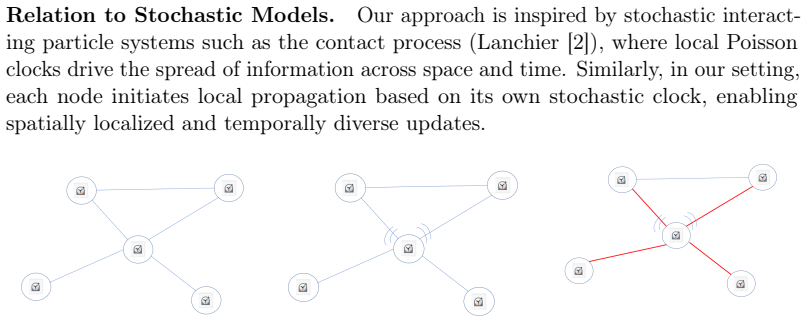
- [Figures 1–5] The captions are uninformative ('Graph,' 'One Alarm rings,' 'propogate neighborhoods,' 'Illustration of other data : Image, Text,' 'Illustration of node degree imbalance in graph structures'), and the figures are not referenced in the text. Either integrate them with proper explanatory captions or remove them.
- [Appendix, Figures 6–8] The appendix figures are said to show validation and test accuracy over 200 epochs, but the text does not describe what the curves represent (which method, validation or test, color scheme), and the figures are not included in the text. Please ensure they are legible and labeled.
Circularity Check
Poisson-based node selection is exactly uniform Bernoulli node dropout, so the central 'structure-aware' claim reduces to a reparameterization of DropNode.
-
renaming known result
[Algorithm 1 (Section 3.1); structure-awareness claim in Sections 2.1 and 3.1]
"Sample: For each node v ∈ V, draw Tv ∼ Exp(λ). Select nodes: Vactive ← {v ∈ V | Tv ≤ tcut} ... Unlike uniform random sampling, it allows the selection process to be sensitive to the structural properties of the graph."
For every node, P(Tv ≤ tcut) = 1 − exp(−λ·tcut), which is a constant independent of degree, edges, or any topological property. Therefore Vactive is an independent Bernoulli keep set with probability p = 1 − exp(−λ·tcut), which is exactly DropNode. The 'Poisson' and 'structure-aware' description is a reparameterization of the known uniform node-dropout baseline; the claimed structural advantage is not derived from the algorithm, and the Section 5.1 comparison against DropNode is effectively a comparison of the same selection mechanism with different hyperparameters.
full rationale
The paper contains no load-bearing self-citations and no fitted-to-target derivation; the references are standard background. However, the central contribution — Poisson-based structure-aware node selection — reduces by construction to uniform Bernoulli node dropout. In Algorithm 1, the exponential clock step is just a way to generate a constant-probability Bernoulli mask, because the active probability 1 − exp(−λ·tcut) is identical for all nodes. Algorithm 2 repeats the same independent, structure-free draws across time steps. Consequently, the advertised structure-awareness is not implemented by the algorithm, and the empirical 'SGNN vs DropNode' comparison compares essentially the same mechanism under a different name. This is the renaming-known-result pattern, giving partial circularity with score 6.
Assumptions & free parameters
free parameters (4)
- lambda (Poisson intensity)
- tcut (cutoff threshold)
- T (total simulation time)
- Delta t (time step)
assumptions (4)
- ad hoc to paper Independent Poisson clocks per node with a single constant rate lambda produce structure-aware updates.
- domain assumption Training on the induced subgraph G_active preserves the learning behavior of full-graph GNN training.
- domain assumption Poisson process properties such as superposition and memorylessness apply meaningfully to a static per-round node sampling scheme.
- domain assumption Sparsifying node updates reduces over-smoothing in deep GNNs.
Cite this review
Pith. "Pith review of P-DROP: Poisson-Based Dropout for Graph Neural Networks." pith.science (2026). https://pith.science/paper/BZF3BG6C
@misc{pith2026250521783,
  author       = {Pith},
  title        = {Pith review of: P-DROP: Poisson-Based Dropout for Graph Neural Networks},
  year         = {2026},
  howpublished = {\url{https://pith.science/paper/BZF3BG6C}},
  note         = {Machine review of arXiv:2505.21783}
}
read the original abstract
Over-smoothing remains a major challenge in Graph Neural Networks (GNNs), where repeated message passing causes node representations to converge and lose discriminative power. To address this, we propose a novel node selection strategy based on Poisson processes, introducing stochastic but structure-aware updates. Specifically, we equip each node with an independent Poisson clock, enabling asynchronous and localized updates that preserve structural diversity. We explore two applications of this strategy: as a replacement for dropout-based regularization and as a dynamic subgraph training scheme. Experimental results on standard benchmarks (Cora, Citeseer, Pubmed) demonstrate that our Poisson-based method yields competitive or improved accuracy compared to traditional Dropout, DropEdge, and DropNode approaches, particularly in later training stages.
Figures


Figures from the paper (3 more)


Reference graph
Works this paper leans on
-
[1]
T. Konstantin Rusch, Michael M. Bronstein, and Siddhartha Mishra. A survey on oversmoothing in graph neural networks, 2023. URLhttps://arxiv.org/ abs/2303.10993
arXiv 2023
- [2]
-
[3]
Dropout: A simple way to prevent neural networks from over- fitting
Nitish Srivastava, Geoffrey Hinton, Alex Krizhevsky, Ilya Sutskever, and Ruslan Salakhutdinov. Dropout: A simple way to prevent neural networks from over- fitting. Journal of Machine Learning Research, 15(56):1929–1958, 2014. URL http://jmlr.org/papers/v15/srivastava14a.html
work page 1929
-
[4]
Drope- dge: Towards deep graph convolutional networks on node classification
Yu Rong, Wenbing Huang, Tingyang Xu, and Junzhou Huang. Drope- dge: Towards deep graph convolutional networks on node classification. In International Conference on Learning Representations, 2020. URL https: //openreview.net/forum?id=Hkx1qkrKPr
work page 2020
-
[5]
Dropmessage: Unifying random dropping for graph neural networks
Taoran Fang, Zhiqing Xiao, Chunping Wang, Jiarong Xu, Xuan Yang, and Yang Yang. Dropmessage: Unifying random dropping for graph neural networks. Proceedings of the AAAI Conference on Artificial Intelligence, 37(4):4267–4275, Jun. 2023. doi: 10.1609/aaai.v37i4.25545. URLhttps://ojs.aaai.org/index. php/AAAI/article/view/25545
-
[6]
An introduction to convolutional neural networks,
Keiron O’Shea and Ryan Nash. An introduction to convolutional neural networks,
-
[7]
Finding structure in time.Cognitive science, 14(2):179–211, 1990
Jeffrey L Elman. Finding structure in time.Cognitive science, 14(2):179–211, 1990
1990
-
[8]
Long short-term memory.Neural Comput., 9(8):1735–1780, November 1997
Sepp Hochreiter and Jürgen Schmidhuber. Long short-term memory.Neural Comput., 9(8):1735–1780, November 1997. ISSN 0899-7667. doi: 10.1162/neco. 1997.9.8.1735. URL https://doi.org/10.1162/neco.1997.9.8.1735
doi:10.1162/neco 1997
Show all 11 references
-
[9]
Hamilton, Rex Ying, and Jure Leskovec
William L. Hamilton, Rex Ying, and Jure Leskovec. Inductive representation learning on large graphs, 2018. URLhttps://arxiv.org/abs/1706.02216
2018 arXiv
-
[10]
Graph attention networks, 2018
Petar Veličković, Guillem Cucurull, Arantxa Casanova, Adriana Romero, Pietro Liò, and Yoshua Bengio. Graph attention networks, 2018. URLhttps://arxiv. org/abs/1710.10903. 10
2018 arXiv
-
[2015]
URL https://arxiv.org/abs/1511.08458
Reviewed August 7, 2026 · model on record in the stance chip above.
Discussion (0). Sign in to comment.