REVIEW 5 major objections 5 minor 2 cited by
Primordial black holes from Q-balls produced in a first-order phase transition
T0 review · 5 major / 5 minor · reviewed 2026-08-07 · deepseek-v4-flash
Pith's one-line read Long-lived scalars trapped in false-vacuum remnants can condense into Q-balls that collapse into primordial black holes, producing nHz gravitational waves and gamma-ray signals.
desk verdict Bosonic Q-ball collapse to PBHs is a genuinely new channel with clean free-energy scaling, but the step from 'no stable Q-ball' to 'black hole' is asserted, not derived, and that gap is the whole ballgame. read the letter →
The pith
A machine-rendered reading of the paper's core claim, the machinery that carries it, and where it could break.
The reading
What carries the argument
The central object is a Q-ball formed inside a shrinking false-vacuum bubble, a condensate of long-lived scalar particles carrying a net charge $Q$. The argument is carried by the bubble free energy, written as a cubic polynomial in $R^2$, $f(R^2)=(R^2)^3-pR^2+q$ with $p=Q/(4\tilde U_0)$ and $q=3g^2c_1Q^2/[(4\pi)^2\tilde U_0 M_\phi^2]$; a stable Q-ball exists when $f$ has a positive root, and collapse to a PBH occurs when $f(\sqrt{p/3})>0$, i.e. when the Yukawa-mediation mass falls below $M_\phi<[(9\sqrt{3}g^2c_1)/(4\pi^2)]^{1/2}Q^{1/4}\tilde U_0^{1/4}$. This condition converts the shrinking-bubble geometry into a black-hole formation criterion.
What would settle it
A first-principles simulation of the collapsing Q-ball that tracks the scalar's global U(1) charge, the condensate radius, and the approach to the horizon would settle the collapse step; in particular, if the condensate fragments or stops shrinking before its radius approaches the Schwarzschild radius of a $10^{15}$ g black hole, the predicted PBH population would not form.
Extended reading notes
Core claim
The central claim is that bosonic false-vacuum remnants collapse much earlier and to much smaller masses than fermionic ones. Once the trapped scalars form a condensate, the free energy of the false-vacuum bubble is $F=\pi Q/R-(2\pi^3/135)R^3T^4+(4\pi/3)R^3U_0(T)$, giving a stable Q-ball of radius $R=Q^{1/4}[4U_0(T)]^{-1/4}$ and mass $M=7.91\times10^{15}\,{\rm g}\,[(U_0^{1/4}/{\rm MeV})(Q/10^{60})^{3/4}]$. Adding a Yukawa interaction $V=-g^2 e^{-M_\phi r}/(4\pi r)$ removes the free-energy minimum once $M_\phi$ drops below the threshold in Eq. (17); the bubble then collapses into a PBH whose mass is approximated by the bubble free energy at collapse, about seven eighths of it coming from the scalar kinetic and Yukawa energy. Because the Q-ball radius is parametrically smaller than a Fermi-ball radius, the resulting PBH mass is suppressed by $Q^{-1/4}$ at fixed charge, while the number density of PBHs is unchanged.
Load-bearing premise
The load-bearing premise is that once the Yukawa attraction makes the bubble's free energy increase monotonically as the bubble shrinks, the false-vacuum remnant necessarily collapses into a black hole, and that the black-hole mass is the bubble free energy at that moment.
Editorial extensions
If this is right
- PBHs from Q-balls have the same number density as those from Fermi-balls but each mass is suppressed by $Q^{-1/4}$, so the PBH energy density is much smaller and $f_{\rm PBH}\sim1$ is not achievable in this scenario.
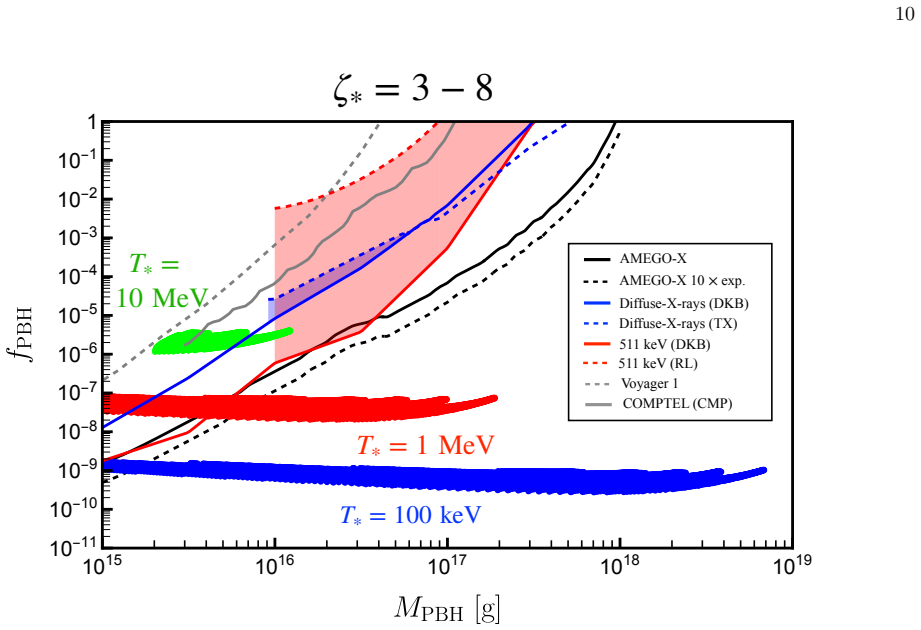
- For percolation temperatures $100\,{\rm keV}\lesssim T_*\lesssim1\,{\rm MeV}$ and $\eta_X=1$, the model produces PBHs with $M_{\rm PBH}>10^{15}$ g that survive past recombination and can be probed through Hawking evaporation at MeV gamma-ray observatories.
- The same phase transition generates a gravitational-wave background peaking near 1 to 100 nHz with $h^2\Omega_{\rm GW}^{\max}\sim10^{-16}$ to $10^{-14}$, within reach of planned nHz observatories if latent-heat conversion into sound waves is efficient.
- A gamma-ray line at $E_\gamma=m_X/2$ from superradiant scalar production and decay would be a unique signature of boson condensate collapse, since a fermion remnant cannot produce it.
- Dark-sector reheating after the transition can yield $\Delta N_{\rm eff}\sim0.4$, which may ease the Hubble tension and would be testable at future CMB experiments; a stable $O(\rm eV)$ dark-sector particle would form a hot dark matter component.
Reading between the lines
- A dynamical question the paper leaves open is whether the condensate actually reaches horizon compactness during collapse: just before collapse the Q-ball radius is around $10^4$ cm for $Q\sim10^{60}$, far above the $\sim10^{-13}$ cm Schwarzschild radius of a $10^{15}$ g PBH, so a numerical study of the collapse is a natural next step.
- A testable extension is to apply the same collapse criterion to other thermal effective potentials: the mechanism should work for any long-lived scalar with a particle-antiparticle asymmetry and a light Yukawa mediator, and the resulting PBH mass function could differ from the quartic example.
- If an nHz gravitational-wave background and an MeV gamma-ray line at $m_X/2$ were both observed with correlated amplitudes, that would strongly distinguish scalar condensate collapse from Fermi-ball collapse; observing one but not the other would point to a different PBH formation channel.
- The intermediate regime of stronger scalar self-interaction, in which collapse precedes full condensation, is outside the paper's analytic treatment; a numerical study there could either widen or close the viable parameter window.
Editorial analysis
A structured set of objections, weighed in public.
Referee Report
Summary. This paper proposes a new mechanism for primordial black hole (PBH) formation from a dark first-order phase transition. Long-lived scalar particles X confined to false-vacuum bubbles condense into Q-balls; a Yukawa attraction mediated by a heavy field φ can remove the free-energy minimum, leading the authors to claim collapse to a PBH. The paper derives the Q-ball radius and mass (R ∝ Q^{1/4}, M ∝ Q^{3/4} U0^{1/4}), the collapse condition (Eqs. 14–17), and the PBH mass (Eq. 20), then computes gravitational wave, Hawking evaporation, superradiance, and ΔNeff signals. A scan over a quartic potential identifies percolation temperatures T* ∼ 100 keV–1 MeV with potentially observable 1–100 nHz GWs and gamma-ray signals.
Significance. If the collapse step is correct, the scenario provides a distinctive PBH formation channel whose signatures (nHz gravitational waves, MeV gamma rays from Hawking radiation and superradiance, and a dark radiation contribution to Neff) differ sharply from Fermi-ball models. The analytic treatment of the Bose condensate and the parametric comparison to Fermi-balls are useful and clearly presented. The paper also gives a concrete, falsifiable parameter scan. However, the central claim depends on an unproven assertion that a free-energy instability in flat space leads to horizon formation; this must be substantiated before the phenomenological predictions can be accepted.
major comments (5)
- [Section II.B, Eqs. (14)–(18)] The condition dF/dR > 0 for all R demonstrates only that the flat-space variational free energy has no local minimum for positive R; it does not establish that the condensed bubble collapses to a black hole. At the threshold (Eq. 17) the radius is R = (p/3)^{1/4}, which for Q = 10^60 and U0^{1/4} = 1 MeV is about 10^4 cm, whereas the Schwarzschild radius of a 10^15 g PBH is about 10^-13 cm. The intervening dynamics—quantum pressure, self-interactions of X, emission of φ, fragmentation, and gravity—are not modeled, and no trapped-surface or horizon-formation criterion is given. Since the PBH mass, abundance, and all multimessenger signals follow from this step, the collapse claim is the load-bearing assumption of the paper.
- [Section II.B, Eq. (20)] The identification MPBH ≃ Fcollapse assumes that the entire bubble free energy at the onset of instability is converted into the black hole mass. The bubble carries a conserved global charge Q from Eq. (3), but black holes are not expected to carry global charge; the paper does not explain how the charge is dissipated or hidden during collapse, nor how dissipative processes (emission of X and φ, gravitational radiation) leave the final mass equal to Fcollapse. A conservative estimate of mass loss or a charge-dissipation mechanism is needed.
- [Section II.B, text around Eq. (18)] The statement 'TPBH < TEC < U0^{1/4}' is internally inconsistent: with TEC ∝ Q^{1/12} U0^{1/4} as given, TEC exceeds U0^{1/4} for any Q > 1, so the chain cannot hold. The condition TPBH < TEC actually implies g < O(Q^{-1/6}), not g < O(Q^{-1/4}) as claimed. This affects the allowed Yukawa coupling range and the parameter scan in Section V, where g ≲ O(10^{-15}) is used for Q ≲ 10^61.
- [Section II.A, after Eq. (4); Section IV.C] The free energy in Eq. (9) neglects scalar self-interactions, but the subsequent collapse mechanism relies on a Yukawa interaction, and scalar self-interactions (even if weak) can be enhanced by the large occupation number Q ∼ 10^60. The paper does not justify this neglect for the condensate or for the collapse dynamics, and it later relies on the same assumption when estimating superradiance in Section IV.C. Fragmentation of the condensate is not addressed; a Q-ball of this size may break into smaller pieces before collapse.
- [Section IV.C, Fig. 2] The superradiance signal assumes a near-maximally spinning PBH (a∗ ≈ 0.99) and a scalar mass mX ≥ 400 keV, but the angular momentum of the progenitor false-vacuum bubbles is only cited from Ref. [16], and the paper does not show that the resulting PBHs retain sufficient spin for the assumed a∗. Without a model for the spin distribution, the claimed sensitivity of AMEGO-X to the superradiance line in Fig. 2 is not robust.
minor comments (5)
- [Introduction, first paragraph] The word 'Morever' should be 'Moreover'.
- [Section IV.C, last paragraph] The phrase 'ontological parsimony is sacrificed' is informal for a physics journal; please rephrase.
- [Section IV.A, Eq. (32)] Please define f1 and f2 in words; currently only formulas are given.
- [Figure 1 caption] The caption line 'T*=100keV T*=1MeV 10MeV T*=' appears to have a rendering artifact; please correct it.
- [Section II.A, Eq. (3)] State explicitly that Q denotes the net number of X particles and also the charge; this dual use may confuse readers.
Circularity Check
No significant circularity: the PBH mass and collapse condition follow from the paper's stated free-energy model, and the self-citations supply peripheral inputs rather than the target result.
full rationale
The derivation chain is self-contained in the relevant sense. The Q-ball radius and mass in Eq. (10) are obtained by minimizing the free energy in Eq. (9), with inputs Q, T, and U0; the PBH mass is then approximated by that same free energy at the instability threshold (Eq. 20). That identification is an unproven physical assumption, not a circular reduction: the paper does not define 'collapse to a PBH' as the free-energy runaway, and it does not fit any parameter and then relabel it as a prediction. The self-citations are peripheral: Ref. [5] (Marfatia, Tseng, Yeh) supplies the false-vacuum bubble radius distribution; Ref. [16] (Acuña, Marfatia, Tseng) supplies the angular-momentum input for the superradiance sub-signal; Ref. [22] (Dent et al.) motivates the Lambda/v = 0.8 scan choice. None of these defines or enforces MPBH, fPBH, or the collapse condition, and none is invoked as a uniqueness theorem. The paper also explicitly acknowledges the regime it does not treat (collapse before condensate formation requires numerical work) and the conditionality of the superradiance signal. I find no equation-level identity or fitted-parameter-renamed-as-prediction that would make the central claim circular, so no circularity step is warranted.
Assumptions & free parameters
free parameters (8)
- η_X =
1
- b =
scanned
- c =
scanned
- Λ/v =
0.8
- ζ* =
3-8
- g =
< O(10^{-15})
- m_X =
400 keV, 2 MeV
- a* =
0.99
assumptions (9)
- domain assumption X particles are trapped in false vacuum bubbles because their mass is larger in the true vacuum; they cannot escape after percolation.
- domain assumption The false vacuum bubble size distribution is given by Eq. (2) from Ref. [5].
- ad hoc to paper When the free energy has no stationary point for R > 0, the Q-ball collapses to a PBH, and MPBH equals the bubble free energy at collapse.
- domain assumption The thermal effective potential is quartic (Eq. 23), and U0(T) is the free energy density difference between false and true vacuum.
- domain assumption The mediator mass scales as Mφ ∝ T from thermal corrections.
- domain assumption Latent heat from the FOPT is deposited entirely in the dark sector; the dark and SM sectors are decoupled.
- ad hoc to paper Scalar self-interactions among X are negligible for Q-ball energetics.
- domain assumption GW efficiency κ = 1 and Δw = 1 (optimistic).
- standard math Standard results for Bose-Einstein statistics and black hole superradiance.
invented entities (2)
-
Dark scalar X
-
Mediator φ
Cite this review
Pith. "Pith review of Primordial black holes from Q-balls produced in a first-order phase transition." pith.science (2026). https://pith.science/paper/TB7GYJLG
@misc{pith2026250521830,
  author       = {Pith},
  title        = {Pith review of: Primordial black holes from Q-balls produced in a first-order phase transition},
  year         = {2026},
  howpublished = {\url{https://pith.science/paper/TB7GYJLG}},
  note         = {Machine review of arXiv:2505.21830}
}
read the original abstract
We consider the formation of Q-balls in false vacuum remnants during a cosmological first-order phase transition. We find that under certain circumstances Q-balls can collapse to form primordial black holes. This scenario can produce multimessenger signals that may be observed at upcoming experiments, including 1-100 nHz gravitational waves from the phase transition, and gamma-rays emitted from primordial black holes as Hawking radiation and as superradiance. These signals are quite distinctive, and differ markedly from signals expected from Fermi-balls. The reheating of the dark sector from the phase transition may address the Hubble tension.
Figures

Forward citations
Cited by 2 Pith papers
-
Numerical simulations of primordial black hole formation via delayed first-order phase transitions
Spherically symmetric numerical relativity shows false-vacuum domains from delayed first-order phase transitions form type B (baby-universe) or type A (direct-collapse) primordial black holes, separated by a robust t_...
-
PBH formation and Gravitational Waves as Multi-messenger Signals of First-order Phase Transitions
False-vacuum collapse during first-order phase transitions can form PBHs and emit GWs across a broad parameter range, and MeV-scale classically conformal U(1)_{B-L} symmetry breaking has the largest region where both ...
Reference graph
Works this paper leans on
-
[16]
B. Carr, K. Kohri, Y. Sendouda, and J. Yokoyama, Constraints on primordial black holes, Rept. Prog. Phys. 84, 116902 (2021), arXiv:2002.12778 [astro-ph.CO]
arXiv 2021
-
[1]
J.-P. Hong, S. Jung, and K.-P. Xie, Fermi-ball dark matter from a first-order phase transition, Phys. Rev. D 102, 075028 (2020), arXiv:2008.04430 [hep-ph]
arXiv 2020
-
[2]
K. Kawana and K.-P. Xie, Primordial black holes from a cosmic phase transition: The collapse of Fermi-balls, Phys. Lett. B 824, 136791 (2022), arXiv:2106.00111 [astro-ph.CO]
arXiv 2022
-
[3]
The latent heat released during the phase transition is then given by E = U0(T∗) − T∗ ∂U0 ∂T T =T∗
To determine the Hubble parameter, we take the number of relativistic degrees of freedom of the dark sector to be a constant gdark ρ = 4.5. The latent heat released during the phase transition is then given by E = U0(T∗) − T∗ ∂U0 ∂T T =T∗ . (30) The strength of the FOPT can be parameterized by α = E ρR(T∗) , (31) where ρR(T ) is the total radiation energy...
-
[4]
D. Marfatia and P.-Y. Tseng, Correlated signals of first-order phase transitions and primordial black hole evaporation, JHEP 08, 001, [Erratum: JHEP 08, 249 (2022)], arXiv:2112.14588 [hep-ph]
arXiv 2022
-
[5]
P. Lu, K. Kawana, and K.-P. Xie, Old phase remnants in first-order phase transitions, Phys. Rev. D 105, 123503 (2022), arXiv:2202.03439 [astro-ph.CO]
arXiv 2022
-
[6]
D. Marfatia, P.-Y. Tseng, and Y.-M. Yeh, Phenomenology of bubble size distributions in a first-order phase transition, (2024), arXiv:2407.15419 [hep-ph]. 13
arXiv 2024
-
[7]
C. L. Wainwright, Cosmotransitions: Computing cosmological phase transition temperatures and bubble profiles with multiple fields, Computer Physics Communications 183, 2006–2013 (2012)
work page 2012
Show all 30 references
-
[8]
Akula, C
S. Akula, C. Bal´ azs, and G. A. White, Semi-analytic techniques for calculating bubble wall profiles, Eur. Phys. J. C 76, 681 (2016), arXiv:1608.00008 [hep-ph]
2016 arXiv
-
[9]
M. Dine, R. G. Leigh, P. Y. Huet, A. D. Linde, and D. A. Linde, Towards the theory of the electroweak phase transition, Phys. Rev. D 46, 550 (1992), arXiv:hep-ph/9203203
1992 arXiv
-
[10]
H.-K. Guo, K. Sinha, D. Vagie, and G. White, Phase Transitions in an Expanding Universe: Stochastic Gravitational Waves in Standard and Non-Standard Histories, JCAP 01, 001, arXiv:2007.08537 [hep-ph]
2007 arXiv
-
[11]
A. D. Linde, Decay of the False Vacuum at Finite Temperature, Nucl. Phys. B 216, 421 (1983), [Erratum: Nucl.Phys.B 223, 544 (1983)]
1983
-
[12]
Megevand and S
A. Megevand and S. Ramirez, Bubble nucleation and growth in very strong cosmological phase transitions, Nucl. Phys. B 919, 74 (2017), arXiv:1611.05853 [astro-ph.CO]
2017 arXiv
-
[13]
Caprini, R
C. Caprini, R. Jinno, M. Lewicki, E. Madge, M. Merchand, G. Nardini, M. Pieroni, A. Roper Pol, and V. Vaskonen (LISA Cosmology Working Group), Gravitational waves from first-order phase transitions in LISA: reconstruction pipeline and physics interpretation, JCAP 10, 020, arXi...
-
[14]
Nakai, M
Y. Nakai, M. Suzuki, F. Takahashi, and M. Yamada, Gravitational Waves and Dark Radiation from Dark Phase Transition: Connecting NANOGrav Pulsar Timing Data and Hubble Tension, Phys. Lett. B 816, 136238 (2021), arXiv:2009.09754 [astro-ph.CO]
2021 arXiv
-
[15]
Auffinger, Primordial black hole constraints with Hawking radiation—A review, Prog
J. Auffinger, Primordial black hole constraints with Hawking radiation—A review, Prog. Part. Nucl. Phys. 131, 104040 (2023), arXiv:2206.02672 [astro-ph.CO]
2023 arXiv
-
[17]
J. T. Acu˜ na, D. Marfatia, and P.-Y. Tseng, Angular momentum of vacuum bubbles in a first-order phase transition, (2025), arXiv:2505.09202 [hep-ph]
2025 arXiv
-
[18]
Brito, V
R. Brito, V. Cardoso, and P. Pani, Superradiance: New Frontiers in Black Hole Physics, Lect. Notes Phys. 906, pp.1 (2015), arXiv:1501.06570 [gr-qc]
2015 arXiv
-
[19]
S. R. Dolan, Instability of the massive Klein-Gordon field on the Kerr spacetime, Phys. Rev. D 76, 084001 (2007), arXiv:0705.2880 [gr-qc]
2007 arXiv
-
[20]
Baumann, H
D. Baumann, H. S. Chia, and R. A. Porto, Probing Ultralight Bosons with Binary Black Holes, Phys. Rev. D 99, 044001 (2019), arXiv:1804.03208 [gr-qc]
2019 arXiv
-
[21]
Janssen et al., Gravitational wave astronomy with the SKA, PoS AASKA14, 037 (2015), arXiv:1501.00127 [astro- ph.IM]
G. Janssen et al., Gravitational wave astronomy with the SKA, PoS AASKA14, 037 (2015), arXiv:1501.00127 [astro- ph.IM]
2015 arXiv
-
[22]
Garcia-Bellido, H
J. Garcia-Bellido, H. Murayama, and G. White, Exploring the early Universe with Gaia and Theia, JCAP 12 (12), 023, arXiv:2104.04778 [hep-ph]
-
[23]
J. B. Dent, B. Dutta, S. Ghosh, J. Kumar, and J. Runburg, Sensitivity to dark sector scales from gravitational wave signatures, JHEP 08, 300, arXiv:2203.11736 [hep-ph]
-
[24]
Boudaud and M
M. Boudaud and M. Cirelli, Voyager 1 e± Further Constrain Primordial Black Holes as Dark Matter, Phys. Rev. Lett. 122, 041104 (2019), arXiv:1807.03075 [astro-ph.HE]
2019 arXiv
-
[25]
Coogan, L
A. Coogan, L. Morrison, and S. Profumo, Direct Detection of Hawking Radiation from Asteroid-Mass Primordial Black Holes, Phys. Rev. Lett. 126, 171101 (2021), arXiv:2010.04797 [astro-ph.CO]
2021 arXiv
-
[26]
De la Torre Luque, J
P. De la Torre Luque, J. Koechler, and S. Balaji, Refining Galactic primordial black hole evaporation constraints, Phys. Rev. D 110, 123022 (2024), arXiv:2406.11949 [astro-ph.HE]
2024
-
[27]
Tan and J.-q
X.-h. Tan and J.-q. Xia, Revisiting bounds on primordial black hole as dark matter with X-ray background, JCAP 09, 022, arXiv:2404.17119 [astro-ph.CO]
-
[28]
Laha, Primordial Black Holes as a Dark Matter Candidate Are Severely Constrained by the Galactic Center 511 keV γ -Ray Line, Phys
R. Laha, Primordial Black Holes as a Dark Matter Candidate Are Severely Constrained by the Galactic Center 511 keV γ -Ray Line, Phys. Rev. Lett. 123, 251101 (2019), arXiv:1906.09994 [astro-ph.HE]
2019 arXiv
-
[29]
W. L. Xu, J. B. Mu˜ noz, and C. Dvorkin, Cosmological constraints on light but massive relics, Phys. Rev. D 105, 095029 (2022), arXiv:2107.09664 [astro-ph.CO]
2022 arXiv
-
[30]
F. H. Peters, A. Schneider, J. Bucko, S. K. Giri, and G. Parimbelli, Constraining hot dark matter sub-species with weak lensing and the cosmic microwave background radiation, Astron. Astrophys. 687, A161 (2024), arXiv:2309.03865 [astro- ph.CO]
2024 arXiv
Reviewed August 7, 2026 · model on record in the stance chip above.
Discussion (0). Sign in to comment.