REVIEW 3 major objections 4 minor 47 references
Polytropic Wind-Driven Bubbles and their Shock Structures in Radially Stratified Ambient Media
T0 review · 3 major / 4 minor · reviewed 2026-08-07 · deepseek-v4-flash
Pith's one-line read A new matching method gives the relative thickness of a wind-blown bubble's two shocked layers without assuming constant pressure inside the shocked wind.
desk verdict Solid extension of KM92b with a self-contained closed-form for Rs/Rsw; validation is thinner than the method deserves, but the core approach is not circular and warrants peer review. read the letter →
The pith
A machine-rendered reading of the paper's core claim, the machinery that carries it, and where it could break.
The reading
What carries the argument
The load-bearing object is the self-similar ODE system for the compressed wind, written in $\xi=r/R_{sw}$ with postshock values at the wind shock as units and integrated inward until the contact discontinuity, located where $\bar v(\xi_c)=\xi_c/\sigma$. The analytic closure is a hyperbolic approximation for the wind-side velocity, $\bar v(\xi)\simeq -n(1/\xi-1)+1$, built from the velocity gradients at the wind shock and at the contact discontinuity, paired with the linear approximation used for the ambient shell. Matching velocity and pressure continuity at the contact discontinuity produces an algebraic equation for the unknown ratio $v_{in}/v_{sw}$, and the shell thickness follows from $R_s/R_{sw}=\xi_c/\lambda_c$. This replaces the isobaric assumption for the shocked wind with a profile-shape assumption and reduces a PDE problem to ODEs plus a one-dimensional root-finding step.
What would settle it
Run a one-dimensional spherical simulation of the same steady-wind, $\rho\propto r^{-2}$ setup with a different density contrast, for example $\delta=1$ or $\delta=0.01$, or with $\gamma\approx 1.2$ and a slow wind, and compare the measured $R_s/R_{sw}$ with the closed-form prediction once the shell reaches self-similar expansion; a systematic deviation larger than the few-percent agreement found for the tested $\gamma=5/3$, $\delta=0.1$ case would show that the assumed profile shapes are not generally accurate.
Extended reading notes
Core claim
The central claim is that the shocked wind region of a bubble can be treated with the same self-similar ODE machinery previously reserved for the shocked ambient medium, so the relative locations of the wind shock, contact discontinuity, and ambient shock can be found without solving the full time-dependent equations and without assuming the shocked wind is isobaric. The paper derives a dimensionless ODE system in the similarity variable $\xi = r/R_{sw}$, approximates the wind-side velocity profile by a hyperbola and the ambient-side profile by a line, and enforces continuity of velocity and pressure at the contact discontinuity. Solving the resulting algebraic matching condition gives the velocity ratio $v_{in}/v_{sw}$ and hence the thickness ratio $R_s/R_{sw} = \xi_c/\lambda_c$, with the values $1.55$ from the exact ODEs and $1.53$ from the hyperbola/linear approximation for $\gamma=5/3$ and density contrast $\delta=0.1$. The numerical study also shows that for small polytropic indices near the isothermal limit the thickness ratio develops a dependence on wind speed that the strong-shock analytic solution does not capture.
Load-bearing premise
The closed-form numbers rest on assuming that the velocity profile inside each shocked layer has a fixed simple shape, linear on the ambient side and hyperbolic on the wind side, determined only by the values at the shocks and the contact discontinuity, and that assumption is tested only for a narrow set of parameters.
Editorial extensions
If this is right
- For strong shocks with $\gamma=5/3$ and a $\rho\propto r^{-2}$ ambient medium, the thickness ratio $R_s/R_{sw}$ is predicted to be approximately $1.55$ (closed form $1.53$), nearly independent of wind speed and matching one-dimensional simulations.
- Bubble shell thickness can be obtained from ODEs and a simple algebraic matching equation, without a full PDE simulation and without assuming constant pressure in the shocked wind.
- For small polytropic indices near the isothermal limit, the thickness ratio becomes sensitive to wind speed, and the strong-shock approximation must be replaced by the full shock-jump compression formula.
- The matching method yields estimates of the velocity ratios $v_s/v_{in}$ and $v_{in}/v_{sw}$ for steady winds into $r^{-2}$ media, with applications to winds expanding into preexisting bubble environments and to collapsing dense cores.
- The resulting shell thickness provides a hydrodynamic baseline for interpreting observations of planetary nebulae, supernova remnants, and protostellar outflows, where thickness affects stability, cooling, and emission morphology.
Reading between the lines
- An untested extension the method invites is applying the same matching to other density power-law indices $k_\rho$ and to unequal polytropic indices on the wind and ambient sides, since the two sides are already treated as separate ODE problems; the paper does not demonstrate those cases, so their accuracy is unknown.
- Because the shell thickness ratio controls cooling and stability, a testable observational consequence is that highly radiative, nearly isothermal bubbles should appear thicker at higher wind speeds, while adiabatic bubbles should show a nearly fixed ratio; mapping shell sizes across sources with known wind speeds could test this without full simulations.
- The Cartesian analog in the appendix shows the same qualitative shock structure in planar geometry, which implies the thickness ratio is geometry-dependent; applying the matching idea to cylindrical or jet-like geometries could give analytic shell thickness estimates for collimated outflows.
Editorial analysis
A structured set of objections, weighed in public.
Referee Report
Summary. This manuscript extends the Koo & McKee (1992a,b) self-similar framework for spherically symmetric wind-driven bubbles from the shocked ambient region to the shocked wind region. For a wind with constant luminosity and an ambient medium with ρ ∝ r^-2, it writes dimensionless ODEs for the shocked wind (Eqs. 26–31), proposes a hyperbolic approximation for the velocity profile and linear approximations for pressure (Eqs. 33–41), and matches the shocked wind and shocked ambient solutions at the contact discontinuity to solve for vin/vsw and the shell thickness ratio Rs/Rsw without invoking the isobaric assumption. It also presents 1D ZeusTW simulations over a range of γ and vin, reports agreement with the semi-analytic method at γ = 5/3, δ = 0.1, and discusses astrophysical applications to preexisting winds and collapsing cores.
Significance. If the approximation is accurate over a useful parameter range, it offers a compact, essentially parameter-free estimate of the shocked-wind and shocked-ambient shell thickness ratio, going beyond the isobaric treatments of Weaver et al. (1977) and Koo & McKee (1992b). The ODEs are explicit, and the approximate matching in Eq. (41) is self-contained in the sense that it does not require simulation input. The numerical scan in §2.2 is a useful exploration of the velocity and polytropic-index dependence. However, the validation is currently anchored on a single density ratio and a single polytropic index, and part of the 'exact' comparison uses simulation input, so the claimed generality is not yet fully established.
major comments (3)
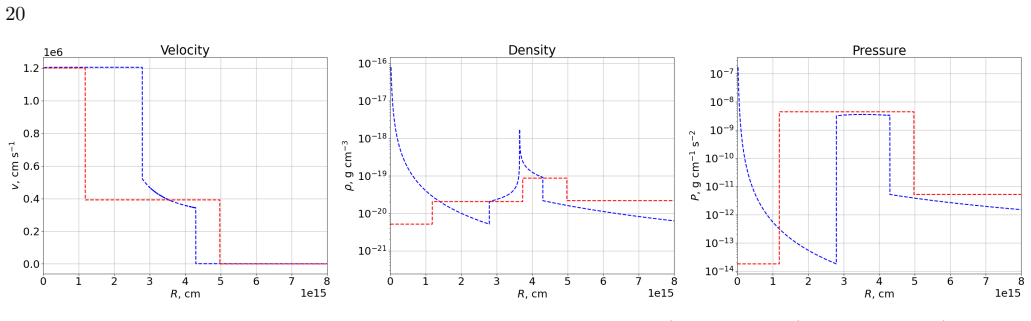
- [Table 1 and Fig. 1] The row labelled 'Exact' in Table 1 is not an independent test of the matching procedure, because vin/vsw = 4.06 is taken from the ZeusTW simulation, as stated in the Fig. 1 caption. The self-contained approximate matching of Eq. (41) predicts vin/vsw = 4.37, about 8% above the simulation value, yet it reproduces Rs/Rsw to about 1.3% (1.53 versus 1.55). This disparity suggests that the close thickness agreement may result from a cancellation between errors in λc and ξc rather than from an accurate velocity matching. The manuscript should implement the shooting method on the exact ODEs (mentioned in §2.1.3) without simulation input, or otherwise quantify the error compensation, before the exact-ODE comparison is used as support.
- [§2.1.3 and §2.2] The central generality claim of the semi-analytic method is not yet supported: the matching is tested only for γ = 5/3 and δ = 0.1 in Table 1, and Table 2 varies only the Mach numbers, not γ or δ. Since the matching equation (37) depends explicitly on δ and the hyperbolic ansatz was motivated by the γ = 5/3 velocity profile, the accuracy for other density ratios and polytropic indices is unestablished. The §2.2 simulations do vary γ, but the quantitative comparison with the semi-analytic result is made at γ = 5/3 only (Section 3.1). A δ scan (for example δ = 0.01, 0.1, 1) and a γ scan (for example γ = 1.1, 1.4, 2) of the approximate matching against the exact ODE shooting or against simulations is needed to substantiate the claimed applicability.
- [§2.1.3, Eqs. (38)–(41)] The pressure matching uses linear approximations for both the shocked ambient and shocked wind pressure profiles, but no error estimate is given for these linearizations away from the single tested point γ = 5/3, δ = 0.1. Table 2 already shows errors in ξc up to about 6% for the Msw = ∞ case, so the closed-form result may degrade in regimes the paper intends to cover. The authors should either derive a bound on the linearization error or test the approximation on a grid of parameters corresponding to the applications in Sections 3.2 and 3.3.
minor comments (4)
- [Introduction, §2.1] There are several wording and typographical errors that should be corrected, for example 'it does not an the isobaric assumption' in §1, 'authentically solves the basic ODES' in §2.1, and 'In this section we over one natural cases' in §3.2.
- [§2.2 and Fig. 12] The caption of Fig. 12 refers to 'the small values of γ = 1.01'; this should be singular, and Table 3's header is awkwardly repeated across two lines.
- [Figs. 10–12] The fit of the numerical velocity profiles to Eq. (43) is described only visually; adding a quantitative residual or RMS error would make the comparison more convincing.
- [§2.1.4] The text says the value 1.55 'agrees completely' with Table 3, but Table 3 lists 1.551; the wording should be softened to 'agrees within the reported precision'.
Circularity Check
Exact-ODE validation uses simulation-derived vin/vsw, so that agreement is partly by construction; the approximate matching itself is self-contained.
-
fitted input called prediction
[Sec. 2.1.4, Table 1 and Fig. 1 caption]
"Value of vin/vsw = 4.06 for the exact solution of compressed wind was obtained through ZeusTW simulations for the same set of parameters."
The 'Exact' row of Table 1 (vin/vsw = 4.06, Rs/Rsw = 1.55) fixes the wind-shock velocity ratio using the ZeusTW simulation, and the text then states that 'the value of 1.55 found for the thickness ratio Rs/Rsw in Table 1 agrees completely with the value found in Table 3' from the same ZeusTW runs. Thus the exact ODE branch is not an independent analytical prediction of the thickness: one of its key parameters is supplied by the numerical solution it is being compared with. The genuinely predictive approximate matching (Eq. 41) instead yields vin/vsw = 4.37, about 8% higher, so the exact branch cannot validate the approximate method's prediction of that velocity ratio; only the final thickness ratio is checked.
full rationale
The central approximate method is not circular: the matching equation (41) is solved for vin/vsw using only the ODE-derived gradients, linear/hyperbolic ansatze, and the density ratio delta, with no simulation input, and it yields Rs/Rsw = 1.53 versus the numerical 1.55. The hyperbola ansatz is admittedly motivated by the shape of ODE and numerical profiles, but it is then used in a self-contained algebraic matching, so it does not reduce the prediction to its inputs. There is no load-bearing self-citation chain or imported uniqueness theorem; citations to KM92b and Shang et al. are for prior framework and applications, not to force the present result. The one genuine circularity concern is the 'exact' ODE comparison in Table 1/Figure 1, which uses vin/vsw taken from the ZeusTW simulation and then presents the resulting thickness as agreement with that same simulation. This weakens the exact branch as an independent validation, though it does not contaminate the approximate method's derivation. The unquantified error for other delta and gamma values is a robustness limitation, not a circularity.
Assumptions & free parameters
free parameters (2)
- wind-to-ambient density ratio delta =
0.1
- sound speeds for numerical scans =
a_amb=0.2 km/s, a_wind0=0.6 km/s
assumptions (5)
- domain assumption Euler equations with a polytropic equation of state and a single global gamma for both shocked regions.
- domain assumption Self-similarity: Rs proportional to t^eta and Rsw proportional to t^kappa with eta=1, kappa=1 for eta_in=1, k_rho=2, so shock velocities are constant in time.
- domain assumption Strong-shock (M to infinity) compression ratios for both shocks in the semi-analytic method.
- domain assumption Ambient medium is cold, at rest, with rho_a proportional to r^-2, and the wind is steady (eta_in=1) and cold with purely kinetic energy injection.
- ad hoc to paper Linear (ambient) and hyperbolic (wind) velocity and pressure profile ansatze for the closed-form matching.
Cite this review
Pith. "Pith review of Polytropic Wind-Driven Bubbles and their Shock Structures in Radially Stratified Ambient Media." pith.science (2026). https://pith.science/paper/4PN54VBF
@misc{pith2026250521839,
  author       = {Pith},
  title        = {Pith review of: Polytropic Wind-Driven Bubbles and their Shock Structures in Radially Stratified Ambient Media},
  year         = {2026},
  howpublished = {\url{https://pith.science/paper/4PN54VBF}},
  note         = {Machine review of arXiv:2505.21839}
}
abstract
We extend the analytic expressions for polytropic wind-driven bubbles and their shock structures, formulated initially in Koo and McKee 1992(a,b), focusing on spherically symmetric configurations in astrophysical environments with $\rho\propto r^{-2}$, which arises naturally in the star-forming environment and has applications to winds flowing into a preexisting bubble. Wind luminosity is assumed to be constant, and as a result the shock velocities of these bubbles are constant in time. The ratio of specific heats is assumed to be the same in the shocked ambient medium and the shocked wind. Numerical results are presented for one selected ratio of wind density to ambient density. Exact ODEs are written for the compressed wind region and approximate solutions are found by fitting the ODE solutions. By analyzing the interactions between stellar winds and ambient media in the strong compression limit, we model the formation and evolution of spherical bubbles, highlighting their shock fronts and contact discontinuities. Our analytic method provides an intuitive approach to calculating the thickness of bubble shells, which is crucial for understanding their dynamics and observational characteristics. A numerical method explores conditions without explicitly requiring the strong compression limit, and then we compare numerical to analytical results under various conditions.
Figures


Figures from the paper (11 more)


Reference graph
Works this paper leans on
-
[1]
, " * write output.state after.block = add.period write newline
ENTRY address archivePrefix author booktitle chapter doi edition editor eprint howpublished institution journal key month number organization pages publisher school series title misctitle type volume year version url label extra.label sort.label short.list INTEGERS output.state before.all mid.sentence after.sentence after.block FUNCTION init.state.consts ...
-
[2]
write newline
" write newline "" before.all 'output.state := FUNCTION format.url url empty "" new.block "" url * "" * if FUNCTION format.eprint eprint empty "" archivePrefix empty "" archivePrefix "arXiv" = new.block " " eprint * " " * new.block " " eprint * " " * if if if FUNCTION format.doi doi empty "" " " doi * " " * if FUNCTION format.pid doi empty eprint empty ur...
-
[3]
I (( 1g/ _Q1! sE @ j LQ2 z oo 0hٲeXkZt&? 0
thebibliography [1] 20pt to REFERENCES 6pt =0pt -12pt 10pt plus 3pt =0pt =0pt =1pt plus 1pt =0pt =0pt -12pt =13pt plus 1pt =20pt =13pt plus 1pt \@M =10000 =-1.0em =0pt =0pt 0pt =0pt =1.0em @enumiv\@empty 10000 10000 `\.\@m \@noitemerr \@latex@warning Empty `thebibliography' environment \@ifnextchar \@reference \@latexerr Missing key on reference command E...
arXiv 2021
-
[4]
2024, The Astrophysical Journal, 964, 147, 10.3847/1538-4357/ad2355
Ai, T.-H., Liu, C.-F., Shang, H., Johnstone, D., & Krasnopolsky, R. 2024, The Astrophysical Journal, 964, 147, 10.3847/1538-4357/ad2355
-
[5]
2022, , 263, 32, 10.3847/1538-4365/ac9279
Bandopadhyay , S., & Shang , H. 2022, , 263, 32, 10.3847/1538-4365/ac9279
-
[6]
Blandford , R. D., & Payne , D. G. 1982, , 199, 883, 10.1093/mnras/199.4.883
-
[7]
1968, , 152, 515, 10.1086/149568
Bodenheimer , P., & Sweigart , A. 1968, , 152, 515, 10.1086/149568
doi:10.1086/149568 1968
-
[8]
Deschner , S. C., Illenseer , T. F., & Duschl , W. J. 2018, SIAM Journal of Applied Mathematics, 78, 80, 10.1137/16M109973X
Show all 47 references
-
[9]
L., Munz , C
Einfeldt , B., Roe , P. L., Munz , C. D., & Sjogreen , B. 1991, Journal of Computational Physics, 92, 273, 10.1016/0021-9991(91)90211-3
1991 doi
-
[10]
M., & Taam , R
Garc \' a-Segura , G., Ricker , P. M., & Taam , R. E. 2018, , 860, 19, 10.3847/1538-4357/aac08c
2018 doi
-
[11]
E., & Ricker , P
Garc \' a-Segura , G., Taam , R. E., & Ricker , P. M. 2020, , 893, 150, 10.3847/1538-4357/ab8006
2020 doi
- [12]
- [13]
-
[14]
Godunov, S. K. 1959, Matematicheskii Sbornik, 271
1959
-
[15]
Koo , B.-C., & McKee , C. F. 1992 a , , 388, 93, 10.1086/171132
1992 doi
- [16]
-
[17]
2013, , 765, 85, 10.1088/0004-637X/765/2/85
Kurono , Y., Saito , M., Kamazaki , T., Morita , K.-I., & Kawabe , R. 2013, , 765, 85, 10.1088/0004-637X/765/2/85
2013 doi
-
[18]
C., Kim , J.-G., & Kim , C.-G
Lancaster , L., Ostriker , E. C., Kim , J.-G., & Kim , C.-G. 2021 a , , 914, 89, 10.3847/1538-4357/abf8ab
2021 doi
-
[19]
2021 b , , 914, 90, 10.3847/1538-4357/abf8ac
---. 2021 b , , 914, 90, 10.3847/1538-4357/abf8ac
2021 doi
-
[20]
D., & Lifshitz, E
Landau, L. D., & Lifshitz, E. M. 1987, Course of Theoretical Physics, Vol. 6, Fluid Mechanics , 2nd edn. (Pergamon)
1987
-
[21]
1998, Computational Methods for Astrophysical Fluid Flow: Saas-Fee Advanced Course 27
LeVeque, R., Steiner, O., Gautschy, A., et al. 1998, Computational Methods for Astrophysical Fluid Flow: Saas-Fee Advanced Course 27. Lecture Notes 1997 Swiss Society for Astrophysics and Astronomy, Saas-Fee Advanced Course (Springer Berlin Heidelberg)
1998
-
[22]
2025, , 979, 17, 10.3847/1538-4357/ad9275
Liu , C.-F., Shang , H., Johnstone , D., et al. 2025, , 979, 17, 10.3847/1538-4357/ad9275
2025 doi
-
[23]
Lombardi , M., Alves , J., & Lada , C. J. 2015, , 576, L1, 10.1051/0004-6361/201525650
2015 doi
-
[24]
2024, , 270, 19, 10.3847/1538-4365/ad12c8
Motoyama , K., Krasnopolsky , R., Shang , H., Aida , K., & Sakane , E. 2024, , 270, 19, 10.3847/1538-4365/ad12c8
2024 doi
-
[25]
2015, , 808, 46, 10.1088/0004-637X/808/1/46
Motoyama , K., Morata , O., Shang , H., Krasnopolsky , R., & Hasegawa , T. 2015, , 808, 46, 10.1088/0004-637X/808/1/46
2015 doi
-
[26]
P., & McKee, C
Ostriker, J. P., & McKee, C. F. 1988, Rev. Mod. Phys., 60, 1, 10.1103/RevModPhys.60.1
1988 doi
- [27]
-
[28]
1999, , 518, 334, 10.1086/307244
Saito , M., Sunada , K., Kawabe , R., Kitamura , Y., & Hirano , N. 1999, , 518, 334, 10.1086/307244
1999 doi
-
[29]
Sedov , L. I. 1946, Journal of Applied Mathematics and Mechanics, 10, 241
1946
-
[30]
2020, The Astrophysical Journal, 905, 116, 10.3847/1538-4357/abbdb0
Shang, H., Krasnopolsky, R., Liu, C.-F., & Wang, L.-Y. 2020, The Astrophysical Journal, 905, 116, 10.3847/1538-4357/abbdb0
2020 doi
-
[31]
2023, , 944, 230, 10.3847/1538-4357/aca763
Shang , H., Liu , C.-F., Krasnopolsky , R., & Wang , L.-Y. 2023, , 944, 230, 10.3847/1538-4357/aca763
2023 doi
-
[32]
1994, , 429, 781, 10.1086/174363
Shu , F., Najita , J., Ostriker , E., et al. 1994, , 429, 781, 10.1086/174363
1994 doi
-
[33]
Shu , F. H. 1977, , 214, 488, 10.1086/155274
1977 doi
-
[34]
1992, The physics of astrophysics
---. 1992, The physics of astrophysics. Volume II: Gas dynamics. (University Science Books)
1992
-
[35]
H., Najita , J., Ostriker , E
Shu , F. H., Najita , J., Ostriker , E. C., & Shang , H. 1995, , 455, L155, 10.1086/309838
1995 doi
-
[36]
H., Ruden , S
Shu , F. H., Ruden , S. P., Lada , C. J., & Lizano , S. 1991, , 370, L31, 10.1086/185970
1991 doi
-
[37]
Sod, G. A. 1978, Journal of Computational Physics, 27, 1, 10.1016/0021-9991(78)90023-2
1978 doi
-
[38]
M., Tomida , K., White , C
Stone , J. M., Tomida , K., White , C. J., & Felker , K. G. 2020, , 249, 4, 10.3847/1538-4365/ab929b
2020 doi
- [39]
-
[40]
1950 a , Proceedings of the Royal Society of London Series A, 201, 159, 10.1098/rspa.1950.0049
Taylor , G. 1950 a , Proceedings of the Royal Society of London Series A, 201, 159, 10.1098/rspa.1950.0049
1950
-
[41]
1950 b , Proceedings of the Royal Society of London Series A, 201, 175, 10.1098/rspa.1950.0050
---. 1950 b , Proceedings of the Royal Society of London Series A, 201, 175, 10.1098/rspa.1950.0050
1950
-
[42]
Toro, E. F. 2013, Riemann Solvers and Numerical Methods for Fluid Dynamics: A Practical Introduction (Springer Berlin Heidelberg)
2013
-
[43]
a is \"a l \
V \"a is \"a l \"a , M. S., Shang , H., Galli , D., Lizano , S., & Krasnopolsky , R. 2023, , 959, 32, 10.3847/1538-4357/acfb00
2023 doi
-
[44]
1977, , 218, 377, 10.1086/155692
Weaver , R., McCray , R., Castor , J., Shapiro , P., & Moore , R. 1977, , 218, 377, 10.1086/155692
1977 doi
-
[45]
1984, Journal of Computational Physics, 54, 115, 10.1016/0021-9991(84)90142-6
Woodward, P., & Colella, P. 1984, Journal of Computational Physics, 54, 115, 10.1016/0021-9991(84)90142-6
1984 doi
-
[46]
1967, Physics of Shock Waves and High Temperature Hydrodynamic Phenomena (Academic Press), 10.1016/B978-0-12-395672-9.X5001-2
Zeldovich, Y., & Raizer, Y. 1967, Physics of Shock Waves and High Temperature Hydrodynamic Phenomena (Academic Press), 10.1016/B978-0-12-395672-9.X5001-2
1967 doi
-
[47]
J., Koempe , C., & Walmsley , C
Zhou , S., Evans , II, N. J., Koempe , C., & Walmsley , C. M. 1993, , 404, 232, 10.1086/172271
1993 doi
Reviewed August 7, 2026 · model on record in the stance chip above.
Discussion (0). Sign in to comment.