REVIEW 4 major objections 5 minor 41 references
HydraNet: Momentum-Driven State Space Duality for Multi-Granularity Tennis Tournaments Analysis
T0 review · 4 major / 5 minor · reviewed 2026-08-07 · deepseek-v4-flash
Pith's one-line read HydraNet claims a single learned Momentum Score reads tennis momentum at all four levels and predicts match winners by the half-time break.
desk verdict A substantial tennis dataset and a Mamba2-style architecture wrapped around an unsupported momentum claim; point-level results are almost certainly label leakage. read the letter →
The pith
A machine-rendered reading of the paper's core claim, the machinery that carries it, and where it could break.
The reading
What carries the argument
The central object is the Momentum Score $M_S$, defined through the three-way decomposition $M_S = \text{Hydra}(M_p, M_e, M_i)$ followed by adversarial pairing: $M_S = \text{CAAM}(\text{VersusLearning}(M_s^1, M_s^2))$. The load-bearing component is the Momentum-Driven State Space Duality (MSSD) block, a state-space model with window size two in which the first window of each game holds implicit momentum from the previous game while later windows hold the previous point's explicit momentum and the current point momentum; cumulative sums of a temporal decay factor produce a state-transition matrix $L$ and decay states $E$ and $F$, and a cross-attention step fuses the within-window diagonal output $Y_{\text{diag}}$ with the across-window off-diagonal output $Y_{\text{off}}$. Around this core sit the Versus Learning loss, which enforces maximum angular separation between the two players' normalized momentum vectors, and CAAM, which recombines the four micro-factors (serve, return, psychology, fatigue) using keys from both players. Together these pieces turn a sequence of 32 per-point features into a momentum trajectory at point, game, set, and match granularities.
What would settle it
Retrain HydraNet on the same WID and USD data with the outcome-determining features removed (drop ace, double fault, winner, net point won, break point won, and all three game, set, and match score-difference columns), and re-measure point-level and match-level AUC; if point-level AUC stays near the reported 0.99, MS carries genuine momentum information, whereas a collapse toward chance would show the current results are explained by features that already encode the point result.
Extended reading notes
Core claim
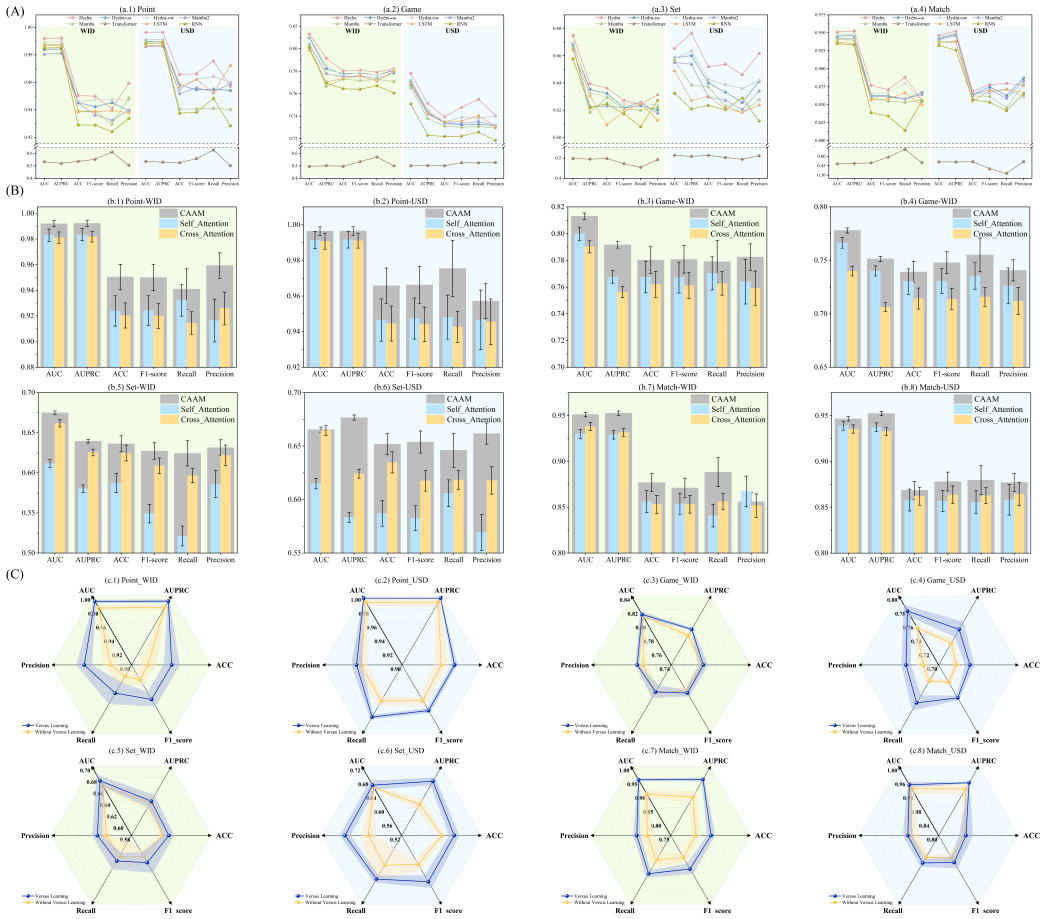
On the paper's own terms, the discovery is that momentum should be modeled as three interacting components rather than one hidden state: point momentum $M_p$, built from 32 in-rally features that span serve, return, psychology, and fatigue; explicit momentum $M_e$, the short-lived effect of the previous point's outcome; and implicit momentum $M_i$, a representation updated only at game or set boundaries to carry long-range effects such as rest, strategy changes, and momentum from a completed game or set. HydraNet's Hydra module converts these three components into a self-momentum $M_s$ using a state-space duality block: a sliding-window (size 2) mechanism computes intra-window momentum states, cumulative decay matrices propagate them across windows, and a cross-attention step fuses short- and long-range features; the implicit momentum $M_i$ is then refreshed at each game or set boundary. A Versus Learning loss pushes the two players' momentum vectors apart by a cosine-similarity margin, and the Collaborative-Adversarial Attention Mechanism (CAAM) lets each player's serve, return, psychology, and fatigue factors attend to the opponent's corresponding factors. The paper claims that the resulting $M_S$ is meaningful at every granularity: it follows winning and losing streaks in match case studies (above 0.5 for winning streaks, below 0.5 for losing ones), predicts point outcomes almost perfectly, predicts game outcomes well, is weakest at the set level, and recovers match-level predictive strength from the half-time reading alone.
Load-bearing premise
The framework only measures momentum if the 32 per-point features it is fed do not already reveal who won the point; several of them — aces, double faults, winners, net points won, break points converted, and the score-difference columns — do reveal exactly that, so the learned Momentum Score could be rearranging the recorded outcome rather than capturing an underlying force.
Editorial extensions
If this is right
- A single $M_S$ trajectory gives coaches and players a real-time, interpretable read on who holds momentum at any moment of a match, and aggregating it over games, sets, and the match as a whole locates the turning points.
- The reported 'half-time champagne' effect — a ~0.95 AUC for match outcome from the last point of the first half — makes the mid-match break a concrete intervention point for momentum management, if the effect holds.
- The modality-ablation results imply that psychology increasingly dominates serve and return as the granularity grows, and that fatigue joins psychology at match level; if correct, this shifts coaching priorities toward mental resilience and recovery as matches lengthen.
- Because the framework only needs point-by-point event data, the same HydraNet pipeline applies to other hierarchically scored racket sports such as badminton or volleyball.
Reading between the lines
- A stress test the paper does not run: retrain HydraNet on features stripped of outcome-determining indicators (aces, double faults, winners, break points converted, and score-difference columns) and re-measure the point-level AUC; if the near-perfect accuracy collapses, the reported MS would be better described as a rearrangement of the scoreline than as latent momentum.
- The half-time momentum reading could be tested against live betting odds: an MS with genuine information should move the market's implied win probability when it diverges from the current scoreline.
- The framework suggests a cross-sport comparison: in volleyball or badminton, where a point always belongs to exactly one player or team, the same three-component momentum structure could be fitted and its game- and set-level predictiveness compared directly.
Editorial analysis
A structured set of objections, weighed in public.
Referee Report
Summary. The paper proposes Momentum Score (MS), a metric intended to quantify momentum in professional tennis at point, game, set, and match granularities, and presents HydraNet, a state-space-duality-based architecture that combines a Hydra module, a Versus Learning loss, and a Collaborative-Adversarial Attention Mechanism. The authors construct a large dataset from Wimbledon and US Open matches, report multi-granularity classification results with AUC values around 0.99 for points, 0.95 for matches, and 0.67 for sets, and claim the MS metric provides actionable momentum insights, including a 'half-time champagne' phenomenon. The paper also includes ablations and a case study on two Wimbledon matches.
Significance. If the MS metric were properly validated, the contribution would be substantial: the paper introduces a multi-granularity momentum formulation, a large released dataset, and an architecture with several novel components. The public code and dataset availability are commendable strengths. However, the current validation is undermined by label leakage and circularity: point-level features encode the point outcome, match-level predictions use cumulative score differences, and the MS is defined as the output of a network trained to predict the very outcomes used for validation. As a result, the reported performance does not establish that HydraNet measures momentum, and the claimed actionable insights are not supported by the evidence.
major comments (4)
- [Section 3, Table 1; Section A.1.1; Section 4.6] The point-level predictions are inflated by label leakage. Table 1 includes p1_ace, p1_double_fault, p1_winner, p1_unf_err, p1_net_pt_won, p1_break_pt_won, and p1_break_pt_missed as inputs, and Table A.5 defines these as events that directly determine or strongly imply the point winner (an ace is a won service point, a double fault is a lost service point, and so on). Since Section A.1.1 constructs the point-outcome label from the same event stream, the model can infer the point winner almost perfectly from these features. The point-level AUC of 0.9919 in Table 2 is therefore nearly tautological and cannot be used as evidence that HydraNet captures momentum.
- [Section 4.6, Table A.5, Section 5.4] The match-level result is confounded by cumulative score features. The 'half-time' point input includes p1_set_diff, p1_game_diff, and p1_points_diff, which encode the running score advantage, and these are naturally predictive of the eventual match winner. The 'half-time champagne' phenomenon is asserted without comparing against a baseline that uses only such score differentials at the halfway point. A logistic regression on the score-difference features alone, or a temporal cross-validation that blocks match identity, is needed before attributing the match AUC of 0.95 to momentum.
- [Section 4.3, Section 4.6, Section 5.1] The validation of MS is circular. The Momentum Score is defined as the output of a network trained with binary cross-entropy to predict point, game, set, and match outcomes (Eq. 17), and Section 5 then 'validates' MS by showing that it predicts these same outcomes. This is a fitting-to-prediction loop rather than an independent test of a momentum construct. A valid demonstration would need to define MS from a model trained only on pre-outcome features, or test whether MS after point t predicts outcome at t+1 after controlling for the score and serving side.
- [Section 5.2, Figure 3] The ablations do not include a leak-free baseline. HydraNet is compared only to other neural sequence models (Mamba, LSTM, RNN, Transformer) and to variants of its own modules, none of which remove the outcome-encoding features. Without a baseline that excludes aces, double faults, winners, unforced errors, net points won, break points won, and cumulative score differences, the ablation results do not establish the contribution of the momentum-specific mechanisms. In particular, the set-level AUC around 0.67 is close to chance and is inconsistent with the strong multi-granularity claims made in the abstract and conclusion.
minor comments (5)
- [Table 3] In the WID Game row for the Psychology modality, the reported Precision is 0.0303±0.0245 while Precision for the other modalities is around 0.76; this appears to be a typographical or scaling error and should be corrected.
- [Eq. (6)] The formula for Y_diag uses the same summation index s in nested sums and the product C_windows·B_windows is not explicitly contracted over the state dimension; the notation should be clarified.
- [Section 5.4 and Conclusion] The paper uses 'half-time champagne' and 'half-court champagne' inconsistently; the terminology should be unified.
- [Section 5.3] The Fisher method for combining p-values is used across six metrics without reporting the number of comparisons or applying a multiple-testing correction; this should be stated explicitly.
- [Abstract and Introduction] The claim of being the 'first work to explore and effectively model momentum across multiple granularities' is too strong given the existing tennis momentum literature cited in the paper; the claim should be softened to reflect the specific contribution.
Circularity Check
Point-level features define the point label by construction, and the 'validation' of MS re-measures the fitted classification objective, so the multi-granularity momentum claim largely reduces to its inputs.
-
self definitional
[Section 3 / Table 1; Appendix A.1.2 / Table A.5; Section 4.6 / Eq. 17]
"p1_double_fault — Instances where player1 missed both serves and lost the point. {0,1}; p1_net_pt_won — Points won by player1 while positioned at the net. {0,1}; p1_ace — Aces served by player1, where the opponent could not return the serve. {0,1}; p1_break_pt_won — Break points converted by player1 when the opponent serves. {0,1}; points_victor — The player who won the point. {1, 2}"
The 32 point-level inputs in Table 1 include per-point event flags whose Table A.5 definitions already assert which player won the point: ace, winner, net_pt_won, and break_pt_won are events that conclude with player1 winning the point, while double_fault, unf_err, and break_pt_missed are defined as events where player1 loses the point. The label points_victor (and the derived y_point) is the same information; Section A.1.1 confirms the label is constructed from the same event stream ('Winning Point Per Round: We assigned a value of 1 or 0 for each round, where 1 indicates the player won the point and 0 indicates they lost'). Because the model is trained with BCE (Eq.
-
fitted input called prediction
[Section 4.6 (Eq. 17) vs. Section 5.1 / Table 2 and Section 5.4]
"We then use the binary cross-entropy loss function to calculate the prediction loss ... L_cla = −1/N Σ (y_cla·log(σ(ŷ_t)) + (1−y_cla)·log(1−σ(ŷ_t))) ... where y_cla represents the true label corresponding to the predicted value ŷ, and cla ∈ {point, game, set, match}. ... We find that the MS metric constructed by HydraNet effectively predicts outcomes at the point, game, and match granularities."
The momentum score is operationally the model output ŷ_t trained by Eq. 17 to predict exactly the labels y_point, y_game, y_set, and y_match. Table 2 then 'validates' the MS by reporting AUC/AUPRC/accuracy on those same labels, and Section 5.4 presents the fitted predictions as independent evidence that momentum impacts outcomes. Testing held-out predictions of the training objective is the procedure that defines the MS, so it cannot serve as an independent confirmation of the momentum construct. The weak set-level result (AUC ≈ 0.67) is also the expected signature of this artifact: the predictive signal is carried by the outcome-encoding point features and cumulative score differences, not by a separately measured latent momentum factor.
1 more flagged steps
-
renaming known result
[Section 4.6 ('half-time champagne' strategy); Table A.5 (p1_set_diff, p1_game_diff, p1_points_diff); Section 5.4]
"For matches, we employ a 'half-time champagne' strategy, using the momentum from the last point in the first half to predict the match outcome. ... The precise prediction of match outcomes under the 'half-time champagne' strategy is a surprising finding ... p1_set_diff — Set difference between player1 and player2 in the match. {..., -1, 0, 1...}"
The feature vector at the half-time point contains p1_set_diff, p1_game_diff, and p1_points_diff — cumulative scoreboard differences built from the same point/set winners that generate the match label y_match. In best-of-five tennis a two-set lead at half-time is nearly decisive, so the match AUC of 0.95 and the case study (w-1301: MS=0.6363, wins; w-1701: MS=0.4701, loses) largely restate the known empirical pattern that the first-half score predicts the match result. Presenting this as the 'half-time champagne' momentum insight discovered by the MS metric renames the scoreboard as momentum rather than measuring a latent momentum effect.
full rationale
The derivation chain is: MS = CAAM(VersusLearning(Hydra(M_p, M_e, M_i))) (Eqs. 1-2), with point momentum M_p built from the 32 Table 1 features; the model is trained (Eqs. 17-18) to predict point/game/set/match outcome labels; and the MS is then 'validated' in Table 2 and Section 5.4 by showing it predicts those same outcome labels. Three reductions are visible. First, at the point level the input flags are defined by the point outcome (Table A.5: ace, winner, net_pt_won, break_pt_won imply the player won; double_fault, unf_err, break_pt_missed imply the player lost), and points_victor is the same information; the point AUC 0.9919 is thus a definitional encoding, not evidence that momentum drives point outcomes. Second, Eq. 17 trains the momentum output on y_point/y_game/y_set/y_match, and Table 2 and Section 5.4 evaluate exactly those labels as 'validation' of the MS; because the metric is defined as a fitted outcome classifier, its outcome predictions cannot independently confirm a momentum interpretation. Third, the match-level 'half-time champagne' strategy uses features that include cumulative score differences (p1_set_diff, p1_game_diff, p1_points_diff), so the match AUC 0.95 and the case-study narrative reduce largely to the first-half scoreboard — a known scoring property renamed as a momentum phenomenon. The game- and set-level AUROCs (0.78-0.81 and 0.65-0.67) are not individually tautological, but they are computed by feeding the same outcome-encoded point features through the learned state and are scored on the same training labels. No load-bearing self-citation was found: the momentum theory citations (e.g., Iso-Ahola et al.) and the SSD baselines (Mamba2, Transformer, LSTM) are external, and the architecture ablations and the dataset construction are independent content. Nevertheless, the paper's central claim — that the MS metric provides validated, actionable multi-granularity momentum insights — is substantially circular: the point-level result is forced by the feature definitions, and the outcome-level validation is a fit-to-prediction loop.
Assumptions & free parameters
free parameters (5)
- Sliding window size S_window =
2
- Versus loss margin m =
not reported
- Serve speed normalization thresholds =
94, 105, 120 mph
- Number of attention heads H =
8
- Implicit momentum update matrices and biases =
learned
assumptions (4)
- domain assumption Momentum can be decomposed into point, explicit, and implicit components per Iso-Ahola et al.
- domain assumption The state space duality model can represent momentum dynamics
- ad hoc to paper Point-level outcome features are valid inputs for learning momentum
- ad hoc to paper The last point of the first half of a match is a meaningful pivot
invented entities (2)
-
Momentum Score (MS)
-
Explicit momentum M_e and implicit momentum M_i
Cite this review
Pith. "Pith review of HydraNet: Momentum-Driven State Space Duality for Multi-Granularity Tennis Tournaments Analysis." pith.science (2026). https://pith.science/paper/YLSXADNE
@misc{pith2026250521882,
  author       = {Pith},
  title        = {Pith review of: HydraNet: Momentum-Driven State Space Duality for Multi-Granularity Tennis Tournaments Analysis},
  year         = {2026},
  howpublished = {\url{https://pith.science/paper/YLSXADNE}},
  note         = {Machine review of arXiv:2505.21882}
}
read the original abstract
In tennis tournaments, momentum, a critical yet elusive phenomenon, reflects the dynamic shifts in performance of athletes that can decisively influence match outcomes. Despite its significance, momentum in terms of effective modeling and multi-granularity analysis across points, games, sets, and matches in tennis tournaments remains underexplored. In this study, we define a novel Momentum Score (MS) metric to quantify a player's momentum level in multi-granularity tennis tournaments, and design HydraNet, a momentum-driven state-space duality-based framework, to model MS by integrating thirty-two heterogeneous dimensions of athletes performance in serve, return, psychology and fatigue. HydraNet integrates a Hydra module, which builds upon a state-space duality (SSD) framework, capturing explicit momentum with a sliding-window mechanism and implicit momentum through cross-game state propagation. It also introduces a novel Versus Learning method to better enhance the adversarial nature of momentum between the two athletes at a macro level, along with a Collaborative-Adversarial Attention Mechanism (CAAM) for capturing and integrating intra-player and inter-player dynamic momentum at a micro level. Additionally, we construct a million-level tennis cross-tournament dataset spanning from 2012-2023 Wimbledon and 2013-2023 US Open, and validate the multi-granularity modeling capability of HydraNet for the MS metric on this dataset. Extensive experimental evaluations demonstrate that the MS metric constructed by the HydraNet framework provides actionable insights into how momentum impacts outcomes at different granularities, establishing a new foundation for momentum modeling and sports analysis. To the best of our knowledge, this is the first work to explore and effectively model momentum across multiple granularities in professional tennis tournaments.
Figures


Figures from the paper (1 more)

Reference graph
Works this paper leans on
-
[1]
Pre- dicting tennis match outcomes with network analysis and machine learning
FirasBayram,DavideGarbarino,andAnnalisaBarla. Pre- dicting tennis match outcomes with network analysis and machine learning. InSOFSEM 2021: Theory and Prac- tice of Computer Science: 47th International Conference on Current Trends in Theory and Practice of Computer Science, SOFSEM 2021, Bolzano-Bozen, Italy, January 25–29, 2021, Proceedings 47, pages 505–...
work page 2021
-
[2]
Univer- sity of Pennsylvania Press, 1987
Howard Brody.Tennis science for tennis players. Univer- sity of Pennsylvania Press, 1987
work page 1987
-
[3]
Jan Carboch, Jakub Siman, Michal Sklenarik, and Matej Blau. Match characteristics and rally pace of male tennis matchesinthreegrandslamtournaments.PhysicalActivity Review, (7):49–56, 2019. 13
work page 2019
-
[4]
JoshuaColomar,FranciscoCorbi,QuimBrich,andErnest Baiget. Determinant physical factors of tennis serve ve- locity: A brief review.International Journal of Sports Physiology and Performance, 17(8):1159–1169, 2022
work page 2022
-
[5]
Anthony C Constantinou. Dolores: a model that predicts footballmatchoutcomesfromallovertheworld.Machine learning, 108(1):49–75, 2019
work page 2019
-
[6]
Yixiong Cui, Haoyang Liu, Hongyou Liu, and Miguel- ÁngelGómez. Data-drivenanalysisofpoint-by-pointper- formance for male tennis player in grand slams.Motrici- dade, 15(1):49–61, 2019
work page 2019
-
[7]
Tri Dao and Albert Gu. Transformers are ssms: Gen- eralized models and efficient algorithms through struc- turedstatespaceduality.arXivpreprintarXiv:2405.21060, 2024
arXiv 2024
-
[8]
Momentum in ten- nis: Controllingthematch.UZHBusinessWorkingPaper Series, (365), 2017
Helmut Dietl and Cornel Nesseler. Momentum in ten- nis: Controllingthematch.UZHBusinessWorkingPaper Series, (365), 2017
work page 2017
Show all 41 references
-
[9]
Soccermap: A deep learning architecture for visually-interpretable analysis in soccer
Javier Fernández and Luke Bornn. Soccermap: A deep learning architecture for visually-interpretable analysis in soccer. InMachineLearningandKnowledgeDiscoveryin Databases. Applied Data Science and Demo Track: Eu- ropean Conference, ECML PKDD 2020, Ghent, Belgium, September 14–...
2020
-
[10]
Hoopinsight: Analyzingandcom- paringbasketballshootingperformancethroughvisualiza- tion.IEEE Transactions on Visualization and Computer Graphics, 2023
YuFuandJohnStasko. Hoopinsight: Analyzingandcom- paringbasketballshootingperformancethroughvisualiza- tion.IEEE Transactions on Visualization and Computer Graphics, 2023
2023
-
[11]
Indrajeet Ghosh, Sreenivasan Ramasamy Ramamurthy, Avijoy Chakma, and Nirmalya Roy. Sports analytics re- view: Artificial intelligence applications, emerging tech- nologies, and algorithmic perspective.Wiley Interdisci- plinaryReviews: DataMiningandKnowledgeDiscovery, 13(5):e1496, 2023
2023
-
[12]
Differentiating movement styles in pro- fessional tennis: A machine learning and hierarchical clustering approach.European Journal of Sport Science, 23(1):44–53, 2023
Brandon Giles, Peter Peeling, Stephanie Kovalchik, and Machar Reid. Differentiating movement styles in pro- fessional tennis: A machine learning and hierarchical clustering approach.European Journal of Sport Science, 23(1):44–53, 2023
2023
-
[13]
Mamba: Linear-time sequence modeling with selective state spaces.arXiv preprint arXiv:2312.00752, 2023
Albert Gu and Tri Dao. Mamba: Linear-time sequence modeling with selective state spaces.arXiv preprint arXiv:2312.00752, 2023
2023 arXiv
-
[14]
Psychological pressure and compounded errors during elite-level tennis.Psychology of sport and exercise, 56:101987, 2021
David J Harris, Samuel J Vine, Michael W Eysenck, and Mark R Wilson. Psychological pressure and compounded errors during elite-level tennis.Psychology of sport and exercise, 56:101987, 2021
2021
-
[15]
Mat Herold, Floris Goes, Stephan Nopp, Pascal Bauer, Chris Thompson, and Tim Meyer. Machine learning in men’s professional football: Current applications and fu- turedirectionsforimprovingattackingplay.International Journal of Sports Science & Coaching, 14(6):798–817, 2019
2019
-
[16]
Coachwise 1st4sport, 2000
Alistair Higham.Momentum: The hidden force in tennis. Coachwise 1st4sport, 2000
2000
-
[17]
Long short- term memory.Neural computation, 9(8):1735–1780, 1997
Sepp Hochreiter and Jürgen Schmidhuber. Long short- term memory.Neural computation, 9(8):1735–1780, 1997
1997
-
[18]
Fatigue in tennis: mechanisms of fatigue andeffectonperformance.SportsMedicine, 37:199–212, 2007
DanielJHornery,DamianFarrow,InigoMujika,andWar- ren Young. Fatigue in tennis: mechanisms of fatigue andeffectonperformance.SportsMedicine, 37:199–212, 2007
2007
-
[19]
A stroke of genius: Predicting the next move in badminton
Magnus Ibh, Stella Graßhof, and Dan Witzner Hansen. A stroke of genius: Predicting the next move in badminton. InProceedingsoftheIEEE/CVFConferenceonComputer Vision and Pattern Recognition, pages 3376–3385, 2024
2024
-
[20]
MartinIngram.Apoint-basedbayesianhierarchicalmodel topredicttheoutcomeoftennismatches.JournalofQuan- titative Analysis in Sports, 15(4):313–325, 2019
2019
-
[21]
Psychologi- cal momentum—a key to continued success.Frontiers in psychology, 7:1328, 2016
Seppo E Iso-Ahola and Charles O Dotson. Psychologi- cal momentum—a key to continued success.Frontiers in psychology, 7:1328, 2016
2016
-
[22]
Per- formance demands of professional male tennis players
Christopher Darren Johnson and MP McHugh. Per- formance demands of professional male tennis players. British journal of sports medicine, 40(8):696–699, 2006
2006
-
[23]
Routledge, 2022
IanJones.Researchmethodsforsportsstudies. Routledge, 2022
2022
-
[24]
Rhythms of vic- tory: Predicting professional tennis matches using ma- chine learning.IEEE Access, 2024
Yilin Lei, Ao Lin, and Jianuo Cao. Rhythms of vic- tory: Predicting professional tennis matches using ma- chine learning.IEEE Access, 2024
2024
-
[25]
On the distribution of rally length in professional tennis matches.Journal of Sports Analytics, 10(1):105– 121, 2024
Francesco Lisi, Matteo Grigoletto, and Mirko Gabriel Briglia. On the distribution of rally length in professional tennis matches.Journal of Sports Analytics, 10(1):105– 121, 2024
2024
-
[26]
Eitnet: An iot-enhanced framework for real-time basket- ball action recognition.Alexandria Engineering Journal, 110:567–578, 2025
Jingyu Liu, Xinyu Liu, Mingzhe Qu, and Tianyi Lyu. Eitnet: An iot-enhanced framework for real-time basket- ball action recognition.Alexandria Engineering Journal, 110:567–578, 2025
2025
-
[27]
Feature selection to win the pointofatptennisplayersusingrallyinformation.Interna- tionalJournalofComputerScienceinSport,19(1):37–50, 2020
M Makino, Tomohiro Odaka, Jousuke Kuroiwa, Izumi Suwa, and Hideyuki Shirai. Feature selection to win the pointofatptennisplayersusingrallyinformation.Interna- tionalJournalofComputerScienceinSport,19(1):37–50, 2020
2020
-
[28]
Momentum in us open men’s singles tennis.International Journal of Perfor- mance Analysis in Sport, 15(3):884–896, 2015
Ben Moss and Peter O’Donoghue. Momentum in us open men’s singles tennis.International Journal of Perfor- mance Analysis in Sport, 15(3):884–896, 2015. 14
2015
-
[29]
Routledge, 2009
Peter O’donoghue.Research methods for sports perfor- mance analysis. Routledge, 2009
2009
-
[30]
YannickPalutandPier-GiorgioZanone.Adynamicalanal- ysis of tennis: Concepts and data.Journal of sports sci- ences, 23(10):1021–1032, 2005
2005
-
[31]
un- xpass: Measuring soccer player’s creativity
PieterRobberechts,MaaikeVanRoy,andJesseDavis. un- xpass: Measuring soccer player’s creativity. InProceed- ings of the 29th ACM SIGKDD conference on knowledge discovery and data mining, pages 4768–4777, 2023
2023
-
[32]
Greensea: visual soccer analysis using broadlearningsystem.IEEETransactionsonCybernetics, 51(3):1463–1477, 2020
Bin Sheng, Ping Li, Yuhan Zhang, Lijuan Mao, and CL Philip Chen. Greensea: visual soccer analysis using broadlearningsystem.IEEETransactionsonCybernetics, 51(3):1463–1477, 2020
2020
-
[33]
Machinelearning for the prediction of professional tennis matches.MEng computing-finalyearproject,ImperialCollegeLondon,2, 2015
MichalSipkoandWilliamKnottenbelt. Machinelearning for the prediction of professional tennis matches.MEng computing-finalyearproject,ImperialCollegeLondon,2, 2015
2015
-
[34]
Performance analysis in tennis since 2000: A sys- tematic review focused on the methods of data collection
Hiroo Takahashi, Shuhei Okamura, Shunsuke Murakami, et al. Performance analysis in tennis since 2000: A sys- tematic review focused on the methods of data collection. 2022
2000
-
[35]
Attention is all you need.Advances in neural information processing systems, 30, 2017
Ashish Vaswani, Noam Shazeer, Niki Parmar, Jakob Uszkoreit, Llion Jones, Aidan N Gomez, Łukasz Kaiser, and Illia Polosukhin. Attention is all you need.Advances in neural information processing systems, 30, 2017
2017
-
[36]
Re- turningserveintennis: aqualitativeexaminationofthein- teraction of anticipatory information sources used by pro- fessional tennis players.Frontiers in Psychology, 9:895, 2018
Georgina Vernon, Damian Farrow, and Machar Reid. Re- turningserveintennis: aqualitativeexaminationofthein- teraction of anticipatory information sources used by pro- fessional tennis players.Frontiers in Psychology, 9:895, 2018
2018
-
[37]
A mul- tidimensional momentum chain model for tennis matches basedondifferenceequations.PloSone,19(12):e0316542, 2024
Jingya Wang, Sihang Guo, and Yuanyun Zhou. A mul- tidimensional momentum chain model for tennis matches basedondifferenceequations.PloSone,19(12):e0316542, 2024
2024
-
[38]
Wei-Yao Wang, Yung-Chang Huang, Tsi-Ui Ik, and Wen- Chih Peng. Shuttleset: A human-annotated stroke-level singlesdatasetforbadmintontacticalanalysis.InProceed- ings of the 29th ACM SIGKDD Conference on Knowledge Discovery and Data Mining, pages 5126–5136, 2023
2023
-
[39]
Recurrent neural network regularization.arXiv preprint arXiv:1409.2329, 2014
Wojciech Zaremba, Ilya Sutskever, and Oriol Vinyals. Recurrent neural network regularization.arXiv preprint arXiv:1409.2329, 2014
2014 arXiv
-
[40]
Using iot smart basketball and wristband motion data to quantitatively evaluate action indicators for basketball shooting.Advanced Intelligent Systems, 5(12):2300239, 2023
Yuliang Zhao, Xiaoai Wang, Jian Li, Weishi Li, Zhiwei Sun, Meilun Jiang, Wenyan Zhang, Zhiping Wang, Meng Chen, and Wen Jung Li. Using iot smart basketball and wristband motion data to quantitatively evaluate action indicators for basketball shooting.Advanced Intelligent Syste...
2023
-
[41]
Using network science to analyze tennis stroke patterns.Chaos, Solitons & Fractals, 170:113305, 2023
Yunjing Zhou, Shouxin Zong, Run Cao, Miguel-Ángel Gómez, Chuqi Chen, and Yixiong Cui. Using network science to analyze tennis stroke patterns.Chaos, Solitons & Fractals, 170:113305, 2023. 15
2023
Reviewed August 7, 2026 · model on record in the stance chip above.
Discussion (0). Sign in to comment.