REVIEW 4 major objections 4 minor 50 references
Online distributed optimization for spatio-temporally constrained real-time peer-to-peer energy trading
T0 review · 4 major / 4 minor · reviewed 2026-08-07 · deepseek-v4-flash
Pith's one-line read Real-time peer-to-peer energy trading with storage and network constraints can be cleared online, distributively, within a bounded cost gap of the stochastic optimum.
desk verdict The algorithmic framework is worth a look, but the central near-optimality theorem has a sign error in the drift bound and the discomfort cost vanishes by definition, so the main theoretical claim doesn't stand as written. read the letter →
The pith
A machine-rendered reading of the paper's core claim, the machinery that carries it, and where it could break.
The reading
What carries the argument
The load-bearing object is the shifted state-of-charge virtual queue $\tilde{S}_{i,t} = S_{i,t} + \epsilon_i$ with per-prosumer weight $\delta_i$, and the drift-plus-penalty objective of P2: minimize $f_t(\Phi_t) + \sum_{i\in\mathcal{N}_p} \delta_i\,[\kappa_i \tilde{S}_{i,t} w_{i,t} + (1-\kappa_i)\epsilon_i w_{i,t} + \tfrac{1}{2} w_{i,t}^2]$. Unlike standard Lyapunov storage control, the quadratic $w^2$ term is kept so the online problem is a quadratic program and the battery decision $w_{i,t}$ may take interior values inside its bounds rather than only boundary values; the paper argues this enlarges the feasible solution space and improves flexibility. The performance gap $\Theta$ is controlled by the variance bound $D[w^\dagger_{i,t}] \le (w_{\max} - w_{\min})^2$ from Lemma 2.2 and by the auxiliary problem P4, whose optimal value lower-bounds $\Psi^*_{P1}(\Phi)$. To distribute P2, each trading variable $e_{i,j,t}$ is duplicated as $u_{i,j,t}$ with the consensus constraint $u_{i,j,t} + u_{j,i,t} = 0$, and closed-form KKT updates for $e$, $w$, $p$, and $u$ are derived; the utility company plays the role of a network manager that returns the aggregated shadow price $R_{i,t}$ for voltage and line-flow constraints.
What would settle it
Evaluate the exact per-slot Lyapunov drift for a single prosumer with $\kappa_i < 1$ at its extreme SoC states and compare it with the claimed constant $M_i$ in Eq. (14); if the exact drift ever exceeds $M_i$, Lemma 2.1 fails and the chain in Theorem 2.1 breaks. A second test: run the closed-form updates on a two-bus one-buyer one-seller market with $\kappa_i < 1$ and check at every ADMM iteration whether the sign constraints (6a)-(6b) and the energy-balance equations (7a)-(7b) are actually satisfied.
Extended reading notes
Core claim
On the paper's own terms, the central claim is Theorem 2.1: if the random system states are i.i.d. over the operation period, then the time-averaged cost $\Psi_{P1}(\Phi^*)$ of the online decision sequence produced by the drift-plus-penalty problem P2 at each slot satisfies $\Psi^*_{P1}(\Phi) \le \Psi_{P1}(\Phi^*) \le \Psi^*_{P1}(\Phi) + \Theta$, where $\Psi^*_{P1}(\Phi)$ is the optimal value of the original spatio-temporally constrained stochastic problem and $\Theta$ is the explicit constant in Eq. (40) built from storage parameters (weight $\delta_i$, shift $\epsilon_i$, efficiency $\kappa_i$, and SoC bounds) together with the width of the charging window. The proof chain runs through Lemma 2.1 (drift upper bound), the auxiliary problem P4 whose optimum lower-bounds $\Psi^*_{P1}$, and Lemma 2.2 (existence of a stationary solution $\Phi^\dagger$ with bounded variance for the battery action), then sums the per-slot inequalities up to $T$ and lets $T \to \infty$. The reformulation from P2 to the distributed problem P3 via consensus ADMM is claimed to be exact, with zero additional performance gap, so the bound applies to the distributed algorithm; the closed-form KKT updates for $e$, $w$, $p$, and $u$ are said to make the distributed solution match the centralized optimum while only traded energies and shadow prices are exchanged between peers and active-power injections are sent to the utility company.
Load-bearing premise
The load-bearing premise is Lemma 2.1's drift inequality: the per-slot change in the shifted battery Lyapunov function must be bounded above by the constant $M_i$ for every feasible state, and if that inequality fails for some $\kappa_i < 1$ the whole gap argument in Theorem 2.1 loses its starting point.
Editorial extensions
If this is right
- Decisions for the real-time P2P market can be made from current and past data alone, without forecasts or look-ahead, at a time-averaged cost within the explicit gap $\Theta$ of the stochastic optimum.
- The consensus-ADMM implementation keeps prosumer cost functions and ESS parameters private: only traded energies and shadow prices are shared with peers, and only active-power injections are shared with the utility company.
- The closed-form per-agent updates reduce the online clearing time on the tested 15- to 141-bus systems to roughly 1/100 to 1/450 of the centralized solver time, making sub-hourly market clearing practical.
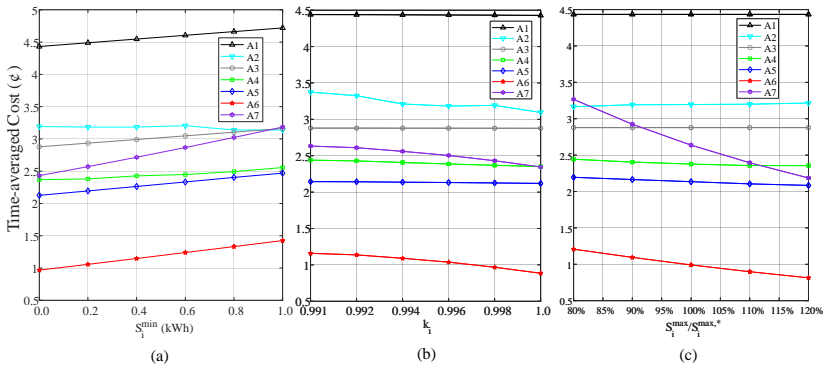
- The gap $\Theta$ depends only on ESS parameters, so it can be reduced offline by the SDP-based tuning of the shifting and weight parameters; the reported one-day simulation shows a 53.10% cost reduction over the greedy algorithm.
Reading between the lines
- The i.i.d. assumption is likely not necessary in practice: the paper notes an extension to finite ergodic Markov chains, and a cheaper empirical test would be to run the same algorithm on historical solar, load, and price traces and compare its time-averaged cost with the offline optimum; if the gap stays near or below $\Theta$, the guarantee holds beyond i.i.d.
- The drift-bound issue in Lemma 2.1 (the coefficient $(\kappa_i^2 - 1)$ is non-positive, so replacing the quadratic term by its maximum is not an upper bound) means a user should verify the constant $M_i$ numerically for their own battery parameters before relying on the guaranteed gap.
- The claim that the distributed reformulation is exactly equivalent to P2 assumes the closed-form updates always respect the bilateral sign constraints and the utility-company balance equations at every iteration; this is worth a direct feasibility check, since the $[\cdot]^+$ projections in Eqs. (7a)-(7b) can in principle produce infeasible iterates when the trading graph is sparse.
- The framework should extend to piecewise-linear or time-varying tariffs, since the closed-form updates come from KKT conditions; re-deriving the $\Theta$ formula for such tariffs would be a concrete testable extension of the paper's method.
Editorial analysis
A structured set of objections, weighed in public.
Referee Report
Summary. The paper proposes an online distributed method for real-time peer-to-peer energy trading with energy storage systems and distribution-network constraints. It formulates the problem as a stochastic program P1, uses a modified Lyapunov drift-plus-cost argument to obtain an online problem P2, then applies consensus ADMM to solve P2 in a distributed manner via P3, with closed-form primal updates. The central theoretical claim is Theorem 2.1, which asserts that the time-averaged cost of the online decisions is within a finite gap Θ of the stochastic optimum. Numerical experiments on 15- to 141-bus systems compare the method against greedy, regret-based, traditional Lyapunov, and offline benchmarks.
Significance. If the theoretical guarantee were valid, this would be a useful contribution: an online, privacy-preserving, distributed algorithm for P2P energy trading that handles ESS and network constraints without forecasts, with closed-form updates and a quantitative optimality gap. The paper deserves credit for a clearly stated problem formulation, for explicitly separating the temporal relaxation from the spatial ADMM decomposition, and for reporting concrete simulation comparisons including scalability on larger systems. However, the central near-optimality guarantee is not established as written: the drift bound in Lemma 2.1 has an algebraic sign error, the gap Θ inherits that error, and the closed-form updates do not enforce the bilateral sign constraints. The significance of the paper is therefore conditional on a substantial revision of the proof and of the algorithmic feasibility argument.
major comments (4)
- [§3.1, Lemma 2.1, Eqs. (13)–(15)] Lemma 2.1 is not a valid upper bound as stated. In the proof, the term 0.5(κ_i^2−1)·max{(S_min+ε_i)^2, (S_max+ε_i)^2} is used to bound 0.5(κ_i^2−1)·̃S_{i,t}^2. Since the paper assumes κ_i∈(0,1], the coefficient 0.5(κ_i^2−1) is non-positive, so replacing ̃S_{i,t}^2 by the maximum squared shifted queue produces the most negative value of that quadratic term, not an upper bound; a valid upper bound would need the squared shifted queue closest to zero. In addition, M_i in Eq. (14) contains the term κ_i(1−κ_i)̃S_{i,t}ε_i, which depends on the state ̃S_{i,t}, so M_i is not a constant for the listed parameters {δ_i, ε_i, κ_i, S_min_i, S_max_i}. Because Theorem 2.1 uses this lemma at Eq. (41a), the main near-optimality claim is currently unsupported.
- [§5.1, Theorem 2.1, Eqs. (40)–(43)] The performance gap Θ inherits the sign error from Lemma 2.1, and further steps in the proof are not justified. In Eq. (40a), the coefficient δ_i(κ_i−1/2−1/2κ_i^2) is non-positive for κ_i≤1, so using the maximum squared shifted queue makes the gap artificially small rather than providing an upper bound. The derivation of Θ_2 in Eqs. (42a)–(42c) is also not a valid chain: Eq. (42a) is asserted to equal an expression containing sqrt(max{(S_min+ε_i)^2, (S_max+ε_i)^2}), and that expression is then bounded by κ_i(1−κ_i)max{(S_min+ε_i)^2, (S_max+ε_i)^2}, without a correct intermediate inequality. Consequently, the proof chain (41a)–(41i) does not establish Ψ_P1(Φ*)≤Ψ*_P1+Θ. Since this is the paper's central advertised theoretical contribution, the issue is load-bearing rather than a local typo.
- [§2.1, Eqs. (5a) and (8)] The discomfort cost term in the objective is identically zero by the paper's own definitions. Equation (5a) defines p_{i,t}=g_{i,t}-d_{i,t}, and Eq. (8) contains the term γ_i(p_{i,t}-g_{i,t}+d_{i,t})^2. Substituting (5a) gives γ_i(0)^2=0 for every prosumer and every time slot. Thus the claimed load-rescheduling/discomfort cost has no effect on the optimization, and the variable d_{i,t} is not penalized as described. This affects the interpretation of the model and of the simulation results involving demand flexibility.
- [§4.2, Eqs. (26)–(30), and §5 preamble] The closed-form updates do not enforce the bilateral sign constraints (6a)–(6b), and the claimed zero performance gap between P2 and P3 is not established. Equations (26a)–(26b) are unconstrained stationary points of the augmented Lagrangian; no projection or inequality multipliers are introduced for the sign restrictions e_{i,j,t}≤0 or e_{i,j,t}≥0. Therefore the primal iterates may violate the buyer/seller sign constraints, so the algorithm is not guaranteed to produce feasible trades. Separately, Section 5 states that the ADMM reformulation P2→P3 is equivalent with zero performance gap, but the algorithm uses a finite stopping threshold r≤10^{-3} and a finite iteration cap k_max; ADMM convergence is asymptotic, and no bound on the suboptimality from early stopping is given. The theorem therefore applies, at best, to an exact solution of P2, not to the implemented distributed algorithm.
minor comments (4)
- [Eq. (14) and its proof] Equation (14) omits the squares on the max arguments, and the proof of Lemma 2.1 writes max{(S_min_i+ε_i)^2, (S_min_i+ε_i)^2} with the same term repeated; the second argument should be (S_max_i+ε_i)^2.
- [Figure 5 and §6.2] The text says Figure 5(b) shows traded energy and Figure 5(a) shows convergence, but the caption states the opposite; the figure parts and the textual references should be reconciled.
- [Eq. (26a)] The numerator uses “−β” without a subscript; it should presumably be −β_i, and the sign convention should be checked against Eq. (26b).
- [§6, numerical experiments] The performance comparisons appear to be based on a single simulation run or a single random draw of prosumer parameters, with no error bars or multiple-seed statistics, so the reported percentage improvements (e.g., 53.10% versus the greedy algorithm) are not accompanied by an indication of variability.
Circularity Check
No circular derivation: the Lyapunov bound is self-contained, though it contains a soundness flaw rather than circularity.
full rationale
The paper's claimed derivation chain does not reduce to its own inputs by construction. P1 is reformulated into P2 via a drift-plus-cost surrogate, P2 to P3 via consensus ADMM, and Theorem 2.1 is meant to bound the gap between the original stochastic problem and the online decisions. No parameter is fitted to cost data and then renamed as a prediction: the offline tuning of δ_i and ϵ_i minimizes the bound Θ, not the realized cost, and the bound itself is an analytic expression in the ESS parameters. The stationary-solution Lemma 2.2 is referred to external Lyapunov and storage-control literature, and the ADMM convergence is cited to Boyd et al.; no load-bearing result rests on the authors' own prior work. The main risk is a correctness defect, not circularity: in Lemma 2.1 and the proof of Theorem 2.1, the term 0.5(κ_i²−1) times the squared shifted queue is bounded using max{(S_min+ϵ)²,(S_max+ϵ)²} even though the coefficient 0.5(κ_i²−1) is non-positive, so the stated inequality is not an upper bound; moreover, M_i in Eq. (14) still contains the state-dependent term κ_i(1−κ_i) ̃S_{i,t}ϵ_i, so it is not a constant. These are internal proof errors, but they are not cases of a conclusion being equivalent to its premise or a fitted value being presented as a prediction. Accordingly, the circularity score is 0.
Assumptions & free parameters
free parameters (5)
- Lyapunov weight parameter delta_i =
optimized by Algorithm 2; example range 1e-2 to 5e-2
- Virtual queue shift parameter epsilon_i =
negative, often -S_max_i or S_max_i - X_i*(S_min_i + S_max_i)
- ADMM penalty factor eta =
12 in simulation
- Dual step sizes tau_p, tau_u, tau_f =
not specified in text
- Charging/discharging coefficient kappa_i =
0.998 in simulation
assumptions (6)
- domain assumption System states R_t are i.i.d. over the operation period, extendable to finite ergodic Markov.
- domain assumption Reactive power injection satisfies q_{j,t} = X_j * p_{j,t} with constant proportion.
- standard math LinDistFlow is a valid linear approximation of the power flow with about 1% error.
- standard math There exists a stationary solution Phi^dagger_t for P4 satisfying Lemma 2.2.
- ad hoc to paper The unconstrained KKT closed-form updates satisfy the bilateral sign constraints and energy balance at every iteration.
- ad hoc to paper The consensus ADMM reformulation P3 is equivalent to P2 with zero performance gap even with finite iterations and stopping tolerance 1e-3.
invented entities (2)
-
Shifted virtual queue tilde S_i,t = S_i,t + epsilon_i
-
Auxiliary trading variables u_i,j,t
Cite this review
Pith. "Pith review of Online distributed optimization for spatio-temporally constrained real-time peer-to-peer energy trading." pith.science (2026). https://pith.science/paper/V7X4UFK7
@misc{pith2026250521884,
  author       = {Pith},
  title        = {Pith review of: Online distributed optimization for spatio-temporally constrained real-time peer-to-peer energy trading},
  year         = {2026},
  howpublished = {\url{https://pith.science/paper/V7X4UFK7}},
  note         = {Machine review of arXiv:2505.21884}
}
read the original abstract
The proliferation of distributed renewable energy triggers the peer-to-peer (P2P) energy market formations. To make profits, prosumers equipped with photovoltaic (PV) panels and even the energy storage system (ESS) can actively participate in the real-time P2P energy market and trade energy. However, in real situations, system states such as energy demands and renewable energy power generation are highly uncertain, making it difficult for prosumers to make optimal real-time decisions. Moreover, severe problems with the physical network can arise from the real-time P2P energy trading, such as bus voltage violations and line overload. To handle these problems, this work first formulates the real-time P2P energy trading problem as a spatio-temporally constrained stochastic optimization problem by considering ESS and the spatial physical network constraints. To deal with the uncertainties online, a modified Lyapunov optimization method is innovatively proposed to approximately reformulate the stochastic optimization problem into an online one by relaxing the time-coupling constraints. Compared with the state-of-the-art online methods, the proposed one renders more flexibility and better performance for the real-time P2P energy market operation. Additionally, to protect the prosumers' privacy, an online distributed algorithm based on the consensus alternating direction method of multipliers (ADMM) is developed to solve the reformulated online problem by decoupling the spatial constraints. The theoretical near-optimal performance guarantee of the proposed online distributed algorithm is derived, and its performance can be further improved by minimizing the performance gap. Simulation results demonstrate that the proposed online distributed algorithm can guarantee the fast, stable, and safe long-term operation of the real-time P2P energy market.
Figures


Figures from the paper (7 more)



Reference graph
Works this paper leans on
-
[1]
T. Morstyn, N. Farrell, S. J. Darby, M. D. McCulloch, Using peer-to- peer energy-trading platforms to incentivize prosumers to form federated power plants, Nature energy 3 (2) (2018) 94–101
work page 2018
- [2]
-
[3]
Y . Liu, Y . Li, H. B. Gooi, Y . Jian, H. Xin, X. Jiang, J. Pan, Distributed robust energy management of a multimicrogrid system in the real-time energy market, IEEE Transactions on Sustainable Energy 10 (1) (2017) 396–406
work page 2017
-
[4]
A. Aminlou, B. Mohammadi-Ivatloo, K. Zare, R. Razzaghi, A. Anvari- Moghaddam, Peer-to-peer decentralized energy trading in industrial town considering central shared energy storage using alternating direction method of multipliers algorithm, IET Renewable Power Generation 16 (12) (2022) 2579–2589
work page 2022
- [5]
- [6]
-
[7]
M. A. Hannan, S. Wali, P. J. Ker, M. S. Abd Rahman, M. Mansor, V . Ra- machandaramurthy, K. Muttaqi, T. M. I. Mahlia, Z. Y . Dong, Battery energy-storage system: A review of technologies, optimization objec- tives, constraints, approaches, and outstanding issues, Journal of Energy Storage 42 (2021) 103023
work page 2021
-
[8]
P. Song, Z. Xu, H. Dong, H. Cai, Z. Xie, Security-constrained line loss minimization in distribution systems with high penetration of renewable energy using upfc, Journal of Modern Power Systems and Clean Energy 5 (6) (2017) 876–886
work page 2017
Show all 50 references
-
[9]
Pillai, M
G. Pillai, M. Allison, T. P. Tun, K. Chandrakumar Jyothi, E. Kol- lonoor Babu, Facilitating higher photovoltaic penetration in residential distribution networks using demand side management and active voltage control, Engineering Reports 3 (10) (2021) e12410
2021
-
[10]
C. H. Leong, C. Gu, F. Li, Auction mechanism for p2p local energy trad- ing considering physical constraints, Energy Procedia 158 (2019) 6613– 6618
2019
-
[11]
Zhong, S
W. Zhong, S. Xie, K. Xie, Q. Yang, L. Xie, Cooperative p2p energy trad- ing in active distribution networks: An milp-based nash bargaining solu- tion, IEEE Transactions on Smart Grid 12 (2) (2020) 1264–1276
2020
-
[12]
Morstyn, A
T. Morstyn, A. Teytelboym, M. D. McCulloch, Bilateral contract net- works for peer-to-peer energy trading, IEEE Transactions on Smart Grid 10 (2) (2018) 2026–2035
2018
-
[13]
Q. Peng, S. H. Low, Distributed optimal power flow algorithm for radial networks, i: Balanced single phase case, IEEE Transactions on Smart Grid 9 (1) (2016) 111–121
2016
-
[14]
Paudel, L
A. Paudel, L. P. M. I. Sampath, J. Yang, H. B. Gooi, Peer-to-peer energy trading in smart grid considering power losses and network fees, IEEE Transactions on Smart Grid 11 (6) (2020) 4727–4737
2020
-
[15]
Paudel, Y
A. Paudel, Y . Jiawei, H. B. Gooi, Peer-to-peer energy trading in smart grids considering network utilization fees, in: 2020 IEEE Power & En- ergy Society General Meeting (PESGM), IEEE, 2020, pp. 1–5
2020
-
[16]
J. Kim, Y . Dvorkin, A p2p-dominant distribution system architecture, IEEE Transactions on Power Systems 35 (4) (2019) 2716–2725
2019
-
[17]
C. Feng, B. Liang, Z. Li, W. Liu, F. Wen, Peer-to-peer energy trading under network constraints based on generalized fast dual ascent, IEEE Transactions on Smart Grid 14 (2) (2022) 1441–1453
2022
-
[18]
K. Umer, Q. Huang, M. Khorasany, M. Afzal, W. Amin, A novel commu- nication efficient peer-to-peer energy trading scheme for enhanced pri- vacy in microgrids, Applied Energy 296 (2021) 117075
2021
-
[19]
W. Shi, N. Li, C.-C. Chu, R. Gadh, Real-time energy management in microgrids, IEEE Transactions on Smart Grid 8 (1) (2015) 228–238
2015
-
[20]
Iqbal, M
S. Iqbal, M. Nasir, M. F. Zia, K. Riaz, H. Sajjad, H. A. Khan, I. Mem- ber, A novel approach for system loss minimization in a peer-to-peer en- ergy sharing community dc microgrid, International Journal of Electrical Power & Energy Systems 129 (2021) 106775
2021
-
[21]
Y . Jia, C. Wan, P. Yu, Y . Song, P. Ju, Security constrained p2p energy trading in distribution network: An integrated transaction and operation model, IEEE Transactions on Smart Grid 13 (6) (2022) 4773–4786
2022
-
[22]
J. Li, C. Zhang, Z. Xu, J. Wang, J. Zhao, Y .-J. A. Zhang, Distributed trans- active energy trading framework in distribution networks, IEEE Transac- tions on Power Systems 33 (6) (2018) 7215–7227
2018
-
[23]
Paudel, K
A. Paudel, K. Chaudhari, C. Long, H. B. Gooi, Peer-to-peer energy trad- ing in a prosumer-based community microgrid: A game-theoretic model, IEEE Transactions on Industrial electronics 66 (8) (2018) 6087–6097
2018
-
[24]
Zhang, R
Z. Zhang, R. Li, F. Li, A novel peer-to-peer local electricity market for joint trading of energy and uncertainty, IEEE Transactions on Smart Grid 11 (2) (2019) 1205–1215
2019
-
[25]
Khorasany, Y
M. Khorasany, Y . Mishra, G. Ledwich, A decentralized bilateral energy trading system for peer-to-peer electricity markets, IEEE Transactions on industrial Electronics 67 (6) (2019) 4646–4657
2019
-
[26]
G. M. Tina, C. Ventura, S. Ferlito, S. De Vito, A state-of-art-review on machine-learning based methods for pv, Applied Sciences 11 (16) (2021) 7550
2021
-
[27]
Bouachir, M
O. Bouachir, M. Aloqaily, ¨O. ¨Ozkasap, F. Ali, Federatedgrids: Federated learning and blockchain-assisted p2p energy sharing, IEEE Transactions on Green Communications and Networking 6 (1) (2022) 424–436
2022
-
[28]
T. Chen, S. Bu, Realistic peer-to-peer energy trading model for microgrids using deep reinforcement learning, in: 2019 IEEE PES Innovative Smart Grid Technologies Europe (ISGT-Europe), IEEE, 2019, pp. 1–5
2019
-
[29]
Zhang, Q
W. Zhang, Q. Li, Q. He, Application of machine learning methods in photovoltaic output power prediction: A review, Journal of Renewable and Sustainable Energy 14 (2) (2022)
2022
-
[30]
Shahriar, A.-R
S. Shahriar, A.-R. Al-Ali, A. H. Osman, S. Dhou, M. Nijim, Machine learning approaches for ev charging behavior: A review, IEEE Access 8 (2020) 168980–168993
2020
-
[31]
G. Wang, W. Cai, Y . Zhang, K. Zhao, X. Xu, Lyapunov optimization based online energy flow control for multi-energy community microgrids, in: 2019 IEEE PES GTD Grand International Conference and Exposition Asia (GTD Asia), IEEE, 2019, pp. 706–711
2019
-
[32]
J. Qin, Y . Chow, J. Yang, R. Rajagopal, Modeling and online control of generalized energy storage networks, in: Proceedings of the 5th interna- tional conference on Future energy systems, 2014, pp. 27–38
2014
-
[33]
Z. Guo, P. Pinson, S. Chen, Q. Yang, Z. Yang, Online optimization for real-time peer-to-peer electricity market mechanisms, IEEE Transactions on Smart Grid 12 (5) (2021) 4151–4163
2021
-
[34]
X. Zhou, Z. Liu, W. Wang, C. Zhao, F. Ding, L. Chen, Hierarchical distributed voltage regulation in networked autonomous grids, in: 2019 American Control Conference (ACC), IEEE, 2019, pp. 5563–5569
2019
-
[35]
H. Zhu, H. J. Liu, Fast local voltage control under limited reactive power: Optimality and stability analysis, IEEE Transactions on Power Systems 31 (5) (2015) 3794–3803
2015
-
[36]
M. H. Ullah, J.-D. Park, Peer-to-peer energy trading in transactive markets considering physical network constraints, IEEE Transactions on Smart Grid 12 (4) (2021) 3390–3403
2021
-
[37]
J. Qin, Y . Chow, J. Yang, R. Rajagopal, Online modified greedy algo- rithm for storage control under uncertainty, IEEE Transactions on Power Systems 31 (3) (2015) 1729–1743
2015
-
[38]
Zhong, K
W. Zhong, K. Xie, Y . Liu, C. Yang, S. Xie, Y . Zhang, Online control and near-optimal algorithm for distributed energy storage sharing in smart grid, IEEE Transactions on Smart Grid 11 (3) (2019) 2552–2562
2019
-
[39]
Neely, Stochastic network optimization with application to communi- cation and queueing systems, Springer Nature, 2022
M. Neely, Stochastic network optimization with application to communi- cation and queueing systems, Springer Nature, 2022
2022
-
[40]
Le Cadre, P
H. Le Cadre, P. Jacquot, C. Wan, C. Alasseur, Peer-to-peer electricity mar- ket analysis: From variational to generalized nash equilibrium, European Journal of Operational Research 282 (2) (2020) 753–771
2020
-
[41]
S. Boyd, N. Parikh, E. Chu, B. Peleato, J. Eckstein, et al., Distributed optimization and statistical learning via the alternating direction method of multipliers, Foundations and Trends® in Machine learning 3 (1) (2011) 1–122
2011
-
[42]
Tushar, C
W. Tushar, C. Yuen, T. K. Saha, T. Morstyn, A. C. Chapman, M. J. E. Alam, S. Hanif, H. V . Poor, Peer-to-peer energy systems for connected communities: A review of recent advances and emerging challenges, Ap- plied energy 282 (2021) 116131
2021
-
[43]
Ouali, A
S. Ouali, A. Cherkaoui, et al., An improved backward /forward sweep power flow method based on a new network information organization for radial distribution systems, Journal of electrical and Computer Engineer- ing 2020 (2020)
2020
-
[44]
Pena-Bello, E
A. Pena-Bello, E. Barbour, M. Gonzalez, M. K. Patel, D. Parra, Opti- mized pv-coupled battery systems for combining applications: Impact of battery technology and geography, Renewable and Sustainable Energy Reviews 112 (2019) 978–990
2019
-
[45]
Grant, S
M. Grant, S. Boyd, Cvx: Matlab software for disciplined convex pro- gramming, version 2.1 (2014)
2014
-
[46]
Huang, Y
Q. Huang, Y . Xu, T. Wang, C. A. Courcoubetis, Market mechanisms for cooperative operation of price-maker energy storage in a power network, IEEE Transactions on Power Systems 33 (3) (2017) 3013–3028
2017
-
[47]
D. R. Conover, A. J. Crawford, V . V . Viswanathan, S. Ferreira, D. Schoen- wald, Protocol for uniformly measuring and expressing the perfor- mance of energy storage systems, Tech. rep., Pacific Northwest National Lab.(PNNL), Richland, W A (United States) (2014)
2014
-
[48]
J. Yang, A. Paudel, H. B. Gooi, H. D. Nguyen, A proof-of-stake public blockchain based pricing scheme for peer-to-peer energy trading, Applied Energy 298 (2021) 117154
2021
-
[49]
Baroche, P
T. Baroche, P. Pinson, R. L. G. Latimier, H. B. Ahmed, Exogenous cost al- location in peer-to-peer electricity markets, IEEE Transactions on Power Systems 34 (4) (2019) 2553–2564
2019
-
[50]
J. Shi, Z. Ye, H. O. Gao, N. Yu, Lyapunov optimization in online battery energy storage system control for commercial buildings, IEEE Transac- tions on Smart Grid 14 (1) (2022) 328–340. 17
2022
Reviewed August 7, 2026 · model on record in the stance chip above.
Discussion (0). Sign in to comment.