REVIEW 3 major objections 5 minor 14 references
Graph-Assisted Culturally Adaptable Idiomatic Translation for Indic Languages
T0 review · 3 major / 5 minor · reviewed 2026-08-07 · deepseek-v4-flash
Pith's one-line read IdiomCE retrieves culturally matched target idioms through an inductive graph neural network and shows that retrieval improves idiomatic translation from English into Hindi, Bengali, Tamil, and Telugu, with average LLM-eval increases…
desk verdict Plausible new GNN pipeline for culturally aware idiom translation into Indic languages, but the unvalidated synthetic graph edges and the conflicting evaluation metrics keep the evidence from being convincing; worth a serious referee, not a desk reject. read the letter →
The pith
A machine-rendered reading of the paper's core claim, the machinery that carries it, and where it could break.
The reading
What carries the argument
The machinery is link prediction on a cultural-element knowledge graph. Each idiom becomes a node whose features are LaBSE embeddings of LLaMA-generated cultural elements (Concepts, Values, Situational and Historical Context); edges are drawn between an English idiom and a target idiom when their cosine similarity passes outlier thresholds from IQR and z-score. A two-layer SAGEConv encoder with mean aggregation and an MLP decoder is trained with binary cross-entropy to score edges. Two augmentations carry the generalization claims: node duplication for cold-start target nodes, and a contrastively trained BERT encoder that attaches an unseen idiom to similar seen idioms before link prediction. The learned edge score is the core object, because it ranks candidate target idioms for a given source idiom.
What would settle it
Take a random sample of linked pairs from the constructed English-Hindi knowledge graph and ask native speakers whether each pair are genuine idioms with the same figurative meaning; if the rate of acceptable pairs is low, the graph's ground truth is invalid. Separately, run the contrastive encoder over held-out MAGPIE idioms and count how many have no training idiom within the cosine threshold 0.75; a large miss rate would break the unseen-idiom pipeline.
Extended reading notes
Core claim
The paper proposes treating idiomatic translation as link prediction on an adaptive knowledge graph whose nodes are idioms and whose edges encode cultural equivalence. Cultural elements for each idiom are generated by the LLaMA-3.1-405B model following a culture taxonomy, embedded with LaBSE, and connected by thresholding cosine similarity with IQR and z-score outlier detection. An inductive SAGEConv encoder paired with an MLP decoder is trained with binary cross-entropy to score edges, and two augmentations extend coverage: node duplication fixes cold-start target nodes, while a contrastively trained BERT encoder attaches unseen idioms to similar seen neighbors. At inference, the GNN retrieves top-k target idioms, an LLM selects the contextually best one, and the LLM translates with that idiom as a constraint. The paper claims this improves English-to-Hindi, English-to-Bengali, English-to-Tamil, and English-to-Telugu idiomatic translation over direct prompting, and that the same trained GNNs support inter-Indic translation through an English pivot.
Load-bearing premise
The load-bearing premise is that idioms with similar machine-generated cultural descriptions are genuine translation equivalents, so the graph built from those similarities is real ground truth, and that every new idiom resembles some training idiom closely enough to attach to the graph.
Editorial extensions
If this is right
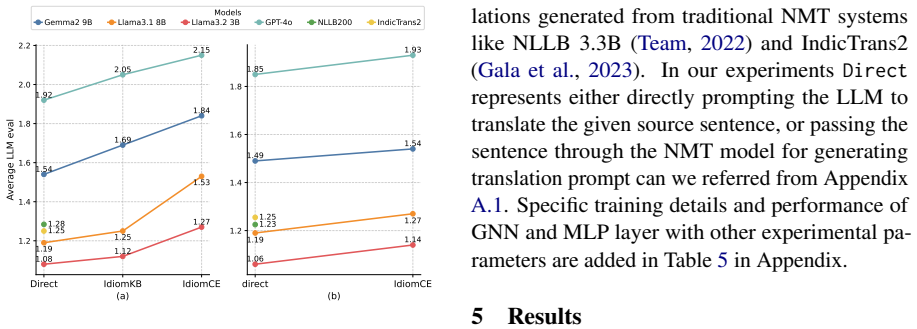
- IdiomCE improves average LLM-eval results over direct prompting in all four English-to-Indic directions: 18.51% for en-hi, 14.71% for en-bn, 6.45% for en-ta, and 10.33% for en-te.
- The approach generalizes to idioms never seen in training via contrastively attached neighbors, so the retrieval does not require retraining for every new idiom.
- Using English as a pivot, the same trained GNNs support idiomatic translation between Indic languages, with average LLM-eval gains of 12.5% to 19.9% over direct prompting.
- Small open LLMs such as Llama-3.2-3B with IdiomCE reach performance comparable to larger directly prompted models, which matters for resource-constrained deployment.
- Human evaluation on en-hi, en-bn, and en-te rates IdiomCE above IdiomKB and direct prompting across the three language pairs tested.
Reading between the lines
- Editorial inference: the same retrieval scaffolding could transfer to other low-resource language pairs where an LLM can write cultural descriptors, even without parallel idiom dictionaries.
- Editorial inference: because the final translation is produced by an LLM conditioned on the retrieved idiom, the method could also constrain NMT decoders or generate idiom-aware training data.
- Editorial inference: the threshold-based graph construction is testable; human validation of the inferred edges would show whether gains come from genuine cultural equivalence or from embedding similarity.
- Editorial inference: the unseen-node assumption, that every new idiom is within cosine distance 0.75 of some training idiom, is an empirical claim; measuring its failure rate on held-out idioms would reveal when the pipeline silently falls back to literal translation.
Editorial analysis
A structured set of objections, weighed in public.
Referee Report
Summary. The paper proposes IdiomCE, an inductive GNN-based retrieval approach for idiomatic translation from English to Hindi, Bengali, Tamil, and Telugu. It constructs a knowledge graph whose nodes are idioms and whose edges are inferred from cosine similarity between LaBSE embeddings of LLaMA-generated cultural elements, then trains a SAGEConv link predictor with node duplication and contrastive learning. At inference, it retrieves top-k target idioms and uses an LLM to select and translate, and it also proposes English-pivot inter-Indic translation. Experiments use a GPT-4o-based LLM-eval score as the primary metric and CometKiwi as a supplementary metric, together with a small human evaluation, across seen, unseen, and mixed idiom sets. The paper reports consistent LLM-eval gains over direct prompting and over the IdiomKB baseline, with the largest gains for English-to-Hindi and English-to-Bengali, and claims that the method is especially helpful for small models.
Significance. If the knowledge-graph edges encode genuine idiomatic equivalences, IdiomCE is a practical and low-cost retrieval-based enhancement for LLM and NMT idiomatic translation, directly addressing one-to-many mapping and unseen-idiom generalization. The paper has genuine strengths: it covers four Indic language pairs, evaluates seen and unseen idioms separately, reports a node-duplication ablation, includes a human evaluation, and provides example translations. However, the central claim is conditional on graph edges that are constructed from synthetic similarity scores and never manually validated, and the supplementary reference-less metric often favors the direct baseline over IdiomCE. The reported gains are therefore not yet sufficient evidence for the method's mechanism or its claimed superiority; the significance would become much clearer after an edge-precision audit and a reconciliation of the conflicting automatic metrics.
major comments (3)
- The knowledge-graph edge construction is the load-bearing component of the paper but is not validated. Edges are created by thresholding cosine similarity between LaBSE embeddings of LLaMA-generated cultural elements, with thresholds chosen by IQR/z-score on the same similarity distribution; no threshold values are reported and no sample of edges is manually checked. Because the GNN retrieval and all downstream claims depend on these edges, the paper should provide a precision audit: for example, sample 100-200 edges per language pair, have annotators judge whether the target idiom is a genuine equivalent of the source idiom in some plausible context, and report precision or the distribution of human scores. The Limitations section concedes that the approach depends heavily on synthetic cultural elements and that noisy features can hurt performance, but that concession does not quantify the risk; if edge precision is low, the claimed graph-semantics mechanism could be driven entirely by the LLM selection and translation prompts rather than by the learned graph structure.
- CometKiwi, the paper's own supplementary metric, contradicts the primary LLM-eval results in most cells. For Gemma2-9b-it, IdiomCE raises LLM-eval but lowers COMET in all four language pairs (e.g., en-hi 0.68 vs. 0.73, en-te 0.62 vs. 0.67); for GPT-4o, Direct has higher COMET in all four pairs; and for Llama-3.2-3B, IdiomCE has lower COMET than Direct in en-hi and en-bn. Because CometKiwi is reference-less and semantic-focused, this consistent pattern suggests that some of the LLM-eval gains may reflect the judge rewarding idiom-for-idiom substitution rather than overall translation quality. The authors should report the disagreement between LLM-eval and COMET, provide significance testing or confidence intervals, and either reconcile the metrics or present a clear argument for why the GPT-4o-based score should be trusted over CometKiwi in this setting.
- The unseen-node assumption is unverified, and the link-prediction scores in Table 5 are partly circular. The edges used to evaluate the GNN were generated from the same LaBSE embedding space that provides the node features, so high Hits@k may reflect reconstructing the cosine-threshold construction rather than learning genuine idiomatic equivalence. For unseen nodes, the method assumes that every test idiom u has some seen idiom v with cos(BCL(u), BCL(v)) >= 0.75, and then randomly selects five target idioms from the top-M retrieved source idioms; the paper reports no statistics on how many of the 200 unseen evaluation idioms satisfy the assumption, no sensitivity analysis for tau or M, and no variance for the random selection. The authors should report coverage of the unseen test set under the tau=0.75 condition, vary tau, and average over multiple random target selections, because without this the claimed 5.67% unseen-node improvement is not robustly established.
minor comments (5)
- The code 'en-tl' is used for English-Telugu in Table 3 and in the human-evaluation discussion, while the standard ISO code for Telugu is 'te' and the same language pair is called 'en-te' in Table 1; the notation should be harmonized.
- The Samanantar dataset is cited as 'et al., 2023' with a malformed reference; the correct citation is Gowtham Ramesh et al. (2023), arXiv:2104.05596.
- The definition of the neighbor set, Nv := {¯v : e_{v,¯v} or e_{¯v,v} ∈ Nv}, is self-referential and does not define a set; it should be rewritten as N_v = {u ∈ V : (v,u) ∈ E or (u,v) ∈ E}.
- The paper refers to 'Appendix 6' for the Donthi et al. baselines and to 'Table A.4' for the human evaluation, but the appendix is unnumbered and the human-evaluation table is Table 3; the references should be corrected, and the SIA and LIA baselines should be described in the main text rather than only appearing in tables.
- The reference list contains duplicate entries: Li et al. 2023a and 2023b are the same paper, and Rezaeimanesh et al. 2024a and 2024b are the same paper; these should be consolidated.
Circularity Check
Link-prediction validation is self-referential because the graph edges and GNN node features come from the same LaBSE embedding space, but the headline translation gains are independently evaluated.
-
self definitional
[Sec. 3.2 (GNN Dataset Formation), Sec. 3.3 (IdiomCE Encoder), Table 5]
"To construct the Knowledge Graph (KG), we first convert the generated cultural elements into Embeddings (we call it cultural features) with Language-agnostic BERT Sentence Embedding (LaBSE) model ... we compute the cosine similarity between the cultural features of English and target (Indic) language idioms to establish pairwise mappings ... Outlier detection is performed by calibrating thresholds based on the skewness and kurtosis of the data, leveraging both the Inter-Quartile Range (IQR) and z-score. ..."
The KG edges E that supervise the GNN are thresholded cosine similarities of LaBSE embeddings of LLaMA-generated cultural elements, while Sec. 3.3 sets GNN node features to LaBSE embeddings of the same idioms. Table 5's link prediction thus asks the model to reconstruct a thresholded similarity function of representations from the same embedding space that generated the labels. High Hits@k/AUC shows the GNN can fit the synthetic graph, not that edges encode validated idiom equivalences. Translation gains are externally measured, so the central claim is not fully circular; the mechanism-level evidence for one-to-many mapping is partly by construction. The Limitations section concedes: 'Our approach heavily depends on the synthetically generated cultural elements (features)'.
full rationale
The only load-bearing circularity is internal to the graph-validation loop. Edges are created by thresholding cosine similarity of LaBSE embeddings of LLaMA-generated cultural elements, and the GNN node features are LaBSE embeddings of the same idioms; hence the link prediction Hits@k/AUC in Table 5 largely measures how well the GNN reconstructs a thresholded similarity function of the same embedding space that defined the labels. This does not validate that the edges are authentic idiomatic equivalences. However, the paper's headline claim, translation quality improvement, is evaluated externally by GPT-4o LLM-eval and by 19 native-speaker human ratings, so it does not reduce to the synthetic graph. The Limitations section openly concedes dependence on synthetic cultural elements and potential noise, which is the right place for this caveat. There are no load-bearing self-citations, imported uniqueness theorems, or ansatz-smuggling citations. Overall circularity is partial and confined to the mechanism-level evidence.
Assumptions & free parameters
free parameters (5)
- edge-construction thresholds (IQR/z-score) =
not disclosed
- tau (unseen-node similarity threshold) =
0.75
- delta (cold/warm node degree threshold) =
3
- alpha (contrastive margin) =
1
- number of random target idioms for unseen nodes =
5
assumptions (4)
- domain assumption The taxonomy of culture (Concepts, Values, Situational/Historical Context) is sufficient to capture idiomatic equivalence.
- domain assumption LaBSE embeddings of cultural element strings preserve cross-lingual idiomatic equivalence.
- domain assumption Idiom detection in source sentences is solved and not part of the evaluation.
- domain assumption GPT-4o-based LLM-eval produces reliable quality scores for idiomatic translation.
Cite this review
Pith. "Pith review of Graph-Assisted Culturally Adaptable Idiomatic Translation for Indic Languages." pith.science (2026). https://pith.science/paper/UEFDWBEJ
@misc{pith2026250521937,
  author       = {Pith},
  title        = {Pith review of: Graph-Assisted Culturally Adaptable Idiomatic Translation for Indic Languages},
  year         = {2026},
  howpublished = {\url{https://pith.science/paper/UEFDWBEJ}},
  note         = {Machine review of arXiv:2505.21937}
}
read the original abstract
Translating multi-word expressions (MWEs) and idioms requires a deep understanding of the cultural nuances of both the source and target languages. This challenge is further amplified by the one-to-many nature of idiomatic translations, where a single source idiom can have multiple target-language equivalents depending on cultural references and contextual variations. Traditional static knowledge graphs (KGs) and prompt-based approaches struggle to capture these complex relationships, often leading to suboptimal translations. To address this, we propose IdiomCE, an adaptive graph neural network (GNN) based methodology that learns intricate mappings between idiomatic expressions, effectively generalizing to both seen and unseen nodes during training. Our proposed method enhances translation quality even in resource-constrained settings, facilitating improved idiomatic translation in smaller models. We evaluate our approach on multiple idiomatic translation datasets using reference-less metrics, demonstrating significant improvements in translating idioms from English to various Indian languages.
Figures


Figures from the paper (1 more)
Reference graph
Works this paper leans on
-
[1]
**Idiom:** - {idiom}
-
[2]
**Concepts:** - Explain the basic meaning and underlying concepts of the idiom
-
[3]
**Values:** - Describe the beliefs or desirable outcomes that the idiom reflects
-
[4]
**Situational Context:** - Describe typical scenarios where the idiom is used
-
[5]
Culturally aware and adapted nlp: A taxon- omy and a survey of the state of the art.Preprint, arXiv:2406.03930. Jatin C. Modh and Jatinderkumar R. Saini. 2020. Con- text based mts for translating gujarati trigram and bigram idioms to english. In2020 International Con- ference for Emerging Technology (INCET), pages 1–6. Geoffrey Nunberg, Ivan A. Sag, and T...
arXiv 2020
-
[14]
**Historical Context:** - Provide any relevant historical background influencing the idiom's usage. Training Details.We train the GNN using a 2-layer SAGEConv architecture, mapping input states from 768 to a hidden dimension of 64. The hidden representation then passes through an MLP with two linear layers and ReLU activation. The model is trained for 50 ...
-
[538]
OpenAI, Josh Achiam, Steven Adler, and Sandhini Agar- wal et al
Cambridge University Press. OpenAI, Josh Achiam, Steven Adler, and Sandhini Agar- wal et al. 2024. Gpt-4 technical report.Preprint, arXiv:2303.08774. Malte Ostendorff, Nils Rethmeier, Isabelle Augenstein, Bela Gipp, and Georg Rehm. 2022. Neighborhood contrastive learning for scientific document represen- tations with citation embeddings. InProceedings of ...
arXiv 2024
-
[1994]
In Stephen Everson, editor,Language: Companions to Ancient Thought, Vol
Idioms. In Stephen Everson, editor,Language: Companions to Ancient Thought, Vol. 3, pages 491–
Show all 14 references
-
[2009]
Surv., 41(3)
Anomaly detection: A survey.ACM Comput. Surv., 41(3). Zhe Chen, Yuehan Wang, Bin Zhao, Jing Cheng, Xin Zhao, and Zongtao Duan. 2020. Knowledge graph completion: A review.IEEE Access, 8:192435– 192456. Arman Cohan, Sergey Feldman, Iz Beltagy, Doug Downey, and Daniel Weld. 2020....
2020 arXiv
-
[2014]
InProceedings of the First Workshop on Computational Approaches to Compound Analysis (ComAComA 2014), pages 81–90
Distinguishing degrees of compositionality in compound splitting for statistical machine translation. InProceedings of the First Workshop on Computational Approaches to Compound Analysis (ComAComA 2014), pages 81–90. Oktay Yagiz and Siros Izadpanah. 2013. Language, culture, id...
2014 arXiv
-
[2017]
Naziya Shaikh
Modeling relational data with graph convolu- tional networks.Preprint, arXiv:1703.06103. Naziya Shaikh. 2020. Determination of idiomatic sen- tences in paragraphs using statement classification and generalization of grammar rules. InProceedings of the WILDRE5– 5th Workshop on ...
2020 arXiv
-
[2018]
Bowen Hao, Jing Zhang, Hongzhi Yin, Cuiping Li, and Hong Chen
Inductive representation learning on large graphs.Preprint, arXiv:1706.02216. Bowen Hao, Jing Zhang, Hongzhi Yin, Cuiping Li, and Hong Chen. 2020. Pre-training graph neural net- works for cold-start users and items representation. Preprint, arXiv:2012.07064. Kazuma Hashimoto a...
2020 arXiv
-
[2023]
InProceedings of the 17th Conference of the European Chapter of the As- sociation for Computational Linguistics, pages 3682– 3700, Dubrovnik, Croatia
Automatic evaluation and analysis of idioms in neural machine translation. InProceedings of the 17th Conference of the European Chapter of the As- sociation for Computational Linguistics, pages 3682– 3700, Dubrovnik, Croatia. Association for Computa- tional Linguistics. Antoni...
2024
-
[2024]
Hessel Haagsma, Johan Bos, and Malvina Nissim
Node duplication improves cold-start link pre- diction.Preprint, arXiv:2402.09711. Hessel Haagsma, Johan Bos, and Malvina Nissim. 2020. MAGPIE: A large corpus of potentially idiomatic ex- pressions. InProceedings of the 12th Language Re- sources and Evaluation Conference, page...
2020 arXiv
Reviewed August 7, 2026 · model on record in the stance chip above.
Discussion (0). Sign in to comment.