REVIEW 1 major objections 4 minor 63 references
Constraints on the strength of first-order phase transition and its relation to nucleon mass
T0 review · 1 major / 4 minor · reviewed 2026-08-07 · deepseek-v4-flash
Pith's one-line read Neutron star data tie the allowed strength of quark-hadron phase transitions to the chiral invariant mass m0, with stronger transitions ruled out for larger m0.
desk verdict Worth a careful look for its use of the integral constraint framework, but the headline 1σ constraints are built on a misquoted NICER radius for PSR J0030+0451, so the numbers need to be recomputed. read the letter →
The pith
A machine-rendered reading of the paper's core claim, the machinery that carries it, and where it could break.
The reading
What carries the argument
The load-bearing apparatus is a three-layer equation-of-state construction: the parity doublet model supplies the hadronic phase up to $n_L$, the Nambu-Jona-Lasinio model supplies quark matter from $n_H = 5\,n_0$ onward, and the integral constraint framework fixes the physically allowed band in between using only causality ($c_s^2 \leq 1$) and the thermodynamic consistency condition $\int n_B \, d\mu = \Delta P$. First-order transitions are inserted by raising the matching density from $n_L$ to $n_L + \delta n_B$ at fixed pressure and chemical potential, which creates a density and energy jump; solving the Tolman-Oppenheimer-Volkoff equations for the stiffest allowable connection gives mass-radius curves whose disagreement with observations rules out large $\delta n_B$.
What would settle it
A NICER-quality measurement of a $2\,M_\odot$ neutron star with a radius larger than the maximum radius allowed by the stiffest permissible equation of state for $m_0 = 600$ MeV would violate the claimed upper bound on $\delta n_B$; conversely, a confirmed twin-star pair whose mass-radius split demands an energy-density jump above $182$ MeV/fm$^3$ at $1\sigma$ would refute the limit.
Extended reading notes
Core claim
The paper's central claim is that the allowable strength of a first-order quark-hadron phase transition in neutron star matter is not free, but is tied to the chiral invariant mass $m_0$: harder hadronic equations of state (smaller $m_0$) tolerate stronger transitions, while softer ones (larger $m_0$) allow only weaker discontinuities. Quantitatively, combining parity doublet hadronic EOS, NJL quark EOS, and integral constraints, then requiring that the resulting mass-radius curves match NICER and gravitational-wave data at $1\sigma$, the author obtains $\delta n_B \leq 1.12\,n_0$ and $\delta\varepsilon \leq 182$ MeV/fm$^3$ for $m_0 = 600$ MeV and $n_L = 1.5\,n_0$, with the corresponding $2\sigma$ bounds of $1.68\,n_0$ and $273$ MeV/fm$^3$. The maximum allowed transition strength decreases with increasing $m_0$ at fixed density, and the constraints converge for stiff hadronic EOS at high matching density.
Load-bearing premise
The result assumes the parity doublet model's hadronic equation of state is still the correct description of matter up to the density $n_L \leq 2\,n_0$ where the first-order jump begins, so that the lower boundary of the transition region is trustworthy.
Editorial extensions
If this is right
- For $m_0 = 600$ MeV and $n_L = 1.5\,n_0$, density jumps above $1.12\,n_0$ ($1\sigma$) or $1.68\,n_0$ ($2\sigma$) are ruled out, meaning strong twin-star transitions are excluded for these parameters.
- For a fixed density, a larger chiral invariant mass $m_0$ tightens the bound, so measuring the maximum allowed transition strength indirectly constrains the origin of nucleon mass.
- At low matching densities near $1.1\,n_0$ the allowed strength is nearly independent of $m_0$, because the EOS is pinned by saturation properties.
- Varying the high-density matching point $n_H$ from $5\,n_0$ to $6\,n_0$ leaves the radius at $1.4\,M_\odot$ essentially unchanged, so the main bounds are robust to that choice.
- A transition strength of $\delta n_B = 2\,n_0$ cannot support a $2\,M_\odot$ neutron star for $m_0 = 600$ MeV, ruling out such strong transitions outright.
Reading between the lines
- If the inverse correlation holds, future radius measurements at the kilometre level could map $m_0$ directly, turning neutron stars into a probe of the chiral structure of QCD.
- The quoted bounds assume the hadronic EOS below $2\,n_0$ contains no hyperons or quarkyonic admixture; including those degrees of freedom would likely shift both $\delta n_B$ limits and the $m_0$ dependence.
- The same integral-constraint setup could be applied to test other first-order transitions, such as low-density deconfinement, using the same observational data.
- A confirmed twin-star pair whose mass-radius split demands an energy-density jump above the $1\sigma$ bound would not only measure the transition but also disfavor large $m_0$, linking a single observation to the nucleon mass question.
Editorial analysis
A structured set of objections, weighed in public.
Referee Report
Summary. The paper constructs neutron star equations of state by matching a parity doublet model (PDM) for the hadronic phase to an NJL-type quark model for the high-density phase, using the Komoltsev-Kurkela integral constraint framework for the intermediate density region. First-order phase transitions are modeled as density jumps at fixed pressure and chemical potential. Comparing the resulting mass-radius relations with NICER and GW170817 observations, the paper claims an inverse correlation between the allowed phase-transition strength and the chiral invariant mass m0, reporting quantitative upper bounds of δnB ≤ 1.12 n0 and δε ≤ 182 MeV/fm^3 at 1σ (and δnB ≤ 1.68 n0, δε ≤ 273 MeV/fm^3 at 2σ) for m0 = 600 MeV and nL = 1.5 n0.
Significance. The paper's framework is logical and the use of the model-independent integral constraint upper boundary is appropriate for translating observational constraints into upper bounds on first-order transition strength. The systematic scan over quark-model parameters and the sensitivity check on the high-density matching point nH are useful. If the quantitative results are correct, the paper provides a novel astrophysical probe of chiral dynamics. However, the headline numerical constraints are directly tied to a misquoted observational input, which currently undermines the quantitative claims. The qualitative inverse correlation between m0 and allowed transition strength is physically expected and likely robust, but the specific numbers require recomputation.
major comments (1)
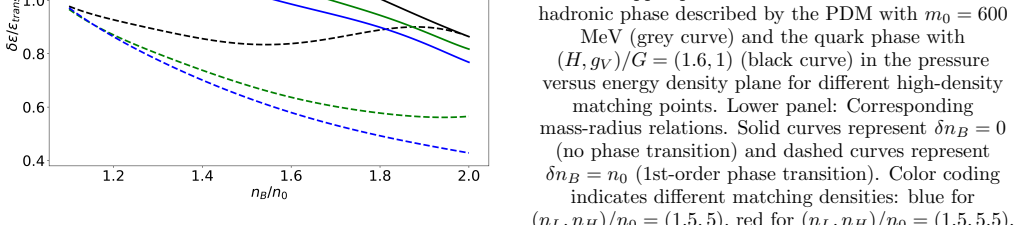
- [Section IV B, Fig. 5, and the derived bounds paragraph] In Section IV B, the manuscript quotes PSR J0030+0451 with M = 1.44 ± 0.07 M⊙ and R = 13.7+2.6−1.5 km, citing Miller et al. (2019). These values are actually the PSR J0740+6620 results from Miller et al. (2021); the published J0030 values are M = 1.44+0.15−0.14 M⊙, R = 13.02+1.24−1.06 km (Miller et al. 2019) or R = 12.71+1.14−1.19 km (Riley et al. 2019). Because the 1σ exclusion of δnB = 1.5 n0 in Fig. 5 and the resulting upper bounds δnB ≤ 1.12 n0 and δε ≤ 182 MeV/fm^3 rely on the lower radius bound of 12.2 km, these quantitative constraints are not robust. With the correct J0030 credible interval (lower 1σ radius 11.96 km for Miller or 11.57 km for Riley), the δnB = 1.5 n0 curve may no longer be excluded at 1σ, shifting the headline bounds upward. The qualitative inverse correlation with m0 is likely unaffected, but the numerical claims in the abstract and Section IV B must be recomputed with the correct NICER inputs.
minor comments (4)
- [Abstract and Section V] The phrase "a inverse correlation" should be corrected to "an inverse correlation".
- [Section I] The text refers to "Appendix V" for the quark matter EOS details, but the appendix is actually labeled "Appendix A"; please correct the cross-reference.
- [Section IV B] There is a typographical artifact in the sentence ending "confidence levels.n Fig. 7, we find" — the stray "n" before "Fig. 7" should be removed.
- [Section IV B] The definition of the energy density jump δε is not explicitly stated; the reader must infer that it is the difference between the energy density at the new low-density point (nL + δnB) and the original hadronic energy density at nL at the same pressure and chemical potential. Please state this definition explicitly.
Circularity Check
No significant circularity: the inverse m0–phase-transition-strength correlation is a computed consequence of the adopted model and external observations, not an input renamed as a prediction.
full rationale
The paper's derivation chain is not circular. The hadronic EOS is produced from the parity-doublet Lagrangian (Sec. II), with m0 varied and the parameter sets fitted to common nuclear saturation properties; the statement that larger m0 softens the EOS is derived from the model equations and displayed in Fig. 1, not assumed as the target result. The intermediate-density region is handled by the model-independent integral-constraint framework of Komoltsev and Kurkela [43], which imposes only causality and thermodynamic consistency. The quark EOS comes from the NJL model with parameters (H, gV) scanned over a grid, and the constraints are obtained by solving the TOV equations and comparing M-R curves with independent NICER and GW170817 observations. The quantity δnB is defined as the imposed density jump (Eq. 13) and then constrained by observations; it is not a parameter fitted to the quantity the paper claims to derive. The inverse correlation in Fig. 7 is a consequence of the computed stiffness ordering combined with the 2M⊙ requirement; the text even labels it 'expected' ('This behavior is expected since larger m0 values lead to softer hadronic EOSs...'), but an expected consequence is not circular equivalence. The paper also explicitly flags its own model-validity limitation for nL ≥ 2n0, which is a robustness caveat rather than a hidden circular input. Self-citations to earlier PDM papers [18,38,44] supply the model and parameter sets, but the central constraints are anchored to external observational inputs and to an independent integral-constraint method, so these citations are not load-bearing in a circular sense. The alleged duplication of the PSR J0030+0451 radius with the PSR J0740+6620 value, if confirmed, is an observational-input accuracy issue that would affect the numerical bounds but not the structural independence of the derivation; it does not raise the circularity score.
Assumptions & free parameters
free parameters (5)
- PDM mean-field couplings (g1, g2, λωρ, and related parameters) =
Values from Ref. [18], not tabulated here
- Chiral invariant mass m0 =
Scanned, with m0 = 500 MeV excluded as too stiff
- NJL vector coupling gV =
Scanned in units of G (e.g., gV/G = 1 in Fig. 4)
- NJL diquark coupling H =
Scanned in units of G (e.g., H/G = 1.6 in Fig. 4)
- Matching densities nL and nH =
nL ≤ 2 n0, nH = 5 n0 (varied to 6 n0 in sensitivity test)
assumptions (6)
- domain assumption No-sea approximation: the Dirac sea is unchanged between vacuum and medium (Sec. II, Eq. (3) and text).
- domain assumption N(939) and N(1535) form a parity doublet whose mass splitting is set by the chiral condensate (Sec. II, mass formula Eq. (4)).
- domain assumption Between nL and nH the only constraints on the EOS are causality and thermodynamic stability, as encoded in the integral constraint framework (Sec. III).
- standard math TOV equations describe hydrostatic neutron star structure.
- domain assumption The hadronic EOS is reliable up to nL ≤ 2 n0 and the NJL quark EOS from nH = 5 n0 (Sec. IV B).
- domain assumption Published NICER and GW170817 radius/mass constraints are adopted at face value at 1σ and 2σ cuts (Sec. IV B).
Cite this review
Pith. "Pith review of Constraints on the strength of first-order phase transition and its relation to nucleon mass." pith.science (2026). https://pith.science/paper/BDGPWTXS
@misc{pith2026250521970,
  author       = {Pith},
  title        = {Pith review of: Constraints on the strength of first-order phase transition and its relation to nucleon mass},
  year         = {2026},
  howpublished = {\url{https://pith.science/paper/BDGPWTXS}},
  note         = {Machine review of arXiv:2505.21970}
}
abstract
We investigate the constraints on the strength of first-order phase transitions in neutron star matter and its relation to the origin of nucleon mass. By combining the parity doublet model for the hadronic phase, the Nambu-Jona-Lasinio model for quark matter, and the integral constraint framework for intermediate densities, we construct equation of states spanning the full density range relevant to neutron stars. Our approach systematically explores how the chiral invariant mass $m_0$ affects the allowable properties of first-order quark-hadron phase transitions. Through comparison with recent neutron star observations, we establish a inverse correlation between the allowed phase transition strength and the chiral invariant mass. Our results demonstrate a direct connection between fundamental questions about the microscopic origin of nucleon mass and macroscopic neutron star observables, providing a novel astrophysical probe of chiral dynamics and QCD physics under extreme conditions.
Figures


Figures from the paper (5 more)


Reference graph
Works this paper leans on
-
[1]
G. Baym, T. Hatsuda, T. Kojo, P. D. Powell, Y. Song, and T. Takatsuka, From hadrons to quarks in neutron stars: a review, Rept. Prog. Phys. 81, 056902 (2018), arXiv:1707.04966 [astro-ph.HE]
arXiv 2018
-
[2]
G. Baym, S. Furusawa, T. Hatsuda, T. Kojo, and H. Togashi, New Neutron Star Equation of State with Quark-Hadron Crossover, Astrophys. J. 885, 42 (2019), arXiv:1903.08963 [astro-ph.HE]
arXiv 2019
-
[3]
T. Kojo, G. Baym, and T. Hatsuda, Implications of NICER for Neutron Star Matter: The QHC21 Equation of State, Astrophys. J. 934, 46 (2022), arXiv:2111.11919 [astro-ph.HE]
arXiv 2022
-
[4]
C. H. Lenzi and G. Lugones, Hybrid stars in the light of the massive pulsar PSR J1614-2230, Astrophys. J. 759, 57 (2012), arXiv:1206.4108 [astro-ph.SR]
arXiv 2012
- [5]
-
[6]
J.-E. Christian, J. Schaffner-Bielich, and S. Rosswog, Which first order phase transitions to quark matter are possible in neutron stars?, Phys. Rev. D 109, 063035 (2024), arXiv:2312.10148 [nucl-th]
arXiv 2024
- [7]
-
[8]
Y. Fujimoto, K. Fukushima, K. Hotokezaka, and K. Kyu- toku, Gravitational Wave Signal for Quark Matter with Realistic Phase Transition, Phys. Rev. Lett. 130, 091404 11 (2023), arXiv:2205.03882 [astro-ph.HE]
arXiv 2023
Show all 63 references
-
[9]
Huang, L
Y.-J. Huang, L. Baiotti, T. Kojo, K. Takami, H. Sotani, H. Togashi, T. Hatsuda, S. Nagataki, and Y.-Z. Fan, Merger and Postmerger of Binary Neutron Stars with a Quark-Hadron Crossover Equation of State, Phys. Rev. Lett. 129, 181101 (2022), arXiv:2203.04528 [astro- ph.HE]
2022 arXiv
-
[10]
Guo, W.-C
L.-J. Guo, W.-C. Yang, Y.-L. Ma, and Y.-L. Wu, Prob- ing Hadron-quark Transition Through Binary Neutron Star Merger, Res. Astron. Astrophys. 25, 035017 (2025), arXiv:2308.01770 [astro-ph.HE]
2025 arXiv
-
[11]
Kampfer, On the Possibility of Stable Quark and Pion Condensed Stars, J
B. Kampfer, On the Possibility of Stable Quark and Pion Condensed Stars, J. Phys. A 14, L471 (1981)
1981
-
[12]
N. K. Glendenning and C. Kettner, Nonidentical neu- tron star twins, Astron. Astrophys. 353, L9 (2000), arXiv:astro-ph/9807155
2000 arXiv
-
[13]
M. G. Alford and A. Sedrakian, Compact stars with se- quential QCD phase transitions, Phys. Rev. Lett. 119, 161104 (2017), arXiv:1706.01592 [astro-ph.HE]
2017 arXiv
-
[14]
E. R. Most, L. R. Weih, L. Rezzolla, and J. Schaffner- Bielich, New constraints on radii and tidal deformabilities of neutron stars from GW170817, Phys. Rev. Lett. 120, 261103 (2018), arXiv:1803.00549 [gr-qc]
2018 arXiv
-
[15]
Weinberg, Algebraic realizations of chiral symmetry, Phys
S. Weinberg, Algebraic realizations of chiral symmetry, Phys. Rev. 177, 2604 (1969)
1969
-
[16]
C. E. Detar and T. Kunihiro, Linear σ Model With Parity Doubling, Phys. Rev. D 39, 2805 (1989)
1989
-
[17]
D. Jido, M. Oka, and A. Hosaka, Chiral symmetry of baryons, Prog. Theor. Phys. 106, 873 (2001), arXiv:hep- ph/0110005
2001
-
[18]
Minamikawa, T
T. Minamikawa, T. Kojo, and M. Harada, Quark-hadron crossover equations of state for neutron stars: constrain- ing the chiral invariant mass in a parity doublet model, Phys. Rev. C 103, 045205 (2021), arXiv:2011.13684 [nucl-th]
2021 arXiv
-
[19]
Zschiesche, L
D. Zschiesche, L. Tolos, J. Schaffner-Bielich, and R. D. Pisarski, Cold, dense nuclear matter in a SU(2) par- ity doublet model, Phys. Rev. C 75, 055202 (2007), arXiv:nucl-th/0608044
2007 arXiv
-
[20]
Dexheimer, S
V. Dexheimer, S. Schramm, and D. Zschiesche, Nuclear matter and neutron stars in a parity doublet model, Phys. Rev. C 77, 025803 (2008)
2008
-
[21]
Sasaki and I
C. Sasaki and I. Mishustin, Thermodynamics of dense hadronic matter in a parity doublet model, Phys. Rev. C 82, 035204 (2010)
2010
-
[22]
Motohiro, Y
Y. Motohiro, Y. Kim, and M. Harada, Asymmetric nu- clear matter in a parity doublet model with hidden local symmetry, Phys. Rev. C 92, 025201 (2015), [Erratum: Phys.Rev.C 95, 059903 (2017)], arXiv:1505.00988 [nucl- th]
2015 arXiv
-
[23]
Marczenko, D
M. Marczenko, D. Blaschke, K. Redlich, and C. Sasaki, Toward a unified equation of state for multi-messenger astronomy, Astron. Astrophys. 643, A82 (2020), arXiv:2004.09566 [astro-ph.HE]
2020 arXiv
-
[24]
Marczenko, K
M. Marczenko, K. Redlich, and C. Sasaki, Chiral symme- try restoration and ∆ matter formation in neutron stars, Phys. Rev. D 105, 103009 (2022), arXiv:2203.00269 [nucl-th]
2022 arXiv
-
[25]
Y. K. Kong, T. Minamikawa, and M. Harada, Neutron star matter based on a parity doublet model including the a0(980) meson, Phys. Rev. C 108, 055206 (2023), arXiv:2306.08140 [nucl-th]
2023 arXiv
-
[26]
Minamikawa, B
T. Minamikawa, B. Gao, T. kojo, and M. Harada, Par- ity doublet model for baryon octets: diquark classifica- tions and mass hierarchy based on the quark-line dia- gram, (2023), arXiv:2306.15564 [hep-ph]
2023 arXiv
-
[27]
B. Gao, Y. Yan, and M. Harada, Reconciling constraints from the supernova remnant HESS J1731-347 with the parity doublet model, Phys. Rev. C 109, 065807 (2024), arXiv:2404.04786 [nucl-th]
2024 arXiv
-
[28]
B. Gao, T. Kojo, and M. Harada, Parity doublet model for baryon octets: Ground states saturated by good di- quarks and the role of bad diquarks for excited states, Phys. Rev. D 110, 016016 (2024), arXiv:2403.18214 [hep- ph]
2024 arXiv
-
[29]
B. P. Abbott et al. (LIGO Scientific, Virgo), GW170817: Observation of Gravitational Waves from a Binary Neu- tron Star Inspiral, Phys. Rev. Lett. 119, 161101 (2017), arXiv:1710.05832 [gr-qc]
2017 arXiv
-
[30]
B. P. Abbott et al. (LIGO Scientific, Virgo, Fermi GBM, INTEGRAL, IceCube, AstroSat Cadmium Zinc Telluride Imager Team, IPN, Insight-Hxmt, ANTARES, Swift, AGILE Team, 1M2H Team, Dark Energy Camera GW-EM, DES, DLT40, GRA WITA, Fermi-LAT, ATCA, ASKAP, Las Cumbres Observatory Gro...
2017 arXiv
-
[31]
B. P. Abbott et al. (LIGO Scientific, Virgo), GW170817: Measurements of neutron star radii and equation of state, Phys. Rev. Lett. 121, 161101 (2018), arXiv:1805.11581 [gr-qc]
2018 arXiv
-
[32]
M. C. Miller et al., PSR J0030+0451 Mass and Radius from N ICERData and Implications for the Properties of Neutron Star Matter, Astrophys. J. Lett. 887, L24 (2019), arXiv:1912.05705 [astro-ph.HE]
2019 arXiv
-
[33]
Since we employ the upper boundary EOS representing the stiffest possible connection between hadronic phase 6 FIG
(M = 2.08+0.07 −0.07 M⊙, R = 13.7+2.6 −1.5 km), as well as ra- dius constraints derived from LIGO-Virgo gravitational wave observations [29–31]. Since we employ the upper boundary EOS representing the stiffest possible connection between hadronic phase 6 FIG. 5: M -R relation ...
-
[34]
M. C. Miller et al., The Radius of PSR J0740+6620 from NICER and XMM-Newton Data, Astrophys. J. Lett. 918, L28 (2021), arXiv:2105.06979 [astro-ph.HE]
2021 arXiv
-
[35]
Baldo, I
M. Baldo, I. Bombaci, and G. F. Burgio, Microscopic nu- clear equation of state with three-body forces and neu- tron star structure, Astron. Astrophys. 328, 274 (1997), arXiv:astro-ph/9707277
1997 arXiv
-
[36]
B.-A. Li, P. G. Krastev, D.-H. Wen, and N.-B. Zhang, Towards Understanding Astrophysical Effects of Nuclear Symmetry Energy, Eur. Phys. J. A 55, 117 (2019), arXiv:1905.13175 [nucl-th]
2019 arXiv
-
[37]
Drischler, J
C. Drischler, J. W. Holt, and C. Wellenhofer, Chiral Ef- fective Field Theory and the High-Density Nuclear Equa- tion of State, Ann. Rev. Nucl. Part. Sci. 71, 403 (2021), arXiv:2101.01709 [nucl-th]
2021 arXiv
-
[38]
Hatsuda and T
T. Hatsuda and T. Kunihiro, QCD phenomenology based on a chiral effective Lagrangian, Phys. Rept. 247, 221 (1994), arXiv:hep-ph/9401310
1994 arXiv
-
[39]
B. Gao, T. Minamikawa, T. Kojo, and M. Harada, Im- pacts of the U(1)A anomaly on nuclear and neutron star equation of state based on a parity doublet model, Phys. 12 Rev. C 106, 065205 (2022), arXiv:2207.05970 [nucl-th]
2022 arXiv
-
[40]
Yuan and A
W.-L. Yuan and A. Li, Two-flavor Color Superconducting Quark Stars May Not Exist, Astrophys. J. 966, 3 (2024), arXiv:2312.17102 [nucl-th]
2024 arXiv
-
[41]
Gholami, I
H. Gholami, I. A. Rather, M. Hofmann, M. Buballa, and J. Schaffner-Bielich, Astrophysical constraints on color- superconducting phases in compact stars within the RG- consistent NJL model, (2024), arXiv:2411.04064 [hep- ph]
2024 arXiv
-
[42]
Kurkela, P
A. Kurkela, P. Romatschke, and A. Vuorinen, Cold Quark Matter, Phys. Rev. D 81, 105021 (2010), arXiv:0912.1856 [hep-ph]
2010 arXiv
-
[43]
Gorda, A
T. Gorda, A. Kurkela, R. Paatelainen, S. S¨ appi, and A. Vuorinen, Soft Interactions in Cold Quark Matter, Phys. Rev. Lett. 127, 162003 (2021), arXiv:2103.05658 [hep-ph]
2021 arXiv
-
[44]
Komoltsev and A
O. Komoltsev and A. Kurkela, How Perturbative QCD Constrains the Equation of State at Neutron- Star Densities, Phys. Rev. Lett. 128, 202701 (2022), arXiv:2111.05350 [nucl-th]
2022 arXiv
-
[45]
Minamikawa, B
T. Minamikawa, B. Gao, T. Kojo, and M. Harada, Chiral Restoration of Nucleons in Neutron Star Matter: Studies Based on a Parity Doublet Model, Symmetry 15, 745 (2023), arXiv:2302.00825 [nucl-th]
2023 arXiv
-
[46]
Fujimoto, K
Y. Fujimoto, K. Fukushima, and K. Murase, Extensive Studies of the Neutron Star Equation of State from the Deep Learning Inference with the Observational Data Augmentation, JHEP 03, 273, arXiv:2101.08156 [nucl- th]
-
[47]
Raaijmakers, S
G. Raaijmakers, S. K. Greif, K. Hebeler, T. Hinderer, S. Nissanke, A. Schwenk, T. E. Riley, A. L. Watts, J. M. Lattimer, and W. C. G. Ho, Constraints on the Dense Matter Equation of State and Neutron Star Prop- erties from NICER’s Mass–Radius Estimate of PSR J0740+6620 and Mul...
2021 arXiv
-
[48]
F. Ozel, D. Psaltis, T. Guver, G. Baym, C. Heinke, and S. Guillot, The Dense Matter Equation of State from Neutron Star Radius and Mass Measurements, Astro- phys. J. 820, 28 (2016), arXiv:1505.05155 [astro-ph.HE]
2016 arXiv
-
[49]
Bogdanov, C
S. Bogdanov, C. O. Heinke, F. ¨Ozel, and T. G¨ uver, Neu- tron Star Mass-Radius Constraints of the Quiescent Low- mass X-ray Binaries X7 and X5 in the Globular Cluster 47 Tuc, Astrophys. J. 831, 184 (2016), arXiv:1603.01630 [astro-ph.HE]
2016 arXiv
-
[50]
Gao and M
B. Gao and M. Harada, Quarkyonic matter with chiral symmetry restoration, Phys. Rev. D 111, 016024 (2025), arXiv:2410.16649 [nucl-th]
2025 arXiv
-
[51]
W.-L. Yuan, B. Gao, Y. Yan, and R. Xu, Hybrid stars with large quark cores within the parity doublet model and modified NJL model, (2025), arXiv:2502.17859 [nucl-th]
2025
-
[52]
Lonardoni, A
D. Lonardoni, A. Lovato, S. Gandolfi, and F. Ped- eriva, Hyperon Puzzle: Hints from Quantum Monte Carlo Calculations, Phys. Rev. Lett. 114, 092301 (2015), arXiv:1407.4448 [nucl-th]
2015 arXiv
-
[53]
A. Gal, E. V. Hungerford, and D. J. Millener, Strangeness in nuclear physics, Rev. Mod. Phys. 88, 035004 (2016), arXiv:1605.00557 [nucl-th]
2016 arXiv
-
[54]
McLerran and R
L. McLerran and R. D. Pisarski, Phases of cold, dense quarks at large N(c), Nucl. Phys. A 796, 83 (2007), arXiv:0706.2191 [hep-ph]
2007 arXiv
-
[55]
D. C. Duarte, S. Hernandez-Ortiz, K. S. Jeong, and L. D. McLerran, Quarkyonic effective field theory, quark- nucleon duality, and ghosts, Phys. Rev. D 104, L091901 (2021), arXiv:2103.05679 [nucl-th]
2021 arXiv
-
[56]
Kojo, Stiffening of matter in quark-hadron continu- ity, Phys
T. Kojo, Stiffening of matter in quark-hadron continu- ity, Phys. Rev. D 104, 074005 (2021), arXiv:2106.06687 [nucl-th]
2021 arXiv
-
[57]
Fujimoto, T
Y. Fujimoto, T. Kojo, and L. D. McLerran, Momentum Shell in Quarkyonic Matter from Explicit Duality: A Dual Model for Cold, Dense QCD, Phys. Rev. Lett. 132, 112701 (2024), arXiv:2306.04304 [nucl-th]
2024 arXiv
-
[58]
Fujimoto, T
Y. Fujimoto, T. Kojo, and L. McLerran, Quarkyonic matter pieces together the hyperon puzzle, (2024), arXiv:2410.22758 [nucl-th]
2024
-
[59]
Ivanytskyi, D
O. Ivanytskyi, D. Blaschke, T. Fischer, and A. Bauswein, Early Quark Deconfinement in Compact Star Astro- physics and Heavy-ion Collisions, Acta Phys. Polon. Supp. 16, 1 (2023), arXiv:2208.09085 [nucl-th]
2023 arXiv
-
[60]
Blaschke, U
D. Blaschke, U. Shukla, O. Ivanytskyi, and S. Liebing, Effect of color superconductivity on the mass of hybrid neutron stars in an effective model with perturbative QCD asymptotics, Phys. Rev. D 107, 063034 (2023), arXiv:2212.14856 [nucl-th]
2023 arXiv
-
[61]
G¨ artlein, O
C. G¨ artlein, O. Ivanytskyi, V. Sagun, and D. Blaschke, Hybrid star phenomenology from the properties of the special point, Phys. Rev. D 108, 114028 (2023), arXiv:2301.10765 [nucl-th]
2023 arXiv
-
[62]
Schaeffer, L
R. Schaeffer, L. Zdunik, and P. Haensel, Phase transitions in stellar cores. I - Equilibrium configurations, aap 126, 121 (1983)
1983
-
[63]
M. G. Alford and S. Han, Characteristics of hybrid com- pact stars with a sharp hadron-quark interface, Eur. Phys. J. A 52, 62 (2016), arXiv:1508.01261 [nucl-th]
2016 arXiv
Reviewed August 7, 2026 · model on record in the stance chip above.
Discussion (0). Sign in to comment.