REVIEW 4 major objections 5 minor 33 references
Two-Stage Feature Generation with Transformer and Reinforcement Learning
T0 review · 4 major / 5 minor · reviewed 2026-08-07 · deepseek-v4-flash
Pith's one-line read TSFG: a two-stage framework where a Transformer encoder-decoder generates arithmetic features and PPO tunes them against the task's own metric, beating existing feature engineering baselines.
desk verdict A plausible two-stage feature generation idea that is undercut by an unspecified gradient path in pretraining and single-run experiments, but the combination is worth a serious referee. read the letter →
The pith
A machine-rendered reading of the paper's core claim, the machinery that carries it, and where it could break.
The reading
What carries the argument
The central machinery is the tokenized feature-transformation language combined with the encoder-decoder architecture. Each token is a single operation-feature pair, such as +V1 or *V2, so a decoded segment between EOS tokens corresponds to one new arithmetic feature; this makes the search space discrete and the generated features directly interpretable. The Transformer's self-attention provides the encoder with a representation of inter-feature dependencies, while the decoder generates the transformation sequence autoregressively with temperature-scaled sampling for exploration. The same network then becomes the PPO policy in the fine-tuning stage, with the reward defined as the downstream metric difference between the augmented and original dataset. Pretraining gives a stable initialization, and PPO's clipped objective keeps the subsequent policy updates from destabilizing it.
What would settle it
Run TSFG's released code on any reported dataset and check how the augmented dataset is passed to the pre-trained MLP once the number of features changes; if the MLP's input dimension stays fixed, the described prediction loss cannot be computed on the generated features, and the pretraining loop is not implemented as written. A second check is to replace the PPO reward with random values while keeping pretraining identical; if downstream performance does not drop, the fine-tuning stage is not the source of the reported gains.
Extended reading notes
Core claim
On its own terms, the paper's discovery is that a single Transformer encoder-decoder can serve both as a feature-transformation generator and as the policy network for reinforcement learning, and that this duality is what lets the framework first learn a useful feature-generation strategy and then refine it for a specific task. The encoder compresses the raw feature set into a latent representation; the decoder emits a sequence of tokens, each binding an arithmetic operator to an original feature, with EOS marking the end of one new feature and STOP marking the end of the sequence. In the first stage the prediction loss of a pre-trained MLP on the augmented dataset is used to update the generator; in the second stage PPO uses the improvement in a downstream metric as the reward. The paper concludes that this staged training reduces feature redundancy and inefficient exploration, and that the resulting feature sets improve downstream model performance across different classifiers and regressors.
Load-bearing premise
The load-bearing assumption is that the pretraining step can transmit a useful learning signal through the whole pipeline: the prediction loss of a pre-trained MLP must be able to update the generator even though the generator outputs are discrete sampled tokens and the new arithmetic features are built by non-differentiable operators, and that same MLP must be able to score a dataset whose feature set has been augmented beyond its original input dimension. If either part of that assumption fails, the pretraining stage cannot work as described.
Editorial extensions
If this is right
- Applied to a tabular dataset, TSFG outputs explicit new features like $V_1+V_2$ and $-V_3 \times V_1$, so a data scientist gets an enriched dataset whose new columns are interpretable arithmetic combinations rather than opaque embeddings.
- Because the reward is a downstream performance metric, the same trained generator can be re-tuned for a new task without re-running an exhaustive feature search.
- The paper reports competitive runtime against deep learning baselines, since the pretrained generator converges faster than reinforcement learning from scratch.
- The framework is downstream-model-agnostic in the paper's experiments: gains appear with Random Forest, XGBoost, SVM, and CatBoost.
- Automated feature generation of this kind removes the manual step of guessing which ratios, products, or differences of raw columns will help a model.
Reading between the lines
- The same two-stage recipe likely transfers to non-tabular data or to feature selection by swapping the operation vocabulary and the reward function, since nothing in the design is specific to tables.
- If the discrete-sampling gradient problem is real, the pretraining gain may actually come from the temperature-scaled exploration that widens the search, not from the prediction loss; an experiment that keeps exploration fixed while randomizing the pretraining target would separate these effects.
- The fixed pre-trained MLP that scores the augmented dataset is a scalability bottleneck: once feature generation changes the feature count, the scoring head either must be re-trained or replaced by a metric that does not require a fixed input dimension.
- The paper's 10 PPO iterations and small-to-medium UCI/OpenML datasets leave open whether the reward signal stays stable on larger benchmarks where evaluating each generated feature set is more expensive.
Editorial analysis
A structured set of objections, weighed in public.
Referee Report
Summary. The paper proposes TSFG, a two-stage automated feature generation framework for tabular data. In the first stage, a Transformer-based encoder-decoder is pre-trained to emit sequences of feature-transformation tokens (e.g., '+V1,+V2,EOS,-V3,*V1,STOP'); the resulting new dataset is evaluated by a pre-trained MLP, and the MLP prediction loss is backpropagated into the encoder-decoder. In the second stage, the same encoder-decoder is treated as a policy network and fine-tuned with PPO, with the reward defined as the downstream metric improvement. Experiments compare TSFG with five baselines on 13 classification and regression datasets, and include ablation, runtime, downstream-model, and feature-importance analyses.
Significance. If the proposed method worked as described, it would be a relevant contribution to automated feature engineering, combining a sequence-generation pretraining stage with RL-based fine-tuning and offering a concrete efficiency argument. The paper provides a code link and evaluates on 13 datasets, which is a useful empirical starting point. However, the manuscript does not specify the gradient path through discrete transformation tokens, does not explain how the fixed-input MLP evaluates augmented feature sets, and reports experimental results without variance or significance information. These gaps directly affect the central claim that TSFG 'outperforms existing state-of-the-art methods,' so the paper's significance cannot be assessed from the manuscript as written.
major comments (4)
- [§3.3 and Algorithm 1 (lines 5–7)] The pretraining loss in Eq. (5) is computed from predictions of a pre-trained MLP on data produced by discretely sampled transformation tokens, but the manuscript never states how gradients of L_classification or L_regression pass through the discrete token selection or through the arithmetic feature-building operations. Temperature scaling in Eq. (4) only reshapes a softmax distribution over actions; it is not a differentiable relaxation of sampling. Algorithm 1 lines 5–7 simply call for backpropagation without specifying a Gumbel-Softmax, straight-through estimator, REINFORCE-type estimator, or any other mechanism. This is load-bearing because the pretraining stage is credited with the stability and efficiency that distinguish TSFG from GRFG and DIFER; without a concrete gradient estimator, the stage is not implementable as described.
- [§3.3 and Algorithm 1 (line 12)] The manuscript says the generated transformation operations are applied to Dtrain to create Dnew_train, and that 'the dataset Dnew_train is then fed into a pre-trained MLP.' The pre-trained MLP's input dimension is fixed by the original feature set, while the generated sequence such as '+V1,+V2,EOS,-V3,*V1,STOP' produces two new features and thereby changes the number of columns. No input-size adaptation, retraining, or feature-subset mechanism is described for the MLP. As written, the evaluation of the generated features by this MLP is undefined, so the pretraining objective cannot be computed.
- [§4.2, Table 1] Table 1 reports only single point estimates for each method and metric, with no standard deviations, no number of runs, and no significance tests. Many of the reported improvements are small (e.g., australian F1-score 0.8832 for TSFG versus 0.8757 for GRFG), and without repeated trials or error bars the abstract's claim that TSFG 'significantly improves' predictive performance and 'outperforms existing state-of-the-art methods' is not statistically substantiated. The authors should report mean and variance over multiple runs and, ideally, pairwise significance tests or at least confidence intervals.
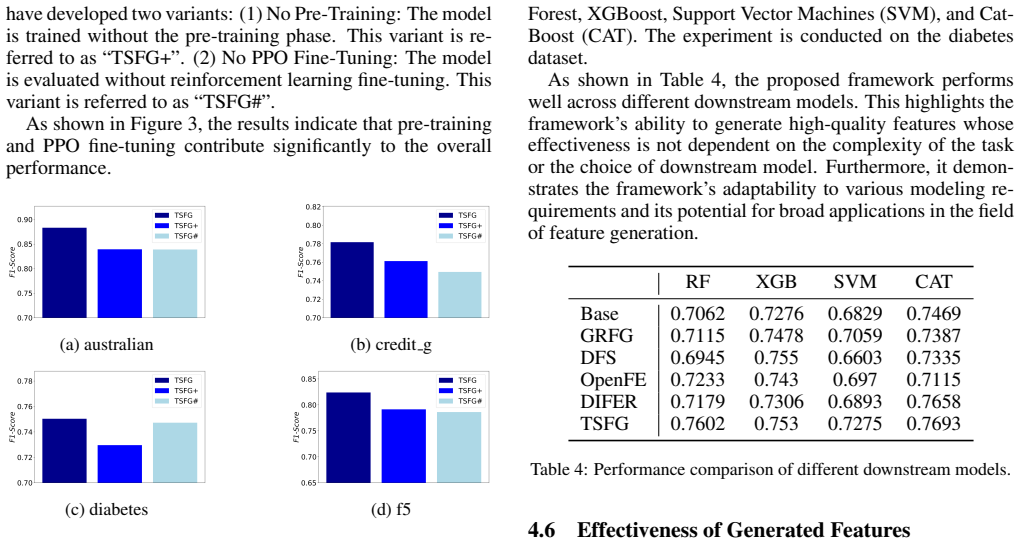
- [§4.3, Figure 3] The ablation study is the only direct evidence that pretraining and PPO fine-tuning each contribute to the final result, but Figure 3 is presented as unlabeled curves for four datasets with no numeric values, no axis labels, and no error bars. The claim that pre-training and PPO fine-tuning 'contribute significantly' cannot be checked from the figure. At minimum, the authors should provide a table with final metric values for 'Base,' 'TSFG+,' 'TSFG#,', and 'TSFG' on the ablated datasets.
minor comments (5)
- [Eq. (4)] The notation P(a,z) = exp(a/T) / sum_i exp(ai/T) uses the action a itself in the exponential, but in a softmax the exponential should be taken over logits or scores associated with actions. Please clarify whether a denotes a score and how the denominator is indexed.
- [Eq. (5)] The displayed cross-entropy loss is the binary form, while several classification datasets in Table 2 have more than two classes. If the framework is intended for multiclass tasks, a multiclass softmax cross-entropy formula should be used or the binary form should be explicitly restricted to binary datasets.
- [Table 1] In the f5 row, the OpenFE precision value is listed as 0.888 while all other OpenFE values for that dataset are between 0.77 and 0.81; this appears to be a typographical error and should be checked against the original results.
- [Figures 1 and 4] Figure 1 contains the misspelling 'Obecit' in the dataset illustration, and Figure 4's caption says 'hepapits' instead of 'hepatitis.' Please correct these typos.
- [§4.4, Table 3] The runtime table reports times in seconds but does not state the hardware, software versions, or whether all methods were run under the same environment; adding this information would make the efficiency comparison reproducible.
Circularity Check
No significant circularity: the framework optimizes the same metric it reports, but this is a standard training objective with external test-set evaluation, not a definitional reduction.
full rationale
The paper's derivation chain is a constructive ML pipeline, not a logical proof that reduces to its inputs. Eq. (7) defines the PPO reward as r = Metric(Dnew) - Metric(D), and Table 1 reports F1/accuracy/1-RAE/R2 improvements; this is an optimization objective, not a fitted parameter renamed as a prediction. The pretraining losses (Eqs. 5-6) are supervised training objectives evaluated by a pre-trained MLP; they do not presuppose the final performance claim. The only author-overlapping citations ([Liu et al., 2019], [Wang et al., 2022], [Zhang and Gao, 2021], [Zhang et al., 2021], [Li et al., 2024]) appear in related-work or baseline descriptions, and none is invoked as a load-bearing justification, uniqueness theorem, or ansatz source. The identified implementability gaps (backpropagation through discrete tokens, fixed-input MLP with augmented features) are correctness/rigor concerns, not circularity, because no equation reduces to another by construction. Thus the central empirical claim is externally checkable against the reported benchmarks.
Assumptions & free parameters
free parameters (5)
- Maximum transformation sequence length =
100
- PPO iterations =
10
- Temperature range T =
0.1 to 1
- Entropy coefficient =
1e-4
- Transformer dimensions =
embedding 128, hidden 128, 8 heads
assumptions (3)
- domain assumption The dataset can be tokenized as a sequence of discrete feature tokens with operations, preserving sufficient information for the Transformer encoder.
- ad hoc to paper Gradients can be backpropagated from the downstream MLP loss through discretely sampled feature transformations to the encoder-decoder parameters.
- ad hoc to paper The pre-trained MLP can accept datasets with augmented feature sets.
Cite this review
Pith. "Pith review of Two-Stage Feature Generation with Transformer and Reinforcement Learning." pith.science (2026). https://pith.science/paper/BUW4XEGB
@misc{pith2026250521978,
  author       = {Pith},
  title        = {Pith review of: Two-Stage Feature Generation with Transformer and Reinforcement Learning},
  year         = {2026},
  howpublished = {\url{https://pith.science/paper/BUW4XEGB}},
  note         = {Machine review of arXiv:2505.21978}
}
read the original abstract
Feature generation is a critical step in machine learning, aiming to enhance model performance by capturing complex relationships within the data and generating meaningful new features. Traditional feature generation methods heavily rely on domain expertise and manual intervention, making the process labor-intensive and challenging to adapt to different scenarios. Although automated feature generation techniques address these issues to some extent, they often face challenges such as feature redundancy, inefficiency in feature space exploration, and limited adaptability to diverse datasets and tasks. To address these problems, we propose a Two-Stage Feature Generation (TSFG) framework, which integrates a Transformer-based encoder-decoder architecture with Proximal Policy Optimization (PPO). The encoder-decoder model in TSFG leverages the Transformer's self-attention mechanism to efficiently represent and transform features, capturing complex dependencies within the data. PPO further enhances TSFG by dynamically adjusting the feature generation strategy based on task-specific feedback, optimizing the process for improved performance and adaptability. TSFG dynamically generates high-quality feature sets, significantly improving the predictive performance of machine learning models. Experimental results demonstrate that TSFG outperforms existing state-of-the-art methods in terms of feature quality and adaptability.
Figures


Figures from the paper (1 more)

Reference graph
Works this paper leans on
-
[1]
Neural machine translation by jointly learning to align and translate
[Bahdanau, 2014] Dzmitry Bahdanau. Neural machine translation by jointly learning to align and translate. arXiv preprint arXiv:1409.0473,
arXiv 2014
-
[8]
On calibration of modern neural net- works
[Guo et al., 2017] Chuan Guo, Geoff Pleiss, Yu Sun, and Kilian Q Weinberger. On calibration of modern neural net- works. In International conference on machine learning , pages 1321–1330. PMLR,
work page 2017
-
[15]
[Kingma and Ba, 2015] Diederik P. Kingma and Jimmy Ba. Adam: A method for stochastic optimization. In Yoshua Bengio and Yann LeCun, editors, 3rd International Con- ference on Learning Representations, ICLR 2015, San Diego, CA, USA, May 7-9, 2015, Conference Track Pro- ceedings,
work page 2015
-
[16]
Hyperopt-sklearn: Automatic hyperpa- rameter configuration for scikit-learn
[Komer et al., 2014] Brent Komer, James Bergstra, and Chris Eliasmith. Hyperopt-sklearn: Automatic hyperpa- rameter configuration for scikit-learn. In Scipy, pages 32– 37,
work page 2014
-
[17]
[LeCun et al., 2015] Yann LeCun, Yoshua Bengio, and Ge- offrey Hinton. Deep learning. nature, 521(7553):436–444,
work page 2015
-
[18]
Multi-label feature selection with high-sparse personalized and low-redundancy shared common features.Information Processing & Management, 61(3):103633,
[Li et al., 2024] Yonghao Li, Liang Hu, and Wanfu Gao. Multi-label feature selection with high-sparse personalized and low-redundancy shared common features.Information Processing & Management, 61(3):103633,
2024
-
[19]
[Lin, 2024] Chih-Jen Lin. Libsvm dataset download. https: //www.csie.ntu.edu.tw/∼cjlin/libsvmtools/datasets/,
work page 2024
-
[20]
[Liu et al., 2019] Kunpeng Liu, Yanjie Fu, Pengfei Wang, Le Wu, Rui Bo, and Xiaolin Li
Accessed: 2024-05-01. [Liu et al., 2019] Kunpeng Liu, Yanjie Fu, Pengfei Wang, Le Wu, Rui Bo, and Xiaolin Li. Automating feature sub- space exploration via multi-agent reinforcement learning. In Ankur Teredesai, Vipin Kumar, Ying Li, R ´omer Ros- ales, Evimaria Terzi, and George Karypis, editors, Pro- ceedings of the 25th ACM SIGKDD International Confer- ...
work page 2024
Show all 33 references
-
[22]
Body mass index (bmi)
[Obese, 1998] HJOR Obese. Body mass index (bmi). Obes Res, 6(2):51S–209S,
1998
-
[23]
[Public, 2024b] Public
Accessed: 2024-05-01. [Public, 2024b] Public. UCI Dataset Download. https:// archive.ics.uci.edu/,
2024
-
[24]
[Raffel et al., 2020] Colin Raffel, Noam Shazeer, Adam Roberts, Katherine Lee, Sharan Narang, Michael Matena, Yanqi Zhou, Wei Li, and Peter J Liu
Accessed: 2024-05-01. [Raffel et al., 2020] Colin Raffel, Noam Shazeer, Adam Roberts, Katherine Lee, Sharan Narang, Michael Matena, Yanqi Zhou, Wei Li, and Peter J Liu. Exploring the lim- its of transfer learning with a unified text-to-text trans- former. Journal of machine le...
2024
-
[25]
Proximal policy optimization algorithms
[Schulman et al., 2017] John Schulman, Filip Wolski, Pra- fulla Dhariwal, Alec Radford, and Oleg Klimov. Proximal policy optimization algorithms. CoRR, abs/1707.06347,
2017 arXiv
-
[26]
Sequence to sequence learn- ing with neural networks.arXiv preprint arXiv:1409.3215,
[Sutskever, 2014] I Sutskever. Sequence to sequence learn- ing with neural networks.arXiv preprint arXiv:1409.3215,
2014 arXiv
-
[27]
Gomez, Lukasz Kaiser, and Illia Polosukhin
[Vaswani et al., 2017] Ashish Vaswani, Noam Shazeer, Niki Parmar, Jakob Uszkoreit, Llion Jones, Aidan N. Gomez, Lukasz Kaiser, and Illia Polosukhin. Attention is all you need. In Isabelle Guyon, Ulrike von Luxburg, Samy Bengio, Hanna M. Wallach, Rob Fergus, S. V . N. Vish- wan...
2017
-
[28]
Generative partial multi-view clustering with adaptive fusion and cy- cle consistency
[Wang et al., 2021] Qianqian Wang, Zhengming Ding, Zhiqiang Tao, Quanxue Gao, and Yun Fu. Generative partial multi-view clustering with adaptive fusion and cy- cle consistency. IEEE Transactions on Image Processing, 30:1771–1783,
2021
-
[29]
Group-wise reinforcement feature generation for optimal and explainable representa- tion space reconstruction
[Wang et al., 2022] Dongjie Wang, Yanjie Fu, Kunpeng Liu, Xiaolin Li, and Yan Solihin. Group-wise reinforcement feature generation for optimal and explainable representa- tion space reconstruction. In Proceedings of the 28th ACM SIGKDD Conference on Knowledge Discovery and Dat...
2022
-
[31]
A conditional-weight joint relevance metric for feature relevancy term
[Zhang et al., 2021] Ping Zhang, Wanfu Gao, Juncheng Hu, and Yonghao Li. A conditional-weight joint relevance metric for feature relevancy term. Engineering Applica- tions of Artificial Intelligence, 106:104481,
2021
-
[32]
Openfe: automated feature generation with expert-level performance
[Zhang et al., 2023] Tianping Zhang, Zheyu Aqa Zhang, Zhiyuan Fan, Haoyan Luo, Fengyuan Liu, Qian Liu, Wei Cao, and Li Jian. Openfe: automated feature generation with expert-level performance. In International Confer- ence on Machine Learning , pages 41880–41901. PMLR,
2023
-
[33]
Feature engineering for machine learning: principles and techniques for data scientists
[Zheng and Casari, 2018] Alice Zheng and Amanda Casari. Feature engineering for machine learning: principles and techniques for data scientists . ” O’Reilly Media, Inc.”,
2018
-
[34]
Difer: differentiable automated feature engineering
[Zhu et al., 2022] Guanghui Zhu, Zhuoer Xu, Chunfeng Yuan, and Yihua Huang. Difer: differentiable automated feature engineering. In International Conference on Auto- mated Machine Learning, pages 17–1. PMLR, 2022
2022
-
[2012]
Feature engineering for machine learning and data analytics
[Dong and Liu, 2018] Guozhu Dong and Huan Liu. Feature engineering for machine learning and data analytics. CRC press,
2018
-
[2013]
Generating sequences with re- current neural networks
[Graves, 2013b] Alex Graves. Generating sequences with re- current neural networks. CoRR, abs/1308.0850,
-
[2014]
A survey on deep reinforcement learning for data processing and ana- lytics
[Cai et al., 2023] Qingpeng Cai, Can Cui, Yiyuan Xiong, Wei Wang, Zhongle Xie, and Meihui Zhang. A survey on deep reinforcement learning for data processing and ana- lytics. IEEE Trans. Knowl. Data Eng., 35(5):4446–4465,
2023
-
[2015]
Explorekit: Automatic feature generation and selection
[Katz et al., 2016] Gilad Katz, Eui Chul Richard Shin, and Dawn Song. Explorekit: Automatic feature generation and selection. In 2016 IEEE 16th International Conference on Data Mining (ICDM), pages 979–984. IEEE,
2016
-
[2016]
[Khurana et al., 2018] Udayan Khurana, Horst Samulowitz, and Deepak S. Turaga. Feature engineering for predic- tive modeling using reinforcement learning. In Proceed- ings of the Thirty-Second AAAI Conference on Artificial Intelligence, (AAAI-18), the 30th innovative Applicati...
2018
-
[2017]
Automl: A survey of the state-of-the-art
[He et al., 2021] Xin He, Kaiyong Zhao, and Xiaowen Chu. Automl: A survey of the state-of-the-art. Knowledge- based systems, 212:106622,
2021
-
[2018]
Strength- ening learning algorithms by feature discovery
[Dor and Reich, 2012] Ofer Dor and Yoram Reich. Strength- ening learning algorithms by feature discovery. Informa- tion Sciences, 189:176–190,
2012
-
[2019]
Autocross: Automatic feature cross- ing for tabular data in real-world applications
[Luo et al., 2019] Yuanfei Luo, Mengshuo Wang, Hao Zhou, Quanming Yao, Wei-Wei Tu, Yuqiang Chen, Wenyuan Dai, and Qiang Yang. Autocross: Automatic feature cross- ing for tabular data in real-world applications. InProceed- ings of the 25th ACM SIGKDD International Conference on...
2019
-
[2020]
Kaggle dataset download
[Howard, 2024] Jeremy Howard. Kaggle dataset download. https://www.kaggle.com/datasets,
2024
-
[2021]
The autofeat python library for automated feature engineering and selection
[Horn et al., 2020] Franziska Horn, Robert Pack, and Michael Rieger. The autofeat python library for automated feature engineering and selection. In Machine Learning and Knowledge Discovery in Databases: International Workshops of ECML PKDD 2019, W ¨urzburg, Germany, September...
2020
-
[2022]
Feature relevance term variation for multi-label feature selection
[Zhang and Gao, 2021] Ping Zhang and Wanfu Gao. Feature relevance term variation for multi-label feature selection. Applied Intelligence, 51:5095–5110,
2021
-
[2023]
A few useful things to know about machine learning
[Domingos, 2012] Pedro Domingos. A few useful things to know about machine learning. Communications of the ACM, 55(10):78–87,
2012
-
[2024]
[Kanter and Veeramachaneni, 2015] James Max Kanter and Kalyan Veeramachaneni
Accessed: 2024- 05-01. [Kanter and Veeramachaneni, 2015] James Max Kanter and Kalyan Veeramachaneni. Deep feature synthesis: Towards automating data science endeavors. In 2015 IEEE interna- tional conference on data science and advanced analytics (DSAA), pages 1–10. IEEE,
2024
Reviewed August 7, 2026 · model on record in the stance chip above.
Discussion (0). Sign in to comment.