REVIEW 3 major objections 5 minor 2 cited by
Understanding gas mixing in the circumgalactic medium
T0 review · 3 major / 5 minor · reviewed 2026-08-07 · deepseek-v4-flash
Pith's one-line read In a simulated Milky Way-mass halo, local velocity dispersion and pure-shear deformation determine how far and in which direction circumgalactic gas mixes.
desk verdict A careful tracer-dye study of CGM mixing; the correlations are plausible and useful for calibrating subgrid models, but the robustness claim rests on a resolution comparison that does not fully rule out numerical diffusion driving the ranking. read the letter →
The pith
A machine-rendered reading of the paper's core claim, the machinery that carries it, and where it could break.
The reading
What carries the argument
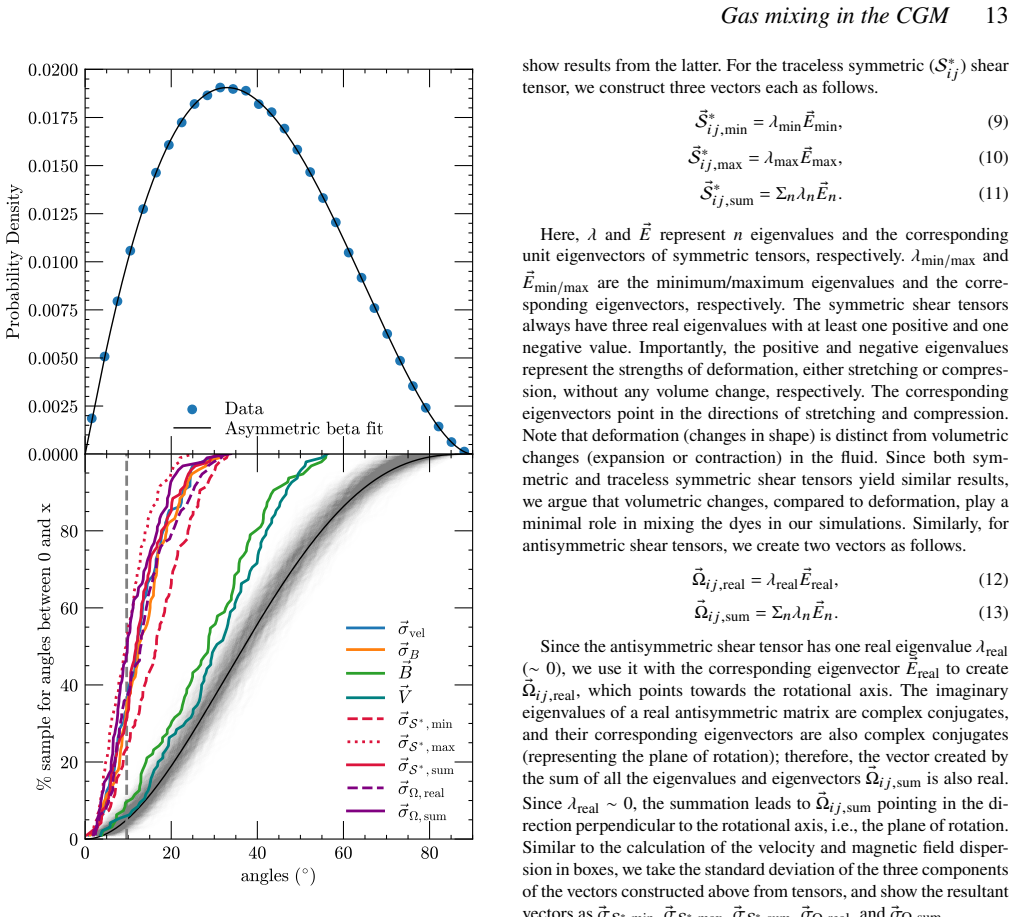
The central objects are the tracer dyes, passive scalars injected into single cells and advected with the flow, and the velocity-gradient decomposition into symmetric (strain), traceless symmetric (pure shear), and antisymmetric (vorticity) tensors derived from the velocity field's partial derivatives. Eigenvectors of the traceless symmetric tensor define stretching/compression directions; the antisymmetric tensor's eigenvector gives the plane of rotation. The paper correlates dye spread magnitude and direction with these tensor statistics and velocity dispersion at multiple box sizes and times, and fits power-law and scaling-constant relations to convert the correlation into diffusion coefficients usable in subgrid models.
What would settle it
A higher-resolution simulation (e.g., ~300 pc or better in the same halo) that reduces numerical diffusion while keeping the same physics: if the Spearman correlations between velocity dispersion/shear and dye spread drop significantly or change ranking compared to the 1 kpc run, the claim that fixed resolution preserves relative mixing rates would be falsified.
Extended reading notes
Core claim
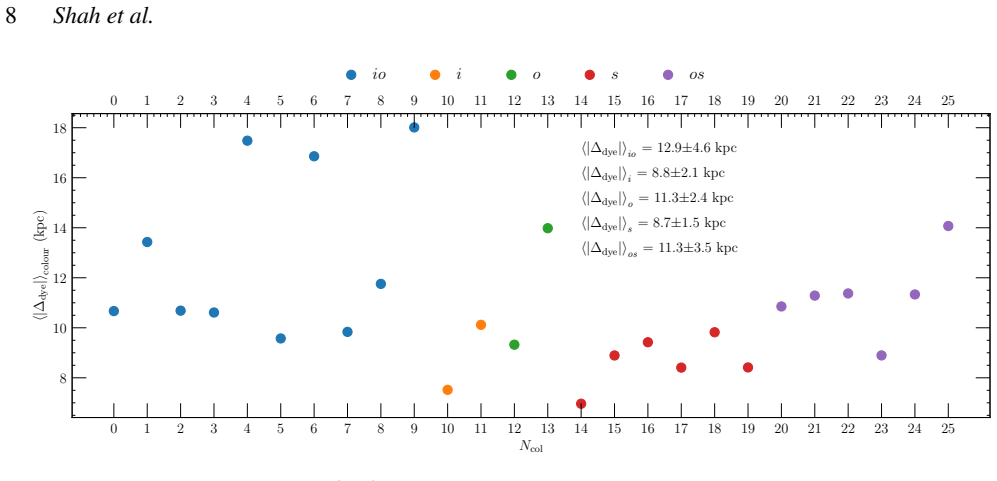
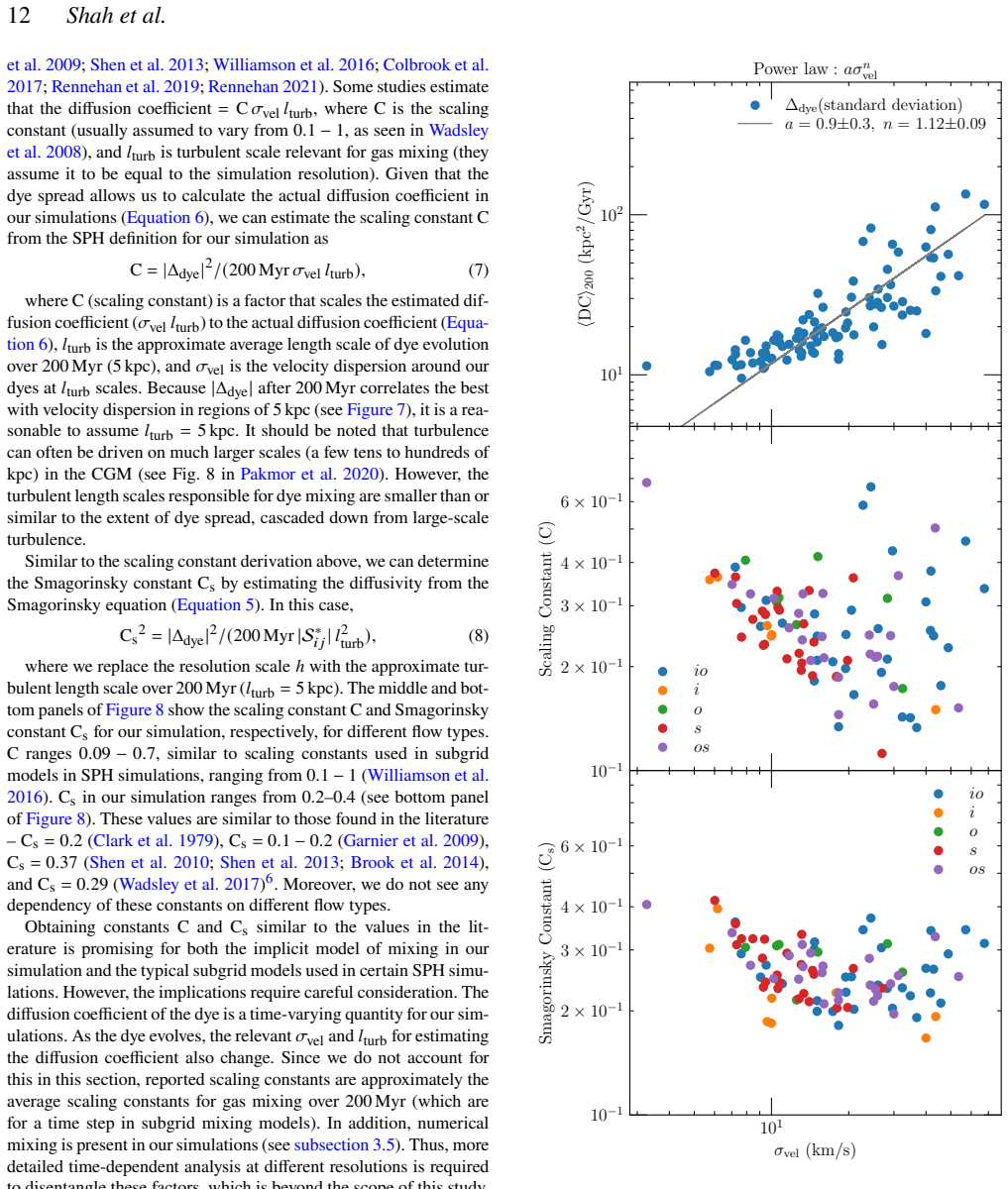
The central claim is that the local velocity structure, specifically the velocity dispersion and the pure-shear (traceless symmetric) part of the velocity gradient tensor, determines both how far and in which direction gas from a point source mixes. Extent after 200 Myr correlates most strongly (Spearman r_s≈0.86–0.87) with velocity dispersion and |S*_ij| in 5 kpc regions around the injection site, with the correlation peaking ~70–120 Myr after injection, implying a delay in the transfer of local shear to mixing. The direction of spread aligns best (≈70% of dyes within 9.6°) with the dispersion of the stretching eigenvector of the traceless symmetric shear tensor and the plane-of-rotation eigenvector of the antisymmetric (vorticity) tensor evaluated in ≥10 kpc boxes. The derived subgrid calibration constants—scaling constant C≈0.1–0.6 and Smagorinsky constant C_s≈0.2–0.4—match values used in SPH subgrid models, and the dye spread grows as t^β with β≈1.06, indicating superdiffusive/hyperballistic mixing over the 200 Myr window.
Load-bearing premise
The load-bearing premise is that the relative ranking of mixing rates across different CGM environments is preserved even though numerical diffusion dominates the total mixing at the 1 kpc resolution used, so a 2 kpc comparison run is treated as sufficient to establish robustness without a higher-resolution run that actually reduces numerical diffusion.
Editorial extensions
If this is right
- Subgrid mixing models in SPH and other codes can calibrate diffusivity using velocity dispersion and |S*_ij|, with C≈0.1–0.6 and C_s≈0.2–0.4, rather than assuming universal constants.
- The diffusion coefficient scales nearly linearly (n≈1.1) with velocity dispersion, implying a dynamic, time-dependent diffusivity rather than a constant.
- Mixing is superdiffusive/hyperballistic over 200 Myr, so constant diffusion coefficients underestimate mixing on CGM timescales.
- The radial decrease in velocity dispersion implies less mixing at larger galactocentric radii, affecting metal and magnetic field distribution in the CGM.
- Resolving outer CGM turbulence requires a few hundred pc resolution (vs current 1 kpc), providing a target for future simulations.
Reading between the lines
- The correlation framework could be tested observationally by comparing CGM metal distribution with velocity dispersion maps inferred from absorption-line kinematics.
- The ~100 Myr delay between shear and maximum correlation suggests that mixing models might need a time-lag or memory term, not just an instantaneous diffusivity.
- If numerical diffusion dominates absolute mixing, the derived constants may be numerical rather than physical; higher-resolution runs could reveal whether C and C_s converge to the same values.
- The same dye method could be applied to ram-pressure stripping or satellite wakes to test whether the same shear statistics predict mixing in other environments.
Editorial analysis
A structured set of objections, weighed in public.
Referee Report
Summary. The paper uses Arepo zoom-in simulations of a Milky Way-mass halo at 1 kpc and 2 kpc resolution, injects passive dye scalars at 95 CGM locations, and correlates the dye spread extent and shape at 200 Myr with local gas properties. It reports that velocity dispersion and traceless symmetric shear magnitude in small regions (≤ 5 kpc) best predict the extent, while the dispersion of stretching and plane-of-rotation eigenvectors in larger regions (≥ 10 kpc) best predicts the shape. It derives diffusion calibration constants C ≈ 0.09–0.7, Cs ≈ 0.2–0.4, a nearly linear power-law exponent n ≈ 1.1 for the diffusion coefficient versus velocity dispersion, and a superdiffusive temporal scaling. The paper acknowledges that numerical diffusion significantly affects the absolute mixing and that the resolution is insufficient to resolve the turbulent cascade, but it claims the correlation results are robust because the spatial resolution is fixed throughout the CGM.
Significance. If the correlation result is trustworthy, the paper provides practical calibration constants for subgrid-scale mixing models in SPH and moving-mesh codes, with C and Cs values consistent with literature ranges. The dye-injection methodology and the explicit treatment of different CGM flow environments are strengths, as is the transparent acknowledgment of numerical diffusion and the Reynolds-number analysis. However, the central quantitative claims—especially the n ≈ 1.1 scaling and the robustness statement—rest on an untested assumption about numerical diffusivity, so the significance is conditional on a stronger resolution or numerical-diffusion test.
major comments (3)
- [Section 3.5, Fig. 12] The claim that fixed spatial resolution makes the correlation results robust is not tested by the 1 kpc versus 2 kpc comparison. Both runs are in the numerically diffusive regime: the paper states that gas mixing at these resolutions is significantly affected by numerical diffusion, and Fig. 12 shows that the dye spread doubles when going from 1 kpc to 2 kpc. In a moving-mesh code, numerical diffusivity is not a function of cell size alone; it depends on local velocity jumps, mesh motion, and concentration gradients, and it can plausibly increase with the same velocity dispersion and shear that the paper identifies as physical predictors. The offered test shows only that the correlations survive when numerical diffusion is stronger; it does not show they survive when numerical diffusion is weaker. A higher-resolution run (for example, a few hundred pc in the outer CGM, which Section 3.6 identifies as the required resolution) or a quantitative estimate of the numerical diffusivity contribution is needed to support the robustness claim.
- [Section 3.2, Eqs. (6)–(8), Fig. 8] The diffusion coefficient is defined from the same dye spread Δ_dye that is used to fit the power law and to compute C and Cs. The paper correctly frames this as calibration rather than prediction, but the fitted exponent n ≈ 1.1 is therefore not an independent test of physical turbulent diffusion; it is a fit to the simulation's effective diffusivity, which includes a dominant numerical component at 1 kpc resolution. Without separating numerical from physical diffusion, the n ≈ 1.1 scaling may describe how numerical diffusivity scales with velocity dispersion rather than how CGM turbulent mixing scales. The statement in Section 4, point (iii), that the exponent is 'robust to changes in resolution' is supported only by the 1 kpc versus 2 kpc comparison, which does not reduce numerical diffusivity.
- [Section 3.5 and Table 4] The superdiffusion/hyperballistic conclusion is based on power-law exponents β = 1.06, 1.16, and 1.63, but the simulations are in a regime where numerical diffusion is significant, and the paper itself lists numerical diffusion as a possible cause of the superdiffusive behaviour. The spread in β across resolutions and injection sizes is large, and the average is skewed by outliers (β > 4 for a few dyes). Without a demonstration that β converges as numerical diffusion is reduced, the abstract's statement that the linear temporal dependence 'suggests superdiffusion in the CGM' is not established. The caution later in the text that the behaviour may not apply to the general CGM is welcome but is in tension with the abstract's unqualified claim.
minor comments (5)
- [Introduction, paragraph 4] The word 'resollution' should be 'resolution' in the sentence about stellar mass and H I column densities changing with resolution.
- [Section 2.2] The phrase 'the the dye both advects and diffuses' contains a duplicated article and should read 'the dye both advects and diffuses'.
- [Section 3.5, first paragraph] The text 'standard + 2kpcsspatial refinement' contains a typo ('kpcss') and should be 'standard + 2 kpc spatial refinement'.
- [Section 3.2, Eq. (6)] The notation Δ_dye is used elsewhere in the paper for the 1st–99th percentile spread, but in Section 3.2 it is redefined as the standard deviation for the diffusion calculation; this change of definition should be flagged more prominently to avoid confusion.
- [Acknowledgements] The acknowledgements thank the referee by name ('our referee, Douglas Rennehan'); this is unconventional in a submitted manuscript and should be removed or anonymized before publication.
Circularity Check
No significant circularity in the central correlation analysis; the diffusion calibration constants are self-referential fits, but the paper transparently treats them as calibration.
-
fitted input called prediction
[Section 3.2, Equations (6)-(8), Figure 8]
"With our tracer dyes, we can calculate the average diffusion coefficient over T (Myr) as ⟨DC⟩T=|Δdye|2/T ... where we substitute T = 200 Myr ... Assuming a power-law dependence of the diffusion coefficient on the velocity dispersion, we determine the power-law exponent to be n≈1.1 ... C=|Δdye|2/(200 Myr σvel lturb) ... Cs2=|Δdye|2/(200 Myr |S∗ij|l2turb)."
Equations (7) and (8) are algebraic rearrangements of Equation (6), using the same measured dye spread |Δdye| after 200 Myr. The derived scaling constants C and Cs, as well as the power-law exponent n, are therefore fits to the same data they are used to parameterize, rather than independent predictions. The agreement with literature values is a consistency check, not an independent validation. This is a minor self-referential calibration step; it does not invalidate the separate correlation analysis, which compares the measured dye spread with independently computed velocity-dispersion and shear statistics.
full rationale
The paper's central claim is an empirical correlation study: tracer dyes are advected in a simulated CGM, and the measured dye-spread magnitude and direction are compared with independently computed velocity dispersion, shear tensors, magnetic fields, and other gas properties. Those predictors are not constructed from the dye spread, so the Spearman correlations in Sections 3.1 and 3.3 are descriptive statistics, not circular derivations. The robustness claim regarding fixed spatial resolution is a numerical-convergence concern rather than a circularity, and the paper explicitly acknowledges that the absolute amount of mixing is not converged and is significantly affected by numerical diffusion. The only self-referential element is in Section 3.2, where the 'actual diffusion coefficient' is defined directly from the measured dye spread and then used to derive the scaling constants C and Cs. This is a calibration procedure, transparently presented as such, and the resulting constants are compared with external literature values (Clark et al. 1979; Garnier et al. 2009; Shen et al. 2010; Wadsley et al. 2017). No load-bearing self-citation chain or imported uniqueness theorem appears. Overall circularity is minor, so the score is set to 2.
Assumptions & free parameters
free parameters (2)
- lturb =
5 kpc
- Power-law amplitude a and exponent n =
a = 0.9 ± 0.3, n = 1.12 ± 0.09
assumptions (5)
- domain assumption The dye is a passive scalar that does not affect gas dynamics.
- domain assumption The arepo moving-mesh code's implicit mixing model represents the relevant subgrid physics.
- ad hoc to paper Fixed spatial resolution preserves the relative ordering of mixing rates across environments.
- domain assumption Velocity dispersion scales as l^0.4-0.6 for the CGM turbulence.
- domain assumption Effective numerical Reynolds number scales as N_grid^(4/3).
Cite this review
Pith. "Pith review of Understanding gas mixing in the circumgalactic medium." pith.science (2026). https://pith.science/paper/VLVH35YQ
@misc{pith2026250521980,
  author       = {Pith},
  title        = {Pith review of: Understanding gas mixing in the circumgalactic medium},
  year         = {2026},
  howpublished = {\url{https://pith.science/paper/VLVH35YQ}},
  note         = {Machine review of arXiv:2505.21980}
}
read the original abstract
We study gas mixing in a simulated Milky Way-mass galaxy's circumgalactic medium (CGM) using cosmological `zoom-in' simulations. We insert tracer dyes in the CGM with different gas flows (shearing, coherent, and static) and diverse physical properties to track gas mixing. We correlate the extent and shape of the dye spread with the local gas properties to understand gas mixing. Velocity dispersion and traceless symmetric shear tensors (pure shear deformation) in small regions (<= 5 kpc) around the dye injection locations best predict the dye spread extent after 200 Myr. We use this to determine diffusion calibration constants for subgrid-scale mixing models. While the dye shape after 200 Myr aligns well with the velocity dispersion and magnetic field dispersion, the best alignment occurs with the dispersion of stretching eigenvectors (traceless symmetric shear tensor) and plane-of-rotation (antisymmetric shear or vorticity tensor) in large regions (10 kpc) around the dye injection locations. Therefore, shear statistics and velocity dispersion best predict the extent and shape of mixed gas. The linear temporal dependence of the dye spread suggests superdiffusion in the CGM, potentially due to turbulent and large-scale coherent flows or numerical diffusion. Despite significant numerical mixing from our 1 kpc resolution (insufficient to resolve Reynolds numbers ~10^2-10^3, which require a few hundred pc resolution), our correlation results are robust thanks to fixed spatial resolution throughout the CGM. These results can be used to predict diffusion coefficients to model magnetic field diffusion, heat transport, and metal mixing.
Figures


Figures from the paper (10 more)





Forward citations
Cited by 2 Pith papers
-
Accurate Extragalactic Magnetic Fields from Faraday Rotation with Optimal Dispersion Measure Estimators
Calibrated on MHD galaxy simulations, an EM-based power-law estimator converts Faraday rotation measures to magnetic field strengths with ~0.1 dex error.
-
The Synthetic Absorption Line Spectral Almanac (SALSA)
A new public library generates millions of mock quasar absorption spectra from cosmological simulations, using a novel mesh-free Voronoi ray-tracing algorithm.
Reference graph
Works this paper leans on
-
[1]
Amaral A. D., Vernstrom T., Gaensler B. M., 2021, @doi [mnras] 10.1093/mnras/stab564 , https://ui.adsabs.harvard.edu/abs/2021MNRAS.tmp..583A
-
[2]
Armillotta L., Fraternali F., Werk J. K., Prochaska J. X., Marinacci F., 2017, @doi [Monthly Notices of the Royal Astronomical Society] 10.1093/mnras/stx1239 , 470, 114–125
-
[3]
Arámburo-García A., Bondarenko K., Boyarsky A., Neronov A., Scaife A., Sokolenko A., 2023, @doi [Monthly Notices of the Royal Astronomical Society] 10.1093/mnras/stac3728 , 519, 4030–4035
-
[4]
G., 2008, Turbulence and Diffusion , @doi 10.1007/978-3-540-68222-6
Bakunin O. G., 2008, Turbulence and Diffusion , @doi 10.1007/978-3-540-68222-6
-
[5]
Banda-Barrag \'a n W. E., Federrath C., Crocker R. M., Bicknell G. V., 2018, @doi [ ] 10.1093/mnras/stx2541 , https://ui.adsabs.harvard.edu/abs/2018MNRAS.473.3454B 473, 3454
-
[8]
C., Fabian A
Begelman M. C., Fabian A. C., 1990, , https://ui.adsabs.harvard.edu/abs/1990MNRAS.244P..26B 244, 26P
1990
-
[9]
Behroozi P. S., Conroy C., Wechsler R. H., 2010, @doi [ ] 10.1088/0004-637X/717/1/379 , https://ui.adsabs.harvard.edu/abs/2010ApJ...717..379B 717, 379
-
[10]
Bernet M. L., Miniati F., Lilly S. J., 2013, @doi [The Astrophysical Journal] 10.1088/2041-8205/772/2/l28 , 772, L28
Show all 138 references
-
[11]
Bigiel F., et al., 2011, @doi [The Astrophysical Journal] 10.1088/2041-8205/730/2/l13 , 730, L13
2011 doi
-
[12]
B\" o ckmann K., et al., 2023, @doi [Astronomy & Astrophysics] 10.1051/0004-6361/202346777 , 678, A56
2023 doi
-
[13]
Bouchaud J.-P., Georges A., 1990, @doi [ ] 10.1016/0370-1573(90)90099-N , https://ui.adsabs.harvard.edu/abs/1990PhR...195..127B 195, 127
1990 doi
-
[14]
Brandenburg A., Subramanian K., 2005, @doi [Physics Reports] 10.1016/j.physrep.2005.06.005 , 417, 1
2005 doi
-
[15]
J., Mohammed A., 2004, @doi [Physics of Fluids] 10.1063/1.1651480 , 16, 1020–1027
Brandenburg A., K\" a pyl\" a P. J., Mohammed A., 2004, @doi [Physics of Fluids] 10.1063/1.1651480 , 16, 1020–1027
2004 doi
-
[16]
B., Stinson G., Gibson B
Brook C. B., Stinson G., Gibson B. K., Shen S., Macci \`o A. V., Obreja A., Wadsley J., Quinn T., 2014, @doi [ ] 10.1093/mnras/stu1406 , https://ui.adsabs.harvard.edu/abs/2014MNRAS.443.3809B 443, 3809
2014 doi
-
[17]
Burnecki K., Kepten E., Garini Y., Sikora G., Weron A., 2015, @doi [Scientific Reports] 10.1038/srep11306 , 5
2015 doi
-
[18]
Clarendon Press
Chandrasekhar S., 1968, Hydrodynamic and hydromagnetic stability. Clarendon Press
1968
-
[19]
R., Davé R., Brooks A., Quinn T., Shen S., 2018, @doi [The Astrophysical Journal] 10.3847/1538-4357/aae374 , 867, 142
Christensen C. R., Davé R., Brooks A., Quinn T., Shen S., 2018, @doi [The Astrophysical Journal] 10.3847/1538-4357/aae374 , 867, 142
2018 doi
-
[20]
A., Ferziger J
Clark R. A., Ferziger J. H., Reynolds W. C., 1979, @doi [Journal of Fluid Mechanics] 10.1017/S002211207900001X , 91, 1–16
1979 doi
-
[21]
J., Ma X., Hopkins P
Colbrook M. J., Ma X., Hopkins P. F., Squire J., 2017, @doi [ ] 10.1093/mnras/stx261 , https://ui.adsabs.harvard.edu/abs/2017MNRAS.467.2421C 467, 2421
2017 doi
-
[22]
A., van de Voort F., 2023, @doi [Annual Review of Astronomy and Astrophysics] 10.1146/annurev-astro-041923-043618 , 61, 473–515
Crain R. A., van de Voort F., 2023, @doi [Annual Review of Astronomy and Astrophysics] 10.1146/annurev-astro-041923-043618 , 61, 473–515
2023 doi
-
[23]
E., 2015, @doi [ ] 10.1016/j.newar.2015.06.001 , https://ui.adsabs.harvard.edu/abs/2015NewAR..68....1D 68, 1
Dale J. E., 2015, @doi [ ] 10.1016/j.newar.2015.06.001 , https://ui.adsabs.harvard.edu/abs/2015NewAR..68....1D 68, 1
2015 doi
-
[24]
K., Gronke M., 2023, @doi [Monthly Notices of the Royal Astronomical Society] 10.1093/mnras/stad3125 , 527, 991–1013
Das H. K., Gronke M., 2023, @doi [Monthly Notices of the Royal Astronomical Society] 10.1093/mnras/stad3125 , 527, 991–1013
2023 doi
-
[25]
Das S., Mathur S., Gupta A., Krongold Y., 2021, @doi [The Astrophysical Journal] 10.3847/1538-4357/ac0e8e , 918, 83
2021 doi
-
[26]
C., MacFadyen A
Duffell P. C., MacFadyen A. I., 2011, @doi [ ] 10.1088/0067-0049/197/2/15 , https://ui.adsabs.harvard.edu/abs/2011ApJS..197...15D 197, 15
2011 doi
-
[27]
Escala I., et al., 2018, @doi [ ] 10.1093/mnras/stx2858 , https://ui.adsabs.harvard.edu/abs/2018MNRAS.474.2194E 474, 2194
2018 doi
-
[28]
P., 2023, Key Physical Processes in the Circumgalactic Medium, @doi 10.48550/ARXIV.2301.10253 , https://arxiv.org/abs/2301.10253
Faucher-Giguere C.-A., Oh S. P., 2023, Key Physical Processes in the Circumgalactic Medium, @doi 10.48550/ARXIV.2301.10253 , https://arxiv.org/abs/2301.10253
-
[29]
P., 2023, @doi [Annual Review of Astronomy and Astrophysics] 10.1146/annurev-astro-052920-125203 , 61, 131–195
Faucher-Giguère C.-A., Oh S. P., 2023, @doi [Annual Review of Astronomy and Astrophysics] 10.1146/annurev-astro-052920-125203 , 61, 131–195
2023 doi
-
[30]
S., 2012, @doi [The Astrophysical Journal] 10.1088/0004-637x/761/2/156 , 761, 156
Federrath C., Klessen R. S., 2012, @doi [The Astrophysical Journal] 10.1088/0004-637x/761/2/156 , 761, 156
2012 doi
-
[31]
S., Schmidt W., Mac Low M., 2010, @doi [ ] 10.1051/0004-6361/200912437 , http://adsabs.harvard.edu/abs/2010A
Federrath C., Roman-Duval J., Klessen R. S., Schmidt W., Mac Low M., 2010, @doi [ ] 10.1051/0004-6361/200912437 , http://adsabs.harvard.edu/abs/2010A
2010 doi
-
[32]
S., Iapichino L., Beattie J
Federrath C., Klessen R. S., Iapichino L., Beattie J. R., 2021, @doi [Nature Astronomy] 10.1038/s41550-020-01282-z , https://ui.adsabs.harvard.edu/abs/2021NatAs...5..365F 5, 365
2021 doi
-
[33]
A., 2017, @doi [ ] 10.1093/mnras/stw3326 , https://ui.adsabs.harvard.edu/abs/2017MNRAS.466.3810F 466, 3810
Fielding D., Quataert E., McCourt M., Thompson T. A., 2017, @doi [ ] 10.1093/mnras/stw3326 , https://ui.adsabs.harvard.edu/abs/2017MNRAS.466.3810F 466, 3810
2017 doi
-
[34]
J., Wakker B
Fox A. J., Wakker B. P., Smoker J. V., Richter P., Savage B. D., Sembach K. R., 2010, @doi [ ] 10.1088/0004-637X/718/2/1046 , https://ui.adsabs.harvard.edu/abs/2010ApJ...718.1046F 718, 1046
2010 doi
-
[35]
Fukugita M., Peebles P. J. E., 2006, @doi [The Astrophysical Journal] 10.1086/499556 , 639, 590–599
2006 doi
-
[36]
J., Peebles P
Fukugita M., Hogan C. J., Peebles P. J. E., 1998, @doi [The Astrophysical Journal] 10.1086/306025 , 503, 518–530
1998 doi
-
[37]
M., Madsen G
Gaensler B. M., Madsen G. J., Chatterjee S., Mao S. A., 2008, @doi [ ] 10.1071/AS08004 , https://ui.adsabs.harvard.edu/abs/2008PASA...25..184G 25, 184
2008 doi
-
[38]
Springer Netherlands, @doi 10.1007/978-90-481-2819-8 , http://dx.doi.org/10.1007/978-90-481-2819-8
Garnier E., Adams N., Sagaut P., 2009, Large Eddy Simulation for Compressible Flows. Springer Netherlands, @doi 10.1007/978-90-481-2819-8 , http://dx.doi.org/10.1007/978-90-481-2819-8
2009 doi
-
[39]
H., 1991, @doi [Physics of Fluids A: Fluid Dynamics] 10.1063/1.857955 , 3, 1760
Germano M., Piomelli U., Moin P., Cabot W. H., 1991, @doi [Physics of Fluids A: Fluid Dynamics] 10.1063/1.857955 , 3, 1760
1991 doi
-
[40]
Grand R. J. J., et al., 2017, @doi [ ] 10.1093/mnras/stx071 , https://ui.adsabs.harvard.edu/abs/2017MNRAS.467..179G 467, 179
2017 doi
-
[41]
Grand R. J. J., et al., 2019, @doi [ ] 10.1093/mnras/stz2928 , https://ui.adsabs.harvard.edu/abs/2019MNRAS.490.4786G 490, 4786
2019 doi
-
[42]
Grand R. J. J., et al., 2021, @doi [ ] 10.1093/mnras/stab2492 , https://ui.adsabs.harvard.edu/abs/2021MNRAS.507.4953G 507, 4953
2021 doi
-
[44]
Gr nnow A., Tepper-Garc \' a T., Bland-Hawthorn J., 2018, @doi [ ] 10.3847/1538-4357/aada0e , https://ui.adsabs.harvard.edu/abs/2018ApJ...865...64G 865, 64
2018 doi
-
[45]
Y., 2022, meshoid: A meshless finite-volume code for hydrodynamics, https://github.com/mikegrudic/meshoid
Grudi \'c M. Y., 2022, meshoid: A meshless finite-volume code for hydrodynamics, https://github.com/mikegrudic/meshoid
2022
-
[46]
Hafen Z., et al., 2020, @doi [Monthly Notices of the Royal Astronomical Society] 10.1093/mnras/staa902 , 494, 3581–3595
2020 doi
-
[47]
R., et al., 2020, @doi [Nature] 10.1038/s41586-020-2649-2 , 585, 357–362
Harris C. R., et al., 2020, @doi [Nature] 10.1038/s41586-020-2649-2 , 585, 357–362
2020 doi
-
[48]
Heavens A., Panter B., Jimenez R., Dunlop J., 2004, @doi [Nature] 10.1038/nature02474 , 428, 625
2004 doi
-
[49]
Heesen V., et al., 2023, @doi [Astronomy & Astrophysics] 10.1051/0004-6361/202346008 , 670, L23
2023 doi
-
[50]
H., Brunt C
Heyer M. H., Brunt C. M., 2004, @doi [The Astrophysical Journal] 10.1086/425978 , 615, L45–L48
2004 doi
-
[51]
F., et al., 2018, @doi [Monthly Notices of the Royal Astronomical Society] 10.1093/mnras/sty1690 , 480, 800–863
Hopkins P. F., et al., 2018, @doi [Monthly Notices of the Royal Astronomical Society] 10.1093/mnras/sty1690 , 480, 800–863
2018 doi
-
[52]
H., 2022, @doi [ ] 10.1093/mnras/stab3363 , https://ui.adsabs.harvard.edu/abs/2022MNRAS.509.6091H 509, 6091
Huang S., Katz N., Cottle J., Scannapieco E., Dav \'e R., Weinberg D. H., 2022, @doi [ ] 10.1093/mnras/stab3363 , https://ui.adsabs.harvard.edu/abs/2022MNRAS.509.6091H 509, 6091
2022 doi
-
[53]
B., et al., 2019, @doi [ ] 10.3847/1538-4357/ab378f , https://ui.adsabs.harvard.edu/abs/2019ApJ...882..156H 882, 156
Hummels C. B., et al., 2019, @doi [ ] 10.3847/1538-4357/ab378f , https://ui.adsabs.harvard.edu/abs/2019ApJ...882..156H 882, 156
2019 doi
-
[54]
D., 2007, @doi [Computing in Science & Engineering] 10.1109/mcse.2007.55 , 9, 90–95
Hunter J. D., 2007, @doi [Computing in Science & Engineering] 10.1109/mcse.2007.55 , 9, 90–95
2007 doi
-
[55]
Ilievski E., De Nardis J., Gopalakrishnan S., Vasseur R., Ware B., 2021, @doi [Phys. Rev. X] 10.1103/PhysRevX.11.031023 , 11, 031023
2021 doi
-
[56]
S., Sijacki D., Dubois Y., 2023, @doi [ ] 10.1093/mnras/stac3426 , https://ui.adsabs.harvard.edu/abs/2023MNRAS.518.5215J 518, 5215
Jennings F., Beckmann R. S., Sijacki D., Dubois Y., 2023, @doi [ ] 10.1093/mnras/stac3426 , https://ui.adsabs.harvard.edu/abs/2023MNRAS.518.5215J 518, 5215
2023 doi
-
[57]
P., Masterson P., 2019, @doi [Monthly Notices of the Royal Astronomical Society] 10.1093/mnras/stz1248 , 487, 737
Ji S., Oh S. P., Masterson P., 2019, @doi [Monthly Notices of the Royal Astronomical Society] 10.1093/mnras/stz1248 , 487, 737
2019 doi
-
[58]
G., Churchill C
Kacprzak G. G., Churchill C. W., 2011, @doi [The Astrophysical Journal] 10.1088/2041-8205/743/2/l34 , 743, L34
2011 doi
-
[59]
A., Wang H., Pope S
Kemenov K. A., Wang H., Pope S. B., 2011, @doi [Flow, Turbulence and Combustion] 10.1007/s10494-011-9380-x , 88, 529–561
2011 doi
-
[60]
C., Evans N
Kennicutt R. C., Evans N. J., 2012, @doi [Annual Review of Astronomy and Astrophysics] 10.1146/annurev-astro-081811-125610 , 50, 531
2012 doi
-
[61]
S., Lin D
Klessen R. S., Lin D. N. C., 2003, @doi [Phys. Rev. E] 10.1103/PhysRevE.67.046311 , 67, 046311
2003 doi
-
[62]
R., Seta A., Federrath C., 2022, @doi [ ] 10.1093/mnras/stac969 , https://ui.adsabs.harvard.edu/abs/2022MNRAS.513.2457K 513, 2457
Kriel N., Beattie J. R., Seta A., Federrath C., 2022, @doi [ ] 10.1093/mnras/stac969 , https://ui.adsabs.harvard.edu/abs/2022MNRAS.513.2457K 513, 2457
2022 doi
-
[63]
G., Norman M
Kritsuk A. G., Norman M. L., Padoan P., Wagner R., 2007, @doi [ ] 10.1086/519443 , https://ui.adsabs.harvard.edu/abs/2007ApJ...665..416K 665, 416
2007 doi
-
[64]
B., Shelton R
Kwak K., Henley D. B., Shelton R. L., 2011, @doi [ ] 10.1088/0004-637X/739/1/30 , https://ui.adsabs.harvard.edu/abs/2011ApJ...739...30K 739, 30
2011 doi
-
[65]
X., 2020, @doi [mnras] 10.1093/mnras/staa1750 , https://ui.adsabs.harvard.edu/abs/2020MNRAS.496.3142L 496, 3142
Lan T.-W., Prochaska J. X., 2020, @doi [mnras] 10.1093/mnras/staa1750 , https://ui.adsabs.harvard.edu/abs/2020MNRAS.496.3142L 496, 3142
2020 doi
-
[66]
Landau L., Lifshitz E., 2013, Fluid Mechanics: Volume 6. No. v. 6, Pergamon, https://books.google.com.au/books?id=CeBbAwAAQBAJ
2013
-
[67]
B., 1981, @doi [ ] 10.1093/mnras/194.4.809 , https://ui.adsabs.harvard.edu/abs/1981MNRAS.194..809L 194, 809
Larson R. B., 1981, @doi [ ] 10.1093/mnras/194.4.809 , https://ui.adsabs.harvard.edu/abs/1981MNRAS.194..809L 194, 809
1981 doi
-
[68]
18, Turbulent Diffusion in Environmental Pollution
Leonard A., 1975, in Frenkiel F., Munn R., eds, Advances in Geophysics, Vol. 18, Turbulent Diffusion in Environmental Pollution. Elsevier, pp 237--248, @doi https://doi.org/10.1016/S0065-2687(08)60464-1 , https://www.sciencedirect.com/science/article/pii/S0065268708604641
1975 doi
-
[69]
Lesieur M., Metais O., 1996, @doi [Annual Review of Fluid Mechanics] https://doi.org/10.1146/annurev.fl.28.010196.000401 , 28, 45
1996
-
[70]
Locatelli N., et al., 2024, @doi [Astronomy & Astrophysics] 10.1051/0004-6361/202347061 , 681, A78
2024 doi
-
[71]
Marinacci F., Vogelsberger M., Mocz P., Pakmor R., 2015, @doi [Monthly Notices of the Royal Astronomical Society] 10.1093/mnras/stv1692 , 453, 4000–4020
2015 doi
-
[72]
Mastropietro C., Moore B., Mayer L., Wadsley J., Stadel J., 2005, @doi [ ] 10.1111/j.1365-2966.2005.09435.x , https://ui.adsabs.harvard.edu/abs/2005MNRAS.363..509M 363, 509
2005
-
[73]
J., 2012, @doi [ ] 10.1111/j.1365-2966.2011.19972.x , https://ui.adsabs.harvard.edu/abs/2012MNRAS.419.3319M 419, 3319
McCourt M., Sharma P., Quataert E., Parrish I. J., 2012, @doi [ ] 10.1111/j.1365-2966.2011.19972.x , https://ui.adsabs.harvard.edu/abs/2012MNRAS.419.3319M 419, 3319
2012
-
[74]
S., Schombert J
McGaugh S. S., Schombert J. M., de Blok W. J. G., Zagursky M. J., 2009, @doi [The Astrophysical Journal] 10.1088/2041-8205/708/1/l14 , 708, L14–L17
2009 doi
-
[75]
Meneveau C., Katz J., 2000, @doi [Annual Review of Fluid Mechanics] https://doi.org/10.1146/annurev.fluid.32.1.1 , 32, 1
2000 doi
-
[76]
S., Brandenburg A., Zweibel E
Miesch M. S., Brandenburg A., Zweibel E. G., 2000, @doi [Physical Review E] 10.1103/physreve.61.457 , 61, 457–467
2000 doi
-
[77]
J., Bregman J
Miller M. J., Bregman J. N., 2015, @doi [ ] 10.1088/0004-637X/800/1/14 , https://ui.adsabs.harvard.edu/abs/2015ApJ...800...14M 800, 14
2015 doi
-
[78]
D., Schaye J., Bower R
Mitchell P. D., Schaye J., Bower R. G., Crain R. A., 2020, @doi [Monthly Notices of the Royal Astronomical Society] 10.1093/mnras/staa938 , 494, 3971–3997
2020 doi
-
[79]
Mohapatra R., Jetti M., Sharma P., Federrath C., 2021a, @doi [Monthly Notices of the Royal Astronomical Society] 10.1093/mnras/stab3429 , 510, 2327–2343
-
[80]
Mohapatra R., Jetti M., Sharma P., Federrath C., 2021b, @doi [Monthly Notices of the Royal Astronomical Society] 10.1093/mnras/stab3603 , 510, 3778–3793
-
[81]
Murante G., Monaco P., Borgani S., Tornatore L., Dolag K., Goz D., 2014, @doi [Monthly Notices of the Royal Astronomical Society] 10.1093/mnras/stu2400 , 447, 178–201
2014 doi
-
[82]
L., et al., 2017, @doi [Monthly Notices of the Royal Astronomical Society] 10.1093/mnras/stx667 , 468, 4170–4188
Muratov A. L., et al., 2017, @doi [Monthly Notices of the Royal Astronomical Society] 10.1093/mnras/stx667 , 468, 4170–4188
2017 doi
-
[83]
E., Ji A
Nugent A. E., Ji A. P., Fong W.-f., Shah H., van de Voort F., 2025, @doi [The Astrophysical Journal] 10.3847/1538-4357/adbb6a , 982, 144
2025 doi
-
[85]
J., Ohlmann S
Pakmor R., Springel V., Bauer A., Mocz P., Munoz D. J., Ohlmann S. T., Schaal K., Zhu C., 2015, @doi [Monthly Notices of the Royal Astronomical Society] 10.1093/mnras/stv2380 , 455, 1134
2015 doi
-
[86]
Pakmor R., et al., 2017, @doi [Monthly Notices of the Royal Astronomical Society] 10.1093/mnras/stx1074 , 469, 3185–3199
2017 doi
-
[87]
Pakmor R., et al., 2020, @doi [Monthly Notices of the Royal Astronomical Society] 10.1093/mnras/staa2530 , 498, 3125–3137
2020 doi
-
[88]
Pan L., Scannapieco E., Scalo J., 2012, @doi [Journal of Fluid Mechanics] 10.1017/jfm.2012.143 , https://ui.adsabs.harvard.edu/abs/2012JFM...700..459P 700, 459
2012 doi
-
[89]
S., Werk J
Peeples M. S., Werk J. K., Tumlinson J., Oppenheimer B. D., Prochaska J. X., Katz N., Weinberg D. H., 2014, @doi [The Astrophysical Journal] 10.1088/0004-637x/786/1/54 , 786, 54
2014 doi
-
[90]
S., et al., 2019, @doi [ ] 10.3847/1538-4357/ab0654 , https://ui.adsabs.harvard.edu/abs/2019ApJ...873..129P 873, 129
Peeples M. S., et al., 2019, @doi [ ] 10.3847/1538-4357/ab0654 , https://ui.adsabs.harvard.edu/abs/2019ApJ...873..129P 873, 129
2019 doi
-
[91]
Piomelli U., Liu J., 1995, @doi [Physics of Fluids] 10.1063/1.868607 , https://ui.adsabs.harvard.edu/abs/1995PhFl....7..839P 7, 839
1995 doi
-
[92]
Planck Collaboration et al., 2014, @doi [ ] 10.1051/0004-6361/201321591 , https://ui.adsabs.harvard.edu/abs/2014A&A...571A..16P 571, A16
2014 doi
-
[93]
Prandtl L., 1925, @doi [ZAMM - Journal of Applied Mathematics and Mechanics / Zeitschrift für Angewandte Mathematik und Mechanik] https://doi.org/10.1002/zamm.19250050212 , 5, 136
1925 doi
-
[94]
E., 2017, in , Gas Accretion onto Galaxies
Putman M. E., 2017, in , Gas Accretion onto Galaxies. Springer International Publishing, pp 1--13, @doi 10.1007/978-3-319-52512-9_1 , https://doi.org/10.1007/978-3-319-52512-9_1
2017 doi
-
[95]
Ramesh R., Nelson D., Heesen V., Br\" u ggen M., 2023, @doi [Monthly Notices of the Royal Astronomical Society] 10.1093/mnras/stad3104 , 526, 5483–5493
2023 doi
-
[96]
Rennehan D., 2021, @doi [Monthly Notices of the Royal Astronomical Society] 10.1093/mnras/stab1813 , 506, 2836–2852
2021 doi
-
[97]
F., Dav \'e R., Moa B., 2019, @doi [ ] 10.1093/mnras/sty3376 , https://ui.adsabs.harvard.edu/abs/2019MNRAS.483.3810R 483, 3810
Rennehan D., Babul A., Hopkins P. F., Dav \'e R., Moa B., 2019, @doi [ ] 10.1093/mnras/sty3376 , https://ui.adsabs.harvard.edu/abs/2019MNRAS.483.3810R 483, 3810
2019 doi
-
[98]
(A.)] 10.1098/rsta.1895.0004 , 186, 123
Reynolds O., 1895, @doi [Philosophical Transactions of the Royal Society of London. (A.)] 10.1098/rsta.1895.0004 , 186, 123
-
[99]
S., Moin P., 1984, @doi [Annual Review of Fluid Mechanics] 10.1146/annurev.fl.16.010184.000531 , https://ui.adsabs.harvard.edu/abs/1984AnRFM..16...99R 16, 99
Rogallo R. S., Moin P., 1984, @doi [Annual Review of Fluid Mechanics] 10.1146/annurev.fl.16.010184.000531 , https://ui.adsabs.harvard.edu/abs/1984AnRFM..16...99R 16, 99
1984
-
[100]
B., Faucher-Gigu \`e re C.-A., 2024, @doi [ ] 10.1093/mnras/stad3142 , https://ui.adsabs.harvard.edu/abs/2024MNRAS.527..265R 527, 265
Roy M., Su K.-Y., Tonnesen S., Fielding D. B., Faucher-Gigu \`e re C.-A., 2024, @doi [ ] 10.1093/mnras/stad3142 , https://ui.adsabs.harvard.edu/abs/2024MNRAS.527..265R 527, 265
2024 doi
-
[101]
Saeedzadeh V., et al., 2023, @doi [ ] 10.1093/mnras/stad2637 , https://ui.adsabs.harvard.edu/abs/2023MNRAS.525.5677S 525, 5677
2023 doi
-
[102]
Springer-Verlag, @doi 10.1007/b137536 , http://dx.doi.org/10.1007/b137536
Sagaut P., 2006, Large Eddy Simulation for Incompressible Flows . Springer-Verlag, @doi 10.1007/b137536 , http://dx.doi.org/10.1007/b137536
2006 doi
-
[103]
Scannapieco E., Br \"u ggen M., 2015, @doi [ ] 10.1088/0004-637X/805/2/158 , https://ui.adsabs.harvard.edu/abs/2015ApJ...805..158S 805, 158
2015 doi
-
[104]
Schmidt W., 2015, @doi [Living Reviews in Computational Astrophysics] 10.1007/lrca-2015-2 , 1
2015 doi
-
[105]
G., 2007, @doi [Comptes Rendus
Schmitt F. G., 2007, @doi [Comptes Rendus. M\'ecanique] 10.1016/j.crme.2007.08.004 , 335, 617
2007 doi
-
[106]
E., Robertson B
Schneider E. E., Robertson B. E., 2017, @doi [ ] 10.3847/1538-4357/834/2/144 , https://ui.adsabs.harvard.edu/abs/2017ApJ...834..144S 834, 144
2017 doi
-
[107]
E., Ostriker E
Schneider E. E., Ostriker E. C., Robertson B. E., Thompson T. A., 2020, @doi [ ] 10.3847/1538-4357/ab8ae8 , https://ui.adsabs.harvard.edu/abs/2020ApJ...895...43S 895, 43
2020 doi
-
[108]
Seta A., Federrath C., 2020, @doi [ ] 10.1093/mnras/staa2978 , https://ui.adsabs.harvard.edu/abs/2020MNRAS.499.2076S 499, 2076
2020 doi
-
[109]
Seta A., Federrath C., 2021, @doi [Physical Review Fluids] 10.1103/PhysRevFluids.6.103701 , https://ui.adsabs.harvard.edu/abs/2021PhRvF...6j3701S 6, 103701
2021 doi
-
[110]
Seta A., Federrath C., 2022, @doi [ ] 10.1093/mnras/stac1400 , https://ui.adsabs.harvard.edu/abs/2022MNRAS.514..957S 514, 957
2022 doi
-
[111]
Shah H., Seta A., 2021, @doi [Monthly Notices of the Royal Astronomical Society] 10.1093/mnras/stab2500 , 508, 1371
2021 doi
-
[112]
Shen S., Wadsley J., Stinson G., 2010, @doi [ ] 10.1111/j.1365-2966.2010.17047.x , https://ui.adsabs.harvard.edu/abs/2010MNRAS.407.1581S 407, 1581
2010
-
[113]
Shen S., Madau P., Aguirre A., Guedes J., Mayer L., Wadsley J., 2012, @doi [ ] 10.1088/0004-637X/760/1/50 , https://ui.adsabs.harvard.edu/abs/2012ApJ...760...50S 760, 50
2012 doi
-
[114]
X., Wadsley J., 2013, @doi [The Astrophysical Journal] 10.1088/0004-637X/765/2/89 , 765, 89
Shen S., Madau P., Guedes J., Mayer L., Prochaska J. X., Wadsley J., 2013, @doi [The Astrophysical Journal] 10.1088/0004-637X/765/2/89 , 765, 89
2013 doi
-
[115]
M., Federrath C., 2025, @doi [Monthly Notices of the Royal Astronomical Society] 10.1093/mnras/staf160 , 537, 2961
Shivakumar L. M., Federrath C., 2025, @doi [Monthly Notices of the Royal Astronomical Society] 10.1093/mnras/staf160 , 537, 2961
2025 doi
-
[116]
M., Jones J
Shull J. M., Jones J. R., Danforth C. W., Collins J. A., 2009, @doi [ ] 10.1088/0004-637X/699/1/754 , https://ui.adsabs.harvard.edu/abs/2009ApJ...699..754S 699, 754
2009 doi
-
[118]
Smagorinsky J., 1963, @doi [Monthly Weather Review] 10.1175/1520-0493(1963)091<0099:GCEWTP>2.3.CO;2 , 91, 99
1963 doi
-
[119]
Soko owska A., Babul A., Mayer L., Shen S., Madau P., 2018, @doi [ ] 10.3847/1538-4357/aae43a , https://ui.adsabs.harvard.edu/abs/2018ApJ...867...73S 867, 73
2018 doi
-
[120]
Sparre M., Pfrommer C., Vogelsberger M., 2018, @doi [Monthly Notices of the Royal Astronomical Society] 10.1093/mnras/sty3063 , 482, 5401
2018 doi
-
[121]
Spitzer Lyman J., 1956, @doi [ ] 10.1086/146200 , https://ui.adsabs.harvard.edu/abs/1956ApJ...124...20S 124, 20
1956 doi
-
[122]
Springel V., 2010, @doi [ ] 10.1111/j.1365-2966.2009.15715.x , https://ui.adsabs.harvard.edu/abs/2010MNRAS.401..791S 401, 791
2010
-
[123]
C., Erb D
Steidel C. C., Erb D. K., Shapley A. E., Pettini M., Reddy N., Bogosavljevi \'c M., Rudie G. C., Rakic O., 2010, @doi [ ] 10.1088/0004-637X/717/1/289 , https://ui.adsabs.harvard.edu/abs/2010ApJ...717..289S 717, 289
2010 doi
-
[124]
Stern J., Fielding D., Faucher-Giguère C.-A., Quataert E., 2019, @doi [Monthly Notices of the Royal Astronomical Society] 10.1093/mnras/stz1859 , 488, 2549–2572
2019 doi
-
[125]
S., et al., 2012, @doi [Monthly Notices of the Royal Astronomical Society] 10.1111/j.1365-2966.2012.21522.x , 425, 1270–1277
Stinson G. S., et al., 2012, @doi [Monthly Notices of the Royal Astronomical Society] 10.1111/j.1365-2966.2012.21522.x , 425, 1270–1277
2012
-
[126]
L., Gulian M., Zayernouri M., D’Elia M., 2022, @doi [Journal of Peridynamics and Nonlocal Modeling] 10.1007/s42102-022-00085-2 , 5, 392–459
Suzuki J. L., Gulian M., Zayernouri M., D’Elia M., 2022, @doi [Journal of Peridynamics and Nonlocal Modeling] 10.1007/s42102-022-00085-2 , 5, 392–459
2022 doi
-
[127]
A., Quataert E., Zhang D., Weinberg D
Thompson T. A., Quataert E., Zhang D., Weinberg D. H., 2015, @doi [Monthly Notices of the Royal Astronomical Society] 10.1093/mnras/stv2428 , 455, 1830–1844
2015 doi
-
[128]
R., Pontzen A., Anderson L., Bellovary J., 2017, @doi [ ] 10.1093/mnras/stx1160 , https://ui.adsabs.harvard.edu/abs/2017MNRAS.470.1121T 470, 1121
Tremmel M., Karcher M., Governato F., Volonteri M., Quinn T. R., Pontzen A., Anderson L., Bellovary J., 2017, @doi [ ] 10.1093/mnras/stx1160 , https://ui.adsabs.harvard.edu/abs/2017MNRAS.470.1121T 470, 1121
2017 doi
-
[129]
A., et al., 2004, @doi [The Astrophysical Journal] 10.1086/423264 , 613, 898
Tremonti C. A., et al., 2004, @doi [The Astrophysical Journal] 10.1086/423264 , 613, 898
2004 doi
-
[130]
Tumlinson J., et al., 2011, @doi [ ] 10.1088/0004-637X/733/2/111 , https://ui.adsabs.harvard.edu/abs/2011ApJ...733..111T 733, 111
2011 doi
-
[131]
S., Werk J
Tumlinson J., Peeples M. S., Werk J. K., 2017, @doi [ ] 10.1146/annurev-astro-091916-055240 , https://ui.adsabs.harvard.edu/abs/2017ARA&A..55..389T 55, 389
2017 doi
-
[132]
Valdarnini R., 2011, @doi [Astronomy & Astrophysics] 10.1051/0004-6361/201015340 , 526, A158
2011 doi
-
[133]
Virtanen P., et al., 2020, @doi [Nature Methods] 10.1038/s41592-019-0686-2 , 17, 261–272
2020 doi
-
[134]
W., Veeravalli G., Couchman H
Wadsley J. W., Veeravalli G., Couchman H. M. P., 2008, @doi [ ] 10.1111/j.1365-2966.2008.13260.x , https://ui.adsabs.harvard.edu/abs/2008MNRAS.387..427W 387, 427
2008
-
[135]
W., Keller B
Wadsley J. W., Keller B. W., Quinn T. R., 2017, @doi [ ] 10.1093/mnras/stx1643 , https://ui.adsabs.harvard.edu/abs/2017MNRAS.471.2357W 471, 2357
2017 doi
-
[136]
P., van Woerden H., 1997, @doi [ ] 10.1146/annurev.astro.35.1.217 , https://ui.adsabs.harvard.edu/abs/1997ARA&A..35..217W 35, 217
Wakker B. P., van Woerden H., 1997, @doi [ ] 10.1146/annurev.astro.35.1.217 , https://ui.adsabs.harvard.edu/abs/1997ARA&A..35..217W 35, 217
1997 doi
-
[137]
P., et al., 2007, @doi [ ] 10.1086/524222 , https://ui.adsabs.harvard.edu/abs/2007ApJ...670L.113W 670, L113
Wakker B. P., et al., 2007, @doi [ ] 10.1086/524222 , https://ui.adsabs.harvard.edu/abs/2007ApJ...670L.113W 670, L113
2007 doi
-
[138]
Weinberger R., Springel V., Pakmor R., 2020, @doi [ ] 10.3847/1538-4365/ab908c , https://ui.adsabs.harvard.edu/abs/2020ApJS..248...32W 248, 32
2020 doi
-
[139]
K., et al., 2014, @doi [ ] 10.1088/0004-637X/792/1/8 , https://ui.adsabs.harvard.edu/abs/2014ApJ...792....8W 792, 8
Werk J. K., et al., 2014, @doi [ ] 10.1088/0004-637X/792/1/8 , https://ui.adsabs.harvard.edu/abs/2014ApJ...792....8W 792, 8
2014 doi
-
[140]
Williamson D., Martel H., Kawata D., 2016, @doi [The Astrophysical Journal] 10.3847/0004-637x/822/2/91 , 822, 91
2016 doi
-
[141]
C., Pakmor R., 2019, @doi [ ] 10.1093/mnrasl/sly190 , https://ui.adsabs.harvard.edu/abs/2019MNRAS.482L..85V 482, L85
van de Voort F., Springel V., Mandelker N., van den Bosch F. C., Pakmor R., 2019, @doi [ ] 10.1093/mnrasl/sly190 , https://ui.adsabs.harvard.edu/abs/2019MNRAS.482L..85V 482, L85
2019 doi
-
[142]
van de Voort F., Pakmor R., Grand R. J. J., Springel V., G \'o mez F. A., Marinacci F., 2020, @doi [ ] 10.1093/mnras/staa754 , https://ui.adsabs.harvard.edu/abs/2020MNRAS.494.4867V 494, 4867
2020 doi
-
[143]
A., Grand R
van de Voort F., Bieri R., Pakmor R., Gómez F. A., Grand R. J. J., Marinacci F., 2021, @doi [Monthly Notices of the Royal Astronomical Society] 10.1093/mnras/staa3938 , 501, 4888
2021 doi
Reviewed August 7, 2026 · model on record in the stance chip above.
Discussion (0). Sign in to comment.