REVIEW 4 major objections 6 minor 20 references
Align-DA: Align Score-based Atmospheric Data Assimilation with Multiple Preferences
T0 review · 4 major / 6 minor · reviewed 2026-08-07 · deepseek-v4-flash
Pith's one-line read Align-DA claims that reward-guided preference alignment of a diffusion prior consistently reduces analysis and forecast error in score-based atmospheric data assimilation, replacing manual prior tuning.
desk verdict Multi-preference DPO on a latent diffusion prior gives consistent but small DA gains; the missing regression-to-ERA5 baseline leaves the core claim under-supported. read the letter →
The pith
A machine-rendered reading of the paper's core claim, the machinery that carries it, and where it could break.
The reading
What carries the argument
The engine is the Diffusion-DPO objective, a stepwise form of direct preference optimization that bypasses training a separate reward model. Its implementable loss is $\mathcal{L}(\theta)=-\mathbb{E}\log\sigma(-\beta T\,\omega(\lambda_t)(\Delta_\theta(x_t^w,\epsilon^w)-\Delta_\theta(x_t^l,\epsilon^l)))$, with $\Delta_\theta(x_t,\epsilon)=\|\epsilon-\epsilon_\theta(x_t,t)\|_2^2-\|\epsilon-\epsilon_{\mathrm{ref}}(x_t,t)\|_2^2$ measuring how far the aligned noise predictor has moved from the reference. This loss is applied to preference pairs drawn from the reference model's own outputs: 32 candidate analyses per background are decoded and ranked by the three rewards, top performers are paired with bottom performers, and a KL-regularization coefficient $\beta=8000$ keeps the aligned prior close to the reference prior.
What would settle it
Rank the preference pairs using observations that were not derived from ERA5, for example unfiltered GDAS prepbufr observations rather than the 0.1-standard-error-filtered subset, and compare Align-DPS-M against the unaligned DPS baseline. If the reported analysis and forecast gains disappear or reverse, the claim that multi-reward alignment transfers beyond the training truth would be refuted.
Extended reading notes
Core claim
The paper claims that the distribution a score-based data assimilation system places on analyses can be reshaped by preference alignment, and that this reshaping is what produces better analyses and forecasts. Writing the posterior score in latent space as $\nabla_{z_t}\log p(z_t|z_b,y)\approx s_\theta(z_t,z_b)+\nabla_{z_t}\log p(y|z_t)$, it trains $s_\theta$ on the background-conditioned prior and then applies Diffusion-DPO to the noise-prediction network, using pairwise preferences built from three rewards: assimilation accuracy against ERA5, 48-hour forecast skill, and a geostrophic-balance score. The result is a prior that assigns higher probability to analyses scoring well on those rewards, yielding consistent error reductions in both the analyses themselves and the forecasts initialized from them across all three guidance schemes tested.
Load-bearing premise
The entire alignment gain rests on the pre-trained reference model sometimes producing candidate analyses that score highly on the rewards; if the reference prior rarely generates high-reward candidates, the preference pairs contain no useful signal and direct preference optimization cannot recover the claimed improvements.
Editorial extensions
If this is right
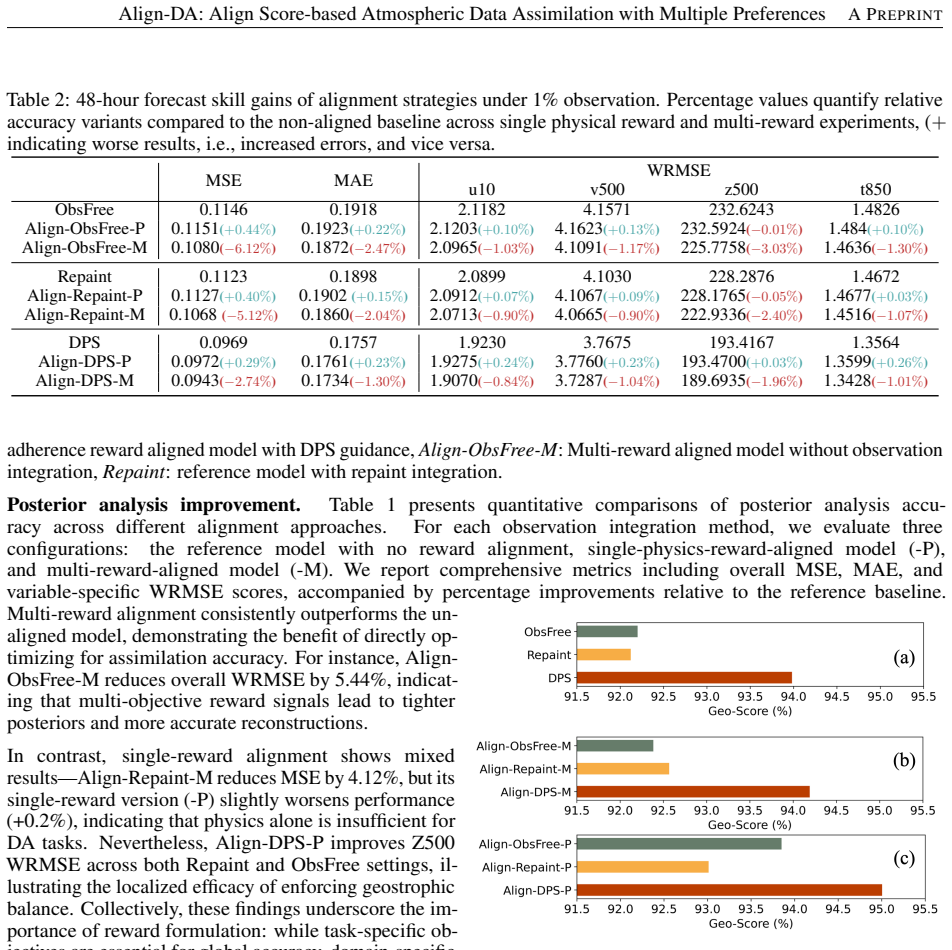
- Multi-reward alignment improves both the analysis and the 48-hour forecast initialized from it: for example, Align-Repaint-M lowers analysis MSE by 4.12 percent and forecast MSE by 5.12 percent relative to the unaligned Repaint baseline.
- Reward composition controls the trade-off: aligning only on geostrophic balance raises the Geo-Score from 93.85 to 95.00 but leaves overall accuracy roughly unchanged or slightly worse, while multi-reward alignment improves all metrics.
- The alignment gain shrinks as observation constraints tighten, so the largest improvements appear in the observation-free setting and diminish through Repaint to DPS.
- Multi-reward alignment remains beneficial as observation density rises from 1 percent to 10 percent and as observation error increases up to standard deviation 0.05, and it transfers to GDAS real observations after the paper's filtering step.
Reading between the lines
- The paper leaves implicit that any physical principle expressible as a differentiable score, not just geostrophic balance, could enter a learned DA prior this way, making preference alignment a generic soft-constraint mechanism for data assimilation.
- Because the preference pairs are ranked against ERA5, the aligned prior may inherit a bias toward that reanalysis; ranking candidates against independent observations would reveal whether the demonstrated gains survive outside the training-truth paradigm.
- The offline coverage sensitivity implies a design rule: alignment will help most when the reference model is sampled with high diversity, and online reinforcement learning could push the prior further once the reference's high-reward modes are exhausted.
- A testable extension is to make the forecast-skill reward differentiable by backpropagating through a differentiable forecast model, which could amplify the forecast gains beyond the frozen forecast model used in the paper.
Editorial analysis
A structured set of objections, weighed in public.
Referee Report
Summary. The paper proposes Align-DA, a framework that applies direct preference optimization (DPO) to a latent score-based diffusion model used for atmospheric data assimilation. The diffusion prior is first trained to model p(z|z_b), and then fine-tuned with Diffusion-DPO on preference pairs constructed from samples of the reference model. Three reward signals are defined: assimilation accuracy (WRMSE against ERA5), 48-hour forecast skill (FengWu forecast error against ERA5), and physical adherence (geostrophic balance score relative to ERA5). The aligned model is evaluated with three observation-guidance methods (ObsFree, Repaint, DPS) on the held-out year 2019, reporting analysis and forecast improvements for the multi-reward variant, mixed results for the physics-only variant, and additional ablations on observation density, observation error, and GDAS real observations. The central claim is that multi-reward preference alignment provides a viable soft-constraint mechanism for embedding domain knowledge into learned DA priors.
Significance. If the central claim holds, this is a useful contribution: it is, to my knowledge, the first application of multi-reward diffusion DPO to atmospheric data assimilation, and it evaluates the approach across three observation-guidance strategies, multiple observation densities, and an observation-error robustness check. The experimental design has real strengths: the rewards are external benchmarks, evaluation is on a held-out year (2019) separate from the preference-data year (2018), and the multi-reward variant shows consistent percentage improvements in Tables 1 and 2. However, the paper does not yet establish that the improvements come from preference alignment rather than from plain regression toward ERA5-like samples, and it lacks uncertainty quantification. Appendix D's acknowledgment of offline-RL coverage sensitivity is honest but does not address the missing control. With a proper regression baseline and statistical error bars, the contribution would be solid; as it stands, the central mechanism is plausible but not demonstrated.
major comments (4)
- [Section 4.2, Eqs. (15)-(17); Tables 1-2] The three rewards are all monotone functions of distance to ERA5: R_assim is WRMSE against ERA5, R_forecast is FengWu forecast error against ERA5, and R_phys in Eq. (17) is a sigmoid of |D_i - D_GT|/D_GT where D_GT is derived from ERA5. The preference pairs therefore label samples closer to ERA5 as winners, and Eq. (14) increases the likelihood of those winners. The paper does not include the natural control: fine-tuning the same reference diffusion model on the winning samples using the standard denoising loss, i.e., plain supervised regression toward the ERA5-like subset. Without this baseline, the 2-8% analysis and 2-6% forecast improvements in Tables 1 and 2 cannot be attributed to the pairwise preference ranking; they may be a trivial consequence of supervised fine-tuning toward the reward-maximizing samples. The -P ablation reinforces this concern because R_phys is also ERA5-relative, so the failure of single-reward alignment shows the gains are not a general property of the DPO mechanism but depend on which ERA5-closeness component is optimized.
- [Section 4.3, Tables 1-3] All reported metrics are single annual-mean point estimates over 2019, with no error bars, confidence intervals, or significance tests. Several multi-reward improvements are small (e.g., t850 WRMSE improvements of 0.20-0.53% in Table 1 and 1.01-1.30% forecast gains in Table 2), and no standard deviations across the 6-hourly cycles or across diffusion sampling seeds are reported. Without uncertainty quantification, the claim of consistent gains across guidance methods and densities is not fully supported. Please provide bootstrap or ensemble estimates to rule out sampling noise.
- [Appendix C, Table 5] The GDAS real-data experiment removes all observations whose deviation from ERA5 exceeds 0.1 standard error before assimilation. This filtering deletes exactly the observations that would test transfer to an operational observation network and biases the comparison toward the ERA5-as-truth setup used in the synthetic experiments. The paper does not report how many observations were removed, the observation error standard deviations used, or an unfiltered sensitivity check. Consequently, the conclusion that alignment is 'effective and beneficial for practical, real-world applications' (Appendix C) is not supported by the presented evidence.
- [Section 4.2, Eq. (17); Section 4.3] The 'physical adherence' reward is defined as closeness to ERA5's geostrophic imbalance D_GT, so it is not an independent physical constraint but rather another ERA5-distance term. This weakens the claim that Align-DA embeds physical knowledge as a soft constraint independent of the reference reanalysis. The Geo-Score improvements in Figure 3 are expected under the regression-to-ERA5 interpretation. The paper should either define a physical reward that does not use ERA5 as the target, or explicitly discuss the consequences of this dependence for the physical-adherence claims.
minor comments (6)
- [Table 3, 1% observation row] The MAE value for Align-Repaint-M is reported as 0.3440, which is inconsistent with Table 1 (0.1344) and with the stated -1.78% change relative to the baseline MAE of 0.1368. This appears to be a typographical error.
- [Appendix F, Figures 5-8] The word 'Visulaization' should be 'Visualization' in the figure captions.
- [Table 4] The header 'Idea' should be 'Ideal' for the zero-observation-error setting.
- [Section 3.1] The notation mixes bold and non-bold symbols (e.g., x vs. xxx, x_t vs. xxxt) and contains the informal expression 'x= arg max x p(x|xb,y)'. Please use consistent mathematical notation throughout.
- [Section 4.2 and Appendix D] The hyperparameters beta=8000, the DPS guidance scale zeta, and the preference dataset size and selection percentiles are fixed without sensitivity analysis. Appendix D acknowledges offline-RL coverage sensitivity, but no experiment varies the preference dataset size or the win/lose selection thresholds.
- [General] No code or data availability statement is provided. Given the computational details in Appendix E, a public implementation would aid reproducibility.
Circularity Check
No significant circularity: DPO gains are validated on held-out 2019 data; self-citations are not load-bearing.
full rationale
The central derivation is self-contained. Preference data are generated from the reference model over 2018 and ranked by ERA5-relative rewards (WRMSE, 48-hour FengWu forecast error, Geo-Score), while all headline evaluations are on held-out 2019 (Tables 1-3) or GDAS (Table 5), so the reported improvements are not fit to the test outcomes. The only metric-reward overlap is the Geo-Score physical-adherence result: R_phys (Eq. 17) is the same quantity reported in Figure 3, making that specific claim a reward-improvement check rather than a fully independent test; however, because the 2019 evaluation is out-of-distribution relative to the 2018 preference corpus, this is a validation-design caveat, not a reduction by construction. Self-citations to FengWu, CRA5, and Fan et al. 2025 are used as a forecast tool, a VAE architecture, and a latent-DA precedent, respectively; none supplies the load-bearing premise that alignment improves DA, so they do not raise the circularity score. The absence of a supervised-regression-to-ERA5 control is a legitimate experimental-ablation gap relevant to correctness and interpretability, but it is not a circular step under the stated criteria.
Assumptions & free parameters
free parameters (3)
- DPO KL regularization beta =
8000
- DPS guidance scale zeta =
not reported
- Preference dataset size and selection percentiles =
4000 pairs; top/bottom deciles
assumptions (5)
- domain assumption ERA5 reanalysis is treated as ground truth for reward computation and evaluation (Section 4.1, Appendix A).
- domain assumption The latent representation from the VAE preserves the information relevant to DA and the three rewards (Section 3.2, Appendix B).
- domain assumption The reference diffusion model's samples provide a diverse enough base for constructing preference pairs (Section 4.2).
- domain assumption Geostrophic balance is a suitable physical-adherence reward for the full 69-variable state (Section 4.2).
- standard math The step-wise Diffusion-DPO loss (Equation 14) is a valid surrogate for the trajectory-level KL-regularized reward objective (Equation 9).
Cite this review
Pith. "Pith review of Align-DA: Align Score-based Atmospheric Data Assimilation with Multiple Preferences." pith.science (2026). https://pith.science/paper/WFGAKNIW
@misc{pith2026250522008,
  author       = {Pith},
  title        = {Pith review of: Align-DA: Align Score-based Atmospheric Data Assimilation with Multiple Preferences},
  year         = {2026},
  howpublished = {\url{https://pith.science/paper/WFGAKNIW}},
  note         = {Machine review of arXiv:2505.22008}
}
read the original abstract
Data assimilation (DA) aims to estimate the full state of a dynamical system by combining partial and noisy observations with a prior model forecast, commonly referred to as the background. In atmospheric applications, this problem is fundamentally ill-posed due to the sparsity of observations relative to the high-dimensional state space. Traditional methods address this challenge by simplifying background priors to regularize the solution, which are empirical and require continual tuning for application. Inspired by alignment techniques in text-to-image diffusion models, we propose Align-DA, which formulates DA as a generative process and uses reward signals to guide background priors, replacing manual tuning with data-driven alignment. Specifically, we train a score-based model in the latent space to approximate the background-conditioned prior, and align it using three complementary reward signals for DA: (1) assimilation accuracy, (2) forecast skill initialized from the assimilated state, and (3) physical adherence of the analysis fields. Experiments with multiple reward signals demonstrate consistent improvements in analysis quality across different evaluation metrics and observation-guidance strategies. These results show that preference alignment, implemented as a soft constraint, can automatically adapt complex background priors tailored to DA, offering a promising new direction for advancing the field.
Figures


Figures from the paper (5 more)


Reference graph
Works this paper leans on
-
[11]
Yongquan Qu, Juan Nathaniel, Shuolin Li, and Pierre Gentine
URLhttps://arxiv.org/abs/2406.16947. Yongquan Qu, Juan Nathaniel, Shuolin Li, and Pierre Gentine. Deep generative data assimilation in multimodal setting. InProceedings of the IEEE/CVF Conference on Computer Vision and Pattern Recognition, pages 449–459,
-
[13]
Human preference score: Better aligning text- to-image models with human preference
Xiaoshi Wu, Keqiang Sun, Feng Zhu, Rui Zhao, and Hongsheng Li. Human preference score: Better aligning text- to-image models with human preference. InProceedings of the IEEE/CVF International Conference on Computer Vision, pages 2096–2105, 2023a. Ying Fan, Olivia Watkins, Yuqing Du, Hao Liu, Moonkyung Ryu, Craig Boutilier, Pieter Abbeel, Mohammad Ghavamza...
-
[14]
Xiaoshi Wu, Yiming Hao, Keqiang Sun, Yixiong Chen, Feng Zhu, Rui Zhao, and Hongsheng Li. Human preference score v2: A solid benchmark for evaluating human preferences of text-to-image synthesis.arXiv preprint arXiv:2306.09341, 2023b. Kimin Lee, Hao Liu, Moonkyung Ryu, Olivia Watkins, Yuqing Du, Craig Boutilier, Pieter Abbeel, Mohammad Ghavamzadeh, and Shi...
-
[15]
URL https://arxiv.org/abs/2502.02588. Dipesh Tamboli, Souradip Chakraborty, Aditya Malusare, Biplab Banerjee, Amrit Singh Bedi, and Vaneet Aggarwal. Balanceddpo: Adaptive multi-metric alignment.arXiv preprint arXiv:2503.12575,
-
[18]
Kang Chen, Tao Han, Junchao Gong, Lei Bai, Fenghua Ling, Jing-Jia Luo, Xi Chen, Leiming Ma, Tianning Zhang, Rui Su, et al. Fengwu: Pushing the skillful global medium-range weather forecast beyond 10 days lead.arXiv preprint arXiv:2304.02948, 2023c. Stephan Rasp, Peter D Dueben, Sebastian Scher, Jonathan A Weyn, Soukayna Mouatadid, and Nils Thuerey. Weathe...
-
[20]
Fixing weight decay regularization in adam.arXiv preprint arXiv:1711.05101, 5:5,
Ilya Loshchilov, Frank Hutter, et al. Fixing weight decay regularization in adam.arXiv preprint arXiv:1711.05101, 5:5,
-
[1926]
Zhanhao Liang, Yuhui Yuan, Shuyang Gu, Bohan Chen, Tiankai Hang, Mingxi Cheng, Ji Li, and Liang Zheng. Aesthetic post-training diffusion models from generic preferences with step-by-step preference optimization.arXiv preprint arXiv:2406.04314,
-
[1952]
Tao Han, Zhenghao Chen, Song Guo, Wanghan Xu, and Lei Bai. Cra5: Extreme compression of era5 for portable global climate and weather research via an efficient variational transformer.arXiv preprint arXiv:2405.03376,
Show all 20 references
-
[2000]
doi:10.1175/1520- 0493(2000)128<2905:AHEKFV>2.0.CO;2
ISSN 0027-0644, 1520-0493. doi:10.1175/1520- 0493(2000)128<2905:AHEKFV>2.0.CO;2. Ross N Bannister. A review of operational methods of variational and ensemble-variational data assimilation.Quarterly Journal of the Royal Meteorological Society, 143(703):607–633,
2000 doi
-
[2001]
doi:10.1175/1520-0493(2001)129<2776:DDFOBE>2.0.CO;2
ISSN 0027-0644, 1520-0493. doi:10.1175/1520-0493(2001)129<2776:DDFOBE>2.0.CO;2. Thomas M. Hamill and Chris Snyder. A Hybrid Ensemble Kalman Filter–3D Variational Analysis Scheme. Monthly Weather Review, 128(8):2905–2919, August
2001 doi
-
[2003]
Data assimilation in the geosciences: An overview of methods, issues, and perspectives.Wiley Interdisciplinary Reviews: Climate Change, 9(5):e535, 2018a
Alberto Carrassi, Marc Bocquet, Laurent Bertino, and Geir Evensen. Data assimilation in the geosciences: An overview of methods, issues, and perspectives.Wiley Interdisciplinary Reviews: Climate Change, 9(5):e535, 2018a. Alberto Carrassi, Marc Bocquet, Laurent Bertino, and Gei...
-
[2013]
Tutorial on variational autoencoders.arXiv preprint arXiv:1606.05908,
Carl Doersch. Tutorial on variational autoencoders.arXiv preprint arXiv:1606.05908,
-
[2015]
doi:10.5194/gmd-8-669-2015
ISSN 1991-9603. doi:10.5194/gmd-8-669-2015. Thomas M. Hamill, Jeffrey S. Whitaker, and Chris Snyder. Distance-Dependent Filtering of Background Error Covariance Estimates in an Ensemble Kalman Filter.Monthly Weather Review, 129(11):2776–2790, November
1991 doi
-
[2016]
The era5 global reanalysis.Quarterly journal of the royal meteorological society, 146(730):1999–2049,
Hans Hersbach, Bill Bell, Paul Berrisford, Shoji Hirahara, András Horányi, Joaquín Muñoz-Sabater, Julien Nicolas, Carole Peubey, Raluca Radu, Dinand Schepers, et al. The era5 global reanalysis.Quarterly journal of the royal meteorological society, 146(730):1999–2049,
1999
-
[2020]
ISBN 9781713829546
Curran Associates Inc. ISBN 9781713829546. URL https://proceedings.neurips.cc/paper/2020/file/ 4c5bcfec8584af0d967f1ab10179ca4b-Paper.pdf. François Rozet and Gilles Louppe. Score-based data assimilation. InThirty-seventh Conference on Neural Information Processing Systems, 202...
2020 arXiv
-
[2021]
Physically consistent global atmospheric data assimilation with machine learning in a latent space.arXiv preprint arXiv:2502.02884,
Hang Fan, Ben Fei, Pierre Gentine, Yi Xiao, Kun Chen, Yubao Liu, Yongquan Qu, Fenghua Ling, and Lei Bai. Physically consistent global atmospheric data assimilation with machine learning in a latent space.arXiv preprint arXiv:2502.02884,
-
[2022]
Training diffusion models with reinforcement learning.arXiv preprint arXiv:2305.13301,
Kevin Black, Michael Janner, Yilun Du, Ilya Kostrikov, and Sergey Levine. Training diffusion models with reinforcement learning.arXiv preprint arXiv:2305.13301,
-
[2023]
Fourcastnet: A global data-driven high- resolution weather model using adaptive fourier neural operators.arXiv preprint arXiv:2202.11214,
Jaideep Pathak, Shashank Subramanian, Peter Harrington, Sanjeev Raja, Ashesh Chattopadhyay, Morteza Mardani, Thorsten Kurth, David Hall, Zongyi Li, Kamyar Azizzadenesheli, et al. Fourcastnet: A global data-driven high- resolution weather model using adaptive fourier neural ope...
-
[2024]
Towards an end-to-end artificial intelligence driven global weather forecasting system.arXiv preprint arXiv:2312.12462, 2023b
Kun Chen, Lei Bai, Fenghua Ling, Peng Ye, Tao Chen, Jing-Jia Luo, Hao Chen, Yi Xiao, Kang Chen, Tao Han, et al. Towards an end-to-end artificial intelligence driven global weather forecasting system.arXiv preprint arXiv:2312.12462, 2023b. Yi Xiao, Qilong Jia, Kun Chen, Lei Bai...
-
[2025]
Adaf: An artificial intelligence data assimilation framework for weather forecasting
Yanfei Xiang, Weixin Jin, Haiyu Dong, Mingliang Bai, Zuliang Fang, Pengcheng Zhao, Hongyu Sun, Kit Thambiratnam, Qi Zhang, and Xiaomeng Huang. Adaf: An artificial intelligence data assimilation framework for weather forecasting. arXiv preprint arXiv:2411.16807,
Reviewed August 7, 2026 · model on record in the stance chip above.
Discussion (0). Sign in to comment.