REVIEW 3 major objections 5 minor 15 references
Guess the Age of Photos: An Interactive Web Platform for Historical Image Age Estimation
T0 review · 3 major / 5 minor · reviewed 2026-08-07 · deepseek-v4-flash
Pith's one-line read Relative dating beats absolute year guesses on historical photos
desk verdict A real deployed platform, but the headline accuracy comparison compares a 50%-baseline binary task to a ~15.7%-baseline ±5-year guess, so the main claim does not follow from the reported numbers. read the letter →
The pith
A machine-rendered reading of the paper's core claim, the machinery that carries it, and where it could break.
The reading
What carries the argument
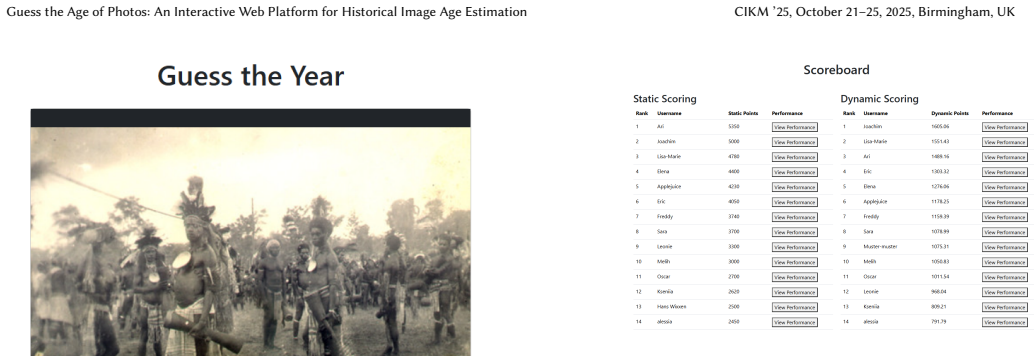
The mechanism that carries the argument is a controlled contrast between two game modes built on the same curated 10,150-image collection, with roughly 145 images per year across 1930–1999. Guess the Year forces an absolute numeric response, while Timeline Challenge forces a pairwise relative response, so the accuracy gap between the modes isolates the difficulty of absolute versus relative temporal judgment. The engagement machinery, including dynamic scoring, leaderboards, instant feedback with ground-truth dates, and a demo mode, is what generated the large gameplay log and the satisfaction data.
What would settle it
A decisive check would be to run the same two game modes on a demographically stratified sample of several hundred users spanning different ages, countries, and levels of historical familiarity; if the pairwise advantage over absolute year guesses shrinks to chance levels or the older-decade advantage reverses, the central perceptual claim would fail.
Extended reading notes
Core claim
The core discovery is that relative temporal judgment is substantially easier than absolute year recall for historical photographs. In the Timeline Challenge, where users compare two images and choose the older one, users answered correctly in 8,708 of 13,221 plays, or 65.9%. In the Guess the Year mode, where users must assign a single image to a calendar year, only 577 of 2,252 guesses fell within five years of the true date, or 25.62%. Accuracy is uneven across time: images from the 1930s and 1940s are recognized far more reliably than later decades, which the paper attributes to distinctive cues such as black-and-white imagery. A secondary claim is that the gamified format works as an engagement tool, since 113 users produced 15,473 gameplays, the top 10% of users contributed 48% of plays, retention reached 70%, and the mean satisfaction rating was 4.25 out of 5.
Load-bearing premise
The load-bearing premise is that the 113 users, drawn mainly from one Austrian high school and the developer's personal circle, represent human perception broadly enough for the accuracy numbers to support general conclusions.
Editorial extensions
If this is right
- If the accuracy gap holds, future image-age estimation can lean on pairwise comparisons, which are easier for humans than absolute year guesses.
- The gameplay log is a ready-made collection of human date judgments, complete with error patterns per decade, that can be used to train or evaluate computer vision models.
- The strong performance on 1930s–1940s images suggests that models should weight analog-era visual cues, while the confusion on 1970s–1980s images points to where more training data or hint systems are needed.
- The engagement metrics indicate that a leaderboard-and-scoring design can sustain voluntary participation in heritage education settings.
Reading between the lines
- Beyond the paper: the pairwise comparison log could be combined into a global ranking, for instance by sorting or rating-style updates, to produce per-image date estimates that may beat any single absolute guess; the paper does not test this.
- The decade-wise error patterns could be mined to identify which visual features drive human judgments, such as film grain, clothing, or architecture, and those features could then serve as explainable inputs for automatic dating; the paper only gestures at this possibility.
- Because the user sample is dominated by young users from one high school and the developer's personal network, the absolute accuracy numbers likely overstate how well the general public can date historical photos; a more diverse sample might change the ranking of decades even if the relative-versus-absolute ordering survives.
Editorial analysis
A structured set of objections, weighed in public.
Referee Report
Summary. The paper presents Guess the Age of Photos, a gamified web platform for estimating the year of historical photographs, with two modes: Guess the Year (absolute year prediction) and Timeline Challenge (choose which of two images is older). The system uses a 10,150-image subset of the Date Estimation in the Wild dataset spanning 1930–1999, is implemented with Flask, Bootstrap, and PostgreSQL, and includes scoring, leaderboards, and instant feedback. An evaluation with 113 users and 15,473 gameplays is reported, yielding a 4.25/5 satisfaction rating, 65.9% accuracy in Timeline Challenge, and 25.62% accuracy in Guess the Year (within ±5 years). The paper claims this shows relative judgments are easier than absolute year guesses, that older decades are easier to identify, and that the platform can serve as an educational tool and as a source of human-perception data for computer vision.
Significance. If the empirical claims were as stated, the platform would be a useful demonstration of gamified heritage engagement and a modest source of behavioral data about human estimation of image age. The system is real and operational, the dataset choice is reasonable, and the paper is transparent that its conclusions are empirical observations rather than results of parameter fitting, so there is no circularity concern. The engagement and satisfaction numbers are meaningful for a system paper. However, the headline cognitive claim—that relative comparisons are easier than absolute guesses—rests on comparing two tasks with different chance baselines, and the report does not provide the statistical support needed for the broader claims about human perception. The paper's significance therefore depends on whether that comparison can be repaired through re-analysis or appropriately weakened.
major comments (3)
- [§5.2, Accuracy Analysis] The claim that Timeline Challenge 'outperforming Guess the Year ... confirming relative judgments are easier' compares a binary task with a 50% chance baseline to a within-±5-years task whose chance baseline is approximately 15.7% (11/70, assuming uniform year draws over 1930–1999). The raw 40.3-point gap is therefore largely a baseline artifact; after subtracting chance, Timeline exceeds chance by about 15.9 points and Guess the Year by about 9.9 points, a difference that is far less dramatic and that is not tested for significance. The paper reports neither exact-match accuracy for Guess the Year, nor confidence intervals, nor a common normalized metric. As written, the central conclusion that relative judgments are easier does not follow from the reported numbers; please re-analyze with comparable baselines or explicitly restrict the claim to the raw accuracies of the two tasks.
- [§5.2, Decade-wise analysis and Figure 4] The statement that older decades (1930s–1940s) showed higher correct guess percentages (up to 90%) is not accompanied by per-decade chance baselines, sample sizes, or a definition of the denominator. For Guess the Year, the chance baseline for a ±5-year window is not uniform across the 1930–1999 range (edge decades have narrower windows), and user guesses may be non-uniformly distributed, so the observed decade pattern could reflect response bias rather than perceptual ease. Please report per-decade accuracy with explicit baselines and counts, or appropriately temper the claim.
- [§5, Evaluation sample and statistical reporting] All 113 users were based in Austria, with a significant portion from BORG Innsbruck high school and the developer's personal network, and the satisfaction rating of 4.25/5 is based on only 20–24 respondents. No significance tests or confidence intervals are reported for any of the accuracy differences (including the older-user comparison of 32.82% vs. 77.8%), and subgroup sizes are not given. These issues do not invalidate the platform as a system, but they do not support the abstract's and Section 1's framing of the results as evidence about 'human perception of temporal cues.' Please add appropriate statistical measures and response-rate reporting, or narrow the scope of the claims.
minor comments (5)
- [References] Reference [12] contains the placeholder text 'Hypothetical; replace if specific ECIR paper is known.' This must be replaced with the actual citation before submission; the current text is not a valid reference.
- [ACM Reference Format] The DOI in the ACM reference format is left as 'https://doi.org/XXXXXXX.XXXXXXX'; please supply the correct DOI or remove the placeholder.
- [§5.3, Engagement] The term 'retention rate of 70% over the evaluation period' is used without a definition. Please specify how retention is computed (e.g., fraction of users active in the last week among those active in the first week) and state the denominator.
- [Figure 4] The caption of Figure 4 does not state what is plotted on the axes, which metric is shown as 'correct guess percentages,' or how it relates to 'total guesses and images shown.' A more descriptive caption would aid interpretation.
- [§5.1, User Feedback] The satisfaction survey is described as 'Feedback from 20–24 users,' but the number of users invited and the response rate are not stated; please report these details so the 4.25/5 rating can be interpreted.
Circularity Check
No significant circularity: the paper reports direct measurements from gameplay rather than fitting a model to data and re-deriving the same values.
full rationale
This paper is an empirical user-study and system description, not a derivation. The headline accuracy figures (65.9% for Timeline Challenge and 25.62% for Guess the Year) are direct counts of recorded gameplays, not outputs of any fitted model and not quantities defined in terms of one another. The conclusion that relative judgments are easier is supported by citing Tversky and Kahneman's independent work on heuristics and biases, not by a self-citation or by construction of the scoring rules. The only self-citation is reference [15], the live demo URL, which is not load-bearing for any scientific claim. The skeptical concern that the two accuracy metrics have different chance baselines (50% binary placement versus approximately 15.7% for a uniform draw within ±5 years over a 70-year range) is a methodological validity issue about metric comparability, not a circularity issue: the paper never fits either metric to the other or defines one mode's score in terms of the other. No formula in the paper equates the reported accuracies to inputs, no parameter is fitted to a subset and then predicted on a related quantity, and no uniqueness claim is imported from prior work by the authors. Consequently, the analysis is self-contained in the sense required by the circularity check, and the appropriate finding is no significant circularity.
Assumptions & free parameters
assumptions (3)
- domain assumption The DEW dataset provides accurate ground truth years for the images.
- domain assumption User gameplay performance reflects general human perception of temporal cues in images.
- domain assumption Gamification elements increase engagement and learning outcomes.
Cite this review
Pith. "Pith review of Guess the Age of Photos: An Interactive Web Platform for Historical Image Age Estimation." pith.science (2026). https://pith.science/paper/33VRK2E2
@misc{pith2026250522031,
  author       = {Pith},
  title        = {Pith review of: Guess the Age of Photos: An Interactive Web Platform for Historical Image Age Estimation},
  year         = {2026},
  howpublished = {\url{https://pith.science/paper/33VRK2E2}},
  note         = {Machine review of arXiv:2505.22031}
}
read the original abstract
This paper introduces Guess the Age of Photos, a web platform engaging users in estimating the years of historical photographs through two gamified modes: Guess the Year (predicting a single image's year) and Timeline Challenge (comparing two images to identify the older). Built with Python, Flask, Bootstrap, and PostgreSQL, it uses a 10,150-image subset of the Date Estimation in the Wild dataset (1930-1999). Features like dynamic scoring and leaderboards boost engagement. Evaluated with 113 users and 15,473 gameplays, the platform earned a 4.25/5 satisfaction rating. Users excelled in relative comparisons (65.9% accuracy) over absolute year guesses (25.6% accuracy), with older decades easier to identify. The platform serves as an educational tool, fostering historical awareness and analytical skills via interactive exploration of visual heritage. Furthermore, the platform provides a valuable resource for studying human perception of temporal cues in images and could be used to generate annotated data for training and evaluating computer vision models.
Figures


Figures from the paper (1 more)

Reference graph
Works this paper leans on
-
[12]
Matthias Springstein, Eric Müller, and Ralph Ewerth. 2020. Deep Learning for Historical Image Date Estimation. In Proceedings of the 42nd European Conference on Information Retrieval (ECIR) . Springer, 456–463. https://doi.org/10.1007/978- 3-030-45439-5_30 Hypothetical; replace if specific ECIR paper is known
doi:10.1007/978- 2020
-
[1]
Sebastian Deterding, Dan Dixon, Rilla Khaled, and Lennart Nacke. 2011. From game design elements to gamefulness: Defining "gamification". In Proceedings of the 15th International Academic MindTrek Conference . ACM, 9–15. https: //doi.org/10.1145/2181037.2181040
arXiv 2011
-
[2]
Adrián Domínguez, José Sáenz-de Navarrete, Luis de Marcos, Luis Fernández- Sanz, Carmen Pagés, and José J. Martínez-Herráiz. 2013. Gamifying learning experiences: Practical implications and outcomes. Computers & Education 63 (2013), 380–392. https://doi.org/10.1016/j.compedu.2012.12.020
-
[3]
Basura Fernando, Efstratios Gavves, and Jose M. Oramas. 2020. Temporal Feature Learning for Historical Image Dating. In Proceedings of the IEEE Conference on Computer Vision and Pattern Recognition (CVPR) . IEEE, 7890–7899. https: //doi.org/10.1109/CVPR42600.2020.00792
arXiv 2020
-
[4]
Juho Hamari, Jonna Koivisto, and Harri Sarsa. 2014. Does gamification work? – A literature review of empirical studies on gamification. In Proceedings of the 47th Hawaii International Conference on System Sciences (HICSS) . IEEE, 3025–3034. https://doi.org/10.1109/HICSS.2014.377
-
[5]
Eilean Hooper-Greenhill. 2012. Museums and Education: Purpose, Pedagogy, Performance. Routledge. https://doi.org/10.4324/9780203937525
-
[6]
David Lowenthal. 1998. The Heritage Crusade and the Spoils of History. Cambridge University Press
work page 1998
-
[7]
Eric Müller, Matthias Springstein, and Ralph Ewerth. 2017. When Was This Picture Taken? Image Date Estimation in the Wild. In Advances in Information Retrieval: Proceedings of the 39th European Conference on Information Retrieval (ECIR) (Lecture Notes in Computer Science (LNCS), Vol. 10193) . Springer, 619–625. https://doi.org/10.1007/978-3-319-56608-5_49
Show all 15 references
-
[8]
Scott Nicholson. 2015. A recipe for meaningful gamification. In Gamification in Education and Business, Torsten Reiners and Lincoln C. Wood (Eds.). Springer, 1–20. https://doi.org/10.1007/978-3-319-10208-5_1
2015 doi
-
[9]
Matthew G. Rhodes. 2009. Age estimation of faces: A review. Applied Cognitive Psychology 23, 1 (2009), 1–12. https://doi.org/10.1002/acp.1442
2009 doi
-
[10]
Katie Seaborn and Deborah I. Fels. 2015. Gamification in theory and action: A survey. International Journal of Human-Computer Studies 74 (2015), 14–31. https://doi.org/10.1016/j.ijhcs.2014.09.006
2015 doi
-
[11]
Laurajane Smith. 2006. Uses of Heritage . Routledge. https://doi.org/10.4324/ 9780203602263
2006
-
[13]
TIB Visual Analytics. 2017. DEW-Downloader GitHub Repository. https://github. com/TIB-Visual-Analytics/DEW-Downloader
2017
-
[14]
Amos Tversky and Daniel Kahneman. 1974. Judgment under Uncertainty: Heuris- tics and Biases. Science 185, 4157 (1974), 1124–1131. https://doi.org/10.1126/ science.185.4157.1124
1974
-
[15]
Hasan Yucedag and Adam Jatowt. 2025. Guess the Age of Photos: Live Demo. http://disc-imageguessing.uibk.ac.at/login. Accessed: 2025-05-02
2025
Reviewed August 7, 2026 · model on record in the stance chip above.
Discussion (0). Sign in to comment.