REVIEW 3 major objections 4 minor 1 cited by
Systematic generation of electron models for Second-Principles Density Functional Theory Methods
T0 review · 3 major / 4 minor · reviewed 2026-08-07 · deepseek-v4-flash
Pith's one-line read A quasi-automated, symmetry-enforced pipeline builds SPDFT electron models that reproduce DFT band structures on geometries outside the training set, for SrTiO3 and LiF.
desk verdict A genuinely useful automation of SPDFT electronic-model construction with solid neutral-geometry validation, but the abstract's charge-state fidelity claim is tested nowhere. read the letter →
The pith
A machine-rendered reading of the paper's core claim, the machinery that carries it, and where it could break.
The reading
What carries the argument
The central object is the SPDFT energy functional of Eq. (9), written in a basis of localized Wannier orbitals (orbitals extracted from the DFT wavefunctions): the one-electron hopping matrix $\gamma_{ab}$, the linear and quadratic electron-lattice couplings $\mathbf{f}_{ab,\lambda}$ and $\overleftrightarrow{g}_{ab,\lambda\upsilon}$, and the effective electron-electron integrals $U_{ab,a'b'}$ and $I_{ab,a'b'}$. Space-group operations of the reference geometry are applied to every tensor, grouping symmetry-equivalent parameters and letting one DFT calculation stand for all symmetry-equivalent distortions; the resulting symmetry constraints are enforced with Lagrange multipliers during the electron-electron fit. The electron-electron integrals are obtained by solving the linear fitting equations (32)-(33) against Hamiltonians from the training set, and their influence is screened by a spatial cutoff $\delta_{ree}$ and a goal-function threshold $\delta_\Theta$ that retain only the integrals that matter. This machinery converts the old fitting problem into a mostly computed, symmetry-consistent, and systematically refinable model.
What would settle it
Train a SrTiO3 model using only the paper's stated doping range, −0.3 to +0.3 e with spin polarizations up to 0.3 e, then compute the DFT Hamiltonian for a held-out +0.5 e doped supercell and compare the model's valence and t2g bands near the gap. If the error approaches the LDA gap of about 1.7 eV, the fitted $U$ and $I$ integrals have failed to transfer to an unseen charge state, and the central claim of high-fidelity reproduction across charge states is falsified.
Extended reading notes
Core claim
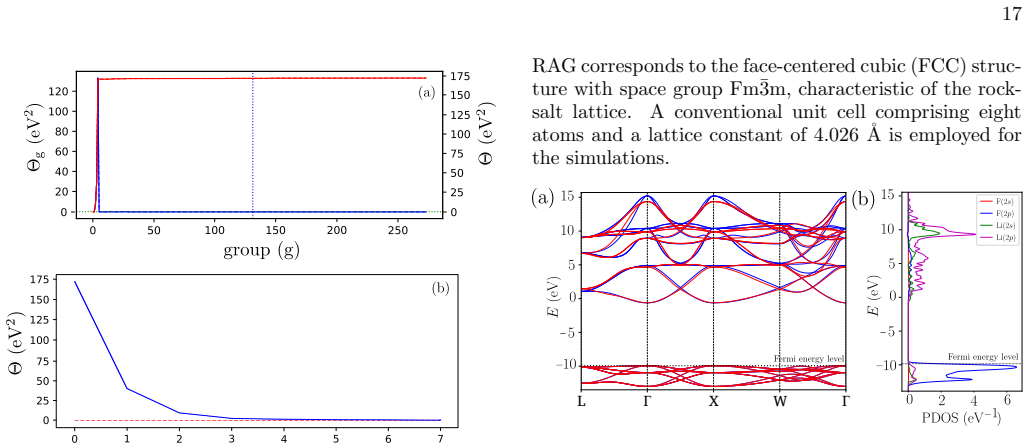
The paper claims that a largely automated protocol can construct SPDFT electronic models that reproduce DFT reference data across atomic configurations and charge states. The protocol works in a basis of localized Wannier orbitals, separates valence and conduction manifolds during wannierization so the reference density stays well defined, and enforces the space group of the reference structure on all Hamiltonian, electron-lattice, and electron-electron parameters. One-electron and electron-lattice terms are computed directly (hoppings from wannierized Hamiltonians; couplings by finite differences), while the electron-electron integrals $U_{ab,a'b'}$ and $I_{ab,a'b'}$ — effective responses of the Hamiltonian to changes in density and spin — are fitted to a standardized training set that includes hole/electron doping and spin-polarized configurations. For SrTiO3 and LiF, the resulting models keep deviations in the valence and lower conduction bands small even for random atomic displacements up to 0.17 Å, with errors much smaller than typical band separations, and the training set shrinks to a few hundred single-point calculations.
Load-bearing premise
The load-bearing premise is that the electron-electron interaction parameters fitted to a small set of doped and spin-polarized supercell calculations transfer unchanged to other geometries, larger supercells, and charge states outside that training set.
Editorial extensions
If this is right
- Materials with strong electron-lattice coupling, such as transition-metal perovskites, can be simulated in supercells large enough for polaron formation and hopping without a self-consistent DFT loop at every step.
- The real-time time-dependent SPDFT extension can compute optical spectra with explicit electron-hole interactions, making exciton binding and dynamics in wide-gap insulators like LiF directly accessible.
- Because symmetry turns tens of thousands of candidate DFT calculations into a few hundred, systematic model generation for new materials becomes affordable, and the models become comparable across different systems and users.
- The explicit hierarchy of cutoffs ($\delta_{rh}$, $\delta_{rel}$, $\delta_f$, $\delta_g$, $\delta_{ree}$, $\delta_\Theta$) gives a principled route to refinement: tighten a cutoff and the model improves in a controlled way.
Reading between the lines
- The paper tests random geometries within the same charge-state range as the training set, so a natural extension is to hold out entire charge states or spin configurations; the fitted $U$ and $I$ parameters either transfer, which would confirm the claim, or they do not, which would set the method's actual domain of validity.
- Because the fitted electron-electron integrals are effective density responses rather than bare Coulomb integrals, their values could be read across materials as a screening descriptor; the paper does not discuss this, but the model files it produces would permit such a comparison.
- The LDA-based SrTiO3 model did not localize electron polarons, and the paper attributes this to self-interaction error; a direct test of the pipeline is to rebuild it from hybrid-functional data, where localization should emerge if the fitted parameters carry the needed physics.
- For metals, where the reference density matrix must be non-diagonal and geometry-dependent, the subtraction procedure that separates electron-electron from electron-lattice effects is more delicate and remains largely untested; applying the pipeline to a simple metal would reveal whether quasi-automation survives metallic occupations.
Editorial analysis
A structured set of objections, weighed in public.
Referee Report
Summary. The manuscript presents an improved, largely automated workflow for constructing the electronic part of second-principles DFT (SPDFT) models. The authors generalize the reference electron density to allow non-diagonal density matrices, reformulate linear and quadratic electron-lattice couplings using absolute atomic displacements with acoustic-sum-rule constraints, enforce space-group symmetry to reduce the number of required DFT calculations, and combine direct computation of one-electron and electron-lattice parameters with fitting of the electron-electron parameters U and I to a standardized training set of doped and spin-polarized DFT Hamiltonians. The workflow is applied to SrTiO3 and LiF; the authors report low goal-function values on random-displacement test sets, band-structure error bars at d = 0.17 Å, and a check against an alternative SrTiO3 phase. The central claim is that the resulting models reproduce DFT reference data with high fidelity across various atomic configurations and charge states.
Significance. If the geometry-transferability results hold, this is a substantial practical advance: the symmetry-based reduction in the number of first-principles calculations (e.g., from 57,840 to 15 for the SrTiO3 electron-lattice data at δrel = 2.0 Å) makes SPDFT model construction feasible for a wider class of materials, and the explicit goal-function metric provides a transparent quality assessment. The validation on held-out random geometries, the test on the antiferrodistortive phase of SrTiO3, and the careful documentation of cutoff choices are genuine strengths. The main weakness is that the charge-state half of the abstract's claim is not validated by any held-out test; because U and I are fitted parameters, their transferability to unseen doping levels, spin polarizations, and combined distortion-doping configurations is load-bearing for the promised polaron/exciton applications.
major comments (3)
- [Sec. IV C 2, Sec. IV D, Abstract] The abstract claims high fidelity 'across various atomic configurations and charge states,' but the charge-state part is not tested. The U and I parameters are fitted on the Sec. IV C 2 training set (charges from -0.3 to +0.3 e in 0.1 e steps, with fully spin-polarized variants, plus neutral magnetizations for LiF), while the Sec. IV D validation consists of random neutral geometries and alternative phases. No held-out doping level, held-out magnetization, or doped distorted geometry is reported. Since U and I carry the entire density/spin response of the model, the claim that the models reproduce DFT for arbitrary charge states is unsupported. Please add a cross-validation where at least one doping level or magnetization is excluded from the fit and the model error on that held-out configuration is reported, or compare model vs DFT for a doped distorted geometry (e.g., the electron-doped SrTiO3 configuration discussed in Sec. VI A).
- [Sec. VI A, Figs. 5-6; Sec. VI B, Figs. 11-12] The same random-displacement test set appears to be used both for selecting the cutoffs δrel, δf, and δg and for reporting the final model errors. Fig. 5(a) is used to choose δrel, Fig. 5(b) to choose δf and δg, and Fig. 6 then reports the errors of the selected model on the same kind of test set; the analogous procedure is used for LiF in Figs. 11 and 12. This makes the reported errors an in-sample estimate of model performance after hyperparameter tuning. Please either reserve a separate final test set not used in any cutoff selection, or report the sensitivity of the final error to the cutoff choices so that the reader can assess the potential optimism bias.
- [Sec. VI A, polaron paragraph] The only application that would exercise the fitted U/I response outside the training set is the attempted electron doping of SrTiO3, but the outcome is reported only as a failure to localize charge, attributed to the LDA functional. No comparison of the second-principles model against DFT for that doped configuration is provided, so this episode neither validates nor invalidates the charge-state transferability of U/I. Please clarify whether such a comparison was performed, or state explicitly that it was not and that the charge-state transferability remains to be established.
minor comments (4)
- [Figs. 5 and 11 captions] The captions call Θ the 'average error per calculation,' but the text (e.g., Sec. VI B) describes Θ as a sum over Hamiltonian matrix-element deviations (≈1 eV2 summed over 11,964 terms). Please clarify the normalization used in the plots.
- [Sec. III D] The final sentence, 'More details will be given in a forthcoming simulation,' is an incomplete placeholder and should be replaced by a reference or removed.
- [Sec. I and Sec. VII] The statement that the LiF model has 'already proven capable' of describing optical properties such as excitons is not demonstrated in this manuscript; either show the data or refer explicitly to the forthcoming publication.
- [Eq. (29)] Equation (29) appears to contain a typographical error: the first equality writes h^{DFT}_{a'b'}(u_{λ'}) on both sides, while the intended relation should connect the Hamiltonian at the symmetry-related geometry to the Hamiltonian at u_λ. Please correct the indices.
Circularity Check
Charge-state fidelity is a least-squares restatement: the U/I electron-electron parameters are fit to doped and spin-polarized DFT Hamiltonians, and the abstract's 'various charge states' claim is evidenced only by that training objective; only atomic-configuration transfer is tested out-of-sample.
-
fitted input called prediction
[Abstract; Sec. IV C 2 (Eqs. 30-32, 34-35); Sec. IV D; Sec. VI A (Fig. 8)]
"In both cases, the resulting models reproduce DFT reference data with high fidelity across various atomic configurations and charge states. / Electron-electron parameters are determined by fitting to a training set of DFT-calculated Hamiltonians for a representative ensemble of electronic configurations {A}."
The U and I parameters are the entire charge/spin response of the model (Eq. 10). They are obtained by minimizing Θ = Σ_ab Σ_A [h_model − h_DFT]^2 (Eqs. 30-32) over doped and spin-polarized configurations, with total charge varied from −0.3 to +0.3 e in steps of 0.1 e and, for LiF, neutral magnetizations up to 2.0 μB. The paper's only evidence for the 'charge states' part of the abstract claim is Fig. 8, which plots this same training objective as U/I terms are added. The validation protocol (Sec. IV D) generates test geometries only by random atomic displacements; no held-out doping level, no held-out magnetization, and no doped distorted geometry is reported.
full rationale
The paper's derivation of the electronic model is mostly self-contained: one-electron hoppings are computed from wannier90, electron-lattice couplings are obtained by finite differences of DFT Hamiltonians with acoustic-sum-rule enforcement, and the validation on randomly displaced geometries (Sec. IV D, Figs. 5-7, 11-12) is a genuine held-out test against external DFT data. The symmetry reduction and the linear-equation fitting procedure are internally consistent. The one circular element is the charge-state part of the central claim: U/I electron-electron parameters are fitted to a training set of doped and spin-polarized DFT Hamiltonians, and the abstract's statement that the models 'reproduce DFT reference data ... across various ... charge states' is supported only by the fitting objective, not by any held-out charge-state test. The paper itself acknowledges the limitation in Sec. I ('it does not include a comprehensive validation in more complex or application-driven scenarios') and in Sec. VII ('analogous procedures to compute electron-electron interaction terms—such as the Uab,a′b′—are not yet available'), which confirms that U/I are fit-only quantities. This is partial circularity: the atomic-configuration prediction is independent and well tested, while the charge-state reproduction reduces by construction to the least-squares fit. Self-citations to Refs. [23], [31], and [45] are normal prior-work support and are not load-bearing circularity here, because the central geometry validation is against external DFT data computed for this paper.
Assumptions & free parameters
free parameters (6)
- Hamiltonian cutoff delta_rh =
8.0 Å for both SrTiO3 and LiF
- Electron-lattice coupling cutoff delta_rel =
4.0 Å (SrTiO3), 3.0 Å (LiF)
- Electron-lattice pruning thresholds delta_f and delta_g =
0.1 eV/Å and 0.1 eV/Å^2
- Electron-electron fitting threshold delta_Theta =
0.2 eV^2
- Electron-electron integrals U_ab,a'b' and I_ab,a'b' =
not tabulated; determined by fitting (Eqs. 32-35)
- Finite-difference step delta_x for e-l couplings =
not stated in manuscript
assumptions (6)
- domain assumption Born-Oppenheimer approximation: electrons follow nuclei adiabatically
- domain assumption The deformation density delta_n is small enough for a low-order expansion of the DFT energy (Eq. 7)
- domain assumption No bond-topology transformations occur; Taylor expansion around the RAG is valid
- standard math Wannier functions transform under space-group operations as the atomic basis orbitals do
- ad hoc to paper Displacements of atoms farther apart than delta_rel are uncorrelated for electron-lattice coupling
- domain assumption The DFT functional used (LDA for SrTiO3, PBE for LiF) provides a valid reference for the target physics
Cite this review
Pith. "Pith review of Systematic generation of electron models for Second-Principles Density Functional Theory Methods." pith.science (2026). https://pith.science/paper/GDC7MN2X
@misc{pith2026250522056,
  author       = {Pith},
  title        = {Pith review of: Systematic generation of electron models for Second-Principles Density Functional Theory Methods},
  year         = {2026},
  howpublished = {\url{https://pith.science/paper/GDC7MN2X}},
  note         = {Machine review of arXiv:2505.22056}
}
abstract
We present a systematic, quasi-automated methodology for generating electronic models in the framework of second-principles density functional theory (SPDFT). This approach enables the construction of accurate and computationally efficient models by deriving all necessary parameters from first-principles calculations on a carefully designed training set. A key feature of our method is the enforcement of space group symmetries, which reduces both the number of independent parameters and the required computational effort. The formalism includes improved treatments of one-electron Hamiltonians, electron-lattice coupling-through both linear and quadratic terms-and electron-electron interactions, enabling accurate modeling of structural and electronic responses. We apply the methodology to SrTiO$_{3}$ and LiF, materials representative of transition-metal perovskites and wide-band-gap insulators, respectively. In both cases, the resulting models reproduce DFT reference data with high fidelity across various atomic configurations and charge states. Our results validate the robustness of the approach and highlight its potential for simulating complex phenomena such as polarons and excitons. This work lays the foundation for extending SPDFT to real-time simulations of optoelectronic properties and further integration with machine-learning methods.
Figures


Figures from the paper (9 more)




Forward citations
Cited by 1 Pith paper
-
Extension of Second-Principles Density Functional Theory into the time domain
A real-time, real-space extension of second-principles DFT that propagates the density matrix and yields optical spectra for large metallic and insulating systems.
Reference graph
Works this paper leans on
-
[1]
However, enforcing the symmetry condition of Eq
One-electron parameters The hopping matrix elements, γab, are computed using wannier90 from a nonmagnetic ground-state DFT cal- culation at the RAG. However, enforcing the symmetry condition of Eq. (23) requires high numerical precision in the DFT setup, such as dense k-point meshes, which is computationally demanding. An alternative approach, implemented...
-
[2]
Electron-electron parameters, training set and fitting procedure Electron-electron parameters are determined by fitting to a training set of DFT-calculated Hamiltonians for a representative ensemble of electronic configurations {A}. The target is to minimize the deviation between the DFT matrix elements, hDFT ab (A), and the second-principles model predic...
-
[3]
Electron-lattice terms Electron-lattice coupling terms are computed us- ing finite-difference approximations applied to the one- electron Hamiltonian obtained from density functional theory (DFT). Specifically, the x-component of the linear electron-lattice coupling vector ⃗f fd ab,λ is estimated using the central difference formula f fd,x ab,λ ≈ − hDFT a...
-
[4]
R. M. Martin, Electronic Structure: Basic Theory and Practical Methods (Cambridge University Press, 2004)
2004
-
[5]
Kohanoff, Electronic Structure Calculations for Solids and Molecules: Theory and Computational Methods (Cambridge University Press, 2006)
J. Kohanoff, Electronic Structure Calculations for Solids and Molecules: Theory and Computational Methods (Cambridge University Press, 2006)
2006
-
[6]
R. G. Parr and W. Yang, Density F unctional T heory of Atoms and M olecules (Oxford University Press, 1989)
1989
-
[7]
R. M. Dreizler and E. K. U. Gross, Density Functional Theory: An Approach to the Quantum Many-Body Prob- lem (Springer, 1990)
work page 1990
-
[8]
A. Szabo and N. Ostlund, Modern Quantum Chemistry: Introduction to Advanced Electronic Structure Theory , Dover Books on Chemistry (Dover Publications, 1996)
work page 1996
Show all 69 references
-
[9]
D. R. Bowler and T. Miyazaki, Calculations for millions of atoms with density functional theory: linear scal- ing shows its potential, J. Phys.: Condens. Matter 22, 074207 (2010)
2010
-
[10]
P. W. Anderson, More is different, Science 177, 393 (1972)
1972
-
[11]
H. Y. Hwang, Y. Iwasa, M. Kawasaki, B. Keimer, N. Na- gaosa, and Y. Tokura, Emergent phenomena at oxide interfaces, Nat. Mater. 11, 103 (2012), (and references therein)
2012
-
[12]
Nagaosa and Y
N. Nagaosa and Y. Tokura, Emergent electromagnetism in solids, Phys. Scr. 2012, 014020 (2012)
2012
-
[13]
Ohtomo and H
A. Ohtomo and H. Y. Hwang, A high-mobility electron gas at the LaAlO 3/SrTiO3 heterointerface, Nature 427, 423 (2004)
2004
-
[14]
Nagaosa and Y
N. Nagaosa and Y. Tokura, Topological properties and dynamics of magnetic skyrmions, Nat. Nanotechnol. 8, 899 (2013)
2013
-
[15]
S. Das, Y. L. Tang, Z. Hong, M. A. P. Gon¸ calves, M. R. McCarter, C. Klewe, K. X. Nguyen, F. G´ omez-Ortiz, P. Shafer, E. Arenholz, V. A. Stoica, S.-L. Hsu, B. Wang, C. Ophus, J. F. Liu, C. T. Nelson, S. Saremi, B. Prasad, A. B. Mei, D. G. Schlom, J.´I˜ niguez, P. Garc ´ ıa-F...
2019
-
[16]
Junquera, Y
J. Junquera, Y. Nahas, S. Prokhorenko, L. Bellaiche, J. ´I˜ niguez, D. G. Schlom, L.-Q. Chen, S. Salahuddin, D. A. Muller, L. W. Martin, and R. Ramesh, Topological phases in polar oxide nanostructures, Rev. Mod. Phys. 95, 025001 (2023)
2023
-
[17]
Binder and D
K. Binder and D. W. Heermann, Monte Carlo Simulation in Statistical Physics. An Introduction (Springer, 2019)
2019
-
[18]
Schnakenberg, Polaronic impurity hopping conduction, Phys
J. Schnakenberg, Polaronic impurity hopping conduction, Phys. Stat. Sol. (b) 28, 623 (1968)
1968
-
[19]
Asadi, A
K. Asadi, A. J. Kronemeijer, T. Cramer, L. Jan An- ton Koster, P. W. M. Blom, and D. M. de Leeuw, Polaron hopping mediated by nuclear tunnelling in semiconduct- ing polymers at high carrier density, Nat. Commun. 4, 1710 (2013)
2013
-
[20]
T. G. Castner and W. K¨ anzig, The electronic structure of v-centers, J. Phys. Chem. Solids 3, 178 (1957)
1957
-
[21]
K¨ anzig and T
W. K¨ anzig and T. O. Woodruff, The electronic structure of an h-center, J. Phys. Chem. Solids 9, 70 (1959)
1959
-
[22]
J. M. Garc ´ ıa-Lastra, J. S. G. Myrdal, R. Christensen, K. S. Thygesen, and T. Vegge, DFT + U study of pola- ronic conduction in Li 2O2 and Li2CO3: Implications for Li–Air batteries, J. Phys. Chem. C 117, 5568 (2013)
2013
-
[23]
S. P. Ong, Y. Mo, and G. Ceder, Low hole polaron migra- tion barrier in lithium peroxide, Phys. Rev. B 85, 081105 (2012)
2012
-
[24]
Q. Guo, Y. Liu, M. Liu, H. Zhang, X. Qian, J. Yang, J. Wang, W. Xue, Q. Zhao, X. Xu, W. Ma, Z. Tang, Y. Li, and Z. Bo, Enhancing the performance of organic solar cells by prolonging the lifetime of photogenerated excitons, Adv. Mater. 32, 2003164 (2020)
2020
-
[25]
Q. Guo, X. Zhao, B. Song, J. Luo, and J. Tang, Light emission of self-trapped excitons in inorganic metal halides for optoelectronic applications, Adv. Mater. 34, 2201008 (2022)
2022
-
[26]
Garc ´ ıa-Fern´ andez, J
P. Garc ´ ıa-Fern´ andez, J. C. Wojde l, J. ´I˜ niguez, and J. Junquera, Second-principles method for materials sim- ulations including electron and lattice degrees of freedom, Phys. Rev. B 93, 195137 (2016)
2016
-
[27]
Schmidt, M
J. Schmidt, M. R. G. Marques, S. Botti, and M. A. L. Marques, Recent advances and applications of machine learning in solid-state materials science, Npj Comput. Mater. 5, 83 (2019)
2019
-
[28]
Z. J. Baum, X. Yu, P. Ayala, Y. Zhao, S. P. Watkins, and Q. Zhou, Artificial intelligence in chemistry: Current trends and future directions, J. Chem. Inf. Model. 61, 3197 (2021)
2021
-
[29]
H. Li, Z. Wang, N. Zou, M. Ye, R. Xu, X. Gong, W. Duan, and Y. Xu, Deep-learning density functional theory hamiltonian for efficient ab initio electronic- structure calculation, Nat. Comput. Sci. 2, 367 (2022)
2022
-
[30]
com/mzjb/DeepH-pack, accessed: 1 April 2025
Deeph (deep hamiltonian) method, https://github. com/mzjb/DeepH-pack, accessed: 1 April 2025
2025
-
[31]
Y. Zhuo, A. Mansouri T., and J. Brgoch, Predicting the band gaps of inorganic solids by machine learning, J. Phys. Chem. Lett. 9, 1668 (2018)
2018
-
[32]
J. D. Evans and F.-X. Coudert, Predicting the mechani- cal properties of zeolite frameworks by machine learning, Chem. Mater. 29, 7833 (2017)
2017
-
[33]
Marzari, A
N. Marzari, A. A. Mostofi, J. R. Yates, I. Souza, and D. Vanderbilt, Maximally localized Wannier functions: Theory and applications, Rev. Mod. Phys. 84, 1419 (2012)
2012
-
[34]
J. C. Wojde l, P. Hermet, M. P. Ljungberg, P. Ghosez, and J. ´I˜ niguez, First-principles model potentials for lattice- dynamical studies: general methodology and example of application to ferroic perovskite oxides, J. Phys.: Con- dens. Matter 25, 305401 (2013)
2013
-
[35]
Porezag, T
D. Porezag, T. Frauenheim, T. K¨ ohler, G. Seifert, and R. Kaschner, Construction of tight-binding-like potentials on the basis of density-functional theory: Application to carbon, Phys. Rev. B 51, 12947 (1995)
1995
-
[36]
W. M. C. Foulkes and R. Haydock, Tight-binding models and density-functional theory, Phys. Rev. B 39, 12520 22 (1989)
1989
-
[37]
Elstner, D
M. Elstner, D. Porezag, G. Jungnickel, J. Elsner, M. Haugk, T. Frauenheim, S. Suhai, and G. Seifert, Self-consistent-charge density-functional tight-binding method for simulations of complex materials properties, Phys. Rev. B 58, 7260 (1998)
1998
-
[38]
Gonze, B
X. Gonze, B. Amadon, G. Antonius, F. Arnardi, L. Baguet, J.-M. Beuken, J. Bieder, F. Bottin, J. Bouchet, E. Bousquet, N. Brouwer, F. Bruneval, G. Brunin, T. Cavignac, J.-B. Charraud, W. Chen, M. Cˆ ot´ e, S. Cottenier, J. Denier, G. Geneste, P. Ghosez, M. Giantomassi, Y. Gille...
2020
-
[39]
Fern´ andez-Ruiz, N
T. Fern´ andez-Ruiz, N. Carral-Sainz, J. ´I˜ niguez, J. Jun- quera, and P. Garcia-Fernandez, to be sent to Phys. Rev. B (2025)
2025
-
[40]
J. M. Soler, E. Artacho, J. D. Gale, A. Garc ´ ıa, J. Jun- quera, P. Ordej´ on, and D. S´ anchez-Portal, Thesiesta method for ab initio order- N materials simulation, J. Phys.: Condens. Matter 14, 2745 (2002)
2002
-
[41]
A. A. Mostofi, J. R. Yates, Y.-S. Lee, I. Souza, D. Van- derbilt, and N. Marzari, wannier90: A tool for obtaining maximally-localised wannier functions, Comput. Phys. Commun. 178, 685 (2008)
2008
-
[42]
Pizzi, V
G. Pizzi, V. Vitale, R. Arita, S. Bl¨ ugel, F. Freimuth, G. G´ eranton, M. Gibertini, D. Gresch, C. Johnson, T. Koretsune, J. Iba˜ nez-Azpiroz, H. Lee, J.-M. Lihm, D. Marchand, A. Marrazzo, Y. Mokrousov, J. I. Mustafa, Y. Nohara, Y. Nomura, L. Paulatto, S. Ponc´ e, T. Pon- wei...
2020
-
[43]
Souza, N
I. Souza, N. Marzari, and D. Vanderbilt, Maximally local- ized wannier functions for entangled energy bands, Phys. Rev. B 65, 035109 (2001)
2001
-
[44]
Marzari, A
N. Marzari, A. A. Mostofi, J. R. Yates, I. Souza, and D. Vanderbilt, Maximally localized wannier functions: Theory and applications, Rev. Mod. Phys. 84, 1419 (2012)
2012
-
[45]
Garc ´ ıa, N
A. Garc ´ ıa, N. Papior, A. Akhtar, E. Artacho, V. Blum, E. Bosoni, P. Brandimarte, M. Brandbyge, J. I. Cerd´ a, F. Corsetti, R. Cuadrado, V. Dikan, J. Ferrer, J. Gale, P. Garc ´ ıa-Fern´ andez, V. M. Garc ´ ıa-Su´ arez, S. Garc ´ ıa, G. Huhs, S. Illera, R. Koryt´ ar, P. Koval...
2020
-
[46]
M. I. Aroyo, J. M. P´ erez-Mato, D. Orobengoa, E. Tasci, G. De La Flor, and A. Kirov, Crystallography online: Bil- bao crystallographic server, Bulg. Chem. Commun. 43, 183 (2011)
2011
-
[47]
M. I. Aroyo, A. Kirov, C. Capillas, J. M. P´ erez-Mato, and H. Wondratschek, Bilbao Crystallographic Server. II. Representations of crystallographic point groups and space groups, Acta Cryst. A62, 115 (2006)
2006
-
[48]
Escorihuela-Sayalero, J
C. Escorihuela-Sayalero, J. C. Wojde l, and J.´I˜ niguez, Ef- ficient systematic scheme to construct second-principles lattice dynamical models, Phys. Rev. B 95, 094115 (2017)
2017
-
[49]
Kaduk, T
B. Kaduk, T. Kowalczyk, and T. Van Voorhis, Con- strained density functional theory, Chem. Rev. 112, 321 (2012)
2012
-
[50]
Garc ´ ıa, N
A. Garc ´ ıa, N. Papior, A. Akhtar, E. Artacho, V. Blum, E. Bosoni, P. Brandimarte, M. Brandbyge, J. I. Cerd´ a, F. Corsetti, R. Cuadrado, V. Dikan, J. Ferrer, J. Gale, P. Garc ´ ıa-Fern´ andez, V. M. Garc ´ ıa-Su´ arez, S. Garc ´ ıa, G. Huhs, S. Illera, R. Koryt´ ar, P. Koval...
2020
-
[51]
D. M. Ceperley and B. J. Alder, Ground state of the electron gas by a stochastic method, Phys. Rev. Lett. 45, 566 (1980)
1980
-
[52]
J. P. Perdew and A. Zunger, Self-interaction correction to density-functional approximations for many-electron systems, Phys. Rev. B 23, 5048 (1981)
1981
-
[53]
J. P. Perdew, K. Burke, and M. Ernzerhof, Generalized gradient approximation made simple, Phys. Rev. Lett. 77, 3865 (1996)
1996
-
[54]
Junquera, O
J. Junquera, O. Paz, D. S´ anchez-Portal, and E. Artacho, Numerical atomic orbitals for linear-scaling calculations, Phys. Rev. B 64, 235111 (2001)
2001
-
[55]
D. R. Hamann, M. Schl¨ uter, and C. Chiang, Norm- conserving pseudopotentials, Phys. Rev. Lett. 43, 1494 (1979)
1979
-
[56]
Troullier and J
N. Troullier and J. L. Martins, Efficient pseudopotentials for plane-wave calculations, Physical review B 43, 1993 (1991)
1991
-
[57]
Kleinman and D
L. Kleinman and D. M. Bylander, Efficacious form for model pseudopotentials, Phys. Rev. Lett. 48, 1425 (1982)
1982
-
[58]
H. J. Monkhorst and J. D. Pack, Special points for Brillouin-zone integrations, Phys. Rev. B 13, 5188 (1976)
1976
-
[59]
Marzari and D
N. Marzari and D. Vanderbilt, Maximally localized gen- eralized Wannier functions for composite energy bands, Phys. Rev. B 56, 12847 (1997)
1997
-
[60]
Zhong and D
W. Zhong and D. Vanderbilt, Effect of quantum fluc- tuations on structural phase transitions in SrTiO 3 and BaTiO3, Phys. Rev. B 53, 5047 (1996)
1996
-
[61]
Y. L. Li, S. Choudhury, J. H. Haeni, M. D. Biegal- ski, A. Vasudevarao, A. Sharan, H. Z. Ma, J. Levy, V. Gopalan, S. Trolier-McKinstry, D. G. Schlom, Q. X. Jia, and L. Q. Chen, Phase transitions and domain struc- tures in strained pseudocubic (100) SrTiO 3 thin films, Phys. Re...
2006
-
[62]
Block and A
D. Block and A. Wasiela, Self-trapped exciton in alkali fluorides: ODMR study, Solid State Commun. 28, 455 (1978)
1978
-
[63]
K. S. Song and H. T. Williams, Self-trapped excitons (Springer, 1996). 23
1996
-
[64]
Williams and K
R. Williams and K. Song, The self-trapped exciton, J. Phys. Chem. Solids 51, 679 (1990)
1990
-
[65]
S´ anchez, C
F. S´ anchez, C. Ocal, and J. Fontcuberta, Tailored sur- faces of perovskite oxide substrates for conducted growth of thin films, Chem. Soc. Rev. 43, 2272 (2014)
2014
-
[66]
Kawasaki, A
M. Kawasaki, A. Ohtomo, T. Arakane, K. Takahashi, M. Yoshimoto, and H. Koinuma, Atomic control of SrTiO3 surface for perfect epitaxy of perovskite oxides, App. Surf. Sci. 107, 102 (1996)
1996
-
[67]
van Benthem, C
K. van Benthem, C. Els¨ asser, and R. H. French, Bulk electronic structure of SrTiO 3: Experiment and theory, J. Appl. Phys. 90, 6156 (2001)
2001
-
[68]
A. V. Krukau, O. A. Vydrov, A. F. Izmaylov, and G. E. Scuseria, Influence of the exchange screening parame- ter on the performance of screened hybrid functionals, J. Chem. Phys. 125, 224106 (2006)
2006
-
[69]
At higher energies, beyond the usual range of optical/UV experiments, the bands differ
The low-lying conduction bands obtained in siesta are a good match for those of a more accurate plane-wave code. At higher energies, beyond the usual range of optical/UV experiments, the bands differ. In particular, the ones ob- tained with siesta become disentangled. This for...
Reviewed August 7, 2026 · model on record in the stance chip above.
Discussion (0). Sign in to comment.