REVIEW 4 major objections 5 minor 49 references
MObyGaze: a film dataset of multimodal objectification densely annotated by experts
T0 review · 4 major / 5 minor · reviewed 2026-08-07 · deepseek-v4-flash
Pith's one-line read The paper introduces MObyGaze, presented as the first audiovisual dataset labeled for the high-level construct of objectification, and shows that current vision and language models can classify and localize objectification in films.
desk verdict A genuinely new multimodal dataset for a high-level interpretive construct, with honest benchmarks—but the label validity rests on two co-designing annotators, so treat the feasibility numbers as conditional on construct validation. read the letter →
The pith
A machine-rendered reading of the paper's core claim, the machinery that carries it, and where it could break.
The reading
What carries the argument
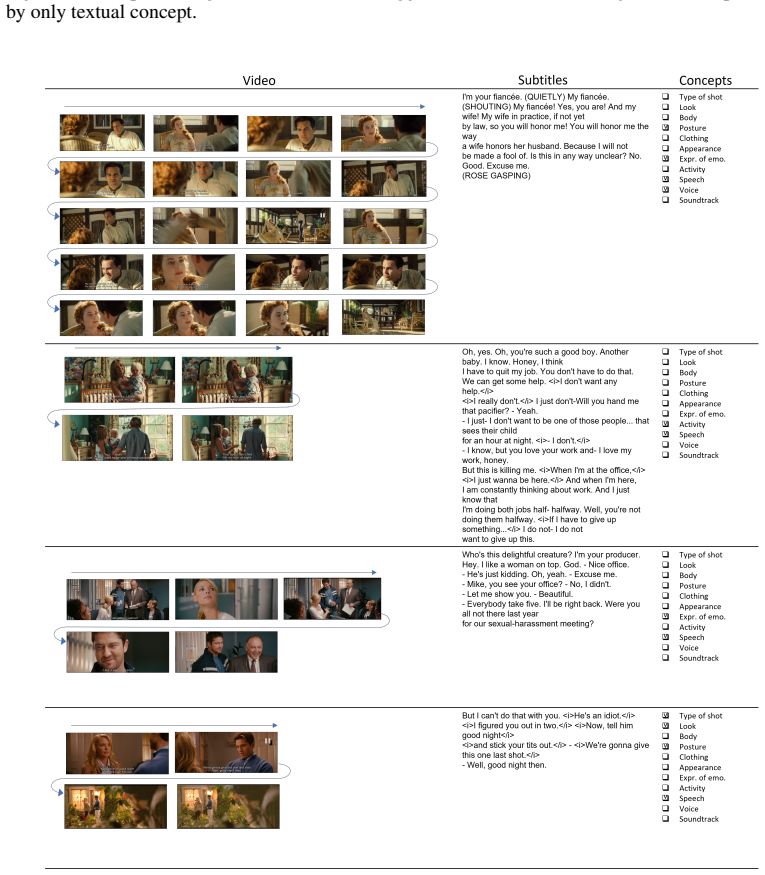
The load-bearing object is the thesaurus of objectification: five sub-constructs, grounded in film studies and social psychology, operationalized as eleven annotatable concepts spanning vision, speech, and sound. Because it decomposes the high-level construct into concrete, codeable dimensions, it makes the labeling reproducible enough that two experts reach an inter-annotator agreement of $\sigma = 0.74$ on objectification levels, and it lets the paper formulate classification and localization as well-defined machine learning tasks. The complementary mechanism is the four-level rating scale, in which the hard-negative level captures segments that contain objectifying elements but are not perceived as objectifying; the paper shows these hard negatives are the strongest confusers for models.
What would settle it
Have annotators who did not design the thesaurus independently re-annotate a sample of the films; if their agreement with the original labels on Sound and Expression of emotion is as low as the reported values of 0.22 and 0.37, then the measured construct is annotator-specific rather than a stable property of the films.
Extended reading notes
Core claim
The central claim is that objectification in audiovisual storytelling is a measurable, multimodal construct that can be turned into a learning task. The authors define objectification through a thesaurus of five sub-constructs grounded in film studies and psychology, manifested through eleven concepts—type of shot, look, body, posture, clothing, appearance, activities, expression of emotion, voice, speech, and sound—spanning vision, text, and audio. Two expert annotators watched each of the twenty films in full, freely delimiting every timespan where at least one objectifying concept was present, and rated each segment on a four-level scale: easy negative, hard negative, sure objectification, and not sure. The resulting dataset contains 6,072 segments totaling 43 hours, with fine-grained concept tags and hard negatives that expose ambiguity. The paper then benchmarks vision, text, and audio models on classification and temporal localization, reporting that the visual and textual tasks are accessible to existing models while the audio-only task is not, and that a label-aggregation strategy merging the two annotators' labels into one per segment yields the best performance on the raw data.
Load-bearing premise
The dataset is valid only if the thesaurus and the two expert annotators who designed it capture objectification as other audiences would perceive it, rather than encoding a private reading by its own authors.
Editorial extensions
If this is right
- A shared, quantified definition of on-screen objectification becomes available to computational media studies, allowing subtle gender-representation patterns to be measured across large film corpora rather than only through close reading.
- Classification of objectification from visual and textual modalities is already feasible with current models, so the bottleneck shifts to multimodal integration and better concept-level representations rather than dataset existence.
- Hard negatives prove to be a decisive design choice: they are the main source of model confusion, so datasets for interpretive constructs should include them to separate presence of elements from perception of the construct.
- Label aggregation into a single merged label per segment outperforms per-annotator separation on raw-data evaluation, supporting the use of expert-consensus labels even when the number of annotators is very small.
- Audio-only objectification classification fails to beat trivial baselines, indicating that future multimodal models must weight audio contributions carefully.
Reading between the lines
- Re-annotating a subset of films with fresh experts from a different cultural background would test whether the thesaurus transfers; the low agreement on Sound (KS 0.22) and Expression of emotion (KS 0.37) are the most likely fault lines.
- The dataset could double as a fairness probe for vision models, since objectifying shots often frame body parts without heads and may expose systematic detection failures in pose estimators and person detectors.
- The same thesaurus-based recipe could be extended to other interpretive constructs such as agency or vulnerability, turning qualitative film-studies notions into trainable datasets.
- Because annotation stops at scene level, a natural follow-up is to test whether segment-level models can be composed to capture whole-film narrative tropes, the open direction the paper itself flags.
Editorial analysis
A structured set of objections, weighed in public.
Referee Report
Summary. The paper introduces MObyGaze, a dataset of 20 feature-length films selected from MovieGraphs, densely annotated by two expert annotators for the high-level construct of objectification. The annotation protocol uses a custom thesaurus of 5 sub-constructs and 11 concepts spanning vision, text, and sound, with freely delimited segments, yielding 6072 segments over 43 hours. The authors formulate classification and localization tasks, propose several label-aggregation strategies for learning from a small number of annotators, and benchmark X-CLIP-based video models, Actionformer, DistilRoBERTa, LLaMA-2, and wav2vec2. They report that vision and text models outperform trivial baselines, while audio-only models do not, and claim this is the first audiovisual dataset annotated for objectification as a multimodal construct.
Significance. If the annotations are accepted as valid measurements of objectification, MObyGaze is a valuable new resource: it is the first dense expert annotation of a high-level multimodal interpretive construct over full-length films, with reproducible splits, released code, datasheet documentation, and Croissant metadata. The benchmark study is honest in reporting modest margins over baselines and a negative audio result, and the label-diversity analysis addresses a real problem. The significance is conditional on ground-truth validity: because the two annotators also designed and refined the thesaurus, the reported inter-annotator agreement validates consistency within one pair rather than generalizability of the construct, and several concept-level agreements are low (Sound KS = 0.22, Expression of emotion KS = 0.37). If independent validation is added, the dataset could support a new line of computational media analysis.
major comments (4)
- [App. A.2.3 and Table 9] The load-bearing assumption is that the MObyGaze labels measure objectification rather than the private calibration of the two annotators. Per App. A.2.3, the same two experts designed the thesaurus, annotated two movies, compared their disagreements, and changed the definitions (expanding Activities, trimming Appearance) before annotating the remaining 18 films. The reported IAA sigma = 0.74 is a consistency measure for this pair, and the per-concept KS values in Table 9 are low for exactly the audio and emotion channels (Sound 0.22, Expression of emotion 0.37, Look and Voice 0.41). The explanation that most concept disagreements are due to one annotator overlooking concepts is made post hoc by the same annotators and is not independently checked. The benchmark claims in Tables 2-5 and the audio null result in Table 10 are therefore conditional on an unvalidated ground truth. The manuscript needs an external validation study, for example independent annotators applying the final thesaurus to a subset of films, or a comparison against an established objectification scale, or the claims must be substantially restricted.
- [Table 10 and Sec. 4.4] The conclusion that audio alone is not discriminative for objectification is not supported, because the audio labels themselves have the lowest reliability. Sound has KS = 0.22 and Voice 0.41 in Table 9. The wav2vec2 result in Table 10 (AUC 0.589, std 0.089) is within one standard deviation of chance, but that could reflect label noise rather than the intrinsic non-discriminability of the audio channel. The 6% standalone-occurrence argument in Sec. 4.4 is not a substitute for a clean-label analysis. The authors should either re-run audio experiments on segments where both annotators agree on an audio concept, or explicitly state that the audio null result is confounded by label noise.
- [Sec. 4.2 and Table 4] The evaluation of label-diversity strategies is circular for Ragg2labv and favorable to Ragg2labm. The inverse variety loss trains on the closer of the two labels, namely L = min_l l(f(vid), l^l), and the Evar evaluation uses a winner-takes-all metric that compares the model output to its closest label. Thus Ragg2labv, and to a lesser extent Ragg2labm, are scored under the same closest-label principle used in training. The Evar columns in Table 4 therefore do not demonstrate that label separation is preferable to aggregation; they only show that a model trained and evaluated with closest-label matching achieves high closest-label agreement. The authors should report a single fixed evaluation metric, such as hard-label agreement on aggregated labels or agreement with both annotators, for all training strategies, and treat Evar only as a diagnostic of output diversity rather than as a performance metric.
- [Table 2] In Table 2, the WSL rows report standard deviations of 0.004 for AUC-ROC and F1 over five leave-4-movies-out folds (e.g., EN vs S: AUC 0.719 +/- 0.004, F1 0.517 +/- 0.004). Because the test sets are disjoint movies, such near-zero variance is implausible unless the metrics are computed on pooled predictions or there is leakage between folds. Please clarify how per-fold metrics and standard deviations are computed. This is important because the feasibility claim rests in part on the margin over trivial baselines in this table.
minor comments (5)
- [Table 8] The header 'MoviGraphs' in Table 8 is a typo for 'MovieGraphs', and App. A.2.3 contains 'Actitivies' for 'Activities'.
- [Table 5] The cell for Llama-2-7B fine-tuned Recall uses a comma decimal separator ('0,431 (0,102)') unlike the rest of the table; please standardize the number format.
- [Sec. 5] Section 5 describes the annotation granularity as 'scene-level', but the dataset uses freely delimited segments that do not necessarily coincide with scenes; please clarify the relationship between segments and scenes.
- [Datasheet, A.1] The datasheet's answer to 'Are there any errors, sources of noise, or redundancies?' is 'N/A', which is inconsistent with the paper's discussion of annotator overlook in App. A.2.5; please document known noise sources in the datasheet.
- [App. A.4.1] In App. A.4.1, 'HNUS' should be 'HN∪S' in the descriptions of the classification tasks.
Circularity Check
The dataset and main feasibility claims are self-contained; the only by-construction element is the Evar evaluation for the inverse-variety-loss model, which reuses the model's own training objective.
-
fitted input called prediction
[Sec. 4.2 (Learning under label diversity), inverse variety loss definition and Table 1, Evar row]
"We adapt the variety loss to our case, and introduce the inverse variety loss: for a sample with two labels, the training error is computed only on the label closest to the prediction: L(f(vid(s j, ej)), l1 j , l2 j ) = minl=1,2 l(f(vid(s j, ej)), ll j). We evaluate these models on the raw data (Ehard in Table 1), and on the time-aggregated segments with 2 labels each, using a winner-takes-all metric (Bhattacharyya et al. (2018); Marchetti et al. (2020)), which compares the model output to its closest label (Evar in Table 1)."
For Ragg2labv, the training loss is exactly the minimum over the two annotator labels of the per-label binary cross-entropy. The Evar evaluation is the same winner-takes-all minimum-over-labels distance computed on held-out segments. Thus the Evar score for Ragg2labv is not an independent measure of the model's ability to predict objectification; it is the same objective the model was optimized against, so the high Evar result and the conclusion that label separation is preferable are partly forced by construction. This does not affect the dataset creation or the main vision/text feasibility claims, which are standard supervised evaluations against trivial baselines, but it is a real by-construction component of the label-diversity analysis.
full rationale
The central contribution of the paper is the MObyGaze dataset and the benchmark showing that objectification classification/localization is accessible to existing vision and text models. Those claims are self-contained: the thesaurus is grounded in film studies and psychology, the annotations are expert labels on films, and the benchmark numbers in Tables 2, 3 and 5 are held-out evaluations against random/all-positive/all-negative baselines that do not reduce to the labels by construction. The citation to the authors' prior work (Tores et al. 2024) is used only for related-work positioning and is not load-bearing. The co-production of the thesaurus and annotations by the same two experts is a genuine construct-validity limitation, but it is not a formal circularity under the stated rules: the labels are not derived from model outputs, and the reported IAA is not definitionally equal to the construct being measured. The one identifiable circular element is the Evar metric for the inverse-variety-loss model, where the evaluation function coincides with the training objective. Because this affects a secondary analysis rather than the dataset's central feasibility claim, the overall circularity score is low.
Assumptions & free parameters
free parameters (3)
- Actionformer regression ranges =
[[0,11],[11,22],[22,36],[36,47],[47,10000]]
- Actionformer sequence length and window size =
(512,17)
- Binary class configurations =
EN vs S; EN vs HN∪S; EN∪HN vs S
assumptions (3)
- domain assumption The concept of objectification as defined in the male gaze and objectification theory literature is a valid, measurable construct for analyzing films.
- domain assumption The MovieGraphs dataset provides a representative and suitable selection of 20 films for studying objectification.
- standard math Inter-annotator agreement metrics (Braylan et al. 2022; Kolmogorov-Smirnov) are appropriate for this annotation structure.
Cite this review
Pith. "Pith review of MObyGaze: a film dataset of multimodal objectification densely annotated by experts." pith.science (2026). https://pith.science/paper/UXRZEO65
@misc{pith2026250522084,
  author       = {Pith},
  title        = {Pith review of: MObyGaze: a film dataset of multimodal objectification densely annotated by experts},
  year         = {2026},
  howpublished = {\url{https://pith.science/paper/UXRZEO65}},
  note         = {Machine review of arXiv:2505.22084}
}
read the original abstract
Characterizing and quantifying gender representation disparities in audiovisual storytelling contents is necessary to grasp how stereotypes may perpetuate on screen. In this article, we consider the high-level construct of objectification and introduce a new AI task to the ML community: characterize and quantify complex multimodal (visual, speech, audio) temporal patterns producing objectification in films. Building on film studies and psychology, we define the construct of objectification in a structured thesaurus involving 5 sub-constructs manifesting through 11 concepts spanning 3 modalities. We introduce the Multimodal Objectifying Gaze (MObyGaze) dataset, made of 20 movies annotated densely by experts for objectification levels and concepts over freely delimited segments: it amounts to 6072 segments over 43 hours of video with fine-grained localization and categorization. We formulate different learning tasks, propose and investigate best ways to learn from the diversity of labels among a low number of annotators, and benchmark recent vision, text and audio models, showing the feasibility of the task. We make our code and our dataset available to the community and described in the Croissant format: https://anonymous.4open.science/r/MObyGaze-F600/.
Figures


Figures from the paper (7 more)




Reference graph
Works this paper leans on
-
[1]
Agarwal Apoorv, Zheng Jiehan, Kamath Shruti, Balasubramanian Sriramkumar, Ann Dey Shirin . Key Female Characters in Film Have More to Talk About Besides Men : Automating the Bechdel Test // Proceedings of the 2015 Conference of the North American Chapter of the Association for Computational Linguistics : Human Language Technologies . Denver, Colorado: Ass...
work page 2015
-
[2]
Akhtar Mubashara, Benjelloun Omar, Conforti Costanza, Gijsbers Pieter, Giner-Miguelez Joan, Jain Nitisha, Kuchnik Michael, Lhoest Quentin, Marcenac Pierre, Maskey Manil, Mattson Peter, Oala Luis, Ruyssen Pierre, Shinde Rajat, Simperl Elena, Thomas Goeffry, Tykhonov Slava, Vanschoren Joaquin, Velde Jos van der, Vogler Steffen, Wu Carole-Jean . Croissant: A...
work page 2024
-
[3]
Bernard Philippe, Cogoni Carlotta, Carnaghi Andrea . The Sexualization – Objectification Link : Sexualization Affects the Way People See and Feel Toward Others // Current Directions in Psychological Science. IV 2020. 29, 2. 134--139
work page 2020
-
[4]
Bernard Philippe, Gervais Sarah J., Klein Olivier . Objectifying objectification: When and why people are cognitively reduced to their parts akin to objects // European Review of Social Psychology. I 2018. 29, 1. 82--121. Publisher: Routledge \_eprint: https://doi.org/10.1080/10463283.2018.1471949
arXiv 2018
-
[5]
Bernard Philippe, Hanoteau Florence, Gervais Sarah, Servais Lara, Bertolone Irene, Deltenre Paul, Colin Cécile . Revealing Clothing Does Not Make the Object : ERP Evidences That Cognitive Objectification is Driven by Posture Suggestiveness , Not by Revealing Clothing // Personality and Social Psychology Bulletin. I 2019. 45, 1. 16--36
work page 2019
-
[6]
Bhattacharyya A., Schiele B., Fritz M. Accurate and Diverse Sampling of Sequences Based on a "Best of Many" Sample Objective // 2018 IEEE/CVF Conference on Computer Vision and Pattern Recognition (CVPR). Los Alamitos, CA, USA: IEEE Computer Society, jun 2018. 8485--8493
work page 2018
-
[7]
Birhane Abeba, Prabhu Vinay, Han Sanghyun, Boddeti Vishnu, Luccioni Sasha . Into the LAION s Den: Investigating Hate in Multimodal Datasets // Thirty-seventh Conference on Neural Information Processing Systems Datasets and Benchmarks Track. 2023
work page 2023
-
[8]
Braylan Alexander, Alonso Omar, Lease Matthew . Measuring Annotator Agreement Generally across Complex Structured , Multi -object, and Free -text Annotation Tasks // Proceedings of the ACM Web Conference 2022. IV 2022. 1720--1730. arXiv:2212.09503 [cs]
work page Pith review arXiv 2022
Show all 49 references
-
[9]
Le regard f \'e minin-Une r \'e volution \`a l' \'e cran
Brey Iris . Le regard f \'e minin-Une r \'e volution \`a l' \'e cran. 2020
2020
-
[10]
Leveraging Inter-Rater Agreement for Classification in the Presence of Noisy Labels // 2023 IEEE/CVF Conference on Computer Vision and Pattern Recognition (CVPR)
Bucarelli M., Cassano L., Siciliano F., Mantrach A., Silvestri F. Leveraging Inter-Rater Agreement for Classification in the Presence of Noisy Labels // 2023 IEEE/CVF Conference on Computer Vision and Pattern Recognition (CVPR). Los Alamitos, CA, USA: IEEE Computer Society, ju...
2023
-
[11]
A Test of Objectification Theory : The Effect of the Male Gaze on Appearance Concerns in College Women // Psychology of Women Quarterly
Calogero Rachel M. A Test of Objectification Theory : The Effect of the Male Gaze on Appearance Concerns in College Women // Psychology of Women Quarterly. III 2004. 28, 1. 16--21
2004
-
[12]
Calogero Rachel M., Tantleff-Dunn Stacey, Thompson J. Kevin . Operationalizing self-objectification: Assessment and related methodological issues. // Self-objectification in women: Causes , consequences, and counteractions. Washington: American Psychological Association, 2011. 23--49
2011
-
[13]
Concept Whitening for Interpretable Image Recognition // Nature Machine Intelligence
Chen Zhi, Bei Yijie, Rudin Cynthia . Concept Whitening for Interpretable Image Recognition // Nature Machine Intelligence. XII 2020. 2, 12. 772--782. arXiv:2002.01650 [cs, stat]
2020 arXiv
-
[14]
Da San Martino Giovanni, Yu Seunghak, Barrón-Cedeño Alberto, Petrov Rostislav, Nakov Preslav . Fine- Grained Analysis of Propaganda in News Article // Proceedings of the 2019 Conference on Empirical Methods in Natural Language Processing and the 9th International Joint Confere...
2019
-
[15]
Daneshjou Roxana, Yuksekgonul Mert, Cai Zhuo Ran, Novoa Roberto A., Zou James . SkinCon: A skin disease dataset densely annotated by domain experts for fine-grained debugging and analysis // Thirty-sixth Conference on Neural Information Processing Systems Datasets and Benchmar...
2022
-
[16]
Development and Psychometric Evaluation of the Interpersonal Sexual Objectification Scale
Denchik Angela . Development and Psychometric Evaluation of the Interpersonal Sexual Objectification Scale. 2005
2005
-
[17]
Fersini Elisabetta, Gasparini Francesca, Corchs Silvia . Detecting Sexist MEME On The Web : A Study on Textual and Visual Cues // 2019 8th International Conference on Affective Computing and Intelligent Interaction Workshops and Demos ( ACIIW ). 2019. 226--231
2019
-
[18]
Datasheets for datasets // Commun
Gebru Timnit, Morgenstern Jamie, Vecchione Briana, Vaughan Jennifer Wortman, Wallach Hanna, III Hal Daum\' e , Crawford Kate . Datasheets for datasets // Commun. ACM. nov 2021. 64, 12. 86–92
2021
-
[19]
The Social Interaction Model of Objectification : A process model of goal‐based objectifying exchanges between men and women // British Journal of Social Psychology
Gervais Sarah J., Sáez Gemma, Riemer Abigail R., Klein Olivier . The Social Interaction Model of Objectification : A process model of goal‐based objectifying exchanges between men and women // British Journal of Social Psychology. I 2020. 59, 1. 248--283
2020
-
[20]
Gender Representation in Cinematic Content : A Multimodal Approach // Proceedings of the 2015 ACM on International Conference on Multimodal Interaction
Guha Tanaya, Huang Che-Wei, Kumar Naveen, Zhu Yan, Narayanan Shrikanth S. Gender Representation in Cinematic Content : A Multimodal Approach // Proceedings of the 2015 ACM on International Conference on Multimodal Interaction . Seattle Washington USA: ACM, XI 2015. 31--34
2015
-
[21]
Social GAN : Socially Acceptable Trajectories with Generative Adversarial Networks // 2018 IEEE / CVF Conference on Computer Vision and Pattern Recognition
Gupta Agrim, Johnson Justin, Fei-Fei Li, Savarese Silvio, Alahi Alexandre . Social GAN : Socially Acceptable Trajectories with Generative Adversarial Networks // 2018 IEEE / CVF Conference on Computer Vision and Pattern Recognition . Salt Lake City, UT: IEEE, VI 2018. 2255--2264
2018
-
[22]
ActivityNet : A large-scale video benchmark for human activity understanding // 2015 IEEE Conference on Computer Vision and Pattern Recognition ( CVPR )
Heilbron Fabian Caba, Escorcia Victor, Ghanem Bernard, Niebles Juan Carlos . ActivityNet : A large-scale video benchmark for human activity understanding // 2015 IEEE Conference on Computer Vision and Pattern Recognition ( CVPR ). Boston, MA, USA: IEEE, VI 2015. 961--970
2015
-
[23]
Quantification of Gender Representation Bias in Commercial Films based on Image Analysis // Proceedings of the ACM on Human-Computer Interaction
Jang Ji Yoon, Lee Sangyoon, Lee Byungjoo . Quantification of Gender Representation Bias in Commercial Films based on Image Analysis // Proceedings of the ACM on Human-Computer Interaction. XI 2019. 3, CSCW. 1--29
2019
-
[24]
The Hateful Memes Challenge: Detecting Hate Speech in Multimodal Memes // Proceedings of the 34th International Conference on Neural Information Processing Systems
Kiela Douwe, Firooz Hamed, Mohan Aravind, Goswami Vedanuj, Singh Amanpreet, Ringshia Pratik, Testuggine Davide . The Hateful Memes Challenge: Detecting Hate Speech in Multimodal Memes // Proceedings of the 34th International Conference on Neural Information Processing Systems....
2020
-
[25]
Label Supervised LLaMA Finetuning
Li Zongxi, Li Xianming, Liu Yuzhang, Xie Haoran, Li Jing, Wang Fu lee, Li Qing, Zhong Xiaoqin . Label Supervised LLaMA Finetuning. 2023
2023
-
[26]
RoBERTa: A Robustly Optimized BERT Pretraining Approach
Liu Yinhan, Ott Myle, Goyal Naman, Du Jingfei, Joshi Mandar, Chen Danqi, Levy Omer, Lewis Mike, Zettlemoyer Luke, Stoyanov Veselin . RoBERTa: A Robustly Optimized BERT Pretraining Approach. 2019
2019
-
[27]
Multiple Trajectory Prediction of Moving Agents with Memory Augmented Networks // IEEE Transactions on Pattern Analysis and Machine Intelligence
Marchetti Francesco, Becattini Federico, Seidenari Lorenzo, Del Bimbo Alberto . Multiple Trajectory Prediction of Moving Agents with Memory Augmented Networks // IEEE Transactions on Pattern Analysis and Machine Intelligence. 2020. 1--1
2020
-
[28]
Boys don’t cry (or kiss or dance): A computational linguistic lens into gendered actions in film // PLOS ONE
Martinez Victor R., Somandepalli Krishna, Narayanan Shrikanth . Boys don’t cry (or kiss or dance): A computational linguistic lens into gendered actions in film // PLOS ONE. XII 2022. 17, 12. e0278604
2022
-
[29]
Computational appraisal of gender representativeness in popular movies // Humanities and Social Sciences Communications
Mazières Antoine, Menezes Telmo, Roth Camille . Computational appraisal of gender representativeness in popular movies // Humanities and Social Sciences Communications. XII 2021. 8, 1. 137
2021
-
[30]
The objectified body consciousness scale: Development and validation // Psychology of women quarterly
McKinley Nita Mary, Hyde Janet Shibley . The objectified body consciousness scale: Development and validation // Psychology of women quarterly. 1996. 20, 2. 181--215
1996
-
[31]
Visual Pleasure and Narrative Cinema // Screen
Mulvey Laura . Visual Pleasure and Narrative Cinema // Screen. 10 1975. 16, 3. 6--18
1975
-
[32]
Expanding Language-Image Pretrained Models for General Video Recognition // European Conference on Computer Vision (ECCV)
Ni Bolin, Peng Houwen, Chen Minghao, Zhang Songyang, Meng Gaofeng, Fu Jianlong, Xiang Shiming, Ling Haibin . Expanding Language-Image Pretrained Models for General Video Recognition // European Conference on Computer Vision (ECCV). 2022
2022
-
[33]
Data and its (dis)contents: A survey of dataset development and use in machine learning research // Patterns
Paullada Amandalynne, Raji Inioluwa Deborah, Bender Emily M., Denton Emily, Hanna Alex . Data and its (dis)contents: A survey of dataset development and use in machine learning research // Patterns. XI 2021. 2, 11. 100336
2021
-
[34]
Learning Transferable Visual Models From Natural Language Supervision // Proceedings of the 38th International Conference on Machine Learning
Radford Alec, Kim Jong Wook, Hallacy Chris, Ramesh Aditya, Goh Gabriel, Agarwal Sandhini, Sastry Girish, Askell Amanda, Mishkin Pamela, Clark Jack, Krueger Gretchen, Sutskever Ilya . Learning Transferable Visual Models From Natural Language Supervision // Proceedings of the 38...
2021
-
[35]
Call me sexist, but
Samory Mattia, Sen Indira, Kohne Julian, Flöck Fabian, Wagner Claudia . “Call me sexist, but...” : Revisiting Sexism Detection Using Psychological Scales and Adversarial Samples // Proceedings of the International AAAI Conference on Web and Social Media. May 2021. 15, 1. 573--584
2021
-
[36]
Connotation frames of power and agency in modern films // Proceedings of the 2017 conference on empirical methods in natural language processing
Sap Maarten, Prasettio Marcella Cindy, Holtzman Ari, Rashkin Hannah, Choi Yejin . Connotation frames of power and agency in modern films // Proceedings of the 2017 conference on empirical methods in natural language processing. 2017. 2329--2334
2017
-
[37]
Gender- Distinguishing Features in Film Dialogue // Proceedings of the Fifth Workshop on Computational Linguistics for Literature
Schofield Alexandra, Mehr Leo . Gender- Distinguishing Features in Film Dialogue // Proceedings of the Fifth Workshop on Computational Linguistics for Literature . San Diego, California, USA: Association for Computational Linguistics, 2016. 32--39
2016
-
[38]
Computational Media Intelligence : Human - Centered Machine Analysis of Media // Proceedings of the IEEE
Somandepalli Krishna, Guha Tanaya, Martinez Victor R., Kumar Naveen, Adam Hartwig, Narayanan Shrikanth . Computational Media Intelligence : Human - Centered Machine Analysis of Media // Proceedings of the IEEE. V 2021. 109, 5. 891--910
2021
-
[39]
TrUMAn : Trope Understanding in Movies and Animations // Proceedings of the 30th ACM International Conference on Information & Knowledge Management
Su Hung-Ting, Shen Po-Wei, Tsai Bing-Chen, Cheng Wen-Feng, Wang Ke-Jyun, Hsu Winston H. TrUMAn : Trope Understanding in Movies and Animations // Proceedings of the 30th ACM International Conference on Information & Knowledge Management . New York, NY, USA: Association for ...
2021
-
[40]
Real-World Anomaly Detection in Surveillance Videos // 2018 IEEE/CVF Conference on Computer Vision and Pattern Recognition
Sultani Waqas, Chen Chen, Shah Mubarak . Real-World Anomaly Detection in Surveillance Videos // 2018 IEEE/CVF Conference on Computer Vision and Pattern Recognition. 2018. 6479--6488
2018
-
[41]
Visual Objectification in Films: Towards a New AI Task for Video Interpretation // 2024 IEEE Conference on Computer Vision and Pattern Recognition ( CVPR )
Tores Julie, Sassatelli Lucile, Wu Hui-Yin, Bergman Clement, Andolfi Lea, Ecrement Victor, Precioso Frederic, Devars Thierry, Guaresi Magali, Julliard Virginie, Lecossais Sarah . Visual Objectification in Films: Towards a New AI Task for Video Interpretation // 2024 IEEE Confe...
2024
-
[42]
Llama 2: Open Foundation and Fine-Tuned Chat Models
Touvron Hugo, Martin Louis, Stone Kevin, Albert Peter, Almahairi Amjad, Babaei Yasmine, Bashlykov Nikolay, Batra Soumya, Bhargava Prajjwal, Bhosale Shruti, Bikel Dan, Blecher Lukas, Ferrer Cristian Canton, Chen Moya, Cucurull Guillem, Esiobu David, Fernandes Jude, Fu Jeremy, F...
2023
-
[43]
Learning from Disagreement : A Survey // Journal of Artificial Intelligence Research
Uma Alexandra N., Fornaciari Tommaso, Hovy Dirk, Paun Silviu, Plank Barbara, Poesio Massimo . Learning from Disagreement : A Survey // Journal of Artificial Intelligence Research. XII 2021. 72. 1385--1470
2021
-
[44]
MovieGraphs : Towards Understanding Human - Centric Situations from Videos // IEEE Conference on Computer Vision and Pattern Recognition ( CVPR )
Vicol Paul, Tapaswi Makarand, Castrejon Lluis, Fidler Sanja . MovieGraphs : Towards Understanding Human - Centric Situations from Videos // IEEE Conference on Computer Vision and Pattern Recognition ( CVPR ). 2018
2018
-
[45]
REVISE: A Tool for Measuring and Mitigating Bias in Visual Datasets // Int
Wang Angelina, Liu Alexander, Zhang Ryan, Kleiman Anat, Kim Leslie, Zhao Dora, Shirai Iroha, Narayanan Arvind, Russakovsky Olga . REVISE: A Tool for Measuring and Mitigating Bias in Visual Datasets // Int. J. Comput. Vision. jul 2022. 130, 7. 1790–1810
2022
-
[46]
To Aggregate or Not ? Learning with Separate Noisy Labels // Proceedings of the 29th ACM SIGKDD Conference on Knowledge Discovery and Data Mining
Wei Jiaheng, Zhu Zhaowei, Luo Tianyi, Amid Ehsan, Kumar Abhishek, Liu Yang . To Aggregate or Not ? Learning with Separate Noisy Labels // Proceedings of the 29th ACM SIGKDD Conference on Knowledge Discovery and Data Mining . New York, NY, USA: Association for Computing Machine...
2023
-
[47]
Evaluation of deep pose detectors for automatic analysis of film style // EUROGRAPHICS Workshop on Intelligent Cinematography and Editing
Wu Hui-Yin, Nguyen Luan, Tabei Yoldoz, Sassatelli Lucile . Evaluation of deep pose detectors for automatic analysis of film style // EUROGRAPHICS Workshop on Intelligent Cinematography and Editing . Reims, France, 2022. 9
2022
-
[48]
Concept Embedding Models // Advances in Neural Information Processing Systems
Zarlenga Mateo Espinosa, Barbiero Pietro, Ciravegna Gabriele, Marra Giuseppe, Giannini Francesco, Diligenti Michelangelo, Shams Zohreh, Precioso Frederic, Melacci Stefano, Weller Adrian, Lio Pietro, Jamnik Mateja . Concept Embedding Models // Advances in Neural Information Pro...
2022
-
[49]
ActionFormer: Localizing Moments of Actions with Transformers // European Conference on Computer Vision
Zhang Chen-Lin, Wu Jianxin, Li Yin . ActionFormer: Localizing Moments of Actions with Transformers // European Conference on Computer Vision. 13664. 2022. 492--510. (LNCS)
2022
Reviewed August 7, 2026 · model on record in the stance chip above.
Discussion (0). Sign in to comment.