REVIEW 2 major objections 7 minor 64 references
Accountable, Scalable and DoS-resilient Secure Vehicular Communication
T0 review · 2 major / 7 minor · reviewed 2026-08-07 · deepseek-v4-flash
Pith's one-line read This paper claims that a vehicular message verification scheme keeps benign CAMs and DENMs timely under bogus-signature floods by having one signature verification validate many queued messages, while keeping every accepted message…
desk verdict Real engineering, overstated non-repudiation claim: cooperative acceptance bypasses the target's own signature check. read the letter →
The pith
A machine-rendered reading of the paper's core claim, the machinery that carries it, and where it could break.
The reading
What carries the argument
The central object is the message verification facilitator: an extra piggybacked field on each signed beacon carrying (i) a one-time key from a per-PC hash chain, which serves as a cheap filter against masqueraded beacons once a signature has established trust in the chain; (ii) k self-chained verifiers, each a beacon id and digest, so one valid signature authenticates the sender's recent beacons; (iii) cooperative verifiers pointing to beacons the sender recently verified, reusing one node's signature work for its neighbors; and (iv) event-message facilitators, digests cached ahead of a delayed DENM so receivers can pick the genuine event message out of a flood. Verification proceeds on a last-come-first-served queue with separate CPU budgets for discovered and undiscovered senders, and all verifiers for the same message are cross-checked to catch false cooperative validators.
What would settle it
Run the paper's clogging-DoS simulation with the same settings (16 flooders, urban mobility traces, 6 Mbps links, 2 ms verification delay) but let each flooder hold a valid pseudonymous certificate and transmit correctly signed beacons with valid one-time keys at 500-1000 Hz; if the benign beacon expiration ratio rises above about 1% or the average verification delay above 50 ms, the DoS-resilience claim fails for authenticated floods.
Extended reading notes
Core claim
On the paper's own terms, the central discovery is that DoS-resilience and non-repudiation are compatible: by attaching hash-chain one-time keys, self-chained verifiers, cooperative verifiers, and event-message digests to pseudonymously signed beacons, receivers can triage and validate a flood of messages without verifying every signature, yet every accepted message traces back to a public-key signature. The claimed result is that under clogging DoS, with bogus CAM and DENM floods up to 1000 Hz, the scheme sustains an average 50 ms verification delay with under 1% of benign beacons expiring, while a standard FCFS signature-everything baseline lets 50% to nearly 100% of benign messages expire. The scheme also makes event-driven messages discoverable and verifiable under DoS, and detects malicious validators via probabilistic signature checks and cross-checking of conflicting verifiers.
Load-bearing premise
The availability guarantees hold against external adversaries who flood bogus signatures; the model explicitly excludes internal adversaries flooding properly authenticated messages, and for such authenticated floods the cheap key-chain check cannot tell the attack from legitimate load, so the under-1% expiration claim would not follow.
Editorial extensions
If this is right
- Under a flood of bogus signatures, benign CAMs can still be validated within a beacon interval, so vehicles keep a fresh view of neighbors where the baseline lets 50% to 100% of beacons expire.
- Event-driven messages such as DENMs become verifiable under DoS: a facilitator piggybacked on a validated beacon tells the receiver which incoming event message is worth a signature check, sharply cutting event-message expiration.
- Non-repudiation is preserved because every accepted message traces to a public-key signature verification, directly or through chained or cooperative verifiers anchored to one, which symmetric-key-only schemes cannot provide for eviction.
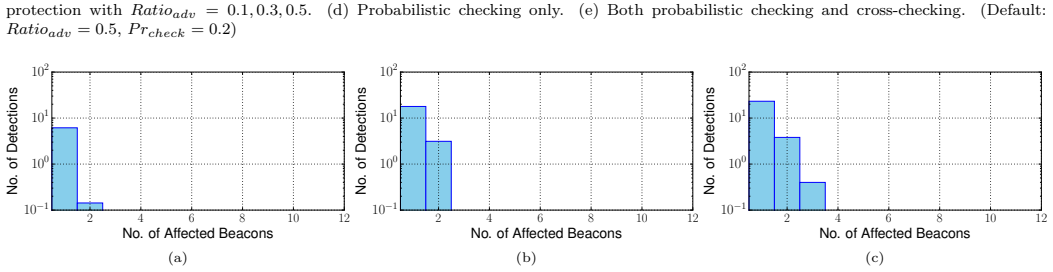
- The scheme detects and evicts misbehaving validators that try to certify bogus beacons: probabilistic signature checks plus cross-checking conflicting verifiers keep the number of falsely accepted beacons low.
Reading between the lines
- Beyond the paper: the quantified guarantees assume external adversaries flooding bogus signatures; a credentialed insider who floods properly signed beacons at high rate sits outside the model, and the cheap key-chain filter cannot distinguish those from legitimate load, so the under-1% expiration figure should not be read as covering that scenario.
- Beyond the paper: the facilitator pattern of cheap pre-filtering via chained keys and piggybacked verifiers followed by mandatory signature anchoring is transport-agnostic and could transfer to other broadcast-authentication domains such as drone swarms or mesh IoT, though the paper only argues for standardized vehicular communication.
- Beyond the paper: a natural testable extension is adaptive operation, running the baseline in lightly loaded neighborhoods and switching on facilitators only under load, which the paper identifies as future work; the expected benefit is avoiding the extra communication overhead in sparse conditions.
- Beyond the paper: because rising link rates increase the flood bandwidth available to attackers faster than signature verification costs drop, the scheme's advantage over per-message signature verification is likely to widen as communication technology advances.
Editorial analysis
A structured set of objections, weighed in public.
Referee Report
Summary. This paper proposes a DoS-resilient extension of standardized pseudonymous ECDSA-based authentication for V2X safety messages (CAMs and DENMs). The scheme combines: (i) per-pseudonym hash key chains whose disclosed elements allow receivers to cheaply filter beacons that do not carry the correct one-time key, and to validate earlier beacons of a discovered sender via MAC checks (Secs. 4.2.1-4.2.4); (ii) self-chained (SELF) verifiers, so one signature-verified beacon authenticates the sender's immediately preceding beacons (Sec. 4.2.5); (iii) cooperative (COOP) verifiers piggybacked on signature-verified beacons, which assert the validity of other beacons by digest and allow a receiver to accept a discovered node's beacon without checking its own signature, with probability 1-P_rcheck (Secs. 4.2.6, Algorithm 5); (iv) event-message facilitators carried in beacons to pre-announce DENMs and misbehavior evidence, which are themselves always signature-verified (Sec. 4.2.8); and (v) probabilistic re-checking and cross-checking of verifiers, with KRL and PRL lists, to detect malicious validators (Sec. 4.2.7).
Significance. Assuming the claims survive revision, this is a relevant contribution to V2X security. The cost asymmetry between generating and verifying bogus signatures is a real operational problem, and the facilitator constructs are a reasonable, concrete answer that goes beyond the authors' prior cooperative-verification work by also covering event-driven messages (DENMs), which the paper correctly identifies as a gap (Sec. 2, Challenge 3). The protocol is specified in unusual engineering detail: the beacon format, key-chain construction, queueing discipline, and CPU time allocation are all pinned down in Algorithms 1-5, which makes the scheme implementable and the evaluation meaningful. The evaluation uses a realistic simulation stack (OMNeT++, Veins, SUMO with the TAPASCologne trace), explicit parameters for verification delay, bitrate, DoS rate, and malicious-node ratios (Table 3), and it produces falsifiable predictions (e.g., median discovery delay under 0.5 s for alpha >= 3; expiration ratios near zero) under a declared default configuration. The paper also credits its own limitations honestly: Sec.
major comments (2)
- [Abstract; §5.4 (Theorem 2, Lemma 2); Alg. 5, lines 14-15; Alg. 2, lines 3-5] The abstract claims that 'any message acceptance is strictly based on public-key based message authentication/verification for accountability, i.e., non-repudiation is not sacrificed.' This is stronger than what the mechanisms deliver. In Algorithm 5 (lines 12-15), a COOP verifier piggybacked on a SIG/SELF-verified beacon causes the target beacon to be accepted or rejected according to the verifier's asserted validity with probability 1-P_rcheck, without the receiver checking the target's own ECDSA signature; Algorithm 2 (lines 3-5) does the same for a beacon in Queuecheck whose PC has meanwhile been discovered. Under the paper's own internal-adversary model (Sec. 6.3), the 'affected beacons' counted in Figs. 12-13 are precisely messages whose signatures were never verified, so the nominal sender of such a message is not bound by it. What Theorem 2 and Lemma 2 actually establish is the non-repudiation of the validating node's assertion (Lemma 2's wording, 'the sender of the latter cannot deny the validation of Bi,' and Theorem 2's 'traced back to the validation by a legitimate node' say exactly this), not the non-repudiation of the target message's sender. This distinction matters for the paper's headline contrast with TESLA/symmetric-key schemes (Sec. 2, Table 1): for a COOP-accepted beacon, the accepted message's own authenticator is not a signature that has been checked, and the sender could successfully deny authorship (for genuinely bogus beacons, the nominal PC holder is not even the author). The paper should (i) rephrase the abstract and Sec. 5.4 so the delivered property is stated as: every acceptance is supported by a chain rooted in signature verification, with sender-side non-repudiation guaranteed only for SIG/SELF-verified messages and for COOP-accepted messages only upon a later signature check, i.e., with the residual risk quantified in Sec. 6.3; and (ii) either prove that validator-side non-repudiation satisfies the Sec. 3.3 sender-accountability requirement, or explicitly qualify Table 1 and the contrast with [33] accordingly.
- [§3.2; §6.2; §6.5] The availability guarantee (50 ms, <1% expiration) is established only for the external bogus-signature flood. Section 3.2 excludes internal adversaries flooding with properly authenticated messages, with the justification that high frequency is 'trivially detected and attributed to each PC.' This is a defensible modeling choice, but the boundary deserves a precise statement. Algorithm 1's one-time-key checks (lines 7 and 18) do bound a single-PC authenticated flood to at most one queued beacon per time slot per receiver, so the scheme does not reduce entirely to the signature-verification baseline for that case; but the paper provides no mechanism, parameter, or evaluation for the frequency-based detection it invokes, and the residual case (an aggregate of many colluding compromised nodes, each flooding within its own valid PC and key chain, at combined rates above 1/tau) is unaddressed in both the model and the Discussion. Section 6.5 should state explicitly that the headline resilience numbers assume the Section 3.2 external adversary, and that the authenticated-flood case is deferred to a frequency-based detection layer outside the evaluated mechanisms; the conclusion's unconditional phrasing ('even under DoS attacks') should be scoped accordingly.
minor comments (7)
- [§4.2.1] The key-chain length is written as L = tau * gamma_max with tau denoting the PC validity period, but Table 2 defines tau as the average message verification delay; please rename one of the two (e.g., T_PC for the pseudonym validity period). Also correct the typo 'SHA-13' (clearly SHA-1) and the storage estimate: 864,000 x 20 bytes is approximately 17.3 MB, not 'around 14 MB.'
- [§6.1; §6.3] Only five seeded runs are averaged, and several plots (Figs. 9a-9c, 12, 13) show no variance information; it is also unclear whether the histograms in Figs. 12-13 aggregate pairs across all five runs or show a representative run. Please add confidence intervals or per-seed spreads for the headline metrics (waiting time, expiration ratio, discovery delay) and state the aggregation rule.
- [Abstract; §6.2] The headline numbers '50 ms' and 'less than 1% expiration' should be tied to the exact default configuration (alpha, P_rcheck, tau, bitrate, gamma_DoS), because the plots show the metrics vary with alpha and P_rcheck; the text currently leaves it ambiguous whether the numbers come from Figs. 8-9 with the default parameters, and some plotted configurations (e.g., alpha = 0) appear to show expiration ratios above 1%.
- [§6.2, Fig. 9d] The sentence about improvements with alpha > 0 and overlapping lines appears twice in succession ('There is slight improvement with alpha > 0... almost overlap with higher positive alpha values. Improvements with positive alpha values (i.e., alpha > 0) are still observable, while the lines almost overlap with higher positive alpha values.'); please remove the duplication.
- [§4.2.8; §6.4] A benign DENM whose facilitator was not cached (e.g., because the carrying beacon was lost) is dropped by design, and the scheme adds at least one beacon interval of dissemination latency to event messages. Please quantify the facilitator-loss failure mode in the benign scenario and discuss whether the added latency and the facilitator-loss vulnerability are acceptable for the most critical DENM categories, beyond the net-benefit argument given for the DoS case.
- [§6.5] The admission that the baseline is preferable in lightly loaded networks would be more actionable with a concrete switching criterion, e.g., compare measured arrival rate lambda_beacon to the verification capacity 1/tau; the paper currently leaves the criterion qualitative even though the relevant quantities are already used in Sec. 6.2.
- [§6.1] Consider releasing the simulation configuration and seeds so the quantitative claims can be independently reproduced; at a minimum, provide per-seed values for the default scenario's waiting time and expiration ratio.
Circularity Check
Non-repudiation claim is self-definitional: cooperative verification accepts beacons without target signature, and Theorem 2's traceability is just the acceptance rule.
-
self definitional
[Abstract; Sec. 4.2.6 Algorithm 5; Sec. 5.4 Lemma 2 / Theorem 2]
"Any message acceptance is strictly based on public-key based message authentication/verification for accountability, i.e., non-repudiation is not sacrificed, unlike symmetric key based approaches. ... Any successful message validation can be always traced back to the validation by a legitimate node in a non-repudiable manner."
Algorithm 5 (lines 14-15) accepts a COOP-verified beacon with probability 1-Prcheck based solely on the verifier's claimed validity, without verifying the target beacon's own ECDSA signature. Therefore Theorem 2's 'every successful validation traces to a legitimate node' is a restatement of the acceptance rule, not a cryptographic conclusion about the accepted message's sender. Sec. 3.3 requires sender non-repudiation ('Nodes should not be able to deny actions performed, thus messages sent'), but Lemma 2 only binds the node that issued the verifier. The abstract's central claim that acceptance is 'strictly based on public-key ...
full rationale
The quantitative DoS-resilience results are simulation outputs under explicitly stated parameters (OMNeT++/Veins, Table 3), not derived by fitting, so no fitted-input-called-prediction circularity is present. Self-citations are not load-bearing: [33] is explicitly not compared, and [23]/[30] provide background building blocks rather than the paper's conclusions. The only definitional circularity is the non-repudiation/accountability claim: the acceptance procedure defines 'validated' to include cooperative assertions from signature-verified carriers, so the theorem that all accepted messages are traceable to a legitimate node is true by construction. This proves accountability of the verifying node, not the non-repudiation of the accepted message's sender required in Sec. 3.3; the paper's headline claim that acceptance is 'strictly based on public-key' and non-repudiation is 'not sacrificed' therefore rests on a redefinition rather than a derivation. Because this affects a central security claim but not the main simulation-based performance findings, the score is 5 rather than higher.
Assumptions & free parameters
free parameters (5)
- alpha (number of COOP verifiers per beacon) =
3 (default; varied 0 to 4).
- k (number of SELF verifiers per beacon) =
3.
- P_rcheck (probabilistic signature re-check probability) =
0.2 (default; varied 0, 0.2, 0.5, 0.8).
- beta1 and beta2 (event facilitator and event repetition counts) =
beta1 = 1, beta2 = 3 (default; variants beta1 = 2, beta2 = 2 tested).
- RatioD and RatioND (CPU time allocation between discovered and non-discovered nodes) =
0.5 and 0.5.
assumptions (6)
- domain assumption ECDSA signatures and VPKI-issued pseudonymous certificates remain secure, with PCs having non-overlapping lifetimes.
- standard math The hash function H is second-preimage resistant, so one-time keys cannot be predicted or forged before disclosure.
- domain assumption External adversaries are limited to flooding with bogus signatures; internal adversaries with valid credentials are not considered for high-rate floods.
- domain assumption Only single-hop V2V transmissions are considered; multi-hop geocast is out of scope.
- domain assumption Message content validation and position verification are handled by orthogonal mechanisms.
- domain assumption The simulation setup with Tblife = 1 second, gamma = 10 Hz, tau = 0.4 to 4 ms, and 50% penetration approximates real deployment conditions.
invented entities (3)
-
Message verification facilitators (SELF and COOP verifiers)
-
Event message facilitator
-
Key Chain Revocation List (KRL)
Cite this review
Pith. "Pith review of Accountable, Scalable and DoS-resilient Secure Vehicular Communication." pith.science (2026). https://pith.science/paper/VVVZRG44
@misc{pith2026250522162,
  author       = {Pith},
  title        = {Pith review of: Accountable, Scalable and DoS-resilient Secure Vehicular Communication},
  year         = {2026},
  howpublished = {\url{https://pith.science/paper/VVVZRG44}},
  note         = {Machine review of arXiv:2505.22162}
}
read the original abstract
Paramount to vehicle safety, broadcasted Cooperative Awareness Messages (CAMs) and Decentralized Environmental Notification Messages (DENMs) are pseudonymously authenticated for security and privacy protection, with each node needing to have all incoming messages validated within an expiration deadline. This creates an asymmetry that can be easily exploited by external adversaries to launch a clogging Denial of Service (DoS) attack: each forged VC message forces all neighboring nodes to cryptographically validate it; at increasing rates, easy to generate forged messages gradually exhaust processing resources and severely degrade or deny timely validation of benign CAMs/DENMs. The result can be catastrophic when awareness of neighbor vehicle positions or critical reports are missed. We address this problem making the standardized VC pseudonymous authentication DoS-resilient. We propose efficient cryptographic constructs, which we term message verification facilitators, to prioritize processing resources for verification of potentially valid messages among bogus messages and verify multiple messages based on one signature verification. Any message acceptance is strictly based on public-key based message authentication/verification for accountability, i.e., non-repudiation is not sacrificed, unlike symmetric key based approaches. This further enables drastic misbehavior detection, also exploiting the newly introduced facilitators, based on probabilistic signature verification and cross-checking over multiple facilitators verifying the same message; while maintaining verification latency low even when under attack, trading off modest communication overhead. Our facilitators can also be used for efficient discovery and verification of DENM or any event-driven message, including misbehavior evidence used for our scheme.
Figures


Figures from the paper (11 more)



Reference graph
Works this paper leans on
-
[33]
H. Jin, P. Papadimitratos, Dos-resilient cooperative beacon ver- ification for vehicular communication systems, Ad Hoc Net- works 90 (2019) 101775
work page 2019
-
[1]
IEEE Std 1609.12, Ieee standard for wireless access in vehicular environments (wave) - identifier allocations (2016)
work page 2016
-
[2]
ETSI EN 302 637-2, ITS; Vehicular Communications; Basic Set of Applications; Part 2: Specification of Cooperative Awareness Basic Service (2019)
work page 2019
-
[3]
ETSI EN 302 637-3, ITS; Vehicular Communications; Basic Set of Applications; Part 3: Specifications of Decentralized Envi- ronmental Notification Basic Service (2019)
work page 2019
-
[4]
P. Papadimitratos, L. Buttyan, T. Holczer, E. Schoch, J. Freudi- ger, M. Raya, Z. Ma, F. Kargl, A. Kung, J.-P. Hubaux, Se- cure vehicular communication systems: Design and architec- ture, IEEE Communications Magazine 46 (11)
- [5]
-
[6]
P. Papadimitratos, A. La Fortelle, K. Evenssen, R. Brignolo, S. Cosenza, Vehicular communication systems: Enabling tech- nologies, applications, and future outlook on intelligent trans- portation, IEEE Communications Magazine 47 (11)
-
[7]
M. Khodaei, H. Jin, P. Papadimitratos, Towards deploying a scalable & robust vehicular identity and credential management infrastructure, in: IEEE VNC, Paderborn, Germany, 2014
work page 2014
Show all 64 references
-
[8]
Khodaei, P
M. Khodaei, P. Papadimitratos, The key to intelligent trans- portation: Identity and credential management in vehicular communication systems, IEEE VT Magazine 10 (4)
-
[9]
Khodaei, H
M. Khodaei, H. Jin, P. Papadimitratos, Secmace: Scalable and robust identity and credential management infrastructure in vehicular communication systems, IEEE Transactions on ITS 19 (5) (2018) 1430–1444
2018
-
[10]
I. S. 1609.2, Ieee standard for wireless access in vehicular environments–security services for applications and manage- ment messages, IEEE Std 1609.2-2016
2016
-
[11]
Calandriello, P
G. Calandriello, P. Papadimitratos, J.-P. Hubaux, A. Lioy, On the performance of secure vehicular communication systems, IEEE TDSC 8 (6) (2011) 898–912. 19
2011
-
[12]
Petit, Z
J. Petit, Z. Mammeri, Authentication and consensus overhead in vehicular ad hoc networks, Telecommunication systems 52 (4) (2013) 2699–2712
2013
-
[13]
M. A. R. Baee, L. Simpson, E. Foo, J. Pieprzyk, Broadcast authentication in latency-critical applications: On the efficiency of ieee 1609.2, IEEE TVT 68 (12) (2019) 11577–11587
2019
-
[14]
J. Pan, J. Cui, L. Wei, Y. Xu, H. Zhong, Secure data sharing scheme for vanets based on edge computing, EURASIP Journal on Wireless Communications and Networking 2019 (1)
2019
-
[15]
PRESER VE, Deliverable 3.2 fot trial 2 results (Jul. 2015)
2015
-
[16]
CAMP VSC5, Security credential management system proof-of- concept implementation - - ee requirements and specifications supporting scms software release 1.1 (May 2016)
2016
-
[17]
M. A. Mehrabi, A. Jolfaei, Efficient cryptographic hardware for safety message verification in internet of connected vehicles, ACM Transactions on Internet Technology 22 (4) (2022) 1–16
2022
-
[18]
Sepulcre, J
M. Sepulcre, J. Gozalvez, B. Coll-Perales, Why 6 mbps is not (always) the optimum data rate for beaconing in vehicular net- works, IEEE Transactions on Mobile Computing 16 (12)
-
[19]
CAR 2 CAR Communication Consortium, Survey on its-g5 cam statistics (Dec. 2018)
2018
-
[20]
Calandriello, P
G. Calandriello, P. Papadimitratos, J.-P. Hubaux, A. Lioy, Ef- ficient and robust pseudonymous authentication in vanet, in: ACM V ANET, New York, USA, 2007
2007
-
[21]
Schoch, F
E. Schoch, F. Kargl, On the efficiency of secure beaconing in vanets, in: ACM WiSec, Hoboken, NJ, 2010
2010
-
[22]
Feiri, J
M. Feiri, J. Petit, F. Kargl, Formal model of certificate omission schemes in vanet, in: IEEE VNC, Paderborn, Germany, 2014
2014
-
[23]
H. Jin, P. Papadimitratos, Proactive certificate validation for V ANETs, in: IEEE VNC, Columbus, OH, 2016
2016
-
[24]
Studer, F
A. Studer, F. Bai, B. Bellur, A. Perrig, Flexible, extensible, and efficient vanet authentication, Journal of Communications and Networks 11 (6) (2009) 574–588
2009
-
[25]
Hsiao, A
H.-C. Hsiao, A. Studer, C. Chen, A. Perrig, F. Bai, B. Bellur, A. Iyer, Flooding-resilient broadcast authentication for vanets, in: ACM MobiCom, Las Vegas, NV, 2011
2011
-
[26]
C. Lyu, D. Gu, Y. Zeng, P. Mohapatra, PBA: Prediction-Based Authentication for Vehicle-to-Vehicle Communications, IEEE TDSC 13 (1) (2016) 71–83
2016
-
[27]
Papadimitratos, V
P. Papadimitratos, V. Gligor, J.-P. Hubaux, Securing vehicular communications-assumptions, requirements, and principles, in: ESCAR, Berlin, Germany, 2006
2006
-
[28]
ETSI TR 102 893, Intelligent transport systems (its); security; threat, vulnerability and risk analysis (tvra) (2017)
2017
-
[29]
X. Lin, X. Li, Achieving efficient cooperative message authen- tication in vehicular ad hoc networks, IEEE Transactions on Vehicular Technology 62 (7) (2013) 3339–3348
2013
-
[30]
H. Jin, P. Papadimitratos, Scaling V ANET security through cooperative message verification, in: IEEE VNC, Japan, 2015
2015
-
[31]
M. Raya, P. Papadimitratos, V. D. Gligor, J.-P. Hubaux, On data-centric trust establishment in ephemeral ad hoc networks, in: IEEE INFOCOM, Phoenix, AZ, 2008
2008
-
[32]
Gisdakis, T
S. Gisdakis, T. Giannetsos, P. Papadimitratos, SHIELD: A Data Verification Framework for Participatory Sensing Systems, in: ACM WiSec, New York, NY, 2015
2015
-
[34]
Y.-c. Hu, K. P. Laberteaux, Strong vanet security on a budget, in: ESCAR, Berlin, Germany, 2006
2006
-
[35]
Dongre, H
S. Dongre, H. Rahbari, Message sieving to mitigate smart grid- lock attacks in v2v, in: ACM WiSec, 2021
2021
-
[36]
C. Sun, J. Liu, X. Xu, J. Ma, A privacy-preserving mutual authentication resisting dos attacks in vanets, IEEE Access 5 (2017) 24012–24022
2017
-
[37]
P. Liu, B. Liu, Y. Sun, B. Zhao, I. You, Mitigating dos attacks against pseudonymous authentication through puzzle-based co- authentication in 5g-vanet, IEEE Access 6 (2018) 20795–20806
2018
-
[38]
A. K. Lenstra, E. R. Verheul, Selecting cryptographic key sizes, Journal of cryptology 14 (2001) 255–293
2001
-
[39]
H. Jin, Z. Zhou, P. Papadimitratos, Future-proofing secure v2v communication against clogging dos attacks, in: ARES, 2024
2024
-
[40]
Hankerson, A
D. Hankerson, A. J. Menezes, S. Vanstone, Guide to elliptic curve cryptography, Springer Science & Business Media, 2006
2006
-
[41]
Perrig, R
A. Perrig, R. Canetti, J. D. Tygar, D. Song, Efficient authenti- cation and signing of multicast streams over lossy channels, in: IEEE Symposium on Security and Privacy, San Francisco, CA, 2000
2000
-
[42]
Q. Dong, D. Liu, P. Ning, Providing dos resistance for signature- based broadcast authentication in sensor networks, ACM Trans. on Embedded Computing Systems 12 (3) (2013) 73
2013
-
[43]
Givehchian, N
H. Givehchian, N. Bhaskar, A. Redding, H. Zhao, A. Schulman, D. Bharadia, Practical obfuscation of ble physical-layer finger- prints on mobile devices, in: IEEE Symposium on Security and Privacy, San Francisco, CA, 2024
2024
-
[44]
Von Ahn, B
L. Von Ahn, B. Maurer, C. McMillen, D. Abraham, M. Blum, recaptcha: Human-based character recognition via web security measures, Science 321 (5895) (2008) 1465–1468
2008
-
[45]
Twardokus, H
G. Twardokus, H. Rahbari, Vehicle-to-nothing? securing c-v2x against protocol-aware dos attacks, in: IEEE INFOCOM, 2022
2022
-
[46]
CAMP VSC2, Vehicle safety communications - applications (vsc-a) final report (Sep. 2011)
2011
-
[47]
J. B. Kenney, Dedicated short-range communications (dsrc) standards in the united states, Proceedings of the IEEE 99 (7) (2011) 1162–1182
2011
-
[48]
Petit, F
J. Petit, F. Schaub, M. Feiri, F. Kargl, Pseudonym schemes in vehicular networks: A survey, IEEE communications surveys & tutorials 17 (1) (2015) 228–255
2015
-
[49]
Festag, P
A. Festag, P. Papadimitratos, T. Tielert, Design and Perfor- mance of Secure Geocast for Vehicular Communication, IEEE TVT 59 (5) (2010) 2456–2471
2010
-
[50]
F. A. Teixeira, V. F. e Silva, J. L. Leoni, D. F. Macedo, J. M. Nogueira, Vehicular networks using the ieee 802.11 p standard: An experimental analysis, Vehicular Communications 1 (2) (2014) 91–96
2014
-
[51]
Chang, H.-C
C.-Y. Chang, H.-C. Yen, D.-J. Deng, V2V QoS guaranteed channel access in IEEE 802.11 p V ANETs, IEEE TDSC 13 (1)
-
[52]
Fiore, C
M. Fiore, C. E. Casetti, C. F. Chiasserini, P. Papadimitratos, Discovery and Verification of Neighbor Positions in Mobile Ad Hoc Networks, IEEE TMC 12 (2) (2013) 289–303
2013
-
[53]
Poturalski, P
M. Poturalski, P. Papadimitratos, J. P. Hubaux, Formal Anal- ysis of Secure Neighbor Discovery in Wireless Networks, IEEE TDSC 10 (6) (2013) 355–367
2013
-
[54]
ETSI EN 302 637-2, Intelligent transport systems; vehicular communications; basic set of applications; part 2: Specification of cooperative awareness basic service (Nov. 2014)
2014
-
[55]
Stevens, E
M. Stevens, E. Bursztein, P. Karpman, A. Albertini, Y. Markov, The first collision for full sha-1, in: CRYPTO, Santa Barbara, CA, 2017, pp. 570–596
2017
-
[56]
M. Raya, P. Papadimitratos, I. Aad, D. Jungels, J.-P. Hubaux, Eviction of misbehaving and faulty nodes in vehicular networks, IEEE JSAC 25 (8) (2007) 1557–1568
2007
-
[57]
Nguyen, H.-Y
H.-H. Nguyen, H.-Y. Jeong, Mobility-adaptive beacon broad- cast for vehicular cooperative safety-critical applications, IEEE Transactions on ITS 19 (6) (2018) 1996–2010
2018
-
[58]
Varga, R
A. Varga, R. Hornig, An overview of the omnet++ simulation environment, in: SIMUTOOLS, Marseille, France, 2008
2008
-
[59]
Sommer, R
C. Sommer, R. German, F. Dressler, Bidirectionally Coupled Network and Road Traffic Simulation for Improved IVC Anal- ysis, IEEE TMC 10 (1) (2011) 3–15
2011
-
[60]
Krajzewicz, J
D. Krajzewicz, J. Erdmann, M. Behrisch, L. Bieker, Recent development and applications of SUMO - Simulation of Urban MObility, International Journal On Advances in Systems and Measurements 5 (3&4) (2012) 128–138
2012
-
[61]
Uppoor, O
S. Uppoor, O. Trullols-Cruces, M. Fiore, J. M. Barcelo-Ordinas, Generation and analysis of a large-scale urban vehicular mobil- ity dataset, IEEE TMC 13 (5) (2013) 1061–1075
2013
-
[62]
C2C-CC, Triggering conditions and data quality exchange of ircs (Aug. 2018)
2018
-
[63]
Triwinarko, I
A. Triwinarko, I. Dayoub, S. Cherkaoui, Phy layer enhance- ments for next generation v2x communication, Vehicular Com- munications 32 (2021) 100385. 20
2021
-
[64]
C.-X. Wang, J. Huang, H. Wang, X. Gao, X. You, Y. Hao, 6g wireless channel measurements and models: Trends and chal- lenges, IEEE Vehicular Technology Magazine 15 (4). 21
Reviewed August 7, 2026 · model on record in the stance chip above.
Discussion (0). Sign in to comment.