REVIEW 2 major objections 5 minor 73 references
Thermal Modeling and Optimal Allocation of Avionics Safety-critical Tasks on Heterogeneous MPSoCs
T0 review · 2 major / 5 minor · reviewed 2026-08-07 · deepseek-v4-flash
Pith's one-line read Software-only task placement can cut MPSoC temperature by up to 5.5 °C in safety-critical avionics workloads.
desk verdict New problem formulation with real-hardware validation, but the temperature superiority claim needs more statistical support. read the letter →
The pith
A machine-rendered reading of the paper's core claim, the machinery that carries it, and where it could break.
The reading
What carries the argument
The load-bearing object is the Sum-Max power model, which predicts a window's average power as the sum over clusters of per-task dynamic coefficients scaled by duty cycle, plus the largest static offset among tasks running in the window, plus idle power. A large-constant linearization turns the max term into linear constraints, so the whole allocation problem becomes an integer linear program whose objective is estimated average power over the major frame. The argument is carried by the combination of this linearized objective with the ARINC-653 window constraints, together with the steady-state single-output thermal relation that links average power to temperature linearly.
What would settle it
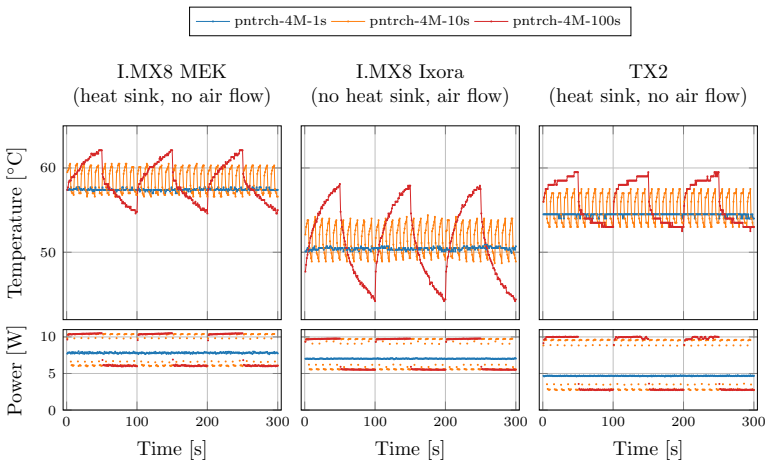
Run the same benchmark suite with a 100-second major frame instead of a one-second frame and compare measured steady-state temperatures of the ILP-SM and ILP-IDLE-MAX schedules; if the gap disappears or the ordering reverses, the linear average-power-to-temperature assumption that carries the method is violated in that regime. A more direct check is to compare the schedules' ranking by measured big-cluster temperature against their ranking by average power across many workloads with sub-second frames.
Extended reading notes
Core claim
The central claim is that minimizing a carefully chosen estimate of average power consumption, specifically the empirical Sum-Max power model, is the right objective for minimizing steady-state on-chip temperature under ARINC-653 temporal isolation. The paper reports that ILP-SM outperformed all other tested methods on all three platforms in nearly every instance, achieving up to 5.5 °C lower steady-state temperature than the worst uninformed idle-time optimizer and saving up to 1.6 °C over a simple greedy heuristic. A secondary finding is that the more accurate linear-regression power model led to worse optimization outcomes than the less accurate but consistently pessimistic Sum-Max model, which the authors attribute to the latter preserving the ordering between schedules even while overestimating power. The paper also establishes the formal hardness of the allocation problem and identifies a polynomial-time subproblem.
Load-bearing premise
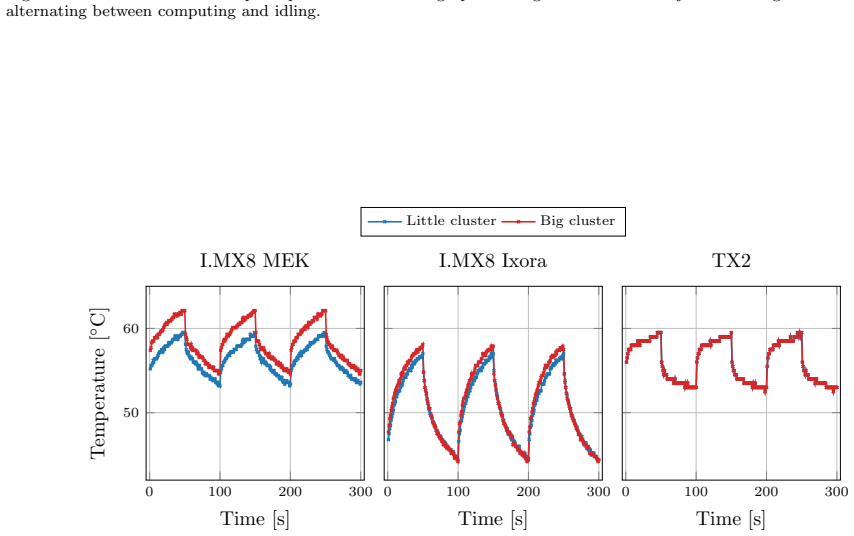
The argument depends on a steady-state, single-output thermal model in which average power maps linearly to temperature near the big cluster, so that minimizing estimated average power also minimizes measured temperature; the paper validates this mainly for short major frames around one second, and longer frames show transient heating and cooling that this model ignores.
Editorial extensions
If this is right
- On the three tested platforms, switching from the worst uninformed schedule to ILP-SM lowers steady-state temperature by up to 5.5 °C, a 22 % reduction relative to ambient temperature.
- The best-performing methods all use the Sum-Max model even though the linear-regression model has lower prediction error, so model-optimizer harmony matters more than raw model accuracy.
- A genetic-algorithm variant using the same Sum-Max model is nearly as good as ILP-SM and scales better, and it does not require a commercial solver.
- Fixing window lengths renders the decision problem polynomial via Minimum Cost Flow, which offers a route to scalable decomposition methods for larger task sets.
Reading between the lines
- Editorial inference: the ordering-preserving property of the Sum-Max model may transfer to other heterogeneous platforms, but only if the per-task coefficients are re-measured; the 5.5 °C gap is platform- and workload-specific.
- Editorial inference: if major frames grow to tens of seconds, the steady-state assumption weakens and the temperature ranking of schedules may change; the paper's own 100-second experiments suggest such a regime exists.
- Editorial inference: the minimum-cost-flow subproblem could be embedded in a logic-based Benders decomposition to scale beyond the tested instances, which the authors mention as future work.
- Editorial inference: the same design pattern, choose an upper-bound power model that preserves schedule ordering, could apply to other safety-critical standards with temporal partitioning, such as automotive or industrial systems.
Editorial analysis
A structured set of objections, weighed in public.
Referee Report
Summary. The paper studies offline thermal-aware allocation of periodic safety-critical tasks on heterogeneous MPSoCs running at fixed clock frequency under ARINC-653 temporal isolation. It formalizes an ARINC allocation problem, proves weak NP-hardness by reduction from PARTITION, and shows that the fixed-window-length variant is solvable in polynomial time via minimum-cost flow. It then introduces three power models (empirical Sum-Max, linear regression, and an upper-bound variant LR-UB) and integrates them into several optimizers, including ILP, QP, genetic-algorithm black-box search, a greedy heuristic, and two uninformed idle-time ILP formulations. The experimental evaluation on three platforms (i.MX8 MEK, i.MX8 Ixora, TX2) measures both power and steady-state temperature, reporting that the ILP-SM method, which minimizes the Sum-Max power model, achieves the lowest temperature among all compared methods, with up to 5.5 °C difference from the worst method.
Significance. If the empirical claims hold, this is a practically valuable result: it shows that software-only task placement under ARINC-653 isolation can reduce MPSoC operating temperature on real hardware, with a sober trade-off analysis showing that a simpler but consistently biased power model (SM) outperforms a more accurate regression model (LR) when integrated into optimization. The complexity results are clean and strengthen the paper's contribution by delineating the NP-hard core from the polynomially solvable fixed-window subproblem. The paper also has notable reproducibility strengths: the authors release their scheduler, measured data, and optimization code, and they report a substantial measurement campaign (three platforms, roughly 100 hours of power measurements and 42 hours of schedule evaluation per platform). The main weakness is that the headline temperature-based superiority claim rests on only six random instances per condition without error bars or significance testing, and the measured temperature differences among the best methods are small relative to the reported spatial and sensor variability.
major comments (2)
- [Section 7.5, Figure 13] The central claim that ILP-SM outperforms all other methods in steady-state temperature is based on averages over only six randomly generated instances per workload type per platform, with no error bars, confidence intervals, or significance tests. The reported advantages over the HEUR baseline (1.6 °C, 1.3 °C, and 0.6 °C on the three platforms) are small relative to the per-instance scatter visible in the power-offset data of Table 5 (for example, on TX2 mixed workloads, HEUR's power offset is equal to or lower than ILP-SM's in instances 3 and 5). Provide per-schedule measured temperature data or paired significance tests across the six instances to support the claim that ILP-SM is statistically better in temperature, not merely better on average.
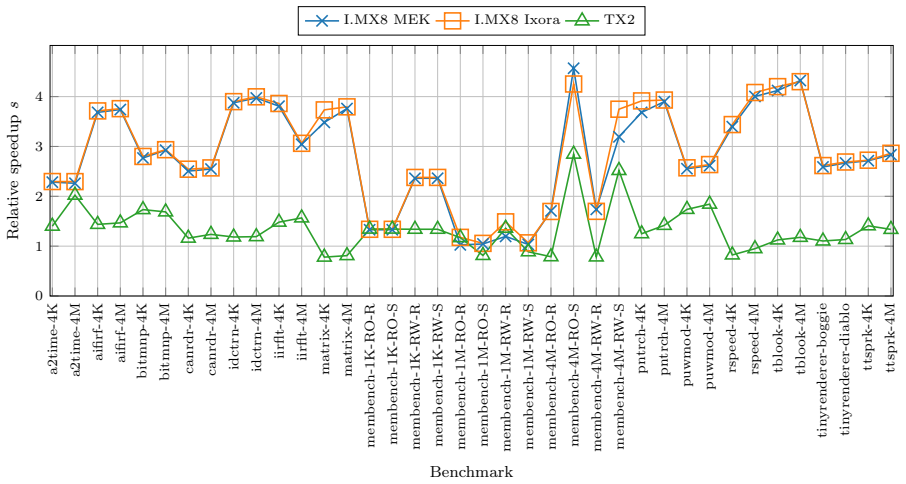
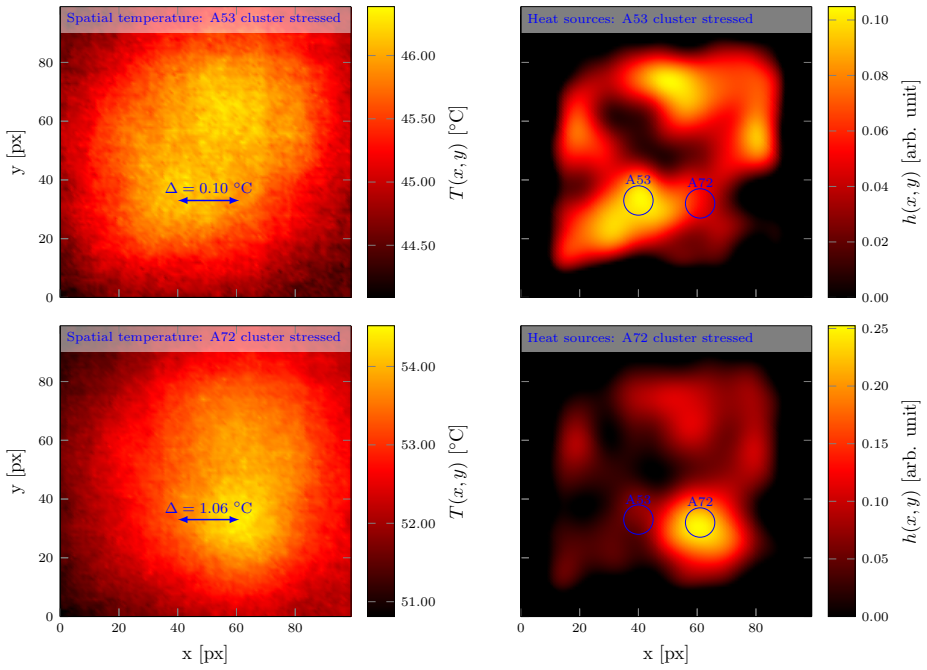
- [Section 7.2 and Eq. (3)] The linear relation between average power and steady-state temperature is validated in Figure 10 over a wide power span (roughly 2-12 W), but the differences among optimized schedules are only about 0.2-1.5 W in average power (Table 5). Since Figure 13 reports directly measured temperatures, the evaluation is not circular, but the manuscript does not demonstrate that these small power offsets translate into measured temperature differences that are distinguishable from measurement noise. This is compounded by Section 7.1.2, which reports a ~1 °C spatial temperature difference between stressing the big and little clusters at comparable total power; the single-output model in Eq. (3) ignores this spatial degree of freedom, and 1 °C is the same order as the claimed 0.6-1.6 °C advantages over HEUR. A direct per-schedule power-versus-temperature scatter for the evaluated schedules, or per-schedule temperature tables, would substantiate the temperature-based ranking.
minor comments (5)
- [Section 8] The percentage reductions reported in the conclusion ("up to 16%, 14% and 10%") are inconsistent with Section 7.5, which reports 22%, 19.6%, and 14.4% relative to ambient temperature for the same worst-to-best comparison. Clarify the basis for each percentage.
- [Section 7.4] The statement that the SM model "steadily provides an upper bound on the measured power consumption" is stronger than the evidence presented: Table 3 reports mean absolute error but not the frequency or magnitude of underestimation, and no formal bound is proven. Either soften the wording or quantify the proportion of instances where SM underestimates the measured power.
- [Appendix D] The schedule illustration labels one method as "ILP-SM-I" while the main text and tables use "ILP-SM"; please make the notation consistent.
- [Throughout] There are several typos, including "uniformed heuristics" (should be "uninformed heuristics") in Section 1, "major fame" (should be "major frame") in Section 7.1.1, and "I.MX8 MEX" (should be "I.MX8 MEK") in Section 7.4.
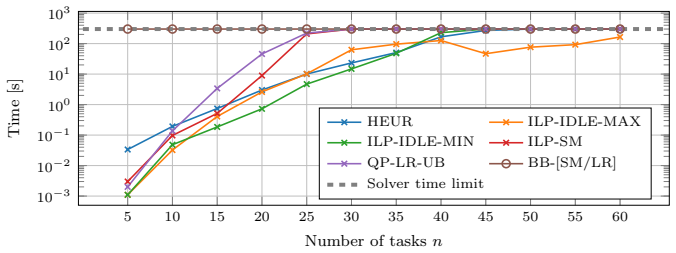
- [Figure 14] The legend entry "BB-[SM/LR]" is not defined in the caption or text; specify that it denotes both BB-SM and BB-LR.
Circularity Check
No significant circularity; the optimization comparison is evaluated on measured physical temperature against independently fitted power models.
full rationale
I found no circularity in the claimed derivation chain. The SM and LR power model coefficients are fitted from measured power data in Section 7.3, and the model predictions are then checked against held-out measured power in Section 7.4, not against the training data. The central comparison in Section 7.5 is based on measured steady-state temperature on three physical platforms, so the claim that ILP-SM outperforms other methods in reducing temperature is not an evaluation of the fitted model against its own fit. Equation (3) is a modeling assumption that relates average power to steady-state temperature; it could be under-validated for the small power differences among optimized schedules, but that is an external-validity or correctness concern rather than a circularity. The self-citations to the authors' earlier work [27] for the SM model and to [39] for the testbed are used as prior context, and the SM model is fully re-derived and empirically fitted within this paper, so no load-bearing argument reduces to an unverified self-citation.
Assumptions & free parameters
free parameters (2)
- SM task coefficients a_i,k and o_i,k =
Tables B.7/B.8, e.g., canrdr-4M on I.MX8 MEK little cluster: a=0.41, o=1.36
- LR regression coefficients beta_k,r =
Table 2, e.g., I.MX8 MEK: beta_1,1=1.205, beta_2,1=0.270, beta_1,2=0.969, beta_2,2=0.456
assumptions (5)
- domain assumption Steady-state, single-output thermal model: T = P/B + G*Tamb/B (Eq. 3)
- domain assumption Average power is linearly related to steady-state temperature and leakage power is negligible
- domain assumption Tasks are independent, non-preemptive, periodic, share a common period h, and have deadline h
- domain assumption DVFS is forbidden and clock frequencies are fixed
- ad hoc to paper The Sum-Max model's structural form (z*a_i,k + o_i,k + P_idle for parallel instances) is valid
Cite this review
Pith. "Pith review of Thermal Modeling and Optimal Allocation of Avionics Safety-critical Tasks on Heterogeneous MPSoCs." pith.science (2026). https://pith.science/paper/GZ6WC2YV
@misc{pith2026250522214,
  author       = {Pith},
  title        = {Pith review of: Thermal Modeling and Optimal Allocation of Avionics Safety-critical Tasks on Heterogeneous MPSoCs},
  year         = {2026},
  howpublished = {\url{https://pith.science/paper/GZ6WC2YV}},
  note         = {Machine review of arXiv:2505.22214}
}
read the original abstract
Multi-Processor Systems-on-Chip (MPSoC) can deliver high performance needed in many industrial domains, including aerospace. However, their high power consumption, combined with avionics safety standards, brings new thermal management challenges. This paper investigates techniques for offline thermal-aware allocation of periodic tasks on heterogeneous MPSoCs running at a fixed clock frequency, as required in avionics. The goal is to find the assignment of tasks to (i) cores and (ii) temporal isolation windows while minimizing the MPSoC temperature. To achieve that, we propose and analyze three power models, and integrate them within several novel optimization approaches based on heuristics, a black-box optimizer, and Integer Linear Programming (ILP). We perform the experimental evaluation on three popular MPSoC platforms (NXP i.MX8QM MEK, NXP i.MX8QM Ixora, NVIDIA TX2) and observe a difference of up to 5.5{\deg}C among the tested methods (corresponding to a 22% reduction w.r.t. the ambient temperature). We also show that our method, integrating the empirical power model with the ILP, outperforms the other methods on all tested platforms.
Figures


Figures from the paper (11 more)




Reference graph
Works this paper leans on
-
[1]
C. B. Watkins, R. Walter, Transitioning from federated avionics architectures to Integrated Modular Avionics, in: 2007 IEEE/AIAA 26th Digital Avionics Systems Conference, 2007, pp. 2.A.1–1–2.A.1–10.doi:10.1109/DASC.2007.4391842. URLhttps://ieeexplore.ieee.org/abstract/document/4391842
-
[2]
Avionics Application Software Standard Interface, Part 1, Required Services, ARINC Specification 653 Part 1 Supplement 4 (653P1-4) (2015)
work page 2015
- [3]
-
[4]
A. T. A. Dugo, J.-B. Lefoul, F. G. De Magalhaes, D. Assal, G. Nicolescu, Cache locking content selection algorithms for ARINC-653 compliant RTOS, ACM Trans. Embed. Comput. Syst. 18 (5s).doi:10.1145/3358196. URLhttps://doi.org/10.1145/3358196
-
[5]
P. Han, Z. Zhai, B. Nielsen, U. Nyman, Model-based optimization of ARINC-653partition scheduling, International Journal on Software Tools for Technology Transfer 23 (2021) 1–20.doi:10.1007/s10009-020-00597-6
-
[6]
B. Potteiger, A. Dubey, F. Cai, X. Koutsoukos, Z. Zhang, Moving target defense for the security and resilience of mixed time and event triggered cyber–physical systems, Journal of Systems Architecture 125 (2022) 102420,https://www. sciencedirect.com/science/article/pii/S1383762122000212.doi:10.1016/j.sysarc.2022.102420
arXiv 2022
-
[7]
C. E. Salloum, M. Elshuber, O. H¨ oftberger, H. Isakovic, A. Wasicek, The across mpsoc – a new generation of multi-core processors designed for safety-critical embedded systems, in: 2012 15th Euromicro Conference on Digital System Design, 2012, pp. 105–113.doi:10.1109/DSD.2012.126
-
[8]
G. Lentaris, K. Maragos, I. Stratakos, L. Papadopoulos, O. Papanikolaou, D. Soudris, M. Lourakis, X. Zabulis, D. Gonzalez-Arjona, G. Furano, High-performance embedded computing in space: Evaluation of platforms for vision- based navigation, Journal of Aerospace Information Systems 15 (4) (2018) 178–192.arXiv:https://doi.org/10.2514/1. I010555,doi:10.2514/...
doi:10.2514/1 2018
Show all 73 references
-
[9]
Lakshminarayanan, N
V. Lakshminarayanan, N. Sriraam, The effect of temperature on the reliability of electronic components, in: 2014 IEEE International Conference on Electronics, Computing and Communication Technologies (CONECCT), 2014, pp. 1–6.doi: 10.1109/CONECCT.2014.6740182
2014
-
[11]
Zhuravlev, J
S. Zhuravlev, J. C. Saez, S. Blagodurov, A. Fedorova, M. Prieto, Survey of energy-cognizant scheduling techniques, IEEE Transactions on Parallel and Distributed Systems 24 (7) (2013) 1447–1464.doi:10.1109/TPDS.2012.20
2013 doi
-
[12]
K. Pi, S. Ghosh, K. Khan, P. Bikki, A fully differential operational amplifier with slew rate enhancer and adaptive bias for ultra low power, Journal of Low Power Electronics 13 (2017) 67–75.doi:10.1166/jolpe.2017.1467
2017
-
[13]
Huang, S
W. Huang, S. Ghosh, S. Velusamy, K. Sankaranarayanan, K. Skadron, M. Stan, Hotspot: A compact thermal modeling methodology for early-stage vlsi design, IEEE Transactions on Very Large Scale Integration Systems - VLSI 14 (2006) 501–513.doi:10.1109/TVLSI.2006.876103
2006
-
[14]
C. Yoon, S. Lee, Y. Choi, R. Ha, H. Cha, Accurate power modeling of modern mobile application processors, Journal of Systems Architecture 81 (2017) 17–31.doi:https://doi.org/10.1016/j.sysarc.2017.10.001
2017 doi
-
[15]
J. Zhou, T. Wei, M. Chen, J. Yan, X. S. Hu, Y. Ma, Thermal-Aware Task Scheduling for Energy Minimization in Heterogeneous Real-Time MPSoC Systems, IEEE Transactions on Computer-Aided Design of Integrated Circuits and Systems 35 (8) (2016) 1269–1282.doi:10.1109/TCAD.2015.2501286
2016
-
[16]
Chien, R.-G
T.-H. Chien, R.-G. Chang, A thermal-aware scheduling for multicore architectures, Journal of Systems Architecture 62 (2016) 54–62.doi:https://doi.org/10.1016/j.sysarc.2015.12.003
2016 doi
-
[17]
J. Zhou, J. Yan, K. Cao, Y. Tan, T. Wei, M. Chen, G. Zhang, X. Chen, S. Hu, Thermal-aware correlated two-level scheduling of real-time tasks with reduced processor energy on heterogeneous mpsocs, Journal of Systems Architecture 82 (2018) 1–11.doi:https://doi.org/10.1016/j.sysa...
2018 doi
-
[18]
Z. Wu, L. Han, J. Liu, Y. Robert, F. Vivien, Energy-aware mapping and scheduling strategies for real-time workflows under reliability constraints, Journal of Parallel and Distributed Computing 176 (2023) 1–16.doi:10.1016/j.jpdc.2023.02.004. URLhttps://www.sciencedirect.com/sci...
2023 doi
-
[19]
H. Xu, B. Zhang, C. Pan, K. Li, Energy-efficient triple modular redundancy scheduling on heterogeneous multi-core real- time systems, Journal of Parallel and Distributed Computing 191 (2024) 104915.doi:10.1016/j.jpdc.2024.104915. URLhttps://www.sciencedirect.com/science/articl...
2024
-
[20]
Schieber, B
B. Schieber, B. Samineni, S. Vahidi, Interweaving Real-Time Jobs with Energy Harvesting to Maximize Throughput, in: C.-C. Lin, B. M. T. Lin, G. Liotta (Eds.), W ALCOM: Algorithms and Computation, Springer Nature Switzerland, Cham, 2023, pp. 305–316.doi:10.1007/978-3-031-27051-2_26
2023 doi
-
[21]
X. Li, Z. Li, W. Zhou, Z. Duan, Accurate on-chip temperature sensing for multicore processors using embedded thermal sensors, IEEE Transactions on Very Large Scale Integration (VLSI) Systems 28 (11) (2020) 2328–2341.doi:10.1109/ TVLSI.2020.3012833
2020
-
[22]
Sadiqbatcha, J
S. Sadiqbatcha, J. Zhang, H. Amrouch, S. X.-D. Tan, Real-time full-chip thermal tracking: A post-silicon, machine learning perspective, IEEE Transactions on Computers 71 (6) (2022) 1411–1424.doi:10.1109/TC.2021.3086112
2022
-
[23]
Fakih, A
M. Fakih, A. Lenz, M. Azkarate-Askasua, J. Coronel, A. Crespo, S. Davidmann, J. C. Diaz Garcia, N. G. Romero, K. Gr¨ uttner, S. Schreiner, R. Seyyedi, R. Obermaisser, A. Maleki, J. ¨Oberg, M. T. Mohammadat, J. P´ erez-Cerrolaza, I. Sander, I. S¨ oderquist, SAFEPOWER project: A...
2017 doi
-
[24]
URLhttps://www.nxp.com/design/development-boards/i-mx-evaluation-and-development-boards/ i-mx-8quadmax-multisensory-enablement-kit-mek:MCIMX8QM-CPU
NXP, i.MX 8QuadMax/QuadPlus Multisensory Enablement Kit (2021). URLhttps://www.nxp.com/design/development-boards/i-mx-evaluation-and-development-boards/ i-mx-8quadmax-multisensory-enablement-kit-mek:MCIMX8QM-CPU
2021
-
[25]
NXP, I.MX 8QuadMax Applications Processor (Sep. 2021). URLhttps://www.nxp.com/webapp/Download?colCode=IMX8QMRM
2021
-
[26]
URLhttps://developer.nvidia.com/embedded/jetson-tx2-developer-kit
NVIDIA, Harness ai at the edge with the jetson tx2 developer kit (2022). URLhttps://developer.nvidia.com/embedded/jetson-tx2-developer-kit
2022
-
[27]
Benedikt, M
O. Benedikt, M. Sojka, P. Zaykov, D. Hornof, M. Kafka, P. ˇS ˚ ucha, Z. Hanz´ alek, Thermal-aware scheduling for mpsoc in the avionics domain: Tooling and initial results, in: 2021 IEEE 27th International Conference on Embedded and Real-Time Computing Systems and Applications ...
2021
-
[28]
Tama¸ s-Selicean, P
D. Tama¸ s-Selicean, P. Pop, Optimization of time-partitions for mixed-criticality real-time distributed embedded systems, in: 2011 14th IEEE International Symposium on Object/Component/Service-Oriented Real-Time Distributed Computing Workshops, 2011, pp. 1–10.doi:10.1109/ISOR...
2011 doi
-
[29]
T˘ ama¸ s-Selicean, P
D. T˘ ama¸ s-Selicean, P. Pop, Design optimization of mixed-criticality real-time embedded systems, ACM Trans. Embed. Comput. Syst. 14 (3).doi:10.1145/2700103. URLhttps://doi.org/10.1145/2700103
-
[30]
Waszniowski, J
L. Waszniowski, J. Kr´ akora, Z. Hanz´ alek, Case study on distributed and fault tolerant system modeling based on timed automata, Journal of Systems and Software 82 (10) (2009) 1678–1694, sI: YAU.doi:https://doi.org/10.1016/j.jss. 2009.04.042. URLhttps://www.sciencedirect.com...
2009 doi
-
[31]
J. Chen, C. Du, P. Han, Scheduling independent partitions in integrated modular avionics systems, PLOS ONE 11 (12) (2016) 1–18.doi:10.1371/journal.pone.0168064. URLhttps://doi.org/10.1371/journal.pone.0168064
2016 doi
-
[32]
Chen, C.-F
J.-J. Chen, C.-F. Kuo, Energy-Efficient Scheduling for Real-Time Systems on Dynamic Voltage Scaling (DVS) Platforms, in: 13th IEEE International Conference on Embedded and Real-Time Computing Systems and Applications (RTCSA 2007), 2007, pp. 28–38.doi:10.1109/RTCSA.2007.37. URL...
2007
-
[33]
Fisher, J.-J
N. Fisher, J.-J. Chen, S. Wang, L. Thiele, Thermal-aware global real-time scheduling and analysis on multicore systems, Journal of Systems Architecture 57 (5) (2011) 547–560.doi:10.1016/j.sysarc.2010.09.010
2011 doi
-
[34]
M. E. T. Gerards, J. L. Hurink, P. K. F. H¨ olzenspies, A survey of offline algorithms for energy minimization under deadline constraints, Journal of Scheduling 19 (1) (2016) 3–19.doi:10.1007/s10951-015-0463-8
2016 doi
-
[35]
Perez Rodriguez, P
J. Perez Rodriguez, P. Meumeu Yomsi, Thermal-aware schedulability analysis for fixed-priority non-preemptive real-time systems, in: 2019 IEEE Real-Time Systems Symposium (RTSS), 2019, pp. 154–166.doi:10.1109/RTSS46320.2019.00024
2019
-
[36]
URLhttp://developer.nvidia.com/embedded/dlc/jetson-tx2-series-thermal-design-guide
NVIDIA, Jetson TX2 Series Thermal Design Guide (TDG-09420-001 v1.0) (2019). URLhttp://developer.nvidia.com/embedded/dlc/jetson-tx2-series-thermal-design-guide
2019
-
[37]
Manna, P
K. Manna, P. Mukherjee, S. Chattopadhyay, I. Sengupta, Thermal-Aware Application Mapping Strategy for Network-on- Chip Based System Design, IEEE Transactions on Computers 67 (4) (2018) 528–542.doi:10.1109/TC.2017.2770130
2018
-
[38]
Kanduri, M
A. Kanduri, M. Haghbayan, A. M. Rahmani, M. Shafique, A. Jantsch, P. Liljeberg, adBoost: Thermal Aware Performance Boosting Through Dark Silicon Patterning, IEEE Transactions on Computers 67 (8) (2018) 1062–1077.doi:10.1109/TC. 2018.2805683
2018
-
[39]
Sojka, O
M. Sojka, O. Benedikt, Z. Hanz´ alek, P. Zaykov, Testbed for thermal and performance analysis in mpsoc systems, in: 2020 15th Conference on Computer Science and Information Systems (FedCSIS), 2020, pp. 683–692.doi:10.15439/2020F174
2020 doi
-
[40]
G. Ara, T. Cucinotta, A. Mascitti, Simulating execution time and power consumption of real-time tasks on embedded platforms, in: Proceedings of the 37th ACM/SIGAPP Symposium on Applied Computing, SAC ’22, Association for Computing Machinery, New York, NY, USA, 2022, pp. 491–50...
2022
-
[41]
G. Chen, K. Huang, A. Knoll, Energy optimization for real-time multiprocessor system-on-chip with optimal DVFS and DPM combination, ACM Transactions on Embedded Computing Systems 13 (3s) (2014) 111:1–111:21.doi:10.1145/ 2567935
2014
-
[42]
J. Zhou, J. Sun, P. Cong, Z. Liu, X. Zhou, T. Wei, S. Hu, Security-Critical Energy-Aware Task Scheduling for Hetero- geneous Real-Time MPSoCs in IoT, IEEE Transactions on Services Computing 13 (4) (2020) 745–758, conference Name: IEEE Transactions on Services Computing.doi:10....
2020
-
[43]
Salami, H
B. Salami, H. Noori, F. Mehdipour, M. Baharani, Physical-aware predictive dynamic thermal management of multi-core processors, Journal of Parallel and Distributed Computing 95 (2016) 42–56.doi:10.1016/j.jpdc.2016.03.008
2016 doi
-
[44]
Balsini, L
A. Balsini, L. Pannocchi, T. Cucinotta, Modeling and simulation of power consumption and execution times for real- time tasks on embedded heterogeneous architectures, ACM SIGBED Review 16 (3) (2019) 51–56.doi:10.1145/3373400. 3373408
2019 doi
-
[45]
Shahid, M
A. Shahid, M. Fahad, R. R. Manumachu, A. Lastovetsky, Improving the accuracy of energy predictive models for multicore CPUs by combining utilization and performance events model variables, Journal of Parallel and Distributed Computing 151 (2021) 38–51.doi:10.1016/j.jpdc.2021.01.007
2021 doi
-
[46]
Zhang, A
K. Zhang, A. Guliani, S. Ogrenci-Memik, G. Memik, K. Yoshii, R. Sankaran, P. Beckman, Machine Learning-Based Temperature Prediction for Runtime Thermal Management Across System Components, IEEE Transactions on Parallel and Distributed Systems 29 (2) (2018) 405–419.doi:10.1109/...
2018
-
[47]
D. D. Cofer, M. Rangarajan, Formal Modeling and Analysis of Advanced Scheduling Features in an Avionics RTOS, in: Proceedings of the Second International Conference on Embedded Software, EMSOFT ’02, Springer-Verlag, Berlin, 35 Heidelberg, 2002, pp. 138–152
2002
-
[48]
T. Li, G. Yu, J. Song, Minimizing energy by thermal-aware task assignment and speed scaling in heterogeneous MPSoC systems, Journal of Systems Architecture 89 (2018) 118–130.doi:10.1016/j.sysarc.2018.08.003
2018 doi
-
[49]
D. Zhu, L. Chen, T. M. Pinkston, M. Pedram, TAPP: Temperature-aware application mapping for NoC-based many-core processors, in: 2015 Design, Automation & Test in Europe Conference & Exhibition (DATE), 2015, pp. 1241–1244
2015
-
[50]
Abdollahi, Y
M. Abdollahi, Y. Firouzabadi, F. Dehghani, S. Mohammadi, THAMON: Thermal-aware High-performance Application Mapping onto Opto-electrical network-on-chip, Journal of Systems Architecture 121 (2021) 102315.doi:10.1016/j. sysarc.2021.102315
2021
-
[51]
Chantem, X
T. Chantem, X. S. Hu, R. P. Dick, Temperature-Aware Scheduling and Assignment for Hard Real-Time Applications on MPSoCs, IEEE Transactions on Very Large Scale Integration (VLSI) Systems 19 (10) (2011) 1884–1897.doi:10.1109/ TVLSI.2010.2058873
2011
-
[52]
Jiang, K
X. Jiang, K. Huang, X. Zhang, R. Yan, K. Wang, D. Xiong, X. Yan, Energy-Efficient Scheduling of Periodic Applications on Safety-Critical Time-Triggered Multiprocessor Systems, Electronics 7 (6) (2018) 98.doi:10.3390/electronics7060098
2018 doi
-
[53]
T. Li, T. Zhang, G. Yu, J. Song, J. Fan, Minimizing temperature and energy of real-time applications with precedence constraints on heterogeneous MPSoC systems, Journal of Systems Architecture 98 (2019) 79–91.doi:10.1016/j.sysarc. 2019.07.001
2019 doi
-
[54]
Kuo, Y.-F
C.-F. Kuo, Y.-F. Lu, Task assignment with energy efficiency considerations for non-dvs heterogeneous multiprocessor systems, SIGAPP Appl. Comput. Rev. 14 (4) (2015) 8–18.doi:10.1145/2724928.2724929
2015
-
[55]
K. Cao, J. Zhou, T. Wei, M. Chen, S. Hu, K. Li, A survey of optimization techniques for thermal-aware 3D processors, Journal of Systems Architecture 97 (2019) 397–415.doi:10.1016/j.sysarc.2019.01.003
2019 doi
-
[56]
H. Liu, B. Liu, L. T. Yang, M. Lin, Y. Deng, K. Bilal, S. U. Khan, Thermal-Aware and DVFS-Enabled Big Data Task Scheduling for Data Centers, IEEE Transactions on Big Data 4 (2) (2018) 177–190.doi:10.1109/TBDATA.2017.2763612
2018
-
[57]
Lucas, B
J. Lucas, B. Juurlink, MEMPower: Data-Aware GPU Memory Power Model, in: M. Schoeberl, C. Hochberger, S. Uhrig, J. Brehm, T. Pionteck (Eds.), Architecture of Computing Systems – ARCS 2019, Lecture Notes in Computer Science, Springer International Publishing, 2019, pp. 195–207
2019
-
[58]
Mantovani, E
F. Mantovani, E. Calore, Performance and Power Analysis of HPC Workloads on Heterogeneous Multi-Node Clusters, Journal of Low Power Electronics and Applications 8 (2) (2018) 13.doi:10.3390/jlpea8020013
2018 doi
-
[59]
Y. Lee, K. G. Shin, H. S. Chwa, Thermal-aware scheduling for integrated CPUs–GPU platforms, ACM Trans. Embed. Comput. Syst. 18 (5s).doi:10.1145/3358235
-
[60]
Pallister, S
J. Pallister, S. J. Hollis, J. Bennett, Identifying Compiler Options to Minimize Energy Consumption for Embedded Platforms, The Computer Journal 58 (1) (2015) 95–109.doi:10.1093/comjnl/bxt129
2015 doi
-
[61]
M. R. Garey, D. S. Johnson, Computers and Intractability; A Guide to the Theory of NP-Completeness, W. H. Freeman & Co., USA, 1990
1990
-
[62]
Hanen, A
C. Hanen, A. M. Kordon, Fixed-parameter tractability of scheduling dependent typed tasks subject to release times and deadlines, J. Sched. 27 (2) (2024) 119–133.doi:10.1007/S10951-023-00788-4. URLhttps://doi.org/10.1007/s10951-023-00788-4
2024 doi
-
[63]
Pagani, H
S. Pagani, H. Khdr, W. Munawar, J.-J. Chen, M. Shafique, M. Li, J. Henkel, TSP: Thermal safe power: Efficient power budgeting for many-core systems in dark silicon, in: Proceedings of the 2014 International Conference on Hard- ware/Software Codesign and System Synthesis, CODES...
2014
-
[64]
X. Guo, H. Wang, C. Zhang, H. Tang, Y. Yuan, Leakage-aware thermal management for multi-core systems using piecewise linear model based predictive control, 2019, pp. 64–69.doi:10.1145/3287624.3287665. URLhttps://wanghaiuestc.github.io/papers/ASPDAC19_pwl.pdf
2019
-
[65]
Shahid, M
A. Shahid, M. Fahad, R. R. Manumachu, A. Lastovetsky, A Comparative Study of Techniques for Energy Predictive Modeling Using Performance Monitoring Counters on Modern Multicore CPUs, IEEE Access 8 (2020) 143306–143332. doi:10.1109/ACCESS.2020.3013812
2020
-
[66]
URLhttps://www.gurobi.com
Gurobi Optimization, LLC, Gurobi Optimizer Reference Manual (2024). URLhttps://www.gurobi.com
2024
-
[67]
(08 2022)
Wildart, Evolutionary.jl, online, julia package hosted on Github. (08 2022). URLhttps://wildart.github.io/Evolutionary.jl/stable/
2022
-
[68]
NVIDIA, Tegra X2 Series SoC, Technical Reference Manual Parker TRM DP07821001p (Jun. 2017). URLhttps://developer.nvidia.com/embedded/downloads#?search=Tegra%20X2
2017
-
[69]
URLhttps://www.toradex.com/computer-on-modules/apalis-arm-family/nxp-imx-8
Toradex, NXP i.MX 8 Computer on Module (2021). URLhttps://www.toradex.com/computer-on-modules/apalis-arm-family/nxp-imx-8
2021
-
[70]
URLhttps://workswell-thermal-camera.com/workswell-infrared-camera-wic/#specifications
Workswell, Workswell infrared camera (2022). URLhttps://workswell-thermal-camera.com/workswell-infrared-camera-wic/#specifications
2022
-
[71]
URLhttps://www.eembc.org/autobench/
EEMBC, Autobench 2.0 (2022). URLhttps://www.eembc.org/autobench/
2022
-
[72]
J. A. Poovey, T. M. Conte, M. Levy, S. Gal-On, A benchmark characterization of the eembc benchmark suite, IEEE Micro 29 (5) (2009) 18–29.doi:10.1109/MM.2009.74
2009 doi
-
[73]
Zhang, S
J. Zhang, S. Sadiqbatcha, W. Jin, S. X.-D. Tan, Accurate power density map estimation for commercial multi-core microprocessors, in: 2020 Design, Automation Test in Europe Conference Exhibition (DATE), 2020, pp. 1085–1090. doi:10.23919/DATE48585.2020.9116545
2020
-
[74]
J. N. Hooker, Logic-based benders decomposition for large-scale optimization, Large scale optimization in supply chains and smart manufacturing: Theory and applications (2019) 1–26. 36
2019
Reviewed August 7, 2026 · model on record in the stance chip above.
Discussion (0). Sign in to comment.