REVIEW 2 major objections 5 minor 32 references
Cluster sizes, particle displacements and currents in transport mediated by solitary cluster waves
T0 review · 2 major / 5 minor · reviewed 2026-08-07 · deepseek-v4-flash
Pith's one-line read After one soliton period, the sum of all particle displacements per soliton equals exactly one wavelength of the periodic potential, and this unit displacement law determines soliton-mediated currents in overdamped periodic-potential…
desk verdict A clean, parameter-free result (unit displacement law) for a nontrivial many-body transport problem, with a correct but narrow proof and solid simulation support; worth serious refereeing despite the gap in the multi-soliton generalization. read the letter →
The pith
A machine-rendered reading of the paper's core claim, the machinery that carries it, and where it could break.
The reading
What carries the argument
The load-bearing identity is $n_{\mathrm{sol}} m_b - n_b m_{\mathrm{sol}} = 1$, which converts the geometric bookkeeping of one soliton period into the unit displacement law. Here $n_b$ is the size of the basic stable cluster, $m_b$ the number of potential wells it occupies, $n_{\mathrm{sol}}$ the number of particles in a soliton, and $m_{\mathrm{sol}}$ the number of wells the soliton spans. The identity follows for infinitesimal drag from the cluster quantization of Ref. [27] for rational particle diameters, and the paper uses it together with two conservation statements—particle number and space-filling—to derive the soliton extension $m_{\mathrm{sol}} = (n_{\mathrm{sol}} m_b - 1)/n_b$, the current $J = N_{\mathrm{sol}}/(L\tau_{\mathrm{sol}})$, and the counting rules $\delta N_{\mathrm{sol}} = m_b$ and $\delta N_b = m_{\mathrm{sol}}$ when one particle is added.
What would settle it
Run the same driven overdamped dynamics in a periodic potential with a deliberately introduced vacancy (one missing particle in an otherwise running state) and measure $D$ over one soliton period: if $D/N_{\mathrm{sol}}$ is not exactly $1$ while the vacancy remains, the space-filling premise is violated and the unit displacement law is not general. Alternatively, drive the same system in an asymmetric (ratchet) potential where the authors expect but do not prove the law; any measured deviation $D/N_{\mathrm{sol}} \neq 1$ would bound its domain of validity.
Extended reading notes
Core claim
The central claim is the unit displacement law: in a steady running state with $N_{\mathrm{sol}}$ solitary cluster waves, after one soliton period the total particle displacement $D$ satisfies $D/N_{\mathrm{sol}} = 1$. The proof for the sinusoidal potential in the infinitesimal drag limit runs through algebra: a configuration one soliton period later is the same as the initial one with particle indices shifted by $n_b$, giving $D = N\lambda_{\mathrm{sol}} - n_b L$; space-filling $N_b m_b + N_{\mathrm{sol}} m_{\mathrm{sol}} = L$ and particle conservation $N_b n_b + N_{\mathrm{sol}} n_{\mathrm{sol}} = N$; using $\lambda_{\mathrm{sol}} = m_b$ yields $D = N_{\mathrm{sol}}(n_{\mathrm{sol}} m_b - n_b m_{\mathrm{sol}})$. For rational diameters $\sigma_{p,q} = p/q$, cluster quantization gives $n_{\mathrm{sol}} = q$, $m_b = n_b p/q + 1/q$, and $m_{\mathrm{sol}} = p$, so $n_{\mathrm{sol}} m_b - n_b m_{\mathrm{sol}} = 1$ and hence $D/N_{\mathrm{sol}} = 1$. For finite drag $f = 0.2$ and for a smoothed triangle wave, simulations confirm $D/N_{\mathrm{sol}} = 1$ across many particle diameters even though $n_b$, $n_c$, and $N_{\mathrm{sol}}$ change irregularly.
Load-bearing premise
The proof assumes that in a running state every potential well holds a cluster (the space-filling condition) and that the configuration one soliton period later is the initial configuration shifted by $n_b$ particle labels; if vacancies or background drift appear, the sum rule $D = N\lambda_{\mathrm{sol}} - n_b L$ and hence the unit displacement law can fail.
Editorial extensions
If this is right
- The particle current generated by solitary cluster waves is simply $J = N_{\mathrm{sol}}/(L\tau_{\mathrm{sol}})$, needing only the number of solitons, the system length, and the soliton period.
- The spatial extension of a soliton is fixed by cluster sizes: $m_{\mathrm{sol}} = (n_{\mathrm{sol}} m_b - 1)/n_b$, which is measurable in experiments even when the detailed attachment–detachment process is hard to resolve.
- Adding one particle to a running state increases the number of solitons by $m_b$ and decreases the number of basic $n_b$-clusters by $m_{\mathrm{sol}}$, giving controlled stepwise design of soliton numbers.
- The core soliton cluster size $n_c$ is restricted by the Diophantine relation $n_b\delta N_b - m_b n_c = n_b m_b - 1$, and combining this with a maximal residual-free-space rule frequently determines $n_c$ uniquely.
- Under time-periodic driving, the law generalizes: after $p$ periods of soliton motion the sum of displacements equals $p$ potential wavelengths.
Reading between the lines
- If the unit displacement law is exact for all periodic potentials with point symmetry, then soliton-mediated transport in overdamped systems is governed by a quantized total displacement per soliton, linking soliton number to integer transport per period and potentially explaining plateaus in driven colloidal currents beyond the paper's explicit claims.
- The space-filling premise suggests a direct experimental test: introducing a single vacancy into a colloidal running state should locally break the law, so measuring $D/N_{\mathrm{sol}}$ near a deliberately created hole would probe the universality of the identity beyond homogeneous simulations.
- The authors note uncertainty about asymmetric and higher-dimensional potentials; if the law extends there, the formula $J = N_{\mathrm{sol}}/(L\tau_{\mathrm{sol}})$ would give a practical way to predict currents in ratchet systems and in two-dimensional driven colloidal crystals without resolving individual trajectories.
- Because the proof is built for rational diameters $\sigma = p/q$, an open question is whether $D/N_{\mathrm{sol}} = 1$ continues to hold for irrational or experimentally noisy diameters; direct simulation at incommensurate diameters would distinguish a genuine topological identity from a resonant coincidence.
Editorial analysis
A structured set of objections, weighed in public.
Referee Report
Summary. The paper studies solitary cluster waves in overdamped driven particles in periodic potentials and proposes a 'unit displacement law' (UDL): in a steady state carrying Nsol solitary cluster waves, the total particle displacement D over one soliton period satisfies D/Nsol = 1 (Eq. 10). Section IV A gives an analytic proof for a sinusoidal potential at infinitesimal drag, reducing the law to the algebraic identity nsol mb - nb msol = 1. Section IV B reports numerical verification for finite drag f = 0.2 and for a smoothed triangle-wave potential over many particle diameters. Sections V derives consequences: the soliton spatial extension msol = (nsol mb - 1)/nb, the soliton-mediated current J = Nsol/(L tau_sol), and relations for how the numbers of solitons and basic clusters change upon adding one particle. The paper also discusses the heterogeneity of presoliton states and a selection procedure for the soliton core size nc.
Significance. If correct, the UDL is a remarkably simple exact statement for a strongly interacting nonequilibrium system: despite strongly heterogeneous single-particle displacements, the total displacement per soliton per period is exactly one wavelength. The algebraic core for the sinusoidal potential at f = 0+ is clean and correct, and the numerical verification in Fig. 5 is broad (many sigma_pq, two potentials, finite drag). The derived consequences for soliton extension, current, and core-size selection are experimentally testable. However, the analytic proof as written does not fully cover multi-soliton steady states: the key periodic-equivalence assumption (Eq. 12) is only argued for a single soliton. Thus the strength of the central claim currently exceeds what is proven.
major comments (2)
- [IV A, Eq. (12)] The periodic-equivalence relation (12) is the central assumption of the proof, but it is justified only for a single soliton (Fig. 4). For a steady state with Nsol > 1, the final configuration after one soliton period need not equal the initial configuration shifted by nb particle indices and by lambda_sol: the solitons can be unevenly spaced, can interact, or can complete their periods asynchronously, and the space-filling pattern is not in general invariant under a translation by lambda_sol. Since Eqs. (13) and (16), and hence Eq. (10), are derived directly from Eq. (12), the analytic proof of the UDL for arbitrary Nsol is incomplete. Please either prove Eq. (12) for multi-soliton states, or restrict the analytic proof to Nsol = 1 and present the multi-soliton UDL as a conjecture supported by the simulations in Fig. 5; in the latter case, a direct numerical test of Eq. (12) and of lambda_sol = mb for Nsol > 1 at finite f would considerably strengthen the paper.
- [IV A, Eq. (15)] The space-filling condition (15) is asserted without derivation. The derivation of Eq. (16) and the UDL depends on it: if a running state can contain vacancies or regions not occupied by either an nb-cluster or a soliton, then Nb mb + Nsol msol = L fails and the conclusion D = Nsol does not follow. The simulations support the condition for the tested parameters, but the analytic proof should either derive (15) from the equations of motion or state it explicitly as an assumption.
minor comments (5)
- [Abstract] The abstract states the UDL as a general result for driven motion under a constant drag, but the analytic proof covers only the sinusoidal potential at infinitesimal drag; the finite-drag and non-sinusoidal cases are verified only by simulation. Please qualify the abstract accordingly.
- [Sec. VI] The notation <<N(nb)>> in the conclusions should be <<Ncl(nb)>> for consistency with Sec. III.
- [Sec. II and Sec. V B] There are typos: 'accross' in Sec. II and 'be letting' in Sec. V B; the latter should be 'by letting'.
- [Fig. 5] The sigma labels on the horizontal axes overlap and are difficult to read; consider a rotated layout or listing only selected values.
- [IV A, before Eq. (14)] Please define Nb explicitly as the number of stationary nb-clusters that are not part of a soliton, and state how Nsol is counted in a snapshot; the current definition is implicit and important for reproducing the bookkeeping in Eqs. (14) and (15).
Circularity Check
No circular reduction in the UDL derivation; the proof rests on imported cluster quantization from prior work, not on the law itself.
full rationale
The central result D/Nsol=1 (Eq. 10) is derived in Sec. IV A from three ingredients: the periodic equivalence ansatz Eq. (12), the particle/cluster bookkeeping Eqs. (14)-(15), and the f=0+ quantization nsol=q, mb=nb p/q+1/q, msol=p imported from Ref. [27]. None of these is a restatement of Eq. (10); the final step Eq. (17) is an algebraic identity. The simulation tests in Fig. 5 scan many particle diameters and two potentials and do not fit D/Nsol; they are an external benchmark. The comparison in Sec. V B between the UDL-based current Eq. (19) and the earlier current formula Eq. (20) is explicitly presented as a consistency argument that yields d=1 as an alternative statement of the UDL, not as the primary proof. The reliance on Ref. [27] for lambda_sol=mb and for the cluster quantization is a same-author citation, but it supplies structural results of the earlier soliton theory and does not incorporate the unit displacement law itself; it is thus independent support under the stated rules. The main caveats are rigor gaps, not circularity: Eq. (12) is argued for a single soliton and extended to Nsol solitons, and Eq. (15) assumes space-filling, so the proof's generality for multi-soliton states at finite f remains simulation-supported rather than proven. These are correctness-risk concerns and do not make the derivation circular.
Assumptions & free parameters
assumptions (6)
- domain assumption Free space theorem: an n-cluster is stabilizable if and only if its residual free space r(n) is smaller than that of all n'-clusters with n' < n
- domain assumption Space-filling condition in running states: all potential wells are occupied by clusters, Nb mb + Nsol msol = L
- domain assumption Periodic equivalence of configurations one soliton period apart: x'_i = x_{i-nb} + lambda_sol modulo L (Eq. 12)
- domain assumption The distance traveled by a soliton in one period equals mb, the number of wells spanned by the basic nb-cluster (lambda_sol = mb)
- domain assumption For vanishing drag and sigma = p/q rational, solitons exist only for rational sigma, with nsol = q, mb = nb p/q + 1/q, and msol = p
- domain assumption Deterministic overdamped dynamics (Eq. 1): thermal noise is negligible when the potential barriers are much larger than the thermal energy
Cite this review
Pith. "Pith review of Cluster sizes, particle displacements and currents in transport mediated by solitary cluster waves." pith.science (2026). https://pith.science/paper/FH6LRRIR
@misc{pith2026250522260,
  author       = {Pith},
  title        = {Pith review of: Cluster sizes, particle displacements and currents in transport mediated by solitary cluster waves},
  year         = {2026},
  howpublished = {\url{https://pith.science/paper/FH6LRRIR}},
  note         = {Machine review of arXiv:2505.22260}
}
read the original abstract
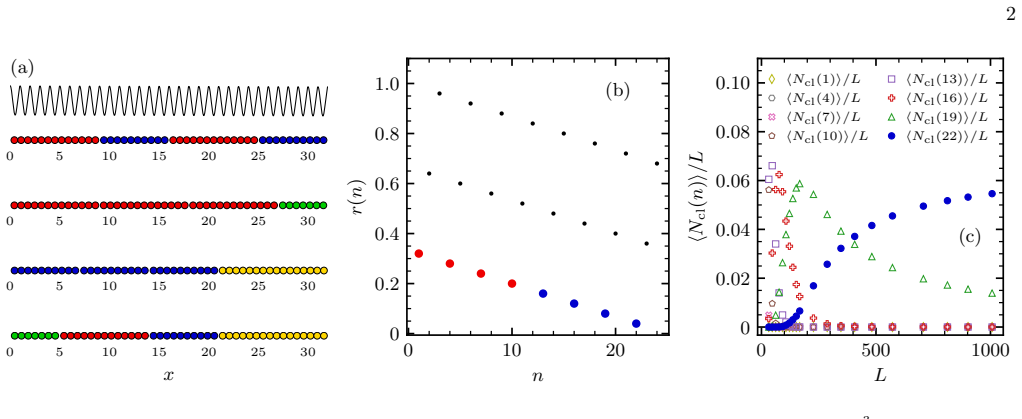
In overdamped particle motion across periodic landscapes, solitary cluster waves can occur at high particle densities and lead to particle transport even in the absence of thermal noise. Here we show that for driven motion under a constant drag, the sum of all particle displacements per soliton equals one wavelength of the periodic potential. This unit displacement law is used to determine particle currents mediated by the solitons. We furthermore derive properties of clusters involved in the wave propagation as well as relations between cluster sizes and soliton numbers.
Figures


Figures from the paper (2 more)


Reference graph
Works this paper leans on
- [1]
-
[2]
K. Misiunas and U. F. Keyser, Density-dependent speed- up of particle transport in channels, Phys. Rev. Lett. 122, 214501 (2019)
work page 2019
-
[3]
S. Su, Y. Zhang, S. Peng, L. Guo, Y. Liu, E. Fu, H. Yao, J. Du, G. Du, and J. Xue, Multifunctional graphene het- erogeneous nanochannel with voltage-tunable ion selec- tivity, Nat. Commun. 13, 4894 (2022)
work page 2022
-
[4]
P. C. Bressloff and J. M. Newby, Stochastic models of intracellular transport, Rev. Mod. Phys. 85, 135 (2013)
work page 2013
-
[5]
W. Xiao, P. A. Greaney, and D. C. Chrzan, Adatom transport on strained Cu(001): Surface crowdions, Phys. Rev. Lett. 90, 156102 (2003)
work page 2003
-
[6]
P. T. Korda, M. B. Taylor, and D. G. Grier, Kinetically locked-in colloidal transport in an array of optical tweez- ers, Phys. Rev. Lett. 89, 128301 (2002)
2002
-
[7]
T. Bohlein, J. Mikhael, and C. Bechinger, Observation of kinks and antikinks in colloidal monolayers driven across ordered surfaces, Nat. Mater. 11, 126 (2012)
work page 2012
-
[8]
T. Bohlein and C. Bechinger, Experimental observation of directional locking and dynamical ordering of colloidal monolayers driven across quasiperiodic substrates, Phys. Rev. Lett. 109, 058301 (2012)
work page 2012
Show all 32 references
-
[9]
Tierno and T
P. Tierno and T. M. Fischer, Excluded volume causes in- teger and fractional plateaus in colloidal ratchet currents, Phys. Rev. Lett. 112, 048302 (2014)
2014
-
[10]
Tierno, T
P. Tierno, T. H. Johansen, and T. M. Fischer, Fast and rewritable colloidal assembly via field synchronized par- ticle swapping, Appl. Phys. Lett. 104, 174102 (2014)
2014
-
[11]
M. P. N. Juniper, A. V. Straube, R. Besseling, D. G. A. L. Aarts, and R. P. A. Dullens, Microscopic dynamics of synchronization in driven colloids, Nat. Commun. 6, 7187 (2015)
2015
-
[12]
X. Cao, E. Panizon, A. Vanossi, N. Manini, and C. Bechinger, Orientational and directional locking of col- loidal clusters driven across periodic surfaces, Nat. Phys. 15, 776 (2019)
2019
-
[13]
R. L. Stoop, A. V. Straube, T. H. Johansen, and P. Tierno, Collective directional locking of colloidal monolayers on a periodic substrate, Phys. Rev. Lett.124, 058002 (2020)
2020
-
[14]
Mirzaee-Kakhki, A
M. Mirzaee-Kakhki, A. Ernst, D. de las Heras, M. Urba- niak, F. Stobiecki, A. Tomita, R. Huhnstock, I. Koch, J. G¨ ordes, A. Ehresmann, D. Holzinger, M. Reginka, and T. M. Fischer, Colloidal trains, Soft Matter 16, 1594 (2020)
2020
-
[15]
D. Lips, R. L. Stoop, P. Maass, and P. Tierno, Emergent colloidal currents across ordered and disordered land- scapes, Commun. Phys. 4, 224 (2021)
2021
-
[16]
S. G. Leyva, R. L. Stoop, I. Pagonabarraga, and P. Tierno, Hydrodynamic synchronization and cluster- ing in ratcheting colloidal matter, Sci. Adv. 8, eabo4546 (2022)
2022
-
[17]
D. Lips, A. Ryabov, and P. Maass, Single-file transport in periodic potentials: The Brownian asymmetric simple exclusion process, Phys. Rev. E 100, 052121 (2019)
2019
-
[18]
Casta˜ neda-Priego, E
R. Casta˜ neda-Priego, E. Sarmiento-G´ omez, Y. M. Sa- talsari, S. U. Egelhaaf, and M. A. Escobedo-S´ anchez, Colloidal transport in periodic potentials: the role of modulated-crowding, Soft Matter 21, 3868 (2025)
2025
-
[19]
D. Lips, A. Ryabov, and P. Maass, Brownian asymmetric simple exclusion process, Phys. Rev. Lett. 121, 160601 (2018)
2018
-
[20]
Derrida, An exactly soluble non-equilibrium system: The asymmetric simple exclusion process, Phys
B. Derrida, An exactly soluble non-equilibrium system: The asymmetric simple exclusion process, Phys. Rep. 301, 65 (1998)
1998
-
[21]
G. M. Sch¨ utz, Exactly solvable models for many-body systems far from equilibrium, in Phase Transitions and 9 Critical Phenomena , Vol. 19, edited by C. Domb and J. Lebowitz (Academic Press, London, 2001) pp. 1–251
2001
-
[22]
Schmittmann and R
B. Schmittmann and R. K. P. Zia, Driven diffusive sys- tems. An introduction and recent developments, Phys. Rep. 301, 45 (1998)
1998
-
[23]
K. Mallick, The exclusion process: A paradigm for non- equilibrium behaviour, Physica A 418, 17 (2015), pro- ceedings of the 13th International Summer School on Fundamental Problems in Statistical Physics
2015
-
[24]
A. P. Antonov, A. Ryabov, and P. Maass, Solitons in overdamped Brownian dynamics, Phys. Rev. Lett. 129, 080601 (2022)
2022
-
[25]
Cereceda-L´ opez, A
E. Cereceda-L´ opez, A. P. Antonov, A. Ryabov, P. Maass, and P. Tierno, Overcrowding induces fast colloidal soli- tons in a slowly rotating potential landscape, Nat. Com- mun. 14, 6448 (2023)
2023
-
[26]
Mishra, A
S. Mishra, A. Ryabov, and P. Maass, Phase locking and fractional shapiro steps in collective dynamics of mi- croparticles, Phys. Rev. Lett. 134, 107102 (2025)
2025
-
[27]
A. P. Antonov, A. Ryabov, and P. Maass, Solitary clus- ter waves in periodic potentials: Formation, propagation, and soliton-mediated particle transport, Chaos, Solitons & Fractals 185, 115079 (2024)
2024
-
[28]
A. P. Antonov, S. Schweers, A. Ryabov, and P. Maass, Fast Brownian cluster dynamics, Comput. Phys. Com- mun. 309, 109474 (2025)
2025
-
[29]
Abramowitz and I
M. Abramowitz and I. Stegun, Handbook of Mathematical Functions: With Formulas, Graphs, and Mathematical Tables, Applied mathematics series (Dover Publications, 1965)
1965
-
[30]
There exists also a variant of the soliton propagation, where during the motion of the composite cluster an nb- cluster first attaches at its back end and shortly after detaches [27]
-
[31]
[27], there is nb/ gcd(nb, nc) in the denominator of Eq
In Ref. [27], there is nb/ gcd(nb, nc) in the denominator of Eq. (20) instead of nb. However, it was shown that nb and nb + nc are coprime and hence nb and nc are coprime also, i.e. their greatest common divisor satisfies gcd(nb, nc) = gcd(nb + nc, nc) = 1
-
[32]
N. N. Vorobyov, Criteria for divisibility (University of Chicago Press, 1980)
1980
Reviewed August 7, 2026 · model on record in the stance chip above.
Discussion (0). Sign in to comment.