REVIEW 4 major objections 6 minor 200 references
Advances in Position-Momentum Entanglement: A Versatile Tool for Quantum Technologies
T0 review · 4 major / 6 minor · reviewed 2026-08-07 · deepseek-v4-flash
Pith's one-line read This review argues that position-momentum entanglement has advanced into a practical high-dimensional resource, with measurements as fast as 140 seconds for 48-dimensional certification and imaging applications that distill…
desk verdict A useful orientation review of position-momentum entanglement that needs a correction pass before it can be trusted as a reference; worth sending to a serious referee. read the letter →
The pith
A machine-rendered reading of the paper's core claim, the machinery that carries it, and where it could break.
The reading
What carries the argument
The load-bearing object is the biphoton mode function Φ(ks, ki, z) at the crystal output, which the review approximates as a product of two Gaussians in the sum and difference of the transverse wavevectors (Eq. 9). This double-Gaussian form makes the position correlation width σ− depend only on crystal length and pump wavelength (Eq. 10), and the momentum correlation width σ+ depend inversely on the pump waist (Eq. 11), allowing the EPR variance product, the Schmidt number, and the joint probability distribution to be predicted directly from source parameters. The same structure is used throughout to explain how pump shaping and partial coherence modify the correlations.
What would settle it
Measure the EPR variance product and the Schmidt number for a sweep of crystal lengths and pump waists, and compare against the Gaussian-approximation formulas (Eqs. 10–11) and a full numerical sinc model; a systematic deviation that grows where the Gaussian is poorest would show the quantitative backbone does not hold.
Extended reading notes
Core claim
The paper's central claim is that position-momentum entanglement is a genuinely high-dimensional, continuous-variable resource whose practical exploitation is now limited less by sources than by measurement speed and propagation losses. The review documents EPR variance products as small as 0.01 ℏ² with slit-based detection, camera-based certification of entanglement in up to 48 dimensions within 140 seconds using SPAD arrays, and imaging demonstrations that distill quantum images from classical stray light, double the effective pixel resolution, and hide images inside correlation functions. It also surveys how the entanglement degrades when pump spatial coherence is reduced and how it can be shaped by elliptical or Bessel-Gaussian pumps, and it highlights the counter-intuitive result that angle-OAM entanglement, unlike position-momentum entanglement, can revive during free-space propagation.
Load-bearing premise
The quantitative backbone of the review is the replacement of the SPDC phase-matching sinc function by a Gaussian with adjustment parameter α=0.455; if that approximation is not faithful across the parameter regimes described, the reported EPR variances and Schmidt numbers derived from it could be systematically wrong.
Editorial extensions
If this is right
- Camera-based correlation measurements with SPAD arrays cut acquisition time from hours to minutes, making high-dimensional entanglement certification fast enough for real-world quality control.
- Reducing the spatial coherence of the pump weakens momentum anti-correlation while leaving position correlation intact, providing a controlled knob to tune entanglement up to a classical limit.
- Elliptical pump beams can preserve entanglement along one transverse axis while erasing it along the other, enabling directional entanglement manipulation.
- Position-momentum entanglement decays rapidly with free-space propagation, while angle-OAM entanglement can revive, guiding which spatial basis to use for long-distance links.
- The transfer of the pump angular spectrum into the SPDC correlations lets one hide arbitrary amplitude or phase objects inside the correlation image while the intensity image stays uniform.
Reading between the lines
- If the double-Gaussian approximation is replaced by a more careful treatment of the sinc phase-matching tails, the EPR variances and Schmidt numbers for short crystals or tightly focused pumps may shift enough to matter for quantitative metrology protocols.
- The pump-to-correlation transfer demonstrated for images suggests that structured pump beams could be used as a classical control channel to program the effective Hilbert-space dimension of the entangled state in real time.
- The revival of angle-OAM entanglement in propagation hints that hybrid position-momentum and angle-OAM encoding could route information across different distance regimes in a future quantum network.
- Combining the SPAD-based fast certification with machine-learned reconstruction of joint probability distributions could push high-dimensional entanglement certification beyond 48 dimensions without longer acquisition times.
Editorial analysis
A structured set of objections, weighed in public.
Referee Report
Summary. The manuscript is a review of position-momentum entanglement generated by spontaneous parametric down-conversion (SPDC), organized into generation theory, measurement techniques, coherence and pump-shaping effects, propagation, and applications in imaging. The central thesis is that position-momentum entanglement has matured into a practical high-dimensional resource for quantum technologies. The review uses a double-Gaussian model of the biphoton amplitude as its quantitative backbone and surveys camera-based certification methods (EMCCD and SPAD arrays), cross-spectral-density measurements, and imaging demonstrations such as ghost imaging, image distillation, and pixel super-resolution.
Significance. If the quantitative statements are corrected, this review could serve as a useful entry point for researchers; the taxonomy of estimation/certification/quantification, the compilation of experimental EPR products, and the discussion of partial-coherence and beam-shaping control are informative. The paper is not an original derivation and does not include machine-checked proofs, but it does aggregate a large body of recent literature and explicitly highlights practical trade-offs such as acquisition time. However, the current text contains a concrete formula error, an inconsistent quantitative claim, and an unvalidated extension of the Gaussian model, so the supporting quantitative narrative needs revision before the review can be relied upon.
major comments (4)
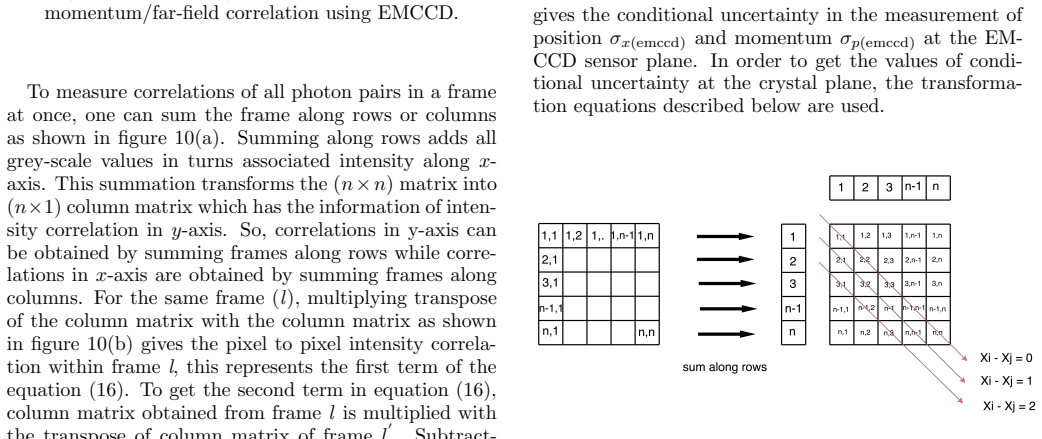
- [III.D, Eq. (16)] In the definition of the joint probability distribution Γ(r_i,r_j), the second term sums over all N × N frame pairs (l′,l), including l′ = l, whereas the text states that the second term contains only accidental coincidences from different frames. As written, the same-frame intensity correlation is subtracted along with the accidental correlations, biasing the estimated JPD. The sum must be restricted to l′ ≠ l (or to explicitly non-overlapping frames) to isolate true coincidences.
- [III.D and IV] The confidence level for the EPR violation obtained with the SPAD camera is reported as 227σ in Section III.D and as 277σ in Section IV. Both statements cite the same experiment [13]. The authors should reconcile these numbers with the source and use one consistent value; as written, a reader cannot tell which quantitative claim is correct.
- [II, V, and VII] The double-Gaussian approximation with α=0.455 is introduced in Eq. (10) under collinear phase matching, but the same σ− is then used in the partially coherent model of Eq. (29) and Eq. (32), in the propagation expression Eq. (39), and as the reference for several experimental comparisons. The review provides no validation of the Gaussian replacement of the sinc phase-matching function for non-collinear geometries, different phase-matching types, or partially coherent pumps. Since the reported EPR products and Schmidt numbers inherit this approximation, the authors should either restrict the model to its validated regime or provide a quantitative comparison with the sinc model (or with data) for each regime in which it is applied.
- [References [19] and [28]] The reference list contains two entries that are not in finished form: Ref. [19] includes editorial notes ('review paper. 27 pages, 9 figures, 250+ references. Comments welcome!') and Ref. [28] names 'J. Doe and J. Smith' as authors. A review's reference list is a load-bearing part of the manuscript; these entries must be replaced with the actual bibliographic data or removed.
minor comments (6)
- [I.D] The name 'Drudmund' should be 'Drummond'.
- [III.D] The phrase 'totatl number of frames' should be 'total number of frames'.
- [V, Eq. (29)] The surrounding text defines the beam waist as w while the equation uses w_p; the notation should be made consistent.
- [VII] The section heading reads 'PROP AGA TION' and should be 'PROPAGATION'.
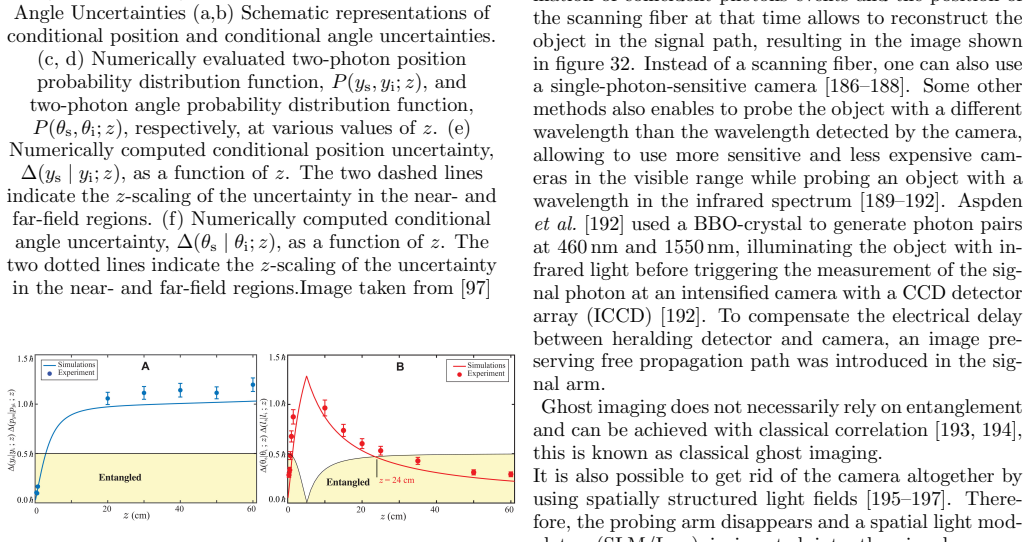
- [VII] The text refers to figure 30(c)-(f) for JPD and conditional-uncertainty evolution, but those panels appear in figure 29; the cross-references should be corrected.
- [VIII.D] The phrase 'Author’s approach' should be 'The authors’ approach'.
Circularity Check
No significant circularity: this review compiles external experimental results and uses the standard double-Gaussian approximation as a modeling tool, not as a fitted prediction.
full rationale
This is a review article, not a derivation with fitted parameters or novel predictions. The quantitative framework is the double-Gaussian approximation of the SPDC biphoton amplitude (Eqs. 8-12), with alpha = 0.455 in Eq. (10). That parameter is an externally established analytical approximation from the literature, not calibrated in this paper, and it is applied to known experimental configurations rather than used to generate predictions that are then fed back into the model. The comparisons to experimental values, for example in Section III.E, use theoretical expressions derived from this model and external experiments; no quantity is fitted to a subset of data and then renamed a prediction. The survey cites several works by the authors themselves (e.g., refs. 17, 45, 47, 48, 103, 161, 165, 166, 168, 169, 172), but these citations point to independent experimental or numerical results and are not used as the sole justification of the review's central claims, nor to exclude alternative approaches. No uniqueness theorem from the authors' prior work is invoked, and no ansatz is smuggled in via self-citation. The possible concern that the double-Gaussian approximation might be applied beyond its validated collinear regime is a question of model fidelity and correctness, not circularity, because the review does not derive its conclusions from the same data it claims to predict. The central assertion that position-momentum entanglement is a versatile resource is supported by a broad body of externally reported experiments and remains independently falsifiable. Therefore the paper exhibits no significant circularity.
Assumptions & free parameters
free parameters (1)
- alpha (Gaussian approximation parameter for phase-matching sinc) =
0.455
assumptions (4)
- domain assumption The SPDC biphoton state can be represented by the mode function in Eqs. (7)-(8) under collinear phase matching and paraxial approximation.
- ad hoc to paper The phase-matching sinc function can be approximated by a Gaussian with alpha = 0.455.
- domain assumption Intensity correlation measurements with camera arrays yield the joint probability distribution of the biphoton state when subtracting accidental coincidences.
- standard math The EPR criterion (Eq. 1) is a valid witness of entanglement for the states under consideration.
Cite this review
Pith. "Pith review of Advances in Position-Momentum Entanglement: A Versatile Tool for Quantum Technologies." pith.science (2026). https://pith.science/paper/3VODXA4A
@misc{pith2026250522265,
  author       = {Pith},
  title        = {Pith review of: Advances in Position-Momentum Entanglement: A Versatile Tool for Quantum Technologies},
  year         = {2026},
  howpublished = {\url{https://pith.science/paper/3VODXA4A}},
  note         = {Machine review of arXiv:2505.22265}
}
read the original abstract
Position-momentum entanglement is a versatile high-dimensional resource in quantum optics. From fundamental tests of reality to applications in quantum technologies, spatial entanglement has experienced significant growth in recent years. In this review, we explore these advances, beginning with the generation of spatial entanglement, followed by various types of measurements for certifying entanglement, and concluding with different quantum-based applications. We conclude the review with a discussion and outlook of the field.
Figures



Figures from the paper (31 more)










Reference graph
Works this paper leans on
-
[27]
Ali Khan and J
I. Ali Khan and J. C. Howell, Experimental demon- stration of high two-photon time-energy entanglement, Phys. Rev. A 73, 031801 (2006)
2006
-
[13]
Y. Liu, X. Yuan, M.-H. Li, W. Zhang, Q. Zhao, J. Zhong, Y. Cao, Y.-H. Li, L.-K. Chen, H. Li, T. Peng, Y.-A. Chen, C.-Z. Peng, S.-C. Shi, Z. Wang, L. You, X. Ma, J. Fan, Q. Zhang, and J.-W. Pan, High-speed device-independent quantum random number genera- tion without a detection loophole, Phys. Rev. Lett. 120, 010503 (2018)
2018
-
[19]
Zhang, R
W. Zhang, R. Fickler, E. Giese, L. Chen, and R. W. Boyd, Influence of pump coherence on the generation of position-momentum entanglement in optical parametric down-conversion, Opt. Express 27, 20745 (2019). 23
2019
-
[28]
L. K. Shalm, D. R. Hamel, Z. Yan, C. Simon, K. J. Resch, and T. Jennewein, Three-photon energy–time entanglement, Nature Physics 9, 19 (2013)
2013
-
[1]
− |ρs + ρi|2 4w(z)2 # × exp
Beam shaping In another reference [94], a generalized study of spatial shaping of the pump has been reported. The spatial profile of the pump beam is modified using a spatial light modulator (SLM). The setup for the experiment is shown in the figure 26. A continuous wave laser illuminates the SLM that tailor its beam profile and 15 Figure 22: Intensity di...
1995
-
[2]
Schr¨ odinger, Discussion of probability relations be- tween separated systems, Mathematical Proceedings of the Cambridge Philosophical Society 31, 555–563 (1935)
E. Schr¨ odinger, Discussion of probability relations be- tween separated systems, Mathematical Proceedings of the Cambridge Philosophical Society 31, 555–563 (1935)
1935
-
[3]
engi- neered
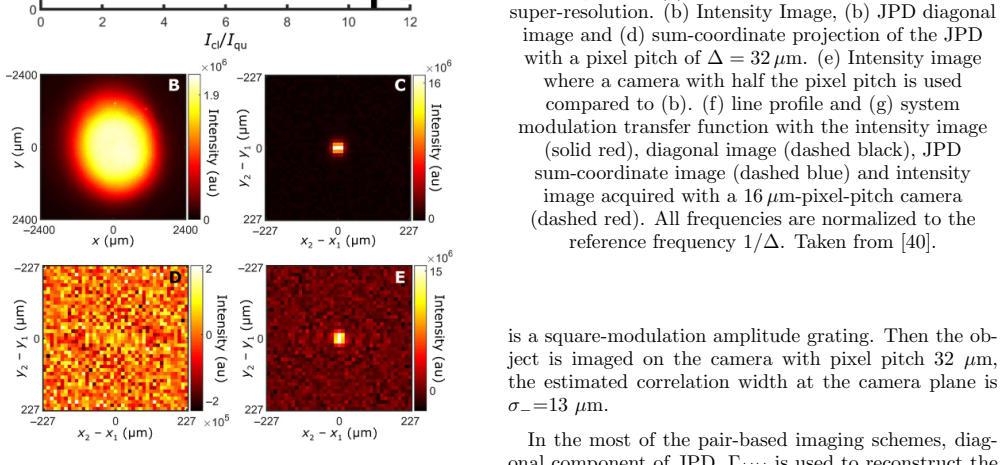
Such projection retrieves the image of the object with pixel resolution increased by P + i+j+ = NXX i=1 NYX j=1 Γ(i+−i)(j+−j)ij, (41) where, NX ×NY are the number of pixels of the illumi- nated region, P + is the sum-coordinate projection of the JPD and ( i+, j+) sum-coordinate pixel indices. Because of the pixel-super resolution, one can see that the spu...
-
[4]
Einstein, B
A. Einstein, B. Podolsky, and N. Rosen, Can quantum- mechanical description of physical reality be considered complete?, Phys. Rev. 47, 777 (1935)
1935
Show all 200 references
-
[5]
B. S. Cirel’son, Quantum generalizations of bell’s in- equality, Letters in Mathematical Physics 4, 93 (1980)
1980
-
[6]
Bohm and Y
D. Bohm and Y. Aharonov, Discussion of experimental proof for the paradox of einstein, rosen, and podolsky, Phys. Rev. 108, 1070 (1957)
1957
-
[7]
J. S. Bell, On the einstein podolsky rosen paradox, Physics Physique Fizika 1, 195 (1964)
1964
-
[8]
Bouwmeester, J.-W
D. Bouwmeester, J.-W. Pan, K. Mattle, M. Eibl, H. We- infurter, and A. Zeilinger, Experimental quantum tele- portation, Nature 390, 575 (1997)
1997
-
[9]
J. F. Clauser, M. A. Horne, A. Shimony, and R. A. Holt, Proposed experiment to test local hidden-variable theories, Phys. Rev. Lett. 23, 880 (1969)
1969
-
[10]
A. K. Ekert, Quantum cryptography based on bell’s the- orem, Phys. Rev. Lett. 67, 661 (1991)
1991
-
[11]
J. C. F. Matthews, X.-Q. Zhou, H. Cable, P. J. Shad- bolt, D. J. Saunders, G. A. Durkin, G. J. Pryde, and J. L. O’Brien, Towards practical quantum metrology with photon counting, NPJ Quantum Information 2, 16023 (2016)
2016
-
[12]
J. E. Jacak, W. A. Jacak, W. A. Donderowicz, and L. Jacak, Quantum random number generators with en- tanglement for public randomness testing, Scientific Re- ports 10, 164 (2020)
2020
-
[14]
Leach, R
J. Leach, R. E. Warburton, D. G. Ireland, F. Izdebski, S. M. Barnett, A. M. Yao, G. S. Buller, and M. J. Pad- gett, Quantum correlations in position, momentum, and intermediate bases for a full optical field of view, Phys. Rev. A 85, 013827 (2012)
2012
-
[15]
J. C. Howell, R. S. Bennink, S. J. Bentley, and R. W. Boyd, Realization of the einstein-podolsky-rosen para- dox using momentum- and position-entangled photons from spontaneous parametric down conversion, Phys. Rev. Lett. 92, 210403 (2004)
2004
-
[16]
Defienne, T
H. Defienne, T. Reichert, Q. Sun, R. S. Aspden, T. Schneider, K. Lee, R. Fickler, G. Leuchs, R. W. Boyd, and C. Silberhorn, Imaging and certifying high-dimensional entanglement with a single-photon avalanche diode camera, npj Quantum Information 6, 1 (2020)
2020
-
[17]
Patil, S
S. Patil, S. Prabhakar, A. Biswas, A. Kumar, and R. P. Singh, Anisotropic spatial entanglement, Physics Let- ters A 457, 128583 (2023)
2023
-
[18]
Achatz, E
L. Achatz, E. Ortega, K. Dovzhik, R. F. Shiozaki, J. Fuenzalida, S. Wengerowsky, M. Bohmann, and R. Ursin, Certifying position-momentum entanglement at telecommunication wavelengths, Journal of Optics 22, 125201 (2020)
2020
-
[21]
J. D. Franson, Bell inequality for position and time, Phys. Rev. Lett. 62, 2205 (1989)
1989
-
[22]
G. B. Xavier, J.- . Larsson, P. Villoresi, G. Val- lone, and A. Cabello, Energy-time and time-bin en- tanglement: past, present and future, arXiv preprint arXiv:2503.14675 (2025), review paper. 27 pages, 9 fig- ures, 250+ references. Comments welcome!
2025 arXiv
-
[23]
P. G. Kwiat, A. M. Steinberg, and R. Y. Chiao, High- visibility interference in a bell-inequality experiment for energy and time, Phys. Rev. A 47, R2472 (1993)
1993
-
[24]
Ali-Khan, C
I. Ali-Khan, C. J. Broadbent, and J. C. Howell, Large- alphabet quantum key distribution using energy-time entangled bipartite states, Phys. Rev. Lett. 98, 060503 (2007)
2007
-
[25]
D. V. Strekalov, T. B. Pittman, A. V. Sergienko, Y. H. Shih, and P. G. Kwiat, Postselection-free energy-time entanglement, Phys. Rev. A 54, R1 (1996)
1996
-
[26]
Z. Y. Ou, S. F. Pereira, H. J. Kimble, and K. C. Peng, Quantum entanglement and squeezing of the quadrature difference of bright light fields, Physical Review Letters 68, 3663 (1992)
1992
-
[29]
W. P. Bowen, R. Schnabel, P. K. Lam, and T. C. Ralph, Experimental investigation of criteria for contin- uous variable entanglement, Phys. Rev. Lett.90, 043601 (2003)
2003
-
[30]
Doe and J
J. Doe and J. Smith, Quadrature entanglement in the microwave domain with a phase locking protocol, Phys- ical Review Letters 130, 060501 (2023)
2023
-
[31]
Furusawa, J
A. Furusawa, J. L. Sørensen, S. L. Braunstein, C. A. Fuchs, H. J. Kimble, and E. S. Polzik, Experimental re- alization of spatially separated entanglement with con- tinuous variables using laser pulse trains, Science 282, 706 (1998)
1998
-
[32]
Leach, B
J. Leach, B. Jack, J. Romero, A. K. Jha, A. M. Yao, S. Franke-Arnold, D. G. Ireland, R. W. Boyd, S. M. Barnett, and M. J. Padgett, Quan- tum correlations in optical angle–orbital angular momentum variables, Science 329, 662 (2010), https://www.science.org/doi/pdf/10.1126/scien...
2010 doi
-
[33]
Edgar, D
M. Edgar, D. Tasca, F. Izdebski, R. Warburton, J. Leach, M. Agnew, G. Buller, R. Boyd, and M. Pad- gett, Imaging high-dimensional spatial entanglement with a camera, Nature Communications 3, 984 (2012)
2012
-
[34]
Moreau, F
P.-A. Moreau, F. Devaux, and E. Lantz, Einstein- podolsky-rosen paradox in twin images, Phys. Rev. Lett. 113, 160401 (2014)
2014
-
[35]
Giedke, B
G. Giedke, B. Kraus, M. Lewenstein, and J. I. Cirac, Entanglement criteria for all bipartite gaussian states, Phys. Rev. Lett. 87, 167904 (2001)
2001
-
[36]
A. E. Rastegin, R´ enyi formulation of entanglement cri- teria for continuous variables, Phys. Rev. A 95, 042334 (2017)
2017
-
[37]
Saboia, F
A. Saboia, F. Toscano, and S. P. Walborn, Family of continuous-variable entanglement criteria using general entropy functions, Phys. Rev. A 83, 032307 (2011)
2011
-
[38]
S. L. Braunstein and H. J. Kimble, Teleportation of con- tinuous quantum variables, Phys. Rev. Lett. 80, 869 (1998)
1998
-
[39]
Simon, Peres-horodecki separability criterion for con- tinuous variable systems, Phys
R. Simon, Peres-horodecki separability criterion for con- tinuous variable systems, Phys. Rev. Lett. 84, 2726 (2000)
2000
-
[40]
Scarfe, Y
L. Scarfe, Y. Zhang, and E. Karimi, Spatial-mode quan- tum cryptography in a 545-dimensional hilbert space (2025), arXiv:2503.22058 [quant-ph]
2025
-
[41]
used a SPAD camera proving their worth in various fields including quantum imaging in a robust scheme against stray light. C. Pixel-super-resolution imaging Due to the presence of strong position correlations in photon pairs, this can be leveraged to achieve pixel super-resolu...
-
[42]
Defienne, M
H. Defienne, M. Reichert, J. W. Fleis- cher, and D. Faccio, Quantum image distil- lation, Science Advances 5, eaax0307 (2019), https://www.science.org/doi/pdf/10.1126/sciadv.aax0307
2019 doi
-
[44]
Defienne, J
H. Defienne, J. Zhao, E. Charbon, and D. Faccio, Full- field quantum imaging with a single-photon avalanche diode camera, Phys. Rev. A 103, 042608 (2021)
2021
-
[45]
Reichert, H
M. Reichert, H. Defienne, X. Sun, and J. W. Fleis- cher, Biphoton transmission through non-unitary ob- jects, Journal of Optics 19, 034013 (2017)
2017
-
[46]
Ndagano and D
B. Ndagano and D. Faccio, Quantum microscopy based on hong–ou–mandel interference, Nature Communica- tions 13, 1215 (2022)
2022
-
[47]
Moreau, E
P.-A. Moreau, E. Toninelli, P. A. Morris, R. S. Aspden, T. Gregory, G. Spalding, R. W. Boyd, and M. J. Pad- gett, Resolution limits of quantum ghost imaging, Opt. Express 26, 7528 (2018)
2018
-
[48]
Fuenzalida, A
J. Fuenzalida, A. Hochrainer, G. B. Lemos, E. A. Or- tega, R. Lapkiewicz, M. Lahiri, and A. Zeilinger, Res- olution of quantum imaging with undetected photons, Quantum 6, 646 (2022)
2022
-
[49]
Viswanathan, G
B. Viswanathan, G. Barreto Lemos, and M. Lahiri, Resolution limit in quantum imaging with undetected photons using position correlations, Optics Express 29, 38185 (2021)
2021
-
[50]
A. Vega, E. A. Santos, J. Fuenzalida, M. Gilaberte Bas- set, T. Pertsch, M. Gr¨ afe, S. Saravi, and F. Setzp- fandt, Fundamental resolution limit of quantum imaging with undetected photons, Physical Review Research 4, 033252 (2022)
2022
-
[51]
Gilaberte Basset, R
M. Gilaberte Basset, R. Sondenheimer, J. Fuenzalida, A. Vega, S. T¨ opfer, E. A. Santos, S. Saravi, F. Set- zpfandt, F. Steinlechner, and M. Gr¨ afe, Experimental analysis of image resolution of quantum imaging with undetected light through position correlations, Physical Revi...
2023
-
[52]
Giovannetti, S
V. Giovannetti, S. Lloyd, and L. Maccone, Advances in quantum metrology, Nature Photonics 5, 222 (2011)
2011
-
[53]
Giovannetti, S
V. Giovannetti, S. Lloyd, and L. Maccone, Quantum metrology, Phys. Rev. Lett. 96, 010401 (2006)
2006
-
[54]
Aspect, P
A. Aspect, P. Grangier, and G. Roger, Experimental tests of realistic local theories via bell’s theorem, Phys. Rev. Lett. 47, 460 (1981)
1981
-
[55]
Aspect, J
A. Aspect, J. Dalibard, and G. Roger, Experimental test of bell’s inequalities using time-varying analyzers, Phys. Rev. Lett. 49, 1804 (1982). 24
1982
-
[56]
C. A. Kocher and E. D. Commins, Polarization corre- lation of photons emitted in an atomic cascade, Phys. Rev. Lett. 18, 575 (1967)
1967
-
[57]
W. H. Louisell, A. Yariv, and A. E. Siegman, Quantum fluctuations and noise in parametric processes. i., Phys. Rev. 124, 1646 (1961)
1961
-
[58]
T. G. Giallorenzi and C. L. Tang, Quantum theory of spontaneous parametric scattering of intense light, Phys. Rev. 166, 225 (1968)
1968
-
[59]
S. E. Harris, M. K. Oshman, and R. L. Byer, Obser- vation of tunable optical parametric fluorescence, Phys. Rev. Lett. 18, 732 (1967)
1967
-
[60]
D. C. Burnham and D. L. Weinberg, Observation of simultaneity in parametric production of optical photon pairs, Phys. Rev. Lett. 25, 84 (1970)
1970
-
[61]
Hanbury Brown and R
R. Hanbury Brown and R. Q. Twiss, A test of a new type of stellar interferometer on sirius, Nature178, 1046 (1956)
1956
-
[62]
R. W. Boyd, Nonlinear Optics, 3rd ed. (Academic Press, 2008)
2008
-
[63]
M. H. Rubin, D. N. Klyshko, Y. H. Shih, and A. V. Sergienko, Theory of two-photon entanglement in type- ii optical parametric down-conversion, Phys. Rev. A 50, 5122 (1994)
1994
-
[64]
P. G. Kwiat, P. H. Eberhard, A. M. Steinberg, and R. Y. Chiao, Proposal for a loophole-free bell inequality exper- iment, Phys. Rev. A 49, 3209 (1994)
1994
-
[65]
P. G. Kwiat, K. Mattle, H. Weinfurter, A. Zeilinger, A. V. Sergienko, and Y. Shih, New high-intensity source of polarization-entangled photon pairs, Phys. Rev. Lett. 75, 4337 (1995)
1995
-
[66]
P. G. Kwiat, E. Waks, A. G. White, I. Appelbaum, and P. H. Eberhard, Ultrabright source of polarization- entangled photons, Phys. Rev. A 60, R773 (1999)
1999
-
[67]
J. G. Rarity and P. R. Tapster, Experimental viola- tion of bell’s inequality based on phase and momentum, Phys. Rev. Lett. 64, 2495 (1990)
1990
-
[68]
A. Mair, A. Vaziri, G. Weihs, and A. Zeilinger, Entan- glement of the orbital angular momentum states of pho- tons, Nature 412, 313 (2001)
2001
-
[70]
S. P. Walborn and C. H. Monken, Transverse spatial en- tanglement in parametric down-conversion, Phys. Rev. A 76, 062305 (2007)
2007
-
[71]
J. A. Armstrong, N. Bloembergen, J. Ducuing, and P. S. Pershan, Interactions between Light Waves in a Nonlin- ear Dielectric, Physical Review 127, 1918 (1962), pub- lisher: American Physical Society
1962
-
[72]
Mattle, H
K. Mattle, H. Weinfurter, P. G. Kwiat, and A. Zeilinger, Dense coding in experimental quantum communication, Phys. Rev. Lett. 76, 4656 (1996)
1996
-
[73]
C. H. Bennett, G. Brassard, and N. D. Mermin, Quan- tum cryptography without bell’s theorem, Phys. Rev. Lett. 68, 557 (1992)
1992
-
[74]
W. K. Wootters and W. H. Zurek, A single quantum cannot be cloned, Nature 299, 802 (1982)
1982
-
[75]
R. A. Beth, Mechanical detection and measurement of the angular momentum of light, Phys. Rev. 50, 115 (1936)
1936
-
[76]
Padgett, J
M. Padgett, J. Courtial, and L. Allen, Light’s Orbital Angular Momentum, Physics Today 57, 35 (2004), https://pubs.aip.org/physicstoday/article- pdf/57/5/35/8317006/35 1 online.pdf
2004
-
[77]
Molina-Terriza, J
G. Molina-Terriza, J. P. Torres, and L. Torner, Twisted photons, Nature Physics 3, 305 (2007)
2007
-
[78]
Brandt, M
F. Brandt, M. Hiekkam¨ aki, F. Bouchard, M. Huber, and R. Fickler, High-dimensional quantum gates using full- field spatial modes of photons, Optica 7, 98 (2020)
2020
-
[79]
Anwar, S
A. Anwar, S. Prabhakar, and R. P. Singh, Size-invariant twisted optical modes for the efficient generation of higher-dimensional quantum states, J. Opt. Soc. Am. B 38, 2976 (2021)
2021
-
[80]
Karimipour, A
V. Karimipour, A. Bahraminasab, and S. Bagher- inezhad, Entanglement swapping of generalized cat states and secret sharing, Physical Review A 65, 042320 (2002)
2002
-
[81]
Bechmann-Pasquinucci and A
H. Bechmann-Pasquinucci and A. Peres, Quantum cryp- tography with 3-state systems, Physical Review Letters 85, 3313 (2000)
2000
-
[82]
Molina-Terriza, J
G. Molina-Terriza, J. P. Torres, and L. Torner, Manage- ment of the angular momentum of light: Preparation of photons in multidimensional vector states of angular momentum, Phys. Rev. Lett. 88, 013601 (2001)
2001
-
[83]
Vaziri, G
A. Vaziri, G. Weihs, and A. Zeilinger, Experimental two- photon, three-dimensional entanglement for quantum communication, Phys. Rev. Lett. 89, 240401 (2002)
2002
-
[84]
J. P. Torres, Y. Deyanova, L. Torner, and G. Molina- Terriza, Preparation of engineered two-photon entan- gled states for multidimensional quantum information, Phys. Rev. A 67, 052313 (2003)
2003
-
[85]
Anwar, N
A. Anwar, N. Lal, S. Prabhakar, and R. P. Singh, Selec- tive tuning of hilbert spaces in states encoded with spa- tial modes of light, New Journal of Physics 22, 113020 (2020)
2020
-
[86]
M. V. Jabir, A. Anwar, and G. K. Samanta, Controlling the bi-photon orbital angular momentum eigenmodes using asymmetric pump vortex beam, Journal of Optics 21, 055201 (2019)
2019
-
[87]
M. D. Reid and P. D. Drummond, Quantum correlations of phase in nondegenerate parametric oscillation, Phys. Rev. Lett. 60, 2731 (1988)
1988
-
[88]
Z. Y. Ou, S. F. Pereira, H. J. Kimble, and K. C. Peng, Realization of the einstein-podolsky-rosen paradox for continuous variables, Phys. Rev. Lett. 68, 3663 (1992)
1992
-
[89]
L.-M. Duan, G. Giedke, J. I. Cirac, and P. Zoller, Insep- arability criterion for continuous variable systems, Phys. Rev. Lett. 84, 2722 (2000)
2000
-
[90]
D. V. Strekalov, A. V. Sergienko, D. N. Klyshko, and Y. H. Shih, Observation of two-photon “ghost” interfer- ence and diffraction, Phys. Rev. Lett. 74, 3600 (1995)
1995
-
[91]
T. B. Pittman, Y. H. Shih, D. V. Strekalov, and A. V. Sergienko, Optical imaging by means of two-photon quantum entanglement, Phys. Rev. A52, R3429 (1995)
1995
-
[92]
C. H. Monken, P. H. S. Ribeiro, and S. P´ adua, Trans- fer of angular spectrum and image formation in spon- taneous parametric down-conversion, Phys. Rev. A 57, 3123 (1998)
1998
-
[93]
A. F. Abouraddy, M. B. Nasr, B. E. A. Saleh, A. V. Sergienko, and M. C. Teich, Demonstration of the com- plementarity of one- and two-photon interference, Phys. Rev. A 63, 063803 (2001)
2001
-
[94]
S. P. Walborn, D. S. Lemelle, M. P. Almeida, and P. H. S. Ribeiro, Quantum key distribution with higher- order alphabets using spatially encoded qudits, Phys. Rev. Lett. 96, 090501 (2006). 25
2006
-
[95]
S. P. Walborn, D. S. Lemelle, D. S. Tasca, and P. H. Souto Ribeiro, Schemes for quantum key distribution with higher-order alphabets using single-photon frac- tional fourier optics, Phys. Rev. A 77, 062323 (2008)
2008
-
[97]
Boucher, H
P. Boucher, H. Defienne, and S. Gigan, Engineering spatial correlations of entangled photon pairs by pump beam shaping, Opt. Lett. 46, 4200 (2021)
2021
-
[98]
Verni` ere and H
C. Verni` ere and H. Defienne, Hiding Images in Quan- tum Correlations, Physical Review Letters 133, 093601 (2024)
2024
-
[99]
Reichert, X
M. Reichert, X. Sun, and J. W. Fleischer, Quality of spa- tial entanglement propagation, Phys. Rev. A95, 063836 (2017)
2017
-
[100]
Bhattacharjee, M
A. Bhattacharjee, M. K. Joshi, S. Karan, J. Leach, and A. K. Jha, Propagation-induced revival of entanglement in the angle-oam bases, Science Advances 8, eabn7876 (2022), https://www.science.org/doi/pdf/10.1126/sciadv.abn7876
2022 doi
-
[102]
D. S. Tasca, S. P. Walborn, P. H. Souto Ribeiro, F. Toscano, and P. Pellat-Finet, Propagation of trans- verse intensity correlations of a two-photon state, Phys. Rev. A 79, 033801 (2009)
2009
-
[103]
Friis, G
N. Friis, G. Vitagliano, M. Malik, and M. Huber, Entan- glement certification from theory to experiment, Nat. Rev. Phys. 1, 72 (2019)
2019
-
[104]
Brambilla, A
E. Brambilla, A. Gatti, M. Bache, and L. A. Lugiato, Simultaneous near-field and far-field spatial quantum correlations in the high-gain regime of parametric down- conversion, Phys. Rev. A 69, 023802 (2004)
2004
-
[105]
Kviatkovsky, H
I. Kviatkovsky, H. M. Chrzanowski, E. G. Avery, H. Bartolomaeus, and S. Ramelow, Microscopy with undetected photons in the mid-infrared, Sci. Adv. 6, eabd0264 (2020)
2020
-
[106]
M. Hong, R. G´ omez, V. Flavio Gili, J. Fuenzalida, and M. Gr¨ afe, Polarization-entangled photon-pair source us- ing beam displacers and thin crystals, Opt. Lett. 49, 5467 (2024)
2024
-
[107]
C. K. Law and J. H. Eberly, Analysis and interpretation of high transverse entanglement in optical parametric down conversion, Phys. Rev. Lett. 92, 127903 (2004)
2004
-
[109]
E. A. Ortega, J. Fuenzalida, M. Selimovic, K. Dovzhik, L. Achatz, S. Wengerowsky, R. F. Shiozaki, S. P. Neu- mann, M. Bohmann, and R. Ursin, Spatial and spectral characterization of photon pairs at telecommunication wavelengths from type-0 spontaneous parametric down- conversi...
2022
-
[110]
F. Just, A. Cavanna, M. V. Chekhova, and G. Leuchs, Transverse entanglement of biphotons, New J. Phys.15, 083015 (2013)
2013
-
[111]
Brida, V
G. Brida, V. Caricato, M. Fedorov, M. Genovese, M. Gramegna, and S. Kulik, Characterization of spec- tral entanglement of spontaneous parametric-down con- version biphotons in femtosecond pulsed regime, EPL 87, 64003 (2009)
2009
-
[112]
M. V. Fedorov, M. A. Efremov, A. E. Kazakov, K. W. Chan, C. K. Law, and J. H. Eberly, Packet narrowing and quantum entanglement in photoionization and pho- todissociation, Phys. Rev. A 69, 052117 (2004)
2004
-
[113]
K. W. Chan, J. P. Torres, and J. H. Eberly, Transverse entanglement migration in hilbert space, Phys. Rev. A 75, 050101 (2007)
2007
-
[114]
Defienne, M
H. Defienne, M. Reichert, and J. W. Fleischer, General model of photon-pair detection with an image sensor, Phys. Rev. Lett. 120, 203604 (2018)
2018
-
[115]
Eckmann, B
B. Eckmann, B. Bessire, M. Untern¨ ahrer, L. Gasparini, M. Perenzoni, and A. Stefanov, Characterization of space-momentum entangled photons with a time resolv- ing cmos spad array, Opt. Express 28, 31553 (2020)
2020
-
[116]
Kundu, J
S. Kundu, J. Szuniewicz, G. Firlik, A. Krupinski- Ptaszek, and R. Lapkiewicz, High-dimensional quan- tum correlation measurements with an adaptively gated hybrid single-photon camera, Optica Quantum 2, 206 (2024)
2024
-
[117]
Courme, C
B. Courme, C. Verni` ere, P. Svihra, S. Gigan, A. Nomerotski, and H. Defienne, Quantifying high- dimensional spatial entanglement with a single-photon- sensitive time-stamping camera, Opt. Lett. 48, 3439 (2023)
2023
-
[118]
Severini, I
F. Severini, I. Cusini, F. Madonini, D. Brescia, R. Cam- phausen, A. Cuevas, S. Tisa, and F. Villa, Spatially re- solved event-driven 24 x 24 pixels spad imager with 100 % duty cycle for low optical power quantum entangle- ment detection, IEEE Journal of Solid-State Circuits 5...
2023
-
[119]
Reichert, H
M. Reichert, H. Defienne, and J. W. Fleischer, Opti- mizing the signal-to-noise ratio of biphoton distribution measurements, Phys. Rev. A 98, 013841 (2018)
2018
-
[120]
Defienne, P
H. Defienne, P. Cameron, B. Ndagano, A. Lyons, M. Re- ichert, J. Zhao, A. R. Harvey, E. Charbon, J. W. Fleis- cher, and D. Faccio, Pixel super-resolution with spa- tially entangled photons, Nature Communications 13, 3566 (2022)
2022
-
[121]
Rochas, M
A. Rochas, M. Gosch, A. Serov, P. Besse, R. Popovic, T. Lasser, and R. Rigler, First fully integrated 2-d array of single-photon detectors in standard cmos technology, IEEE Photonics Technology Letters 15, 963 (2003)
2003
-
[122]
Bronzi, F
D. Bronzi, F. Villa, S. Tisa, A. Tosi, F. Zappa, D. Durini, S. Weyers, and W. Brockherde, 100 000 frames/s 64 × 32 single-photon detector array for 2- d imaging and 3-d ranging, IEEE Journal of Selected Topics in Quantum Electronics 20, 355 (2014)
2014
-
[123]
Lindner, C
S. Lindner, C. Zhang, I. M. Antolovic, M. Wolf, and E. Charbon, A 252 × 144 spad pixel flash lidar with 1728 dual-clock 48.8 ps tdcs, integrated histogramming and 14.9-to-1 compression in 180nm cmos technology, in 2018 IEEE Symposium on VLSI Circuits (2018) pp. 69–70
2018
-
[124]
R. K. Henderson, N. Johnston, S. W. Hutchings, I. Gy- ongy, T. A. Abbas, N. Dutton, M. Tyler, S. Chan, and J. Leach, 5.7 a 256 ×256 40nm/90nm cmos 3d-stacked 120db dynamic-range reconfigurable time-resolved spad imager, in 2019 IEEE International Solid-State Circuits Conferenc...
2019
-
[125]
Bruschini, H
C. Bruschini, H. Homulle, I. M. Antolovic, S. Burri, and E. Charbon, Author correction: Single-photon avalanche diode imagers in biophotonics: review and outlook, Light: Science & Applications 9, 12 (2020), an amendment to this paper has been published and can 26 be accessed v...
2020
-
[126]
D.-U. Li, J. Arlt, J. Richardson, R. Walker, A. Buts, D. Stoppa, E. Charbon, and R. Henderson, Real-time fluorescence lifetime imaging system with a 32 × 32 0.13µm cmos low dark-count single-photon avalanche diode array, Opt. Express 18, 10257 (2010)
2010
-
[127]
R. K. Henderson, N. Johnston, H. Chen, D. D.-U. Li, G. Hungerford, R. Hirsch, D. McLoskey, P. Yip, and D. J. Birch, A 192 ×128 time correlated single photon counting imager in 40nm cmos technology, in ESSCIRC 2018 - IEEE 44th European Solid State Circuits Con- ference (ESSCIRC...
2018
-
[128]
Lyons, F
A. Lyons, F. Tonolini, A. Boccolini, A. Repetti, R. Hen- derson, Y. Wiaux, and D. Faccio, Computational time- of-flight diffuse optical tomography, Nature Photonics 13, 575 (2019)
2019
-
[129]
Gariepy, F
G. Gariepy, F. Tonolini, R. Henderson, J. Leach, and D. Faccio, Detection and tracking of moving objects hid- den from view, Nature Photonics 10, 23 (2016)
2016
-
[130]
Lubin, R
G. Lubin, R. Tenne, I. M. Antolovic, E. Charbon, C. Br- uschini, and D. Oron, Quantum correlation measure- ment with single photon avalanche diode arrays, Opt. Express 27, 32863 (2019)
2019
-
[131]
Untern¨ ahrer, B
M. Untern¨ ahrer, B. Bessire, L. Gasparini, D. Stoppa, and A. Stefanov, Coincidence detection of spatially cor- related photon pairs with a monolithic time-resolving detector array, Opt. Express 24, 28829 (2016)
2016
-
[132]
Bavaresco, N
J. Bavaresco, N. Herrera Valencia, C. Kl¨ ockl, M. Pivo- luska, P. Erker, N. Friis, M. Malik, and M. Huber, Measurements in two bases are sufficient for certify- ing high-dimensional entanglement, Nature Physics 14, 1032 (2018)
2018
-
[133]
Schneeloch, C
J. Schneeloch, C. C. Tison, M. L. Fanto, P. M. Als- ing, and G. A. Howland, Quantifying entanglement in a 68-billion-dimensional quantum state space, Nature Communications 10, 2785 (2019)
2019
-
[135]
Bhattacharjee, N
A. Bhattacharjee, N. Meher, and A. K. Jha, Mea- surement of two-photon position–momentum ein- stein–podolsky–rosen correlations through single- photon intensity measurements, New Journal of Physics 24, 053033 (2022)
2022
-
[136]
A. K. Jha, G. S. Agarwal, and R. W. Boyd, Partial angular coherence and the angular schmidt spectrum of entangled two-photon fields, Phys. Rev. A 84, 063847 (2011)
2011
-
[137]
Kulkarni and A
G. Kulkarni and A. K. Jha, Single-shot measurement of the orbital-angular-momentum spectrum of light, Na- ture Communications 8, 1054 (2017)
2017
-
[138]
Kulkarni, L
G. Kulkarni, L. Taneja, S. Aarav, and A. K. Jha, An- gular schmidt spectrum of entangled photons: Deriva- tion of an exact formula and experimental characteriza- tion for noncollinear phase matching, Phys. Rev. A 97, 063846 (2018)
2018
-
[139]
Di Lorenzo Pires, C
H. Di Lorenzo Pires, C. H. Monken, and M. P. van Ex- ter, Direct measurement of transverse-mode entangle- ment in two-photon states, Phys. Rev. A 80, 022307 (2009)
2009
-
[140]
Hochrainer, M
A. Hochrainer, M. Lahiri, R. Lapkiewicz, G. B. Lemos, and A. Zeilinger, Quantifying the mo- mentum correlation between two light beams by detecting one, Proceedings of the Na- tional Academy of Sciences 114, 1508 (2017), https://www.pnas.org/doi/pdf/10.1073/pnas.1620979114
2017 doi
-
[141]
Bhattacharjee, S
A. Bhattacharjee, S. Aarav, and A. K. Jha, Two-shot measurement of spatial coher- ence, Applied Physics Letters 113, 051102 (2018), https://pubs.aip.org/aip/apl/article- pdf/doi/10.1063/1.5041076/13193415/051102 1 online.pdf
2018 doi
-
[142]
P. B. Dixon, G. A. Howland, J. Schneeloch, and J. C. Howell, Quantum mutual information capacity for high- dimensional entangled states, Phys. Rev. Lett. 108, 143603 (2012)
2012
-
[143]
MANDEL and E
L. MANDEL and E. WOLF, Coherence properties of optical fields, Rev. Mod. Phys. 37, 231 (1965)
1965
-
[144]
M. V. Fedorov, Y. M. Mikhailova, and P. A. Volkov, Gaussian modelling and schmidt modes of spdc bipho- ton states, Journal of Physics B: Atomic, Molecular and Optical Physics 42, 175503 (2009)
2009
-
[145]
Defienne and S
H. Defienne and S. Gigan, Spatially entangled photon- pair generation using a partial spatially coherent pump beam, Phys. Rev. A 99, 053831 (2019)
2019
-
[146]
Schneeloch and J
J. Schneeloch and J. C. Howell, Introduction to the transverse spatial correlations in spontaneous paramet- ric down-conversion through the biphoton birth zone, Journal of Optics 18, 053501 (2016)
2016
-
[147]
Defienne, M
H. Defienne, M. Reichert, and J. W. Fleischer, Adaptive quantum optics with spatially entangled photon pairs, Phys. Rev. Lett. 121, 233601 (2018)
2018
-
[148]
Defienne, M
H. Defienne, M. Barbieri, I. A. Walmsley, B. J. Smith, and S. Gigan, Two-photon quantum walk in a mul- timode fiber, Science Advances 2, e1501054 (2016), https://www.science.org/doi/pdf/10.1126/sciadv.1501054
2016 doi
-
[149]
Ferreri, V
A. Ferreri, V. Ansari, B. Brecht, C. Silberhorn, and P. R. Sharapova, Spatial entanglement and state engi- neering via four-photon hong–ou–mandel interference, Quantum Science and Technology 5, 045020 (2020)
2020
-
[150]
Zhang, F
Y. Zhang, F. S. Roux, T. Konrad, M. Agnew, J. Leach, and A. Forbes, Engineering two-photon high-dimensional states through quantum inter- ference, Science Advances 2, e1501165 (2016), https://www.science.org/doi/pdf/10.1126/sciadv.1501165
2016 doi
-
[151]
K. Wang, J. G. Titchener, S. S. Kruk, L. Xu, H.-P. Chung, M. Parry, I. I. Kravchenko, Y.-H. Chen, A. S. Solntsev, Y. S. Kivshar, D. N. Neshev, and A. A. Sukho- rukov, Quantum metasurface for multiphoton interfer- ence and state reconstruction, Science 361, 1104 (2018), https:/...
2018 doi
-
[152]
T. Stav, A. Faerman, E. Maguid, D. Oren, V. Kleiner, E. Hasman, and M. Segev, Quantum entanglement of the spin and orbital angular momentum of pho- tons using metamaterials, Science 361, 1101 (2018), https://www.science.org/doi/pdf/10.1126/science.aat9042
2018 doi
-
[153]
Lib and Y
O. Lib and Y. Bromberg, Thermal biphotons, APL Pho- tonics 7, 031301 (2022)
2022
-
[154]
Lib and Y
O. Lib and Y. Bromberg, Spatially entangled airy pho- tons, Opt. Lett. 45, 1399 (2020)
2020
-
[155]
O. Lib, G. Hasson, and Y. Bromberg, Real-time shaping of entangled photons by classical control and feedback, Science Advances 6, eabb6298 (2020), https://www.science.org/doi/pdf/10.1126/sciadv.abb6298
2020 doi
-
[156]
Vaity and L
P. Vaity and L. Rusch, Perfect vortex beam: Fourier transformation of a bessel beam, Opt. Lett. 40, 597 (2015)
2015
-
[157]
Walborn, C
S. Walborn, C. Monken, S. P´ adua, and P. Souto Ribeiro, Spatial correlations in parametric down-conversion, 27 Physics Reports 495, 87 (2010)
2010
-
[158]
Gilaberte Basset, F
M. Gilaberte Basset, F. Setzpfandt, F. Steinlechner, E. Beckert, T. Pertsch, and M. Gr¨ afe, Perspectives for Applications of Quantum Imaging, Laser & Photonics Reviews 13, 10.1002/lpor.201900097 (2019)
2019 doi
-
[159]
Defienne, W
H. Defienne, W. P. Bowen, M. Chekhova, G. B. Lemos, D. Oron, S. Ramelow, N. Treps, and D. Faccio, Ad- vances in quantum imaging, Nature Photonics 18, 1024 (2024)
2024
-
[160]
Classen, J
A. Classen, J. von Zanthier, M. O. Scully, and G. S. Agarwal, Superresolution via structured illumination quantum correlation microscopy, Optica 4, 580 (2017)
2017
-
[161]
Untern¨ ahrer, B
M. Untern¨ ahrer, B. Bessire, L. Gasparini, M. Perenzoni, and A. Stefanov, Super-resolution quantum imaging at the heisenberg limit, Optica 5, 1150 (2018)
2018
-
[162]
Tenne, U
R. Tenne, U. Rossman, B. Rephael, Y. Israel, A. Krupinski-Ptaszek, R. Lapkiewicz, Y. Silberberg, and D. Oron, Super-resolution enhancement by quan- tum image scanning microscopy, Nature Photonics 13, 116 (2019)
2019
-
[163]
Camphausen, ´A
R. Camphausen, ´A. Cuevas, L. Duempelmann, R. A. Terborg, E. Wajs, S. Tisa, A. Ruggeri, I. Cusini, F. Steinlechner, and V. Pruneri, A quantum-enhanced wide-field phase imager, Science advances 7, eabj2155 (2021)
2021
-
[164]
Camphausen, A
R. Camphausen, A. S. Perna, . Cuevas, A. De- muth, J. A. Chill´ on, M. Gr¨ afe, F. Steinlechner, and V. Pruneri, Fast quantum-enhanced imaging with visible-wavelength entangled photons, Optics Express 31, 6039 (2023), publisher: Optica Publishing Group
2023
-
[165]
Brida, M
G. Brida, M. Genovese, and I. Ruo Berchera, Experi- mental realization of sub-shot-noise quantum imaging, Nat. Photon. 4, 227 (2010)
2010
-
[166]
Samantaray, I
N. Samantaray, I. Ruo-Berchera, A. Meda, and M. Gen- ovese, Realization of the first sub-shot-noise wide field microscope, Light: Science & Applications 6, e17005 (2017)
2017
-
[167]
Defienne, B
H. Defienne, B. Ndagano, A. Lyons, and D. Faccio, Po- larization entanglement-enabled quantum holography, Nature Physics 17, 591 (2021)
2021
-
[168]
T¨ opfer, M
S. T¨ opfer, M. Gilaberte Basset, J. Fuenzalida, F. Stein- lechner, J. P. Torres, and M. Gr¨ afe, Quantum hologra- phy with undetected light, Science advances 8, eabl4301 (2022)
2022
-
[169]
T¨ opfer, S
S. T¨ opfer, S. Tovar-Perez, J. R. L. Torres, D. Derr, E. Giese, J. Fuenzalida, and M. Gr¨ afe, Synthetic quan- tum holography with undetected light, Optica Quantum 3, 129 (2025), publisher: Optica Publishing Group
2025
-
[170]
G. B. Lemos, V. Borish, G. D. Cole, S. Ramelow, R. Lapkiewicz, and A. Zeilinger, Quantum imaging with undetected photons, Nature 512, 409 (2014)
2014
-
[171]
Fuenzalida, E
J. Fuenzalida, E. Giese, and M. Gr¨ afe, Nonlinear inter- ferometry: A new approach for imaging and sensing, Advanced Quantum Technologies 7, 2300353 (2024)
2024
-
[172]
Gilaberte Basset, A
M. Gilaberte Basset, A. Hochrainer, S. T¨ opfer, F. Riexinger, P. Bickert, J. Le´ on-Torres, F. Stein- lechner, and M. Gr¨ afe, Video-Rate Imaging with Un- detected Photons, Laser & Photonics Reviews 15, 10.1002/lpor.202000327 (2021)
2021 doi
-
[173]
Lloyd, Enhanced sensitivity of photodetection via quantum illumination, Science 321, 1463 (2008)
S. Lloyd, Enhanced sensitivity of photodetection via quantum illumination, Science 321, 1463 (2008)
2008
-
[174]
Gregory, P.-A
T. Gregory, P.-A. Moreau, E. Toninelli, and M. J. Pad- gett, Imaging through noise with quantum illumination, Science advances 6, eaay2652 (2020)
2020
-
[175]
Fuenzalida, M
J. Fuenzalida, M. Gilaberte Basset, S. T¨ opfer, J. P. Torres, and M. Gr¨ afe, Experimental quantum imaging distillation with undetected light, Science advances 9, eadg9573 (2023)
2023
-
[176]
E. A. Ortega, K. Dovzhik, J. Fuenzalida, S. Wengerowsky, J. C. Alvarado-Zacarias, R. F. Shiozaki, R. Amezcua-Correa, M. Bohmann, and R. Ursin, Experimental space-division multiplexed polarization-entanglement distribution through 12 paths of a multicore fiber, PRX quantum 2, 0...
2021
-
[177]
Achatz, L
L. Achatz, L. Bulla, S. Ecker, E. A. Ortega, M. Bar- tokos, J. C. Alvarado-Zacarias, R. Amezcua-Correa, M. Bohmann, R. Ursin, and M. Huber, Simultaneous transmission of hyper-entanglement in three degrees of freedom through a multicore fiber, npj Quantum Infor- mation 9, 45 (2023)
2023
-
[178]
Ecker, J
S. Ecker, J. Pseiner, J. Piris, and M. Bohmann, Ad- vances in entanglement-based QKD for space applica- tions, in International Conference on Space Optics — ICSO 2022 , Vol. 12777 (SPIE, 2023) pp. 925–945
2022
-
[179]
S.-H. Wei, B. Jing, X.-Y. Zhang, J.-Y. Liao, C.-Z. Yuan, B.-Y. Fan, C. Lyu, D.-L. Zhou, Y. Wang, G.-W. Deng, H.-Z. Song, D. Oblak, G.-C. Guo, and Q. Zhou, Towards Real-World Quantum Networks: A Review, Laser & Photonics Reviews 16, 2100219 (2022), eprint: https://onlinelibrary...
2022 doi
-
[180]
E. A. Ortega, J. Fuenzalida, K. Dovzhik, R. F. Shiozaki, J. Carlos Alvarado-Zacarias, R. Amezcua-Correa, M. Bohmann, S. Wengerowsky, and R. Ursin, Imple- mentation of space-division multiplexed entanglement- based quantum cryptography over multicore fiber, Op- tica Quantum 2, ...
2024
-
[181]
Defienne, M
H. Defienne, M. Barbieri, I. A. Walmsley, B. J. Smith, and S. Gigan, Two-photon quantum walk in a multi- mode fiber, Science advances 2, e1501054 (2016)
2016
-
[182]
N. H. Valencia, S. Goel, W. McCutcheon, H. Defienne, and M. Malik, Unscrambling entanglement through a complex medium, Nature Physics 16, 1112 (2020)
2020
-
[183]
Gr¨ afe, R
M. Gr¨ afe, R. Heilmann, M. Lebugle, D. Guzman-Silva, A. Perez-Leija, and A. Szameit, Integrated photonic quantum walks, Journal of Optics 18, 103002 (2016), publisher: IOP Publishing
2016
-
[184]
Di Giuseppe, L
G. Di Giuseppe, L. Martin, A. Perez-Leija, R. Keil, F. Dreisow, S. Nolte, A. Szameit, A. F. Abouraddy, D. N. Christodoulides, and B. E. A. Saleh, Einstein- Podolsky-Rosen Spatial Entanglement in Ordered and Anderson Photonic Lattices, Physical Review Letters 110, 150503 (2013)...
2013
-
[185]
Gr¨ afe, R
M. Gr¨ afe, R. Heilmann, R. Keil, T. Eichelkraut, M. Heinrich, S. Nolte, and A. Szameit, Correlations of indistinguishable particles in non-Hermitian lattices, New Journal of Physics 15, 033008 (2013), publisher: IOP Publishing
2013
-
[186]
Cameron, B
P. Cameron, B. Courme, C. Verni` ere, R. Pandya, D. Faccio, and H. Defienne, Adaptive optical imaging with entangled photons, Science 383, 1142 (2024)
2024
-
[187]
D. V. Strekalov, A. V. Sergienko, D. N. Klyshko, and Y. H. Shih, Observation of Two-Photon “Ghost” In- terference and Diffraction, Physical Review Letters 74, 3600 (1995). 28
1995
-
[188]
T. B. Pittman, Y. H. Shih, D. V. Strekalov, and A. V. Sergienko, Optical imaging by means of two-photon quantum entanglement, Physical Review A 52, R3429 (1995)
1995
-
[189]
R. S. Aspden, D. S. Tasca, R. W. Boyd, and M. J. Pad- gett, EPR-based ghost imaging using a single-photon- sensitive camera, New Journal of Physics 15, 073032 (2013)
2013
-
[190]
Fickler, M
R. Fickler, M. Krenn, R. Lapkiewicz, S. Ramelow, and A. Zeilinger, Real-Time Imaging of Quantum Entan- glement, Scientific Reports 3, 1914 (2013), publisher: Nature Publishing Group
2013
-
[191]
P. A. Morris, R. S. Aspden, J. E. C. Bell, R. W. Boyd, and M. J. Padgett, Imaging with a small number of pho- tons, Nature Communications 6, 5913 (2015), publisher: Nature Publishing Group
2015
-
[192]
C. C. Kim and G. Kanner, Infrared two-color ghost imaging using entangled beams, in Quantum Commu- nications and Quantum Imaging VIII , Vol. 7815 (SPIE,
-
[193]
M. H. Rubin and Y. Shih, Resolution of ghost imag- ing for nondegenerate spontaneous parametric down- conversion, Physical Review A 78, 033836 (2008)
2008
-
[194]
Karmakar and Y
S. Karmakar and Y. Shih, Two-color ghost imaging with enhanced angular resolving power, Physical Review A 81, 033845 (2010), publisher: American Physical Soci- ety
2010
-
[195]
R. S. Aspden, N. R. Gemmell, P. A. Morris, D. S. Tasca, L. Mertens, M. G. Tanner, R. A. Kirkwood, A. Rug- geri, A. Tosi, R. W. Boyd, G. S. Buller, R. H. Hadfield, and M. J. Padgett, Photon-sparse microscopy: visible light imaging using infrared illumination, Optica2, 1049 (2015)
2015
-
[196]
Two- Photon
R. S. Bennink, S. J. Bentley, and R. W. Boyd, “Two- Photon” Coincidence Imaging with a Classical Source, Physical Review Letters 89, 113601 (2002), publisher: American Physical Society
2002
-
[197]
Valencia, G
A. Valencia, G. Scarcelli, M. D’Angelo, and Y. Shih, Two-Photon Imaging with Thermal Light, Physical Re- view Letters 94, 063601 (2005)
2005
-
[198]
J. H. Shapiro, Computational ghost imaging, Physical Review A 78, 061802 (2008)
2008
-
[199]
Bromberg, O
Y. Bromberg, O. Katz, and Y. Silberberg, Ghost imag- ing with a single detector, Physical Review A79, 053840 (2009), publisher: American Physical Society
2009
-
[200]
Moodley and A
C. Moodley and A. Forbes, All-digital quantum ghost imaging: tutorial, JOSA B 40, 3073 (2023), publisher: Optica Publishing Group
2023
-
[201]
Moreau, E
P.-A. Moreau, E. Toninelli, T. Gregory, and M. J. Padgett, Ghost Imaging Using Optical Correlations, Laser & Photonics Reviews 12, 1700143 (2018), eprint: https://onlinelibrary.wiley.com/doi/pdf/10.1002/lpor.201700143
2018 doi
-
[202]
E. J. Candes and M. B. Wakin, An Introduction To Compressive Sampling, IEEE Signal Processing Maga- zine 25, 21 (2008), conference Name: IEEE Signal Pro- cessing Magazine
2008
-
[203]
Romberg, Imaging via Compressive Sampling, IEEE Signal Processing Magazine 25, 14 (2008), conference Name: IEEE Signal Processing Magazine
J. Romberg, Imaging via Compressive Sampling, IEEE Signal Processing Magazine 25, 14 (2008), conference Name: IEEE Signal Processing Magazine
2008
-
[204]
O. Katz, Y. Bromberg, and Y. Silberberg, Compres- sive ghost imaging, Applied Physics Letters 95, 131110 (2009)
2009
-
[205]
Gregory, P.-A
T. Gregory, P.-A. Moreau, E. Toninelli, and M. J. Padgett, Imaging through noise with quantum illu- mination, Science Advances 6, eaay2652 (2020), eprint: https://www.science.org/doi/pdf/10.1126/sciadv.aay2652
2020 doi
-
[206]
Reichert, H
M. Reichert, H. Defienne, and J. W. Fleischer, Massively Parallel Coincidence Counting of High-Dimensional En- tangled States, Scientific Reports 8, 7925 (2018), pub- lisher: Nature Publishing Group
2018
-
[207]
Toninelli, P.-A
E. Toninelli, P.-A. Moreau, T. Gregory, A. Mihalyi, M. Edgar, N. Radwell, and M. Padgett, Resolution- enhanced quantum imaging by centroid estimation of biphotons, Optica 6, 347 (2019), publisher: Optica Pub- lishing Group
2019
Reviewed August 7, 2026 · model on record in the stance chip above.
Discussion (0). Sign in to comment.