REVIEW 3 major objections 5 minor 2 cited by
Low Crosstalk in a Scalable Superconducting Quantum Lattice
T0 review · 3 major / 5 minor · reviewed 2026-08-07 · deepseek-v4-flash
Pith's one-line read A 4x4 fixed-frequency transmon lattice demonstrates that parasitic crosstalk between non-neighboring qubits is negligible, while engineered nearest-neighbor couplings remain intact.
desk verdict Solid 4x4 lattice hardware paper with a central low-crosstalk claim that is more qualitative than the text admits; worth refereeing. read the letter →
The pith
A machine-rendered reading of the paper's core claim, the machinery that carries it, and where it could break.
The reading
What carries the argument
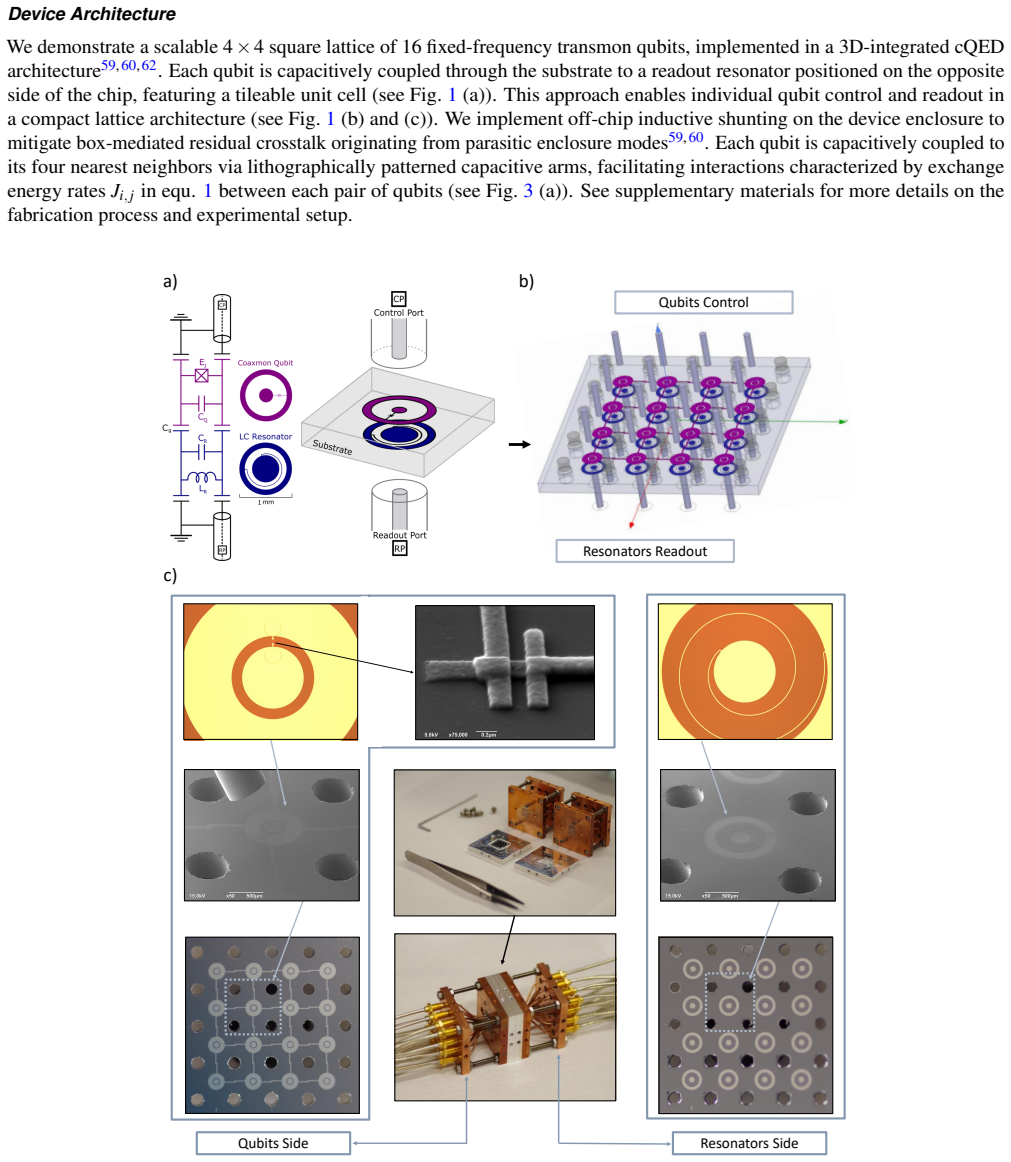
The central object is the tileable unit cell of the 3D-integrated circuit-QED architecture: a fixed-frequency transmon on one side of a silicon chip, capacitively coupled through the substrate to a readout resonator on the opposite side, with nearest-neighbor exchange couplings $J_{i,j}$ provided by lithographic capacitive arms and spurious enclosure modes suppressed by off-chip inductive shunting. The argument is carried by two measurement tools: the static ZZ shift, related to $J$ by the formula $\zeta \approx -2J^2(\alpha_i+\alpha_j)/((\Delta_{ij}+\alpha_i)(\alpha_j-\Delta_{ij}))$, and AC-Stark-shift Ramsey anticrossing spectroscopy, in which one qubit is tuned through resonance with another and the exchange coupling is extracted from the avoided-crossing splitting. For non-nearest-neighbor pairs the same measurement is used as a crosstalk diagnostic: the absence of a resolvable anticrossing is the paper's evidence that parasitic couplings are negligible.
What would settle it
For a diagonal pair such as Q5-Q11, repeat the AC-Stark sweep with longer integration and higher drive power, extract the full anticrossing fit parameters, and report the minimum resolvable splitting; if any non-nearest-neighbor exchange coupling is resolved at the level of tens of kilohertz or above, the claim that long-range crosstalk is negligible is falsified.
Extended reading notes
Core claim
On the paper's own terms, the discovery is that residual parasitic interactions in a 16-qubit square lattice can be pushed below the level of intrinsic frequency noise while retaining strong, uniform nearest-neighbor couplings. Direct AC-Stark anticrossing measurements on diagonal pairs such as Q6-Q2, Q6-Q10, Q5-Q11, Q8-Q10, and Q10-Q16 show no avoided crossings, and the authors interpret the observed frequency fluctuations (5 to 39 kHz) as evidence that long-range couplings are negligible. The nearest-neighbor couplings extracted from static ZZ shifts, ranging from 0.401 to 1.064 MHz, agree with those extracted from Stark-driven swap and anticrossing measurements, supporting the model that only designed couplings matter. Simultaneous randomized benchmarking errors are comparable to individual errors across the lattice, and two-qubit CZ gates are implemented via the siZZle technique with fidelities of 95.15% and 96.44% on two pairs, plus a three-qubit GHZ state with 83.88% fidelity. Together these results are offered as validation of a tileable 3D-integrated architecture in which off-chip inductive shunting suppresses enclosure-mediated crosstalk.
Load-bearing premise
The conclusion that parasitic crosstalk is negligible rests on treating the absence of visible level repulsions in a small set of diagonal qubit pairs as proof that all non-nearest-neighbor couplings are small, even though the reported numbers are frequency jitter, not direct upper limits on those couplings.
Editorial extensions
If this is right
- Larger lattices can be formed by tiling the same unit cell, with the expectation that non-nearest-neighbor couplings remain near the intrinsic frequency-fluctuation floor rather than growing with qubit count.
- Simultaneous single-qubit operations do not need extra crosstalk cancellation because simultaneous randomized benchmarking errors are comparable to individual errors despite the always-on ZZ coupling.
- Fixed-frequency transmons without tunable couplers can still implement entangling gates, as demonstrated by CZ fidelities around 95 to 96 percent obtained with the siZZle technique on two qubit pairs.
- Low qubit-frequency spreads of 0.5 percent and 1.5 percent for the two alternating groups, and a 0.6 percent anharmonicity spread, are achievable without post-fabrication junction annealing, simplifying fabrication targeting.
- Correlated errors from spectator qubits are small enough that independent-error assumptions in quantum error correction become more plausible in this architecture.
Reading between the lines
- A rigorous upper bound on parasitic coupling would follow from publishing the full anticrossing fit parameters ($A$, $B$, $C$) and the minimum resolvable splitting; that conversion of null observations into a quantitative crosstalk bound is an open next step.
- A direct scaling test follows from the tileability claim: build an 8x8 version and check that diagonal and next-nearest-neighbor ZZ shifts remain below the noise floor.
- The static crosstalk characterization could be extended to the driven regime, testing whether simultaneous Stark or gate drives activate parasitic couplings that are invisible at rest.
- Comparing devices with and without the off-chip inductive shunts would clarify how much of the suppression comes from that design choice rather than from the lattice geometry itself.
Editorial analysis
A structured set of objections, weighed in public.
Referee Report
Summary. This manuscript reports a 4x4 lattice of 16 fixed-frequency transmon qubits in a 3D-integrated, tileable circuit architecture with off-chip inductive shunting. It presents measured device parameters, coherence times, nearest-neighbor couplings extracted both from static ZZ shifts and from AC-Stark anticrossings, non-nearest-neighbor crosstalk measurements, individual and simultaneous single-qubit randomized benchmarking, and siZZle-based CZ gates with Bell and GHZ state demonstrations. The central claim is that parasitic long-range crosstalk is negligible, so that always-on nearest-neighbor coupling does not degrade simultaneous single-qubit gate errors.
Significance. If the low-crosstalk claim is established, the result would be significant for scalable fixed-frequency transmon lattices: it would show that a tileable 3D-integrated package can suppress enclosure-mode and long-range couplings without tunable couplers. The paper's strengths include the independent cross-check of nearest-neighbor J from static ZZ and AC-Stark measurements, detailed fabrication and coherence statistics, and an explicit comparison of individual versus simultaneous RB. The main weakness is that the central negative crosstalk result is presented as a set of frequency-fluctuation standard deviations rather than as calibrated upper bounds on parasitic couplings, and the simultaneous RB was performed on four-qubit sets rather than on the full 16-qubit device.
major comments (3)
- [Crosstalk Characterization, Table 2 and Fig. 5] The statement 'we observe no long-range couplings across the lattice' is not supported by a quantitative upper bound. Table 2 lists only five non-nearest-neighbor pairs and reports 'Std-Dev' values of 5-39 kHz, but a standard deviation of Ramsey frequency fluctuations is not an upper bound on the parasitic exchange coupling eJ. In the AC-Stark anticrossing measurement a nonzero eJ produces an avoided crossing with splitting of order 2eJ at resonance, while away from resonance the frequency shift scales as eJ^2/Delta; without the A, B, C fit parameters or a linewidth/sensitivity analysis, the null traces cannot exclude eJ values comparable to the nearest-neighbor couplings (0.401-1.064 MHz). For example, for Q6-Q10 with Delta=7.6 MHz, an eJ of about 0.5 MHz would produce a ZZ shift of roughly 5 kHz, below the reported 12 kHz standard deviation. Five pairs out of 96 non-nearest-neighbor pairs also do not support a global 'across the lattice' statement.
- [Single-Qubit Gate Errors, Tables 5 and 6] The claim that simultaneous single-qubit gate errors are comparable to individual errors is only partially supported. The simultaneous RB experiments were performed on four-qubit sets, so spectator crosstalk from the other twelve qubits was not tested; this should be stated explicitly when the abstract says 'simultaneous single-qubit gate errors across the device.' In addition, several qubits show simultaneous EPGs 1.7-2.1 times their individual values (Q4: 6.62e-3 to 1.11e-2; Q6: 1.56e-3 to 2.87e-3; Q14: 7.43e-4 to 1.31e-3; Q16: 7.42e-4 to 1.56e-3), while the text only flags Q3-Q4. The absolute errors are low, but the 'comparable' claim needs either a quantitative threshold or a discussion of these outliers.
- [Conclusion] The conclusion that 'inter-qubit couplings remain localized, with negligible long-range parasitic interactions' is stronger than the evidence in Table 2. The manuscript should either add a sensitivity analysis that converts each null measurement into an upper bound on eJ for the probed pair, or restrict the claim to the five measured pairs and to the frequency range probed by the AC-Stark scans.
minor comments (5)
- [Methodology, Eq. (3)] Equation (3) refers to δ_i and δ_j as the anharmonicities, but these symbols are not defined; the text should use α_i and α_j consistently.
- [Basic Device Parameters] The phrase 'measured with very low frequency spreads of0.5% and 1.5% MHz' is not grammatical; the percentages and the MHz unit should be separated or corrected.
- [Tables 1 and 2] Tables 1 and 2 have inconsistent column ordering for the qubit frequencies: for example, the Q6-Q2 row in Table 2 lists 4795.6 MHz and 4824.8 MHz, which appears to reverse the Q6 and Q2 frequencies relative to Table 4; please check the table formatting.
- [Throughout] There are several typos, including 'receptively' (Basic Device Parameters), 'oberving' (Two-Qubit Interactions), 'initail' and 'interctaion' (Supplementary Materials), and 'stark shifted' in the caption of Fig. 5; these should be corrected.
- [Single-Qubit Gate Errors] The RB description 'each experiment was performed with 16 different Clifford sequences with total sequence length of 1000 gates and with each sequence repeated for N=10 distinct Clifford gates' is confusing; please clarify the number of randomizations and how N relates to the reported EPG uncertainties.
Circularity Check
No significant circularity: the low-crosstalk conclusion rests on new multi-qubit measurements, and the Table 2 null result is a sensitivity limitation rather than a construction-level circular step.
full rationale
The central low-crosstalk claim is supported by new experimental data — static ZZ shifts, AC-Stark anticrossing traces, swap dynamics, and simultaneous randomized benchmarking — rather than by a parameter fitted to the target conclusion. Nearest-neighbour exchange couplings are extracted in two independent ways: from static ZZ shifts via Eq. 3 and from AC-Stark anticrossing fits, with the comparison shown in Table 1. This is a consistency check between two measurements of the same physical quantity, not a self-definitional reduction. The off-chip inductive-shunting architecture is motivated by prior same-group references (59, 60), but the present 16-qubit device is a new measurement and the cited prior work is externally testable experimental and modelling evidence; the argument does not reduce to an unverified self-citation. Table 2 does report frequency-fluctuation standard deviations rather than explicit upper bounds on parasitic exchange eJ, which is a genuine sensitivity and statistical limitation of the null crosstalk result, but it is not an instance of the conclusion being equivalent to its input by construction. No fitted parameter is renamed as a prediction, no uniqueness theorem is imported solely from the authors' prior work, and no ansatz is smuggled in through a self-citation. The paper therefore exhibits no significant circularity.
Assumptions & free parameters
free parameters (1)
- A, B, C in anticrossing fit model =
not reported
assumptions (4)
- domain assumption Equation 3, zeta approximately -2 J^2 (alpha_i + alpha_j) / ((Delta_ij + alpha_i)(alpha_j - Delta_ij)), relates static ZZ shift to exchange coupling J.
- domain assumption The absence of a visible avoided crossing in a Stark sweep implies the residual coupling eJ is negligible.
- domain assumption Off-chip inductive shunting suppresses enclosure-mediated parasitic modes.
- domain assumption A single 16-qubit device is representative of the scalable tileable architecture.
Cite this review
Pith. "Pith review of Low Crosstalk in a Scalable Superconducting Quantum Lattice." pith.science (2026). https://pith.science/paper/COH2SU2D
@misc{pith2026250522276,
  author       = {Pith},
  title        = {Pith review of: Low Crosstalk in a Scalable Superconducting Quantum Lattice},
  year         = {2026},
  howpublished = {\url{https://pith.science/paper/COH2SU2D}},
  note         = {Machine review of arXiv:2505.22276}
}
read the original abstract
Superconducting quantum circuits are a key platform for advancing quantum information processing and simulation. Scaling efforts currently encounter challenges such as Josephson-junction fabrication yield, design frequency targeting, and crosstalk arising both from spurious microwave modes and intrinsic interactions between qubits. We demonstrate a scalable 4x4 square lattice with low crosstalk, comprising 16 fixed-frequency transmon qubits with nearest-neighbor capacitive coupling that is implemented in a tileable, 3D-integrated circuit architecture with off-chip inductive shunting to mitigate spurious enclosure modes. We report on the design and comprehensive characterization, and show that our implementation achieves targeted device parameters with very low frequency spreads and simultaneous single-qubit gate errors across the device. Our results provide a promising pathway toward a scalable, low-crosstalk superconducting lattice topology with high qubit connectivity for quantum error correction and simulation.
Figures


Figures from the paper (10 more)


Forward citations
Cited by 2 Pith papers
-
Connectivity-induced surface-loss penalty in superconducting qubit-coupler lattices
Embedding a transmon in a flip-chip qubit-coupler lattice raises surface dielectric loss by factors of 1.3 (two couplers) and 1.8 (four couplers) relative to an isolated qubit.
-
Intrinsic Multi-Mode Interference for Passive Suppression of Purcell Decay in Superconducting Circuits
Breaking the symmetry of a transmon capacitor activates multi-mode interference that can suppress Purcell decay, shown analytically, in simulation, and in one four-qubit device.
Reference graph
Works this paper leans on
-
[5]
Putterman, H.et al.Hardware-efficient quantum error correction using concatenated bosonic qubits.arXiv preprint arXiv:2409.13025(2024). 6.Brock, B. L.et al.Quantum error correction of qudits beyond break-even.arXiv preprint arXiv:2409.15065(2024)
arXiv 2024
-
[7]
Lacroix, N.et al.Scaling and logic in the color code on a superconducting quantum processor.arXiv preprint arXiv:2412.14256(2024). 8.Acharya, R.et al.Quantum error correction below the surface code threshold.arXiv preprint arXiv:2408.13687(2024). 9.Eickbusch, A.et al.Demonstrating dynamic surface codes.arXiv preprint arXiv:2412.14360(2024). 10.Karamlou, A...
arXiv 2024
-
[11]
Rosenberg, E.et al.Dynamics of magnetization at infinite temperature in a heisenberg spin chain.Science384, 48–53 (2024)
work page 2024
-
[12]
Cochran, T. A.et al.Visualizing dynamics of charges and strings in (2+ 1) d lattice gauge theories.arXiv preprint arXiv:2409.17142(2024)
arXiv 2024
-
[13]
Gyawali, G.et al.Observation of disorder-free localization and efficient disorder averaging on a quantum processor.arXiv preprint arXiv:2410.06557(2024). 14.Measurement-induced entanglement and teleportation on a noisy quantum processor.Nature622, 481–486 (2023)
arXiv 2024
-
[15]
Malz, D. & Smith, A. Topological two-dimensional Floquet lattice on a single superconducting qubit.Phys. Rev. Lett.126, 163602 (2021). 16.Daley, A. J.et al.Practical quantum advantage in quantum simulation.Nature607, 667–676 (2022). 17.Siddiqi, I. Engineering high-coherence superconducting qubits.Nat. Rev. Mater.6, 875–891 (2021)
work page 2021
-
[18]
Alghadeer, M.et al.Characterization of nanostructural imperfections in superconducting quantum circuits.arXiv preprint arXiv:2501.15059(2025)
arXiv 2025
-
[19]
Alghadeer, M.et al.Mitigating coherent loss in superconducting circuits using molecular self-assembled monolayers.Sci. Reports14, 27340 (2024)
work page 2024
Show all 65 references
-
[20]
ACS Appl
Alghadeer, M.et al.Surface passivation of niobium superconducting quantum circuits using self-assembled monolayers. ACS Appl. Mater. & Interfaces15, 2319–2328 (2022)
2022
-
[21]
Chistolini, T.et al.Performance of Superconducting Resonators Suspended on SiN Membranes.arXiv preprint arXiv:2405.01784(2024). 16/19
2024 arXiv
-
[22]
Altoé, M. V . P.et al.Localization and mitigation of loss in niobium superconducting circuits.PRX Quantum3, 020312 (2022)
2022
-
[23]
Bakr, M.et al.Multiplexed Readout of Superconducting Qubits Using a 3D Re-entrant Cavity Filter.arXiv preprint arXiv:2412.14853(2024)
2024 arXiv
-
[24]
Dynamic josephson junction metasurfaces for multiplexed control of superconducting qubits.arXiv preprint arXiv:2411.01345(2024)
Bakr, M. Dynamic josephson junction metasurfaces for multiplexed control of superconducting qubits.arXiv preprint arXiv:2411.01345(2024)
2024
-
[25]
D.et al.Complementing the transmon by integrating a geometric shunt inductor.arXiv preprint arXiv:2410.10416(2024)
Fasciati, S. D.et al.Complementing the transmon by integrating a geometric shunt inductor.arXiv preprint arXiv:2410.10416(2024)
2024 arXiv
-
[26]
Mohseni, M.et al.How to build a quantum supercomputer: Scaling challenges and opportunities.arXiv preprint arXiv:2411.10406(2024)
2024 arXiv
-
[27]
C.et al.Mitigating losses of superconducting qubits strongly coupled to defect modes.arXiv preprint arXiv:2407.18746(2024)
Zanuz, D. C.et al.Mitigating losses of superconducting qubits strongly coupled to defect modes.arXiv preprint arXiv:2407.18746(2024)
2024 arXiv
-
[28]
V .et al.Identification of different types of high-frequency defects in superconducting qubits.PRX Quantum3, 040332 (2022)
Abdurakhimov, L. V .et al.Identification of different types of high-frequency defects in superconducting qubits.PRX Quantum3, 040332 (2022). 29.Bilmes, A.et al.Resolving the positions of defects in superconducting quantum bits.Sci. reports10, 3090 (2020)
2022
-
[30]
6, 2 (2019)
Krinner, S.et al.Engineering cryogenic setups for 100-qubit scale superconducting circuit systems.EPJ Quantum Technol. 6, 2 (2019)
2019
-
[31]
H., Cykiert, M
Le, N. H., Cykiert, M. & Ginossar, E. Scalable and robust quantum computing on qubit arrays with fixed coupling.npj Quantum Inf.9, 1 (2023)
2023
-
[32]
Koch, J.et al.Charge-insensitive qubit design derived from the cooper pair box.Phys. Rev. A At. Mol. Opt. Phys.76, 042319 (2007)
2007
-
[33]
P.et al.New material platform for superconducting transmon qubits with coherence times exceeding 0.3 milliseconds.Nat
Place, A. P.et al.New material platform for superconducting transmon qubits with coherence times exceeding 0.3 milliseconds.Nat. communications12, 1779 (2021)
2021
-
[34]
Yan, F.et al.Tunable coupling scheme for implementing high-fidelity two-qubit gates.Phys. Rev. Appl.10, 054062 (2018)
2018
-
[35]
& Wellens, T
Ketterer, A. & Wellens, T. Characterizing crosstalk of superconducting transmon processors.Phys. Rev. Appl.20, 034065 (2023)
2023
-
[36]
Tripathi, V .et al.Suppression of crosstalk in superconducting qubits using dynamical decoupling.Phys. Rev. Appl.18, 024068 (2022)
2022
-
[37]
C., Martonosi, M
Murali, P., McKay, D. C., Martonosi, M. & Javadi-Abhari, A. Software mitigation of crosstalk on noisy intermediate- scale quantum computers. InProceedings of the Twenty-Fifth International Conference on Architectural Support for Programming Languages and Operating Systems, 100...
2020
-
[38]
Krinner, S.et al.Benchmarking coherent errors in controlled-phase gates due to spectator qubits.Phys. Rev. Appl.14, 024042 (2020)
2020
-
[39]
Zhao, P.et al.Quantum crosstalk analysis for simultaneous gate operations on superconducting qubits.PRX quantum3, 020301 (2022)
2022
-
[40]
P., Fernández-Pendás, J
Fors, S. P., Fernández-Pendás, J. & Kockum, A. F. Comprehensive explanation of ZZ coupling in superconducting qubits. arXiv preprint arXiv:2408.15402(2024)
2024 arXiv
-
[41]
M.et al.Simple all-microwave entangling gate for fixed-frequency superconducting qubits.Phys
Chow, J. M.et al.Simple all-microwave entangling gate for fixed-frequency superconducting qubits.Phys. review letters 107, 080502 (2011)
2011
-
[43]
review letters125, 240503 (2020)
Xu, Y .et al.High-fidelity, high-scalability two-qubit gate scheme for superconducting qubits.Phys. review letters125, 240503 (2020)
2020
-
[44]
Wei, K.et al.Hamiltonian engineering with multicolor drives for fast entangling gates and quantum crosstalk cancellation. Phys. Rev. Lett.129, 060501 (2022)
2022
-
[45]
review letters125, 240503 (2020)
Xu, Y .et al.High-fidelity, high-scalability two-qubit gate scheme for superconducting qubits.Phys. review letters125, 240503 (2020). 17/19
2020
-
[46]
C.et al.Implementation of conditional phase gates based on tunable zz interactions.Phys
Collodo, M. C.et al.Implementation of conditional phase gates based on tunable zz interactions.Phys. review letters125, 240502 (2020)
2020
-
[47]
Sung, Y .et al.Realization of high-fidelity CZ and ZZ-free iSW AP gates with a tunable coupler.Phys. Rev. X11, 021058 (2021)
2021
-
[48]
review letters 127, 080505 (2021)
Stehlik, J.et al.Tunable coupling architecture for fixed-frequency transmon superconducting qubits.Phys. review letters 127, 080505 (2021)
2021
-
[49]
Long, J.et al.A universal quantum gate set for transmon qubits with strong ZZ interactions.arXiv preprint arXiv:2103.12305(2021)
2021 arXiv
-
[50]
& Yan, F
Chu, J. & Yan, F. Coupler-assisted controlled-phase gate with enhanced adiabaticity.Phys. Rev. Appl.16, 054020 (2021)
2021
-
[51]
Chen, Y .et al.V oltage-activated parametric entangling gates based on gatemon qubits.Phys. Rev. Appl.20, 044012 (2023)
2023
-
[52]
Ganzhorn, M.et al.Benchmarking the noise sensitivity of different parametric two-qubit gates in a single superconducting quantum computing platform.Phys. Rev. Res.2, 033447 (2020)
2020
-
[53]
C., Sheldon, S., Smolin, J
McKay, D. C., Sheldon, S., Smolin, J. A., Chow, J. M. & Gambetta, J. M. Three-qubit randomized benchmarking.Phys. review letters122, 200502 (2019). 54.Bharti, K.et al.Noisy intermediate-scale quantum algorithms.Rev. Mod. Phys.94, 015004 (2022). 55.Megrant, A. & Chen, Y . Scali...
2019
-
[57]
N.et al.Reworkable superconducting qubit package for quantum computing
Das, R. N.et al.Reworkable superconducting qubit package for quantum computing. In2024 IEEE 74th Electronic Components and Technology Conference (ECTC), 427–432 (IEEE, 2024). 58.Huang, S.et al.Microwave package design for superconducting quantum processors.PRX Quantum2, 020306 (2021)
2021
-
[59]
& Leek, P
Spring, P., Tsunoda, T., Vlastakis, B. & Leek, P. Modeling enclosures for large-scale superconducting quantum circuits. Phys. Rev. Appl.14, 024061 (2020)
2020
-
[60]
A.et al.High coherence and low cross-talk in a tileable 3D integrated superconducting circuit architecture.Sci
Spring, P. A.et al.High coherence and low cross-talk in a tileable 3D integrated superconducting circuit architecture.Sci. Adv.8, eabl6698 (2022)
2022
-
[61]
Krasnok, A.et al.Superconducting microwave cavities and qubits for quantum information systems.Appl. Phys. Rev.11 (2024). 62.Rahamim, J.et al.Double-sided coaxial circuit qed with out-of-plane wiring.Appl. Phys. Lett.110(2017)
2024
-
[63]
DiCarlo, L.et al.Demonstration of two-qubit algorithms with a superconducting quantum processor.Nature460, 240–244 (2009)
2009
-
[64]
M.et al.Microwave-activated conditional-phase gate for superconducting qubits.New J
Chow, J. M.et al.Microwave-activated conditional-phase gate for superconducting qubits.New J. Phys.15, 115012 (2013)
2013
-
[65]
& Gambetta, J
Magesan, E. & Gambetta, J. M. Effective hamiltonian models of the cross-resonance gate.Phys. Rev. A101, 052308 (2020)
2020
-
[66]
Solgun, F., DiVincenzo, D. P. & Gambetta, J. M. Simple impedance response formulas for the dispersive interaction rates in the effective hamiltonians of low anharmonicity superconducting qubits.IEEE transactions on microwave theory techniques67, 928–948 (2019)
2019
-
[67]
& Srinivasan, S
Solgun, F. & Srinivasan, S. Direct calculation of ZZ interaction rates in multimode circuit quantum electrodynamics.Phys. Rev. Appl.18, 044025 (2022)
2022
-
[68]
L., Girvin, S
Blais, A., Grimsmo, A. L., Girvin, S. M. & Wallraff, A. Circuit quantum electrodynamics.Rev. Mod. Phys.93, 025005 (2021)
2021
-
[69]
B.et al.Laser-annealing josephson junctions for yielding scaled-up superconducting quantum processors
Hertzberg, J. B.et al.Laser-annealing josephson junctions for yielding scaled-up superconducting quantum processors. npj Quantum Inf.7, 129 (2021)
2021
-
[70]
Wallraff, A.et al.Sideband transitions and two-tone spectroscopy of a superconducting qubit strongly coupled to an on-chip cavity.Phys. Rev. Lett.99, 050501 (2007)
2007
-
[71]
review letters102, 090502 (2009)
Chow, J.et al.Randomized benchmarking and process tomography for gate errors in a solid-state qubit.Phys. review letters102, 090502 (2009). 18/19
2009
-
[72]
M.et al.Characterization of addressability by simultaneous randomized benchmarking.Phys
Gambetta, J. M.et al.Characterization of addressability by simultaneous randomized benchmarking.Phys. review letters 109, 240504 (2012)
2012
-
[73]
M., Rebentrost, P
Motzoi, F., Gambetta, J. M., Rebentrost, P. & Wilhelm, F. K. Simple pulses for elimination of leakage in weakly nonlinear qubits.Phys. review letters103, 110501 (2009)
2009
-
[74]
C., Wood, C
McKay, D. C., Wood, C. J., Sheldon, S., Chow, J. M. & Gambetta, J. M. Efficient z gates for quantum computing.Phys. Rev. A96, 022330 (2017)
2017
-
[75]
K.et al.Hardware-efficient microwave-activated tunable coupling between superconducting qubits.Phys
Mitchell, B. K.et al.Hardware-efficient microwave-activated tunable coupling between superconducting qubits.Phys. Rev. Lett.127, 200502, DOI: 10.1103/PhysRevLett.127.200502 (2021)
2021 doi
-
[76]
X.et al.Hamiltonian engineering with multicolor drives for fast entangling gates and quantum crosstalk cancellation.Phys
Wei, K. X.et al.Hamiltonian engineering with multicolor drives for fast entangling gates and quantum crosstalk cancellation.Phys. Rev. Lett.129, 060501, DOI: 10.1103/PhysRevLett.129.060501 (2022)
2022 doi
-
[77]
Wei, K.et al.Quantum crosstalk cancellation for fast entangling gates and improved multi-qubit performance.arXiv preprint arXiv:2106.00675(2021)
2021 arXiv
-
[78]
Cao, S.et al.Emulating two qubits with a four-level transmon qudit for variational quantum algorithms.arXiv preprint arXiv:2303.04796(2023)
2023 arXiv
-
[79]
Cao, S.Implementation of variational quantum algorithms on superconducting qudits. Ph.D. thesis, University of Oxford (2023). 80.Koch, J.et al.Charge-insensitive qubit design derived from the cooper pair box.Phys. Rev. A76, 042319 (2007)
2023
-
[81]
Peterer, M.Experiments on multi-level superconducting qubits and coaxial circuit QED. Ph.D. thesis, University of Oxford (2016)
2016
-
[82]
& Dunsmuir, J
Dolan, G. & Dunsmuir, J. Very small ( 20 nm) lithographic wires, dots, rings, and tunnel junctions.Phys. B: Condens. Matter152, 7–13 (1988)
1988
-
[83]
Xu, Y .et al.Qubic: An open-source fpga-based control and measurement system for superconducting quantum information processors.IEEE Transactions on Quantum Eng.2, 1–11 (2021)
2021
-
[84]
In2023 IEEE International Conference on Quantum Computing and Engineering (QCE), vol
Huang, G.et al.Qubic 2.0: A flexible advanced full stack quantum bit control system. In2023 IEEE International Conference on Quantum Computing and Engineering (QCE), vol. 2, 248–249 (IEEE, 2023). 19/19
2023
Reviewed August 7, 2026 · model on record in the stance chip above.
Discussion (0). Sign in to comment.