REVIEW 4 major objections 5 minor 56 references
Intermittency in Interplanetary Coronal Mass Ejections Observed by Parker Solar Probe and Solar Orbiter
T0 review · 4 major / 5 minor · reviewed 2026-08-07 · deepseek-v4-flash
Pith's one-line read In coronal mass ejections, turbulence intermittency is radially invariant between 0.25 and 1 au, while sheath regions become more intermittent with distance.
desk verdict A useful first statistical sample of ICME intermittency, but the radial-invariance claim needs significance testing or softer wording before it can stand. read the letter →
The pith
A machine-rendered reading of the paper's core claim, the machinery that carries it, and where it could break.
The reading
What carries the argument
The analysis is carried by scale-dependent kurtosis of magnetic-field increments, $\kappa(\tau) = S_4^B(\tau)/(S_2^B(\tau))^2$, computed from second- and fourth-order structure functions of the field magnitude; $\kappa = 3$ marks a Gaussian distribution and higher values indicate intermittency. The intermittency level is quantified by $\alpha_\kappa$, the exponent of the power-law fit $\kappa \propto f^{\alpha_\kappa}$ (or $\kappa \propto k\,d_i^{\alpha_\kappa}$) across bins in the inertial range, with steeper exponents meaning a more developed turbulent cascade. Spacecraft frequencies are converted to plasma-frame scales $k\,d_i$ through Taylor's hypothesis, and a wavelet-based local intermittency measure (LIM) is used as a consistency check and to locate the fluctuations that drive the non-Gaussian tails. The comparison across radial distances is made by averaging event-wise $\alpha_\kappa$ in a fixed bin, $10^{-2.5} < k\,d_i < 10^{-1.5}$, away from injection and kinetic scales.
What would settle it
Apply the same kurtosis analysis after subtracting a fitted smooth flux-rope model (for example a force-free cylindrical field) instead of a running average, and check whether ακ in ICMEs remains radially invariant; if the invariance vanishes or the exponent values shift systematically, the result is an artifact of the background-removal choice.
Extended reading notes
Core claim
The central claim is that the level of intermittency in ICME interiors, measured by the scaling exponent $\alpha_\kappa$ of magnetic-field kurtosis in the MHD inertial range ($10^{-2.5} < k\,d_i < 10^{-1.5}$), does not vary with heliocentric distance between 0.25 and 1 au. In the ICME sheath regions, by contrast, $\alpha_\kappa$ increases with distance. Kurtosis behaves similarly across all four interval types (upstream wind, sheath, ICME, downstream wind), with values well above the Gaussian level at small scales and a gradual return toward Gaussian statistics at larger scales; the average intermittency level is comparable in all intervals. Correlations between $\alpha_\kappa$ and distance, speed, spectral index, residual energy, cross helicity, and proton $\beta$ are generally low, with the only clear radial trends appearing in upstream and sheath intervals. The authors conclude that ICMEs are relatively static, well-developed turbulent environments, while sheaths are younger structures whose turbulence is not yet fully developed at small heliocentric distances; unusually high absolute kurtosis with low scaling exponent in some sheaths may reflect non-turbulent structures rather than an evolved cascade.
Load-bearing premise
The conclusion rests on assuming that, after subtracting a 1–4 hour running average, the residual magnetic-field fluctuations inside each ICME are stationary, homogeneous turbulence; if flux-rope rotation, interval boundaries, or non-turbulent coherent structures contaminate the residual, the measured kurtosis and its radial invariance would not describe turbulent intermittency.
Editorial extensions
If this is right
- ICME interiors can be treated as statistically stationary turbulence over 0.25–1 au, so observations at different heliocentric distances can be merged when studying their small-scale fluctuations.
- The absence of radial evolution means the turbulent state of an ICME is established early and is not reset by expansion or interaction with the surrounding solar wind.
- Sheath turbulence is still developing near the Sun, so radial distance must be accounted for when comparing sheath intermittency between events or missions.
- In sheaths, absolute kurtosis and scaling exponent can disagree, so studies that report only kurtosis values may overstate the development of the turbulent cascade.
- Because intermittency levels are similar across ICMEs, sheaths, and ambient wind, intermittency alone cannot identify an ICME interval in the magnetic-field data.
Reading between the lines
- Editorial inference: if ICME turbulence is already fully developed at 0.25 au, particle-acceleration and cosmic-ray transport models may be able to use a fixed fluctuation-scattering prescription inside ejecta rather than a distance-dependent one.
- Editorial inference: the sheath trend predicts even lower intermittency at distances below 0.25 au, so close perihelion passes could test whether the increase continues or saturates.
- Editorial inference: separating coherent structures from turbulence in sheaths (for example by thresholding the local intermittency measure or checking phase coherence) on the same events would test whether the high-κ, low-ακ population is truly non-turbulent.
- Editorial inference: re-running the analysis separately for magnetic clouds and complex ejecta would show whether radial invariance is generic to ICMEs or specific to smooth flux ropes.
Editorial analysis
A structured set of objections, weighed in public.
Referee Report
Summary. The paper analyzes scale-dependent magnetic-field intermittency in 49 ICMEs observed by Parker Solar Probe and Solar Orbiter between 0.25 and 1 au, together with their sheath, upstream, and downstream solar-wind intervals. It uses structure-function-based kurtosis κ(τ) and its scaling exponent ακ, with a wavelet-based local intermittency measure as a cross-check, and reports Kendall correlations between ακ and heliocentric distance R, speed, spectral index, residual energy, cross helicity, and proton beta. The central claims are that ICMEs show a radially invariant level of intermittency, interpreted as relatively static, fully developed turbulence, while sheaths show increasing intermittency with distance, interpreted as still-evolving turbulence.
Significance. If the central claim is substantiated, this would be a valuable multi-spacecraft statistical result: it would show that large-scale ICME expansion does not, by itself, modify inertial-range intermittency, and it would provide a concrete observational contrast between ICMEs and sheaths. The study has clear strengths: a 49-event sample from two modern spacecraft, a transparent event list in Table 2, use of standard structure-function and wavelet diagnostics, and explicit comparison with earlier case studies. The analysis is reproducible in principle because the events are listed and the data are public. However, the headline distinction between 'radially invariant ICME' and 'evolving sheath' currently rests on low Kendall coefficients without significance tests, confidence intervals, or equivalence tests, and the radial sampling is bimodal between the two spacecraft. These issues are load-bearing for the paper's conclusions.
major comments (4)
- [§3.2, Table 1; §5] The conclusion that ICMEs are 'radially invariant' rests on the single Kendall coefficient τ=0.11 between ακ and R for ICMEs, while the sheath value is τ=0.30. No p-values, confidence intervals, or equivalence tests are reported anywhere. With 49 events, the approximate 95% CI for τ=0.11 is about −0.08 to 0.30, so a radial trend as strong as the sheath trend is not excluded by the ICME data, and the claimed ICME-versus-sheath difference is not demonstrated. The statement in §3.2 that 'the values remain low in other kdi ranges' does not supply the missing uncertainty quantification. Please add bootstrap confidence intervals and/or equivalence tests (e.g., two one-sided tests against a pre-specified margin), and report p-values for all entries in Table 1. Without this, 'radial invariance' is an under-determined null result rather than a supported claim.
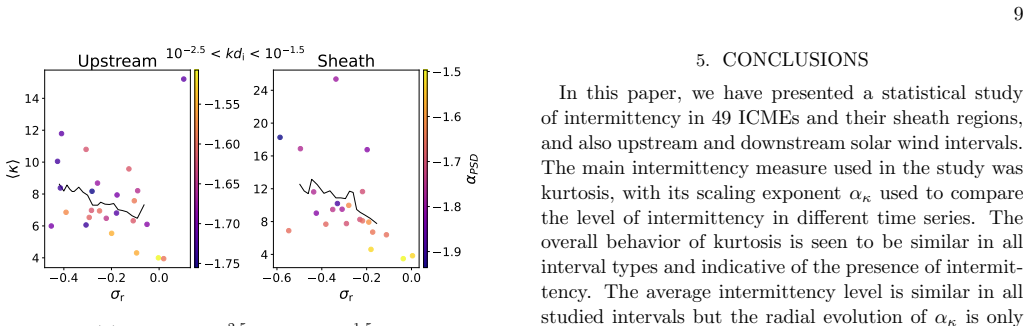
- [§3.2, Figure 4; Table 2] The radial comparison is confounded by the bimodal spacecraft sampling. In Table 2, PSP events are concentrated at R ≤ 0.69 au and SolO events at R ≥ 0.61 au, with few events in the overlap region. If PSP and SolO yield systematically different ακ values due to different noise levels, cadences, or data processing, a spacecraft-dependent offset could either create or mask the apparent radial trend in ακ versus R. Please test for a spacecraft dependence by including spacecraft as a covariate, computing within-spacecraft Kendall coefficients, or overlaying the ακ distributions by spacecraft in Figure 4. This is particularly important for the sheath trend, where τ=0.30 could in principle be driven by a PSP/SolO offset rather than by a true radial evolution.
- [§3.2, Figure 3] The choice of the fitting range 10^-2.5 < kdi < 10^-1.5 appears post hoc. The text states that power-law fitting was performed in seven one-decade bins, that the two outermost bins were excluded because they include parts of the injection and kinetic scales, and that the analysis then concentrates on one middle range. The paper says that correlation values remain low in other kdi ranges but does not show them. Because the central claim concerns ακ and its correlations, please report the Kendall coefficients for all seven bins (for example, in a supplementary table) and either justify the chosen range a priori or demonstrate that the ICME/sheath distinction is stable across the full inertial range. Small shifts in the fitting range could alter the apparent radial invariance.
- [§3.1–3.2] The interpretation of ακ as an intermittency measure of homogeneous turbulence assumes that the residual fluctuations, after removing running averages of 1 to 4 hours, are stationary and are not dominated by the large-scale flux-rope rotation or boundary layers. The paper itself notes in §3.1 that 'some systematic inhomogeneities in the distribution of enhanced fluctuation amplitudes across the subintervals may be enhancing the LIM', and it removes only 10% of the ICME interval at each boundary. In addition, the shortest ICMEs have durations near the 3-hour minimum, for which a 4-hour running average is ill-defined, and the stated robustness check is not shown quantitatively. Please provide a stationarity analysis of the residuals (e.g., splitting each interval into subintervals and comparing ακ) or a flux-rope model subtraction for a subset of events. Without such a check, the measured kurtosis may reflect non-turbulent large-scale structure rather than turbulence intermittency, and the radial invariance could be an artifact of averaging over heterogeneous intervals.
minor comments (5)
- [§3.2] Please specify the fitting procedure used to obtain ακ and αPSD (log-log least squares, weighting, number of points per bin) and how the 'center of each bin' is defined.
- [§2] The sentence 'only events with average proton β of less than 0.5 are included' should state the time averaging window and data source used for β; Table 2 does not list β, so the reader cannot verify this selection criterion.
- [§3.1] For the example event, the ακ value of 0.40 is reported without an uncertainty, and the fitting range (10^-3 to 10^-1 Hz) differs from the range used in the statistical analysis; please give the fit uncertainty and clarify the relationship between the two ranges.
- [Figure 4] The color scales for αPSD and |σc| are not described in the caption or in the text; please add color-bar labels and explain the five-point moving average used for the trend lines.
- [Table 1 and Table 2] The phrase 'T able 2' should be corrected, and Table 2 should clarify that shock times are absent for some events rather than implying a complete shock-time column.
Circularity Check
No significant circularity: kurtosis and its scaling exponent are measured from data with standard definitions, and the radial-invariance conclusion is an observational interpretation, not a fitted prediction or self-citation-dependent derivation.
full rationale
The paper's central quantities are computed directly from measured magnetic field data: kurtosis is defined by Eq. (2) as κ(τ) = S4_B(τ)/(S2_B(τ))^2, and the intermittency measure ακ is obtained by power-law fitting of κ versus kdi in a chosen inertial-range bin. No parameter is fitted to the radial trend and then repackaged as a prediction; the Kendall correlations in Table 1 are reported as measured associations, and the claim of radial invariance in ICMEs is an interpretation of a low correlation coefficient (τ = 0.11), not a derivation from the definition of κ or ακ. The conclusion that 'steeper values of the scaling exponent, ακ, correspond to more developed turbulence' is a standard interpretive convention supported by external literature (Sorriso-Valvo et al. 2019, 2021; Telloni et al. 2021), not a circular redefinition. Self-citations appear for context or as data/catalog sources (e.g., Good et al. 2023 for related indications; ICMECAT catalog with co-author Möstl), but the load-bearing measurement chain does not reduce to any self-citation. The choice of the kdi range 10^-2.5 < kdi < 10^-1.5 is a methodological selection made after inspecting the data, which is a statistical or robustness concern rather than circularity. The paper is a self-contained observational statistical study against external benchmarks, so no circular step meeting the evidence standard is present.
Assumptions & free parameters
free parameters (3)
- kdi fitting range =
10^-2.5 to 10^-1.5
- Boundary removal fraction =
10% of interval duration
- Minimum ICME duration =
3 hours
assumptions (4)
- domain assumption Taylor's hypothesis holds, so spacecraft frequency maps to plasma-frame wavenumber k via mean flow speed and density.
- domain assumption After detrending, residual magnetic field fluctuations are stationary and homogeneous within each interval.
- domain assumption ICMECAT interval boundaries (shock, start, end) are accurate for all but one event.
- domain assumption The scaling exponent alpha_kappa, fitted over one decade in k_di, is a valid measure of intermittency level and turbulence development.
Cite this review
Pith. "Pith review of Intermittency in Interplanetary Coronal Mass Ejections Observed by Parker Solar Probe and Solar Orbiter." pith.science (2026). https://pith.science/paper/QJCAD5CX
@misc{pith2026250522283,
  author       = {Pith},
  title        = {Pith review of: Intermittency in Interplanetary Coronal Mass Ejections Observed by Parker Solar Probe and Solar Orbiter},
  year         = {2026},
  howpublished = {\url{https://pith.science/paper/QJCAD5CX}},
  note         = {Machine review of arXiv:2505.22283}
}
read the original abstract
Intermittency has been studied extensively in the fast and slow solar winds but to a far lesser extent in interplanetary coronal mass ejections (ICMEs). While ICMEs are often characterized by their relatively smooth, large-scale magnetic flux rope structures, a spectrum of fluctuations is nonetheless present at smaller scales. We have examined kurtosis and its scaling exponents at magnetohydrodynamic inertial scales in 49 ICMEs observed between 0.25 and 1 au by Parker Solar Probe and Solar Orbiter, and compared the results to those obtained for the ICME sheath regions and ambient solar wind intervals. Kurtosis behaves similarly in all intervals studied and presents a universal behavior typical of intermittent time series. The ICMEs displayed a radially invariant level of intermittency, suggesting that they are relatively static, well-developed turbulent environments. In the sheath regions, the level of intermittency increased with distance, indicating that the turbulence is not yet fully developed at small heliocentric distances. In addition to intermittent fluctuations related to turbulence, the sheath regions may possess a population of non-turbulent structures that increase the absolute value of kurtosis.
Figures


Figures from the paper (2 more)

Reference graph
Works this paper leans on
-
[1]
Bale, S. D., Goetz, K., Harvey, P. R., et al. 2016, Space Science Reviews, 204, 49, doi: 10.1007/s11214-016-0244-5
-
[2]
Borovsky, J. E. 2008, Journal of Geophysical Research (Space Physics), 113, A08110, doi: 10.1029/2007ja012684
-
[3]
Bowen, T. A., Mallet, A., Bonnell, J. W., & Bale, S. D. 2018, The Astrophysical Journal, 865, 45, doi: 10.3847/1538-4357/aad95b
-
[4]
2019, Earth and Space Science, 6, 656, doi: 10.1029/2018ea000535
Bruno, R. 2019, Earth and Space Science, 6, 656, doi: 10.1029/2018ea000535
-
[5]
2013, Living Reviews in Solar Physics, 10, 2, doi: 10.12942/lrsp-2013-2
Bruno, R., & Carbone, V. 2013, Living Reviews in Solar Physics, 10, 2, doi: 10.12942/lrsp-2013-2
-
[6]
2003, Journal of Geophysical Research (Space Physics), 108, 1130, doi: 10.1029/2002ja009615
Bruno, R., Carbone, V., Sorriso-Valvo, L., & Bavassano, B. 2003, Journal of Geophysical Research (Space Physics), 108, 1130, doi: 10.1029/2002ja009615
-
[7]
2001, Planetary and Space Science, 49, 1201, doi: 10.1016/s0032-0633(01)00061-7
Bavassano, B. 2001, Planetary and Space Science, 49, 1201, doi: 10.1016/s0032-0633(01)00061-7
-
[8]
Burlaga, L., Sittler, E., Mariani, F., & Schwenn, R. 1981, J. Geophys. Res., 86, 6673, doi: 10.1029/JA086iA08p06673
Show all 56 references
-
[9]
V., & Richardson, I
Cane, H. V., & Richardson, I. G. 2003, Journal of Geophysical Research (Space Physics), 108, 1156, doi: 10.1029/2002JA009817
2003 doi
-
[10]
Chen, C. H. K. 2016, Journal of Plasma Physics, 82, 535820602, doi: 10.1017/s0022377816001124 Dudok de Wit, T., Alexandrova, O., Furno, I.,
2016 doi
-
[11]
2013, Space Science Reviews, 178, 665, doi: 10.1007/s11214-013-9974-9
Sorriso-Valvo, L., & Zimbardo, G. 2013, Space Science Reviews, 178, 665, doi: 10.1007/s11214-013-9974-9
2013 doi
-
[12]
Elsasser, W. M. 1950, Physical Review, 79, 183, doi: 10.1103/PhysRev.79.183
1950 doi
-
[13]
1992, Annual Review of Fluid Mechanics, 24, 395, doi: 10.1146/annurev.fl.24.010192.002143
Farge, M. 1992, Annual Review of Fluid Mechanics, 24, 395, doi: 10.1146/annurev.fl.24.010192.002143
1992
-
[14]
J., Velli, M
Fox, N. J., Velli, M. C., Bale, S. D., et al. 2016, Space Science Reviews, 204, 7, doi: 10.1007/s11214-015-0211-6
2016 doi
-
[15]
1995, Turbulence: The Legacy of A
Frisch, U. 1995, Turbulence: The Legacy of A. N. Kolmogorov (Cambridge University Press)
1995
-
[16]
W., Hatakka, L
Good, S. W., Hatakka, L. M., Ala-Lahti, M., et al. 2022, Monthly Notices of the Royal Astronomical Society, 514, 2425, doi: 10.1093/mnras/stac1388
2022 doi
-
[17]
W., Kilpua, E
Good, S. W., Kilpua, E. K. J., Ala-Lahti, M., et al. 2020, The Astrophysical Journal, 900, L32, doi: 10.3847/2041-8213/abb021
2020 doi
-
[18]
W., Rantala, O
Good, S. W., Rantala, O. K., Jylh¨ a, A. S. M., et al. 2023, The Astrophysical Journal, 956, L30, doi: 10.3847/2041-8213/acfd1c
2023 doi
-
[19]
S., O’Brien, H., Carrasco Blazquez, I., et al
Horbury, T. S., O’Brien, H., Carrasco Blazquez, I., et al. 2020, Astronomy and Astrophysics, 642, A9, doi: 10.1051/0004-6361/201937257
2020 doi
-
[20]
J., Torbert, R
Janoo, L., Farrugia, C. J., Torbert, R. B., et al. 1998, Journal of Geophysical Research, 103, 17249, doi: 10.1029/97ja03173
1998 doi
-
[21]
C., Abiad, R., Austin, G., et al
Kasper, J. C., Abiad, R., Austin, G., et al. 2016, Space Science Reviews, 204, 131, doi: 10.1007/s11214-015-0206-3
2016 doi
-
[22]
Kendall, M. G. 1938, Biometrika, 30, 81, doi: 10.1093/biomet/30.1-2.81
1938 doi
-
[23]
Kilpua, E., Koskinen, H. E. J., & Pulkkinen, T. I. 2017, Living Reviews in Solar Physics, 14, 5, doi: 10.1007/s41116-017-0009-6
2017 doi
-
[24]
Kilpua, E. K. J., Good, S. W., Ala-Lahti, M., et al. 2021, Frontiers in Astronomy and Space Sciences, 7, 109, doi: 10.3389/fspas.2020.610278
2021
-
[25]
Kilpua, E. K. J., Fontaine, D., Moissard, C., et al. 2019, Space Weather, 17, 1257, doi: 10.1029/2019SW002217
2019 doi
-
[26]
Kilpua, E. K. J., Fontaine, D., Good, S. W., et al. 2020, Annales Geophysicae, 38, 999, doi: 10.5194/angeo-38-999-2020
2020 doi
-
[27]
H., Osman, K
Kiyani, K. H., Osman, K. T., & Chapman, S. C. 2015, Philosophical Transactions of the Royal Society A:
2015
-
[28]
Mathematical, Physical and Engineering Sciences, 373, 20140155, doi: doi:10.1098/rsta.2014.0155
2014
-
[29]
2011, Physical Review Letters, 106, 125001, doi: 10.1103/PhysRevLett.106.125001
Li, G., Miao, B., Hu, Q., & Qin, G. 2011, Physical Review Letters, 106, 125001, doi: 10.1103/PhysRevLett.106.125001
2011 doi
-
[30]
H., Wan, M., Servidio, S., et al
Matthaeus, W. H., Wan, M., Servidio, S., et al. 2015, Philosophical Transactions of the Royal Society A:
2015
-
[31]
Mathematical, Physical and Engineering Sciences, 373, 20140154, doi: 10.1098/rsta.2014.0154
2014
-
[32]
1991, Journal of Fluid Mechanics, 232, 469, doi: 10.1017/s0022112091003786
Meneveau, C. 1991, Journal of Fluid Mechanics, 232, 469, doi: 10.1017/s0022112091003786
1991 doi
-
[33]
Meneveau, C., & Sreenivasan, K. R. 1991, Journal of Fluid Mechanics, 224, 429, doi: 10.1017/s0022112091001830
1991 doi
-
[34]
Moestl, C., Davies, E., & Weiler, E. 2020, HELIO4CAST Interplanetary Coronal Mass Ejection Catalog v2.2, doi: 10.6084/m9.figshare.6356420.v21 11 T able 2.List of analyzed ICMEs ακ Event Shock Time Start Time End Time Spacecraft R Upstream Sheath ICME Downstream Number (UT) (UT...
2020 doi
-
[35]
2019, Journal of Geophysical Research (Space Physics), 124, 8208, doi: 10.1029/2019JA026952 M´ arquez Rodr ´ ıguez, R., Sorriso-Valvo, L., & Yordanova, E
Moissard, C., Fontaine, D., & Savoini, P. 2019, Journal of Geophysical Research (Space Physics), 124, 8208, doi: 10.1029/2019JA026952 M´ arquez Rodr ´ ıguez, R., Sorriso-Valvo, L., & Yordanova, E. 2023, Solar Physics, 298, 54, doi: 10.1007/s11207-023-02146-1 M¨ ostl, C., Isavn...
2019 doi
-
[36]
J., Bruno, R., Livi, S., et al
Owen, C. J., Bruno, R., Livi, S., et al. 2020, Astronomy and Astrophysics, 642, A16, doi: 10.1051/0004-6361/201937259
2020 doi
-
[37]
Y., et al
Palmerio, E., Carcaboso, F., Khoo, L. Y., et al. 2024, The Astrophysical Journal, 963, 108, doi: 10.3847/1538-4357/ad1ab4
2024 doi
-
[38]
2024, A&A, 686, A116, doi: 10.1051/0004-6361/202348700 Pitˇ na, A.,ˇSafr´ ankov´ a, J., Nˇ emeˇ cek, Z.,ˇDurovcov´ a, T., &
Pezzi, O., Trotta, D., Benella, S., et al. 2024, A&A, 686, A116, doi: 10.1051/0004-6361/202348700 Pitˇ na, A.,ˇSafr´ ankov´ a, J., Nˇ emeˇ cek, Z.,ˇDurovcov´ a, T., &
2024 doi
-
[39]
2021, Frontiers in Physics, 8, 654, doi: 10.3389/fphy.2020.626768
Kis, A. 2021, Frontiers in Physics, 8, 654, doi: 10.3389/fphy.2020.626768
2021
-
[40]
W., Alexandrova, O., Sorriso-Valvo, L., et al
Roberts, O. W., Alexandrova, O., Sorriso-Valvo, L., et al. 2022, Journal of Geophysical Research (Space Physics), 127, e29483, doi: 10.1029/2021JA029483
2022 doi
-
[41]
Ruohotie, J., Kilpua, E. K. J., Good, S. W., & Ala-Lahti, M. 2022, Frontiers in Astronomy and Space Sciences, 9, 943247, doi: 10.3389/fspas.2022.943247
2022
-
[42]
Ruzmaikin, A., Feynman, J., & Smith, E. J. 1997, Journal of Geophysical Research, 102, 19753, doi: 10.1029/97ja01558
1997 doi
-
[43]
2025, The Astrophysical Journal, 979, 152, doi: 10.3847/1538-4357/ad9f38
Shi, C., Sioulas, N., Huang, Z., et al. 2025, The Astrophysical Journal, 979, 152, doi: 10.3847/1538-4357/ad9f38
2025 doi
-
[44]
2022, The Astrophysical Journal, 934, 143, doi: 10.3847/1538-4357/ac7aa2
Sioulas, N., Huang, Z., Velli, M., et al. 2022, The Astrophysical Journal, 934, 143, doi: 10.3847/1538-4357/ac7aa2
2022 doi
-
[45]
E., Good, S
Soljento, J. E., Good, S. W., Osmane, A., & Kilpua, E. K. J. 2023, ApJL, 946, L19, doi: 10.3847/2041-8213/acc071
2023 doi
-
[46]
Song, P., & Russell, C. T. 1999, SSRv, 87, 387, doi: 10.1023/A:1005035800454
1999 doi
-
[47]
2018, Solar Physics, 293, 10, doi: 10.1007/s11207-017-1229-6
Sorriso-Valvo, L., Carbone, F., Perri, S., et al. 2018, Solar Physics, 293, 10, doi: 10.1007/s11207-017-1229-6
2018 doi
- [48]
-
[49]
2021, The Astrophysical Journal, 919, L30, doi: 10.3847/2041-8213/ac26c5
Telloni, D. 2021, The Astrophysical Journal, 919, L30, doi: 10.3847/2041-8213/ac26c5
2021 doi
-
[50]
2019, Frontiers in Physics, 7, 108, doi: 10.3389/fphy.2019.00108
Sorriso-Valvo, L., De Vita, G., Fraternale, F., et al. 2019, Frontiers in Physics, 7, 108, doi: 10.3389/fphy.2019.00108
2019
-
[51]
E., Eriksson, S., Wilder, F
Stawarz, J. E., Eriksson, S., Wilder, F. D., et al. 2016, Journal of Geophysical Research (Space Physics), 121, 11,021, doi: 10.1002/2016JA023458
2016 doi
-
[52]
J., D´ emoulin, P., & Dasso, S
Steed, K., Owen, C. J., D´ emoulin, P., & Dasso, S. 2011, Journal of Geophysical Research (Space Physics), 116, A01106, doi: 10.1029/2010ja015940
2011 doi
-
[53]
D., et al
Telloni, D., Sorriso-Valvo, L., Woodham, L. D., et al. 2021, The Astrophysical Journal, 912, L21, doi: 10.3847/2041-8213/abf7d1
2021 doi
-
[54]
Torrence, C., & Compo, G. P. 1998, Bulletin of the American Meteorological Society, 79, 61, doi: 10.1175/1520-0477(1998)079 ⟨0061:Apgtwa⟩2.0.Co;2
1998 doi
-
[55]
G., & Maruca, B
Verscharen, D., Klein, K. G., & Maruca, B. A. 2019, Living Reviews in Solar Physics, 16, 5, doi: 10.1007/s41116-019-0021-0
2019 doi
-
[56]
2021, Frontiers in Astronomy and Space Sciences, 7, 99, doi: 10.3389/fspas.2020.617113
Wawrzaszek, A., & Echim, M. 2021, Frontiers in Astronomy and Space Sciences, 7, 99, doi: 10.3389/fspas.2020.617113
2021
Reviewed August 7, 2026 · model on record in the stance chip above.
Discussion (0). Sign in to comment.