REVIEW 3 major objections 6 minor 53 references
From Controlled Scenarios to Real-World: Cross-Domain Degradation Pattern Matching for All-in-One Image Restoration
T0 review · 3 major / 6 minor · reviewed 2026-08-07 · deepseek-v4-flash
Pith's one-line read UDAIR claims that a single 11.24-million-parameter model, using a degradation codebook and correlation-alignment test-time adaptation, outperforms existing all-in-one image restoration methods on all five tasks across ten source and…
desk verdict Real cross-domain gains on most tasks, but the 'all metrics SOTA' claim is false on the paper's own tables and the CORAL-based TTA step is under-specified to the point of being non-runnable as written. read the letter →
The pith
A machine-rendered reading of the paper's core claim, the machinery that carries it, and where it could break.
The reading
What carries the argument
The central object is the degradation codebook inside the DAAM: an embedding matrix of size $[K,D]$ that maps each continuous feature vector $z_e$ to its nearest discrete code $e_{k^*}$, turning unknown degradations into matched prototypes in a shared cross-domain latent space. It is trained jointly with the MAE reconstruction loss and the cross-sample contrastive loss, and at test time the same codebook serves as the anchor set that the CORAL-based test-time adaptation pulls target features toward. The gating mechanism after quantization selects the most representative channels, and the Domain Adaptation Module wraps the degradation features with channel expansion and squeeze-excitation before sending them to the decoder.
What would settle it
Run the target-domain inference while logging the shape of the feature tensor feeding Eqs. 16-19: if the DAM returns a single 96-dimensional vector per test image, the target covariance $C_t$ is either undefined or rank-deficient, and the reported gains cannot come from the stated CORAL computation. The claim would also be testable by replacing the source 'anchor' of Eq. 16 with a fixed random covariance matrix; if the metric gains persist, the mechanism is not the one described.
Extended reading notes
Core claim
UDAIR treats cross-domain generalization as a degradation-pattern matching problem. A Degradation Aware and Analysis Module uses a codebook of $K$ discrete embeddings to quantize continuous degradation features into prototypes, while a cross-sample contrastive loss pulls together features from different images sharing the same degradation and pushes apart different degradations. During target-domain inference, a Domain Adaptation Module is activated and fine-tuned per sample with a CORAL loss that aligns the covariance of target features to the source feature statistics, pulling each target degradation toward its corresponding source cluster center. The paper reports that this combination achieves state-of-the-art performance on all five tasks on both source-domain and target-domain datasets, with the largest gains on deraining, and that the alignment reduces the KL divergence between source and target feature distributions.
Load-bearing premise
The load-bearing premise is that the test-time adaptation step can actually be computed as written: each single test image must supply enough feature vectors to form a valid covariance matrix to compare against the source cluster statistics; if only one vector comes out of the module, the stated alignment formula has no well-defined value, and the reported gains would have to come from a different mechanism.
Editorial extensions
If this is right
- A single model can replace per-task restoration systems in real-world applications, since one weight set handles noise, haze, rain, low light, and underwater color shifts.
- The codebook plus contrastive learning gives the model a label-free way to identify which degradation is present, which is what makes the unified restoration possible.
- The reported target-domain gains indicate that test-time adaptation, not just a bigger training set, is a viable route to closing the synthetic-to-real gap for all-in-one restoration.
- Removing either the codebook or the test-time adaptation step measurably worsens target-domain results, so the paper's improvement depends on both components working together.
- The decrease in KL divergence after adaptation provides a direct feature-level check that the domain gap is being reduced, not merely that output metrics improve.
Reading between the lines
- The codebook-as-prototype recipe is transferable: any task with discrete latent degradation states, such as video restoration or medical imaging, could reuse the same cross-sample contrastive learning and anchor-based alignment.
- A natural stress test is composite degradation, which the paper itself flags as future work; the codebook would need to represent combinations such as rain-plus-haze-plus-low-light rather than single prototypes.
- A testable extension is to freeze the restoration decoder during adaptation; if the reported metric gains persist, the alignment step alone is responsible, and if not, the two stages interact in a way the paper does not isolate.
Editorial analysis
A structured set of objections, weighed in public.
Referee Report
Summary. The paper proposes UDAIR, a unified all-in-one image restoration framework that combines a codebook of discrete degradation prototypes, cross-sample contrastive learning (CSCL), and a correlation-alignment-based test-time adaptation (TTA) module with a domain adaptation module (DAM). The method is evaluated on five restoration tasks (denoising, dehazing, deraining, low-light enhancement, underwater enhancement), each with a source-domain training set and a target-domain test set, and the authors claim state-of-the-art performance across all tasks and all reported metrics, along with improved degradation identification as shown by feature-cluster visualization and reduced KL divergence.
Significance. If the proposed mechanism works as described, the contribution is practically valuable: a single 11.24M-parameter model that handles five degradation types and adapts to unseen target domains at test time without labels would be a meaningful step for real-world all-in-one restoration. The codebook-based degradation prototype idea and the cross-sample contrastive learning strategy are well-motivated and are reasonable responses to the limitations of sample-wise feature learning. The paper also reports an extensive benchmark across ten datasets and includes ablations that isolate the contributions of the codebook, CSCL, and TTA. The complexity comparison (Table 5) is useful and suggests a favorable efficiency-accuracy trade-off. However, the headline claim of universal state-of-the-art performance is contradicted by the paper's own tables, and the test-time adaptation procedure is not specified precisely enough to be reproducible; these issues must be resolved before the contribution can be accepted at its claimed strength.
major comments (3)
- [§1 (contribution bullet), Abstract, Table 1, Table 2] The claim that UDAIR 'achieves new state-of-the-art performance in an AiOIR way for all five tasks on both 10 open-source closed and real-world scenario datasets, in terms of all the proposed metrics' is directly contradicted by the results in the paper's own tables. In Table 1, on the source-domain UIE task, DiffUIR achieves SSIM 0.840 and PSNR 21.962, while UDAIR achieves SSIM 0.833 and PSNR 21.208. In Table 2, on the target-domain LLIE task, PromptIR achieves NIQE 4.714 versus UDAIR's 4.814; on the target-domain UIE task, ROP+ achieves UIQM 3.051 and UCIQE 0.627 versus UDAIR's 2.811 and 0.626. Because the claim is universal over all metrics, these single counterexamples falsify it as written. The authors should either weaken the claim to 'state-of-the-art on most tasks/metrics' or provide a precise enumeration of which metrics are improved, together with an explanation for the exceptions.
- [§2.4, Eqs. (16)–(19), Algorithm 1, Fig. 1 caption] The CORAL-based test-time adaptation is not well-defined as described. The CORAL loss in Eqs. (16)–(19) requires covariance matrices of source and target feature matrices with at least two samples per domain. However, the text and Fig. 1 state that TTA fine-tunes the model 'for each sample,' and the CSCL algorithm treats each sample as one feature vector. With a single target feature vector, the covariance in Eq. (17) has n_t = 1, making the denominator zero and the covariance undefined. The authors must clarify whether the target 'feature matrix' is formed by pooling spatial vectors from the feature map, by accumulating features over multiple images in a batch, or by some other construction. Without this detail, the central adaptation mechanism cannot be reproduced or evaluated.
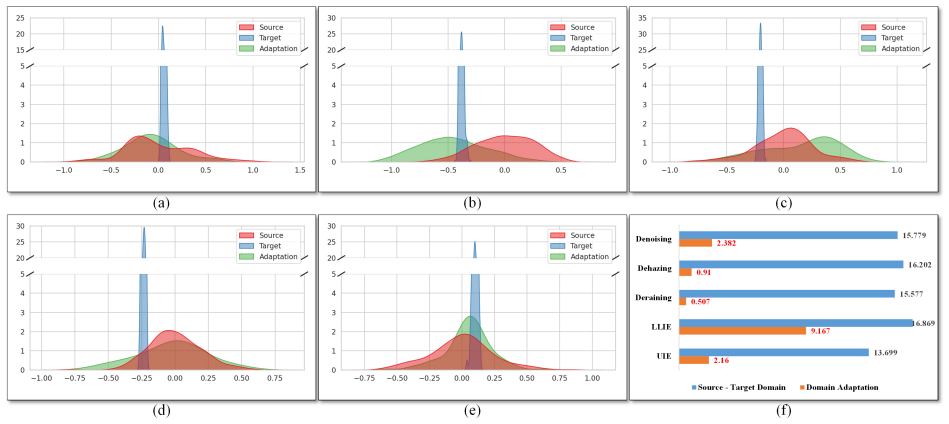
- [§3.8, Fig. 12(f), §3.6] The KL-divergence decrease reported in Fig. 12(f) is used as evidence that the domain adaptation strategy effectively aligns source and target distributions. However, the TTA objective is itself a correlation-alignment loss that directly minimizes a second-order distributional discrepancy on the same degradation features that are plotted. The observed decrease in KL divergence after adaptation is therefore partly a re-statement of the optimization objective rather than an independent confirmation of improved degradation identification. To support the claimed mechanism, the authors should report KL divergence (or another distributional measure) on features that are not directly optimized by the TTA loss, such as features from the frozen encoder or features of the restored images, or compare against a control that optimizes the same objective without the codebook.
minor comments (6)
- [§2.3, Eq. (4)] The definition of the global embedding E in Eq. (4) uses notation that is not fully explained; please specify the shape of x and the range of the summation variables, and check the placement of the square root.
- [§2.4, text after Eq. (15)] The word 'precessed' should be 'processed'.
- [§3.4] The TTA procedure is described as using five steps, but no learning rate, optimizer, or loss-weight schedule for the CORAL loss during TTA is given, and it is not stated whether the backbone weights are frozen while only DAM is updated; these hyperparameters are needed for reproducibility.
- [§3.1] The composition of the source-domain training set is given in detail, but the target-domain dataset sizes and the number of test images per task are not reported; please add them.
- [§3.2, Ref. [42]] The paper cites Zhou et al. for the PSNR/SSIM metrics; the canonical references for PSNR and SSIM (e.g., Wang et al., 2004) should be cited instead or in addition.
- [Figures 9 and 12] The t-SNE and density plots would benefit from labeled axes, legends, and a statement of which feature layer is visualized; currently the reader must infer the exact feature source.
Circularity Check
No construction-level circularity: the SOTA claim is anchored in external benchmarks; the only self-referential evidence is feature-alignment diagnostics that mirror the CORAL and contrastive training objectives.
-
self definitional
[Section 3.8, Fig.12(f); also contribution list in Section 1]
"Fig.12 (f) shows the KL divergence of samples from different tasks. The divergence between the source and raw target domains is large, indicating a pronounced distribution shift. After domain adaptation, the divergence between the source and target domains decreases sharply. The substantial decrease in divergence confirms the effectiveness of the adaptation module in narrowing the source–target gap."
The adaptation module is trained with the CORAL loss (Eqs. 16-19), which directly penalizes the covariance discrepancy between source and target degradation features. KL divergence between the same source and target feature distributions is another measure of the same distributional gap that the loss explicitly minimizes. A post-adaptation decrease is therefore a check that the optimization objective was met, not independent confirmation that the alignment strategy improves restoration. The target-domain restoration gains in Table 2 are the independent evidence; the Fig.12(f) 'effectiveness' claim is a self-referential verification of the training objective rather than a prediction.
-
self definitional
[Section 3.7.1, Fig.9]
"The t-SNE is applied to project the degradation features from DAAM into a two-dimensions space. The resulting visualization, presented in Fig.9 (a) and (b), further demonstrates the pivotal role of CSCL in separating the different degradation categories."
CSCL's loss (Eq. 12) is explicitly constructed to pull same-degradation features together and push different-degradation features apart. The t-SNE separation shown for the model trained with CSCL is a direct visualization of that same objective, so it cannot serve as an independent validation that the learned features identify degradation patterns. It confirms that the loss was optimized rather than testing degradation identification on unseen conditions. This evidence is not load-bearing for the restored-image quality numbers, which come from external datasets and baselines.
full rationale
The central restoration claims are tested on 10 open-source datasets against independent baselines, and no target-domain metric is used as a training loss, so the main empirical comparison is not circular by construction. The CORAL objective and the CSCL loss do not directly optimize PSNR/SSIM/NIQE/UIQM, and the reported gains in Tables 1 and 2 therefore have independent content. I found no load-bearing self-citation chain, no imported uniqueness theorem, and no ansatz smuggled in via citation; the one author self-citation ([50]) merely supports choice of UIE metrics. The two flagged steps are self-referential diagnostics: the KL-divergence decrease and t-SNE clustering largely restate the CORAL and contrastive objectives rather than independently validating the mechanism. These are minor and non-load-bearing, so the score is 2. Separately, the paper's own tables contradict the abstract's 'all proposed metrics' SOTA phrasing (e.g., UDAIR is not best on source UIE SSIM/PSNR or target LLIE NIQE), and the CORAL covariance computation is underspecified for per-sample TTA; both are correctness and reproducibility concerns, not circularity.
Assumptions & free parameters
free parameters (6)
- contrastive temperature tau =
not reported
- codebook size K =
not reported
- TTA learning rate eta =
not reported
- TTA steps =
5
- loss weights alpha, beta =
1, 0.2
- DAM channel expansion =
2x
assumptions (5)
- domain assumption Image degradations form a small discrete set of K prototypes that are shared across source and target domains
- domain assumption Aligning second-order statistics (covariance) of target features to source features reduces harmful domain shift
- domain assumption Source-domain cluster centers remain valid fixed anchors while the DAM is updated at test time
- domain assumption Random permutation within same-task mini-batches produces degradation-level positive pairs, not spurious pairs
- domain assumption VQ nearest-neighbor quantization (Eqs. 1-3) preserves information sufficient for high-quality restoration
invented entities (1)
-
degradation pattern codebook (K discrete cross-domain prototypes)
Cite this review
Pith. "Pith review of From Controlled Scenarios to Real-World: Cross-Domain Degradation Pattern Matching for All-in-One Image Restoration." pith.science (2026). https://pith.science/paper/TGU67Z6P
@misc{pith2026250522284,
  author       = {Pith},
  title        = {Pith review of: From Controlled Scenarios to Real-World: Cross-Domain Degradation Pattern Matching for All-in-One Image Restoration},
  year         = {2026},
  howpublished = {\url{https://pith.science/paper/TGU67Z6P}},
  note         = {Machine review of arXiv:2505.22284}
}
read the original abstract
As a fundamental imaging task, All-in-One Image Restoration (AiOIR) aims to achieve image restoration caused by multiple degradation patterns via a single model with unified parameters. Although existing AiOIR approaches obtain promising performance in closed and controlled scenarios, they still suffered from considerable performance reduction in real-world scenarios since the gap of data distributions between the training samples (source domain) and real-world test samples (target domain) can lead inferior degradation awareness ability. To address this issue, a Unified Domain-Adaptive Image Restoration (UDAIR) framework is proposed to effectively achieve AiOIR by leveraging the learned knowledge from source domain to target domain. To improve the degradation identification, a codebook is designed to learn a group of discrete embeddings to denote the degradation patterns, and the cross-sample contrastive learning mechanism is further proposed to capture shared features from different samples of certain degradation. To bridge the data gap, a domain adaptation strategy is proposed to build the feature projection between the source and target domains by dynamically aligning their codebook embeddings, and a correlation alignment-based test-time adaptation mechanism is designed to fine-tune the alignment discrepancies by tightening the degradation embeddings to the corresponding cluster center in the source domain. Experimental results on 10 open-source datasets demonstrate that UDAIR achieves new state-of-the-art performance for the AiOIR task. Most importantly, the feature cluster validate the degradation identification under unknown conditions, and qualitative comparisons showcase robust generalization to real-world scenarios.
Figures



Figures from the paper (9 more)


Reference graph
Works this paper leans on
-
[1]
Fast, efficient, and accu- rate neuro-imaging denoising via supervised deep learning,
S. Chaudhary, S. Moon, and H. Lu, “Fast, efficient, and accu- rate neuro-imaging denoising via supervised deep learning,” Nature communications, vol. 13, no. 1, p. 5165, 2022
work page 2022
-
[2]
Ad- vancing real-world image dehazing: Perspective, modules, and training,
Y . Feng, L. Ma, X. Meng, F. Zhou, R. Liu, and Z. Su, “Ad- vancing real-world image dehazing: Perspective, modules, and training,”IEEE Transactions on Pattern Analysis and Machine Intelligence, 2024
work page 2024
-
[3]
Multiscale low-light image enhancement network with il- lumination constraint,
G.-D. Fan, B. Fan, M. Gan, G.-Y . Chen, and C. P. Chen, “Multiscale low-light image enhancement network with il- lumination constraint,”IEEE Transactions on Circuits and Systems for Video Technology, vol. 32, no. 11, pp. 7403– 7417, 2022
work page 2022
-
[4]
Bridg- ing the gap between haze scenarios: A unified image dehaz- ing model,
Y . Feng, Z. Su, L. Ma, X. Li, R. Liu, and F. Zhou, “Bridg- ing the gap between haze scenarios: A unified image dehaz- ing model,”IEEE Transactions on Circuits and Systems for Video Technology, 2024
work page 2024
-
[5]
A survey on all-in-one image restoration: Taxonomy, evaluation and future trends,
J. Jiang, Z. Zuo, G. Wu, K. Jiang, and X. Liu, “A survey on all-in-one image restoration: Taxonomy, evaluation and future trends,”arXiv preprint arXiv:2410.15067, 2024
arXiv 2024
-
[6]
A comprehensive review of deep learning-based real-world image restoration,
L. Zhai, Y . Wang, S. Cui, and Y . Zhou, “A comprehensive review of deep learning-based real-world image restoration,” IEEE Access, vol. 11, pp. 21 049–21 067, 2023
work page 2023
-
[7]
Vision language models in au- tonomous driving: A survey and outlook,
X. Zhou, M. Liu, E. Yurtsever, B. L. Zagar, W. Zimmer, H. Cao, and A. C. Knoll, “Vision language models in au- tonomous driving: A survey and outlook,”IEEE Transac- tions on Intelligent Vehicles, 2024
work page 2024
-
[8]
Maui: modular analytics of uas imagery for specialty crop research,
K. Kanaley, M. J. Murdock, T. Qiu, E. Liu, S. E. Seyram, D. Starzmann, L. B. Smart, K. M. Gold, and Y . Jiang, “Maui: modular analytics of uas imagery for specialty crop research,”Plant Methods, vol. 21, no. 1, pp. 1–17, 2025
work page 2025
Show all 53 references
-
[9]
Vision- based real-time marine and offshore structural health mon- itoring system using underwater robots,
P. Jiao, X. Ye, C. Zhang, W. Li, and H. Wang, “Vision- based real-time marine and offshore structural health mon- itoring system using underwater robots,”Computer-Aided Civil and Infrastructure Engineering, vol. 39, no. 2, pp. 281– 299, 2024
2024
-
[10]
Development and external valida- tion of an artificial intelligence-based method for scalable chest radiograph diagnosis: A multi-country cross-sectional study,
Z. Liu, J. Xu, C. Yin, G. Han, Y . Che, G. Fan, X. Li, L. Xie, L. Bao, Z. Penget al., “Development and external valida- tion of an artificial intelligence-based method for scalable chest radiograph diagnosis: A multi-country cross-sectional study,”Research, vol. 7, p. 0426, 2024
2024
-
[11]
Parallel driving with big models and foundation intelligence in cyber–physical–social spaces,
X. Wang, J. Huang, Y . Tian, C. Sun, L. Yang, S. Lou, C. Lv, C. Sun, and F.-Y . Wang, “Parallel driving with big models and foundation intelligence in cyber–physical–social spaces,”Research, vol. 7, p. 0349, 2024
2024
-
[12]
Spatial- frequency dual-domain feature fusion network for low-light remote sensing image enhancement,
Z. Yao, G. Fan, J. Fan, M. Gan, and C. P. Chen, “Spatial- frequency dual-domain feature fusion network for low-light remote sensing image enhancement,”IEEE Transactions on Geoscience and Remote Sensing, 2024
2024
-
[13]
Spatial residual for underwater object detection,
J. Zhou, Z. He, D. Zhang, S. Liu, X. Fu, and X. Li, “Spatial residual for underwater object detection,”IEEE Transactions on Pattern Analysis and Machine Intelligence, 2025
2025
-
[14]
Energy-efficient high-fidelity image reconstruction with memristor arrays for medical di- agnosis,
H. Zhao, Z. Liu, J. Tang, B. Gao, Q. Qin, J. Li, Y . Zhou, P. Yao, Y . Xi, Y . Linet al., “Energy-efficient high-fidelity image reconstruction with memristor arrays for medical di- agnosis,”Nature Communications, vol. 14, no. 1, p. 2276, 2023
2023
-
[15]
Swinir: Image restoration using swin transformer,
J. Liang, J. Cao, G. Sun, K. Zhang, L. Van Gool, and R. Tim- ofte, “Swinir: Image restoration using swin transformer,” in Proceedings of the IEEE/CVF international conference on computer vision, 2021, pp. 1833–1844
2021
-
[16]
Restormer: Efficient transformer for high-resolution image restoration,
S. W. Zamir, A. Arora, S. Khan, M. Hayat, F. S. Khan, and M.-H. Yang, “Restormer: Efficient transformer for high-resolution image restoration,” inProceedings of the IEEE/CVF conference on computer vision and pattern recognition, 2022, pp. 5728–5739
2022
-
[17]
Mambair: A simple baseline for image restoration with state-space model,
H. Guo, J. Li, T. Dai, Z. Ouyang, X. Ren, and S.-T. Xia, “Mambair: A simple baseline for image restoration with state-space model,” inEuropean conference on computer vi- sion. Springer, 2024, pp. 222–241
2024
-
[18]
Image restoration via frequency selection,
Y . Cui, W. Ren, X. Cao, and A. Knoll, “Image restoration via frequency selection,”IEEE Transactions on Pattern Analy- sis and Machine Intelligence, vol. 46, no. 2, pp. 1093–1108, 2023
2023
-
[19]
AdaIR: Adaptive all-in-one image restoration via fre- quency mining and modulation,
Y . Cui, S. W. Zamir, S. Khan, A. Knoll, M. Shah, and F. S. Khan, “AdaIR: Adaptive all-in-one image restoration via fre- quency mining and modulation,” inThe Thirteenth Interna- tional Conference on Learning Representations, 2025
2025
-
[20]
Prompt-based ingredient-oriented all-in-one image restora- tion,
H. Gao, J. Yang, Y . Zhang, N. Wang, J. Yang, and D. Dang, “Prompt-based ingredient-oriented all-in-one image restora- tion,”IEEE Transactions on Circuits and Systems for Video Technology, 2024
2024
-
[21]
Towards effective multiple-in-one image restoration: A sequential and prompt learning strategy,
X. Kong, C. Dong, and L. Zhang, “Towards effective multiple-in-one image restoration: A sequential and prompt learning strategy,”arXiv preprint arXiv:2401.03379, 2024
2024 arXiv
-
[22]
Controlling vision-language models for universal image restoration,
Z. Luo, F. K. Gustafsson, Z. Zhao, J. Sj ¨olund, and T. B. Sch¨on, “Controlling vision-language models for universal image restoration,”arXiv preprint arXiv:2310.01018, 2023
2023 arXiv
-
[23]
Real-world scene im- age enhancement with contrastive domain adaptation learn- ing,
Y . Zhang, Y . Cai, D. Yan, and R. Lin, “Real-world scene im- age enhancement with contrastive domain adaptation learn- ing,”ACM Transactions on Multimedia Computing, Commu- nications and Applications, vol. 20, no. 12, pp. 1–23, 2024
2024
-
[24]
Promp- tir: Prompting for all-in-one image restoration,
V . Potlapalli, S. W. Zamir, S. Khan, and F. Khan, “Promp- tir: Prompting for all-in-one image restoration,” inThirty- seventh Conference on Neural Information Processing Sys- tems, 2023
2023
-
[25]
All-in-one image restoration for unknown corruption,
B. Li, X. Liu, P. Hu, Z. Wu, J. Lv, and X. Peng, “All-in-one image restoration for unknown corruption,” inProceedings of the IEEE/CVF conference on computer vision and pattern recognition, 2022, pp. 17 452–17 462
2022
-
[26]
Multi- modal prompt perceiver: Empower adaptiveness generaliz- ability and fidelity for all-in-one image restoration,
Y . Ai, H. Huang, X. Zhou, J. Wang, and R. He, “Multi- modal prompt perceiver: Empower adaptiveness generaliz- ability and fidelity for all-in-one image restoration,” inPro- ceedings of the IEEE/CVF Conference on Computer Vision and Pattern Recognition, 2024, pp. 25 432–25 444
2024
-
[27]
Tent: Fully test-time adaptation by entropy minimization,
D. Wang, E. Shelhamer, S. Liu, B. Olshausen, and T. Darrell, “Tent: Fully test-time adaptation by entropy minimization,” inInternational Conference on Learning Representations,
-
[28]
Adaptformer: Adapting vision transformers for scal- able visual recognition,
S. Chen, C. Ge, Z. Tong, J. Wang, Y . Song, J. Wang, and P. Luo, “Adaptformer: Adapting vision transformers for scal- able visual recognition,”Advances in Neural Information Processing Systems, vol. 35, pp. 16 664–16 678, 2022
2022
-
[29]
Test- time degradation adaptation for open-set image restoration,
Y . Gou, H. Zhao, B. Li, X. Xiao, and X. Peng, “Test- time degradation adaptation for open-set image restoration,” arXiv preprint arXiv:2312.02197, 2023
2023 arXiv
-
[30]
Continual test- time domain adaptation,
Q. Wang, O. Fink, L. Van Gool, and D. Dai, “Continual test- time domain adaptation,” inProceedings of the IEEE/CVF Conference on Computer Vision and Pattern Recognition, 2022, pp. 7201–7211
2022
-
[31]
An image is worth 16x16 words: Transformers for image recognition at scale,
A. Dosovitskiy, L. Beyer, A. Kolesnikov, D. Weissenborn, X. Zhai, T. Unterthiner, M. Dehghani, M. Minderer, G. Heigold, S. Gellyet al., “An image is worth 16x16 words: Transformers for image recognition at scale,”arXiv preprint arXiv:2010.11929, 2020
2010 arXiv
-
[32]
Deep coral: Correlation alignment for deep domain adaptation,
B. Sun and K. Saenko, “Deep coral: Correlation alignment for deep domain adaptation,” inComputer vision–ECCV 2016 workshops: Amsterdam, the Netherlands, October 8- 10 and 15-16, 2016, proceedings, part III 14. Springer, 2016, pp. 443–450
2016
-
[33]
A high-quality denoising dataset for smartphone cameras,
A. Abdelhamed, S. Lin, and M. S. Brown, “A high-quality denoising dataset for smartphone cameras,” inProceedings of the IEEE conference on computer vision and pattern recognition, 2018, pp. 1692–1700
2018
-
[34]
Benchmarking single-image dehazing and be- yond,
B. Li, W. Ren, D. Fu, D. Tao, D. Feng, W. Zeng, and Z. Wang, “Benchmarking single-image dehazing and be- yond,”IEEE Transactions on Image Processing, vol. 28, no. 1, pp. 492–505, 2018
2018
-
[35]
Toward real-world single image deraining: A new bench- mark and beyond,
W. Li, Q. Zhang, J. Zhang, Z. Huang, X. Tian, and D. Tao, “Toward real-world single image deraining: A new bench- mark and beyond,”arXiv preprint arXiv:2206.05514, 2022
2022 arXiv
-
[36]
Deep retinex decomposition for low-light enhancement,
C. Wei, W. Wang, W. Yang, and J. Liu, “Deep retinex decomposition for low-light enhancement,”arXiv preprint arXiv:1808.04560, 2018
2018 arXiv
-
[37]
An underwater image enhancement benchmark dataset and beyond,
C. Li, C. Guo, W. Ren, R. Cong, J. Hou, S. Kwong, and D. Tao, “An underwater image enhancement benchmark dataset and beyond,”IEEE transactions on image process- ing, vol. 29, pp. 4376–4389, 2019
2019
-
[38]
Real-world noisy image denoising: A new benchmark,
J. Xu, H. Li, Z. Liang, D. Zhang, and L. Zhang, “Real-world noisy image denoising: A new benchmark,”arXiv preprint arXiv:1804.02603, 2018
2018 arXiv
-
[39]
From sky to the ground: A large-scale benchmark and simple baseline towards real rain removal,
Y . Guo, X. Xiao, Y . Chang, S. Deng, and L. Yan, “From sky to the ground: A large-scale benchmark and simple baseline towards real rain removal,” inProceedings of the IEEE/CVF International Conference on Computer Vision (ICCV), Octo- ber 2023, pp. 12 097–12 107
2023
-
[40]
Lime: Low-light image en- hancement via illumination map estimation,
X. Guo, Y . Li, and H. Ling, “Lime: Low-light image en- hancement via illumination map estimation,”IEEE Transac- tions on image processing, vol. 26, no. 2, pp. 982–993, 2016
2016
-
[41]
Simultaneous enhance- ment and super-resolution of underwater imagery for im- proved visual perception,
M. J. Islam, P. Luo, and J. Sattar, “Simultaneous enhance- ment and super-resolution of underwater imagery for im- proved visual perception,”arXiv preprint arXiv:2002.01155, 2020
2002 arXiv
-
[42]
Underwater camera: Improving visual perception via adap- tive dark pixel prior and color correction,
J. Zhou, Q. Liu, Q. Jiang, W. Ren, K.-M. Lam, and W. Zhang, “Underwater camera: Improving visual perception via adap- tive dark pixel prior and color correction,”International Journal of Computer Vision, pp. 1–19, 2023
2023
-
[43]
Referenceless pre- diction of perceptual fog density and perceptual image de- fogging,
L. K. Choi, J. You, and A. C. Bovik, “Referenceless pre- diction of perceptual fog density and perceptual image de- fogging,”IEEE Transactions on Image Processing, vol. 24, no. 11, pp. 3888–3901, 2015
2015
-
[44]
Real-world non-homogeneous haze removal by sliding self-attention wavelet network,
Y . Feng, X. Meng, F. Zhou, W. Lin, and Z. Su, “Real-world non-homogeneous haze removal by sliding self-attention wavelet network,”IEEE Transactions on Circuits and Sys- tems for Video Technology, vol. 33, no. 10, pp. 5470–5485, 2023
2023
-
[45]
Making a “completely blind
A. Mittal, R. Soundararajan, and A. C. Bovik, “Making a “completely blind” image quality analyzer,”IEEE Signal processing letters, vol. 20, no. 3, pp. 209–212, 2012
2012
-
[46]
Bilevel fast scene adaptation for low-light image enhance- ment,
L. Ma, D. Jin, N. An, J. Liu, X. Fan, Z. Luo, and R. Liu, “Bilevel fast scene adaptation for low-light image enhance- ment,”International Journal of Computer Vision, pp. 1–19, 2023
2023
-
[47]
No-reference image quality assessment in the spatial domain,
A. Mittal, A. K. Moorthy, and A. C. Bovik, “No-reference image quality assessment in the spatial domain,”IEEE Transactions on image processing, vol. 21, no. 12, pp. 4695– 4708, 2012
2012
-
[48]
Human-visual-system- inspired underwater image quality measures,
K. Panetta, C. Gao, and S. Agaian, “Human-visual-system- inspired underwater image quality measures,”IEEE Journal of Oceanic Engineering, vol. 41, no. 3, pp. 541–551, 2015
2015
-
[49]
An underwater color image qual- ity evaluation metric,
M. Yang and A. Sowmya, “An underwater color image qual- ity evaluation metric,”IEEE Transactions on Image Process- ing, vol. 24, no. 12, pp. 6062–6071, 2015
2015
-
[50]
See through wa- ter: Heuristic modeling towards color correction for under- water image enhancement,
J. Fan, J. Xu, J. Zhou, D. Meng, and Y . Lin, “See through wa- ter: Heuristic modeling towards color correction for under- water image enhancement,”IEEE Transactions on Circuits and Systems for Video Technology, 2024
2024
-
[51]
Rank-one prior: Real- time scene recovery,
J. Liu, R. W. Liu, J. Sun, and T. Zeng, “Rank-one prior: Real- time scene recovery,”IEEE Transactions on Pattern Analy- sis and Machine Intelligence, vol. 45, no. 7, pp. 8845–8860, 2022
2022
-
[52]
Selective hourglass mapping for universal im- age restoration based on diffusion model,
D. Zheng, X.-M. Wu, S. Yang, J. Zhang, J.-F. Hu, and W.- S. Zheng, “Selective hourglass mapping for universal im- age restoration based on diffusion model,” inProceedings of the IEEE/CVF Conference on Computer Vision and Pattern Recognition, 2024, pp. 25 445–25 455
2024
-
[2021]
Available: https://openreview.net/forum?id= uXl3bZLkr3c
[Online]. Available: https://openreview.net/forum?id= uXl3bZLkr3c
Reviewed August 7, 2026 · model on record in the stance chip above.
Discussion (0). Sign in to comment.