REVIEW 4 major objections 6 minor 1 cited by
ChatPD: An LLM-driven Paper-Dataset Networking System
T0 review · 4 major / 6 minor · reviewed 2026-08-07 · deepseek-v4-flash
Pith's one-line read ChatPD claims that an LLM pipeline can extract dataset usage from papers and resolve variant names to canonical entities, outperforming the manually curated PapersWithCode and reaching about 90% precision and recall in entity resolution.
desk verdict A useful LLM-based paper-dataset network with credible system claims, but the evaluation numbers need independent ground-truth validation before they harden. read the letter →
The pith
A machine-rendered reading of the paper's core claim, the machinery that carries it, and where it could break.
The reading
What carries the argument
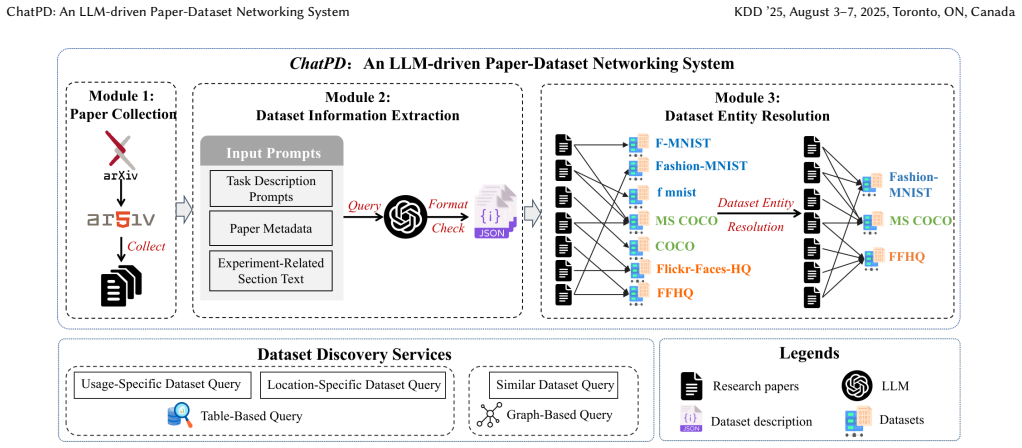
The entity-resolution core is a graph whose nodes are dataset descriptions (D-nodes), candidate canonical entities (E-nodes), and identity attributes (I-nodes) such as 'dataset name' and 'dataset URL'. When a description shares an I-node with an entity, the description is matched to that entity; after a match, every I-node belonging to the description is also attached to the entity, so subsequent descriptions sharing any of those identifiers get matched transitively. Ambiguous I-nodes that would link to multiple entities, for instance a generic Kaggle URL, are removed to preserve integrity. This iterative completion runs up to three iterations and is the mechanism that lifts recall from 0.6477 for graph inference without completion to 0.8727.
What would settle it
Ask an independent team, blind to the authors' labels, to annotate the same 119 papers and 1,000 dataset descriptions, or a fresh sample, and rerun the comparisons; if ChatPD no longer beats PapersWithCode on extraction or SiGMa and ZeroER on entity resolution, the central claim fails. A cheaper check is to hand-verify a random sample of the 444 newly discovered dataset entities, each of which should have a working specific URL, a correct name, and genuine use in the cited papers, not a generic repository link or an LLM hallucination.
Extended reading notes
Core claim
The central discovery is that the two hard parts of building a paper-dataset network, recognizing dataset mentions in free text and deciding which mentions name the same dataset, can both be automated with current LLMs plus a deterministic graph algorithm. The paper reports extraction precision around 0.99 with recall around 0.87 for GPT-4o-mini on 119 KDD and NeurIPS papers, against PwC's precision around 0.83 on the same papers. For entity resolution, its Graph Completion and Inference algorithm yields precision 0.9826 and recall 0.8727, an F1 of 0.8829, on 1,000 dataset descriptions, outperforming SiGMa with F1 0.6778 and ZeroER with F1 0.6300. The authors also argue that the same machinery rediscovers datasets PwC missed, listing 444 new entities, including UltraFeedback, which appears in more than 40 papers and was still absent from PwC at the time of writing.
Load-bearing premise
Every headline performance number rests on labels that the authors wrote themselves for 119 papers and 1,000 dataset descriptions, with no second annotator, no agreement score, and no confidence interval, so if those labels are biased or noisy the claimed superiority over PapersWithCode and the baseline entity-resolution methods is not established.
Editorial extensions
If this is right
- If the reported numbers hold, dataset cataloguing can be refreshed automatically: in 2024 arXiv cs.AI, ChatPD extracted dataset information from 85.5% of papers with accessible text while PwC covered 34.5% of the same set.
- The new-entity discovery rule adds 444 dataset entities not in PwC, including UltraFeedback, used in more than 40 papers, so manual platforms can be expected to lag behind automated extraction on emerging resources.
- The 1500-token cost optimization makes continuous extraction economically feasible at about $0.00063 per paper, with performance close to full-text input.
- Because the pipeline needs only paper text, a user could build a private paper-dataset network from local PDFs without depending on any external platform.
Reading between the lines
- Editorial extension: the D-node, E-node, and I-node graph design does not depend on the dataset domain, so the same completion-and-inference machinery could build paper-code, paper-model, or paper-figure networks from the same paper text.
- Editorial extension: the new-entity rule of a URL plus at least three mentions will undercount real datasets that are cited without URLs and may overcount entities whose papers share a generic URL, so a human audit of a random sample of the 444 new entities would quantify both error directions.
- Editorial extension: the 1500-token input biases extraction toward experimental sections, and the appendix's agentic framework raises recall but lowers precision by pulling in related-work mentions, suggesting that a section-aware mention-role classifier is a natural next step.
- Editorial extension: if the results replicate, the long-term shift is from manual annotation to manual calibration of machine-generated records, turning human effort into verification rather than initial cataloguing.
Editorial analysis
A structured set of objections, weighed in public.
Referee Report
Summary. The paper presents ChatPD, an end-to-end system that collects arXiv cs.AI papers, uses LLMs (primarily GPT-4o-mini) with a constrained JSON prompt to extract dataset usage descriptions from paper sections, and then resolves those descriptions to dataset entities in PapersWithCode using a graph-completion and inference algorithm. The system also discovers new dataset entities via a mention-frequency threshold and is deployed as a public dataset-discovery service. The main empirical claims are that ChatPD reaches approximately 0.99 precision in dataset-usage extraction (F1 0.872 in Table 7), outperforms PapersWithCode and rule-based baselines, and reaches 0.8829 F1 in entity resolution, beating SiGMa and ZeroER.
Significance. If the quantitative claims are established, this is a useful systems contribution: an automated, low-cost pipeline for building a paper-dataset network, with a deployed service and a large released network (60,126 papers, 4,224 entities, 137,004 usage records). The multi-LLM comparison, the explicit graph algorithms, the cost analysis, and the open-sourced deployment are strengths. The central caveat is that the headline numbers rest on author-created labels and an entity-resolution gold standard that may share the same matching cues as the algorithm, so the current evidence cannot fully separate a genuinely better extraction/resolution method from one that is tuned to the annotation rule.
major comments (4)
- [Section 5.1.1, Fig. 3, Table 7] The extraction ground truth is created by manually annotating 119 papers without reporting an annotation protocol, inter-annotator agreement, or any variance estimate. Since the paper's central claim of approximately 0.99 precision and 0.872 F1 is computed against these labels, it is not yet possible to assess whether the labels are consistent or whether the LLM's outputs are accidentally aligned with the annotators' expectations. Please add a second annotator on a subset, report agreement (e.g., Cohen's kappa), and provide confidence intervals (e.g., bootstrap by paper) for all headline extraction metrics.
- [Section 5.2.1, Table 2] The entity-resolution evaluation may be partly circular. The manual linking of 1,000 dataset descriptions to PwC entities appears to have been performed with the same identity evidence, dataset name and URL, that Algorithms 1 and 2 use exclusively, and no annotation protocol is reported. If annotators used those fields, the gold standard is generated by the same rule the algorithm implements, so the 0.8829 F1 measures exact and alias attribute matching rather than general entity resolution. Please describe the annotation instructions, report inter-annotator agreement, and provide examples of links that require semantic inference beyond name/URL; if such examples are rare, the comparison with SiGMa and ZeroER should be reframed.
- [Table 2, Section 5.2.1] The comparison with SiGMa and ZeroER is not apples-to-apples because 526 of the 1,000 descriptions (52.6%) have no PwC entity, and SiGMa and ZeroER are not given an explicit 'no match' option in the reported setup. It is unclear how unlinked descriptions are scored and whether the baselines ever abstain. Please specify the evaluation protocol for the 526 unlinked descriptions, adapt the baselines with a threshold or an additional 'no match' class, and report results both on all 1,000 descriptions and on the 474 linkable descriptions separately.
- [Section 4.3.2, Table 4] The new-entity discovery threshold lambda is a free parameter set to 3 in deployment with no sensitivity analysis. The reported 444 new entities, and therefore the claimed coverage advantage over PwC, depends directly on this threshold. Please vary lambda (e.g., 2, 3, 5, 10) and validate a random sample of newly discovered entities by external inspection to measure the precision of the discovery rule.
minor comments (6)
- [Abstract, Section 1] The abstract and introduction state that ChatPD achieves 'about 90% precision and recall in entity resolution tasks,' but Table 2 reports precision 0.9826 and recall 0.8727; the claim should be rephrased to match the actual numbers, e.g., 'about 98% precision and 87% recall.'
- [Section 4.2.3, Table 7] The 1.5k-token input has markedly lower recall than the full-paper input (0.780 vs. 0.850); the text says the two are 'close,' which is fair, but the claim 'even outperforms it in certain metrics like Precision' should be accompanied by the observation that recall drops by about 7 points.
- [Algorithm 1] The loop condition 'while iteration_limit is not reached' should be replaced with a concrete stopping criterion (e.g., iterate until no new edges are added) or an explicit statement of the default iteration limit in the pseudocode.
- [Section 6.1, Section 6.2] Section 6.1 reports an offline sample of 35,310 cs.AI papers, while Section 6.2 reports 32,959 arXiv cs.AI papers in 2024; the relationship between these two corpora should be clarified.
- [Table 3] The columns 'PwC (2024.11.16)' and 'PwC (2025.01.16)' should be described in the text, including how these dates were obtained and what a checkmark means; a versioned snapshot or access date for the PwC database would make the comparison reproducible.
- [Conclusion] The concluding statement that 'there may be some errors' due to LLM limitations is not quantified; adding a small error analysis or examples of failure cases would make the limitation concrete.
Circularity Check
No significant circularity: ChatPD's extraction and entity-resolution results are not equivalent to their inputs by construction.
full rationale
ChatPD's derivation chain is not circular. The dataset-information-extraction module applies a prompt-based LLM call to paper text and returns JSON descriptions; the entity-resolution module maps descriptions to PwC entities through name/URL identity nodes with transitive graph completion. Neither module's output is defined in terms of the evaluation labels, and no reported number is produced by fitting a parameter and then predicting a quantity that is the fit by construction. Design choices such as the 1500-token input limit, the iteration limit of 3, and the new-entity threshold lambda are stated implementation decisions rather than fitted values. The evaluation does rely on manual annotations created by the authors (Sections 5.1.1 and 5.2.1) without inter-annotator agreement or external validation, and the entity-resolution gold standard may plausibly have been constructed using the same name/URL cues that Algorithms 1 and 2 use; that is a genuine evaluation-validity concern, but the paper does not define the ground truth as the algorithm's rule, so it is not a demonstrated circular reduction. There are no load-bearing self-citations, no imported uniqueness theorems, and no renamed known result. The comparisons with PapersWithCode, SiGMa, and ZeroER also raise benchmark-design questions (e.g., whether the baselines had an explicit no-match option), but those are fairness issues, not circularity. Overall, the central claims have independent content and are not forced by definition or by self-citation.
Assumptions & free parameters
free parameters (3)
- new entity threshold lambda =
3 papers
- input token truncation length =
1500 tokens
- graph completion iteration limit =
3
assumptions (4)
- domain assumption Dataset mention identity is captured by exact dataset name and URL strings; nodes sharing these identifiers refer to the same real-world dataset.
- domain assumption The PwC dataset entity database is an acceptable canonical entity set for initialization and evaluation.
- domain assumption Author-produced manual annotations are correct ground truth.
- domain assumption LLM JSON outputs can be repaired by the three post-processing rules into valid structured data.
Cite this review
Pith. "Pith review of ChatPD: An LLM-driven Paper-Dataset Networking System." pith.science (2026). https://pith.science/paper/HGDFE7O6
@misc{pith2026250522349,
  author       = {Pith},
  title        = {Pith review of: ChatPD: An LLM-driven Paper-Dataset Networking System},
  year         = {2026},
  howpublished = {\url{https://pith.science/paper/HGDFE7O6}},
  note         = {Machine review of arXiv:2505.22349}
}
read the original abstract
Scientific research heavily depends on suitable datasets for method validation, but existing academic platforms with dataset management like PapersWithCode suffer from inefficiencies in their manual workflow. To overcome this bottleneck, we present a system, called ChatPD, that utilizes Large Language Models (LLMs) to automate dataset information extraction from academic papers and construct a structured paper-dataset network. Our system consists of three key modules: \textit{paper collection}, \textit{dataset information extraction}, and \textit{dataset entity resolution} to construct paper-dataset networks. Specifically, we propose a \textit{Graph Completion and Inference} strategy to map dataset descriptions to their corresponding entities. Through extensive experiments, we demonstrate that ChatPD not only outperforms the existing platform PapersWithCode in dataset usage extraction but also achieves about 90\% precision and recall in entity resolution tasks. Moreover, we have deployed ChatPD to continuously extract which datasets are used in papers, and provide a dataset discovery service, such as task-specific dataset queries and similar dataset recommendations. We open source ChatPD and the current paper-dataset network on this [GitHub repository]{https://github.com/ChatPD-web/ChatPD}.
Figures


Figures from the paper (2 more)


Forward citations
Cited by 1 Pith paper
-
A Survey on Open Dataset Search in the LLM Era: Retrospectives and Perspectives
A structured review of open dataset search across tabular, spatial, JSON, graph, and vector data, plus the two-way relationship with LLMs.
Reference graph
Works this paper leans on
-
[1]
Diginetica dataset for CIKM Cup 2016 challenge
2016. Diginetica dataset for CIKM Cup 2016 challenge. https://competitions.cod alab.org/competitions/11161
work page 2016
-
[2]
Josh Achiam, Steven Adler, Sandhini Agarwal, Lama Ahmad, Ilge Akkaya, Floren- cia Leoni Aleman, Diogo Almeida, Janko Altenschmidt, Sam Altman, Shyamal Anadkat, et al. 2023. Gpt-4 technical report. arXiv preprint arXiv:2303.08774 (2023)
arXiv 2023
-
[3]
arXiv.org submitters. 2024. arXiv Dataset. https://doi.org/10.34740/KAGGLE/ DSV/7548853
arXiv 2024
-
[4]
Peter Bandi, Oscar Geessink, Quirine Manson, Marcory Van Dijk, Maschenka Balkenhol, Meyke Hermsen, Babak Ehteshami Bejnordi, Byungjae Lee, Kyunghyun Paeng, Aoxiao Zhong, et al . 2018. From detection of individual metastases to classification of lymph node status at the patient level: the CAME- LYON17 challenge. IEEE Transactions on Medical Imaging (2018)
work page 2018
-
[5]
Mathieu Bastian, Sebastien Heymann, and Mathieu Jacomy. 2009. Gephi: an open source software for exploring and manipulating networks. In Proceedings of the international AAAI conference on web and social media , Vol. 3. 361–362
work page 2009
-
[6]
David Ben-Shimon, Alexander Tsikinovsky, Michael Friedmann, Bracha Shapira, Lior Rokach, and Johannes Hoerle. 2015. Recsys challenge 2015 and the yoochoose dataset. In Proceedings of the 9th ACM Conference on Recommender Systems . 357– 358
work page 2015
-
[7]
Dan Brickley, Matthew Burgess, and Natasha Noy. 2019. Google Dataset Search: Building a search engine for datasets in an open Web ecosystem. In The World Wide Web Conference. 1365–1375
work page 2019
-
[8]
Adriane Chapman, Elena Simperl, Laura Koesten, George Konstantinidis, Luis- Daniel Ibáñez, Emilia Kacprzak, and Paul Groth. 2020. Dataset search: a survey. The VLDB Journal 29, 1 (2020), 251–272
work page 2020
Show all 64 references
-
[9]
Maxime Chevalier-Boisvert, Dzmitry Bahdanau, Salem Lahlou, Lucas Willems, Chitwan Saharia, Thien Huu Nguyen, and Yoshua Bengio. 2018. BabyAI: A platform to study the sample efficiency of grounded language learning. Preprint arXiv:1810.08272 (2018)
2018 arXiv
-
[10]
William W Cohen. 2000. Data integration using similarity joins and a word-based information representation language. ACM Transactions on Information Systems (TOIS) 18, 3 (2000), 288–321
2000
-
[11]
2023.RedPajama: An Open Source Recipe to Reproduce LLaMA training dataset
Together Computer. 2023.RedPajama: An Open Source Recipe to Reproduce LLaMA training dataset. https://github.com/togethercomputer/RedPajama-Data
2023
-
[12]
Marius Cordts, Mohamed Omran, Sebastian Ramos, Timo Rehfeld, Markus En- zweiler, Rodrigo Benenson, Uwe Franke, Stefan Roth, and Bernt Schiele. 2016. The cityscapes dataset for semantic urban scene understanding. In Proceedings of the IEEE conference on computer vision and patt...
2016
-
[13]
Jim Cowie and Wendy Lehnert. 1996. Information extraction. Commun. ACM 39, 1 (jan 1996), 80–91. https://doi.org/10.1145/234173.234209
1996
-
[14]
Ganqu Cui, Lifan Yuan, Ning Ding, Guanming Yao, Wei Zhu, Yuan Ni, Guotong Xie, Zhiyuan Liu, and Maosong Sun. 2023. UltraFeedback: Boosting Language Models with High-quality Feedback. arXiv:2310.01377 [cs.CL]
2023 arXiv
-
[15]
Will Cukierski. 2012. Titanic - Machine Learning from Disaster. https://kaggle.c om/competitions/titanic
2012
-
[16]
FICO. 2018. Fico xml challenge. https://community.fico.com/s/explainable- machine-learning-challenge
2018
-
[17]
C Lee Giles, Kurt D Bollacker, and Steve Lawrence. 1998. CiteSeer: An automatic citation indexing system. In Proceedings of the third ACM conference on Digital libraries. 89–98
1998
-
[18]
Benjamin A Goldstein, Ann Marie Navar, Michael J Pencina, and John PA Ioan- nidis. 2017. Opportunities and challenges in developing risk prediction models with electronic health records data: a systematic review. Journal of the American Medical Informatics Association: JAMIA 2...
2017
-
[19]
Kathleen Gregory, Paul Groth, Andrea Scharnhorst, and Sally Wyatt. 2020. Lost or Found? Discovering Data Needed for Research. Harvard Data Science Review, 4 2020
2020
-
[20]
Max Grusky, Mor Naaman, and Yoav Artzi. 2018. Newsroom: A dataset of 1.3 mil- lion summaries with diverse extractive strategies. arXiv preprint arXiv:1804.11283 (2018)
2018 arXiv
-
[21]
Qianyue Hao, Jingyang Fan, Fengli Xu, Jian Yuan, and Yong Li. 2024. HLM-Cite: Hybrid Language Model Workflow for Text-based Scientific Citation Prediction. In Advances in Neural Information Processing Systems , A. Globerson, L. Mackey, D. Belgrave, A. Fan, U. Paquet, J. Tomcza...
2024
-
[22]
Mandar Joshi, Eunsol Choi, Daniel S Weld, and Luke Zettlemoyer. 2017. Triviaqa: A large scale distantly supervised challenge dataset for reading comprehension. arXiv preprint arXiv:1705.03551 (2017)
2017 arXiv
-
[23]
Tero Karras, Samuli Laine, and Timo Aila. 2019. A style-based generator ar- chitecture for generative adversarial networks. In Proceedings of the IEEE/CVF conference on computer vision and pattern recognition . 4401–4410
2019
-
[24]
Dagmar Kern and Brigitte Mathiak. 2015. Are there any differences in data set retrieval compared to well-known literature retrieval?. In Research and Advanced Technology for Digital Libraries: 19th International Conference on Theory and Practice of Digital Libraries, TPDL 2015...
2015
-
[25]
Laura Koesten, Elena Simperl, Tom Blount, Emilia Kacprzak, and Jeni Tennison
-
[26]
Laura M Koesten, Emilia Kacprzak, Jenifer FA Tennison, and Elena Simperl
-
[27]
Tom Kwiatkowski, Jennimaria Palomaki, Olivia Redfield, Michael Collins, Ankur Parikh, Chris Alberti, Danielle Epstein, Illia Polosukhin, Jacob Devlin, Kenton Lee, et al. 2019. Natural questions: a benchmark for question answering research. Transactions of the Association for C...
2019
-
[28]
Simon Lacoste-Julien, Konstantina Palla, Alex Davies, Gjergji Kasneci, Thore Graepel, and Zoubin Ghahramani. 2013. Sigma: Simple greedy matching for align- ing large knowledge bases. In Proceedings of the 19th ACM SIGKDD international conference on Knowledge discovery and data...
2013
-
[29]
Yinghao Li, Colin Lockard, Prashant Shiralkar, and Chao Zhang. 2023. Extracting Shopping Interest-Related Product Types from the Web. InFindings of the Associ- ation for Computational Linguistics: ACL 2023 , Anna Rogers, Jordan Boyd-Graber, and Naoaki Okazaki (Eds.). Associati...
2023 doi
-
[30]
Yinghao Li, Le Song, and Chao Zhang. 2022. Sparse Conditional Hidden Markov Model for Weakly Supervised Named Entity Recognition. In Proceedings of the 28th ACM SIGKDD Conference on Knowledge Discovery and Data Mining (Wash- ington DC, USA) (KDD ’22). Association for Computing...
2022
-
[31]
Yongqi Li, Yu Yu, and Tieyun Qian. 2023. Type-Aware Decomposed Frame- work for Few-Shot Named Entity Recognition. In Findings of the Association for Computational Linguistics: EMNLP 2023 , Houda Bouamor, Juan Pino, and Kalika Bali (Eds.). Association for Computational Linguist...
2023 doi
-
[32]
Tsung-Yi Lin, Michael Maire, Serge Belongie, James Hays, Pietro Perona, Deva Ramanan, Piotr Dollár, and C Lawrence Zitnick. 2014. Microsoft coco: Common objects in context. In Computer Vision–ECCV 2014: 13th European Conference, Zurich, Switzerland, September 6-12, 2014, Proce...
2014
-
[33]
Zhouhan Lin, Minwei Feng, Cicero Nogueira dos Santos, Mo Yu, Bing Xiang, Bowen Zhou, and Yoshua Bengio. 2017. A structured self-attentive sentence embedding. arXiv preprint arXiv:1703.03130 (2017)
2017 arXiv
-
[34]
Pierre Lison, Jeremy Barnes, Aliaksandr Hubin, and Samia Touileb. 2020. Named Entity Recognition without Labelled Data: A Weak Supervision Approach. In Proceedings of the 58th Annual Meeting of the Association for Computational Linguistics, Dan Jurafsky, Joyce Chai, Natalie Sc...
2020 doi
-
[35]
Aixin Liu, Bei Feng, Bing Xue, Bingxuan Wang, Bochao Wu, Chengda Lu, Cheng- gang Zhao, Chengqi Deng, Chenyu Zhang, Chong Ruan, et al. 2024. Deepseek-v3 technical report. arXiv preprint arXiv:2412.19437 (2024)
2024 arXiv
-
[36]
Yinhan Liu. 2019. Roberta: A robustly optimized bert pretraining approach.arXiv preprint arXiv:1907.11692 364 (2019)
2019 arXiv
-
[37]
Ziwei Liu, Ping Luo, Xiaogang Wang, and Xiaoou Tang. 2015. Deep learning face attributes in the wild. In Proceedings of the IEEE international conference on computer vision. 3730–3738
2015
-
[38]
Tingting Ma, Huiqiang Jiang, Qianhui Wu, Tiejun Zhao, and Chin-Yew Lin. 2022. Decomposed Meta-Learning for Few-Shot Named Entity Recognition. InFindings of the Association for Computational Linguistics: ACL 2022 , Smaranda Muresan, Preslav Nakov, and Aline Villavicencio (Eds.)...
2022 doi
-
[39]
Fernando Martínez-Plumed, Pablo Barredo, Sean O Heigeartaigh, and Jose Hernandez-Orallo. 2021. Research community dynamics behind popular AI benchmarks. Nature Machine Intelligence 3, 7 (2021), 581–589
2021
-
[40]
Bonan Min, Hayley Ross, Elior Sulem, Amir Pouran Ben Veyseh, Thien Huu Nguyen, Oscar Sainz, Eneko Agirre, Ilana Heintz, and Dan Roth. 2023. Recent advances in natural language processing via large pre-trained language models: A survey. Comput. Surveys 56, 2 (2023), 1–40
2023
-
[41]
Alvaro E Monge, Charles Elkan, et al. 1996. The field matching problem: algo- rithms and applications.. In Kdd, Vol. 2. 267–270
1996
-
[42]
Janna Neumann and Jan Brase. 2014. DataCite and DOI names for research data. Journal of computer-aided molecular design 28 (2014), 1035–1041. KDD ’25, August 3–7, 2025, Toronto, ON, Canada Anjie Xu, Ruiqing Ding, and Leye Wang
2014
-
[43]
Tri Nguyen, Mir Rosenberg, Xia Song, Jianfeng Gao, Saurabh Tiwary, Rangan Majumder, and Li Deng. 2016. Ms marco: A human-generated machine reading comprehension dataset. (2016)
2016
-
[44]
Folorunsho Olaiya and Adesesan Barnabas Adeyemo. 2012. Application of data mining techniques in weather prediction and climate change studies.International Journal of Information Engineering and Electronic Business 4, 1 (2012), 51
2012
-
[45]
Kelley Pace and Ronald Barry. 1997. Sparse spatial autoregressions. Statistics & Probability Letters 33, 3 (1997), 291–297. https://EconPapers.repec.org/RePEc: eee:stapro:v:33:y:1997:i:3:p:291-297
1997
-
[46]
Huitong Pan, Qi Zhang, Eduard Dragut, Cornelia Caragea, and Longin Jan Latecki
-
[47]
Animesh Prasad, Chenglei Si, and Min-Yen Kan. 2019. Dataset mention extrac- tion and classification. In Proceedings of the Workshop on Extracting Structured Knowledge from Scientific Publications . 31–36
2019
-
[48]
Xavier Puig, Kevin Ra, Marko Boben, Jiaman Li, Tingwu Wang, Sanja Fidler, and Antonio Torralba. 2018. Virtualhome: Simulating household activities via programs. In Proceedings of the IEEE Conference on Computer Vision and Pattern Recognition. 8494–8502
2018
-
[49]
Pranav Rajpurkar, Jian Zhang, Konstantin Lopyrev, and Percy Liang. 2016. Squad: 100,000+ questions for machine comprehension of text. arXiv preprint arXiv:1606.05250 (2016)
2016 arXiv
-
[50]
Pradeep Ravikumar and William Cohen. 2012. A hierarchical graphical model for record linkage. arXiv preprint arXiv:1207.4180 (2012)
2012 arXiv
-
[51]
Prithviraj Sen, Galileo Namata, Mustafa Bilgic, Lise Getoor, Brian Galligher, and Tina Eliassi-Rad. 2008. Collective classification in network data. AI magazine 29, 3 (2008), 93–93
2008
-
[52]
Heinrich Stamerjohanns, Michael Kohlhase, Deyan Ginev, Catalin David, and Bruce Miller. 2010. Transforming large collections of scientific publications to XML. Mathematics in Computer Science 3 (2010), 299–307
2010
-
[53]
Qwen Team. 2024. Qwen2.5: A Party of Foundation Models. https://qwenlm.git hub.io/blog/qwen2.5/
2024
-
[54]
Hanghang Tong, Christos Faloutsos, and Jia-Yu Pan. 2008. Random walk with restart: fast solutions and applications. Knowledge and Information Systems 14 (2008), 327–346
2008
-
[55]
Adam Trischler, Tong Wang, Xingdi Yuan, Justin Harris, Alessandro Sordoni, Philip Bachman, and Kaheer Suleman. 2016. Newsqa: A machine comprehension dataset. arXiv preprint arXiv:1611.09830 (2016)
2016 arXiv
-
[56]
Alex Wang, Amanpreet Singh, Julian Michael, Felix Hill, Omer Levy, and Samuel R Bowman. 2018. GLUE: A multi-task benchmark and analysis platform for natural language understanding. arXiv preprint arXiv:1804.07461 (2018)
2018 arXiv
-
[57]
Mu-Chun Wang, Zixuan Liu, and Sheng Wang. 2022. Textomics: a dataset for genomics data summary generation. In Proceedings of the 60th Annual Meeting of the Association for Computational Linguistics (Volume 1: Long Papers) . 4878–4891
2022
-
[58]
Jason Wei, Maarten Bosma, Vincent Y Zhao, Kelvin Guu, Adams Wei Yu, Brian Lester, Nan Du, Andrew M Dai, and Quoc V Le. 2021. Finetuned language models are zero-shot learners. arXiv preprint arXiv:2109.01652 (2021)
2021 arXiv
-
[59]
Renzhi Wu, Sanya Chaba, Saurabh Sawlani, Xu Chu, and Saravanan Thirumu- ruganathan. 2020. Zeroer: Entity resolution using zero labeled examples. In Proceedings of the 2020 ACM SIGMOD International Conference on Management of Data. 1149–1164
2020
-
[60]
Han Xiao, Kashif Rasul, and Roland Vollgraf. 2017. Fashion-mnist: a novel image dataset for benchmarking machine learning algorithms. arXiv preprint arXiv:1708.07747 (2017)
2017 arXiv
-
[61]
a r x i v i d
Zheng Zhang, Jie Gao, Ranjodh Singh Dhaliwal, and Toby Jia-Jun Li. 2023. Visar: A human-ai argumentative writing assistant with visual programming and rapid draft prototyping. In Proceedings of the 36th Annual ACM Symposium on User Interface Software and Technology. 1–30. A AP...
2023
-
[2017]
In Proceedings of the 2017 CHI conference on human factors in computing systems
The Trials and Tribulations of Working with Structured Data: -a Study on Information Seeking Behaviour. In Proceedings of the 2017 CHI conference on human factors in computing systems . 1277–1289
2017
-
[2020]
International journal of human-computer studies 135 (2020), 102367
Everything you always wanted to know about a dataset: Studies in data summarisation. International journal of human-computer studies 135 (2020), 102367
2020
-
[2023]
Transactions of the Association for Computational Linguistics 11 (2023), 1132–1146
Dmdd: A large-scale dataset for dataset mentions detection. Transactions of the Association for Computational Linguistics 11 (2023), 1132–1146
2023
Reviewed August 7, 2026 · model on record in the stance chip above.
Discussion (0). Sign in to comment.