REVIEW 3 major objections 6 minor 2 cited by
AgentDNS: A Root Domain Naming System for LLM Agents
T0 review · 3 major / 6 minor · reviewed 2026-08-07 · deepseek-v4-flash
Pith's one-line read A root domain naming system modeled on the internet's DNS would let LLM agents autonomously discover, invoke, and pay for third-party services.
desk verdict A plausible DNS-inspired design for agent service discovery, but the headline claims about secure autonomous invocation are unsupported: there is no implementation, and the architecture's 'trustless authentication' label is contradicted by the described proxy-and-key model. read the letter →
The pith
A machine-rendered reading of the paper's core claim, the machinery that carries it, and where it could break.
The reading
What carries the argument
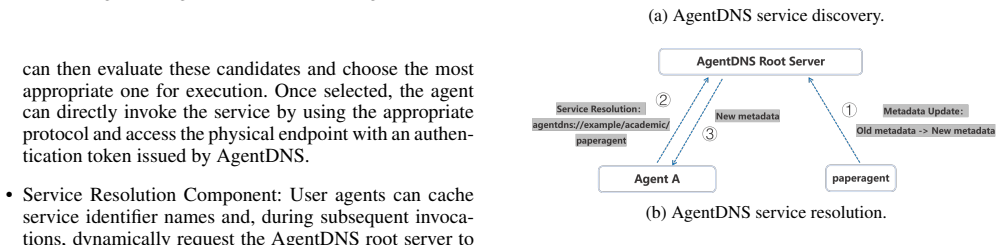
The load-bearing object is the agentdns:// service identifier, following the scheme agentdns://org/category/name, which decouples a service's identity from its physical endpoint. Around that namespace sit five linked mechanisms: a registration component that binds each identifier to metadata about endpoints, capabilities, pricing, and supported protocols; a proxy pool that fronts every registered service so an agent talks to AgentDNS rather than to each vendor; a hybrid search component combining keyword matching with retrieval-augmented generation over capability descriptions; a resolution component that returns fresh metadata for cached identifiers; and a single-sign-on token plus billing layer that lets agents authenticate once and pay through one account. The proxy pool is what makes unified authentication and billing possible, since user agents never hold vendor-specific keys.
What would settle it
A field trial where two independent vendors register services and an off-the-shelf LLM agent is handed a task requiring both services would settle the claim: if the agent cannot discover, authenticate, and invoke them without any human-configured endpoints or credentials, the central promise of autonomous cross-vendor invocation fails.
Extended reading notes
Core claim
The central claim is that the agent internet needs a root domain naming and resolution system analogous to DNS, and that AgentDNS provides it. AgentDNS lets service vendors register under a semantically rich namespace, lets user agents find those services through natural-language queries backed by keyword matching and retrieval-augmented generation, and routes invocations through a proxy pool so that agents authenticate once and receive time-bound tokens valid across all registered vendors. Because each registered service's metadata declares which interoperability protocol it supports, an agent can select MCP, A2A, or another protocol on the fly rather than having that choice hardcoded. The paper presents this as the first root domain naming system designed specifically for LLM agents, with unified authentication and billing as integral parts rather than afterthoughts.
Load-bearing premise
The whole model depends on every agent and every vendor trusting one central AgentDNS root server to act as registry, proxy, and bill collector; if a critical mass of vendors refuses that role, the system cannot bootstrap.
Editorial extensions
If this is right
- Agents can stop hardcoding service endpoints and credentials; they query the namespace, receive metadata, and invoke through the proxy with a single token.
- A vendor that registers under agentdns://org/category/name with capability descriptions becomes reachable by any querying agent without per-customer integration work.
- Because protocol support is part of the metadata, MCP, A2A, and future agent protocols can coexist; the agent selects the protocol rather than the developer hardcoding it.
- Single sign-on plus centralized billing lets agents call paid third-party services autonomously, with AgentDNS handling settlements to individual vendors.
- Caching identifiers and resolving them only when needed reduces repeated lookups to the root server and lowers operational cost.
Reading between the lines
- A working prototype could be tested today by registering two mock services and measuring whether retrieval-augmented search returns the correct service for natural-language requests that paraphrase capability descriptions.
- The trust model implies that the root server becomes a high-value attack target; a stronger test is whether confidentiality and billing integrity hold if the root operator is compromised or adversarial.
- The namespace-plus-metadata pattern generalizes beyond agents: the same design could mediate any AI-facing API economy, including model-as-a-service endpoints.
- Adoption may hinge on governance rather than technology: without neutral and accountable root governance, vendors may prefer per-ecosystem directories, fragmenting the namespace before it reaches scale.
Editorial analysis
A structured set of objections, weighed in public.
Referee Report
Summary. The paper proposes AgentDNS, a DNS-inspired root naming and service discovery system for LLM agents. It describes an architecture in which a centralized root server registers services under names like agentdns://org/category/name, performs natural-language service discovery via keyword matching and RAG, resolves cached identifiers to fresh metadata, and provides unified authentication and billing through a proxy layer that holds vendor API keys. The paper claims that this enables LLM agents to autonomously discover, resolve, and securely invoke third-party agent and tool services across organizational and technological boundaries, and it illustrates the workflow with a manually constructed case study of an agent writing a survey report. The manuscript contains no implementation, no benchmark, no formal analysis, and no protocol specification; the case study is an illustrative walkthrough rather than an empirical evaluation.
Significance. The problem addressed—cross-vendor service discovery, interoperability, and billing for LLM agents—is timely and practically relevant, and the DNS-inspired naming and resolution model is a reasonable conceptual contribution. The paper identifies a real gap left by MCP and A2A and proposes a coherent high-level architecture. However, as written, the central claims are not demonstrated: there is no implementation, no measured discovery or billing behavior, and no security analysis. In particular, the claim of "trustless authentication and billing" is contradicted by the described design, in which the root server stores long-lived vendor credentials and proxies every invocation. If the authors add a concrete protocol, a threat model, and at least a prototype evaluation, the core idea could be a useful contribution to the agent-interoperability literature; at present the manuscript is a proposal with unsupported assertions.
major comments (3)
- [Unified Authentication and Billing; Conclusion] The design described in Section "Unified Authentication and Billing" and Figure 5 places all vendor API keys in the AgentDNS root server and routes every service invocation through its proxy pool. The Conclusion nevertheless calls this "trustless authentication and billing." This is internally inconsistent: the root server can read, replay, modify, and bill for arbitrary invocations, and it can impersonate users to vendors. The paper does not provide a threat model or a protocol that limits root capabilities (e.g., short-lived delegated tokens, vendor-side consent, or signed receipts). Because "securely invoke" is a central claim, this issue is load-bearing and must be fixed either by removing "trustless" and clearly labeling the system as a trusted-third-party design, or by specifying and analyzing a protocol that actually achieves trustless properties.
- [AgentDNS System Overview; AgentDNS Case Study] There is no implementation, benchmark, or formal analysis in the manuscript. The case study in Section "AgentDNS Case Study" and Figure 6 is a manually constructed walkthrough of a hypothetical interaction, not an experiment or a system demonstration. The abstract states that the architecture "demonstrat[es] its potential," and the Conclusion states that AgentDNS "enables" autonomous discovery and secure invocation, but the evidence presented does not support these claims. To make the central claims defensible, the paper needs at least a concrete protocol specification, a working prototype, or a formal model with stated assumptions and properties; without any of these, the paper is a position piece rather than a validated system proposal.
- [Future opportunities; AgentDNS System Overview] The proposed design depends on a single, globally trusted, and universally adopted AgentDNS root server that handles registration, search, resolution, token issuance, proxying, and billing. The paper itself acknowledges in "Future opportunities" that the centralized architecture carries "the risk of single points of failure" and suggests decentralized or federated designs as future work. This admission belongs in the main body as a stated limitation and as an explicit boundary condition on the central claim. Without an analysis of trust assumptions, availability, vendor adoption incentives, and failure modes, the claim that AgentDNS enables secure cross-organizational invocation is overstated. The authors should either strengthen the architecture to address these concerns or substantially qualify the main claim.
minor comments (6)
- [Related Work] In the first paragraph of "Related Work," the phrase "In the industrial, several LLM agents have been launched" should be "In industry, several LLM agents have been launched."
- [Introduction] In the first paragraph, "education, finance, and academic" should be "education, finance, and academia."
- [AgentDNS Case Study] Figure 6 shows "ITUT" in the action plan and metadata; this should be "ITU-T" for consistency with the text and the reference list.
- [Related Work] The related-work section discusses DNS and DNS-based service discovery only briefly and does not compare AgentDNS with prior service-registry or service-discovery systems from the Web services era (e.g., UDDI) or with recent agent-registry efforts. Adding such comparisons would help position AgentDNS's novelty.
- [Service Naming] The Introduction says the naming scheme enables "the semantic embedding of agent capabilities into their identifier name," but the naming format in Section "Service Naming" is a hierarchical string with no explicit capability embedding. The wording should be clarified to avoid overclaiming what the namespace encodes.
- [Service Resolution] The description of caching and re-resolution would benefit from specifying cache-refresh semantics, such as TTLs or versioning, since stale metadata can cause invocation failures; this is a minor completeness issue.
Circularity Check
No circular reasoning found: AgentDNS is a system proposal with no fitted parameters, equations, or derivation chain whose outputs reduce to its inputs.
full rationale
This paper is an architecture and workflow proposal for a root-domain naming and service discovery system for LLM agents. It does not present a formal derivation, mathematical model, fitted parameter, or empirical prediction. The central claims, such as enabling autonomous discovery, resolution, and invocation of third-party services, are supported by describing components (registration, search, resolution, proxy pool, authentication, billing) and a case study, but none of these claims is defined in terms of another claim, and no result is derived from a prior output of the same system. The only self-references present are ordinary citations to prior work on DNS, blockchain, and federated systems, and none is load-bearing for the core proposal. The skeptical observation that the system is not actually 'trustless' because the root server stores vendor keys and proxies every request is a correctness or threat-model concern, not a circularity concern. Accordingly, the appropriate finding is no significant circularity, with score 0.
Assumptions & free parameters
assumptions (3)
- domain assumption DNS naming principles can be meaningfully transferred to agent services, including the idea of a hierarchical, globally unique namespace.
- domain assumption A centralized AgentDNS root server will be trusted, always available, and secure.
- domain assumption Retrieval-augmented generation and keyword matching will accurately map natural language queries to relevant services.
invented entities (1)
-
AgentDNS root server
Cite this review
Pith. "Pith review of AgentDNS: A Root Domain Naming System for LLM Agents." pith.science (2026). https://pith.science/paper/IZADCNHP
@misc{pith2026250522368,
  author       = {Pith},
  title        = {Pith review of: AgentDNS: A Root Domain Naming System for LLM Agents},
  year         = {2026},
  howpublished = {\url{https://pith.science/paper/IZADCNHP}},
  note         = {Machine review of arXiv:2505.22368}
}
read the original abstract
The rapid evolution of Large Language Model (LLM) agents has highlighted critical challenges in cross-vendor service discovery, interoperability, and communication. Existing protocols like model context protocol and agent-to-agent protocol have made significant strides in standardizing interoperability between agents and tools, as well as communication among multi-agents. However, there remains a lack of standardized protocols and solutions for service discovery across different agent and tool vendors. In this paper, we propose AgentDNS, a root domain naming and service discovery system designed to enable LLM agents to autonomously discover, resolve, and securely invoke third-party agent and tool services across organizational and technological boundaries. Inspired by the principles of the traditional DNS, AgentDNS introduces a structured mechanism for service registration, semantic service discovery, secure invocation, and unified billing. We detail the architecture, core functionalities, and use cases of AgentDNS, demonstrating its potential to streamline multi-agent collaboration in real-world scenarios. The source code will be published on https://github.com/agentdns.
Figures


Figures from the paper (3 more)


Forward citations
Cited by 2 Pith papers
-
AI Tool Discovery at Scale: All You Need is DNS
ToolDNS repurposes DNS names and EDNS0 payloads to perform hierarchical semantic tool discovery with O(log N) name resolutions and a reported 95.26% search-space reduction.
-
Agentic Web: Weaving the Next Web with AI Agents
A position paper defines the Agentic Web as the next web era and proposes a three-dimensional conceptual framework for understanding and building it.
Reference graph
Works this paper leans on
-
[1]
Agent Network Protocol Project . 2025. Agent Network Protocol (ANP): Complete Guide to Agent Network Protocol. https://agentnetworkprotocol.com/en/docs/. Accessed: 2025-05-11
work page 2025
-
[2]
Alzubi, S.; Brooks, C.; Chiniya, P.; Contente, E.; von Gerlach, C.; Irwin, L.; Jiang, Y.; Kaz, A.; Nguyen, W.; Oh, S.; et al. 2025. Open deep search: Democratizing search with open-source reasoning agents. arXiv preprint arXiv:2503.20201
arXiv 2025
-
[3]
Anysphere . 2025. Cursor: The AI Code Editor. https://www.cursor.com/. Accessed: 2025-05-11
work page 2025
-
[4]
Buban, J.; Zhang, H.; Angione, C.; Yang, H.; Farhan, A.; Sultanov, S.; Du, M.; Ma, X.; Wang, Z.; Zhao, Y.; et al. 2025. Encrypted Large Model Inference: The Equivariant Encryption Paradigm. arXiv preprint arXiv:2502.01013
arXiv 2025
-
[5]
Chen, Z.; Liu, K.; Wang, Q.; Liu, J.; Zhang, W.; Chen, K.; and Zhao, F. 2024. Mindsearch: Mimicking human minds elicits deep ai searcher. arXiv preprint arXiv:2407.20183
arXiv 2024
-
[6]
Cheshire, S.; and Krochmal, M. 2013. RFC 6763: DNS-Based Service Discovery. https://www.rfc-editor.org/rfc/rfc6763.html. Accessed: 2025-05-11
work page 2013
- [7]
-
[8]
B.; Obraczka, K.; and Kumar, A
Danzig, P. B.; Obraczka, K.; and Kumar, A. 1992. An analysis of wide-area name server traffic: A study of the internet domain name system. In Conference proceedings on Communications architectures & protocols, 281--292
work page 1992
Show all 35 references
-
[9]
Ding, H.; Li, Y.; Wang, J.; and Chen, H. 2024. Large language model agent in financial trading: A survey. arXiv preprint arXiv:2408.06361
2024
-
[10]
Gao, Y.; Xiong, Y.; Gao, X.; Jia, K.; Pan, J.; Bi, Y.; Dai, Y.; Sun, J.; Wang, H.; and Wang, H. 2023. Retrieval-augmented generation for large language models: A survey. arXiv preprint arXiv:2312.10997, 2: 1
2023 arXiv
-
[11]
Google. 2025. An open protocol enabling communication and interoperability between opaque agentic applications. https://github.com/google/A2A. Accessed: 2025-05-11
2025
-
[12]
V.; Wiest, O.; and Zhang, X
Guo, T.; Chen, X.; Wang, Y.; Chang, R.; Pei, S.; Chawla, N. V.; Wiest, O.; and Zhang, X. 2024. Large language model based multi-agents: A survey of progress and challenges. arXiv preprint arXiv:2402.01680
2024 arXiv
-
[13]
Han, S.; Zhang, Q.; Yao, Y.; Jin, W.; Xu, Z.; and He, C. 2024. LLM multi-agent systems: Challenges and open problems. arXiv preprint arXiv:2402.03578
2024 arXiv
-
[14]
Hou, X.; Zhao, Y.; Wang, S.; and Wang, H. 2025. Model context protocol (mcp): Landscape, security threats, and future research directions. arXiv preprint arXiv:2503.23278
2025 arXiv
-
[15]
Hu, M.; Zhao, P.; Xu, C.; Sun, Q.; Lou, J.; Lin, Q.; Luo, P.; and Rajmohan, S. 2024. Agentgen: Enhancing planning abilities for large language model based agent via environment and task generation. arXiv preprint arXiv:2408.00764
2024 arXiv
-
[16]
Huang, C.-K.; and Pierre, G. 2024. Aggregate Monitoring for Geo-Distributed Kubernetes Cluster Federations. IEEE Transactions on Cloud Computing
2024
-
[17]
Huang, X.; Liu, W.; Chen, X.; Wang, X.; Wang, H.; Lian, D.; Wang, Y.; Tang, R.; and Chen, E. 2024. Understanding the planning of LLM agents: A survey. arXiv preprint arXiv:2402.02716
2024 arXiv
-
[18]
IEEE Standards Association . 2025. IEEE Standards Association Official Website. https://standards.ieee.org/. Accessed: 2025-05-11
2025
-
[19]
International Telecommunication Union . 2025. ITU-T: Telecommunication Standardization Sector. https://www.itu.int/en/ITU-T/Pages/Default.aspx. Accessed: 2025-05-11
2025
-
[20]
Jin, B.; Zeng, H.; Yue, Z.; Yoon, J.; Arik, S.; Wang, D.; Zamani, H.; and Han, J. 2025. Search-r1: Training llms to reason and leverage search engines with reinforcement learning. arXiv preprint arXiv:2503.09516
2025 arXiv
-
[21]
Karaarslan, E.; and Adiguzel, E. 2018. Blockchain based DNS and PKI solutions. IEEE Communications Standards Magazine, 2(3): 52--57
2018
-
[22]
Li, Y.; Du, Y.; Zhang, J.; Hou, L.; Grabowski, P.; Li, Y.; and Ie, E. 2024. Improving multi-agent debate with sparse communication topology. arXiv preprint arXiv:2406.11776
2024 arXiv
-
[23]
Li, Z.; Gao, S.; Peng, Z.; Guo, S.; Yang, Y.; and Xiao, B. 2021. B-DNS: A secure and efficient DNS based on the blockchain technology. IEEE Transactions on Network Science and Engineering, 8(2): 1674--1686
2021
-
[24]
Luo, J.; Zhang, W.; Yuan, Y.; Zhao, Y.; Yang, J.; Gu, Y.; Wu, B.; Chen, B.; Qiao, Z.; Long, Q.; et al. 2025. Large Language Model Agent: A Survey on Methodology, Applications and Challenges. arXiv preprint arXiv:2503.21460
2025 arXiv
-
[25]
MarketsandMarkets . 2025. AI Agents Market. https://www.marketsandmarkets.com/Market-Reports/ai-agents-market-15761548.html. Accessed: 2025-05-11
2025
-
[26]
Marro, S.; La Malfa, E.; Wright, J.; Li, G.; Shadbolt, N.; Wooldridge, M.; and Torr, P. 2024. A scalable communication protocol for networks of large language models. arXiv preprint arXiv:2410.11905
2024 arXiv
-
[27]
Monica . 2025. Leave it to Manus. https://manus.im. Accessed: 2025-05-11
2025
-
[28]
OpenAI . 2025. Introducing Deep Research. https://openai.com/index/introducing-deep-research/. Accessed: 2025-05-11
2025
-
[29]
Peiyuan, F.; He, Y.; Huang, G.; Lin, Y.; Zhang, H.; Zhang, Y.; and Li, H. 2024. AGILE: A Novel Reinforcement Learning Framework of LLM Agents. Advances in Neural Information Processing Systems, 37: 5244--5284
2024
-
[30]
L.; Lai, H.; Sun, X.; Zhao, W.; Yang, Y.; Yang, X.; Sun, J.; Yao, S.; et al
Qi, Z.; Liu, X.; Iong, I. L.; Lai, H.; Sun, X.; Zhao, W.; Yang, Y.; Yang, X.; Sun, J.; Yao, S.; et al. 2024. WebRL: Training LLM Web Agents via Self-Evolving Online Curriculum Reinforcement Learning. arXiv preprint arXiv:2411.02337
2024 arXiv
-
[31]
S.; and Liang, Y
Wang, Z.; Cai, S.; Chen, G.; Liu, A.; Ma, X. S.; and Liang, Y. 2023. Describe, explain, plan and select: interactive planning with llms enables open-world multi-task agents. Advances in Neural Information Processing Systems, 36: 34153--34189
2023
-
[32]
Wen, M.; Wan, Z.; Wang, J.; Zhang, W.; and Wen, Y. 2024. Reinforcing LLM Agents via Policy Optimization with Action Decomposition. In The Thirty-eighth Annual Conference on Neural Information Processing Systems
2024
-
[33]
Yang, Y.; Chai, H.; Song, Y.; Qi, S.; Wen, M.; Li, N.; Liao, J.; Hu, H.; Lin, J.; Chang, G.; et al. 2025. A Survey of AI Agent Protocols. arXiv preprint arXiv:2504.16736
2025 arXiv
-
[34]
, " * write output.state after.block = add.period write newline
ENTRY address archivePrefix author booktitle chapter edition editor eid eprint howpublished institution isbn journal key month note number organization pages publisher school series title type volume year label extra.label sort.label short.list INTEGERS output.state before.all...
-
[35]
write newline
" write newline "" before.all 'output.state := FUNCTION n.dashify 't := "" t empty not t #1 #1 substring "-" = t #1 #2 substring "--" = not "--" * t #2 global.max substring 't := t #1 #1 substring "-" = "-" * t #2 global.max substring 't := while if t #1 #1 substring * t #2 gl...
Reviewed August 7, 2026 · model on record in the stance chip above.
Discussion (0). Sign in to comment.