REVIEW 3 major objections 4 minor 53 references
Neural Face Skinning for Mesh-agnostic Facial Expression Cloning
T0 review · 3 major / 4 minor · reviewed 2026-08-07 · deepseek-v4-flash
Pith's one-line read Skinning weights localize facial expression cloning to any target mesh.
desk verdict Skinning-weighted localization of a global FACS code is a real improvement over NFR/ZPT, but the paper's quantitative claims are softer than they look due to a circular inverse-rigging metric and a pseudo-GT ZPT baseline. read the letter →
The pith
A machine-rendered reading of the paper's core claim, the machinery that carries it, and where it could break.
The reading
What carries the argument
The skinning encoder and skinning block carry the argument. A shared CNN + DiffusionNet frontend produces per-vertex features; the skinning encoder emits a per-vertex skinning feature, and a small MLP maps it through softmax to skinning weights $\omega_{\text{Skin}} \in \mathbb{R}^{128}$. The Hadamard product of those weights with the global expression code $z_{GE}$ yields a localized expression code $z_{LE}$ for every vertex, which conditions an eight-layer MLP decoder that outputs per-vertex displacements. The FACS-blendshape losses $L_{BP}$ and $L_{BR}$ are what tie this mechanism back to an interpretable, editable expression code.
What would settle it
Run a trained model on a target mesh that is a uniform two-fold upscale of a training identity. If the predicted skinning weights no longer follow semantic regions and the deformations move the wrong parts of the face, for instance the mouth action deforming the forehead, the transfer assumption fails. A second check is to compute predicted skinning weights on the same face represented with two different triangulations; if the weights diverge strongly for corresponding regions, they depend on mesh discretization rather than on facial semantics.
Extended reading notes
Core claim
The central discovery is that multiplying a global expression embedding by a per-vertex skinning vector converts a single global code into a spatially localized conditioning signal, and that the needed skinning vectors can be learned without manual rigs by supervising with segmentation labels. The model predicts per-vertex skinning weights from the target mesh geometry, localizes the global latent, and decodes per-vertex displacements, so retargeting requires no correspondences and no fixed mesh structure. Two blendshape-based losses tie the latent to the FACS grammar of the ICT model, giving the user an interpretable, editable expression code. The paper reports lower error than its baselines on expression fidelity and inverse rigging, and successful cloning on stylized meshes outside the training distribution.
Load-bearing premise
The load-bearing premise is that soft skinning weights learned from segmentation labels on the ICT model transfer reliably to arbitrary target meshes with different topologies and proportions; if the weights are inaccurate, the localized expression code produces poor deformations on unseen shapes.
Editorial extensions
If this is right
- Expression cloning transfers to meshes with unseen topology and proportions, including stylized characters, because per-vertex skinning weights are learned from geometry rather than from a fixed template.
- The FACS-aligned latent code makes inverse rigging and interactive editing possible: users can modify blendshape coefficients instead of raw vertex positions.
- Because the decoder predicts per-vertex displacements directly, the method sidesteps Poisson-integration artifacts that appear in per-triangle Jacobian approaches.
- Substituting a more expressive blendshape basis, such as one that includes head pose and neck motion, would extend the same pipeline to full-head animation.
Reading between the lines
- The same per-vertex latent-localization trick should generalize to full-body or hand retargeting, where joint skinning weights already provide a natural prior.
- The reliance on hand-labeled segments could eventually be removed by clustering blendshape influence regions in an unsupervised way, making the whole training pipeline automatic.
- A stress test the paper does not run is feeding meshes with non-uniform scale changes or disconnected components to see whether predicted skinning weights stay semantically consistent.
- The architecture suggests a generic recipe, global code multiplied by a per-element localization mask, for any deformation-transfer task that needs local fidelity without losing global control.
Editorial analysis
A structured set of objections, weighed in public.
Referee Report
Summary. The paper proposes a facial expression retargeting method that combines a global, interpretable expression code (supervised to match FACS-based ICT blendshape coefficients) with per-vertex skinning weights predicted by a skinning encoder from segmentation labels. The skinning weights localize the global code, and a per-vertex decoder outputs displacements. The model is trained on synthetic ICT data and Multiface scans using losses for vertex/normal/Jacobian reconstruction, encoder regularization, blendshape projection and reconstruction, and a segmentation NLL loss. Experiments compare against NFR and ZPT on self-retargeting and inverse rigging, with ablations for the proposed components.
Significance. The core idea—localizing a global, user-interpretable expression code through learned per-vertex skinning weights—is interesting and potentially useful, as it could offer a better trade-off between intuitive control and local detail than existing global or local methods. The architecture and losses are clearly specified, and the ablation study in Tables 4–5 provides evidence that the skinning encoder and the blendshape-based losses contribute to the reported performance. If the mesh-agnostic generalization claim were quantitatively validated on truly unseen topologies and scales, this would be a valuable contribution to facial animation retargeting. However, as the paper stands, the central generalization claim is supported mainly by self-retargeting experiments and qualitative stylized-mesh results, with a partly circular inverse-rigging evaluation, so the evidence is not yet fully convincing.
major comments (3)
- [Section 4.2, Table 3, Eqs. (4) and (7)]
- [Section 4, paragraph on ZPT training]
- [Sections 3.3 and 5, Figure 11]
minor comments (4)
- [Section 4.4 heading]
- [Figure 5 caption]
- [Equation (2)]
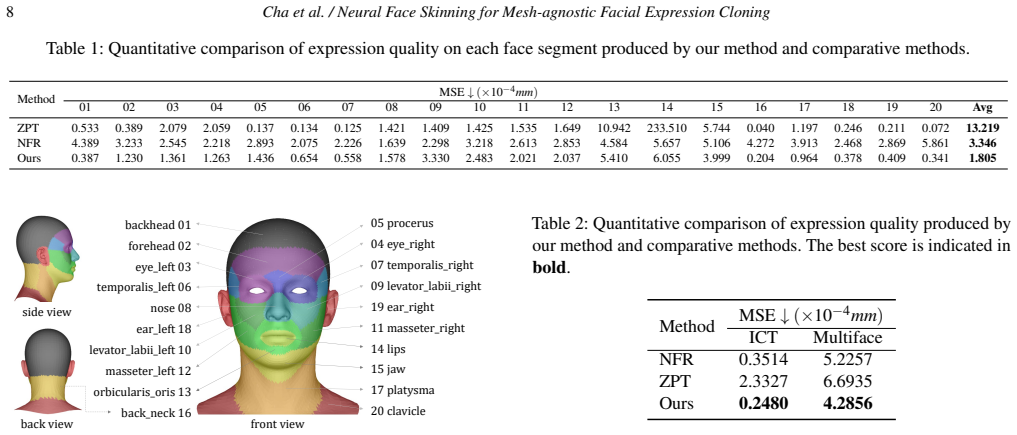
- [Table 1]
Circularity Check
Inverse-rigging table is a self-consistency check against the same ICT blendshape basis used to supervise the global code; the skinning and mesh-agnostic claims retain independent Multiface/stylized evidence.
-
fitted input called prediction
[Section 4.2 (Inverse rigging), Eqs. 4 and 7, Table 3]
"To validate if our constructed expression code conforms to the grammar of the FACS-based ICT blendshape model, we conducted experiments on inverse rigging. ... The expression codes were predicted from the source face mesh with expressions and applied to the ICT blendshape bases. The MSE between the reconstructed face mesh and the source face mesh was then computed. ... LBP = ||z_GE^{1:53} · B - z_GT · B||^2 (7)"
The inverse-rigging metric reconstructs the source mesh by applying the predicted global expression code z_GE to the fixed ICT blendshape basis B and comparing to the source (Sec. 4.2). But on ICT data z_GE is trained by LExp (Eq. 4) to equal the ground truth blendshape coefficients and by LBP (Eq. 7) to make z_GE·B equal z_GT·B. Thus the reported 'inverse rigging quality' is essentially a held-out version of the same supervised objective using the same linear basis; it confirms that the encoder learned to invert the ICT parameterization that generated its training labels, not that the code has externally verified FACS interpretability or transfers to other rigs. The metric is therefore partly forced by construction.
full rationale
No load-bearing self-citation appears: the paper's architecture follows Qin et al. [QSA+], an external group with no author overlap, and the DiffusionNet, ICT, and Multiface references are independent resources. The central skinning mechanism is an empirical module: per-vertex z_Skin is supervised by an NLL loss with ICT segmentation labels (Eq. 2), MLP(z_Skin) forms per-vertex weights, and these weights gate z_GE via a Hadamard product. The claimed benefits are tested by held-out self-retargeting on ICT/Multiface and by qualitative retargeting on four unseen stylized meshes; those results are not entailed by the loss definitions, so the main derivation is self-contained. The partial circularity is limited to the inverse-rigging evaluation (Table 3, Sec. 4.2), where reconstruction uses the same ICT blendshape basis B that supervises z_GE through LExp and LBP, making that table a self-consistency check rather than an external benchmark. The paper's own Limitations section acknowledges that scale-mismatched meshes receive inaccurate skinning weights (Fig. 11), which is a scope/correctness risk, not a circularity.
Assumptions & free parameters
free parameters (3)
- decoder loss weights lambda_v, lambda_n, lambda_g =
10, 1, 1
- number of segmentation labels L (final model) =
20
- weights for LBP, LBR, Lnll losses =
1 each
assumptions (3)
- domain assumption Segmentation labels based on facial muscle groups provide consistent supervision for skinning weights across different face meshes.
- domain assumption ICT blendshape coefficients are an interpretable FACS-based parameterization that can supervise expression codes on arbitrary meshes.
- domain assumption DiffusionNet features generalize to meshes with different topologies and scales.
Cite this review
Pith. "Pith review of Neural Face Skinning for Mesh-agnostic Facial Expression Cloning." pith.science (2026). https://pith.science/paper/S2KF6BOQ
@misc{pith2026250522416,
  author       = {Pith},
  title        = {Pith review of: Neural Face Skinning for Mesh-agnostic Facial Expression Cloning},
  year         = {2026},
  howpublished = {\url{https://pith.science/paper/S2KF6BOQ}},
  note         = {Machine review of arXiv:2505.22416}
}
read the original abstract
Accurately retargeting facial expressions to a face mesh while enabling manipulation is a key challenge in facial animation retargeting. Recent deep-learning methods address this by encoding facial expressions into a global latent code, but they often fail to capture fine-grained details in local regions. While some methods improve local accuracy by transferring deformations locally, this often complicates overall control of the facial expression. To address this, we propose a method that combines the strengths of both global and local deformation models. Our approach enables intuitive control and detailed expression cloning across diverse face meshes, regardless of their underlying structures. The core idea is to localize the influence of the global latent code on the target mesh. Our model learns to predict skinning weights for each vertex of the target face mesh through indirect supervision from predefined segmentation labels. These predicted weights localize the global latent code, enabling precise and region-specific deformations even for meshes with unseen shapes. We supervise the latent code using Facial Action Coding System (FACS)-based blendshapes to ensure interpretability and allow straightforward editing of the generated animation. Through extensive experiments, we demonstrate improved performance over state-of-the-art methods in terms of expression fidelity, deformation transfer accuracy, and adaptability across diverse mesh structures.
Figures


Figures from the paper (7 more)




Reference graph
Works this paper leans on
-
[1]
" write newline "" before.all 'output.state := FUNCTION output.nonempty.mrnumber duplicate missing pop "" 'skip if duplicate empty 'pop " " swap * " " * write if FUNCTION fin.entry add.period write mrnumber output.nonempty.mrnumber newline INTEGERS nameptr namesleft numnames FUNCTION format.language language empty "" " (" language * ")" * if FUNCTION form...
-
[2]
write newline
" write newline "" before.all 'output.state := FUNCTION fin.entry add.period write newline FUNCTION new.block output.state before.all = 'skip after.block 'output.state := if FUNCTION new.sentence output.state after.block = 'skip output.state before.all = 'skip after.sentence 'output.state := if if FUNCTION not #0 #1 if FUNCTION and 'skip pop #0 if FUNCTIO...
-
[3]
write newline
" write newline "" before.all 'output.state := FUNCTION fin.entry.original add.period write newline FUNCTION new.block output.state before.all = 'skip after.block 'output.state := if FUNCTION new.sentence output.state after.block = 'skip output.state before.all = 'skip after.sentence 'output.state := if if FUNCTION not #0 #1 if FUNCTION and 'skip pop #0 i...
- [4]
- [5]
-
[6]
Giorgos Bouritsas, Sergiy Bokhnyak, Stylianos Ploumpis, Michael Bronstein, and Stefanos Zafeiriou, Neural 3d morphable models: Spiral convolutional networks for 3d shape representation learning and generation, Proceedings of the IEEE/CVF international conference on computer vision, 2019, pp. 7213--7222
work page 2019
- [7]
-
[8]
Philippe Bergeron, 3-d character animation on the symbolics system, SIGGRAPH Course Notes (1987)
work page 1987
Show all 53 references
-
[9]
Volker Blanz and Thomas Vetter, A morphable model for the synthesis of 3d faces, Proceedings of the 26th Annual Conference on Computer Graphics and Interactive Techniques (USA), SIGGRAPH '99, ACM Press/Addison-Wesley Publishing Co., 1999, p. 187–194
1999
-
[10]
3877--3886
Timur Bagautdinov, Chenglei Wu, Jason Saragih, Pascal Fua, and Yaser Sheikh, Modeling facial geometry using compositional vaes, Proceedings of the IEEE Conference on Computer Vision and Pattern Recognition, 2018, pp. 3877--3886
2018
-
[11]
345--354
Prashanth Chandran, Derek Bradley, Markus Gross, and Thabo Beeler, Semantic deep face models, 2020 international conference on 3D vision (3DV), IEEE, 2020, pp. 345--354
2020
-
[12]
10101--10111
Daniel Cudeiro, Timo Bolkart, Cassidy Laidlaw, Anurag Ranjan, and Michael Black, Capture, learning, and synthesis of 3D speaking styles , CVPR, 2019, pp. 10101--10111
2019
-
[13]
4, 1--14
Prashanth Chandran, Loic Ciccone, Markus Gross, and Derek Bradley, Local anatomically-constrained facial performance retargeting, ACM Transactions on Graphics (TOG) 41 (2022), no. 4, 1--14
2022
-
[14]
Byoungwon Choe and Hyeong-Seok Ko, Analysis and synthesis of facial expressions with hand-generated muscle actuation basis, ACM SIGGRAPH 2006 Courses, 2006, pp. 21--es
2006
-
[15]
2220--2229
Prashanth Chandran and Gaspard Zoss, Anatomically constrained implicit face models, Proceedings of the IEEE/CVF Conference on Computer Vision and Pattern Recognition, 2024, pp. 2220--2229
2024
-
[16]
41, Wiley Online Library, 2022, pp
Prashanth Chandran, Gaspard Zoss, Markus Gross, Paulo Gotardo, and Derek Bradley, Shape transformers: Topology-independent 3d shape models using transformers, Computer Graphics Forum, vol. 41, Wiley Online Library, 2022, pp. 195--207
2022
-
[17]
Paul Ekman and Wallace V Friesen, Facial action coding system, Environmental Psychology & Nonverbal Behavior (1978)
1978
-
[18]
5, 1--38
Bernhard Egger, William AP Smith, Ayush Tewari, Stefanie Wuhrer, Michael Zollhoefer, Thabo Beeler, Florian Bernard, Timo Bolkart, Adam Kortylewski, Sami Romdhani, et al., 3d morphable face models—past, present, and future, ACM Transactions on Graphics (ToG) 39 (2020), no. 5, 1--38
2020
-
[19]
3, 437--458
Gabriele Fanelli, Matthias Dantone, Juergen Gall, Andrea Fossati, and Luc Van Gool, Random forests for real time 3d face analysis, IJCV 101 (2013), no. 3, 437--458
2013
-
[20]
230--246
Thibault Groueix, Matthew Fisher, Vladimir G Kim, Bryan C Russell, and Mathieu Aubry, 3d-coded: 3d correspondences by deep deformation, Proceedings of the european conference on computer vision (ECCV), 2018, pp. 230--246
2018
-
[21]
6, 1--15
Lin Gao, Jie Yang, Yi-Ling Qiao, Yu-Kun Lai, Paul L Rosin, Weiwei Xu, and Shihong Xia, Automatic unpaired shape deformation transfer, ACM Transactions on Graphics (ToG) 37 (2018), no. 6, 1--15
2018
-
[22]
4, 1--12
Rana Hanocka, Amir Hertz, Noa Fish, Raja Giryes, Shachar Fleishman, and Daniel Cohen-Or, Meshcnn: a network with an edge, ACM Transactions on Graphics (ToG) 38 (2019), no. 4, 1--12
2019
-
[23]
Pushkar Joshi, Wen C Tien, Mathieu Desbrun, and Fr \'e d \'e ric Pighin, Learning controls for blend shape based realistic facial animation, ACM Siggraph 2006 Courses, 2006, pp. 17--es
2006
-
[24]
11957--11966
Zi-Hang Jiang, Qianyi Wu, Keyu Chen, and Juyong Zhang, Disentangled representation learning for 3d face shape, Proceedings of the IEEE/CVF conference on computer vision and pattern recognition, 2019, pp. 11957--11966
2019
-
[25]
Jeff Kleiser, A fast, efficient, accurate way to represent the human face, SIGGRAPH’89 Course Notes 22: State of the Art in Facial Animation (1989), 36--40
1989
-
[26]
John P Lewis, Ken Anjyo, Taehyun Rhee, Mengjie Zhang, Frederic H Pighin, and Zhigang Deng, Practice and theory of blendshape facial models., Eurographics (State of the Art Reports) 1 (2014), no. 8, 2
2014
-
[27]
Tianye Li, Timo Bolkart, Michael J Black, Hao Li, and Javier Romero, Learning a model of facial shape and expression from 4d scans., ACM Trans. Graph. 36 (2017), no. 6, 194--1
2017
-
[28]
Ruilong Li, Karl Bladin, Yajie Zhao, Chinmay Chinara, Owen Ingraham, Pengda Xiang, Xinglei Ren, Pratusha Prasad, Bipin Kishore, Jun Xing, and Hao Li, Learning formation of physically-based face attributes, 2020
2020
-
[29]
2-3, 159--167
Ko-Yun Liu, Wan-Chun Ma, Chun-Fa Chang, Chuan-Chang Wang, and Paul Debevec, A framework for locally retargeting and rendering facial performance, Computer Animation and Virtual Worlds 22 (2011), no. 2-3, 159--167
2011
-
[30]
Wan-Chun Ma, Graham Fyffe, and Paul Debevec, Optimized local blendshape mapping for facial motion retargeting, ACM SIGGRAPH 2011 Talks, 2011, pp. 1--1
2011
-
[31]
Thalmann Magnenat, Richard Laperri \`e re, and Daniel Thalmann, Joint-dependent local deformations for hand animation and object grasping, Proceedings of Graphics Interface'88, Canadian Inf. Process. Soc, 1988, pp. 26--33
1988
-
[32]
277--288
Jun-yong Noh and Ulrich Neumann, Expression cloning, Proceedings of the 28th annual conference on Computer graphics and interactive techniques, 2001, pp. 277--288
2001
-
[33]
6, 1--10
Thomas Neumann, Kiran Varanasi, Stephan Wenger, Markus Wacker, Marcus Magnor, and Christian Theobalt, Sparse localized deformation components, ACM Transactions on Graphics (TOG) 32 (2013), no. 6, 1--10
2013
-
[34]
27, Wiley Online Library, 2008, pp
Ver \'o nica Costa Orvalho, Ernesto Zacur, and Antonio Susin, Transferring the rig and animations from a character to different face models, Computer Graphics Forum, vol. 27, Wiley Online Library, 2008, pp. 1997--2012
2008
-
[35]
451--457
Frederick I Parke, Computer generated animation of faces, Proceedings of the ACM annual conference-Volume 1, 1972, pp. 451--457
1972
-
[36]
Frederic I Parke, Control parameterization for facial animation, Computer Animation’91, Springer, 1991, pp. 3--14
1991
-
[37]
296--301
Pascal Paysan, Reinhard Knothe, Brian Amberg, Sami Romdhani, and Thomas Vetter, A 3d face model for pose and illumination invariant face recognition, 2009 sixth IEEE international conference on advanced video and signal based surveillance, Ieee, 2009, pp. 296--301
2009
-
[38]
Dafei Qin, Jun Saito, Noam Aigerman, Groueix Thibault, and Taku Komura, Neural face rigging for animating and retargeting facial meshes in the wild, SIGGRAPH 2023 Conference Papers, 2023
2023
-
[39]
Black, Generating 3d faces using convolutional mesh autoencoders, ECCV, 9 2018
Anurag Ranjan, Timo Bolkart, Soubhik Sanyal, and Michael J. Black, Generating 3d faces using convolutional mesh autoencoders, ECCV, 9 2018
2018
-
[40]
1556--1560
Stevo Rackovi \'c , Cl \'a udia Soares, Du s an Jakoveti \'c , Zoranka Desnica, and Relja Ljubobratovi \'c , Clustering of the blendshape facial model, 2021 29th European Signal Processing Conference (EUSIPCO), IEEE, 2021, pp. 1556--1560
2021
-
[41]
4, 1--12
Roger Blanco I Ribera, Eduard Zell, John P Lewis, Junyong Noh, and Mario Botsch, Facial retargeting with automatic range of motion alignment, ACM Transactions on graphics (TOG) 36 (2017), no. 4, 1--12
2017
-
[42]
3, 1--16
Nicholas Sharp, Souhaib Attaiki, Keenan Crane, and Maks Ovsjanikov, Diffusionnet: Discretization agnostic learning on surfaces, ACM Transactions on Graphics (TOG) 41 (2022), no. 3, 1--16
2022
-
[43]
2, 1--12
Yeongho Seol, John P Lewis, Jaewoo Seo, Byungkuk Choi, Ken Anjyo, and Junyong Noh, Spacetime expression cloning for blendshapes, ACM Transactions on Graphics (TOG) 31 (2012), no. 2, 1--12
2012
-
[44]
3, 399--405
Robert W Sumner and Jovan Popovi \'c , Deformation transfer for triangle meshes, ACM Transactions on graphics (TOG) 23 (2004), no. 3, 399--405
2004
-
[45]
J Rafael Tena, Fernando De la Torre, and Iain A Matthews, Interactive region-based linear 3d face models., ACM Trans. Graph. 30 (2011), no. 4, 76
2011
-
[46]
5841--5850
Qingyang Tan, Lin Gao, Yu-Kun Lai, and Shihong Xia, Variational autoencoders for deforming 3d mesh models, Proceedings of the IEEE conference on computer vision and pattern recognition, 2018, pp. 5841--5850
2018
-
[47]
41, Wiley Online Library, 2022, pp
Monica Villanueva Aylagas, Hector Anadon Leon, Mattias Teye, and Konrad Tollmar, Voice2face: Audio-driven facial and tongue rig animations with cvaes, Computer Graphics Forum, vol. 41, Wiley Online Library, 2022, pp. 255--265
2022
-
[48]
Daniel Vlasic, Matthew Brand, Hanspeter Pfister, and Jovan Popovic, Face transfer with multilinear models, ACM SIGGRAPH 2006 Courses, 2006, pp. 24--es
2006
-
[49]
4, 1--12
Chenglei Wu, Derek Bradley, Markus Gross, and Thabo Beeler, An anatomically-constrained local deformation model for monocular face capture, ACM transactions on graphics (TOG) 35 (2016), no. 4, 1--12
2016
-
[50]
39, Wiley Online Library, 2020, pp
Mengjiao Wang, Derek Bradley, Stefanos Zafeiriou, and Thabo Beeler, Facial expression synthesis using a global-local multilinear framework, Computer graphics forum, vol. 39, Wiley Online Library, 2020, pp. 235--245
2020
-
[51]
Valerie L Winslow, Classic human anatomy in motion: The artist's guide to the dynamics of figure drawing, Watson-Guptill, 2015
2015
-
[52]
8704--8714
Jiashun Wang, Xueting Li, Sifei Liu, Shalini De Mello, Orazio Gallo, Xiaolong Wang, and Jan Kautz, Zero-shot pose transfer for unrigged stylized 3d characters, Proceedings of the IEEE/CVF Conference on Computer Vision and Pattern Recognition, 2023, pp. 8704--8714
2023
-
[53]
Cheng-hsin Wuu, Ningyuan Zheng, Scott Ardisson, Rohan Bali, Danielle Belko, Eric Brockmeyer, Lucas Evans, Timothy Godisart, Hyowon Ha, Xuhua Huang, Alexander Hypes, Taylor Koska, Steven Krenn, Stephen Lombardi, Xiaomin Luo, Kevyn McPhail, Laura Millerschoen, Michal Perdoch, Ma...
2022
Reviewed August 7, 2026 · model on record in the stance chip above.
Discussion (0). Sign in to comment.