REVIEW 3 major objections 5 minor 1 cited by
Robustness of topological edge states in alternating spin chains against environment
T0 review · 3 major / 5 minor · reviewed 2026-08-07 · deepseek-v4-flash
Pith's one-line read Dimerized chains keep topological edge-state signatures longer than Haldane-like chains when coupled to a surface.
desk verdict Careful Lindblad study with a solid steady-state result, but the headline SSH-vs-Haldane ordering rests on a heuristic threshold the authors themselves call debatable. read the letter →
The pith
A machine-rendered reading of the paper's core claim, the machinery that carries it, and where it could break.
The reading
What carries the argument
The load-bearing diagnostic is the ratio $\Theta_{\mathrm{PT}}(t)$ (Eq. 4), a time-dependent generalization of the authors' closed-chain gap criterion: the maximum of the three lowest energy gaps above the ground state divided by the gap $\Delta E_{4\text{--}5}$ that separates the quasi-fourfold ground-state manifold from excited states, with a flag that sets the ratio to 1 if level crossings destroy the four-state ordering. Values below the threshold $\Theta_{\mathrm{PT}}^{\mathrm{tran}}=0.5$ mark parameters where observing edge states is judged viable. The second essential element is the Lindblad master equation (Eq. 3), solved exactly by vectorizing the density matrix into a superoperator eigenvalue problem via the Choi–Jamiolkowski isomorphism, with jump operators $L_i=S_i^z$ (dephasing) and $L_i=S_i^x$ (spin flips) summed over all sites.
What would settle it
Measure time-resolved edge spin correlations on an on-surface alternating spin-1/2 chain, comparing a dimerized SSH-like coupling ($|J_1| < 1$) with a Haldane-like coupling ($J_1 < -1$) under identical surface-induced dissipation: if the Haldane-like chain retains edge correlations with aligned spin and jump operators for as long as—or longer than—the SSH-like chain, the claimed ordering fails. A cheaper check is to recompute the $\Theta_{\mathrm{PT}}$ diagrams with thresholds of 0.25 and 0.75 and across several times $t$; the SSH-like region must remain the larger one for the paper's conclusion to hold.
Extended reading notes
Core claim
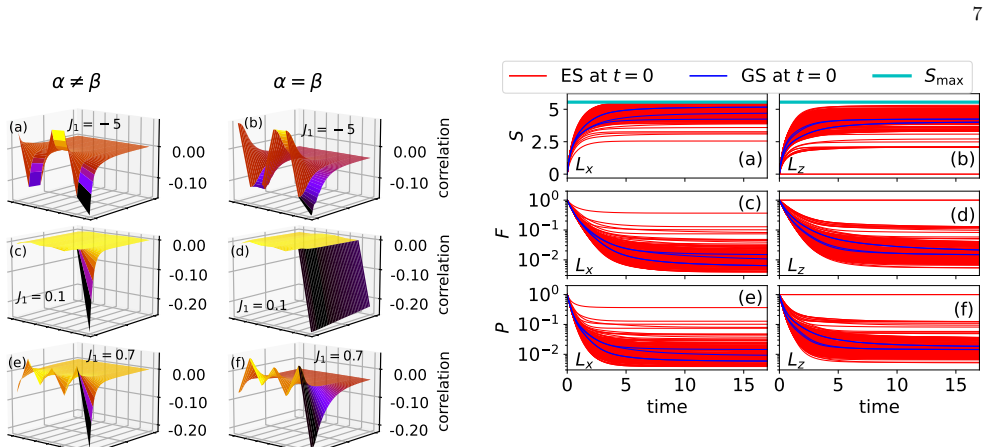
For an alternating spin-1/2 Heisenberg chain with open boundary conditions, coupled to a Markovian environment through local jump operators—dephasing ($L_i = S_i^z$) or spin flips ($L_i = S_i^x$)—the lifetime of topological edge-state signatures is longer when the intra-dimer coupling is antiferromagnetic and the chain resembles an interacting Su-Schrieffer-Heeger model ($|J_1| < 1$) than when it resembles a Haldane spin-1 chain ($J_1 < -1$). The authors establish this by exact diagonalization of the Lindblad master equation for chains up to 12 spins, using a time-dependent energy-gap ratio $\Theta_{\mathrm{PT}}(t)$ that tracks the persistence of the quasi-fourfold degenerate ground-state manifold. They further show that in the steady state all topological signatures vanish; that edge magnetization under spin-flip dissipation decays approximately as a single spin's $e^{-\gamma t/2}$ regardless of topology; and that correlation functions only discriminate the two chain types when the spin operator and the jump operator point in the same direction.
Load-bearing premise
The comparison rests on the assumption that the gap ratio $\Theta_{\mathrm{PT}}$ with threshold 0.5 correctly tracks when topological edge states would actually be observable in an experiment; if that heuristic misjudges observability during time evolution, the claimed ordering of SSH-like over Haldane-like chains does not follow from the $\Theta_{\mathrm{PT}}$ diagrams alone, and the correlation and magnetization data give only partial independent support.
Editorial extensions
If this is right
- For assembling spin chains on surfaces, dimerized SSH-like chains are the more forgiving platform: they keep a near-fourfold degenerate ground state and matching spin correlations for longer times under Markovian dissipation.
- Topological edge states in these chains are transient: in the steady state all topological signatures vanish, so any application that relies on the edge states must operate on timescales short compared with the dissipation-induced decay.
- The quantum Zeno effect can prolong some signatures at strong dissipation, with minimum robustness around $\gamma \sim J_{\mathrm{NN}}$; this behavior already appears for two coupled spins and is not a topological property.
- Observables differ sharply in diagnostic power: edge magnetization under $L_x$ and the entropy, fidelity, and purity do not distinguish topological from trivial chains, while the gap ratio and correlation functions with aligned spin and jump orientation do.
- Robustness generally increases with chain length $N$, so the ordering found for $N = 4$ to $12$ should persist—and strengthen—for the longer chains achievable in experiments.
Reading between the lines
- The robustness ordering probably tracks the size of the protecting energy gap (dimer gap versus Haldane gap) more than topology itself: the paper finds that topologically trivial chains with $J_1 = 1$ also decay quickly, and that $L_x$ dynamics is universal. A testable extension would be to compare two chains with identical gap sizes but different topological classification.
- The $\Theta_{\mathrm{PT}}$ lifetime diagnostic could be exported to other one-dimensional topological wires, such as Kitaev chains, as a practical pre-experiment screen for dissipation tolerance, even though it is explicitly not a topological phase criterion.
- Because the paper treats Markovian, local, site-independent dissipation, a natural open question is whether non-Markovian or spatially correlated surface noise changes the ordering; the Lindblad framework used here cannot capture memory effects.
- The finding that entropy, fidelity, and purity evolve nearly identically for topological and trivial chains suggests that bulk decoherence, not edge physics, dominates these quantities; confirming this with bulk-only observables would separate the two contributions.
Editorial analysis
A structured set of objections, weighed in public.
Referee Report
Summary. The paper studies alternating spin-1/2 Heisenberg chains with nearest-neighbor and next-nearest-neighbor couplings, focusing on SSH-like (dimerized) and Haldane-like parameter regimes, and examines the robustness of their topological edge states under Markovian dissipation described by a Lindblad master equation with S^z (dephasing) and S^x (noise) jump operators. Using exact diagonalization of the Lindblad superoperator for short chains (N=4 to 12), the authors track the time evolution of the quasi-fourfold ground-state degeneracy via the Θ_PT criterion, edge magnetization, spin-spin correlations, entropy, fidelity, purity, and the spectral gap. The central claim, stated in the abstract and Section IV, is that signatures of topological edge states are generally more robust in SSH-like chains than in Haldane-like chains under the investigated dissipative dynamics, while the steady state is topologically trivial. The paper also reports quantum Zeno effects, the absence of topological protection in several observables, and the universality of a fitted decay form for entropy/fidelity/purity.
Significance. If the central claim holds, the paper provides a useful extension of the authors' earlier closed-chain analysis to open systems, with direct relevance to recent experiments assembling spin chains on surfaces. The work is commendable for investigating several complementary observables, for comparing the full chain dynamics with analytically solvable single- and two-spin limits (Appendix B), and for clearly identifying observables that do not distinguish topological from trivial chains. The finding that the steady state is topologically trivial, and that L^x-driven edge magnetization decays like a single spin, is an important negative result. However, the main quantitative support for the SSH-versus-Haldane ordering comes from the Θ_PT diagnostic, which is a heuristic from the authors' previous work and whose open-system validity is not yet established. The paper would be significantly strengthened by validating Θ_PT against direct edge-state observables and by documenting numerical convergence.
major comments (3)
- [Section III A, Eq. (4)] The headline ordering between SSH-like and Haldane-like chains is carried by the Θ_PT(t) criterion with the threshold Θ_tran_PT=0.5 imported from the authors' closed-chain work Ref. [86]. The text itself calls the threshold 'debatable', and the open-system evaluation retains only the 70 lowest states without a documented convergence check in the number of retained states or in the expansion order and time step of Eq. (A2b). Because the definition of Θ_PT(t) must handle time-dependent level crossings, a miscalibrated or underconverged Θ_PT would remove the main evidence for the central claim in Figs. 1-4. Please add a convergence study (e.g., retaining 100 and 150 states) and compare the Θ_PT-based lifetimes with a direct edge-state survival measure, such as the weight of the state on the edge sites or the decay of |C(t,L^β,S^α_r)| for α=β, for representative parameter sets.
- [Section III A, Figs. 1(b) and 3(b)] The L_z results in Figs. 1(b) and 3 are obtained with an ad hoc z-anisotropy of Δ_z=1.001 instead of the isotropic value Δ_z=1, introduced to remove 'rather chaotic behavior' that 'might be due to numerics or finite-size effects'. Since the parameter scan is performed at a slightly different Hamiltonian, these figures do not directly demonstrate robustness of the isotropic model under L_z dissipation. Please either demonstrate convergence of the Δ_z=1 calculation by varying the numerical parameters (Δt, m_max, number of retained states) or present the Δ_z=1.001 results explicitly as an exploratory check with a clear caveat that the isotropic L_z case is not fully resolved. Without this, the L_z columns of Figs. 1-3 should not be used as quantitative support for the SSH-versus-Haldane ordering.
- [Sections III B and IV] The paper's abstract and Section IV state a general robustness ordering, but the independent support from other observables is partial: under L_x, the edge magnetization follows the single-spin exponential decay e^{-γt/2} for both topological and trivial chains (Eq. (9)), and the entropy, fidelity, and purity show no topological distinction (Section III D). The correlation function in Section III C distinguishes the scenarios only for α=β and for the singlet initial state. Thus the only parameter-resolved quantitative diagnostic supporting the ordering remains Θ_PT. Please make the scope of the claim explicit in the abstract and conclusions: the ordering is established by the ground-state-degeneracy diagnostic, with supporting evidence from α=β correlations and L_z edge magnetization, and not by a generic measure of topological protection. This is a framing issue, but it is load-bearing because the current wording overstates the breadth of the evidence.
minor comments (5)
- [Introduction] The phrase 'expensively studied example' should be 'extensively studied example'.
- [Title page] The author affiliation contains a LaTeX artifact 'f¨ ur' that should be rendered as 'für'.
- [Eq. (4)] In the definition of Θ_PT(t), the condition for setting Θ_PT=1 is written compactly; please specify explicitly the index ranges for the max and min operations in the displayed formula to avoid ambiguity about which energy gaps are compared.
- [Figure 5 and Figure 6 captions] The legend entries such as '(a,c)' and '(b,d)' are confusing because they refer to panels in other subfigures; please spell out which panels share which parameters.
- [Appendix A] The iterative scheme with m_max=10 and Δt=0.1 is stated as a 'good parameter selection', but no convergence check or error estimate is reported; a brief statement on how these values were validated for the longest chains would be helpful.
Circularity Check
No load-bearing circularity: the SSH-versus-Haldane robustness ordering is a new open-system result supported by independent diagnostics; only the Theta_PT threshold is a minor self-citation.
full rationale
The paper's central claim is that signatures of topological edge states are more robust in SSH-like alternating chains than in Haldane-like chains under Markovian dissipation. The claim is supported by exact-diagonalization solutions of the Lindblad master equation (Eq. 3) and by several diagnostics: the Theta_PT gap-ratio diagrams (Eq. 4, Figs. 1-4), correlation functions with alpha=beta (Sec. III C), and edge-state magnetization (Sec. III B). No fitted parameter is renamed as a prediction: Eq. (12) is explicitly called a fit-function with fit parameters, and its role is to summarize entropy, fidelity, and purity curves, not to generate the ordering. The single-spin comparison in Eq. (9) and Appendix B provides a parameter-free external benchmark. The only self-citation that enters the analysis is the threshold Theta_tran_PT = 0.5 taken from the authors' closed-chain work [86]; the paper itself flags this value as debatable and asserts robustness to variations. Because the SSH-versus-Haldane ordering also appears in the alpha=beta correlation data, which do not use that threshold, the self-citation is not load-bearing. Numerical caveats, such as the 70-state truncation without a documented convergence check and the ad hoc Delta_z = 1.001 shift for L_z in Figs. 1(b) and 3, are correctness risks rather than circular steps. No uniqueness theorem is invoked, and no step reduces by construction to an input. The derivation chain is therefore self-contained in the sense relevant to circularity.
Assumptions & free parameters
free parameters (3)
- Theta_PT threshold =
0.5
- Fit parameters a, b, c, d in Eq. (12) =
not given
- Delta_z = 1.001 for L_z runs =
1.001
assumptions (4)
- domain assumption Lindblad master equation with local jump operators S^z_i or S^x_i models the surface environment
- ad hoc to paper Theta_PT criterion with threshold 0.5 is a valid proxy for topological edge-state observability
- domain assumption Short chains (N=4 to 12) are representative for on-surface experiments
- ad hoc to paper The chaotic behavior at Delta_z=1 for L_z is a numerical artifact, not physics
Cite this review
Pith. "Pith review of Robustness of topological edge states in alternating spin chains against environment." pith.science (2026). https://pith.science/paper/GSJF5W34
@misc{pith2026250522420,
  author       = {Pith},
  title        = {Pith review of: Robustness of topological edge states in alternating spin chains against environment},
  year         = {2026},
  howpublished = {\url{https://pith.science/paper/GSJF5W34}},
  note         = {Machine review of arXiv:2505.22420}
}
abstract
Both the Haldane spin-$1$ chain and dimerized chains of spin-$1/2$ exhibit topologically protected edge states that are robust against specific perturbations. Recently, such spin chains have been specifically assembled on surfaces and we investigate here the robustness of these edge states against coupling to the surface. Since no physical system can be considered perfectly isolated, it is crucial to examine whether topological robustness is maintained in the presence of environmental coupling. We apply exact diagonalization to a Lindblad master equation that couples an alternating Heisenberg spin chain based on spins $1/2$ to a surface via various jump operators. The robustness of topological states is assessed via the time evolution of quantities such as the ground-state degeneracy, correlation function, entropy, and magnetization of edge states. We investigate chains built from dimers with antiferromagnetic and ferromagnetic intra-dimer coupling, which resemble Su-Schrieffer-Heeger and the Haldane models, resp., and assess the impact of $z$-axis anisotropy and longer-ranged couplings. Generally, we find that signatures of topological properties are more robust in Su-Schrieffer-Heeger-like chains than in Haldane-like chains.
Figures


Figures from the paper (6 more)




Forward citations
Cited by 1 Pith paper
-
Robustness of the flux-free sector of the Kitaev honeycomb against environment
Under Lindblad-type environmental coupling, the flux-free sector of the Kitaev honeycomb model relaxes to a maximally mixed state for most noise operators, its energy gap closes, and only the periodic Kitaev chain lim...
Reference graph
Works this paper leans on
-
[86]
A. Sattler and M. Daghofer, Promising regimes for the observation of topological degeneracy in spin chains, Phys. Rev. B110, 024404 (2024)
work page 2024
-
[1]
F. D. M. Haldane, Nobel Lecture: Topological quantum matter, Rev. Mod. Phys.89, 040502 (2017)
2017
-
[2]
Wen, Colloquium: Zoo of quantum-topological phases of matter, Rev
X.-G. Wen, Colloquium: Zoo of quantum-topological phases of matter, Rev. Mod. Phys.89, 041004 (2017)
2017
-
[3]
C.-K. Chiu, J. C. Y. Teo, A. P. Schnyder, and S. Ryu, Classification of topological quantum matter with sym- metries, Rev. Mod. Phys.88, 035005 (2016)
2016
-
[4]
Qi and S.-C
X.-L. Qi and S.-C. Zhang, Topological insulators and superconductors, Rev. Mod. Phys.83, 1057 (2011)
2011
-
[5]
M. Z. Hasan and C. L. Kane, Colloquium: Topological insulators, Rev. Mod. Phys.82, 3045 (2010)
2010
-
[6]
Hornberg,Entanglement and Decoherence: Foun- dations and Modern Trends, edited by A
K. Hornberg,Entanglement and Decoherence: Foun- dations and Modern Trends, edited by A. Buchleitner, C. Viviescas, and M. Tiersch (Springer Berlin, Heidel- berg, 2009) Chap. 5 Introduction to Decoherence The- ory, Lecture Notes in Physics 768
2009
-
[7]
Breuer and F
H.-P. Breuer and F. Petruccione,The Theory of Open Quantum Systems(Oxford University Press, 2007)
2007
Show all 159 references
-
[8]
Suter and G
D. Suter and G. A. ´Alvarez, Colloquium: Protecting quantum information against environmental noise, Rev. Mod. Phys.88, 041001 (2016)
2016
-
[9]
I. L. Chuang, R. Laflamme, P. W. Shor, and W. H. Zurek, Quantum computers, factoring, and decoher- ence, Science270, 1633 (1995)
1995
-
[10]
Beige, D
A. Beige, D. Braun, B. Tregenna, and P. L. Knight, Quantum computing using dissipation to remain in a decoherence-free subspace, Phys. Rev. Lett.85, 1762 (2000)
2000
-
[11]
D. P. DiVincenzo, The physical implementation of quantum computation, Fortschritte der Physik48, 771 (2000)
2000
-
[12]
T. D. Ladd, F. Jelezko, R. Laflamme, Y. Nakamura, C. Monroe, and J. L. O’Brien, Quantum computers, Na- ture464, 45 (2010)
2010
-
[13]
D. P. DiVincenzo, Two-bit gates are universal for quan- tum computation, Phys. Rev. A51, 1015 (1995)
1995
-
[14]
Lahtinen and J
V. Lahtinen and J. K. Pachos, A short introduction to topological quantum computation, SciPost Phys.3, 021 (2017)
2017
-
[15]
Nayak, S
C. Nayak, S. H. Simon, A. Stern, M. Freedman, and S. Das Sarma, Non-Abelian anyons and topologi- cal quantum computation, Rev. Mod. Phys.80, 1083 (2008)
2008
-
[16]
Steane, Quantum computing, Reports on Progress in Physics61, 117 (1998)
A. Steane, Quantum computing, Reports on Progress in Physics61, 117 (1998)
1998
-
[17]
Lang and H
N. Lang and H. P. B¨ uchler, Topological networks for quantum communication between distant qubits, Quan- tum Information3, 47 (2017)
2017
-
[18]
Dlaska, B
C. Dlaska, B. Vermersch, and P. Zoller, Robust quan- tum state transfer via topologically protected edge chan- nels in dipolar arrays, Quantum Sci. Technol.2, 015001 (2017)
2017
-
[19]
Jaworowski and P
B. Jaworowski and P. Hawrylak, Quantum bits with macroscopic topologically protected states in semicon- ductor devices, Applied Sciences9, 474 (2019)
2019
-
[20]
Jaworowski, N
B. Jaworowski, N. Rogers, M. Grabowski, and P. Hawrylak, Macroscopic singlet-triplet qubit in syn- thetic spin-one chain in semiconductor nanowires, Sci- entific Reports7, 5529 (2017)
2017
-
[21]
S. D. Bartlett, G. K. Brennen, A. Miyake, and J. M. Renes, Quantum computational renormalization in the Haldane phase, Phys. Rev. Lett.105, 110502 (2010)
2010
-
[22]
Miyake, Quantum computation on the edge of a symmetry-protected topological order, Phys
A. Miyake, Quantum computation on the edge of a symmetry-protected topological order, Phys. Rev. Lett. 105, 040501 (2010)
2010
-
[23]
T.-C. Wei, I. Affleck, and R. Raussendorf, Two- dimensional Affleck-Kennedy-Lieb-Tasaki state on the honeycomb lattice is a universal resource for quantum computation, Phys. Rev. A86, 032328 (2012)
2012
-
[24]
Hsieh, Y.-P
C.-Y. Hsieh, Y.-P. Shim, M. Korkusinski, and P. Hawry- lak, Physics of lateral triple quantum-dot molecules with controlled electron numbers, Reports on Progress in Physics75, 114501 (2012)
2012
-
[25]
Manalo, M
J. Manalo, M. Cygorek, A. Altintas, and P. Hawrylak, Electronic and magnetic properties of many-electron complexes in charged InAs xP1−x quantum dots in InP nanowires, Phys. Rev. B104, 125402 (2021)
2021
-
[26]
S. A. Wolf, D. D. Awschalom, R. A. Buhrman, J. M. Daughton, S. von Moln´ ar, M. L. Roukes, A. Y. Chtchelkanova, and D. M. Treger, Spintronics: A spin- based electronics vision for the future, Science294, 1488 (2001)
2001
-
[27]
Hirohata, K
A. Hirohata, K. Yamada, Y. Nakatani, I.-L. Prejbeanu, B. Di´ eny, P. Pirro, and B. Hillebrands, Review on spin- tronics: Principles and device applications, Journal of Magnetism and Magnetic Materials509, 166711 (2020)
2020
-
[28]
ˇZuti´ c, J
I. ˇZuti´ c, J. Fabian, and S. Das Sarma, Spintronics: Fun- damentals and applications, Rev. Mod. Phys.76, 323 (2004)
2004
-
[29]
S. D. Bader and S. S. P. Parkin, Spintronics, Annual Review of Condensed Matter Physics1, 71 (2010)
2010
-
[30]
Klett, H
M. Klett, H. Cartarius, D. Dast, J. Main, and G. Wun- ner, Topological edge states in the Su-Schrieffer-Heeger model subject to balanced particle gain and loss, The European Physical Journal D72, 214 (2018)
2018
-
[31]
Dangel, M
F. Dangel, M. Wagner, H. Cartarius, J. Main, and G. Wunner, Topological invariants in dissipative exten- sions of the Su-Schrieffer-Heeger model, Phys. Rev. A 98, 013628 (2018)
2018
-
[32]
E. G. Cinnirella, A. Nava, G. Campagnano, and D. Giu- 11 liano, Fate of high winding number topological phases in the disordered extended Su-Schrieffer-Heeger model, Phys. Rev. B109, 035114 (2024)
2024
-
[33]
J. C. Budich, S. Walter, and B. Trauzettel, Failure of protection of Majorana based qubits against decoher- ence, Phys. Rev. B85, 121405 (2012)
2012
-
[34]
Viyuela, A
O. Viyuela, A. Rivas, and M. A. Martin-Delgado, Thermal instability of protected end states in a one- dimensional topological insulator, Phys. Rev. B86, 155140 (2012)
2012
-
[35]
Deng and L
T.-S. Deng and L. Pan, Fate of symmetry protected co- herence in open quantum system, Phys. Rev. B104, 094306 (2021)
2021
-
[36]
Zhang, K
J.-H. Zhang, K. Ding, S. Yang, and Z. Bi, Fractonic higher-order topological phases in open quantum sys- tems, Phys. Rev. B108, 155123 (2023)
2023
-
[37]
T.-S. Deng, L. Pan, Y. Chen, and H. Zhai, Stability of time-reversal symmetry protected topological phases, Phys. Rev. Lett.127, 086801 (2021)
2021
-
[38]
Z. Wang, Q. Li, W. Li, and Z. Cai, Symmetry-protected topological edge modes and emergent partial time- reversal symmetry breaking in open quantum many- body systems, Phys. Rev. Lett.126, 237201 (2021)
2021
-
[39]
Linzner, L
D. Linzner, L. Wawer, F. Grusdt, and M. Fleischhauer, Reservoir-induced Thouless pumping and symmetry- protected topological order in open quantum chains, Phys. Rev. B94, 201105 (2016)
2016
-
[40]
Rivas, O
A. Rivas, O. Viyuela, and M. A. Martin-Delgado, Density-matrix Chern insulators: Finite-temperature generalization of topological insulators, Phys. Rev. B 88, 155141 (2013)
2013
-
[41]
Diehl, E
S. Diehl, E. Rico, M. A. Baranov, and P. Zoller, Topol- ogy by dissipation in atomic quantum wires, Nature Physics7, 971 (2011)
2011
-
[42]
Bardyn, M
C.-E. Bardyn, M. A. Baranov, E. Rico, A. ˙Imamo˘ glu, P. Zoller, and S. Diehl, Majorana modes in driven- dissipative atomic superfluids with a zero Chern num- ber, Phys. Rev. Lett.109, 130402 (2012)
2012
-
[43]
Bardyn, M
C.-E. Bardyn, M. A. Baranov, C. V. Kraus, E. Rico, A. ˙Imamo˘ glu, P. Zoller, and S. Diehl, Topology by dis- sipation, New Journal of Physics15, 085001 (2013)
2013
-
[44]
J. C. Budich, P. Zoller, and S. Diehl, Dissipative prepa- ration of Chern insulators, Phys. Rev. A91, 042117 (2015)
2015
-
[45]
Verstraete, M
F. Verstraete, M. M. Wolf, and J. Ignacio Cirac, Quan- tum computation and quantum-state engineering driven by dissipation, Nature Physics5, 633 (2009)
2009
-
[46]
X.-D. Dai, Z. Wang, H.-R. Wang, and Z. Wang, Steady- state topological order, Phys. Rev. B111, 115142 (2025)
2025
-
[47]
X. Mi, M. Sonner, M. Y. Niu, K. W. Lee, B. Foxen, R. Acharya, I. Aleiner, T. I. Andersen, F. Arute, and K. A. et al., Noise-resilient edge modes on a chain of superconducting qubits, Science378, 785 (2022)
2022
-
[48]
S. R. White and D. A. Huse, Numerical renormalization- group study of low-lying eigenstates of the antiferromag- neticS=1 Heisenberg chain, Phys. Rev. B48, 3844 (1993)
1993
-
[49]
Pollmann, A
F. Pollmann, A. M. Turner, E. Berg, and M. Oshikawa, Entanglement spectrum of a topological phase in one dimension, Phys. Rev. B81, 064439 (2010)
2010
-
[50]
Gu and X.-G
Z.-C. Gu and X.-G. Wen, Tensor-entanglement-filtering renormalization approach and symmetry-protected topological order, Phys. Rev. B80, 155131 (2009)
2009
-
[51]
Affleck, Quantum spin chains and the Haldane gap, Journal of Physics: Condensed Matter1, 3047 (1989)
I. Affleck, Quantum spin chains and the Haldane gap, Journal of Physics: Condensed Matter1, 3047 (1989)
1989
-
[52]
Renard, L.-P
J.-P. Renard, L.-P. Regnault, and M. Verdaguer, Hal- dane quantum spin chains, inMagnetism: Molecules to Materials I(John Wiley & Sons, Ltd, 2001) Chap. 2, pp. 49–93
2001
-
[53]
Pollmann, E
F. Pollmann, E. Berg, A. M. Turner, and M. Os- hikawa, Symmetry protection of topological phases in one-dimensional quantum spin systems, Phys. Rev. B 85, 075125 (2012)
2012
-
[54]
F. D. M. Haldane, Continuum dynamics of the 1- D Heisenberg antiferromagnet: Identification with the O(3) nonlinear sigma model, Phys. Rev. A93, 464 (1983)
1983
-
[55]
F. D. M. Haldane, Nonlinear field theory of large-spin Heisenberg antiferromagnets: Semiclassically quantized solitons of the one-dimensional easy-axis N´ eel state, Phys. Rev. Lett.50, 1153 (1983)
1983
-
[56]
Yamanaka, Y
M. Yamanaka, Y. Hatsugai, and M. Kohmoto, Phase diagram of theS=1/2 quantum spin chain with bond alternation, Phys. Rev. B48, 9555 (1993)
1993
-
[57]
Hida, Ground-state phase diagram of the spin-1/2 ferromagnetic-antiferromagnetic alternating Heisenberg chain with anisotropy, Phys
K. Hida, Ground-state phase diagram of the spin-1/2 ferromagnetic-antiferromagnetic alternating Heisenberg chain with anisotropy, Phys. Rev. B46, 8268 (1992)
1992
-
[58]
Hida, Crossover between the Haldane-gap phase and the dimer phase in the spin-1/2 alternating Heisenberg chain, Phys
K. Hida, Crossover between the Haldane-gap phase and the dimer phase in the spin-1/2 alternating Heisenberg chain, Phys. Rev. B45, 2207 (1992)
1992
-
[59]
Kohmoto and H
M. Kohmoto and H. Tasaki, HiddenZ 2×Z2 symmetry breaking and the Haldane phase in theS=1/2 quantum spin chain with bond alternation, Phys. Rev. B46, 3486 (1992)
1992
-
[60]
Hagiwara, K
M. Hagiwara, K. Katsumata, I. Affleck, B. I. Halperin, and J. P. Renard, Observation ofS=1/2 degrees of freedom in anS=1 linear-chain Heisenberg antiferro- magnet, Phys. Rev. Lett.65, 3181 (1990)
1990
-
[61]
Sahoo, D
S. Sahoo, D. Dey, S. K. Saha, and M. Kumar, Haldane and dimer phases in a frustrated spin chain: An ex- act groundstate and associated topological phase transi- tion, Journal of Physics: Condensed Matter32, 335601 (2020)
2020
-
[62]
G. Xu, J. F. DiTusa, T. Ito, K. Oka, H. Takagi, C. Bro- holm, and G. Aeppli, Y 2BaNiO5: A nearly ideal real- ization of theS=1 Heisenberg chain with antiferromag- netic interactions, Phys. Rev. B54, R6827 (1996)
1996
-
[63]
Mutka, J
H. Mutka, J. L. Soubeyroux, G. Bourleaux, and P. Colombet, Support for the Haldane conjecture: Gap for magnetic excitations in the quasi-one-dimensional S=1 Heisenberg antiferromagnet AgVP 2S6, Phys. Rev. B39, 4820 (1989)
1989
-
[64]
J. P. Renard, M. Verdaguer, L. P. Regnault, W. A. C. Erkelens, J. Rossat-Mignod, J. Ribas, W. G. Stirling, and C. Vettier, Quantum energy gap in two quasi- one-dimensionalS=1 Heisenberg antiferromagnets (in- vited), Journal of Applied Physics63, 3538 (1988)
1988
-
[65]
W. J. L. Buyers, R. M. Morra, R. L. Armstrong, M. J. Hogan, P. Gerlach, and K. Hirakawa, Experi- mental evidence for the Haldane gap in a spin-1 nearly isotropic, antiferromagnetic chain, Phys. Rev. Lett.56, 371 (1986)
1986
-
[66]
J. P. Renard, M. Verdaguer, L. P. Regnault, W. A. C. Erkelens, J. Rossat-Mignod, and W. G. Stirling, Pre- sumption for a quantum energy gap in the quasi- one-dimensionalS=1 Heisenberg antiferromagnet 12 Ni(C2H8N2)2NO2(ClO4), Europhysics Letters3, 945 (1987)
1987
-
[67]
Katsumata, H
K. Katsumata, H. Hori, T. Takeuchi, M. Date, A. Ya- magishi, and J. P. Renard, Magnetization process of an S=1 linear-chain Heisenberg antiferromagnet, Phys. Rev. Lett.63, 86 (1989)
1989
-
[68]
R. M. Morra, W. J. L. Buyers, R. L. Armstrong, and K. Hirakawa, Spin dynamics and the Haldane gap in the spin-1 quasi-one-dimensional antiferromagnet CsNiCl 3, Phys. Rev. B38, 543 (1988)
1988
-
[69]
L. P. Regnault and J. P. Renard, Spin dynamics in the Haldane-gap system NENP, Physica B: Condensed Matter215, 71 (1995)
1995
-
[70]
Darriet and L
J. Darriet and L. P. Regnault, The compound Y2BaNiO5: A new example of a Haldane gap in aS=1 magnetic chain, Solid State Communications86, 409 (1993)
1993
-
[71]
Ajiro, T
Y. Ajiro, T. Goto, H. Kikuchi, T. Sakakibara, and T. Inami, High-field magnetization of a quasi-one-dimensionalS=1 antiferromagnet Ni(C2H8N2)2NO2(ClO4): Observation of the Hal- dane gap, Phys. Rev. Lett.63, 1424 (1989)
1989
-
[72]
ˇCiˇ zm´ ar, M
E. ˇCiˇ zm´ ar, M. Ozerov, O. Ignatchik, T. P. Papageor- giou, J. Wosnitza, S. A. Zvyagin, J. Krzystek, Z. Zhou, C. P. Landee, B. R. Landry, M. M. Turnbull, and J. L. Wikaira, Magnetic properties of the Haldane-gap mate- rial [Ni(C 2H8N2)2NO2](BF4), New Journal of Physics 10, ...
2008
-
[73]
Kenzelmann, G
M. Kenzelmann, G. Xu, I. A. Zaliznyak, C. Broholm, J. F. DiTusa, G. Aeppli, T. Ito, K. Oka, and H. Takagi, Structure of end states for a Haldane spin chain, Phys. Rev. Lett.90, 087202 (2003)
2003
-
[74]
S. H. Glarum, S. Geschwind, K. M. Lee, M. L. Kaplan, and J. Michel, Observation of fractional spinS=1/2 on open ends ofS=1 linear antiferromagnetic chains: Nonmagnetic doping, Phys. Rev. Lett.67, 1614 (1991)
1991
-
[75]
Kimura, H
S. Kimura, H. Ohta, M. Motokawa, T. Yokoo, and J. Akimitsu,S=1/2 degrees of freedom in Haldane sys- tem Y 2BaNiO5 observed by submillimeter wave ESR, Journal of the Physical Society of Japan67, 2514–2521 (1998)
1998
-
[76]
Yoshida, K
M. Yoshida, K. Shiraki, S. Okubo, H. Ohta, T. Ito, H. Takagi, M. Kaburagi, and Y. Ajiro, Energy structure of a finite Haldane chain in Y2BaNi0.96Mg0.04O5 studied by high field electron spin resonance, Phys. Rev. Lett. 95, 117202 (2005)
2005
-
[77]
Tedoldi, R
F. Tedoldi, R. Santachiara, and M. Horvati´ c,89YNMR imaging of the staggered magnetization in the doped Haldane chain Y 2BaNi1 –xMgx O5, Phys. Rev. Lett.83, 412 (1999)
1999
-
[78]
Delgado, C
F. Delgado, C. D. Batista, and J. Fern´ andez-Rossier, Local probe of fractional edge states ofS=1 Heisenberg spin chains, Phys. Rev. Lett.111, 167201 (2013)
2013
-
[79]
Mishra, G
S. Mishra, G. Catarina, F. Wu, R. Ortiz, D. Jacob, K. Eimre, J. Ma, C. A. Pignedoli, X. Feng, P. Ruffieux, J. Fern´ andez-Rossier, and R. Fasel, Observation of frac- tional edge excitations in nanographene spin chains, Na- ture598, 287 (2021)
2021
-
[80]
Y. Zhao, K. Jiang, C. Li, Y. Liu, G. Zhu, M. Pizzochero, E. Kaxiras, D. Guan, Y. Li, H. Zheng, C. Liu, J. Jia, M. Qin, X. Zhuang, and S. Wang, Quantum nanomag- nets in on-surface metal-free porphyrin chains, Nature Chemistry15, 53 (2023)
2023
-
[81]
H. Wang, P. Fan, J. Chen, L. Jiang, H.-J. Gao, J. L. Lado, and K. Yang, Construction of topological quan- tum magnets from atomic spins on surfaces, Nature Nanotechnology19, 1782 (2024)
2024
-
[82]
C. Zhao, G. Catarina, J.-J. Zhang, J. C. G. Henriques, L. Yang, J. Ma, X. Feng, O. Gr¨ oning, P. Ruffieux, J. Fern´ andez-Rossier, and R. Fasel, Tunable topologi- cal phases in nanographene-based spin-1/2 alternating- exchange Heisenberg chains, Nature Nanotechnology 19, 1789 (2024)
2024
-
[83]
V. V. Baran and J. Paaske, Spin-1 Haldane chains of superconductor-semiconductor hybrids, Phys. Rev. B 110, 064503 (2024)
2024
-
[84]
Y.-P. Shim, A. Sharma, C.-Y. Hsieh, and P. Hawrylak, Artificial Haldane gap material on a semiconductor chip, Solid State Communications150, 2065 (2010)
2010
-
[85]
Manalo, D
J. Manalo, D. Miravet, and P. Hawrylak, Microscopic design of a synthetic spin-1 chain in an InAsP quantum dot array, Phys. Rev. B109, 085112 (2024)
2024
-
[87]
W.-X. Chen, J. Ren, W.-L. You, X. Hao, and Y.-Z. Wu, Phase diagram of the spin-1/2 Heisenberg alternating chain in a magnetic field, Communications in Theoreti- cal Physics71, 1029 (2019)
2019
-
[88]
K. Hida, Ground-state phase diagram of the spin 1/2 alternating Heisenberg chain with anisotropy on the an- tiferromagnetic bond, Journal of the Physical Society of Japan62, 1463 (1993)
1993
-
[89]
Barnes, J
T. Barnes, J. Riera, and D. A. Tennant,S= 1 2 alternat- ing chain using multiprecision methods, Phys. Rev. B 59, 11384 (1999)
1999
-
[90]
Nakamura and S
M. Nakamura and S. Todo, Order parameter to charac- terize valence-bond-solid states in quantum spin chains, Phys. Rev. Lett.89, 077204 (2002)
2002
-
[91]
Collins, C
A. Collins, C. J. Hamer, and Z. Weihong, Modified triplet-wave expansion method applied to the alternat- ing Heisenberg chain, Phys. Rev. B74, 144414 (2006)
2006
-
[92]
Hida, XY Phase in the ground state of the spin-1/2 anisotropic alternating Heisenberg chain, Journal of the Physical Society of Japan62, 3357 (1993)
K. Hida, XY Phase in the ground state of the spin-1/2 anisotropic alternating Heisenberg chain, Journal of the Physical Society of Japan62, 3357 (1993)
1993
-
[93]
M. S. Bahovadinov, O. G¨ ulseren, and J. Schnack, Lo- cal entanglement and string order parameter in dimer- ized models, Journal of Physics: Condensed Matter31, 505602 (2019)
2019
-
[94]
Haghshenas, A
R. Haghshenas, A. Langari, and A. T. Rezakhani, Sym- metry fractionalization: Symmetry-protected topolog- ical phases of the bond-alternating spin-1/2 Heisen- berg chain, Journal of Physics: Condensed Matter26, 456001 (2014)
2014
-
[95]
Sahoo, V
S. Sahoo, V. M. L. Durga Prasad Goli, D. Sen, and S. Ramasesha, Studies on a frustrated Heisenberg spin chain with alternating ferromagnetic and antiferromag- netic exchanges, Journal of Physics Condensed Matter 26, 276002 (2014)
2014
-
[96]
Yoshida and K
S. Yoshida and K. Okamoto, Phase diagram of spin-1/2 alternating ferromagnetic chain with XY-like anisotropy, Journal of the Physical Society of Japan58, 4367 (1989)
1989
-
[97]
K. Hida, Topological phases of spin-1/2 ferromagnetic- antiferromagnetic alternating Heisenberg chains with al- ternating next-nearest-neighbour interaction, Journal of the Physical Society of Japan85, 124712 (2016)
2016
-
[98]
K. Hida, Characterization of topological phases of spin- 13 1/2 frustrated ferromagnetic-antiferromagnetic alter- nating Heisenberg chains by entanglement spectrum, Journal of the Physical Society of Japan85, 024705 (2016)
2016
-
[99]
Liu, W.-L
G.-H. Liu, W.-L. You, W. Li, and G. Su, Quantum phase transitions and string orders in the spin-1/2 Heisenberg- Ising alternating chain with Dzyaloshinskii-Moriya in- teraction, Journal of Physics Condensed Matter27, 165602 (2015)
2015
-
[100]
H. T. Wang, B. Li, and S. Y. Cho, Topological quantum phase transition in bond-alternating spin-1/2 Heisen- berg chains, Phys. Rev. B87, 054402 (2013)
2013
-
[101]
K. Hida, K. Takano, and H. Suzuki, Topological phases of the spin-1/2 ferromagnetic-antiferromagnetic alter- nating Heisenberg chain with frustrated next-nearest- neighbour iInteraction, Journal of the Physical Society of Japan82, 064703 (2013)
2013
-
[102]
Duffy and K
W. Duffy and K. P. Barr, Theory of alternating antifer- romagnetic Heisenberg linear chains, Phys. Rev.165, 647 (1968)
1968
-
[103]
Manaka, I
H. Manaka, I. Yamada, M. Hagiwara, and M. Toku- naga, High-field and high-frequency ESR study of the Haldane state formed in the ferromagnetic and an- tiferromagnetic alternating Heisenberg chain system (CH3)2CHNH3CuCl3, Phys. Rev. B63, 144428 (2001)
2001
-
[104]
Hida and S
K. Hida and S. Takada, String order parameters in the Haldane gap phase of the spin-1/2 alternating Heisen- berg chain – numerical diagonalization and variational study–, Journal of the Physical Society of Japan61, 1879 (1992)
1992
-
[105]
Chatterjee, M
M. Chatterjee, M. Kumar, and Z. G. Soos, Spin- 1 2 string correlations and singlet-triplet gaps of frustrated lad- ders with ferromagnetic legs and alternate ferromag- netic and antiferromagnetic rungs, Phys. Rev. B109, 094439 (2024)
2024
-
[106]
Chatterjee, M
M. Chatterjee, M. Kumar, and Z. G. Soos, Singlet quan- tum phases of the frustrated spin-1/2 ladder with fer- romagnetic (F) exchange in legs and alternating F-AF exchange in rungs, Physica Scripta99, 025973 (2024)
2024
-
[107]
Lindblad, On the generators of quantum dynamical semigroups, Commun.Math.Phys48, 119 (1976)
G. Lindblad, On the generators of quantum dynamical semigroups, Commun.Math.Phys48, 119 (1976)
1976
-
[108]
Gorini, A
V. Gorini, A. Kossakowski, and E. C. G. Sudarshan, Completely positive dynamical semigroups of N-level systems, Journal of Mathematical Physics17, 821 (1976)
1976
-
[109]
C. A. Brasil, F. F. Fanchini, and R. d. J. Napolitano, A simple derivation of the Lindblad equation, Revista Brasileira de Ensino de Fisica35(2013)
2013
-
[110]
D. A. Lidar, Lecture notes on the theory of open quan- tum systems (2020), arXiv:1902.00967 [quant-ph]
2020 arXiv
-
[111]
Manzano, A short introduction to the Lindblad mas- ter equation, AIP Advances10, 025106 (2020)
D. Manzano, A short introduction to the Lindblad mas- ter equation, AIP Advances10, 025106 (2020)
2020
-
[112]
ˇZnidariˇ c, Relaxation times of dissipative many-body quantum systems, Phys
M. ˇZnidariˇ c, Relaxation times of dissipative many-body quantum systems, Phys. Rev. E92, 042143 (2015)
2015
-
[113]
Cai and T
Z. Cai and T. Barthel, Algebraic versus exponential de- coherence in dissipative many-particle systems, Phys. Rev. Lett.111, 150403 (2013)
2013
-
[114]
van Caspel and V
M. van Caspel and V. Gritsev, Symmetry-protected co- herent relaxation of open quantum systems, Phys. Rev. A97, 052106 (2018)
2018
-
[115]
Shibata and H
N. Shibata and H. Katsura, Dissipative spin chain as a non-Hermitian Kitaev ladder, Phys. Rev. B99, 174303 (2019)
2019
-
[116]
ˇZnidariˇ c, Solvable quantum nonequilibrium model exhibiting a phase transition and a matrix product rep- resentation, Phys
M. ˇZnidariˇ c, Solvable quantum nonequilibrium model exhibiting a phase transition and a matrix product rep- resentation, Phys. Rev. E83, 011108 (2011)
2011
-
[117]
Ajisaka and Y
S. Ajisaka and Y. B. Band, Decoherence of three-level systems: Application to nitrogen-vacancy centers in di- amond near a surface, Phys. Rev. B94, 134107 (2016)
2016
-
[118]
X. G. Wen and Q. Niu, Ground-state degeneracy of the fractional quantum Hall states in the presence of a random potential and on high-genus Riemann surfaces, Phys. Rev. B41, 9377 (1990)
1990
-
[119]
J. K. Asb´ oth, L. Oroszl´ any, and A. P´ alyi,A Short Course on Topological Insulators(Springer Cham, 2016) Lecture Notes in Physics 919
2016
-
[120]
Chen and D.-W
B.-H. Chen and D.-W. Chiou, An elementary rigorous proof of bulk-boundary correspondence in the general- ized Su-Schrieffer-Heeger model, Physics Letters A384, 126168 (2020)
2020
-
[121]
Hung and X.-G
L.-Y. Hung and X.-G. Wen, Universal symmetry- protected topological invariants for symmetry-protected topological states, Phys. Rev. B89, 075121 (2014)
2014
-
[122]
den Nijs and K
M. den Nijs and K. Rommelse, Preroughening tran- sitions in crystal surfaces and valence-bond phases in quantum spin chains, Phys. Rev. B40, 4709 (1989)
1989
-
[123]
Tasaki, Quantum liquid in antiferromagnetic chains: A stochastic geometric approach to the Haldane gap, Phys
H. Tasaki, Quantum liquid in antiferromagnetic chains: A stochastic geometric approach to the Haldane gap, Phys. Rev. Lett.66, 798 (1991)
1991
-
[124]
Misra and E
B. Misra and E. C. G. Sudarshan, The Zeno’s paradox in quantum theory, Journal of Mathematical Physics18, 756 (1977)
1977
-
[125]
Tonielli, R
F. Tonielli, R. Fazio, S. Diehl, and J. Marino, Orthog- onality catastrophe in dissipative quantum many-body systems, Phys. Rev. Lett.122, 040604 (2019)
2019
-
[126]
Roberts, M
W. Roberts, M. Vogl, and G. A. Fiete, Fidelity of the Kitaev honeycomb model under a quench, Phys. Rev. B 109, L220406 (2024)
2024
-
[127]
V. V. Albert and L. Jiang, Symmetries and conserved quantities in Lindblad master equations, Phys. Rev. A 89, 022118 (2014)
2014
-
[128]
Kawabata, R
K. Kawabata, R. Sohal, and S. Ryu, Lieb-Schultz- Mattis theorem in open quantum systems, Phys. Rev. Lett.132, 070402 (2024)
2024
-
[129]
Horodecki, P
R. Horodecki, P. Horodecki, M. Horodecki, and K. Horodecki, Quantum entanglement, Rev. Mod. Phys. 81, 865 (2009)
2009
-
[130]
Affleck, T
I. Affleck, T. Kennedy, E. H. Lieb, and H. Tasaki, Rig- orous results on valence-bond ground states in antifer- romagnets, Phys. Rev. Lett.59, 799 (1987)
1987
-
[131]
A. Nava, C. A. Perroni, R. Egger, L. Lepori, and D. Giu- liano, Dissipation-driven dynamical topological phase transitions in two-dimensional superconductors, Phys. Rev. B109, L041107 (2024)
2024
-
[132]
Wolff, A
S. Wolff, A. Sheikhan, S. Diehl, and C. Kollath, Nonequilibrium metastable state in a chain of interact- ing spinless fermions with localized loss, Phys. Rev. B 101, 075139 (2020)
2020
-
[133]
Fr¨ oml, A
H. Fr¨ oml, A. Chiocchetta, C. Kollath, and S. Diehl, Fluctuation-induced quantum Zeno effect, Phys. Rev. Lett.122, 040402 (2019)
2019
-
[134]
Shackleton and M
H. Shackleton and M. S. Scheurer, Exactly solvable dis- sipative spin liquid, Phys. Rev. B109, 085115 (2024)
2024
-
[135]
Wolff, A
S. Wolff, A. Sheikhan, and C. Kollath, Dissipative time evolution of a chiral state after a quantum quench, Phys. Rev. A94, 043609 (2016)
2016
-
[136]
Secli, M
M. Secli, M. Capone, and M. Schiro, Steady-state quan- tum Zeno effect of driven-dissipative bosons with dy- 14 namical mean-field theory, Phys. Rev. A106, 013707 (2022)
2022
-
[137]
Nakagawa, N
M. Nakagawa, N. Kawakami, and M. Ueda, Exact Liou- villian spectrum of a one-dimensional dissipative Hub- bard model, Phys. Rev. Lett.126, 110404 (2021)
2021
-
[138]
Viciani, M
S. Viciani, M. Lima, M. Bellini, and F. Caruso, Observa- tion of noise-assisted transport in an all-optical cavity- based network, Phys. Rev. Lett.115, 083601 (2015)
2015
-
[139]
M. C. Fischer, B. Guti´ errez-Medina, and M. G. Raizen, Observation of the quantum Zeno and anti-Zeno effects in an unstable system, Phys. Rev. Lett.87, 040402 (2001)
2001
-
[140]
Syassen, D
N. Syassen, D. M. Bauer, M. Lettner, T. Volz, D. Di- etze, J. J. Garcia-Ripoll, J. I. Cirac, G. Rempe, and S. D¨ urr, Strong dissipation inhibits losses and induces correlations in cold molecular gases, Science320, 1329 (2008)
2008
-
[141]
W. M. Itano, D. J. Heinzen, J. J. Bollinger, and D. J. Wineland, Quantum Zeno effect, Phys. Rev. A41, 2295 (1990)
1990
-
[142]
Y. S. Patil, S. Chakram, and M. Vengalattore, Measurement-induced localization of an ultracold lat- tice gas, Phys. Rev. Lett.115, 140402 (2015)
2015
-
[143]
Wiesendanger, Spin mapping at the nanoscale and atomic scale, Rev
R. Wiesendanger, Spin mapping at the nanoscale and atomic scale, Rev. Mod. Phys.81, 1495 (2009)
2009
-
[144]
D.-J. Choi, N. Lorente, J. Wiebe, K. von Bergmann, A. F. Otte, and A. J. Heinrich, Colloquium: Atomic spin chains on surfaces, Rev. Mod. Phys.91, 041001 (2019)
2019
-
[145]
Gauyacq, N
J.-P. Gauyacq, N. Lorente, and F. D. Novaes, Excita- tion of local magnetic moments by tunneling electrons, Progress in Surface Science87, 63 (2012)
2012
-
[146]
J¨ ack, Y
B. J¨ ack, Y. Xie, and A. Yazdani, Detecting and dis- tinguishing Majorana zero modes with the scanning tunnelling microscope, Nature Reviews Physics3, 541 (2021)
2021
-
[147]
Feldmeier, W
J. Feldmeier, W. Natori, M. Knap, and J. Knolle, Local probes for charge-neutral edge states in two-dimensional quantum magnets, Phys. Rev. B102, 134423 (2020)
2020
-
[148]
Udagawa, S
M. Udagawa, S. Takayoshi, and T. Oka, Scanning tun- neling microscopy as a single Majorana detector of Ki- taev’s chiral spin liquid, Phys. Rev. Lett.126, 127201 (2021)
2021
-
[149]
E. J. K¨ onig, M. T. Randeria, and B. J¨ ack, Tunneling spectroscopy of quantum spin liquids, Phys. Rev. Lett. 125, 267206 (2020)
2020
-
[150]
Z. Wang, L. Liu, H. Zheng, M. Zhao, K. Yang, C. Wang, F. Yang, H. Wu, and C. Gao, Direct observation of the mottness and p–d orbital hybridization in the epitaxial monolayerα-RuCl 3, Nanoscale14, 11745 (2022)
2022
-
[151]
Kohsaka, S
Y. Kohsaka, S. Akutagawa, S. Omachi, Y. Iwamichi, T. Ono, I. Tanaka, S. Tateishi, H. Murayama, S. Suet- sugu, K. Hashimoto, T. Shibauchi, M. O. Takahashi, S. Nikolaev, T. Mizushima, S. Fujimoto, T. Terashima, T. Asaba, Y. Kasahara, and Y. Matsuda, Imaging quan- tum interferenc...
2024
-
[152]
Cookmeyer and S
T. Cookmeyer and S. Das Sarma, Engineering the Ki- taev spin liquid in a quantum dot system, Phys. Rev. Lett.132, 186501 (2024)
2024
-
[153]
Choi, Completely positive linear maps on com- plex matrices, Linear Algebra and its Applications10, 285 (1975)
M.-D. Choi, Completely positive linear maps on com- plex matrices, Linear Algebra and its Applications10, 285 (1975)
1975
-
[154]
Jamio lkowski, Linear transformations which preserve trace and positive semidefiniteness of operators, Reports on Mathematical Physics3, 275 (1972)
A. Jamio lkowski, Linear transformations which preserve trace and positive semidefiniteness of operators, Reports on Mathematical Physics3, 275 (1972)
1972
-
[155]
Jaschke and L
D. Jaschke and L. D. Carr, Open source matrix product states: Exact diagonalization and other entanglement- accurate methods revisited in quantum systems, Journal of Physics A Mathematical General51, 465302 (2018)
2018
-
[156]
Am-Shallem, A
M. Am-Shallem, A. Levy, I. Schaefer, and R. Kosloff, Three approaches for representing Lindblad dynamics by a matrix-vector notation (2015), arXiv:1510.08634 [quant-ph]. 15 Appendix A: Numerics The Lindblad operatorL, see Eq. (A1), is a so- called superoperator, since it acts ...
2015 arXiv
-
[157]
(A1), for the diagonal Hamilto- nian Eq
Jump operatorL=S z Following a straightforward calculation of the LME in vectorized form, see Eq. (A1), for the diagonal Hamilto- nian Eq. (B1) and the jump operatorL=S z, we obtain ρ(t)=( ρ11(0)ρ 12(0)e−it∆Ee−t γ 2 ρ21(0)eit∆Ee−t γ 2 ρ22(0) ).(B2) The diagonal elements remain...
-
[158]
B 1, we now discuss the jump operatorL=S x for the Hamiltonian Eq
Jump operatorL=S x Similar to the discussion of the jump operatorL=S z in Sec. B 1, we now discuss the jump operatorL=S x for the Hamiltonian Eq. (B1). The diagonal elements ofρ(t) are ρ11(t)= 1 2 − 1 2 (1−2ρ 11(0))e −γt 2 (B4) ρ22(t)= 1 2 − 1 2 (1−2ρ 22(0))e −γt 2 (B5) and th...
-
[159]
In contrast toL=S x, the combination of these two jump operators does not mix the off-diagonal elements ofρ
Jump operatorsL 1 =S + andL 2 =S − Instead of employingL=S x as a jump operator, an alternative approach involves utilizing two distinct jump operatorsL 1 =S + andL 2 =S −, each with the dissipation strengthsγ + andγ −, respectively. In contrast toL=S x, the combination of the...
Reviewed August 7, 2026 · model on record in the stance chip above.
Discussion (0). Sign in to comment.