REVIEW 4 major objections 6 minor 3 cited by
GeoDrive: 3D Geometry-Informed Driving World Model with Precise Action Control
T0 review · 4 major / 6 minor · reviewed 2026-08-07 · deepseek-v4-flash
Pith's one-line read This paper claims that rendering the desired ego trajectory as a visual 3D condition, rather than as a numerical control vector, lets a driving world model follow actions precisely while staying geometrically consistent, cutting…
desk verdict GeoDrive's visual-trajectory conditioning is a genuinely new idea with strong FID/FVD numbers, but its headline ADE/FDE advantage is likely inflated by a circular MonST3R-based metric. read the letter →
The pith
A machine-rendered reading of the paper's core claim, the machinery that carries it, and where it could break.
The reading
What carries the argument
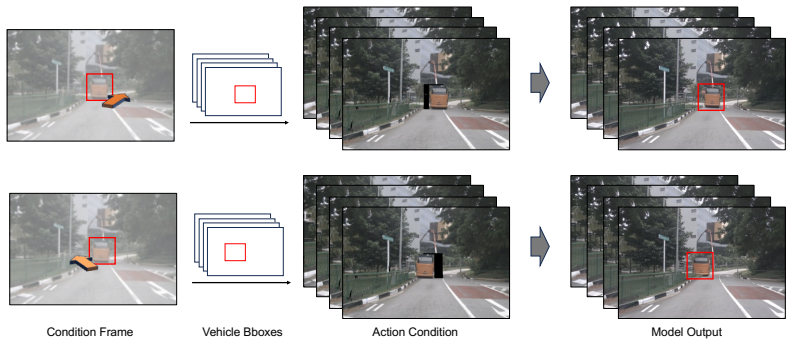
The load-bearing device is visual trajectory conditioning: a rendered video sequence obtained by projecting a monocular 3D point-cloud reconstruction along the requested camera path, used as a visual prompt instead of a numeric control vector. The pipeline first builds a metric point cloud and camera poses from one frame, then uses projective rendering with z-buffering to produce geometrically consistent views along the trajectory. A dynamic editing module moves vehicles using 2D bounding-box tracks during training so the static reconstruction better matches moving traffic. These rendered videos are encoded and fused into a frozen video diffusion transformer through a condition encoder that is only about 6 percent of backbone parameters, with the fusion weights zero-initialized to avoid corrupting the pretrained model.
What would settle it
Run the trajectory-following evaluation using camera poses and trajectories from an independent source, such as LiDAR-inertial odometry or a different structure-from-motion pipeline, for both the condition rendering and the predicted frames, and compare GeoDrive against Vista on the same clips. If the ADE gap of 1.15 (2.77 versus 1.62) narrows or reverses, the control advantage is partly an artifact of sharing the same monocular estimator in conditioning and evaluation.
Extended reading notes
Core claim
The central claim is that explicit visual grounding of the action signal, rather than a larger training corpus, is what makes trajectory conditioning reliable. GeoDrive takes the first frame of a driving video, runs an off-the-shelf monocular dense-stereo estimator to obtain a metric-scale point cloud and camera poses, and projectively renders that point cloud along the user-specified ego trajectory to produce a dynamic-aware conditioning video. A lightweight condition encoder injects this rendered video into a frozen latent video diffusion transformer, constraining the generated frames to agree with the rendered geometry while retaining the backbone's photorealism. With this mechanism, the authors report trajectory-following ADE of 1.62 versus Vista's 2.77, FID of 4.1 versus 6.6, and FVD of 61.6 versus 167.7 on nuScenes, plus zero-shot generalization to shifted and reverse trajectories. The same geometry-conditioned pipeline also controls individual vehicles via 2D bounding-box tracks and synthesizes novel views on Waymo without retraining.
Load-bearing premise
Everything rests on the monocular metric-scale reconstruction being accurate enough to serve as geometric ground truth: if the depth or camera-pose estimates are biased, both the rendered condition and the trajectory-error measurement inherit that bias, so the reported action advantage could shrink or disappear when measured against independent ground truth.
Editorial extensions
If this is right
- Trajectory-following accuracy no longer needs to scale with action-label dataset size: 5 hours of nuScenes data gives an ADE of 1.62 versus Vista's 2.77 on 1,740 hours, implying the rendered condition carries most of the control information.
- The model can follow trajectories absent from training data, including reverse and laterally shifted paths, because the visual condition itself is geometrically consistent.
- Conditioning on rendered geometry keeps static infrastructure fixed across generated frames, reducing the structural drift common in 2D-only world models.
- Dynamic editing with 2D bounding-box tracks gives users control over non-ego vehicles, enabling object insertion, removal, and trajectory control in generated scenes.
- The model can roll out candidate trajectories for a vision-language-action planner, letting the planner reject unsafe maneuvers before execution.
Reading between the lines
- If the mechanism works as claimed, then improving the monocular metric reconstruction, whether through temporal smoothing, multi-frame input, or LiDAR fusion, should directly improve both trajectory control and evaluation accuracy, meaning the world model's ceiling is set by 3D reconstruction rather than by video generation.
- A fair comparison that measures both the condition rendering and the predicted trajectories with an independent or ground-truth pose source would isolate whether the 42 percent improvement comes from the rendered geometry or from aligning both condition and evaluation through the same monocular estimator.
- The rendering-as-condition idea could transfer to other single-image-to-video domains with known camera trajectories, such as robotics manipulation or human motion, though the paper does not test this.
- Because the frozen backbone is large but only about 6 percent of parameters are trained, the geometry-conditioning pipeline may carry over to higher resolutions or longer horizons by swapping the backbone, an extension the paper does not demonstrate.
Editorial analysis
A structured set of objections, weighed in public.
Referee Report
Summary. GeoDrive is a video-diffusion driving world model that uses the off-the-shelf dense stereo model MonST3R to reconstruct a 3D point cloud from a single initial frame, renders that point cloud along a user-specified ego-vehicle trajectory (with an optional dynamic-object editing module), and feeds the resulting rendered video as a visual condition to a frozen CogVideo diffusion transformer via a small trainable condition encoder. The paper claims that this explicit 3D visual conditioning reduces trajectory-following error by 42% relative to Vista on nuScenes (Table 1: ADE 1.62 vs. 2.77), improves generation quality metrics such as FID and FVD on nuScenes, yields zero-shot novel-view synthesis on Waymo, and supports applications including object editing, object trajectory control, and VLA-based planning.
Significance. If the trajectory-following numbers are trustworthy, the paper makes a significant practical contribution: it demonstrates that rendering the desired ego trajectory as a projective visual condition is a far stronger control signal than feeding raw numerical action vectors, and it does so while training only a 6%-parameter condition encoder on a small fine-tuning set. The dynamic-editing and VLA-planning applications are useful extensions of world-model controllability. However, the evaluation protocol currently couples the geometric estimator used to construct the condition with the estimator used to measure trajectory fidelity, and the quantitative tables report no error bars or significance tests. The headline claims therefore need independent validation before their significance can be fully assessed.
major comments (4)
- [Section B.4, Eq. (6); Section 3.1] The ADE/FDE evaluation is potentially circular. MonST3R produces both the point cloud and camera poses that condition GeoDrive (Eqs. (1)-(3)), and Eq. (6) computes ADE/FDE from trajectories "estimated via MonST3R". If MonST3R has any systematic scale or pose bias, a video that faithfully renders the MonST3R point cloud will appear accurately localized to MonST3R even if the true camera motion is wrong, whereas Vista, conditioned on raw control vectors, receives no such benefit. The text is ambiguous about whether y_t is the sensor/calibration pose or another MonST3R estimate. Please clarify the exact provenance of y_t and, more importantly, re-evaluate ADE/FDE for both GeoDrive and baselines using an independent trajectory estimator (e.g., LiDAR/INS odometry or a different monocular pose model), and report sensitivity of the results to MonST3R depth/pose error.
- [Tables 1-4] No error bars or significance tests are reported. Table 1's headline 42% ADE reduction is a point estimate on a 1087-video subset, and Table 3's novel-view synthesis rests on only 5 Waymo scenes. The conclusion of "significant" outperformance is not verifiable without measures of variance. Please provide standard errors or confidence intervals over multiple seeds or scene-level bootstraps, and for NVS report per-scene numbers or use a larger sample.
- [Table 4] The dual-branch ablation does not clearly support the method. The full model has ADE 1.62 versus 3.45 for w/o dual-branch, but its FVD is 85.22 versus 74.76 for w/o dual-branch; the w/o D.E. variant also differs. With no error bars, the ADE advantage could be noise or reflect a trade-off rather than a uniform improvement. Please report statistical significance and explain the FVD regression, or temper the conclusion that the dual-branch conditioning is uniformly beneficial.
- [Section 4.3, Table 3] The text states that GeoDrive "achieves lower (and thus better) FID & FVD scores" than StreetGaussians, but Table 3 contradicts this: on Left@3m, GeoDrive's FID is 67.13, worse than StreetGS's 63.84, although GeoDrive's FVD is better. Please correct the claim and discuss the trade-off, or adjust the evaluation to be consistent with the data.
minor comments (6)
- [Tables 1 and 2] The same methods report different metric values in Tables 1 and 2 (e.g., GeoDrive FID 7.17 vs. 4.1; Vista FID 8.35 vs. 6.6). Since Table 1 is on a subset and Table 2 on the full validation set, please clarify the subset composition and metric protocol to avoid confusion.
- [Throughout] The phrase "significantly outperforms" is used without statistical significance testing; please either add tests or use non-statistical wording such as "outperforms on the reported metrics".
- [Eq. (4)] The notation for the condition-encoder feature fusion, "\(\gamma^\phi_{enc}([z_t, z_R], t)_{i // M}^2\)", is garbled and does not parse; please define the layer indexing and the fusion operation precisely.
- [Section 4.2] The paper says the 1087-video subset has "balanced driving trajectories" but does not define "balanced" or report the trajectory distribution; please specify the balancing criterion.
- [Figure 10 / Section C.1] The claim of generalization to a reverse trajectory is supported only by a qualitative figure; if quantitative trajectory-error numbers for this setting exist, please include them.
- [References] The name "StreetGaussians" is spelled inconsistently as "StreetGaussian" in several places; standardize the spelling.
Circularity Check
ADE/FDE trajectory-following result is partially circular: MonST3R both constructs the conditioning geometry and measures the predicted trajectory, so the 42% improvement is partly self-consistency rather than independent ego-motion accuracy.
-
self definitional
[Sec. 4.2 (Benchmark and Baselines) and Appendix B.4 (Eq. 6)]
"We estimate our condition camera poses by running MonST3R on GT video. ... the trajectory fidelity is quantified by Average Displacement Error (ADE) and Final Displacement Error (FDE) upon the trajectory pair {yt, ˆyt} estimated via MonST3R: ADE = 1/T Σ ∥yt − ˆyt∥2, FDE = ∥yT − ˆyT∥2, where yt denotes ground truth poses and ˆyt predicted positions."
GeoDrive's geometric condition is built by MonST3R: Eqs. (1)-(3) produce the point cloud P0 and camera poses from the GT video, and Sec. 3.2 renders P0 along those same poses. At evaluation, Eq. (6) measures ADE/FDE using trajectories 'estimated via MonST3R', where yt is MonST3R's pose estimate on the GT video and ŷt is MonST3R's pose estimate on the generated frames. The same estimator therefore defines both the conditioning signal and the 'ground truth' for the action-fidelity metric. A generated video that faithfully reproduces the MonST3R-conditioned rendering will appear perfectly localized to MonST3R even if the true camera path is wrong, whereas Vista, conditioned on raw sensor/calibration trajectories, receives no such consistency bonus.
full rationale
There is no formal mathematical derivation in the paper, so classical derivation-circularity does not apply. The central circularity is evaluative and specific: the same monocular geometry estimator, MonST3R, is used to create GeoDrive's conditioning render (Eqs. 1-3 and Sec. 3.2) and to compute the ADE/FDE trajectory-fidelity scores (Eq. 6). The condition poses are 'estimated via MonST3R' and the trajectory pair is also 'estimated via MonST3R', so the metric rewards agreement with MonST3R's own reconstruction, which GeoDrive is explicitly trained and conditioned to reproduce. This makes the headline trajectory-following claim (Table 1: ADE 1.62 vs Vista's 2.77) partially circular, with the 42% improvement inflated by estimator self-consistency. Other results are independent: FID/FVD visual-quality numbers, the novel-view-synthesis comparison with StreetGaussian, and the ablations do not depend on the same estimator in their evaluation, giving the paper substantial non-circular content. The Limitations section candidly notes that performance depends on MonST3R's depth/pose accuracy, which is a relevant admission, but the dependence is not quantified or controlled for. Overall, one prediction (action fidelity) reduces by construction, so a score of 6 is appropriate for partial circularity rather than full circularity.
Assumptions & free parameters
free parameters (3)
- confidence threshold tau =
0.65
- depth range [0.1, 100.0] m =
[0.1, 100.0]
- condition encoder capacity (first two DiT layers, 6% parameters) =
2 layers
assumptions (4)
- standard math The diffusion forward process and denoising objective (Eq. 5) describe a valid generative model.
- domain assumption Additive feature injection from the condition encoder into the frozen DiT (Eq. 4) preserves the pre-trained model's photorealism while steering output.
- domain assumption MonST3R's metric-scale 3D reconstructions and camera poses are accurate for urban driving scenes.
- domain assumption Moving vehicles can be represented by shifting their associated 3D points, and the diffusion model will render plausible motion after editing.
Cite this review
Pith. "Pith review of GeoDrive: 3D Geometry-Informed Driving World Model with Precise Action Control." pith.science (2026). https://pith.science/paper/KFZADPHN
@misc{pith2026250522421,
  author       = {Pith},
  title        = {Pith review of: GeoDrive: 3D Geometry-Informed Driving World Model with Precise Action Control},
  year         = {2026},
  howpublished = {\url{https://pith.science/paper/KFZADPHN}},
  note         = {Machine review of arXiv:2505.22421}
}
read the original abstract
Recent advancements in world models have revolutionized dynamic environment simulation, allowing systems to foresee future states and assess potential actions. In autonomous driving, these capabilities help vehicles anticipate the behavior of other road users, perform risk-aware planning, accelerate training in simulation, and adapt to novel scenarios, thereby enhancing safety and reliability. Current approaches exhibit deficiencies in maintaining robust 3D geometric consistency or accumulating artifacts during occlusion handling, both critical for reliable safety assessment in autonomous navigation tasks. To address this, we introduce GeoDrive, which explicitly integrates robust 3D geometry conditions into driving world models to enhance spatial understanding and action controllability. Specifically, we first extract a 3D representation from the input frame and then obtain its 2D rendering based on the user-specified ego-car trajectory. To enable dynamic modeling, we propose a dynamic editing module during training to enhance the renderings by editing the positions of the vehicles. Extensive experiments demonstrate that our method significantly outperforms existing models in both action accuracy and 3D spatial awareness, leading to more realistic, adaptable, and reliable scene modeling for safer autonomous driving. Additionally, our model can generalize to novel trajectories and offers interactive scene editing capabilities, such as object editing and object trajectory control.
Figures


Figures from the paper (7 more)




Forward citations
Cited by 3 Pith papers
-
WorldLens: Full-Spectrum Evaluations of Driving World Models in Real World
A five-aspect, 24-metric benchmark, a 26K human-annotated dataset, and an AI evaluator show that today's driving world models cannot simultaneously look real, respect geometry, and behave safely.
-
A Comprehensive Survey on World Models for Embodied AI
A unified three-axis taxonomy — functionality, temporal modeling, spatial representation — organizes the world-model literature for embodied AI.
-
3D and 4D World Modeling: A Survey
A survey that defines 3D/4D world modeling, organizes methods into VideoGen, OccGen, and LiDARGen categories, and compiles datasets, metrics, and benchmark numbers.
Reference graph
Works this paper leans on
-
[1]
Act-bench: Towards action controllable world models for autonomous driving, 2024
Hidehisa Arai, Keishi Ishihara, Tsubasa Takahashi, and Yu Yamaguchi. Act-bench: Towards action controllable world models for autonomous driving, 2024
2024
-
[2]
Videopainter: Any-length video inpainting and editing with plug-and-play context control, 2025
Yuxuan Bian, Zhaoyang Zhang, Xuan Ju, Mingdeng Cao, Liangbin Xie, Ying Shan, and Qiang Xu. Videopainter: Any-length video inpainting and editing with plug-and-play context control, 2025
2025
-
[3]
Stable video diffusion: Scaling latent video diffusion models to large datasets
Andreas Blattmann, Tim Dockhorn, Sumith Kulal, Daniel Mendelevitch, Maciej Kilian, Dominik Lorenz, Yam Levi, Zion English, Vikram V oleti, Adam Letts, et al. Stable video diffusion: Scaling latent video diffusion models to large datasets. arXiv preprint arXiv:2311.15127, 2023
arXiv 2023
-
[4]
Align Your Latents: High-Resolution Video Synthesis with Latent Diffusion Models
Andreas Blattmann, Robin Rombach, Huan Ling, Tim Dockhorn, Seung Wook Kim, Sanja Fidler, and Karsten Kreis. Align Your Latents: High-Resolution Video Synthesis with Latent Diffusion Models. In Proc. IEEE Conf. Comput. Vis. Pattern Recognit., 2023
2023
-
[5]
Align your latents: High-resolution video synthesis with latent diffusion models
Andreas Blattmann, Robin Rombach, Huan Ling, Tim Dockhorn, Seung Wook Kim, Sanja Fidler, and Karsten Kreis. Align your latents: High-resolution video synthesis with latent diffusion models. CVPR, 2023
2023
-
[6]
Muvo: A multimodal generative world model for autonomous driving with geometric representations
Daniel Bogdoll, Yitian Yang, and J Marius Zöllner. Muvo: A multimodal generative world model for autonomous driving with geometric representations. arXiv preprint arXiv:2311.11762, 2023
arXiv 2023
-
[7]
Lang, Sourabh V ora, Venice Erin Liong, Qiang Xu, Anush Krishnan, Yuxin Pan, Giancarlo Baldan, and Oscar Beijbom
Holger Caesar, Varun Bankiti, Alex H. Lang, Sourabh V ora, Venice Erin Liong, Qiang Xu, Anush Krishnan, Yuxin Pan, Giancarlo Baldan, and Oscar Beijbom. nuScenes: A Multimodal Dataset for Autonomous Driving. In Proc. IEEE Conf. Comput. Vis. Pattern Recognit., 2020
2020
-
[8]
Training-free regional prompting for diffusion transformers, 2024
Anthony Chen, Jianjin Xu, Wenzhao Zheng, Gaole Dai, Yida Wang, Renrui Zhang, Haofan Wang, and Shanghang Zhang. Training-free regional prompting for diffusion transformers, 2024
2024
Show all 91 references
-
[9]
Eva: An embodied world model for future video anticipation, 2024
Xiaowei Chi, Hengyuan Zhang, Chun-Kai Fan, Xingqun Qi, Rongyu Zhang, Anthony Chen, Chi min Chan, Wei Xue, Wenhan Luo, Shanghang Zhang, and Yike Guo. Eva: An embodied world model for future video anticipation, 2024
2024
-
[10]
Structure and content-guided video synthesis with diffusion models
Patrick Esser, Johnathan Chiu, Parmida Atighehchian, Jonathan Granskog, and Anastasis Germanidis. Structure and content-guided video synthesis with diffusion models. In Proc. IEEE Int. Conf. Comput. Vis., 2023. 10
2023
-
[11]
Pointrnn: Point recurrent neural network for moving point cloud processing
Hehe Fan and Yi Yang. Pointrnn: Point recurrent neural network for moving point cloud processing. arXiv preprint arXiv:1910.08287, 2019
1910 arXiv
-
[12]
Cardreamer: Open-source learning platform for world model based autonomous driving
Dechen Gao, Shuangyu Cai, Hanchu Zhou, Hang Wang, Iman Soltani, and Junshan Zhang. Cardreamer: Open-source learning platform for world model based autonomous driving. arXiv preprint arXiv:2405.09111, 2024
2024 arXiv
-
[13]
Vista: A generalizable driving world model with high fidelity and versatile controllability
Shenyuan Gao, Jiazhi Yang, Li Chen, Kashyap Chitta, Yihang Qiu, Andreas Geiger, Jun Zhang, and Hongyang Li. Vista: A generalizable driving world model with high fidelity and versatile controllability. Proc. Adv. Neural Inf. Process. Syst., 2024
2024
-
[14]
Imagine-2-drive: High-fidelity world modeling in carla for au- tonomous vehicles
Anant Garg and K Madhava Krishna. Imagine-2-drive: High-fidelity world modeling in carla for au- tonomous vehicles. arXiv preprint arXiv:2411.10171, 2024
2024 arXiv
-
[15]
Dome: Taming diffusion model into high-fidelity controllable occupancy world model
Songen Gu, Wei Yin, Bu Jin, Xiaoyang Guo, Junming Wang, Haodong Li, Qian Zhang, and Xiaoxiao Long. Dome: Taming diffusion model into high-fidelity controllable occupancy world model. arXiv preprint arXiv:2410.10429, 2024
2024 arXiv
-
[16]
AnimateDiff: Animate Your Personalized Text-to-Image Diffusion Models without Specific Tuning
Yuwei Guo, Ceyuan Yang, Anyi Rao, Yaohui Wang, Yu Qiao, Dahua Lin, and Bo Dai. AnimateDiff: Animate Your Personalized Text-to-Image Diffusion Models without Specific Tuning. InProc. Int. Conf. Learn. Represent., 2024
2024
-
[17]
Vdt-auto: End-to-end autonomous driving with vlm-guided diffusion transformers, 2025
Ziang Guo, Konstantin Gubernatorov, Selamawit Asfaw, Zakhar Yagudin, and Dzmitry Tsetserukou. Vdt-auto: End-to-end autonomous driving with vlm-guided diffusion transformers, 2025
2025
-
[18]
Gem: A generalizable ego-vision multimodal world model for fine-grained ego-motion, object dynamics, and scene composition control
Mariam Hassan, Sebastian Stapf, Ahmad Rahimi, Pedro Rezende, Yasaman Haghighi, David Brüggemann, Isinsu Katircioglu, Lin Zhang, Xiaoran Chen, Suman Saha, et al. Gem: A generalizable ego-vision multimodal world model for fine-grained ego-motion, object dynamics, and scene compo...
2024 arXiv
-
[19]
Cameractrl: Enabling camera control for text-to-video generation
Hao He, Yinghao Xu, Yuwei Guo, Gordon Wetzstein, Bo Dai, Hongsheng Li, and Ceyuan Yang. Cameractrl: Enabling camera control for text-to-video generation. arXiv preprint arXiv:2404.02101, 2024
2024 arXiv
-
[20]
GANs trained by a two time-scale update rule converge to a local Nash equilibrium
Martin Heusel, Hubert Ramsauer, Thomas Unterthiner, Bernhard Nessler, and Sepp Hochreiter. GANs trained by a two time-scale update rule converge to a local Nash equilibrium. Advances in neural information processing systems, 30, 2017
2017
-
[21]
Video Diffusion Models
Jonathan Ho, Tim Salimans, Alexey Gritsenko, William Chan, Mohammad Norouzi, and David J Fleet. Video Diffusion Models. arXiv preprint arXiv:2204.03458, 2022
2022 arXiv
-
[22]
Cogvideo: Large-scale pretraining for text-to-video generation via transformers
Wenyi Hong, Ming Ding, Wendi Zheng, Xinghan Liu, and Jie Tang. Cogvideo: Large-scale pretraining for text-to-video generation via transformers. arXiv preprint arXiv:2205.15868, 2022
2022 arXiv
-
[24]
GAIA-1: A Generative World Model for Autonomous Driving
Anthony Hu, Lloyd Russell, Hudson Yeo, Zak Murez, George Fedoseev, Alex Kendall, Jamie Shotton, and Gianluca Corrado. GAIA-1: A Generative World Model for Autonomous Driving. arXiv preprint arXiv:2309.17080, 2023
2023 arXiv
-
[25]
Drivingworld: Constructingworld model for autonomous driving via video gpt
Xiaotao Hu, Wei Yin, Mingkai Jia, Junyuan Deng, Xiaoyang Guo, Qian Zhang, Xiaoxiao Long, and Ping Tan. Drivingworld: Constructingworld model for autonomous driving via video gpt. arXiv preprint arXiv:2412.19505, 2024
2024 arXiv
-
[26]
Vad: Vectorized scene representation for autonomous driving
Bencheng Huang, Shaoyu Liu, Tianheng Chen, Xinggang Shen, Zeming Zhu, Zhe Wang, et al. Vad: Vectorized scene representation for autonomous driving. arXiv preprint arXiv:2303.12077, 2023
2023 arXiv
-
[27]
Neural lidar fields for novel view synthesis
Shengyu Huang, Zan Gojcic, Zian Wang, Francis Williams, Yoni Kasten, Sanja Fidler, Konrad Schindler, and Or Litany. Neural lidar fields for novel view synthesis. In Proc. IEEE Int. Conf. Comput. Vis., pages 18236–18246, 2023
2023
-
[28]
Neural volumetric world models for autonomous driving
Zanming Huang, Jimuyang Zhang, and Eshed Ohn-Bar. Neural volumetric world models for autonomous driving. In Proc. Eur . Conf. Comput. Vis., pages 195–213. Springer, 2025
2025
-
[29]
Perceptual losses for real-time style transfer and super-resolution
Justin Johnson, Alexandre Alahi, and Li Fei-Fei. Perceptual losses for real-time style transfer and super-resolution. In Proc. Eur . Conf. Comput. Vis., 2016. 11
2016
-
[30]
Differentiable raycasting for self-supervised occupancy forecasting
Tarasha Khurana, Peiyun Hu, Achal Dave, Jason Ziglar, David Held, and Deva Ramanan. Differentiable raycasting for self-supervised occupancy forecasting. In Proc. Eur . Conf. Comput. Vis., pages 353–369. Springer, 2022
2022
-
[31]
DriveGAN: Towards a Controllable High-Quality Neural Simulation
Seung Wook Kim, Jonah Philion, Antonio Torralba, and Sanja Fidler. DriveGAN: Towards a Controllable High-Quality Neural Simulation. In Proc. IEEE Conf. Comput. Vis. Pattern Recognit., 2021
2021
-
[32]
Adam: A method for stochastic optimization
Diederik P Kingma and Jimmy Ba. Adam: A method for stochastic optimization. arXiv preprint arXiv:1412.6980, 2014
2014 arXiv
-
[33]
Black Forest Labs. Flux. https://github.com/black-forest-labs/flux, 2024
2024
-
[34]
Drivingdiffusion: Layout-guided multi-view driving scene video generation with latent diffusion model
Xiaofan Li, Yifu Zhang, and Xiaoqing Ye. Drivingdiffusion: Layout-guided multi-view driving scene video generation with latent diffusion model. arXiv preprint arXiv:2310.07771, 2023
2023 arXiv
-
[35]
Enhancing end-to-end autonomous driving with latent world model
Yingyan Li, Lue Fan, Jiawei He, Yuqi Wang, Yuntao Chen, Zhaoxiang Zhang, and Tieniu Tan. Enhancing end-to-end autonomous driving with latent world model. arXiv preprint arXiv:2406.08481, 2024
2024 arXiv
-
[36]
Gligen: Open-set grounded text-to-image generation
Yuheng Li, Haotian Liu, Qingyang Wu, Fangzhou Mu, Jianwei Yang, Jianfeng Gao, Chunyuan Li, and Yong Jae Lee. Gligen: Open-set grounded text-to-image generation. In Proc. IEEE Conf. Comput. Vis. Pattern Recognit., 2023
2023
-
[37]
Lidar-based 4d occupancy completion and forecasting
Xinhao Liu, Moonjun Gong, Qi Fang, Haoyu Xie, Yiming Li, Hang Zhao, and Chen Feng. Lidar-based 4d occupancy completion and forecasting. In Proc. IEEE/RSJ Int. Conf. Intell. Robot. Syst. , pages 11102–11109. IEEE, 2024
2024
-
[38]
Monet: Motion-based point cloud prediction network
Fan Lu, Guang Chen, Zhijun Li, Lijun Zhang, Yinlong Liu, Sanqing Qu, and Alois Knoll. Monet: Motion-based point cloud prediction network. IEEE Trans. Intell. Transp. Syst., 23(8):13794–13804, 2021
2021
-
[39]
Wovogen: World volume-aware diffusion for controllable multi-camera driving scene generation
Jiachen Lu, Ze Huang, Zeyu Yang, Jiahui Zhang, and Li Zhang. Wovogen: World volume-aware diffusion for controllable multi-camera driving scene generation. In Proc. Eur . Conf. Comput. Vis., pages 329–345. Springer, 2025
2025
-
[40]
Unleashing generalization of end-to-end autonomous driving with controllable long video generation
Enhui Ma, Lijun Zhou, Tao Tang, Zhan Zhang, Dong Han, Junpeng Jiang, Kun Zhan, Peng Jia, Xianpeng Lang, Haiyang Sun, et al. Unleashing generalization of end-to-end autonomous driving with controllable long video generation. arXiv preprint arXiv:2406.01349, 2024
2024 arXiv
-
[41]
Cam4docc: Benchmark for camera-only 4d occupancy forecasting in autonomous driving applications
Junyi Ma, Xieyuanli Chen, Jiawei Huang, Jingyi Xu, Zhen Luo, Jintao Xu, Weihao Gu, Rui Ai, and Hesheng Wang. Cam4docc: Benchmark for camera-only 4d occupancy forecasting in autonomous driving applications. In Proc. IEEE Conf. Comput. Vis. Pattern Recognit., pages 21486–21495, 2024
2024
-
[42]
Dreamdrive: Generative 4d scene modeling from street view images
Jiageng Mao, Boyi Li, Boris Ivanovic, Yuxiao Chen, Yan Wang, Yurong You, Chaowei Xiao, Danfei Xu, Marco Pavone, and Yue Wang. Dreamdrive: Generative 4d scene modeling from street view images. arXiv preprint arXiv:2501.00601, 2024
2024 arXiv
-
[43]
Latent-nerf for shape- guided generation of 3d shapes and textures
Gal Metzer, Elad Richardson, Or Patashnik, Raja Giryes, and Daniel Cohen-Or. Latent-nerf for shape- guided generation of 3d shapes and textures. In Proc. IEEE Conf. Comput. Vis. Pattern Recognit., 2023
2023
-
[44]
Driveworld: 4d pre-trained scene understanding via world models for autonomous driving
Chen Min, Dawei Zhao, Liang Xiao, Jian Zhao, Xinli Xu, Zheng Zhu, Lei Jin, Jianshu Li, Yulan Guo, Junliang Xing, et al. Driveworld: 4d pre-trained scene understanding via world models for autonomous driving. In Proc. IEEE Conf. Comput. Vis. Pattern Recognit., pages 15522–15533, 2024
2024
-
[45]
T2i- adapter: Learning adapters to dig out more controllable ability for text-to-image diffusion models
Chong Mou, Xintao Wang, Liangbin Xie, Yanze Wu, Jian Zhang, Zhongang Qi, and Ying Shan. T2i- adapter: Learning adapters to dig out more controllable ability for text-to-image diffusion models. In AAAI Conf. Artif. Intell., 2024
2024
-
[46]
Multidiff: Consistent novel view synthesis from a single image
Norman Müller, Katja Schwarz, Barbara Rössle, Lorenzo Porzi, Samuel Rota Bulò, Matthias Nießner, and Peter Kontschieder. Multidiff: Consistent novel view synthesis from a single image. In Proc. IEEE Conf. Comput. Vis. Pattern Recognit., 2024
2024
-
[47]
Recondreamer: Crafting world models for driving scene reconstruction via online restoration
Chaojun Ni, Guosheng Zhao, Xiaofeng Wang, Zheng Zhu, Wenkang Qin, Guan Huang, Chen Liu, Yuyin Chen, Yida Wang, Xueyang Zhang, et al. Recondreamer: Crafting world models for driving scene reconstruction via online restoration. arXiv preprint arXiv:2411.19548, 2024
2024 arXiv
-
[48]
Mofa-video: Controllable image animation via generative motion field adaptions in frozen image-to-video diffusion model
Muyao Niu, Xiaodong Cun, Xintao Wang, Yong Zhang, Ying Shan, and Yinqiang Zheng. Mofa-video: Controllable image animation via generative motion field adaptions in frozen image-to-video diffusion model. arXiv preprint arXiv:2405.20222, 2024. 12
2024 arXiv
-
[49]
Vase: Object-centric appearance and shape manipulation of real videos
Elia Peruzzo, Vidit Goel, Dejia Xu, Xingqian Xu, Yifan Jiang, Zhangyang Wang, Humphrey Shi, and Nicu Sebe. Vase: Object-centric appearance and shape manipulation of real videos. arXiv preprint arXiv:2401.02473, 2024
2024 arXiv
-
[50]
Mitigating covariate shift in imitation learning for autonomous vehicles using latent space generative world models
Alexander Popov, Alperen Degirmenci, David Wehr, Shashank Hegde, Ryan Oldja, Alexey Kamenev, Bertrand Douillard, David Nistér, Urs Muller, Ruchi Bhargava, et al. Mitigating covariate shift in imitation learning for autonomous vehicles using latent space generative world models...
2024 arXiv
-
[51]
Dust3r: Geometric 3d vision made easy
Jérôme Revaud, Vincent Leroy, Philippe Weinzaepfel, Boris Chidlovskii, and Gabriela Csurka. Dust3r: Geometric 3d vision made easy. arXiv preprint arXiv:2312.14132, 2023
2023 arXiv
-
[52]
Gaia-2: A controllable multi-view generative world model for autonomous driving, 2025
Lloyd Russell, Anthony Hu, Lorenzo Bertoni, George Fedoseev, Jamie Shotton, Elahe Arani, and Gianluca Corrado. Gaia-2: A controllable multi-view generative world model for autonomous driving, 2025
2025
-
[53]
Denoising diffusion implicit models
Jiaming Song, Chenlin Meng, and Stefano Ermon. Denoising diffusion implicit models. In Proc. Int. Conf. Learn. Represent., 2021
2021
-
[54]
Probing multimodal llms as world models for driving
Shiva Sreeram, Tsun-Hsuan Wang, Alaa Maalouf, Guy Rosman, Sertac Karaman, and Daniela Rus. Probing multimodal llms as world models for driving. arXiv preprint arXiv:2405.05956, 2024
2024 arXiv
-
[55]
Street-view image generation from a bird’s-eye view layout
Alexander Swerdlow, Runsheng Xu, and Bolei Zhou. Street-view image generation from a bird’s-eye view layout. IEEE Robot. Autom. Lett. , 2024
2024
-
[56]
Drivevlm: The convergence of autonomous driving and large vision-language models, 2024
Xiaoyu Tian, Junru Gu, Bailin Li, Yicheng Liu, Yang Wang, Zhiyong Zhao, Kun Zhan, Peng Jia, Xianpeng Lang, and Hang Zhao. Drivevlm: The convergence of autonomous driving and large vision-language models, 2024
2024
-
[57]
Towards accurate generative models of video: A new metric & challenges
Thomas Unterthiner, Sjoerd Steenkiste, Karol Kurach, Raphael Marinier, Marcin Michalski, and Sylvain Gelly. Towards accurate generative models of video: A new metric & challenges. 2018
2018
-
[58]
ModelScope Text-to-Video Technical Report
Jiuniu Wang, Hangjie Yuan, Dayou Chen, Yingya Zhang, Xiang Wang, and Shiwei Zhang. ModelScope Text-to-Video Technical Report. arXiv preprint arXiv:2308.06571, 2023
2023 arXiv
-
[59]
Occ- sora: 4d occupancy generation models as world simulators for autonomous driving
Lening Wang, Wenzhao Zheng, Yilong Ren, Han Jiang, Zhiyong Cui, Haiyang Yu, and Jiwen Lu. Occ- sora: 4d occupancy generation models as world simulators for autonomous driving. arXiv preprint arXiv:2405.20337, 2024
2024 arXiv
-
[60]
Drivedreamer: Towards real-world-driven world models for autonomous driving
Xiaofeng Wang, Zheng Zhu, Guan Huang, Xinze Chen, Jiagang Zhu, and Jiwen Lu. Drivedreamer: Towards real-world-driven world models for autonomous driving. Proc. Eur . Conf. Comput. Vis., 2024
2024
-
[61]
Worlddreamer: Towards general world models for video generation via predicting masked tokens
Xiaofeng Wang, Zheng Zhu, Guan Huang, Boyuan Wang, Xinze Chen, and Jiwen Lu. Worlddreamer: Towards general world models for video generation via predicting masked tokens. arXiv preprint arXiv:2401.09985, 2024
2024 arXiv
-
[62]
Drivingdojo dataset: Advancing interactive and knowledge-enriched driving world model
Yuqi Wang, Ke Cheng, Jiawei He, Qitai Wang, Hengchen Dai, Yuntao Chen, Fei Xia, and Zhaoxiang Zhang. Drivingdojo dataset: Advancing interactive and knowledge-enriched driving world model. arXiv preprint arXiv:2410.10738, 2024
-
[63]
Bovik, Hamid R
Zhou Wang, Alan C. Bovik, Hamid R. Sheikh, and Eero P. Simoncelli. Image quality assessment: from error visibility to structural similarity. IEEE transactions on image processing, 13(4):600–612, 2004
2004
-
[64]
Mo- tionCtrl: A Unified and Flexible Motion Controller for Video Generation.arXiv preprint arXiv:2312.03641, 2023
Zhouxia Wang, Ziyang Yuan, Xintao Wang, Tianshui Chen, Menghan Xia, Ping Luo, and Ying Shan. Mo- tionCtrl: A Unified and Flexible Motion Controller for Video Generation.arXiv preprint arXiv:2312.03641, 2023
2023 arXiv
-
[65]
Oc- cllama: An occupancy-language-action generative world model for autonomous driving
Julong Wei, Shanshuai Yuan, Pengfei Li, Qingda Hu, Zhongxue Gan, and Wenchao Ding. Oc- cllama: An occupancy-language-action generative world model for autonomous driving. arXiv preprint arXiv:2409.03272, 2024
2024 arXiv
-
[66]
Fast point cloud generation with straight flows
Lemeng Wu, Dilin Wang, Chengyue Gong, Xingchao Liu, Yunyang Xiong, Rakesh Ranjan, Raghuraman Krishnamoorthi, Vikas Chandra, and Qiang Liu. Fast point cloud generation with straight flows. In Proc. IEEE Conf. Comput. Vis. Pattern Recognit., pages 9445–9454, 2023
2023
-
[67]
Holodrive: Holistic 2d-3d multi-modal street scene generation for autonomous driving
Zehuan Wu, Jingcheng Ni, Xiaodong Wang, Yuxin Guo, Rui Chen, Lewei Lu, Jifeng Dai, and Yuwen Xiong. Holodrive: Holistic 2d-3d multi-modal street scene generation for autonomous driving. arXiv preprint arXiv:2412.01407, 2024. 13
2024 arXiv
-
[68]
Tooncrafter: Generative cartoon interpolation
Jinbo Xing, Hanyuan Liu, Menghan Xia, Yong Zhang, Xintao Wang, Ying Shan, and Tien-Tsin Wong. Tooncrafter: Generative cartoon interpolation. arXiv preprint arXiv:2405.17933, 2024
2024 arXiv
-
[69]
Make-your-video: Customized video generation using textual and structural guidance
Jinbo Xing, Menghan Xia, Yuxin Liu, Yuechen Zhang, Yong Zhang, Yingqing He, Hanyuan Liu, Haoxin Chen, Xiaodong Cun, Xintao Wang, et al. Make-your-video: Customized video generation using textual and structural guidance. IEEE Trans. Vis. Comput. Graph., 2024
2024
-
[70]
Dy- namicrafter: Animating open-domain images with video diffusion priors
Jinbo Xing, Menghan Xia, Yong Zhang, Haoxin Chen, Xintao Wang, Tien-Tsin Wong, and Ying Shan. Dy- namicrafter: Animating open-domain images with video diffusion priors. arXiv preprint arXiv:2310.12190, 2023
2023 arXiv
-
[71]
Camco: Camera-controllable 3d-consistent image-to-video generation
Dejia Xu, Weili Nie, Chao Liu, Sifei Liu, Jan Kautz, Zhangyang Wang, and Arash Vahdat. Camco: Camera-controllable 3d-consistent image-to-video generation. arXiv preprint arXiv:2406.02509, 2024
2024 arXiv
-
[72]
Drivingsphere: Building a high-fidelity 4d world for closed-loop simulation
Tianyi Yan, Dongming Wu, Wencheng Han, Junpeng Jiang, Xia Zhou, Kun Zhan, Cheng-zhong Xu, and Jianbing Shen. Drivingsphere: Building a high-fidelity 4d world for closed-loop simulation. arXiv preprint arXiv:2411.11252, 2024
2024 arXiv
-
[73]
Street gaussians: Modeling dynamic urban scenes with gaussian splatting
Yunzhi Yan, Haotong Lin, Chenxu Zhou, Weijie Wang, Haiyang Sun, Kun Zhan, Xianpeng Lang, Xiaowei Zhou, and Sida Peng. Street gaussians: Modeling dynamic urban scenes with gaussian splatting. In ECCV, 2024
2024
-
[74]
Renderworld: World model with self-supervised 3d label.arXiv preprint arXiv:2409.11356, 2024
Ziyang Yan, Wenzhen Dong, Yihua Shao, Yuhang Lu, Liu Haiyang, Jingwen Liu, Haozhe Wang, Zhe Wang, Yan Wang, Fabio Remondino, et al. Renderworld: World model with self-supervised 3d label.arXiv preprint arXiv:2409.11356, 2024
2024 arXiv
-
[75]
Generalized Predictive Model for Autonomous Driving
Jiazhi Yang, Shenyuan Gao, Yihang Qiu, Li Chen, Tianyu Li, Bo Dai, Kashyap Chitta, Penghao Wu, Jia Zeng, Ping Luo, Jun Zhang, Andreas Geiger, Yu Qiao, and Hongyang Li. Generalized Predictive Model for Autonomous Driving. In Proc. IEEE Conf. Comput. Vis. Pattern Recognit., 2024
2024
-
[76]
Drivearena: A closed-loop generative simulation platform for autonomous driving
Xuemeng Yang, Licheng Wen, Yukai Ma, Jianbiao Mei, Xin Li, Tiantian Wei, Wenjie Lei, Daocheng Fu, Pinlong Cai, Min Dou, et al. Drivearena: A closed-loop generative simulation platform for autonomous driving. arXiv preprint arXiv:2408.00415, 2024
2024 arXiv
-
[77]
Visual point cloud forecasting enables scalable autonomous driving
Zetong Yang, Li Chen, Yanan Sun, and Hongyang Li. Visual point cloud forecasting enables scalable autonomous driving. In Proc. IEEE Conf. Comput. Vis. Pattern Recognit., pages 14673–14684, 2024
2024
-
[78]
Cogvideox: Text-to-video diffusion models with an expert transformer
Zhuoyi Yang, Jiayan Teng, Wendi Zheng, Ming Ding, Shiyu Huang, Jiazheng Xu, Yuanming Yang, Wenyi Hong, Xiaohan Zhang, Guanyu Feng, et al. Cogvideox: Text-to-video diffusion models with an expert transformer. arXiv preprint arXiv:2408.06072, 2024
2024 arXiv
-
[79]
Drag- nuwa: Fine-grained control in video generation by integrating text, image, and trajectory
Shengming Yin, Chenfei Wu, Jian Liang, Jie Shi, Houqiang Li, Gong Ming, and Nan Duan. Drag- nuwa: Fine-grained control in video generation by integrating text, image, and trajectory. arXiv preprint arXiv:2308.08089, 2023
2023 arXiv
-
[80]
Nerf-lidar: Generating realistic lidar point clouds with neural radiance fields
Junge Zhang, Feihu Zhang, Shaochen Kuang, and Li Zhang. Nerf-lidar: Generating realistic lidar point clouds with neural radiance fields. In AAAI Conf. Artif. Intell., volume 38, pages 7178–7186, 2024
2024
-
[81]
Monst3r: A simple approach for estimating geometry in the presence of motion
Junyi Zhang, Charles Herrmann, Junhwa Hur, Varun Jampani, Trevor Darrell, Forrester Cole, Deqing Sun, and Ming-Hsuan Yang. Monst3r: A simple approach for estimating geometry in the presence of motion. arXiv preprint arxiv:2410.03825, 2024
-
[82]
Copilot4d: Learning unsupervised world models for autonomous driving via discrete diffusion
Lunjun Zhang, Yuwen Xiong, Ze Yang, Sergio Casas, Rui Hu, and Raquel Urtasun. Copilot4d: Learning unsupervised world models for autonomous driving via discrete diffusion. In Proc. Int. Conf. Learn. Represent., 2024
2024
-
[83]
Adding conditional control to text-to-image diffusion models
Lvmin Zhang, Anyi Rao, and Maneesh Agrawala. Adding conditional control to text-to-image diffusion models. In Proc. IEEE Int. Conf. Comput. Vis., 2023
2023
-
[84]
Bevworld: A multimodal world model for autonomous driving via unified bev latent space
Yumeng Zhang, Shi Gong, Kaixin Xiong, Xiaoqing Ye, Xiao Tan, Fan Wang, Jizhou Huang, Hua Wu, and Haifeng Wang. Bevworld: A multimodal world model for autonomous driving via unified bev latent space. arXiv preprint arXiv:2407.05679, 2024
2024 arXiv
-
[85]
Drivedreamer4d: World models are effective data machines for 4d driving scene representation
Guosheng Zhao, Chaojun Ni, Xiaofeng Wang, Zheng Zhu, Xueyang Zhang, Yida Wang, Guan Huang, Xinze Chen, Boyuan Wang, Youyi Zhang, et al. Drivedreamer4d: World models are effective data machines for 4d driving scene representation. arXiv preprint arXiv:2410.13571, 2024
-
[86]
DriveDreamer-2: LLM-Enhanced World Models for Diverse Driving Video Generation
Guosheng Zhao, Xiaofeng Wang, Zheng Zhu, Xinze Chen, Guan Huang, Xiaoyi Bao, and Xingang Wang. DriveDreamer-2: LLM-Enhanced World Models for Diverse Driving Video Generation. arXiv preprint arXiv:2403.06845, 2024. 14
2024 arXiv
-
[87]
Sce2drivex: A generalized mllm framework for scene-to-drive learning, 2025
Rui Zhao, Qirui Yuan, Jinyu Li, Haofeng Hu, Yun Li, Chengyuan Zheng, and Fei Gao. Sce2drivex: A generalized mllm framework for scene-to-drive learning, 2025
2025
-
[88]
Occworld: Learning a 3d occupancy world model for autonomous driving
Wenzhao Zheng, Weiliang Chen, Yuanhui Huang, Borui Zhang, Yueqi Duan, and Jiwen Lu. Occworld: Learning a 3d occupancy world model for autonomous driving. In Proc. Eur . Conf. Comput. Vis., pages 55–72. Springer, 2025
2025
-
[89]
Doe-1: Closed-loop autonomous driving with large world model
Wenzhao Zheng, Zetian Xia, Yuanhui Huang, Sicheng Zuo, Jie Zhou, and Jiwen Lu. Doe-1: Closed-loop autonomous driving with large world model. arXiv preprint arXiv: 2412.09627 , 2024
2024 arXiv
-
[90]
Xingcheng Zhou, Xuyuan Han, Feng Yang, Yunpu Ma, and Alois C. Knoll. Opendrivevla: Towards end-to-end autonomous driving with large vision language action model, 2025
2025
-
[91]
Simgen: Simulator-conditioned driving scene generation
Yunsong Zhou, Michael Simon, Zhenghao Peng, Sicheng Mo, Hongzi Zhu, Minyi Guo, and Bolei Zhou. Simgen: Simulator-conditioned driving scene generation. arXiv preprint arXiv:2406.09386, 2024
2024 arXiv
-
[92]
Gaussianworld: Gaussian world model for streaming 3d occupancy prediction
Sicheng Zuo, Wenzhao Zheng, Yuanhui Huang, Jie Zhou, and Jiwen Lu. Gaussianworld: Gaussian world model for streaming 3d occupancy prediction. arXiv preprint arXiv:2412.10373, 2024. 15 Appendix A Preliminary Details A.1 Video Diffusion Models A diffusion model [53] is built fro...
2024 arXiv
Reviewed August 7, 2026 · model on record in the stance chip above.
Discussion (0). Sign in to comment.