REVIEW 4 major objections 5 minor 77 references
Lattice Compatibility and Energy Barriers in Intercalation Compounds
T0 review · 4 major / 5 minor · reviewed 2026-08-07 · deepseek-v4-flash
Pith's one-line read The paper claims that intercalation compounds whose lattice stretches satisfy compatibility conditions such as $\lambda_2 = 1$ or $|\det\mathbf{U} - 1| = 0$ have lower elastic energy barriers, require smaller driving forces, and show…
desk verdict The λ2=1 result is solid and worth publishing, but the abstract oversells |detU−1|=0 against the paper's own Fig. 12. read the letter →
The pith
A machine-rendered reading of the paper's core claim, the machinery that carries it, and where it could break.
The reading
What carries the argument
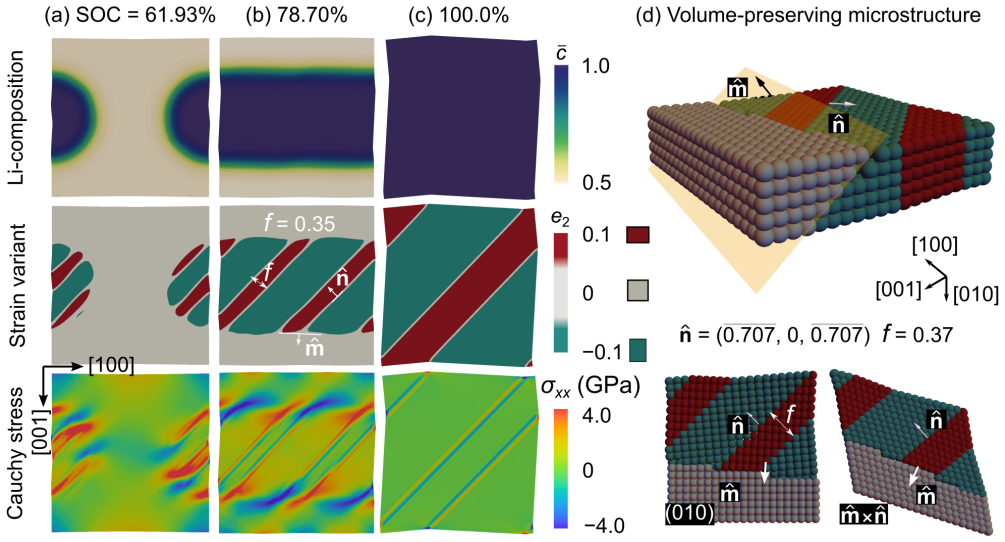
The carrying machinery is a multi-well, chemo-mechanically coupled free-energy functional whose wells represent the cubic LiMn2O4 phase and the three tetragonal Li2Mn2O4 variants. The deformation gradient enters through a stretch tensor $\mathbf{U}$ obtained by minimizing a distance function between reference and transformed lattices. Energy minimization across this landscape, coupled to Li diffusion through the stress chemical potential, makes twinned microstructures, twin-plane orientations, and volume fractions emerge without pre-assumed nucleus shapes. The design analysis then uses the kinematic compatibility conditions of martensite theory, particularly the middle-eigenvalue condition $\lambda_2 = 1$ for stress-free interfaces and $\det\mathbf{U} = 1$ for volume-preserving deformations, as input lattice geometries for the energy landscape.
What would settle it
Grow or identify an intercalation compound whose cubic-to-tetragonal stretch tensor has $\lambda_2 = 1$ (for instance by doping LiMn2O4 toward the vertical line in the lattice-parameter plane), cycle it against Li2Mn2O4 under identical conditions, and measure the voltage hysteresis loop width and the stress at the phase boundary. The model predicts a measurably narrower loop, near-zero interfacial stress, and about 30% smaller driving force; a loop wider than Li2Mn2O4's, or interfacial stresses of order $\pm 4$ GPa, would rule the central claim out.
Extended reading notes
Core claim
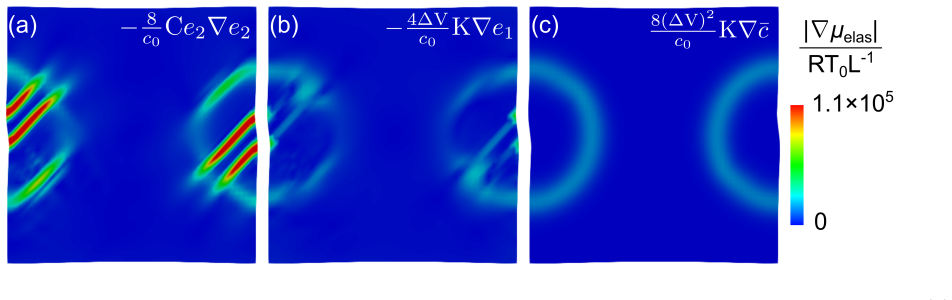
On the paper's own terms, the discovery is that lattice compatibility, not lattice rigidity, controls the energy cost of phase transformation in intercalation compounds. Using a Cauchy-Born stretch tensor $\mathbf{U}$ for each Li-rich variant, the model shows that when the cubic-to-tetragonal transformation satisfies the middle-eigenvalue condition $\lambda_2 = 1$, the cubic/tetragonal interface is exactly compatible and nearly stress-free (about $-0.3$ GPa versus about $\pm 4$ GPa for Li2Mn2O4); this lowers the elastic energy barrier, cuts the maximum driving force across the phase boundary by about 30%, and narrows the voltage hysteresis loop. Volume-preserving deformations ($|\det\mathbf{U} - 1| = 0$) minimize hydrostatic stress, though their phase boundaries still carry significant misfit stress. The paper further argues that twin boundaries formed by energy minimization act as conduits for faster Li diffusion because strain gradients contribute anisotropic driving forces to the chemical potential.
Load-bearing premise
The load-bearing premise is that the free-energy landscape calibrated to Li2Mn2O4, including its thermodynamic and elastic constants, still describes the hypothetical compounds when only the energy-well positions are changed; the paper itself notes in the Discussion that predictions are limited by missing interfacial-energy data and by compounds where atomic shuffling goes beyond a simple lattice stretch, so if that landscape is not transferable the predicted ordering of barriers, driving forces, and hysteresis widths could change.
Editorial extensions
If this is right
- Battery-electrode design space expands from the single zero-strain point ($\alpha = \beta = 1$) to lines and curves of compatible lattice geometries, giving chemists more compositions to work with.
- A $\lambda_2 = 1$ interface is predicted to cut phase-boundary stress from roughly $\pm 4$ GPa to about $-0.3$ GPa and to lower the driving force needed to move the phase boundary by about 30%.
- Voltage hysteresis loops narrow when elastic energy barriers are lowered, meaning less electrochemical energy is dissipated per cycle in compatibly designed compounds.
- Twin boundaries that form during phase transformation can be engineered as fast Li-diffusion pathways, which is relevant for rapid charge and discharge.
- Because microstructures emerge from energy minimization without assumed nucleus shapes, the framework extends to other symmetry-lowering intercalation compounds such as NaMnO2 and Prussian blue analogues.
Reading between the lines
- A direct extension the paper does not pursue: an alloy series that continuously tunes the lattice parameters across the $\lambda_2 = 1$ line should show a voltage-hysteresis minimum at the line; this is testable by measuring open-circuit voltage curves of doped spinels before cycling.
- The model assigns all diffusion anisotropy to strain gradients while keeping mobility isotropic; comparing measured Li diffusivity along and across twin boundaries in Li2Mn2O4 would determine whether the conduit effect is purely chemo-mechanical or has a structural component.
- The same energy-landscape comparison could be repeated with first-principles free energies for the designed compounds to see whether the predicted 30% driving-force reduction survives outside the calibrated polynomial form.
- For materials discovery, the compatibility surfaces are richer targets than the zero-strain point, so a database screen for compounds near these surfaces could yield a wider pool of low-hysteresis cathode compositions.
Editorial analysis
A structured set of objections, weighed in public.
Referee Report
Summary. The paper develops a continuum, chemo-mechanically coupled phase-field model for symmetry-breaking intercalation compounds, built on an Ericksen-type multi-well free energy with Li-composition and lattice-variant strain order parameters. The model is applied to Li2Mn2O4, where it predicts twin-boundary orientations, volume fractions, and phase-boundary geometries consistent with HRTEM experiments. The authors then use the same framework to compare Li2Mn2O4 with two hypothetical lattice geometries, one satisfying the λ2=1 stress-free interface condition and one satisfying the |detU−1|=0 volume-preserving condition, and claim that both types of compatibility reduce elastic energy barriers, lower the driving force for phase transformation, and narrow voltage hysteresis. The paper also reports that twin boundaries act as fast Li-diffusion conduits.
Significance. The model is a valuable contribution to phase-field modeling of intercalation electrodes: it incorporates individual lattice variants, predicts twin fractions and orientations from lattice geometry without a priori microstructure assumptions, and reproduces the measured volume fraction f≈0.2 and twin orientation in Li2Mn2O4 within a few percent. The quantitative comparison of energy barriers, driving forces, and voltage hysteresis across the three lattice geometries is a genuinely new calculation that goes beyond prior sharp-interface analyses. The paper's strongest result is that the λ2=1 interface indeed produces the lowest elastic barrier, smallest driving force, and narrowest hysteresis in the simulations. These are useful, falsifiable predictions. However, the paper's central design claim as stated in the abstract and Discussion is internally contradicted by its own Figs. 11(b), 12(b), and 12(c) for the |detU−1|=0 case, which shows the largest driving force and no narrower hysteresis. This overreach must be corrected before the paper can be recommended for publication.
major comments (4)
- [Abstract; Discussion; Figs. 11(b), 12(b), 12(c)] The central claim that intercalation compounds satisfying λ2=1 or |detU−1|=0 show lower elastic energy barriers, require smaller driving forces, and display narrower voltage hysteresis loops is not supported for the |detU−1|=0 case. In Fig. 11(b) only the λ2=1 interface shows the lowest barrier; the volume-preserving case has a positive-slope elastic barrier comparable to Li2Mn2O4. In Fig. 12(c) the magnitude of the driving force is highest in the volume-preserving case, not lowest. In Fig. 12(b) the volume-preserving case is grouped with Li2Mn2O4 as having relatively wider loops. The abstract and Discussion should therefore restrict the lower-barrier/smaller-driving-force/narrower-hysteresis predicate to λ2=1 and present |detU−1|=0 as a separate design criterion whose demonstrated benefit is the reduced hydrostatic stress shown in Fig. 10(a).
- [Fig. 12(c); Discussion] The '30% lower driving force' claim is specified only as a comparison between the λ2=1 interface and Li2Mn2O4, but the Discussion states that 'these crystallographically designed materials' require driving forces lower by 30%. The volume-preserving case is not 30% lower; it has the highest driving force. The quantitative statement should be assigned specifically to the λ2=1 interface, and the reference case should be stated explicitly (e.g., '30% lower than in Li2Mn2O4').
- [Methods, Eq. (9); Table S5] The energy-barrier and hysteresis comparisons assume that the free-energy landscape of Eq. (9), calibrated to Li2Mn2O4 with Redlich-Kister coefficients from the open-circuit voltage of Ref. [50] and elastic moduli from Ref. [40], remains valid for the hypothetical compounds A and B when only ΔV and β1 are changed (Table S5). This transferability assumption is not discussed or tested. The predicted ordering of energy barriers, driving forces, and hysteresis widths depends on this assumption. The authors should state this limitation explicitly and, if feasible, provide a sensitivity analysis with respect to the elastic and gradient coefficients to show that the qualitative ordering is robust.
- [Crystallographic Designing; Eq. (6); Fig. 8] Part of the paper's claimed prediction is essentially a confirmation of input. The stress-free nature of the λ2=1 interface is prescribed by the analytic compatibility condition Eq. (6); the numerical observation of a nearly stress-free phase boundary in Fig. 8 verifies the numerical implementation but is not an independent prediction. The independent content lies in the quantitative energy-barrier, driving-force, and hysteresis comparisons, which are not pure restatements. The paper should explicitly distinguish model validation from model prediction, for example by presenting the λ2=1 computation as a consistency check and the relative energy-barrier ordering as the novel quantitative result.
minor comments (5)
- [Methods, after Eq. (5)] Typo: 'specfically' should be 'specifically'.
- [Fig. 11 caption] The notation 'Li1−2Mn2O4' appears in the caption of Fig. 11(a) and in the text; it should be 'Li1→2Mn2O4' or 'Li1−2xMn2O4' to denote the intercalation range.
- [Methods, paragraph on coupling Li-diffusion] The sentence 'These factors are not for accounted in the crystallographic theory' contains a typo; 'for accounted' should be 'accounted for'.
- [Energy Barrier Analysis] The term 'energy barrier' is used both for the thermodynamic barrier of Appendix C.4 and for the elastic energy that emerges during phase change. The two meanings should be distinguished explicitly, for instance by calling the latter 'elastic energy barrier' consistently throughout.
- [Footnote 6] The statement that further minimization of the elastic barrier for cubic-to-tetragonal transformations reduces to a rigid lattice constraint should be developed, since it appears to qualify the earlier claim that the compatibility conditions are more general than zero-strain.
Circularity Check
No significant circularity: the model's predictions are computed from externally calibrated inputs and validated against experimental benchmarks, not recovered by construction.
full rationale
The paper's derivation chain is self-contained rather than circular. Lattice stretch tensors are inputs obtained from crystallographic data via a distance-minimization algorithm (Eq. 5), and the free-energy landscape (Eqs. 8-9) is calibrated to the OCV of Li2Mn2O4 (Ref. [50]) and to the elastic constants and equilibrium strains of LiMn2O4. The predicted twin volume fractions and phase-boundary orientations are computed by energy minimization and compared against external HRTEM measurements (Erichsen et al., Ref. [25]); they are not fitted to those measurements. The λ2=1 design result uses the known crystallographic compatibility theorem (Eq. 6) as a design input, and the simulation then confirms the expected stress-free interface; the quantitative barrier, driving-force, and hysteresis outputs are derived from the energy landscape rather than being imposed as inputs. The self-citations to Refs. [39] and [40] supply the stretch-tensor algorithm and prior model details, but the governing equations are stated in the paper and validated against independent experimental data, so these citations are not load-bearing in a circular way. The notable weakness is an internal consistency issue rather than circularity: the abstract and Discussion bundle |detU−1|=0 with the lower-barrier, smaller-driving-force, narrower-hysteresis claims, but the paper's own Fig. 12 shows the volume-preserving case has the highest driving force and relatively wider hysteresis loops. This contradicts the bundled claim but does not reduce the derivation to its inputs. No fitted parameter is renamed as a prediction, and no uniqueness theorem from the authors' prior work is invoked to force the conclusion.
Assumptions & free parameters
free parameters (6)
- mu0 =
-415.6
- alpha1, alpha2, alpha3 =
-597.2, -600.0, -304.2
- beta1 (2D) =
3098.82 (LMO), 9232.82 (stress-free), 3710.70 (volume-preserving) GPa
- deltaV (2D) =
0.07 (LMO), 0.06 (stress-free), 0.03 (volume-preserving)
- lambda, kappa, theta =
7e-14 m^2
- beta0 (3D) =
113.09 GPa
assumptions (5)
- standard math Cauchy-Born rule maps the macroscopic deformation gradient to the lattice deformation (Ericksen 2008).
- domain assumption Li2Mn2O4 and the designed compounds are described as Bravais lattices.
- ad hoc to paper The multi-well energy landscape in Eq. (9) with Redlich-Kister thermodynamics and polynomial elastic terms is an accurate representation of the free energy of the three compared materials.
- domain assumption Mechanical equilibrium is reached instantaneously relative to Li diffusion (Eq. 15).
- domain assumption Li mobility is isotropic (M(c) = D0 c(c0-c)/(RT0 c0) I).
Cite this review
Pith. "Pith review of Lattice Compatibility and Energy Barriers in Intercalation Compounds." pith.science (2026). https://pith.science/paper/R6XPGAUD
@misc{pith2026250522628,
  author       = {Pith},
  title        = {Pith review of: Lattice Compatibility and Energy Barriers in Intercalation Compounds},
  year         = {2026},
  howpublished = {\url{https://pith.science/paper/R6XPGAUD}},
  note         = {Machine review of arXiv:2505.22628}
}
abstract
We present a continuum model for symmetry-breaking phase transformations in intercalation compounds, based on Ericksen's multi-well energy formulation. The model predicts the nucleation and growth of crystallographic microstructures in Li$_{2}$Mn$_{2}$O$_{4}$ -- a representative intercalation compound -- with twin boundary orientations and volume fractions that closely match experimental observations. Our chemo-mechanically coupled model not only generates geometrically accurate microstructures through energy minimization, but also reveals a subtle interplay between twinned domains and electro-chemo-mechanical behavior. A key finding is that intercalation compounds satisfying specific compatibility conditions (e.g., $\lambda_{2} = 1$ or $|\det \mathbf{U} - 1| = 0)$ show lower elastic energy barriers, require smaller driving forces, and display narrower voltage hysteresis loops. Furthermore, we show that twinned domains act as conduits for fast Li-diffusion. These results establish quantitative design guidelines for intercalation compounds, which focuses on tailoring lattice deformations (rather than suppressing them) and reducing energy barriers to mitigate structural degradation and enhance the electrochemical performance of battery electrodes.
Figures


Figures from the paper (10 more)






Reference graph
Works this paper leans on
-
[50]
Thackeray, M. M., David, W. I., Bruce, P. G. & Goodenough, J. B. Lithium insertion into manganese spinels. Materials research bulletin 18, 461–472 (1983)
work page 1983
-
[40]
Zhang, T., Zhang, D. & Balakrishna, A. R. Coupling diffusion and finite deformation in phase trans- formation materials. Journal of the Mechanics and Physics of Solids 183, 105501 (2024)
work page 2024
-
[1]
Whittingham, M. S. Chemistry of intercalation compounds: Metal guests in chalcogenide hosts. Progress in Solid State Chemistry 12, 41–99 (1978)
work page 1978
-
[2]
Rajapakse, M. et al. Intercalation as a versatile tool for fabrication, property tuning, and phase transitions in 2D materials. npj 2D Materials and Applications 5, 30 (2021)
work page 2021
-
[3]
Koerver, R. et al. Capacity fade in solid-state batteries: interphase formation and chemomechanical processes in nickel-rich layered oxide cathodes and lithium thiophosphate solid electrolytes.Chemistry of Materials 29, 5574–5582 (2017)
work page 2017
-
[4]
Van der Ven, A., See, K. A. & Pilon, L. Hysteresis in electrochemical systems. Battery Energy 1, 20210017 (2022)
work page 2022
-
[5]
Santos, D. A. et al. Chemistry–mechanics–geometry coupling in positive electrode materials: a scale- bridging perspective for mitigating degradation in lithium-ion batteries through materials design. Chemical Science 14, 458–484 (2023)
work page 2023
-
[6]
Lewis, J. A., Tippens, J., Cortes, F. J. Q. & McDowell, M. T. Chemo-mechanical challenges in solid- state batteries. Trends in Chemistry 1, 845–857 (2019)
work page 2019
Show all 77 references
-
[7]
Crystallographic design of intercalation materials
Renuka Balakrishna, A. Crystallographic design of intercalation materials. Journal of Electrochemical Energy Conversion and Storage 19, 040802 (2022)
2022
-
[8]
Zhang, R. et al. Compositionally complex doping for zero-strain zero-cobalt layered cathodes. Nature 610, 67–73 (2022)
2022
-
[9]
Schofield, P. et al. Doping-induced pre-transformation to extend solid-solution regimes in li-ion bat- teries. ACS Energy Letters 7, 3286–3292 (2022)
2022
-
[10]
Xiong, P. et al. Strain engineering of two-dimensional multilayered heterostructures for beyond- lithium-based rechargeable batteries. Nature communications 11, 3297 (2020)
2020
-
[11]
Yang, J. et al. Size-independent fast ion intercalation in two-dimensional Titania Nanosheets for alkali-metal-ion batteries. Angewandte Chemie 131, 8832–8837 (2019)
2019
-
[12]
Zhang, D., Sheth, J., Sheldon, B. W. & Balakrishna, A. R. Film strains enhance the reversible cycling of intercalation electrodes. Journal of the Mechanics and Physics of Solids 155, 104551 (2021)
2021
-
[13]
J., Kim, T.-J
Cho, J., Kim, Y. J., Kim, T.-J. & Park, B. Zero-strain intercalation cathode for rechargeable Li-Ion cell. Angewandte Chemie International Edition 40, 3367–3369 (2001)
2001
-
[14]
Wang, L., Liu, T., Wu, T. & Lu, J. Strain-retardant coherent perovskite phase stabilized Ni-rich cathode. Nature 611, 61–67 (2022)
2022
-
[15]
& Yamamoto, N
Ohzuku, T., Ueda, A. & Yamamoto, N. Zero-strain insertion material of Li[Li 1/3Ti5/3]O4 for recharge- able lithium cells. Journal of the Electrochemical Society 142, 1431 (1995)
1995
-
[16]
Bonnick, P. et al. Insights into Mg 2+ intercalation in a zero-strain material: thiospinel Mg xZr2S4. Chemistry of Materials 30, 4683–4693 (2018)
2018
-
[17]
zero-strain
Yang, L. et al. A new sodium calcium cyclotetravanadate framework:“zero-strain” during large- capacity lithium intercalation. Advanced Functional Materials 32, 2105026 (2022)
2022
-
[18]
& Ceder, G
Zhao, X. & Ceder, G. Zero-strain cathode materials for Li-ion batteries. Joule 6, 2683–2685 (2022)
2022
-
[19]
Zhao, X. et al. Design principles for zero-strain Li-ion cathodes. Joule 6, 1654–1671 (2022)
2022
-
[20]
Microstructure of martensite: why it forms and how it gives rise to the shape-memory effect (Oxford University Press, 2003)
Bhattacharya, K. Microstructure of martensite: why it forms and how it gives rise to the shape-memory effect (Oxford University Press, 2003)
2003
-
[21]
Ball, J. M. & James, R. D. Fine phase mixtures as minimizers of energy. Archive for Rational Me- chanics and Analysis 100, 13–52 (1987). 27
1987
-
[22]
& James, R
Chu, C. & James, R. Analysis of microstructures in Cu-14.0%Al-3.9%Ni by energy minimization. J. Phys. IV 5, C8–143 (1995)
1995
-
[23]
& M¨ unch, I
Renuka Balakrishna, A., Huber, J. & M¨ unch, I. Nanoscale periodic domain patterns in tetragonal ferroelectrics: A phase-field study. Physical Review B 93, 174120 (2016)
2016
-
[24]
& James, R
Renuka Balakrishna, A. & James, R. D. Design of soft magnetic materials. npj Computational Mate- rials 8, 4 (2022)
2022
-
[25]
& Volkert, C
Erichsen, T., Pfeiffer, B., Roddatis, V. & Volkert, C. A. Tracking the diffusion-controlled lithiation reaction of LiMn 2O4 by In Situ TEM. ACS Appl. Energy Mater. 3, 5405–5414 (2020)
2020
-
[26]
& James, R
Chen, X., Srivastava, V., Dabade, V. & James, R. D. Study of the cofactor conditions: conditions of supercompatibility between phases. Journal of the Mechanics and Physics of Solids 61, 2566–2587 (2013)
2013
-
[27]
Kn¨ upfer, H., Kohn, R. V. & Otto, F. Nucleation barriers for the cubic-to-tetragonal phase transfor- mation. Communications on pure and applied mathematics 66, 867–904 (2013)
2013
-
[28]
Chluba, C. et al. Ultralow-fatigue shape memory alloy films. Science 348, 1004–1007 (2015)
2015
-
[29]
Zarnetta, R. et al. Identification of quaternary shape memory alloys with near-zero thermal hysteresis and unprecedented functional stability. Advanced Functional Materials 20, 1917–1923 (2010)
2010
-
[30]
Song, Y., Chen, X., Dabade, V., Shield, T. W. & James, R. D. Enhanced reversibility and unusual microstructure of a phase-transforming material. Nature 502, 85–88 (2013)
2013
-
[31]
Wegner, M., Gu, H., James, R. D. & Quandt, E. Correlation between phase compatibility and efficient energy conversion in Zr-doped Barium Titanate. Scientific reports 10, 3496 (2020)
2020
-
[32]
Liang, Y. et al. Tuning the hysteresis of a metal-insulator transition via lattice compatibility. Nature communications 11, 3539 (2020)
2020
-
[33]
Liu, J. et al. Giant reversible magnetocaloric effect in MnNiGe-based materials: minimizing thermal hysteresis via crystallographic compatibility modulation. Acta Materialia 174, 450–458 (2019)
2019
-
[34]
Balakrishna, A. R. Compatible microstructures in magnetic materials. Physical Review Materials 6, 074402 (2022)
2022
-
[35]
& Goodenough, J
Mizushima, K., Jones, P., Wiseman, P. & Goodenough, J. B. Li xCoO2 (0 < x≤ 1): A new cathode material for batteries of high energy density. Solid State Ionics 3, 171–174 (1981)
1981
-
[36]
K., Nanjundaswamy, K
Padhi, A. K., Nanjundaswamy, K. S. & Goodenough, J. B. Phospho-olivines as positive-electrode materials for rechargeable lithium batteries. Journal of the electrochemical society 144, 1188 (1997)
1997
-
[37]
Luo, F. et al. Operando X-ray diffraction analysis of the degradation mechanisms of a spinel LiMn2O4 cathode in different voltage windows. Journal of Energy Chemistry 44, 138–146 (2020)
2020
-
[38]
M., Tsirlin, A
Abakumov, A. M., Tsirlin, A. A., Bakaimi, I., Van Tendeloo, G. & Lappas, A. Multiple twinning as a structure directing mechanism in layered rock-salt-type oxides: NaMnO 2 polymorphism, redox potentials, and magnetism. Chemistry of Materials 26, 3306–3315 (2014)
2014
-
[39]
& Balakrishna, A
Zhang, D. & Balakrishna, A. R. Designing shape-memory-like microstructures in intercalation mate- rials. Acta Materialia 252, 118879 (2023)
2023
-
[41]
Tang, M., Belak, J. F. & Dorr, M. R. Anisotropic phase boundary morphology in nanoscale olivine electrode particles. The Journal of Physical Chemistry C 115, 4922–4926 (2011)
2011
-
[42]
J., Lun, Z
Cl´ ement, R. J., Lun, Z. & Ceder, G. Cation-disordered rocksalt transition metal oxides and oxyfluo- rides for high energy Lithium-ion cathodes. Energy & Environmental Science 13, 345–373 (2020). 28
2020
-
[43]
& Thackeray, M
Choa, J. & Thackeray, M. M. Structural changes of LiMn 2O4 spinel electrodes during electrochemical cycling. Journal of The Electrochemical Society 146, 3577 (1999)
1999
-
[44]
Moriwake, H. et al. First-principles calculations of lithium-ion migration at a coherent grain boundary in a cathode material, LiCoO 2. Advanced Materials 25, 618–622 (2013)
2013
-
[45]
& Manthiram, A
Shin, Y. & Manthiram, A. Factors influencing the capacity fade of spinel lithium manganese oxides. Journal of the Electrochemical Society 151, A204 (2004)
2004
-
[46]
Wang, W. et al. Reversible structural evolution of sodium-rich rhombohedral Prussian blue for sodium- ion batteries. Nature communications 11, 980 (2020)
2020
-
[47]
Zhang, Z. et al. Lithiated Prussian blue analogues as positive electrode active materials for stable non-aqueous lithium-ion batteries. Nature Communications 13, 7790 (2022)
2022
-
[48]
On the cauchy—born rule
Ericksen, J. On the cauchy—born rule. Mathematics and mechanics of solids 13, 199–220 (2008)
2008
-
[49]
D., Alvarado, J., Meng, Y
Radin, M. D., Alvarado, J., Meng, Y. S. & Van der Ven, A. Role of crystal symmetry in the reversibility of stacking-sequence changes in layered intercalation electrodes. Nano letters 17, 7789–7795 (2017)
2017
-
[51]
& Zimmer, J
Bhattacharya, K., Conti, S., Zanzotto, G. & Zimmer, J. Crystal symmetry and the reversibility of martensitic transformations. Nature 428, 55–59 (2004)
2004
-
[52]
Cogswell, D. A. & Bazant, M. Z. Coherency strain and the kinetics of phase separation in LiFePO 4 nanoparticles. ACS nano 6, 2215–2225 (2012)
2012
-
[53]
& Bazant, M
Nadkarni, N., Zhou, T., Fraggedakis, D., Gao, T. & Bazant, M. Z. Modeling the metal–insulator phase transition in Li xCoO2 for energy and information storage. Advanced Functional Materials 29, 1902821 (2019)
2019
-
[54]
Lim, J. et al. Origin and hysteresis of lithium compositional spatiodynamics within battery primary particles. Science 353, 566–571 (2016)
2016
-
[55]
Temprano, I. et al. Advanced methods for characterizing battery interfaces: Towards a comprehensive understanding of interfacial evolution in modern batteries. Energy Storage Materials 73, 103794 (2024)
2024
-
[56]
Puchala, B. et al. CASM—A software package for first-principles based study of multicomponent crystalline solids. Computational Materials Science 217, 111897 (2023)
2023
-
[57]
Bashian, N. H. et al. Correlated polyhedral rotations in the absence of polarons during electrochemical insertion of lithium in ReO3. ACS Energy Letters 3, 2513–2519 (2018)
2018
-
[58]
Lu, J. & Li, Y. Perovskite-type Li-ion solid electrolytes: a review. Journal of Materials Science: Materials in Electronics 32, 9736–9754 (2021)
2021
-
[59]
& Petryk, H
T ˚ uma, K., Stupkiewicz, S. & Petryk, H. Size effects in martensitic microstructures: Finite-strain phase field model versus sharp-interface approach. Journal of the Mechanics and Physics of Solids 95, 284– 307 (2016)
2016
-
[60]
Jetter, J. et al. Tuning crystallographic compatibility to enhance shape memory in ceramics. Physical Review Materials 3, 093603 (2019)
2019
-
[61]
& Renuka Balakrishna, A
Guan, H., Ahani, N., Garc ´ ıa-Cervera, C. & Renuka Balakrishna, A. Hysteresis and energy barriers in soft magnets. Physical Review Materials 9, 044407 (2025)
2025
-
[62]
& Balakrishna, A
Tiwari, D. & Balakrishna, A. R. A Micromechanical Model for Light-interactive Molecular Crystals. arXiv preprint arXiv:2501.14975 (2025)
2025 arXiv
-
[63]
& James, R
Gu, H., Bumke, L., Chluba, C., Quandt, E. & James, R. D. Phase engineering and supercompatibility of shape memory alloys. Materials Today 21, 265–277 (2018). 29
2018
-
[64]
Zhang, Z., James, R. D. & M¨ uller, S. Energy barriers and hysteresis in martensitic phase transforma- tions. Acta Materialia 57, 4332–4352 (2009)
2009
-
[65]
& James, R
Chen, X., Song, Y., Tamura, N. & James, R. D. Determination of the stretch tensor for structural transformations. Journal of the Mechanics and Physics of Solids 93, 34–43 (2016)
2016
-
[66]
Balakrishna, A. R. & James, R. D. A tool to predict coercivity in magnetic materials. Acta Materialia 208, 116697 (2021)
2021
-
[67]
Dubey, K., Devi, P., Singh, A. K. & Singh, S. Improved crystallographic compatibility and magne- tocaloric reversibility in Pt substituted Ni 2Mn1.4In0.6 magnetic shape memory Heusler alloy. Journal of Magnetism and Magnetic Materials 507, 166818 (2020)
2020
-
[68]
& James, R
Srivastava, V., Song, Y., Bhatti, K. & James, R. The direct conversion of heat to electricity using multiferroic alloys. Advanced Energy Materials 1, 97–104 (2011)
2011
-
[69]
Chang, D. et al. Elucidating the origins of phase transformation hysteresis during electrochemical cycling of Li–Sb electrodes. Journal of Materials Chemistry A 3, 18928–18943 (2015)
2015
-
[70]
Kim, D. et al. Enabling sodium batteries using lithium-substituted sodium layered transition metal oxide cathodes. Advanced Energy Materials 1, 333–336 (2011)
2011
-
[71]
Z., Wagemaker, M
Ombrini, P., Bazant, M. Z., Wagemaker, M. & Vasileiadis, A. Thermodynamics of multi-sublattice bat- tery active materials: from an extended regular solution theory to a phase-field model of LiMnyFe1−yPO4. npj Computational Materials 9, 148 (2023)
2023
-
[72]
V., Rejovitzky, E
Di Leo, C. V., Rejovitzky, E. & Anand, L. A Cahn–Hilliard-type phase-field theory for species diffusion coupled with large elastic deformations: application to phase-separating Li-ion electrode materials. Journal of the Mechanics and Physics of Solids 70, 1–29 (2014)
2014
-
[73]
& Krumhansl, J
Barsch, G. & Krumhansl, J. Twin boundaries in ferroelastic media without interface dislocations. Physical Review Letters 53, 1069 (1984)
1984
-
[74]
& Kister, A
Redlich, O. & Kister, A. Algebraic representation of thermodynamic properties and the classification of solutions. Industrial & Engineering Chemistry 40, 345–348 (1948)
1948
-
[75]
Jain, A. et al. Commentary: The Materials Project: A materials genome approach to accelerating materials innovation. APL materials 1 (2013)
2013
-
[76]
& Newman, J
Christensen, J. & Newman, J. A mathematical model of stress generation and fracture in lithium manganese oxide. Journal of The Electrochemical Society 153, A1019 (2006)
2006
-
[77]
& Sastry, A
Zhang, X., Shyy, W. & Sastry, A. M. Numerical simulation of intercalation-induced stress in Li-ion battery electrode particles. Journal of the Electrochemical Society 154, A910 (2007). 30 Appendix A Symbols We summarize all symbols used in our work in Table S1. Symbol Descript...
2007
Reviewed August 7, 2026 · model on record in the stance chip above.
Discussion (0). Sign in to comment.