REVIEW 3 major objections 4 minor 61 references
Training Free Stylized Abstraction
T0 review · 3 major / 4 minor · reviewed 2026-08-07 · deepseek-v4-flash
Pith's one-line read A training-free framework turns a single photo into stylized abstractions—LEGO figures, knitted dolls, or South Park characters—while preserving recognizable identity, and introduces StyleBench, a GPT-based metric designed for abstract…
desk verdict A genuinely new task framing and a plausible training-free pipeline, but the SOTA claim rests on an unvalidated GPT metric and a small single-run experiment. read the letter →
The pith
A machine-rendered reading of the paper's core claim, the machinery that carries it, and where it could break.
The reading
What carries the argument
The central machinery is the cross-domain latent reversal built on rectified flows, paired with inference-time VLLM identity distillation. The VLLM loop converts an input photo into identity-rich text prompts and iteratively self-corrects them using a CLIP similarity threshold or a maximum number of rounds. The rectified-flow inverter treats the already-stylized image as a valid altered-domain starting point, and a time-scheduled controller $\eta_t$ injects structural guidance from a real reference only during a style-dependent temporal window $[\tau_{\text{start}}, \tau_{\text{stop}}]$, so that strong stylization is preserved early and identity geometry is restored selectively. StyleBench supplies the evaluation mechanism: a GPT model scores style adherence, identity preservation, and fusion quality together on a 0–4 scale.
What would settle it
A direct test would be to take a fixed set of generated images, have StyleBench's GPT scorer rate them, and have a large and diverse human panel (for example, 100+ raters over 300+ images) rate the same images with the same 0–4 rubric; if the rank correlation between GPT and human scores is low (for instance Spearman $\rho < 0.5$) on abstract styles such as LEGO and knitted doll, the claim that StyleBench is human-aligned would be falsified.
Extended reading notes
Core claim
The paper's central claim is that semantic identity in stylized abstraction can be carried entirely by distilled text prompts plus a cross-domain latent reversal step, with no parameter updates. From a single photo, a vision-language model generates dense forensic-style descriptions of facial features, clothing, posture, and background; those are compressed into T5 and CLIP prompts and refined through a verifier loop until the generated image resembles the source. The resulting stylized image is then treated not as a degraded photo but as a valid starting point in an altered visual domain: a forward rectified-flow ODE inverts it to a noise latent, and a controlled reverse ODE, guided by a real reference with strength scheduled over a style-dependent time window, reconstructs identity-preserving structure. The authors report that this pipeline, without any training, outperforms fine-tuned and encoder-based baselines on KID, CLIP score, StyleBench, and a human preference study, and that it generalizes to unseen everyday identities across ten abstract styles.
Load-bearing premise
The load-bearing premise is that StyleBench's GPT-assigned scores reflect what humans actually consider good stylized abstraction; the paper validates it on only 25 images rated by 15 annotators and reports no correlation or agreement statistics, so a systematic bias in GPT scoring would invalidate the main quantitative comparison.
Editorial extensions
If this is right
- Stylized abstraction becomes possible for arbitrary individuals without collecting a per-subject training set or fine-tuning the generator.
- The iterative identity-distillation loop can regenerate or re-style a subject from one image, with the paper's own Table 2 showing CLIP similarity rising from 0.66 with a vanilla prompt to 0.86 after three feedback rounds plus a verifier.
- StyleBench offers a protocol for evaluating extreme stylization where pixel-level metrics fail, potentially extending to avatars, merchandise concepting, and animation previsualization.
- Because the method uses only inference-time components, it can be redeployed on new base generators or new style descriptors without retraining, limited only by the underlying model's capabilities.
Reading between the lines
- A natural next test is to measure StyleBench's agreement against a much larger human panel across many styles; if GPT scores and human ranks diverge on extreme abstractions, the state-of-the-art claim would have to lean on other metrics.
- The VLLM feedback loop is essentially structured prompt engineering; one could isolate its contribution by replacing the VLLM with a fixed hand-written attribute template and comparing identity retention.
- Since the authors acknowledge racial and cultural biases in the VLLM descriptions, a demographic audit of identity distillation could reveal whether certain groups' features are systematically distorted or stereotyped in the stylized outputs.
- The style-dependent scheduling parameters are chosen by a VLLM; testing whether fixed, hand-tuned schedules match them would clarify how much of the improvement comes from the controller versus the inversion formulation itself.
Editorial analysis
A structured set of objections, weighed in public.
Referee Report
Summary. The paper proposes a training-free framework for stylized abstraction from a single image. The method first uses a VLLM (InternVL) in a multi-round loop to distill identity-relevant attributes into dense T5 and CLIP prompts, then generates an initial stylized image with Flux, and finally applies a cross-domain rectified flow inversion procedure with style-dependent temporal guidance to restore identity structure while preserving the abstraction style. The paper also introduces StyleBench, a GPT-based evaluation protocol for stylized abstraction, and reports experiments against fine-tuned, encoder-based, and training-free baselines across KID, CLIP score, StyleBench, and a human evaluation on 25 images.
Significance. The task of stylized abstraction for everyday (non-celebrity) identities is timely and underserved, and the proposed pipeline---combining VLLM-based prompt distillation with rectified-flow inversion---is a plausible and novel direction. The paper is honest about its limitations, including a self-identified risk of racial and cultural bias in generated outputs. The authors also release an open-source implementation, which supports reproducibility. If the quantitative evidence were properly validated, the work could serve as a useful benchmark and baseline for the community. However, the main state-of-the-art claim currently rests on an unvalidated GPT-based metric and a very small human study, so the empirical support is not yet convincing.
major comments (3)
- [Section 3.3, Table 1] The central SOTA claim is based on StyleBench and the human evaluation, but StyleBench is not validated as a proxy for human judgment. No correlation or agreement statistics are reported between GPT scores and human ratings, and the human evaluation consists of only 25 images rated by 15 annotators with no inter-annotator reliability reported. Additionally, Section 3.3 mentions optional chain-of-thought reasoning, while Appendix D instructs the model to 'Only return the score. Do not include any justification'; it is unclear which protocol was used. Please report a StyleBench-human correlation (e.g., Spearman or Pearson), a per-style breakdown of StyleBench scores, a detailed description of the human study protocol, and ideally a larger human evaluation. Without these, the headline result in Table 1 cannot be distinguished from a bias of the GPT metric toward the method's outputs.
- [Section 3.2, Eqs. (6) and (7)] The cross-domain latent reversal is the core technical contribution, but its mathematical formulation is not sufficiently specified. In Eq. (6), the term u_t(Y_t | y_1) is described as 'an analytically derived controller via linear quadratic regulation (LQR),' yet no derivation, definition, or citation is provided for this conditional vector field in the rectified flow setting. The roles of y_1 (noise prior) and y_r (real reference) in the forward and reverse ODEs are also unclear. Furthermore, Eq. (8) introduces parameters eta, tau_start, and tau_stop that are said to be 'adaptively chosen using a VLLM-based controller,' but no details are given on how the VLLM maps the style descriptor to these values. The method cannot be reproduced or assessed without explicit definitions, an algorithm pseudocode, and an explanation of the parameter selection mechanism.
- [Section 4, Table 1] The experimental dataset is small and unbalanced: 10 everyday single-subject images versus 30 celebrity images, plus 14 multi-subject images. Table 1 reports single-run numbers with no error bars, confidence intervals, or statistical significance tests. KID estimates on such small sets are known to be noisy, and the CLIP score differences between Ours (0.2272) and the next best method (0.2168) may not be significant without variance information. The claim of strong generalization to unseen identities and styles is not supported by these data. Please provide standard deviations across multiple runs, per-style results, per-subject results, and appropriate significance tests, and consider adding more everyday subjects to balance the evaluation.
minor comments (4)
- [Appendix B] Appendix B cites RB-Modulation as reference [47], but the main text and Table 1 refer to RB-Modulation as [39]; the reference list shows [47] as Wang et al., 'Taming rectified flow for inversion and editing.' Please correct this citation inconsistency.
- [Appendix B] The RF-Inversion baseline setup reads 'RF-Inversion [?]' with a missing citation. Please add the proper reference (presumably [38]).
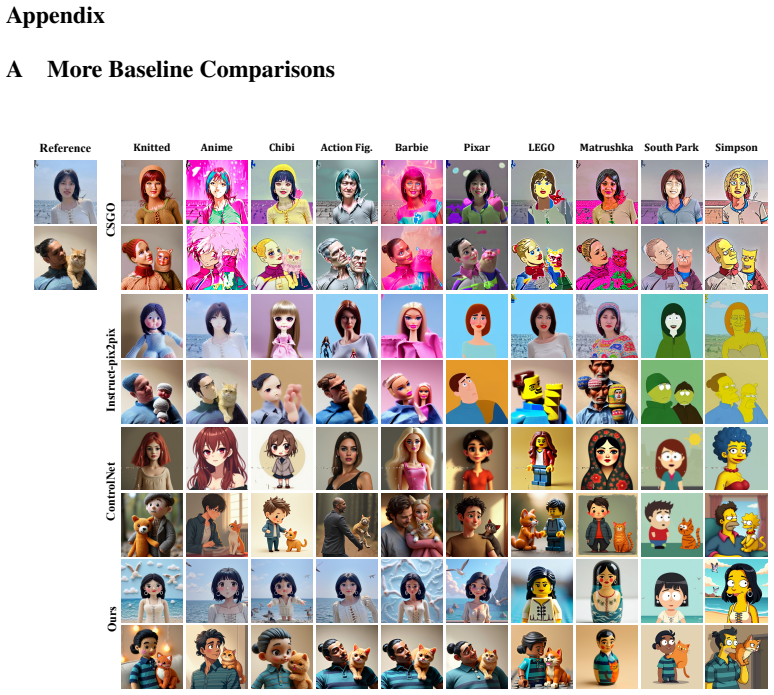
- [Figure 9] Figure 9 includes comparisons with Instruct-pix2pix and ControlNet, but no baseline setup or hyperparameters for these methods are given in Appendix B. Please either add the setup or remove these comparisons.
- [Eq. (4) and general formatting] Equation (4) contains 'stop ⇐ ⇒' which appears to be a formatting error; please rewrite as a proper equivalence. Also, 'Matrushka' is used inconsistently with the more common 'Matryoshka' in Figures 4 and 7.
Circularity Check
No significant circularity: the method is an open training-free pipeline with no fitted parameters or self-citation chains, and the StyleBench validation gap is a benchmark-correctness risk rather than a circular derivation.
full rationale
Pass 1: no load-bearing self-citation. The method builds on external works (RF-Inversion [38], RB-Modulation [39], StyleID [24], DreamBench++ [33]); none of the authors' own prior results are invoked to justify a central design choice, and no uniqueness theorem or ansatz is imported from the authors' own earlier papers. Pass 2: the derivation chain is open-loop. Identity distillation (Eqs. 1-5), iterative refinement (Eqs. 3-4), style-aware prompt transformation (Eq. 5), and cross-domain latent reversal (Eqs. 6-8) are deterministic compositions of pretrained VLLM/Flux components; no parameter is fit to reproduce the method's own outputs, and no downstream evaluation score is used as an input to the generation procedure. Pass 3: the only self-evaluation element is StyleBench (Sec. 3.3). The paper calls it 'human-aligned' but does not report StyleBench-human correlation or inter-annotator agreement, and the human study in Sec. 4 is limited to 25 images and 15 annotators. That is a real empirical validation gap for the state-of-the-art claim, but it is not circular: the metric is not a fitted input, and Table 1 also includes independent human ratings where the proposed method leads (3.8 vs 2.0). A partial overlap exists because the iterative loop stops on CLIP(I, I_hat) (Eq. 4) while Table 1 reports CLIP score, but the evaluation CLIP is computed on final stylized outputs rather than the loop's base images, and no equation equates the two quantities. No specific reduction from a conclusion to its inputs can be exhibited, so the paper is not circular under the stated criteria.
Assumptions & free parameters
free parameters (3)
- gamma
- eta, tau_start, tau_stop =
style-dependent, values not reported
- CLIP convergence threshold tau and iteration budget T
assumptions (4)
- domain assumption The pretrained Flux rectified flow model can invert stylized, non-photorealistic images (Eq. 6) and reconstruct them under reference guidance (Eq. 7).
- domain assumption VLLM-generated forensic descriptions contain all identity-relevant cues and no spurious cues, and prompt compression preserves these cues in T512 and T77.
- domain assumption StyleBench GPT scores are a valid proxy for human judgment of stylized abstraction quality.
- domain assumption CLIP(I, I_hat) is a valid convergence signal for identity preservation (Eq. 4).
Cite this review
Pith. "Pith review of Training Free Stylized Abstraction." pith.science (2026). https://pith.science/paper/IENKSQIX
@misc{pith2026250522663,
  author       = {Pith},
  title        = {Pith review of: Training Free Stylized Abstraction},
  year         = {2026},
  howpublished = {\url{https://pith.science/paper/IENKSQIX}},
  note         = {Machine review of arXiv:2505.22663}
}
read the original abstract
Stylized abstraction synthesizes visually exaggerated yet semantically faithful representations of subjects, balancing recognizability with perceptual distortion. Unlike image-to-image translation, which prioritizes structural fidelity, stylized abstraction demands selective retention of identity cues while embracing stylistic divergence, especially challenging for out-of-distribution individuals. We propose a training-free framework that generates stylized abstractions from a single image using inference-time scaling in vision-language models (VLLMs) to extract identity-relevant features, and a novel cross-domain rectified flow inversion strategy that reconstructs structure based on style-dependent priors. Our method adapts structural restoration dynamically through style-aware temporal scheduling, enabling high-fidelity reconstructions that honor both subject and style. It supports multi-round abstraction-aware generation without fine-tuning. To evaluate this task, we introduce StyleBench, a GPT-based human-aligned metric suited for abstract styles where pixel-level similarity fails. Experiments across diverse abstraction (e.g., LEGO, knitted dolls, South Park) show strong generalization to unseen identities and styles in a fully open-source setup.
Figures


Figures from the paper (6 more)


Reference graph
Works this paper leans on
-
[1]
A neural space-time representation for text-to-image personalization
Yuval Alaluf, Elad Richardson, Gal Metzer, and Daniel Cohen-Or. A neural space-time representation for text-to-image personalization. ACM Transactions on Graphics (TOG) , 42(6):1–10, 2023
work page 2023
-
[2]
Break-a- scene: Extracting multiple concepts from a single image
Omri Avrahami, Kfir Aberman, Ohad Fried, Daniel Cohen-Or, and Dani Lischinski. Break-a- scene: Extracting multiple concepts from a single image. In SIGGRAPH Asia 2023 Conference Papers, pages 1–12, 2023
work page 2023
-
[3]
Style and abstraction in portrait sketching
Itamar Berger, Ariel Shamir, Moshe Mahler, Elizabeth Carter, and Jessica Hodgins. Style and abstraction in portrait sketching. ACM Transactions on Graphics (TOG), 32(4):1–12, 2013
work page 2013
-
[4]
Mikołaj Bi´nkowski, Danica J Sutherland, Michael Arbel, and Arthur Gretton. Demystifying mmd gans. arXiv preprint arXiv:1801.01401, 2018
arXiv 2018
-
[5]
Decoupled textual embeddings for customized image generation
Yufei Cai, Yuxiang Wei, Zhilong Ji, Jinfeng Bai, Hu Han, and Wangmeng Zuo. Decoupled textual embeddings for customized image generation. In Proceedings of the AAAI Conference on Artificial Intelligence, volume 38, pages 909–917, 2024
work page 2024
-
[6]
Artadapter: Text-to-image style transfer using multi-level style encoder and explicit adaptation
Dar-Yen Chen, Hamish Tennent, and Ching-Wen Hsu. Artadapter: Text-to-image style transfer using multi-level style encoder and explicit adaptation. In Proceedings of the IEEE/CVF conference on computer vision and pattern recognition, pages 8619–8628, 2024
work page 2024
-
[7]
Artistic style transfer with internal-external learning and contrastive learning
Haibo Chen, Zhizhong Wang, Huiming Zhang, Zhiwen Zuo, Ailin Li, Wei Xing, Dongming Lu, et al. Artistic style transfer with internal-external learning and contrastive learning. Advances in Neural Information Processing Systems, 34:26561–26573, 2021
work page 2021
-
[8]
Dis- enbooth: Disentangled parameter-efficient tuning for subject-driven text-to-image generation
Hong Chen, Yipeng Zhang, Xin Wang, Xuguang Duan, Yuwei Zhou, and Wenwu Zhu. Dis- enbooth: Disentangled parameter-efficient tuning for subject-driven text-to-image generation. arXiv preprint arXiv:2305.03374, 3(4), 2023
arXiv 2023
Show all 61 references
-
[9]
Subject-driven text-to-image generation via apprenticeship learning
Wenhu Chen, Hexiang Hu, Yandong Li, Nataniel Ruiz, Xuhui Jia, Ming-Wei Chang, and William W Cohen. Subject-driven text-to-image generation via apprenticeship learning. Ad- vances in Neural Information Processing Systems, 36:30286–30305, 2023
2023
-
[10]
Gemini: A family of highly capable multimodal models
Google DeepMind. Gemini: A family of highly capable multimodal models. https://arxiv. org/abs/2312.11805, 2023. Accessed: 2025-05-10
2023 arXiv
-
[11]
Stytr2: Image style transfer with transformers
Yingying Deng, Fan Tang, Weiming Dong, Chongyang Ma, Xingjia Pan, Lei Wang, and Changsheng Xu. Stytr2: Image style transfer with transformers. InProceedings of the IEEE/CVF conference on computer vision and pattern recognition, pages 11326–11336, 2022
2022
-
[12]
Dreamartist: Towards controllable one-shot text- to-image generation via positive-negative prompt-tuning
Ziyi Dong, Pengxu Wei, and Liang Lin. Dreamartist: Towards controllable one-shot text- to-image generation via positive-negative prompt-tuning. arXiv preprint arXiv:2211.11337, 2022
2022 arXiv
-
[13]
An image is worth one word: Personalizing text-to-image generation using textual inversion
Rinon Gal, Yuval Alaluf, Yuval Atzmon, Or Patashnik, Amit H Bermano, Gal Chechik, and Daniel Cohen-Or. An image is worth one word: Personalizing text-to-image generation using textual inversion. arXiv preprint arXiv:2208.01618, 2022
2022 arXiv
-
[14]
A neural algorithm of artistic style
Leon A Gatys, Alexander S Ecker, and Matthias Bethge. A neural algorithm of artistic style. arXiv preprint arXiv:1508.06576, 2015
2015 arXiv
-
[15]
Highly personalized text embedding for image manipulation by stable diffusion
Inhwa Han, Serin Yang, Taesung Kwon, and Jong Chul Ye. Highly personalized text embedding for image manipulation by stable diffusion. arXiv preprint arXiv:2303.08767, 2023
2023 arXiv
-
[16]
Svdiff: Compact parameter space for diffusion fine-tuning
Ligong Han, Yinxiao Li, Han Zhang, Peyman Milanfar, Dimitris Metaxas, and Feng Yang. Svdiff: Compact parameter space for diffusion fine-tuning. In Proceedings of the IEEE/CVF International Conference on Computer Vision, pages 7323–7334, 2023
2023
-
[17]
A data perspective on enhanced identity preservation for diffusion personalization
Xingzhe He, Zhiwen Cao, Nicholas Kolkin, Lantao Yu, Kun Wan, Helge Rhodin, and Ratheesh Kalarot. A data perspective on enhanced identity preservation for diffusion personalization. In 2025 IEEE/CVF Winter Conference on Applications of Computer Vision (WACV) , pages 3782–3791. ...
2025
-
[18]
Instruct-imagen: Image generation with multi-modal instruction
Hexiang Hu, Kelvin CK Chan, Yu-Chuan Su, Wenhu Chen, Yandong Li, Kihyuk Sohn, Yang Zhao, Xue Ben, Boqing Gong, William Cohen, et al. Instruct-imagen: Image generation with multi-modal instruction. In Proceedings of the IEEE/CVF conference on computer vision and pattern recogni...
2024
-
[19]
Dreamtuner: Single image is enough for subject-driven generation
Miao Hua, Jiawei Liu, Fei Ding, Wei Liu, Jie Wu, and Qian He. Dreamtuner: Single image is enough for subject-driven generation. arXiv preprint arXiv:2312.13691, 2023
2023 arXiv
-
[20]
Diffartist: Towards structure and appearance controllable image stylization, 2024
Ruixiang Jiang and Changwen Chen. Diffartist: Towards structure and appearance controllable image stylization, 2024
2024
-
[21]
Neu- ral style transfer: A review
Yongcheng Jing, Yezhou Yang, Zunlei Feng, Jingwen Ye, Yizhou Yu, and Mingli Song. Neu- ral style transfer: A review. IEEE transactions on visualization and computer graphics , 26(11):3365–3385, 2019
2019
-
[22]
Multi- concept customization of text-to-image diffusion
Nupur Kumari, Bingliang Zhang, Richard Zhang, Eli Shechtman, and Jun-Yan Zhu. Multi- concept customization of text-to-image diffusion. In Proceedings of the IEEE/CVF conference on computer vision and pattern recognition, pages 1931–1941, 2023
1931
-
[23]
Black Forest Labs. Flux. https://github.com/black-forest-labs/flux , 2024
2024
-
[24]
Styleid: Identity disentanglement for anonymizing faces
Minh-Ha Le and Niklas Carlsson. Styleid: Identity disentanglement for anonymizing faces. arXiv preprint arXiv:2212.13791, 2022
2022 arXiv
-
[25]
Blip-diffusion: Pre-trained subject representation for controllable text-to-image generation and editing
Dongxu Li, Junnan Li, and Steven Hoi. Blip-diffusion: Pre-trained subject representation for controllable text-to-image generation and editing. Advances in Neural Information Processing Systems, 36:30146–30166, 2023
2023
-
[26]
Text-to-image generation for abstract concepts
Jiayi Liao, Xu Chen, Qiang Fu, Lun Du, Xiangnan He, Xiang Wang, Shi Han, and Dongmei Zhang. Text-to-image generation for abstract concepts. In Proceedings of the AAAI Conference on Artificial Intelligence, volume 38, pages 3360–3368, 2024
2024
-
[27]
Llm4gen: Leveraging semantic representation of llms for text-to-image generation
Mushui Liu, Yuhang Ma, Zhen Yang, Jun Dan, Yunlong Yu, Zeng Zhao, Zhipeng Hu, Bai Liu, and Changjie Fan. Llm4gen: Leveraging semantic representation of llms for text-to-image generation. In Proceedings of the AAAI Conference on Artificial Intelligence, volume 39, pages 5523–5531, 2025
2025
-
[28]
Name your style: text-guided artistic style transfer
Zhi-Song Liu, Li-Wen Wang, Wan-Chi Siu, and Vicky Kalogeiton. Name your style: text-guided artistic style transfer. In Proceedings of the IEEE/CVF Conference on Computer Vision and Pattern Recognition, pages 3530–3534, 2023
2023
-
[29]
Cones: Concept neurons in diffusion models for customized generation
Zhiheng Liu, Ruili Feng, Kai Zhu, Yifei Zhang, Kecheng Zheng, Yu Liu, Deli Zhao, Jingren Zhou, and Yang Cao. Cones: Concept neurons in diffusion models for customized generation. arXiv preprint arXiv:2303.05125, 2023
2023 arXiv
-
[30]
Subject-driven text-to-image generation via preference-based reinforcement learning
Yanting Miao, William Loh, Suraj Kothawade, Pascal Poupart, Abdullah Rashwan, and Yeqing Li. Subject-driven text-to-image generation via preference-based reinforcement learning. Ad- vances in Neural Information Processing Systems, 37:123563–123591, 2024
2024
-
[31]
Freecontrol: Training-free spatial control of any text-to-image diffusion model with any condition
Sicheng Mo, Fangzhou Mu, Kuan Heng Lin, Yanli Liu, Bochen Guan, Yin Li, and Bolei Zhou. Freecontrol: Training-free spatial control of any text-to-image diffusion model with any condition. In Proceedings of the IEEE/CVF Conference on Computer Vision and Pattern Recognition, pag...
2024
-
[32]
Gpt-4o system card
OpenAI. Gpt-4o system card. https://arxiv.org/abs/2410.21276, 2024. Accessed: 2025-05-10
2024 arXiv
-
[33]
Dreambench++: A human-aligned benchmark for personalized image generation
Yuang Peng, Yuxin Cui, Haomiao Tang, Zekun Qi, Runpei Dong, Jing Bai, Chunrui Han, Zheng Ge, Xiangyu Zhang, and Shu-Tao Xia. Dreambench++: A human-aligned benchmark for personalized image generation. arXiv preprint arXiv:2406.16855, 2024
2024 arXiv
-
[34]
Layoutllm-t2i: Eliciting layout guidance from llm for text-to-image generation
Leigang Qu, Shengqiong Wu, Hao Fei, Liqiang Nie, and Tat-Seng Chua. Layoutllm-t2i: Eliciting layout guidance from llm for text-to-image generation. In Proceedings of the 31st ACM International Conference on Multimedia, pages 643–654, 2023. 11
2023
-
[35]
Learning transferable visual models from natural language supervision
Alec Radford, Jong Wook Kim, Chris Hallacy, Aditya Ramesh, Gabriel Goh, Sandhini Agarwal, Girish Sastry, Amanda Askell, Pamela Mishkin, Jack Clark, et al. Learning transferable visual models from natural language supervision. In International conference on machine learning, pa...
2021
-
[36]
Exploring the limits of transfer learning with a unified text-to-text transformer
Colin Raffel, Noam Shazeer, Adam Roberts, Katherine Lee, Sharan Narang, Michael Matena, Yanqi Zhou, Wei Li, and Peter J Liu. Exploring the limits of transfer learning with a unified text-to-text transformer. Journal of machine learning research, 21(140):1–67, 2020
2020
-
[37]
Dreambooth3d: Subject- driven text-to-3d generation
Amit Raj, Srinivas Kaza, Ben Poole, Michael Niemeyer, Nataniel Ruiz, Ben Mildenhall, Shiran Zada, Kfir Aberman, Michael Rubinstein, Jonathan Barron, et al. Dreambooth3d: Subject- driven text-to-3d generation. In Proceedings of the IEEE/CVF international conference on computer ...
2023
-
[38]
Semantic image inversion and editing using rectified stochastic differential equations
L Rout, Y Chen, N Ruiz, C Caramanis, S Shakkottai, and W Chu. Semantic image inversion and editing using rectified stochastic differential equations. In The Thirteenth International Conference on Learning Representations, 2025
2025
-
[39]
Rb-modulation: Training-free stylization using reference-based modulation
L Rout, Y Chen, N Ruiz, A Kumar, C Caramanis, S Shakkottai, and W Chu. Rb-modulation: Training-free stylization using reference-based modulation. In The Thirteenth International Conference on Learning Representations, 2025
2025
-
[40]
Dreambooth: Fine tuning text-to-image diffusion models for subject-driven generation
Nataniel Ruiz, Yuanzhen Li, Varun Jampani, Yael Pritch, Michael Rubinstein, and Kfir Aberman. Dreambooth: Fine tuning text-to-image diffusion models for subject-driven generation. In Proceedings of the IEEE/CVF conference on computer vision and pattern recognition, pages 22500...
2023
-
[41]
Low-rank adaptation for fast text-to-image diffusion fine-tuning
Simo Ryu. Low-rank adaptation for fast text-to-image diffusion fine-tuning. Low-rank adapta- tion for fast text-to-image diffusion fine-tuning, 3, 2023
2023
-
[42]
Styledrop: Text-to-image synthesis of any style
Kihyuk Sohn, Lu Jiang, Jarred Barber, Kimin Lee, Nataniel Ruiz, Dilip Krishnan, Huiwen Chang, Yuanzhen Li, Irfan Essa, Michael Rubinstein, et al. Styledrop: Text-to-image synthesis of any style. Advances in Neural Information Processing Systems, 36:66860–66889, 2023
2023
-
[43]
Autoregressive model beats diffusion: Llama for scalable image generation
Peize Sun, Yi Jiang, Shoufa Chen, Shilong Zhang, Bingyue Peng, Ping Luo, and Zehuan Yuan. Autoregressive model beats diffusion: Llama for scalable image generation. arXiv preprint arXiv:2406.06525, 2024
2024 arXiv
-
[44]
Principle-driven self-alignment of language models from scratch with minimal human supervision
Zhiqing Sun, Yikang Shen, Qinhong Zhou, Hongxin Zhang, Zhenfang Chen, David Cox, Yiming Yang, and Chuang Gan. Principle-driven self-alignment of language models from scratch with minimal human supervision. Advances in Neural Information Processing Systems, 36:2511–2565, 2023
2023
-
[45]
p+: Extended textual conditioning in text-to-image generation
Andrey V oynov, Qinghao Chu, Daniel Cohen-Or, and Kfir Aberman. p+: Extended textual conditioning in text-to-image generation. arXiv preprint arXiv:2303.09522, 2023
2023 arXiv
-
[46]
Instantstyle- plus: Style transfer with content-preserving in text-to-image generation
Haofan Wang, Peng Xing, Renyuan Huang, Hao Ai, Qixun Wang, and Xu Bai. Instantstyle- plus: Style transfer with content-preserving in text-to-image generation. arXiv preprint arXiv:2407.00788, 2024
2024 arXiv
-
[47]
Taming rectified flow for inversion and editing
Jiangshan Wang, Junfu Pu, Zhongang Qi, Jiayi Guo, Yue Ma, Nisha Huang, Yuxin Chen, Xiu Li, and Ying Shan. Taming rectified flow for inversion and editing. arXiv preprint arXiv:2411.04746, 2024
2024 arXiv
-
[48]
Instantid: Zero-shot identity-preserving generation in seconds.arXiv preprint arXiv:2401.07519, 2024
Qixun Wang, Xu Bai, Haofan Wang, Zekui Qin, Anthony Chen, Huaxia Li, Xu Tang, and Yao Hu. Instantid: Zero-shot identity-preserving generation in seconds.arXiv preprint arXiv:2401.07519, 2024
2024 arXiv
-
[49]
Genartist: Multimodal llm as an agent for unified image generation and editing
Zhenyu Wang, Aoxue Li, Zhenguo Li, and Xihui Liu. Genartist: Multimodal llm as an agent for unified image generation and editing. Advances in Neural Information Processing Systems, 37:128374–128395, 2024. 12
2024
-
[50]
Stylediffusion: Controllable disentangled style transfer via diffusion models
Zhizhong Wang, Lei Zhao, and Wei Xing. Stylediffusion: Controllable disentangled style transfer via diffusion models. In Proceedings of the IEEE/CVF International Conference on Computer Vision, pages 7677–7689, 2023
2023
-
[51]
Next-gpt: Any-to-any multimodal llm
Shengqiong Wu, Hao Fei, Leigang Qu, Wei Ji, and Tat-Seng Chua. Next-gpt: Any-to-any multimodal llm. In Forty-first International Conference on Machine Learning, 2024
2024
-
[52]
Self-correcting llm-controlled diffusion models
Tsung-Han Wu, Long Lian, Joseph E Gonzalez, Boyi Li, and Trevor Darrell. Self-correcting llm-controlled diffusion models. In Proceedings of the IEEE/CVF Conference on Computer Vision and Pattern Recognition, pages 6327–6336, 2024
2024
-
[53]
Grok 3 beta — the age of reasoning agents
xAI. Grok 3 beta — the age of reasoning agents. https://x.ai/news/grok-3, 2025. Accessed: 2025-05-10
2025
-
[54]
Csgo: Content-style composition in text-to-image generation
Peng Xing, Haofan Wang, Yanpeng Sun, Qixun Wang, Xu Bai, Hao Ai, Renyuan Huang, and Zechao Li. Csgo: Content-style composition in text-to-image generation. arXiv preprint arXiv:2408.16766, 2024
2024 arXiv
-
[55]
Ip-adapter: Text compatible image prompt adapter for text-to-image diffusion models
Hu Ye, Jun Zhang, Sibo Liu, Xiao Han, and Wei Yang. Ip-adapter: Text compatible image prompt adapter for text-to-image diffusion models. arXiv preprint arXiv:2308.06721, 2023
2023 arXiv
-
[56]
Dino: Detr with improved denoising anchor boxes for end-to-end object detection
Hao Zhang, Feng Li, Shilong Liu, Lei Zhang, Hang Su, Jun Zhu, Lionel M Ni, and Heung- Yeung Shum. Dino: Detr with improved denoising anchor boxes for end-to-end object detection. arXiv preprint arXiv:2203.03605, 2022
2022 arXiv
-
[57]
Adding conditional control to text-to-image diffusion models
Lvmin Zhang, Anyi Rao, and Maneesh Agrawala. Adding conditional control to text-to-image diffusion models. In Proceedings of the IEEE/CVF international conference on computer vision, pages 3836–3847, 2023
2023
-
[58]
Ssr-encoder: Encoding selective subject representation for subject- driven generation
Yuxuan Zhang, Yiren Song, Jiaming Liu, Rui Wang, Jinpeng Yu, Hao Tang, Huaxia Li, Xu Tang, Yao Hu, Han Pan, et al. Ssr-encoder: Encoding selective subject representation for subject- driven generation. In Proceedings of the IEEE/CVF Conference on Computer Vision and Pattern Re...
2024
-
[59]
Uni-controlnet: All-in-one control to text-to-image diffusion models
Shihao Zhao, Dongdong Chen, Yen-Chun Chen, Jianmin Bao, Shaozhe Hao, Lu Yuan, and Kwan-Yee K Wong. Uni-controlnet: All-in-one control to text-to-image diffusion models. Advances in Neural Information Processing Systems, 36:11127–11150, 2023
2023
-
[60]
Internvl3: Exploring advanced training and test-time recipes for open-source multimodal models
Jinguo Zhu, Weiyun Wang, Zhe Chen, Zhaoyang Liu, Shenglong Ye, Lixin Gu, Yuchen Duan, Hao Tian, Weijie Su, Jie Shao, et al. Internvl3: Exploring advanced training and test-time recipes for open-source multimodal models. arXiv preprint arXiv:2504.10479, 2025
2025 arXiv
-
[61]
a portrait of a [man/woman] in [style] style
Jun-Yan Zhu, Taesung Park, Phillip Isola, and Alexei A Efros. Unpaired image-to-image translation using cycle-consistent adversarial networks. InProceedings of the IEEE international conference on computer vision, pages 2223–2232, 2017. 13 Appendix A More Baseline Comparisons ...
2017
Reviewed August 7, 2026 · model on record in the stance chip above.
Discussion (0). Sign in to comment.