REVIEW 4 major objections 5 minor 62 references
LLM-ODDR: A Large Language Model Framework for Joint Order Dispatching and Driver Repositioning
T0 review · 4 major / 5 minor · reviewed 2026-08-07 · deepseek-v4-flash
Pith's one-line read The paper claims that a fine-tuned LLM can jointly dispatch orders and reposition drivers, beating eight baselines in a Manhattan taxi simulator.
desk verdict The LLM-ODDR framework is a novel and clearly described idea, but the evaluation is compromised by fine-tuning on the comparison methods and a missing train/eval split, so the headline results don't currently stand up. read the letter →
The pith
A machine-rendered reading of the paper's core claim, the machinery that carries it, and where it could break.
The reading
What carries the argument
The load-bearing machinery is a three-stage prompt-driven pipeline executed at each one-minute simulator step, with four prompts—Pscorer, Previewer, Pdispatcher, and Prepo—that are referenced but not printed. The scorer assigns each order an overall value by weighing immediate reward, waiting time, and the destination area's future value $f^{(t)}_n$ (historical net order density over 60 minutes); the reviewer checks the whole valuation list and returns feedback for up to three iterations; the dispatcher sorts orders by refined value and asks the LLM to pick a driver from nearby idle candidates using driver attributes including historical earnings; the repositioner asks the LLM to choose among two-neighborhood regions based on 15-minute historical demand, historical matches, and projected future vehicle arrivals from the current dispatch decisions. JointDR-GPT is the same pipeline with the base model replaced by Llama 3.1-70B fine-tuned with LoRA on mixed dispatch and repositioning instruction data. The coupling between dispatcher and repositioner—dispatch outcomes predict arrivals, and repositioning updates area value—is what makes the optimization joint.
What would settle it
Re-run the Small-100 experiment using the released code while paraphrasing only the wording of Pscorer, Previewer, Pdispatcher, and Prepo, keeping every objective and number identical; if GMV or ORR swings by more than the reported advantage over GRC, the result is prompt-wording-sensitive rather than evidence of multi-objective reasoning. A second check: replace the LLM scorer with a direct computation of the same objective (immediate reward plus future value) and the LLM dispatcher with KM; if that reproduces JointDR-GPT's numbers, the LLM is not carrying the gain.
Extended reading notes
Core claim
On the paper's own terms, the central discovery is that an LLM-based decision pipeline can solve the joint order dispatch and driver repositioning problem better than combinatorial, rule-based, reinforcement-learning, and generalist-LLM baselines in simulation. The authors report that JointDR-GPT, a LoRA fine-tuned Llama 3.1-70B, achieves the highest GMV and ORR on all three Manhattan datasets (Small-100, Small-200, and Large-500), with ablation studies showing that each of the three modules contributes to the gain. They also report higher driver income fairness measured by income dispersion, and successful adaptation to synthetic surge demand events, while acknowledging 1-5 seconds of inference latency per decision cycle versus sub-second responses from conventional methods.
Load-bearing premise
The load-bearing premise is that the four hand-written prompts convert textual order and driver features into stable, sensible numerical scores and choices, so that greedily executing the LLM's selections inside the simulator is actually better than the baselines; if the prompts are unstable, arbitrary, or tuned to the evaluation data, the reported gains would not transfer.
Editorial extensions
If this is right
- Ride-hailing platforms can use a prompted LLM as the core of joint dispatch and repositioning and obtain higher GMV and ORR than the KM, TVal, cA2C, GRC, and general-purpose LLM baselines in the Manhattan simulator.
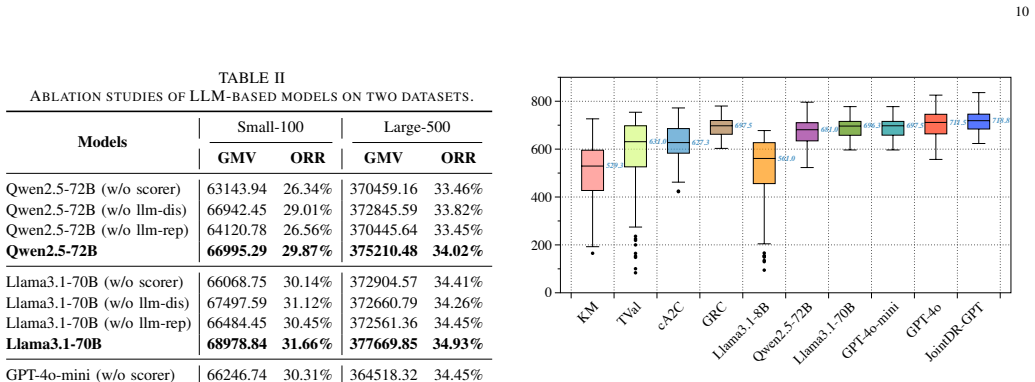
- Each of the three modules carries part of the gain: ablations show performance drops when the value scorer, the LLM dispatcher, or the LLM repositioner is removed.
- A fine-tuned specialist model can outperform larger generalist models, so the approach does not require the largest available LLM at decision time.
- The framework adapts to synthetic surge demand events without retraining, which the paper argues is a practical advantage over traditional methods.
- The acknowledged 1-5 second per-decision latency is a deployment obstacle, and the paper's proposed parallel decomposition and model distillation are the intended mitigation paths.
Reading between the lines
- Inference: If the prompt-based scoring is genuinely what carries the gains, the same three-part design could be adapted to other matching-and-repositioning problems with scarce supply, such as food delivery, courier routing, or emergency vehicle placement, where the objectives are similarly multidimensional.
- Inference: A decisive check the paper leaves implicit is prompt sensitivity: releasing the four prompts and running paraphrase or ablation variants would separate the contribution of LLM reasoning from the contribution of the prompting and fine-tuning setup.
- Inference: The reported latency reduction via parallel decomposition and distillation suggests a production path in which a small distilled model runs the same prompts at scale, but the paper does not report end-to-end throughput or cost per decision, so that path is not yet demonstrated.
Editorial analysis
A structured set of objections, weighed in public.
Referee Report
Summary. The paper proposes LLM-ODDR, a framework that uses large language models for joint order dispatching and driver repositioning in ride-hailing. It consists of three modules: (1) multi-objective-guided order value refinement, in which an LLM scorer and reviewer iteratively assign an overall value to each order; (2) fairness-aware order dispatching, in which an LLM selects a driver for each order while considering historical income; and (3) spatiotemporal demand-aware driver repositioning, in which an LLM chooses a target region using historical demand, historical matches, and predicted future vehicle arrivals. The authors also fine-tune Llama3.1-70B with LoRA on outputs generated by GPT-4, cA2C, and TVal, calling the result JointDR-GPT. Experiments use a Manhattan taxi simulator over July 27-31, 2015, and claim that JointDR-GPT outperforms all eight baselines on GMV and order response rate, with additional ablation, fairness, and surge-event case studies. The paper releases code and states that this is the first LLM-as-decision-agent work for ODDR.
Significance. If the central performance claim holds, the paper would be a useful early demonstration that LLM-driven dispatch and repositioning can compete with learned and combinatorial baselines, while offering interpretable decisions and apparent adaptability to demand surges. The paper's strengths are that it uses a public real-world dataset, a publicly documented simulator from prior work, and it provides a code repository and a pre-trained model release. For that reason, the contribution is potentially valuable to the intelligent-transportation and LLM-agent communities. However, the significance is conditional on resolving several load-bearing threats: the fine-tuning data may overlap the evaluation period, the prompts that define the mechanism are not shown, and the experimental results are single runs with no error bars or significance tests. These issues currently prevent the reader from verifying that the reported margins are due to the proposed modules rather than to evaluation leakage or random variation.
major comments (4)
- [Section IV-E and Section V-B] JointDR-GPT is fine-tuned on order dispatching and repositioning results generated by GPT-4, cA2C, and TVal (Section IV-E), and is then evaluated against those same methods on the same Manhattan simulator and the same July 27-31, 2015 period (Section V-A, Table I). The paper does not report (i) which simulation periods produced the fine-tuning labels, (ii) how cA2C/TVal actions were converted into instruction-output pairs, or (iii) whether any evaluation order or trajectory was excluded from fine-tuning. If the labels came from the same five-day evaluation window, JointDR-GPT has been trained on the behavior of the comparison methods on the test distribution, and the reported margins over GPT-4o (about 1.1% GMV on Small-100 and 0.42% on Small-200) could reflect imitation or exploitation of training labels rather than the proposed order-value refinement, fairness-aware dispatching, or demand-aware repositioning. This is a load-bearing threat to the headline claim. The authors must provide a clean and detailed description of the training/evaluation split, demonstrate that no evaluation data were used in fine-tuning, and ideally re-evaluate on a period not used for label generation.
- [Section IV-B through IV-D] The framework's behavior is determined by four hand-written prompt templates—Pscorer, Previewer, Pdispatcher, and Prepo—which are referenced in Equations (12)-(14), (16), and (21) but never shown. Because the prompts define how textual order/driver features are converted into numerical order values, driver selections, and repositioning choices, omitting them makes the method non-reproducible and prevents an independent audit of the mechanism. This is especially important because the order value scorer and reviewer are both LLMs with no external ground truth for 'order overall value'; the ablation improvements in Table II could be an artifact of prompt-induced scoring rather than a meaningful multi-objective evaluation. Please include the full prompts in an appendix or supplement, and provide evidence that the LLM-generated order values correlate with realized outcomes (e.g., future order value or a counterfactual simulation with fixed downstream policies).
- [Section V-A and Table I] All reported results are single runs with no error bars, confidence intervals, or significance tests. Several margins are small: on Small-200 the overall GMV is 122,074.05 for JointDR-GPT versus 121,564.51 for GPT-4o (0.42%), and on Large-500 the margin over GPT-4o is 10,827.86 (2.84%). Without repeated seeds or a statistical test, the abstract's claim of 'significantly outperforms' and the Section V-B claim that JointDR-GPT 'outperforms all eight baseline models' are not supported. Report the mean and standard deviation over multiple simulation runs or random seeds, and perform a paired significance test against each baseline on the same test intervals.
- [Section V-B] The percentage improvements reported for Small-100 are inconsistent with Table I. The text states improvements of 5.21%, 12.52%, 23.27%, and 38.47% compared to GRC, cA2C, TVal, and KM, respectively, but the GMV values in Table I give (70,597.90 - 68,056.65)/68,056.65 = 3.74% for GRC, not 5.21%. The remaining three percentages match cA2C, TVal, and KM. Please correct the text and verify all derived numbers against the table.
minor comments (5)
- [Section III] In the driver attribute definition, xv_j is written as {clj, tlj, sj, wtj, tti, τmax_idle_j, foj, crj}, but 'tti' is an order trip-time attribute and appears out of place; it should likely be 'wt_j' or another driver-specific wait-time variable. Please clarify.
- [Section V-B] The text refers to the 'morning peak period (7:00–9:00)', while Table I reports Morning as 7:00-10:00. These should be made consistent.
- [Section IV-D, Equation (20)] The weighting function f(tti) is introduced as 'a time-based weighting function' but its explicit form is never defined. Since Equation (20) is a key component of the repositioning module, please specify the function or cite the exact source.
- [Section V-C] The ablation paragraph contains a repeated sentence: 'we also observe that w/o llm-dis performs worse' appears twice, and the second occurrence seems intended for 'w/o llm-rep'. Please fix the duplication and make the description of each ablation variant precise.
- [Section V-E] The synthetic surge-event dataset is described only qualitatively ('generated simulation data at two key time points (10:00 and 18:00) across two distinct locations'). Provide the full generation procedure, including the number of added orders, their spatial distribution, and the vehicle fleet configuration, so that the case study is reproducible.
Circularity Check
JointDR-GPT is fine-tuned on outputs of the exact cA2C/TVal baselines it then claims to beat, and the LLM's own 'overall order value' score drives the GMV it is used to validate.
-
fitted input called prediction
[Section IV-E (Hybrid Instruction Fine-Tuning); compared in Section V-B (Overall Performance) and Table I]
"To develop a more accurate model, we utilize order dispatching and driver repositioning results (generated by GPT-4, cA2C, and TVal) to fine-tune the open-source LLM Llama3-70B via the Low-Rank Adaptation (LoRA) strategy [35], resulting in enhanced performance, named JointDR-GPT. ... As demonstrated by the experimental results, the proposed JointDR-GPT outperforms all eight baseline models across the three datasets."
JointDR-GPT is trained on decision outputs produced by cA2C and TVal, both of which are listed as baselines in Section V-A.3 and appear in Table I. The paper reports that the simulator ran over July 27-31, 2015, but it never states which trajectories generated the fine-tuning labels, whether cA2C/TVal actions were converted into instruction-output pairs, or whether any evaluation period was excluded from training. Consequently, the reported superiority over cA2C and TVal is not an independent comparison: the model has been fitted to the behavior of those exact baselines in the same simulation setting, so those margins can partly reflect imitation or exploitation of training labels rather than the proposed order-value refinement, fairness-aware dispatching, or demand-aware repositioning.
-
self definitional
[Section IV-B, Eq. (10)-(12); Section IV-C, Algorithm 3; Section V-A.4 metrics]
"o1 represents the constraint that orders with shorter waiting time and higher immediate rewards should receive higher overall value to maximize immediate platform revenue and order completion rate. ... The order value scorer then computes an overall value vi ... vi = LLM(Pscorer, ...). ... for each order ri sorted by v′i in descending order do ... j∗ ← LLM(Pdispatcher, ...)."
The 'overall order value' that drives dispatching is the LLM scorer's own output, defined under constraints that reward higher immediate rewards and future-area value; Algorithm 3 then dispatches orders in descending order of this score. The GMV metric is the total value of orders fulfilled in the simulator, so the evaluation re-reads the LLM's constructed score as an externally validated outcome. With no held-out ground truth for 'order overall value' independent of the LLM's judgment, the claimed GMV validation is partly self-definitional: high-reward orders are labeled high-value by the scoring prompt, picked first, and then counted as the GMV improvement.
full rationale
The most direct circularity is the train/evaluation overlap: Section IV-E says JointDR-GPT was fine-tuned on order dispatching and repositioning results generated by GPT-4, cA2C, and TVal, and Section V-B compares the same model against cA2C and TVal on the same Manhattan simulator period (July 27-31, 2015, per Section V-A.1), with no reported data split or label-construction details. That makes the head-to-head margins over cA2C/TVal at least partly forced, though not wholly vacuous because JointDR-GPT also beats methods not used in fine-tuning (e.g., GRC and GPT-4o). A second, weaker loop is that the 'overall order value' is an LLM-generated score that is then used to rank orders, while GMV is the aggregate value of fulfilled orders; the reported GMV therefore partly reflects the scorer's own definition rather than an external ground truth. The authors' own simulator [60] is a self-citation, but I do not count it as circular because it is an external dynamical environment whose outcomes are not analytically fixed by the paper's scoring equations. The four prompts (Pscorer, Previewer, Pdispatcher, Prepo) are never shown, which is an auditability problem but not itself a circularity. Overall score 6: a central quantitative claim is partially reduced by fitting to the baselines and by self-scoring the target metric, while independent comparisons to non-trained baselines keep the framework from being entirely vacuous.
Assumptions & free parameters
free parameters (6)
- Kmax (max refinement iterations) =
3
- Future value time window T =
60 minutes
- Historical demand/matching lookback =
15 minutes
- Candidate region radius =
two-neighborhood
- Pickup distance threshold =
950 meters
- Idle time threshold tau_max =
not specified
assumptions (5)
- domain assumption The ride-hailing simulator from [60] captures the essential dynamics of real order dispatching and repositioning.
- domain assumption Historical order density over a 60-minute window predicts the future value of an area.
- ad hoc to paper An LLM can produce consistent, meaningful numerical order values and driver picks from textual prompts.
- ad hoc to paper Fine-tuning Llama3.1-70B on labels from GPT-4, cA2C, and TVal transfers to better decisions in the simulator.
- ad hoc to paper Driver income fairness can be achieved by instructing the LLM to consider historical income.
Cite this review
Pith. "Pith review of LLM-ODDR: A Large Language Model Framework for Joint Order Dispatching and Driver Repositioning." pith.science (2026). https://pith.science/paper/NXIJH6QP
@misc{pith2026250522695,
  author       = {Pith},
  title        = {Pith review of: LLM-ODDR: A Large Language Model Framework for Joint Order Dispatching and Driver Repositioning},
  year         = {2026},
  howpublished = {\url{https://pith.science/paper/NXIJH6QP}},
  note         = {Machine review of arXiv:2505.22695}
}
read the original abstract
Ride-hailing platforms face significant challenges in optimizing order dispatching and driver repositioning operations in dynamic urban environments. Traditional approaches based on combinatorial optimization, rule-based heuristics, and reinforcement learning often overlook driver income fairness, interpretability, and adaptability to real-world dynamics. To address these gaps, we propose LLM-ODDR, a novel framework leveraging Large Language Models (LLMs) for joint Order Dispatching and Driver Repositioning (ODDR) in ride-hailing services. LLM-ODDR framework comprises three key components: (1) Multi-objective-guided Order Value Refinement, which evaluates orders by considering multiple objectives to determine their overall value; (2) Fairness-aware Order Dispatching, which balances platform revenue with driver income fairness; and (3) Spatiotemporal Demand-Aware Driver Repositioning, which optimizes idle vehicle placement based on historical patterns and projected supply. We also develop JointDR-GPT, a fine-tuned model optimized for ODDR tasks with domain knowledge. Extensive experiments on real-world datasets from Manhattan taxi operations demonstrate that our framework significantly outperforms traditional methods in terms of effectiveness, adaptability to anomalous conditions, and decision interpretability. To our knowledge, this is the first exploration of LLMs as decision-making agents in ride-hailing ODDR tasks, establishing foundational insights for integrating advanced language models within intelligent transportation systems. While the current framework incurs higher computational costs than traditional methods, we show that parallel decomposition and model distillation can reduce latency to production-viable levels for deployment.
Figures


Figures from the paper (2 more)


Reference graph
Works this paper leans on
-
[1]
Ride-hailing, travel behaviour and sustainable mobility: an international review,
A. Tirachini, “Ride-hailing, travel behaviour and sustainable mobility: an international review,” Transportation, vol. 47, no. 4, pp. 2011–2047, 2020
work page 2011
-
[2]
T. S ¨uhr, A. J. Biega, M. Zehlike, K. P. Gummadi, and A. Chakraborty, “Two-sided fairness for repeated matchings in two-sided markets: A case study of a ride-hailing platform,” in Proceedings of the 25th ACM SIGKDD International Conference on Knowledge Discovery & Data Mining, 2019, pp. 3082–3092
work page 2019
-
[3]
How machine learning informs ride-hailing services: A survey,
Y . Liu, R. Jia, J. Ye, and X. Qu, “How machine learning informs ride-hailing services: A survey,” Communications in Transportation Research, vol. 2, p. 100075, 2022
2022
-
[4]
Y . Tong, D. Shi, Y . Xu, W. Lv, Z. Qin, and X. Tang, “Combinatorial op- timization meets reinforcement learning: Effective taxi order dispatching at large-scale,” IEEE Transactions on Knowledge and Data Engineering, vol. 35, no. 10, pp. 9812–9823, 2021
work page 2021
-
[5]
T-share: A large-scale dynamic taxi ridesharing service,
S. Ma, Y . Zheng, and O. Wolfson, “T-share: A large-scale dynamic taxi ridesharing service,” in 2013 IEEE 29th International Conference on Data Engineering (ICDE) . IEEE, 2013, pp. 410–421
work page 2013
-
[6]
Coride: joint order dispatching and fleet management for multi-scale ride-hailing platforms,
J. Jin, M. Zhou, W. Zhang, M. Li, Z. Guo, Z. Qin, Y . Jiao, X. Tang, C. Wang, J. Wang et al. , “Coride: joint order dispatching and fleet management for multi-scale ride-hailing platforms,” in Proceedings of the 28th ACM international conference on information and knowledge management, 2019, pp. 1983–1992
work page 2019
-
[7]
Deep reinforcement learning with graph repre- sentation for vehicle repositioning,
Z. Yu and M. Hu, “Deep reinforcement learning with graph repre- sentation for vehicle repositioning,” IEEE Transactions on Intelligent Transportation Systems, vol. 23, no. 8, pp. 13 094–13 107, 2021
work page 2021
-
[8]
H. Wei, Z. Yang, X. Liu, Z. Qin, X. Tang, and L. Ying, “A reinforcement learning and prediction-based lookahead policy for vehicle reposition- ing in online ride-hailing systems,” IEEE Transactions on Intelligent Transportation Systems, vol. 25, no. 2, pp. 1846–1856, 2023
work page 2023
Show all 62 references
-
[9]
Reinforcement learning for online dispatching policy in real-time train timetable rescheduling,
P. Yue, Y . Jin, X. Dai, Z. Feng, and D. Cui, “Reinforcement learning for online dispatching policy in real-time train timetable rescheduling,” IEEE transactions on intelligent transportation systems , vol. 25, no. 1, pp. 478–490, 2023
2023
-
[10]
Learning the on-demand adaptable matching range with a reinforcement learning,
Y . Liu, S. Feng, Y . Bao, and H. Yang, “Learning the on-demand adaptable matching range with a reinforcement learning,” Transportation Research Part C: Emerging Technologies, vol. 172, p. 105018, 2025
2025
-
[11]
Bmg-q: Localized bipartite match graph attention q-learning for ride-pooling order dispatch,
Y . Hu, S. Feng, and S. Li, “Bmg-q: Localized bipartite match graph attention q-learning for ride-pooling order dispatch,” arXiv preprint arXiv:2501.13448, 2025
2025
-
[12]
A taxi order dispatch model based on combinatorial optimization,
L. Zhang, T. Hu, Y . Min, G. Wu, J. Zhang, P. Feng, P. Gong, and J. Ye, “A taxi order dispatch model based on combinatorial optimization,” in Proceedings of the 23rd ACM SIGKDD international conference on knowledge discovery and data mining , 2017, pp. 2151–2159
2017
-
[13]
Large-scale order dispatch in on-demand ride-hailing platforms: A learning and planning approach,
Z. Xu, Z. Li, Q. Guan, D. Zhang, Q. Li, J. Nan, C. Liu, W. Bian, and J. Ye, “Large-scale order dispatch in on-demand ride-hailing platforms: A learning and planning approach,” in Proceedings of the 24th ACM SIGKDD international conference on knowledge discovery & data mining, ...
2018
-
[14]
Efficient large-scale fleet manage- ment via multi-agent deep reinforcement learning,
K. Lin, R. Zhao, Z. Xu, and J. Zhou, “Efficient large-scale fleet manage- ment via multi-agent deep reinforcement learning,” in Proceedings of the 24th ACM SIGKDD international conference on knowledge discovery & data mining, 2018, pp. 1774–1783
2018
-
[15]
Optimizing long-term efficiency and fairness in ride-hailing under budget constraint via joint order dispatching and driver repositioning,
J. Sun, H. Jin, Z. Yang, and L. Su, “Optimizing long-term efficiency and fairness in ride-hailing under budget constraint via joint order dispatching and driver repositioning,” IEEE Transactions on Knowledge and Data Engineering , 2024
2024
-
[16]
Optimizing long- term efficiency and fairness in ride-hailing via joint order dispatching and driver repositioning,
J. Sun, H. Jin, Z. Yang, L. Su, and X. Wang, “Optimizing long- term efficiency and fairness in ride-hailing via joint order dispatching and driver repositioning,” in Proceedings of the 28th ACM SIGKDD Conference on Knowledge Discovery and Data Mining, 2022, pp. 3950– 3960
2022
-
[17]
Beyond accuracy: Evaluating the reasoning behavior of large language models-a survey,
P. Mondorf and B. Plank, “Beyond accuracy: Evaluating the reasoning behavior of large language models-a survey,” in First Conference on Language Modeling
-
[18]
Rethinking the bounds of llm reasoning: Are multi-agent discussions the key?
Q. Wang, Z. Wang, Y . Su, H. Tong, and Y . Song, “Rethinking the bounds of llm reasoning: Are multi-agent discussions the key?” in 62nd Annual Meeting of the Association for Computational Linguistics, ACL 2024 . Association for Computational Linguistics (ACL), 2024, pp. 6106–6131
2024
-
[19]
Llmlight: Large language models as traffic signal control agents,
S. Lai, Z. Xu, W. Zhang, H. Liu, and H. Xiong, “Llmlight: Large language models as traffic signal control agents,” in Proceedings of the 31st ACM SIGKDD international conference on knowledge discovery & data mining, 2025
2025
-
[20]
Fincon: A synthesized llm multi-agent system with conceptual verbal reinforcement for enhanced financial decision making,
Y . Yu, Z. Yao, H. Li, Z. Deng, Y . Jiang, Y . Cao, Z. Chen, J. Suchow, Z. Cui, R. Liu et al. , “Fincon: A synthesized llm multi-agent system with conceptual verbal reinforcement for enhanced financial decision making,” Advances in Neural Information Processing Systems , vol. ...
2024
-
[21]
Large language models as urban residents: An llm agent framework for personal mobility generation,
W. JIAWEI, R. Jiang, C. Yang, Z. Wu, R. Shibasaki, N. Koshizuka, C. Xiao et al. , “Large language models as urban residents: An llm agent framework for personal mobility generation,” Advances in Neural Information Processing Systems , vol. 37, pp. 124 547–124 574, 2024
2024
-
[22]
Urbangpt: Spatio-temporal large language models,
Z. Li, L. Xia, J. Tang, Y . Xu, L. Shi, L. Xia, D. Yin, and C. Huang, “Urbangpt: Spatio-temporal large language models,” in Proceedings of the 30th ACM SIGKDD Conference on Knowledge Discovery and Data Mining, 2024, pp. 5351–5362
2024
-
[23]
Mul- timodal llm for intelligent transportation systems,
D. Le, A. Yunusoglu, K. Tiwari, M. Isik, and I. Dikmen, “Mul- timodal llm for intelligent transportation systems,” arXiv preprint arXiv:2412.11683, 2024
2024 arXiv
-
[24]
Large language models for mobility in transportation systems: A survey on forecasting tasks,
Z. Zhang, Y . Sun, Z. Wang, Y . Nie, X. Ma, P. Sun, and R. Li, “Large language models for mobility in transportation systems: A survey on forecasting tasks,” arXiv preprint arXiv:2405.02357 , 2024
2024 arXiv
-
[25]
LLM-a*: Large language model enhanced incremental heuristic search on path planning,
S. Meng, Y . Wang, C.-F. Yang, N. Peng, and K.-W. Chang, “LLM-a*: Large language model enhanced incremental heuristic search on path planning,” in Findings of the Association for Computational Linguistics: EMNLP 2024, 2024
2024
-
[26]
Llm-planner: Few-shot grounded planning for embodied agents with large language models,
C. H. Song, J. Wu, C. Washington, B. M. Sadler, W.-L. Chao, and Y . Su, “Llm-planner: Few-shot grounded planning for embodied agents with large language models,” in Proceedings of the IEEE/CVF International Conference on Computer Vision , 2023, pp. 2998–3009
2023
-
[27]
Gpt-augmented reinforcement learning with intelligent control for vehicle dispatching,
X. Han, Z. Zhang, X. Zhao, G. Shen, X. Kong, X. Wei, L. Nie, and J. Ye, “Gpt-augmented reinforcement learning with intelligent control for vehicle dispatching,” arXiv preprint arXiv:2408.10286 , 2024
2024 arXiv
-
[28]
Transcompressor: Llm-powered multi- modal data compression for smart transportation,
H. Yang, R. Wu, and W. Xu, “Transcompressor: Llm-powered multi- modal data compression for smart transportation,” in Proceedings of the 30th Annual International Conference on Mobile Computing and Networking, 2024, pp. 2335–2340
2024
-
[29]
Garlic: Gpt-augmented reinforcement learning with intelligent control for vehicle dispatching,
X. Han, Z. Zhang, X. Zhao, G. Shen, X. Kong, X. Wei, L. Nie, and J. Ye, “Garlic: Gpt-augmented reinforcement learning with intelligent control for vehicle dispatching,” in The 39th Annual AAAI Conference on Artificial Intelligence , 2025
2025
-
[30]
Rethinking order dispatching in online ride-hailing platforms,
Z. Yang, H. Jin, G. Fan, M. Lu, Y . Liu, X. Yue, H. Pan, Z. Xu, G. Wu, Q. Li et al., “Rethinking order dispatching in online ride-hailing platforms,” in Proceedings of the 30th ACM SIGKDD Conference on Knowledge Discovery and Data Mining , 2024, pp. 3863–3873
2024
-
[31]
Spatial- temporal large language model for traffic prediction,
C. Liu, S. Yang, Q. Xu, Z. Li, C. Long, Z. Li, and R. Zhao, “Spatial- temporal large language model for traffic prediction,” in 2024 25th IEEE International Conference on Mobile Data Management (MDM) . IEEE, 2024, pp. 31–40
2024
-
[32]
The crossroads of llm and traffic control: A study on large language models in adaptive traffic signal control,
M. Movahedi and J. Choi, “The crossroads of llm and traffic control: A study on large language models in adaptive traffic signal control,” IEEE Transactions on Intelligent Transportation Systems , 2024
2024
-
[33]
Trafficsafe- tygpt: Tuning a pre-trained large language model to a domain-specific expert in transportation safety,
O. Zheng, M. Abdel-Aty, D. Wang, C. Wang, and S. Ding, “Trafficsafe- tygpt: Tuning a pre-trained large language model to a domain-specific expert in transportation safety,” arXiv preprint arXiv:2307.15311, 2023
2023 arXiv
-
[34]
Large language models for air transportation: A critical review,
Y . Liu, “Large language models for air transportation: A critical review,” Journal of the Air Transport Research Society , p. 100024, 2024
2024
-
[35]
Lora: Low-rank adaptation of large language models,
E. J. Hu, P. Wallis, Z. Allen-Zhu, Y . Li, S. Wang, L. Wang, W. Chen et al., “Lora: Low-rank adaptation of large language models,” in Inter- national Conference on Learning Representations , 2022
2022
-
[36]
Adaptive dynamic bipartite graph matching: A reinforcement learning approach,
Y . Wang, Y . Tong, C. Long, P. Xu, K. Xu, and W. Lv, “Adaptive dynamic bipartite graph matching: A reinforcement learning approach,” in 2019 IEEE 35th international conference on data engineering (ICDE). IEEE, 2019, pp. 1478–1489
2019
-
[37]
Spatial–temporal upfront pricing under a mixed pooling and non-pooling market with reinforcement learning,
J. Wang, S. Feng, and H. Yang, “Spatial–temporal upfront pricing under a mixed pooling and non-pooling market with reinforcement learning,” IEEE Transactions on Intelligent Transportation Systems , 2024
2024
-
[38]
Online minimum matching in real-time spatial data: experiments and analysis,
Y . Tong, J. She, B. Ding, L. Chen, T. Wo, and K. Xu, “Online minimum matching in real-time spatial data: experiments and analysis,” 13 Proceedings of the VLDB Endowment , vol. 9, no. 12, pp. 1053–1064, 2016
2016
-
[39]
Stable matching for dynamic ride- sharing systems,
X. Wang, N. Agatz, and A. Erera, “Stable matching for dynamic ride- sharing systems,” Transportation Science, vol. 52, no. 4, pp. 850–867, 2018
2018
-
[40]
A unified approach to online matching with conflict-aware constraints,
P. Xu, Y . Shi, H. Cheng, J. Dickerson, K. A. Sankararaman, A. Srini- vasan, Y . Tong, and L. Tsepenekas, “A unified approach to online matching with conflict-aware constraints,” in Proceedings of the AAAI conference on artificial intelligence , vol. 33, no. 01, 2019, pp. 2221– 2228
2019
-
[41]
A multi- functional simulation platform for on-demand ride service operations,
S. Feng, T. Chen, Y . Zhang, J. Ke, Z. Zheng, and H. Yang, “A multi- functional simulation platform for on-demand ride service operations,” Communications in Transportation Research , vol. 4, p. 100141, 2024
2024
-
[42]
Dynamic matching radius decision model for on-demand ride services: A deep multi- task learning approach,
T. Chen, Z. Shen, S. Feng, L. Yang, and J. Ke, “Dynamic matching radius decision model for on-demand ride services: A deep multi- task learning approach,” Transportation Research Part E: Logistics and Transportation Review, vol. 193, p. 103822, 2025
2025
-
[43]
A collaborative multiagent taxi-dispatch system,
K. T. Seow, N. H. Dang, and D.-H. Lee, “A collaborative multiagent taxi-dispatch system,” IEEE Transactions on Automation science and engineering, vol. 7, no. 3, pp. 607–616, 2009
2009
-
[44]
Real-time rideshare driver supply values using online reinforcement learning,
B. Han, H. Lee, and S. Martin, “Real-time rideshare driver supply values using online reinforcement learning,” in Proceedings of the 28th ACM SIGKDD Conference on Knowledge Discovery and Data Mining , 2022, pp. 2968–2976
2022
-
[45]
Reinforcement learning in the wild: Scalable rl dispatching algorithm deployed in ridehailing marketplace,
S. Sadeghi Eshkevari, X. Tang, Z. Qin, J. Mei, C. Zhang, Q. Meng, and J. Xu, “Reinforcement learning in the wild: Scalable rl dispatching algorithm deployed in ridehailing marketplace,” in Proceedings of the 28th ACM SIGKDD Conference on Knowledge Discovery and Data Mining, 20...
2022
-
[46]
A deep value-network based approach for multi-driver order dispatching,
X. Tang, Z. Qin, F. Zhang, Z. Wang, Z. Xu, Y . Ma, H. Zhu, and J. Ye, “A deep value-network based approach for multi-driver order dispatching,” in Proceedings of the 25th ACM SIGKDD international conference on knowledge discovery & data mining , 2019, pp. 1780–1790
2019
-
[47]
Multi-objective distributional reinforcement learning for large-scale order dispatching,
F. Zhou, C. Lu, X. Tang, F. Zhang, Z. Qin, J. Ye, and H. Zhu, “Multi-objective distributional reinforcement learning for large-scale order dispatching,” in 2021 IEEE International Conference on Data Mining (ICDM). IEEE, 2021, pp. 1541–1546
2021
-
[48]
Efficient ridesharing order dispatching with mean field multi-agent reinforcement learning,
M. Li, Z. Qin, Y . Jiao, Y . Yang, J. Wang, C. Wang, G. Wu, and J. Ye, “Efficient ridesharing order dispatching with mean field multi-agent reinforcement learning,” in The world wide web conference , 2019, pp. 983–994
2019
-
[49]
When recommender systems meet fleet management: Practical study in online driver repositioning system,
Z. Xu, C. Men, P. Li, B. Jin, G. Li, Y . Yang, C. Liu, B. Wang, and X. Qie, “When recommender systems meet fleet management: Practical study in online driver repositioning system,” in Proceedings of The Web Conference 2020, 2020, pp. 2220–2229
2020
-
[50]
Taxi dispatch with real-time sensing data in metropolitan areas: A receding horizon control approach,
F. Miao, S. Lin, S. Munir, J. A. Stankovic, H. Huang, D. Zhang, T. He, and G. J. Pappas, “Taxi dispatch with real-time sensing data in metropolitan areas: A receding horizon control approach,” in Proceed- ings of the ACM/IEEE Sixth International Conference on Cyber-Physical Sy...
2015
-
[51]
Supply-demand- aware deep reinforcement learning for dynamic fleet management,
B. Zheng, L. Ming, Q. Hu, Z. L ¨u, G. Liu, and X. Zhou, “Supply-demand- aware deep reinforcement learning for dynamic fleet management,”ACM Transactions on Intelligent Systems and Technology (TIST) , vol. 13, no. 3, pp. 1–19, 2022
2022
-
[52]
Large language models are zero-shot time series forecasters,
N. Gruver, M. Finzi, S. Qiu, and A. G. Wilson, “Large language models are zero-shot time series forecasters,” Advances in Neural Information Processing Systems, vol. 36, 2024
2024
-
[53]
Integrating large lan- guage models for severity classification in traffic incident management: A machine learning approach,
A. Grigorev, K. Saleh, Y . Ou, and A.-S. Mihaita, “Integrating large lan- guage models for severity classification in traffic incident management: A machine learning approach,” arXiv preprint arXiv:2403.13547, 2024
2024 arXiv
-
[54]
Prompt min- ing for language-based human mobility forecasting,
H. Xue, T. Tang, A. Payani, and F. D. Salim, “Prompt min- ing for language-based human mobility forecasting,” arXiv preprint arXiv:2403.03544, 2024
2024 arXiv
-
[55]
Promptcast: A new prompt-based learning paradigm for time series forecasting,
H. Xue and F. D. Salim, “Promptcast: A new prompt-based learning paradigm for time series forecasting,” IEEE Transactions on Knowledge and Data Engineering , 2023
2023
-
[56]
Leveraging language foun- dation models for human mobility forecasting,
H. Xue, B. P. V outharoja, and F. D. Salim, “Leveraging language foun- dation models for human mobility forecasting,” in Proceedings of the 30th International Conference on Advances in Geographic Information Systems, 2022, pp. 1–9
2022
-
[57]
Explainable traf- fic flow prediction with large language models,
X. Guo, Q. Zhang, M. Peng, M. Zhua et al. , “Explainable traf- fic flow prediction with large language models,” arXiv preprint arXiv:2404.02937, 2024
2024
-
[58]
Exploring large language models for human mobility prediction under public events,
Y . Liang, Y . Liu, X. Wang, and Z. Zhao, “Exploring large language models for human mobility prediction under public events,” Computers, Environment and Urban Systems , vol. 112, p. 102153, 2024
2024
-
[59]
Agenttuning: Enabling generalized agent abilities for llms,
A. Zeng, M. Liu, R. Lu, B. Wang, X. Liu, Y . Dong, and J. Tang, “Agenttuning: Enabling generalized agent abilities for llms,” arXiv preprint arXiv:2310.12823, 2023
2023 arXiv
-
[60]
Coordinating ride-sourcing and public transport services with a reinforcement learning approach,
S. Feng, P. Duan, J. Ke, and H. Yang, “Coordinating ride-sourcing and public transport services with a reinforcement learning approach,” Transportation Research Part C: Emerging Technologies , vol. 138, p. 103611, 2022
2022
-
[61]
The llama 3 herd of models,
A. Dubey, A. Jauhri, A. Pandey, A. Kadian, A. Al-Dahle, A. Letman, A. Mathur, A. Schelten, A. Yang, A. Fan et al. , “The llama 3 herd of models,” arXiv preprint arXiv:2407.21783 , 2024
2024 arXiv
-
[62]
Qwen2. 5 technical report,
A. Yang, B. Yang, B. Zhang, B. Hui, B. Zheng, B. Yu, C. Li, D. Liu, F. Huang, H. Wei et al. , “Qwen2. 5 technical report,” arXiv preprint arXiv:2412.15115, 2024. Tengfei Lyu is a PhD student at the Thrust of Artifi- cial Intelligence, The Hong Kong University of Sci- ence and ...
2024 arXiv
Reviewed August 7, 2026 · model on record in the stance chip above.
Discussion (0). Sign in to comment.