REVIEW 2 major objections 6 minor 300 references
Connecting Planetary Composition with Formation: a New Paradigm Emerges
T0 review · 2 major / 6 minor · reviewed 2026-08-07 · deepseek-v4-flash
Pith's one-line read This review argues that magnetized disk winds, not disk turbulence, drive protoplanetary disk evolution and thereby shape exoplanet compositions, radii, and orbits.
desk verdict An invited review that gives a clear map of the MHD-wind paradigm, but the headline claim outruns the evidence: the paradigm rests on unmeasured net poloidal flux, and the population-synthesis predictions carry over the authors' own input assumptions. read the letter →
The pith
A machine-rendered reading of the paper's core claim, the machinery that carries it, and where it could break.
The reading
What carries the argument
The argument is carried by two coupled pieces. The first is the vertically averaged disk angular momentum equation (equation 1), whose two source terms are a radial turbulent/Maxwell stress and a vertical wind stress $\sigma_{z,\phi} = B_z B_\phi$; because the vertical term has no radial derivative it drives a laminar advective inflow at speed $v_m = B_\phi B_z/(3\pi\Sigma\Omega)$ rather than a diffusive spreading, and the wind lever arm $\lambda = (r_A/r_0)^2$ sets the mass-loss efficiency $\dot{M}_a/\dot{M}_w = 2(\lambda-1)$ (equation 3). The second is the torque balance for an embedded planet, $\Gamma = \Gamma_{\mathrm{Lindblad}} + \Gamma_{\mathrm{corotation}}$: in wind-dominated disks the corotation torque is replenished on the advective time scale rather than the viscous one, so zero-net-torque 'planet traps' form at the heat transition, the dead-zone edge, and ice lines, and embryos migrate with their traps at the slow advective speed while accreting the local gas and solids. These two pieces convert the wind assumption into concrete predictions for planetary composition, radius, and orbital architecture.
What would settle it
A decisive test is a direct measurement of the large-scale magnetic field threading a protoplanetary disk, for example through Zeeman splitting or Faraday rotation of disk-tracing emission lines, combined with ALMA kinematic limits on turbulent broadening: the paradigm requires a persistent, disk-wide net field and turbulence far too weak to drive the observed accretion ($\alpha \ll 10^{-2}$). Finding no such field, or detecting turbulent broadening at the level of the accretion rate, would point back to viscous transport instead. A second, independent check is the radius valley around M dwarfs, where the paper notes photoevaporation models already fail; if the valley's shape there matches photoevaporation rather than the superposed-population explanation, that leg of the argument gives way.
Extended reading notes
Core claim
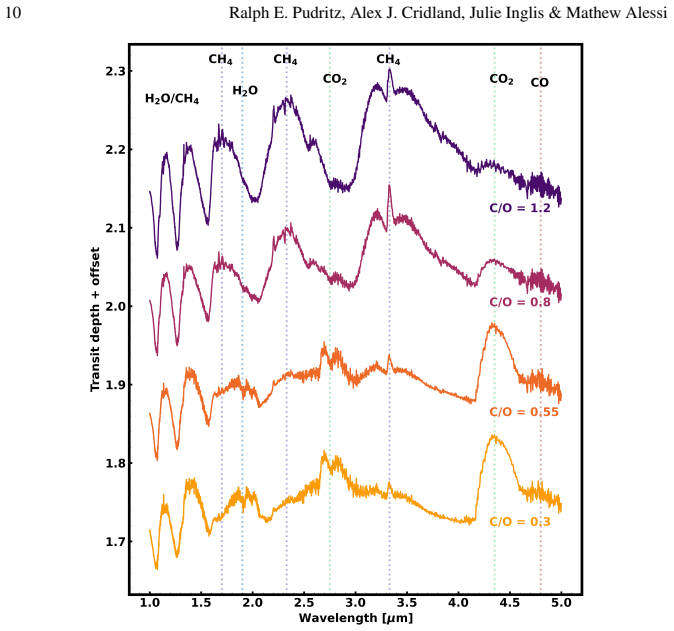
On the paper's own terms, the central claim is that a new dynamic paradigm for planet formation is emerging in which MHD disk winds, not disk turbulence, play the central role in angular momentum transport, gap and ring formation, disk astrochemistry, and planet formation and migration. The evidence the review assembles includes measured disk turbulence levels an order of magnitude too low to drive the observed accretion rates; non-ideal MHD simulations in which Ohmic and ambipolar diffusion suppress the magnetorotational instability and launch winds that drive a laminar accretion flow; global simulations in which wind-driven concentration of magnetic flux produces long-lived rings and gaps before any planet exists; three-dimensional planet-disk simulations in which wind torques deepen gaps and shift the migration torque; and population synthesis in which wind-driven evolution reproduces the mass-radius diagram, sends ice-rich mini-Neptunes inward from beyond the ice line, and yields a dry-super-Earth/icy-mini-Neptune mass separation with the signature of the observed radius valley. The atmospheric C/O 'main sequence' connects the final composition to the ratio of solid to gas accretion during formation. The review concludes that these processes leave their mark on the radii, atmospheric composition, and orbital characteristics of exoplanet populations, offering the possibility of future observational tests.
Load-bearing premise
The paradigm rests on one unmeasured premise: protoplanetary disks keep a large-scale magnetic field, spread across the disk, strong enough to launch winds that carry off most of the angular momentum over the disk's multi-million-year lifetime, and the review itself notes that everything depends on 'the amount of magnetic flux that threads it' because if that field is eroded by reconnection or the Hall effect, turbulence-driven viscous transport would reclaim the central role.
Editorial extensions
If this is right
- Disk evolution becomes laminar and advective: the wind torque drives inward flow at speed $v_m = B_\phi B_z/(3\pi\Sigma\Omega)$ instead of viscous spreading, so disks stay more compact, dust settles and grows faster, and pebbles drift across a wider range of disk radii.
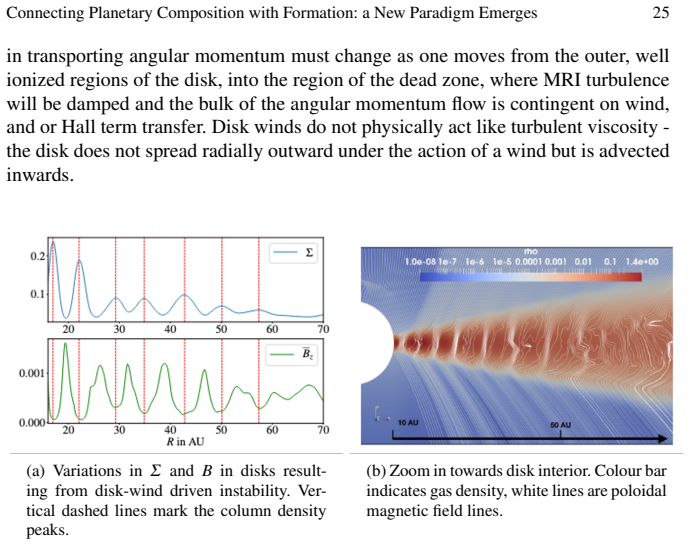
- Rings and gaps can form before planets do: wind-driven magnetic flux concentration creates long-lived dust-trapping pressure bumps that may be the first sites of planet formation.
- Planet migration is regulated by traps: embryos are captured at zero-torque radii (heat transition, dead-zone edge, ice lines) and move inward on million-year advective timescales, providing a physical remedy for the factor of 30-300 slowdown that early population synthesis required.
- Composition becomes a formation record: the atmospheric C/O main sequence links a planet's final C/O to the ratio of solid to gas accretion, and the radius valley is explained by the superposition of dry super-Earths and ice-rich mini-Neptunes that migrated in from beyond the ice line.
- The paradigm is observationally addressable: layered outflows detected from disk radii of 50-90 AU connect winds directly to ring structure, and precise JWST phase-curve measurements of tidally deformed ultra-hot Jupiters can test the core masses predicted by core accretion.
Reading between the lines
- An extension the paper leaves implicit is quantitative: wind-dominated disks are more compact, so the model predicts a higher fraction of planets ending in short-period orbits than viscous-disk models; the observed hot-Jupiter occurrence rate and the inner pile-up of super-Earths are therefore direct statistical tests of the paradigm.
- Because the Hall effect transports magnetic flux inward or outward depending on field polarity relative to disk rotation, the same formation model should yield systematically different migration and compositional outcomes for disks of opposite polarity, a polarity test that no current observation yet discriminates.
- The trap framework suggests an inversion strategy the paper does not pursue: a single planet's measured C/O and N/O could be mapped back onto model formation tracks to infer its assembly radius and trap type, turning sparse JWST spectra of individual planets into formation diagnostics.
- The radius-valley explanation competes directly with photoevaporation, and the paper itself notes that photoevaporation models fail around M stars; a survey resolving the valley's shape at low stellar masses would discriminate between the two mechanisms.
Editorial analysis
A structured set of objections, weighed in public.
Referee Report
Summary. This review, written for the Springer Handbook of Exoplanets (second edition), argues that a new paradigm is emerging in which MHD disk winds, rather than turbulent viscosity, dominate angular momentum transport, gap and ring formation, disk chemistry, planet migration, and the resulting exoplanet compositions. It synthesizes (i) exoplanet demographic observations (M-a and M-R diagrams, radius valley, host-star abundances), (ii) ALMA/JWST observations of disk substructure, kinematics, layered outflows, and molecules, (iii) physical processes in disks (non-ideal MHD, dead zones, ice lines, pebble drift), (iv) migration and planet-trap theory, and (v) the authors' population synthesis models that connect these to C/O ratios, ice fractions, and the radius valley. A roadmap section bundles the paradigm's claims, and the conclusions list testable predictions, including a C/O main sequence and ice-rich origins for the radius valley.
Significance. If the paradigm holds, it would change how disk observations are interpreted and how migration and planetary composition are connected. The review is valuable as a comprehensive, current synthesis: it accurately represents a large body of simulations and observations, includes explicit caveats (low observed turbulence, residual hydrodynamic instabilities, Hall-effect polarity dependence), and makes concrete falsifiable predictions, especially the C/O main sequence and the radius-valley dichotomy. Its primary weakness is that the central claim depends on sustained net poloidal magnetic flux over 3-10 Myr, and the review does not establish or quantify the flux-evolution problem; in addition, the population-synthesis predictions are computed from models with fixed assumptions whose sensitivity is not discussed. These are fixable in a review by reframing the claim as conditional and by adding flux-transport and sensitivity material.
major comments (2)
- [Angular momentum transport and disk evolution (Eq. 4)] The review's central claim that MHD disk winds, not turbulence, drive disk evolution over the 3-10 Myr planet-formation epoch requires that a net poloidal magnetic flux Bz thread the disk for that entire period. Equation (4), which underlies the population-synthesis models, contains no evolution equation for Bz; the review itself notes in the population-synthesis section that Eq. (4) 'must be supplemented by equations that consider the back reaction on the magnetic fields.' The Hall-effect paragraph acknowledges that flux transport is polarity-dependent and can be inwards or outwards, but neither quantitative flux-transport timescales nor any replenishment mechanism (for example, ambipolar diffusion, reconnection, or streamer-fed flux injection) is discussed. As written, the 'not disk turbulence' claim is conditional on a premise that is plausible but currently unmeasured. I request a dedicated subsection on poloidal flux evolution and observational constraints (for example, Zeeman or Faraday rotation measurements, or indirect wind diagnostics) that quantifies whether Bz can survive for 3-10 Myr.
- [Population synthesis: C/O main sequence and radius valley] The population-synthesis predictions presented as tests of the paradigm—the C/O main sequence and the ice-rich origin of the radius valley—are computed from models that fix the disk-wind mass-loss ratio at Mw/Ma ~ 0.1 (Section 'The effects of MHD disk winds on planetary populations') and the initial global C/O at 0.4 (Section 'Atmospheres'). The review states these values but does not quantify how sensitive the predictions are to them. If the C/O main sequence is governed by the solid-to-gas accretion ratio, its normalization must depend on the initial volatile C/O; the chosen 0.4 value is lower than the protosolar value of ~0.54 and covers only part of the stellar C/O distribution shown in Figure 3. Please add a sensitivity analysis or an explicit statement of which predictions are robust to varying these inputs within observed ranges; otherwise the falsifiability of the C/O main sequence is overstated.
minor comments (6)
- [Section heading after 'Planet structure'] The heading 'Panetary structure' should be 'Planetary structure' (page 54 of the manuscript).
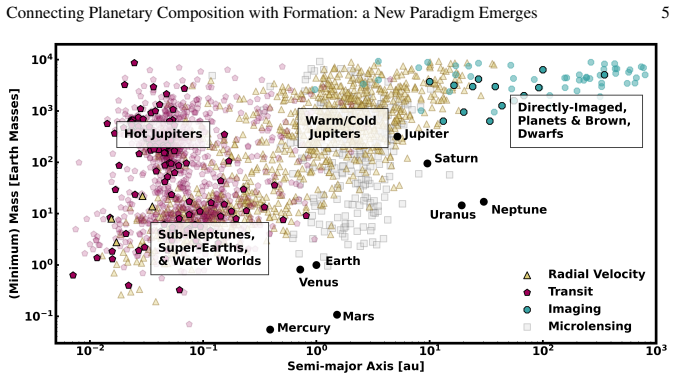
- [Figure 2(a) discussion] In the text describing Figure 2(a), 'less than 120 solar masses' and '10-25 M_sun' should read Earth masses (M_earth), not solar masses; as printed, these values conflict with the exoplanet masses shown in the figure.
- [Figure 19 captions] The captions of Figure 19 contain typos: 'assiciated' should be 'associated', 'tubulent' should be 'turbulent', and the phrase 'for disk wind evolved planetary populations' should be 'for disk-wind-evolved planetary populations.'
- [Solid and Ice Lines section] In the subsection on ice lines and grain growth, 'grwoth' should be 'growth' (page 33 of the manuscript).
- [Conclusions] In the conclusions, 'promore' should be 'promote' (page 64 of the manuscript), and 'the are ~1 Myr old' in 'Disk formation and initial chemical composition' should be 'they are ~1 Myr old.'
- [Figure and text permissions] Several captions and the text spell 'permisson' instead of 'permission' (e.g., Figures 3, 16, and 18); please correct these.
Circularity Check
No significant circularity: the review's derivation chain is self-contained, with the wind paradigm grounded in independent simulations and the population-synthesis predictions clearly presented as model outputs.
full rationale
This is a review paper rather than a new derivation, and I found no step in which a prediction reduces by construction to its own inputs. The central claim that MHD disk winds rather than turbulence dominate angular momentum transport is supported by externally authored MHD simulations (Bai and Stone 2013; Gressel et al. 2015; Aoyama and Bai 2023) and by independent kinematic and dust-settling observations of low turbulence, so the paradigm does not rest on a self-citation. The population-synthesis section does rely heavily on the authors' own chain of papers (Cridland et al. 2016, 2017a,b, 2019a,b, 2020; Alessi et al. 2017; Alessi and Pudritz 2022), and the assumed wind mass-loss ratio (Mdot_w/Mdot_a ~ 0.1) and initial disk C/O = 0.4 are inputs to those models. However, these inputs are not fitted to the same exoplanet observables that the models are later compared with; they are calibrated to independent outflow observations and adopted chemical initial conditions. The so-called C/O main sequence is a model-generated correlation between atmospheric C/O and the fraction of mass accreted as solids; while this correlation is strongly influenced by the assumed carbon-poor nature of solids relative to gas, it is not presented as an independent empirical discovery and is not used as the sole evidence for the paradigm. The acknowledgment that equation (4) 'must be supplemented by equations that consider the back reaction on the magnetic fields' identifies a missing piece of physics, but missing physics is a completeness or robustness limitation, not a circular argument. No uniqueness theorem is imported from the authors' prior work, and no ansatz is smuggled in solely via self-citation. The review's claims are therefore not circular, even though the underlying paradigm may be contested on empirical grounds.
Assumptions & free parameters
free parameters (4)
- Disk wind mass-loss to accretion ratio (M_w/M_a) =
~0.1
- Turbulent viscosity parameter alpha_turb =
10^-4 to 10^-3 (lognormal draw)
- Initial global C/O of the disk =
0.4
- Envelope opacity kappa_env for gas accretion =
0.001 cm^2 g^-1
assumptions (4)
- domain assumption Protoplanetary disks retain a net poloidal magnetic field strong enough to launch MHD winds across the planet-forming region.
- domain assumption Non-ideal MHD effects (ambipolar diffusion, Ohmic resistivity) with the adopted ionization structure suppress MRI and launch laminar winds as in Bai & Stone (2013) and Gressel et al. (2015).
- domain assumption Core accretion is the dominant giant-planet formation mechanism.
- domain assumption Equilibrium thermodynamics adequately describes condensation of refractory materials in the inner disk.
Cite this review
Pith. "Pith review of Connecting Planetary Composition with Formation: a New Paradigm Emerges." pith.science (2026). https://pith.science/paper/UCDJXOHQ
@misc{pith2026250522724,
  author       = {Pith},
  title        = {Pith review of: Connecting Planetary Composition with Formation: a New Paradigm Emerges},
  year         = {2026},
  howpublished = {\url{https://pith.science/paper/UCDJXOHQ}},
  note         = {Machine review of arXiv:2505.22724}
}
read the original abstract
Extensive ground and space based surveys have now characterized the properties of thousands of exoplanets; their radii, masses, orbits around their host stars, and the beginnings of accurate measurements of the chemical compositions of their atmospheres and cores. How are these properties linked to their formation in physically and chemically evolving protoplanetary disks wherein they accrete pebbles, planetesimals, and gas as they undergo migration? To address this challenge, our review assembles a large and varied body of exoplanet observations as well as recent Atacama Large Millimeter Array (ALMA) and James Webb Space Telescope (JWST) observations of disk structure, chemistry, kinematics, and winds. The latest advances in theory and MHD simulations that bear on these issues are also reviewed and compared with the observations. Taken together, this review argues that a new dynamic paradigm for planet formation is emerging wherein MHD disk winds and not disk turbulence play a central role in disk evolution and planet formation including: angular momentum transport, gap and ring formation. disk astrochemistry, and planet formation and migration. These processes leave their mark on the resulting atmospheric composition, radii, and orbital characteristics of exoplanet populations, offering the possibility of future observational tests.
Figures


Figures from the paper (23 more)




Reference graph
Works this paper leans on
-
[1]
, " * write output.state after.block = add.period write newline
ENTRY address archive author booktitle chapter doi edition editor eid eprint howpublished institution journal key month note number organization pages publisher school series title type url volume year label extra.label sort.label short.list INTEGERS output.state before.all mid.sentence after.sentence after.block FUNCTION init.state.consts #0 'before.all ...
-
[2]
write newline
" write newline "" before.all 'output.state := FUNCTION add.period duplicate empty 'skip "." * add.blank if FUNCTION if.digit duplicate "0" = swap duplicate "1" = swap duplicate "2" = swap duplicate "3" = swap duplicate "4" = swap duplicate "5" = swap duplicate "6" = swap duplicate "7" = swap duplicate "8" = swap "9" = or or or or or or or or or FUNCTION ...
-
[3]
Ag \'u ndez M, Parmentier V, Venot O, Hersant F Selsis F (2014) Pseudo 2D chemical model of hot-Jupiter atmospheres: application to HD 209458b and HD 189733b . 564:A73
2014
-
[4]
Two-dimensional distributions and column densities of gaseous molecules
Aikawa Y Herbst E (1999) Molecular evolution in protoplanetary disks. Two-dimensional distributions and column densities of gaseous molecules . 351:233--246
1999
-
[5]
On the effect of tidal deformation on planetary phase curves
Akinsanmi B, Lendl M, Boue G Barros SCC (2023) On the effect of tidal deformation on planetary phase curves. doi:10.48550/arXiv.2310.03553, ://ui.adsabs.harvard.edu/abs/2023arXiv231003553A, publication Title: arXiv e-prints ADS Bibcode: 2023arXiv231003553A
work page Pith review arXiv doi:10.48550/arxiv.2310.03553 2023
-
[6]
(2024) The tidal deformation and atmosphere of WASP -12 b from its phase curve
Akinsanmi B, Barros SCC, Lendl M et al. (2024) The tidal deformation and atmosphere of WASP -12 b from its phase curve. Astronomy & Astrophysics 685:A63, ://www.aanda.org/articles/aa/abs/2024/05/aa48502-23/aa48502-23.html, publisher: EDP Sciences
2024
-
[7]
(2023) Early Release Science of the exoplanet WASP-39b with JWST NIRSpec G395H
Alderson L, Wakeford HR, Alam MK et al. (2023) Early Release Science of the exoplanet WASP-39b with JWST NIRSpec G395H . 614(7949):664--669
2023
-
[8]
515(2):2548--2577
Alessi M Pudritz RE (2022) Combined effects of disc winds and turbulence-driven accretion on planet populations . 515(2):2548--2577
2022
Show all 300 references
-
[9]
464:428--452
Alessi M, Pudritz RE Cridland AJ (2017) On the formation and chemical composition of super Earths . 464:428--452
2017
-
[10]
Effects of initial disc size and radial dust drift
Alessi M, Pudritz RE Cridland AJ (2020) Formation of planetary populations - II. Effects of initial disc size and radial dust drift . 493(1):1013--1033
2020
-
[11]
Alibert Y, Mordasini C Benz W (2011) Extrasolar planet population synthesis. III. Formation of planets around stars of different masses . 526:A63
2011
-
[12]
(2015) The 2014 ALMA Long Baseline Campaign: First Results from High Angular Resolution Observations toward the HL Tau Region
ALMA Partnership , Brogan CL, P \'e rez LM et al. (2015) The 2014 ALMA Long Baseline Campaign: First Results from High Angular Resolution Observations toward the HL Tau Region . 808:L3
2015
-
[13]
(2010) From filamentary clouds to prestellar cores to the stellar IMF: Initial highlights from the Herschel Gould Belt Survey
Andr \'e P, Men'shchikov A, Bontemps S et al. (2010) From filamentary clouds to prestellar cores to the stellar IMF: Initial highlights from the Herschel Gould Belt Survey . 518:L102
2010
-
[14]
(2014) From Filamentary Networks to Dense Cores in Molecular Clouds: Toward a New Paradigm for Star Formation
Andr \'e P, Di Francesco J, Ward-Thompson D et al. (2014) From Filamentary Networks to Dense Cores in Molecular Clouds: Toward a New Paradigm for Star Formation . In: Beuther H, Klessen RS, Dullemond CP Henning T (eds) Protostars and Planets VI, pp 27--51, doi:10.2458/azu_uapr...
2014 doi
-
[15]
659:705--728
Andrews SM Williams JP (2007) High-Resolution Submillimeter Constraints on Circumstellar Disk Structure . 659:705--728
2007
-
[16]
Andrews SM, Wilner DJ, Hughes AM, Qi C Dullemond CP (2010) Protoplanetary Disk Structures in Ophiuchus. II. Extension to Fainter Sources . 723:1241--1254
2010
-
[17]
(2018) The Disk Substructures at High Angular Resolution Project (DSHARP)
Andrews SM, Huang J, P \'e rez LM et al. (2018) The Disk Substructures at High Angular Resolution Project (DSHARP). I. Motivation, Sample, Calibration, and Overview . 869(2):L41
2018
-
[18]
(2016) ALMA Survey of Lupus Protoplanetary Disks
Ansdell M, Williams JP, van der Marel N et al. (2016) ALMA Survey of Lupus Protoplanetary Disks. I. Dust and Gas Masses . 828:46
2016
-
[19]
Aoyama Y Bai XN (2023) Three-dimensional Global Simulations of Type-II Planet-Disk Interaction with a Magnetized Disk Wind. I. Magnetic Flux Concentration and Gap Properties . 946(1):5
2023
-
[20]
Armitage PJ (2020) Astrophysics of planet formation, Second Edition
2020
-
[21]
(2016) The Origin and Evolution of Saturn, with Exoplanet Perspective
Atreya SK, Crida A, Guillot T et al. (2016) The Origin and Evolution of Saturn, with Exoplanet Perspective . arXiv e-prints arXiv:1606.04510
2016 arXiv
-
[22]
(2018) Disks around T Tauri Stars with SPHERE (DARTTS-S)
Avenhaus H, Quanz SP, Garufi A et al. (2018) Disks around T Tauri Stars with SPHERE (DARTTS-S). I. SPHERE/IRDIS Polarimetric Imaging of Eight Prominent T Tauri Disks . 863(1):44
2018
-
[23]
(2025) ALMA chemical survey of disk-outflow sources in Taurus (ALMA-DOT) VII: the layered molecular outflow from HL Tau and its relationship with the ringed disk
Bacciotti F, Nony T, Podio L et al. (2025) ALMA chemical survey of disk-outflow sources in Taurus (ALMA-DOT) VII: the layered molecular outflow from HL Tau and its relationship with the ringed disk . arXiv e-prints arXiv:2501.03920
2025
-
[24]
850(2):201
Bae J, Zhu Z Hartmann L (2017) On the Formation of Multiple Concentric Rings and Gaps in Protoplanetary Disks . 850(2):201
2017
-
[25]
(2023) Structured Distributions of Gas and Solids in Protoplanetary Disks
Bae J, Isella A, Zhu Z et al. (2023) Structured Distributions of Gas and Solids in Protoplanetary Disks . In: Inutsuka S, Aikawa Y, Muto T, Tomida K Tamura M (eds) Protostars and Planets VII, Astronomical Society of the Pacific Conference Series, vol 534, p 423, doi:10.48550/a...
-
[26]
Bai XN (2014) Hall-effect-Controlled Gas Dynamics in Protoplanetary Disks. I. Wind Solutions at the Inner Disk . 791:137
2014
-
[27]
Bai XN (2016) Towards a Global Evolutionary Model of Protoplanetary Disks . 821:80
2016
-
[28]
Bai XN Stone JM (2013) Wind-driven Accretion in Protoplanetary Disks. I. Suppression of the Magnetorotational Instability and Launching of the Magnetocentrifugal Wind . 769:76
2013
-
[29]
Bai XN Stone JM (2017) Hall Effect-Mediated Magnetic Flux Transport in Protoplanetary Disks . 836:46
2017
-
[30]
I - Linear analysis
Balbus SA Hawley JF (1991) A powerful local shear instability in weakly magnetized disks. I - Linear analysis. II - Nonlinear evolution . 376:214--233
1991
-
[31]
641:949--960
Banerjee R Pudritz RE (2006) Outflows and Jets from Collapsing Magnetized Cloud Cores . 641:949--960
2006
-
[32]
(2023) JWST Reveals Excess Cool Water near the Snow Line in Compact Disks, Consistent with Pebble Drift
Banzatti A, Pontoppidan KM, Carr JS et al. (2023) JWST Reveals Excess Cool Water near the Snow Line in Compact Disks, Consistent with Pebble Drift . 957(2):L22
2023
-
[33]
Protostars and Planets VI pp 763--786
Baraffe I, Chabrier G, Fortney J Sotin C (2014) Planetary Internal Structures . Protostars and Planets VI pp 763--786
2014
-
[34]
The Astrophysical Journal 878:70, ://ui.adsabs.harvard.edu/abs/2019ApJ...878...70B, publisher: IOP ADS Bibcode: 2019ApJ...878...70B
Batalha NE, Marley MS, Lewis NK Fortney JJ (2019) Exoplanet Reflected -light Spectroscopy with PICASO . The Astrophysical Journal 878:70, ://ui.adsabs.harvard.edu/abs/2019ApJ...878...70B, publisher: IOP ADS Bibcode: 2019ApJ...878...70B
2019
-
[35]
Proceedings of the National Academy of Science 111:12,647--12,654
Batalha NM (2014) Exploring exoplanet populations with NASA's Kepler Mission . Proceedings of the National Academy of Science 111:12,647--12,654
2014
-
[36]
419:3115--3146
Bate MR (2012) Stellar, brown dwarf and multiple star properties from a radiation hydrodynamical simulation of star cluster formation . 419:3115--3146
2012
-
[37]
475:5618--5658
Bate MR (2018) On the diversity and statistical properties of protostellar discs . 475:5618--5658
2018
-
[38]
Protostars and Planets VI pp 691--713
Benz W, Ida S, Alibert Y, Lin D Mordasini C (2014) Planet Population Synthesis . Protostars and Planets VI pp 691--713
2014
-
[39]
Proceedings of the National Academy of Science 112:8965--8970
Bergin EA, Blake GA, Ciesla F, Hirschmann MM Li J (2015) Tracing the ingredients for a habitable earth from interstellar space through planet formation . Proceedings of the National Academy of Science 112:8965--8970
2015
-
[40]
B \'e thune W, Lesur G Ferreira J (2017) Global simulations of protoplanetary disks with net magnetic flux. I. Non-ideal MHD case . 600:A75
2017
-
[41]
62(1):157--202
Birnstiel T (2024) Dust Growth and Evolution in Protoplanetary Disks . 62(1):157--202
2024
-
[42]
539:A148
Birnstiel T, Klahr H Ercolano B (2012) A simple model for the evolution of the dust population in protoplanetary disks . 539:A148
2012
-
[43]
205(1-4):41--75
Birnstiel T, Fang M Johansen A (2016) Dust Evolution and the Formation of Planetesimals . 205(1-4):41--75
2016
-
[44]
Bitsch B, Crida A, Morbidelli A, Kley W Dobbs-Dixon I (2013) Stellar irradiated discs and implications on migration of embedded planets. I. Equilibrium discs . 549:A124
2013
-
[45]
582:A112
Bitsch B, Lambrechts M Johansen A (2015) The growth of planets by pebble accretion in evolving protoplanetary discs . 582:A112
2015
-
[46]
(2018) Pebble-isolation mass: Scaling law and implications for the formation of super-Earths and gas giants
Bitsch B, Morbidelli A, Johansen A et al. (2018) Pebble-isolation mass: Scaling law and implications for the formation of super-Earths and gas giants . 612:A30
2018
-
[47]
(2019) Formation of planetary systems by pebble accretion and migration: growth of gas giants
Bitsch B, Izidoro A, Johansen A et al. (2019) Formation of planetary systems by pebble accretion and migration: growth of gas giants . 623:A88
2019
-
[48]
199:883--903
Blandford RD Payne DG (1982) Hydromagnetic flows from accretion discs and the production of radio jets . 199:883--903
1982
-
[49]
67:391--408
Bodenheimer P Pollack JB (1986) Calculations of the accretion and evolution of giant planets The effects of solid cores . 67:391--408
1986
-
[50]
(2017) The Juno Mission
Bolton SJ, Lunine J, Stevenson D et al. (2017) The Juno Mission . 213:5--37
2017
-
[51]
Bond JC, O'Brien DP Lauretta DS (2010) The Compositional Diversity of Extrasolar Terrestrial Planets. I. In Situ Simulations . 715:1050--1070
2010
-
[52]
Booth AS, van der Marel N, Leemker M, van Dishoeck EF Ohashi S (2021) A major asymmetric ice trap in a planet-forming disk. II. Prominent SO and SO _ 2 pointing to C/O < 1 . 651:L6
2021
-
[53]
487(3):3998--4011
Booth RA Ilee JD (2019) Planet-forming material in a protoplanetary disc: the interplay between chemical evolution and pebble drift . 487(3):3998--4011
2019
-
[54]
469:3994--4011
Booth RA, Clarke CJ, Madhusudhan N Ilee JD (2017) Chemical enrichment of giant planets and discs due to pebble drift . 469:3994--4011
2017
-
[55]
ArXiv e-prints
Bosman AD, Tielens AGGM van Dishoeck EF (2017) Efficiency of radial transport of ices in protoplanetary disks probed with infrared observations: the case of CO \_2 . ArXiv e-prints
2017
-
[56]
Science 276:1836--1839
Boss AP (1997) Giant planet formation by gravitational instability. Science 276:1836--1839
1997
-
[57]
128(10):102,001
Bowler BP (2016) Imaging Extrasolar Giant Planets . 128(10):102,001
2016
-
[58]
Brewer JM, Fischer DA Madhusudhan N (2017) C/O and O/H Ratios Suggest Some Hot Jupiters Originate Beyond the Snow Line . 153:83
2017
-
[59]
The outcomes of population synthesis models
Br \"u gger N, Burn R, Coleman GAL, Alibert Y Benz W (2020) Pebbles versus planetesimals. The outcomes of population synthesis models . 640:A21
2020
-
[60]
968(2):L25
Bryan ML Lee EJ (2024) Friends Not Foes: Strong Correlation between Inner Super-Earths and Outer Gas Giants . 968(2):L25
2024
-
[61]
(2024) A radius valley between migrated steam worlds and evaporated rocky cores
Burn R, Mordasini C, Mishra L et al. (2024) A radius valley between migrated steam worlds and evaporated rocky cores . Nature Astronomy 8:463--471
2024
-
[62]
The Astrophysical Journal 512:843--863, ://ui.adsabs.harvard.edu/abs/1999ApJ...512..843B, publisher: IOP ADS Bibcode: 1999ApJ...512..843B
Burrows A Sharp CM (1999) Chemical Equilibrium Abundances in Brown Dwarf and Extrasolar Giant Planet Atmospheres . The Astrophysical Journal 512:843--863, ://ui.adsabs.harvard.edu/abs/1999ApJ...512..843B, publisher: IOP ADS Bibcode: 1999ApJ...512..843B
1999
-
[63]
(2015) Formation mechanism of glycolaldehyde and ethylene glycol in astrophysical ices from HCO ^ • and ^ • CH _ 2 OH recombination: an experimental study
Butscher T, Duvernay F, Theule P et al. (2015) Formation mechanism of glycolaldehyde and ethylene glycol in astrophysical ices from HCO ^ • and ^ • CH _ 2 OH recombination: an experimental study . 453:1587--1596
2015
-
[64]
(2022) An Atmospheric Retrieval of the Brown Dwarf Gliese 229B
Calamari E, Faherty JK, Burningham B et al. (2022) An Atmospheric Retrieval of the Brown Dwarf Gliese 229B . The Astrophysical Journal 940:164, ://ui.adsabs.harvard.edu/abs/2022ApJ...940..164C, publisher: IOP ADS Bibcode: 2022ApJ...940..164C
2022
-
[65]
(2024) Predicting Cloud Conditions in Substellar Mass Objects Using Ultracool Dwarf Companions
Calamari E, Faherty JK, Visscher C et al. (2024) Predicting Cloud Conditions in Substellar Mass Objects Using Ultracool Dwarf Companions . The Astrophysical Journal 963(1):67, ://dx.doi.org/10.3847/1538-4357/ad1f6d, publisher: The American Astronomical Society
2024 doi
-
[66]
In: Corbelli E, Palla F Zinnecker H (eds) The Initial Mass Function 50 Years Later, Astrophysics and Space Science Library, vol 327, p 41, doi:10.1007/978-1-4020-3407-7_5
Chabrier G (2005) The Initial Mass Function: From Salpeter 1955 to 2005 . In: Corbelli E, Palla F Zinnecker H (eds) The Initial Mass Function 50 Years Later, Astrophysics and Space Science Library, vol 327, p 41, doi:10.1007/978-1-4020-3407-7_5
2005 doi
-
[67]
661:L81--L84
Chabrier G Baraffe I (2007) Heat Transport in Giant (Exo)planets: A New Perspective . 661:L81--L84
2007
-
[68]
The Astrophysical Journal 943(2):112, ://dx.doi.org/10.3847/1538-4357/aca614, publisher: The American Astronomical Society
Chachan Y, Knutson HA, Lothringer J Blake GA (2023) Breaking Degeneracies in Formation Histories by Measuring Refractory Content in Gas Giants . The Astrophysical Journal 943(2):112, ://dx.doi.org/10.3847/1538-4357/aca614, publisher: The American Astronomical Society
2023 doi
-
[69]
879(2):98
Chambers J (2019) An Analytic Model for an Evolving Protoplanetary Disk with a Disk Wind . 879(2):98
2019
-
[70]
705:1206--1214
Chambers JE (2009) An Analytic Model for the Evolution of a Viscous, Irradiated Disk . 705:1206--1214
2009
-
[71]
Chatterjee S Ford EB (2015) Planetesimal Interactions Can Explain the Mysterious Period Ratios of Small Near-Resonant Planets . 803:33
2015
-
[72]
686:580-602
Chatterjee S, Ford EB, Matsumura S Rasio FA (2008) Dynamical Outcomes of Planet-Planet Scattering . 686:580-602
2008
-
[73]
Chen J Kipping D (2017) Probabilistic Forecasting of the Masses and Radii of Other Worlds . 834:17
2017
-
[74]
431:3444--3455
Chiang E Laughlin G (2013) The minimum-mass extrasolar nebula: in situ formation of close-in super-Earths . 431:3444--3455
2013
-
[75]
490:368--376
Chiang EI Goldreich P (1997) Spectral Energy Distributions of T Tauri Stars with Passive Circumstellar Disks . 490:368--376
1997
-
[76]
(2018) Reactive desorption of co hydrogenation products under cold pre-stellar core conditions
Chuang KJ, Fedoseev G, Qasim D et al. (2018) Reactive desorption of co hydrogenation products under cold pre-stellar core conditions. The Astrophysical Journal 853(2):102, ://stacks.iop.org/0004-637X/853/i=2/a=102
2018
-
[77]
Cleeves LI, Adams FC Bergin EA (2013) Exclusion of Cosmic Rays in Protoplanetary Disks: Stellar and Magnetic Effects . 772:5
2013
-
[78]
(2014) The ancient heritage of water ice in the solar system
Cleeves LI, Bergin EA, Alexander CMO et al. (2014) The ancient heritage of water ice in the solar system . Science 345:1590--1593
2014
-
[79]
159(5):211
Cloutier R Menou K (2020) Evolution of the Radius Valley around Low-mass Stars from Kepler and K2 . 159(5):211
2020
-
[80]
445:479--499
Coleman GAL Nelson RP (2014) On the formation of planetary systems via oligarchic growth in thermally evolving viscous discs . 445:479--499
2014
-
[81]
460:2779--2795
Coleman GAL Nelson RP (2016) Giant planet formation in radially structured protoplanetary discs . 460:2779--2795
2016
-
[82]
649:1048--1063
Cooper CS Showman AP (2006) Dynamics and Disequilibrium Carbon Chemistry in Hot Jupiter Atmospheres, with Application to HD 209458b . 649:1048--1063
2006
-
[83]
534(2):1394--1413
Cordwell AJ Rafikov RR (2024) Early stages of gap opening by planets in protoplanetary discs . 534(2):1394--1413
2024
-
[84]
377:1324--1336
Crida A Morbidelli A (2007) Cavity opening by a giant planet in a protoplanetary disc and effects on planetary migration . 377:1324--1336
2007
-
[85]
Connecting disc astrochemistry to the formation of planetary atmospheres
Cridland AJ, Pudritz RE Alessi M (2016) Composition of early planetary atmospheres - I. Connecting disc astrochemistry to the formation of planetary atmospheres . 461:3274--3295
2016
-
[86]
465:3865--3878
Cridland AJ, Pudritz RE Birnstiel T (2017 a ) Radial drift of dust in protoplanetary discs: the evolution of ice lines and dead zones . 465:3865--3878
2017
-
[87]
Coupled Dust and chemical evolution in protoplanetary discs
Cridland AJ, Pudritz RE, Birnstiel T, Cleeves LI Bergin EA (2017 b ) Composition of early planetary atmospheres - II. Coupled Dust and chemical evolution in protoplanetary discs . 469:3910--3927
2017
-
[88]
484(1):345--363
Cridland AJ, Pudritz RE Alessi M (2019 a ) Physics of planet trapping with applications to HL Tau . 484(1):345--363
2019
-
[89]
A main sequence for C/O in hot exoplanetary atmospheres
Cridland AJ, van Dishoeck EF, Alessi M Pudritz RE (2019 b ) Connecting planet formation and astrochemistry. A main sequence for C/O in hot exoplanetary atmospheres . 632:A63
2019
-
[90]
C/Os and N/Os of warm giant planets and Jupiter analogues
Cridland AJ, van Dishoeck EF, Alessi M Pudritz RE (2020) Connecting planet formation and astrochemistry. C/Os and N/Os of warm giant planets and Jupiter analogues . 642:A229
2020
-
[91]
614:490--496
Cuzzi JN Zahnle KJ (2004) Material Enhancement in Protoplanetary Nebulae by Particle Drift through Evaporation Fronts . 614:490--496
2004
-
[92]
(2024) The atmospheric composition of the ultra-hot Jupiter WASP -178 b observed with ESPRESSO
Damasceno YC, Seidel JV, Prinoth B et al. (2024) The atmospheric composition of the ultra-hot Jupiter WASP -178 b observed with ESPRESSO . Astronomy & Astrophysics 689:A54, ://www.aanda.org/articles/aa/abs/2024/09/aa50119-24/aa50119-24.html, publisher: EDP Sciences
2024
-
[93]
Effects of saturation, cooling and stellar irradiation
Dittkrist KM, Mordasini C, Klahr H, Alibert Y Henning T (2014) Impacts of planet migration models on planetary populations. Effects of saturation, cooling and stellar irradiation . 567:A121
2014
-
[94]
Gaps Opened by Single and Multiple Young Planets in Disks
Dong R, Zhu Z Whitney B (2015) Observational Signatures of Planets in Protoplanetary Disks I. Gaps Opened by Single and Multiple Young Planets in Disks . 809(1):93
2015
-
[95]
(2017) A generalized Bayesian inference method for constraining the interiors of super Earths and sub-Neptunes
Dorn C, Venturini J, Khan A et al. (2017) A generalized Bayesian inference method for constraining the interiors of super Earths and sub-Neptunes . 597:A37
2017
-
[96]
(2023) Planet Formation Theory in the Era of ALMA and Kepler: from Pebbles to Exoplanets
Drazkowska J, Bitsch B, Lambrechts M et al. (2023) Planet Formation Theory in the Era of ALMA and Kepler: from Pebbles to Exoplanets . In: Inutsuka S, Aikawa Y, Muto T, Tomida K Tamura M (eds) Protostars and Planets VII, Astronomical Society of the Pacific Conference Series, v...
-
[97]
(2016) Cometary ices in forming protoplanetary disc midplanes
Drozdovskaya MN, Walsh C, van Dishoeck EF et al. (2016) Cometary ices in forming protoplanetary disc midplanes . 462(1):977--993
2016
-
[98]
Duffell PC, Haiman Z, MacFadyen AI, D'Orazio DJ Farris BD (2014) The Migration of Gap-opening Planets is Not Locked to Viscous Disk Evolution . 792:L10
2014
-
[99]
(2018) The Disk Substructures at High Angular Resolution Project (DSHARP)
Dullemond CP, Birnstiel T, Huang J et al. (2018) The Disk Substructures at High Angular Resolution Project (DSHARP). VI. Dust Trapping in Thin-ringed Protoplanetary Disks . 869(2):L46
2018
-
[100]
ArXiv e-prints
Edgar RG (2008) Type II Migration: Varying Planet Mass and Disc Viscosity . ArXiv e-prints
2008
-
[101]
Does chemical evolution in disk midplanes matter? 595:A83
Eistrup C, Walsh C van Dishoeck EF (2016) Setting the volatile composition of (exo)planet-building material. Does chemical evolution in disk midplanes matter? 595:A83
2016
-
[102]
Eistrup C, Walsh C van Dishoeck EF (2018) Molecular abundances and C/O ratios in chemically evolving planet-forming disk midplanes . 613:A14
2018
-
[103]
221:859--874
Elser S, Meyer MR Moore B (2012) On the origin of elemental abundances in the terrestrial planets . 221:859--874
2012
-
[104]
(2021) The New Generation Planetary Population Synthesis (NGPPS)
Emsenhuber A, Mordasini C, Burn R et al. (2021) The New Generation Planetary Population Synthesis (NGPPS). I. Bern global model of planet formation and evolution, model tests, and emerging planetary systems . 656:A69
2021
-
[105]
508(2):1675--1685
Ercolano B, Picogna G, Monsch K, Drake JJ Preibisch T (2021) The dispersal of protoplanetary discs - II: photoevaporation models with observationally derived irradiating spectra . 508(2):1675--1685
2021
-
[106]
669:1298--1315
Fabrycky D Tremaine S (2007) Shrinking Binary and Planetary Orbits by Kozai Cycles with Tidal Friction . 669:1298--1315
2007
-
[107]
(2014) Architecture of Kepler's Multi-transiting Systems
Fabrycky DC, Lissauer JJ, Ragozzine D et al. (2014) Architecture of Kepler's Multi-transiting Systems. II. New Investigations with Twice as Many Candidates . 790:146
2014
-
[108]
(2011) WASP -39b: a highly inflated Saturn -mass planet orbiting a late G -type star
Faedi F, Barros SCC, Anderson DR et al. (2011) WASP -39b: a highly inflated Saturn -mass planet orbiting a late G -type star. Astronomy and Astrophysics 531:A40, ://ui.adsabs.harvard.edu/abs/2011A&A...531A..40F, publisher: EDP ADS Bibcode: 2011A&A...531A..40F
2011
-
[109]
Fang J Margot JL (2012) Architecture of Planetary Systems Based on Kepler Data: Number of Planets and Coplanarity . 761:92
2012
-
[110]
(2013) Probing the Radial Temperature Structure of Protoplanetary Disks with Herschel/HIFI
Fedele D, Bruderer S, van Dishoeck EF et al. (2013) Probing the Radial Temperature Structure of Protoplanetary Disks with Herschel/HIFI . 776:L3
2013
-
[111]
622:1102--1117
Fischer DA Valenti J (2005) The Planet-Metallicity Correlation . 622:1102--1117
2005
-
[112]
(2017) A Three-dimensional View of Turbulence: Constraints on Turbulent Motions in the HD 163296 Protoplanetary Disk Using DCO ^ +
Flaherty KM, Hughes AM, Rose SC et al. (2017) A Three-dimensional View of Turbulence: Constraints on Turbulent Motions in the HD 163296 Protoplanetary Disk Using DCO ^ + . 843(2):150
2017
-
[113]
(2018) Turbulence in the TW Hya Disk
Flaherty KM, Hughes AM, Teague R et al. (2018) Turbulence in the TW Hya Disk . 856(2):117
2018
-
[114]
(2015) Gaps, rings, and non-axisymmetric structures in protoplanetary disks
Flock M, Ruge JP, Dzyurkevich N et al. (2015) Gaps, rings, and non-axisymmetric structures in protoplanetary disks. From simulations to ALMA observations . 574:A68
2015
-
[115]
Fogel JKJ, Bethell TJ, Bergin EA, Calvet N Semenov D (2011) Chemistry of a Protoplanetary Disk with Grain Settling and Ly Radiation . 726:29
2011
-
[116]
(2024) MINDS: Mid-infrared atomic and molecular hydrogen lines in the inner disk around a low-mass star
Franceschi R, Henning T, Tabone B et al. (2024) MINDS: Mid-infrared atomic and molecular hydrogen lines in the inner disk around a low-mass star . 687:A96
2024
-
[117]
(2014) Jets and Outflows from Star to Cloud: Observations Confront Theory
Frank A, Ray TP, Cabrit S et al. (2014) Jets and Outflows from Star to Cloud: Observations Confront Theory . Protostars and Planets VI pp 451--474
2014
-
[118]
(2017) The California-Kepler Survey
Fulton BJ, Petigura EA, Howard AW et al. (2017) The California-Kepler Survey. III. A Gap in the Radius Distribution of Small Planets . 154(3):109
2017
-
[119]
Gammie CF (1996) Linear Theory of Magnetized, Viscous, Self-gravitating Gas Disks . 462:725
1996
-
[120]
553(1):174--183
Gammie CF (2001) Nonlinear Outcome of Gravitational Instability in Cooling, Gaseous Disks . 553(1):174--183
2001
-
[121]
(2020) Disks Around T Tauri Stars with SPHERE (DARTTS-S)
Garufi A, Avenhaus H, P \'e rez S et al. (2020) Disks Around T Tauri Stars with SPHERE (DARTTS-S). II. Twenty-one new polarimetric images of young stellar disks . 633:A82
2020
-
[122]
(2023) MINDS
Gasman D, van Dishoeck EF, Grant SL et al. (2023) MINDS. Abundant water and varying C/O across the disk of Sz 98 as seen by JWST/MIRI . 679:A117
2023
-
[123]
Monthly Notices of the Royal Astronomical Society 512(3):4618--4638, ://doi.org/10.1093/mnras/stac091
Gibson NP, Nugroho SK, Lothringer J, Maguire C Sing DK (2022) Relative abundance constraints from high-resolution optical transmission spectroscopy of WASP -121b, and a fast model-filtering technique for accelerating retrievals. Monthly Notices of the Royal Astronomical Societ...
2022 doi
-
[124]
179:483--491
Gillett FC Forrest WJ (1973) Spectra of the Becklin-Neugebauer point source and the Kleinmann-Low nebula from 2.8 to 13.5 microns. 179:483--491
1973
-
[125]
476(1):759--765
Ginzburg S, Schlichting HE Sari R (2018) Core-powered mass-loss and the radius distribution of small exoplanets . 476(1):759--765
2018
-
[126]
615(2):972--990
Glassgold AE, Najita J Igea J (2004) Heating Protoplanetary Disk Atmospheres . 615(2):972--990
2004
-
[127]
233:857--871
Goldreich P Tremaine S (1979) The excitation of density waves at the Lindblad and corotation resonances by an external potential . 233:857--871
1979
-
[128]
Gonz \'a lez-Cataldo F, Wilson HF Militzer B (2014) Ab Initio Free Energy Calculations of the Solubility of Silica in Metallic Hydrogen and Application to Giant Planet Cores . 787:79
2014
-
[129]
205:125--152
Gorti U, Liseau R, S \'a ndor Z Clarke C (2016) Disk Dispersal: Theoretical Understanding and Observational Constraints . 205:125--152
2016
-
[130]
(2023) JWST - TST DREAMS : Quartz Clouds in the Atmosphere of WASP -17b
Grant D, Lewis NK, Wakeford HR et al. (2023) JWST - TST DREAMS : Quartz Clouds in the Atmosphere of WASP -17b. The Astrophysical Journal Letters 956(2):L32, ://dx.doi.org/10.3847/2041-8213/acfc3b, publisher: The American Astronomical Society
2023 doi
-
[131]
(2023) MINDS
Grant SL, van Dishoeck EF, Tabone B et al. (2023) MINDS. The Detection of ^ 13 CO _ 2 with JWST-MIRI Indicates Abundant CO _ 2 in a Protoplanetary Disk . 947(1):L6
2023
-
[132]
693:722--733
Grasset O, Schneider J Sotin C (2009) A Study of the Accuracy of Mass-Radius Relationships for Silicate-Rich and Ice-Rich Planets up to 100 Earth Masses . 693:722--733
2009
-
[133]
Gressel O, Turner NJ, Nelson RP McNally CP (2015) Global Simulations of Protoplanetary Disks With Ohmic Resistivity and Ambipolar Diffusion . 801:84
2015
-
[134]
(2019) Two accreting protoplanets around the young star PDS 70
Haffert SY, Bohn AJ, de Boer J et al. (2019) Two accreting protoplanets around the young star PDS 70 . Nature Astronomy 3:749--754
2019
-
[135]
553:L153--L156
Haisch KE Jr, Lada EA Lada CJ (2001) Disk Frequencies and Lifetimes in Young Clusters . 553:L153--L156
2001
-
[136]
643:A105
Haldemann J, Alibert Y, Mordasini C Benz W (2020) AQUA: a collection of H _ 2 O equations of state for planetary models . 643:A105
2020
-
[137]
Haldemann J, Dorn C, Venturini J, Alibert Y Benz W (2024) BICEPS: An improved characterization model for low- and intermediate-mass exoplanets . 681:A96
2024
-
[138]
Hansen BMS Murray N (2013) Testing in Situ Assembly with the Kepler Planet Candidate Sample . 775:53
2013
-
[139]
Physica Scripta Volume T 130(1):014012
Hartmann L (2008) Masses and mass distributions of protoplanetary disks . Physica Scripta Volume T 130(1):014012
2008
-
[140]
322:393--398
Hartmann L Kenyon SJ (1987) High spectral resolution infrared observations of V1057 Cygni . 322:393--398
1987
-
[141]
Multiple planet traps in gaseous discs
Hasegawa Y Pudritz RE (2011) The origin of planetary system architectures - I. Multiple planet traps in gaseous discs . 417:1236--1259
2011
-
[142]
760(2):117
Hasegawa Y Pudritz RE (2012) Evolutionary Tracks of Trapped, Accreting Protoplanets: The Origin of the Observed Mass-Period Relation . 760(2):117
2012
-
[143]
Hasegawa Y Pudritz RE (2013) Planetary Populations in the Mass-Period Diagram: A Statistical Treatment of Exoplanet Formation and the Role of Planet Traps . 778:78
2013
-
[144]
Hasegawa Y Pudritz RE (2014) Planet Traps and Planetary Cores: Origins of the Planet-Metallicity Correlation . 794:25
2014
-
[145]
845(1):31
Hasegawa Y, Okuzumi S, Flock M Turner NJ (2017) Magnetically Induced Disk Winds and Transport in the HL Tau Disk . 845(1):31
2017
-
[146]
(2014) Giant Planet Formation, Evolution, and Internal Structure
Helled R, Bodenheimer P, Podolak M et al. (2014) Giant Planet Formation, Evolution, and Internal Structure . Protostars and Planets VI pp 643--665
2014
-
[147]
(2014) Disk Evolution, Element Abundances and Cloud Properties of Young Gas Giant Planets
Helling C, Woitke P, Rimmer PB et al. (2014) Disk Evolution, Element Abundances and Cloud Properties of Young Gas Giant Planets . Life 4
2014
-
[148]
Chemical Reviews 113:9016--9042
Henning T Semenov D (2013) Chemistry in Protoplanetary Disks . Chemical Reviews 113:9016--9042
2013
-
[149]
(2024) MINDS: The JWST MIRI Mid-INfrared Disk Survey
Henning T, Kamp I, Samland M et al. (2024) MINDS: The JWST MIRI Mid-INfrared Disk Survey . 136(5):054302
2024
-
[150]
(2007) Spitzer Observations of the Orion OB1 Association: Disk Census in the Low-Mass Stars
Hern \'a ndez J, Calvet N, Brice \ n o C et al. (2007) Spitzer Observations of the Orion OB1 Association: Disk Census in the Low-Mass Stars . 671:1784--1799
2007
-
[151]
The Astronomical Journal 148:54, ://ui.adsabs.harvard.edu/abs/2014AJ....148...54H, publisher: IOP ADS Bibcode: 2014AJ....148...54H
Hinkel NR, Timmes FX, Young PA, Pagano MD Turnbull MC (2014) Stellar Abundances in the Solar Neighborhood : The Hypatia Catalog . The Astronomical Journal 148:54, ://ui.adsabs.harvard.edu/abs/2014AJ....148...54H, publisher: IOP ADS Bibcode: 2014AJ....148...54H
2014
-
[152]
Hollenbach D, Johnstone D, Lizano S Shu F (1994) Photoevaporation of Disks around Massive Stars and Application to Ultracompact H II Regions . 428:654
1994
-
[153]
(2010) The Occurrence and Mass Distribution of Close-in Super-Earths, Neptunes, and Jupiters
Howard AW, Marcy GW, Johnson JA et al. (2010) The Occurrence and Mass Distribution of Close-in Super-Earths, Neptunes, and Jupiters . Science 330:653
2010
-
[154]
(2012) Planet Occurrence within 0.25 AU of Solar-type Stars from Kepler
Howard AW, Marcy GW, Bryson ST et al. (2012) Planet Occurrence within 0.25 AU of Solar-type Stars from Kepler . 201:15
2012
-
[155]
(2013) A rocky composition for an Earth-sized exoplanet
Howard AW, Sanchis-Ojeda R, Marcy GW et al. (2013) A rocky composition for an Earth-sized exoplanet . 503:381--384
2013
-
[156]
(2018) The Disk Substructures at High Angular Resolution Project (DSHARP)
Huang J, Andrews SM, Dullemond CP et al. (2018) The Disk Substructures at High Angular Resolution Project (DSHARP). II. Characteristics of Annular Substructures . 869(2):L42
2018
-
[157]
arXiv e-prints arXiv:2503.19026
Huang P, Yu F, Lee EJ, Dong R Bai XN (2025) Leaky Dust Traps in Planet-Embedded Protoplanetary Disks . arXiv e-prints arXiv:2503.19026
2025 arXiv
-
[158]
56:541--591
Hughes AM, Duch \^e ne G Matthews BC (2018) Debris Disks: Structure, Composition, and Variability . 56:541--591
2018
-
[159]
Ida S Lin DNC (2004 a ) Toward a Deterministic Model of Planetary Formation. I. A Desert in the Mass and Semimajor Axis Distributions of Extrasolar Planets . 604:388--413
2004
-
[160]
Ida S Lin DNC (2004 b ) Toward a Deterministic Model of Planetary Formation. II. The Formation and Retention of Gas Giant Planets around Stars with a Range of Metallicities . 616:567--572
2004
-
[161]
Ida S Lin DNC (2005) Toward a Deterministic Model of Planetary Formation. III. Mass Distribution of Short-Period Planets around Stars of Various Masses . 626:1045--1060
2005
-
[162]
Ida S Lin DNC (2008 a ) Toward a Deterministic Model of Planetary Formation. IV. Effects of Type I Migration . 673:487-501
2008
-
[163]
Ida S Lin DNC (2008 b ) Toward a Deterministic Model of Planetary Formation. V. Accumulation Near the Ice Line and Super-Earths . 685:584-595
2008
-
[164]
537:1013--1025
Ikoma M, Nakazawa K Emori H (2000) Formation of Giant Planets: Dependences on Core Accretion Rate and Grain Opacity . 537:1013--1025
2000
-
[165]
(2024) Quartz Clouds in the Dayside Atmosphere of the Quintessential Hot Jupiter HD 189733 b
Inglis J, Batalha NE, Lewis NK et al. (2024) Quartz Clouds in the Dayside Atmosphere of the Quintessential Hot Jupiter HD 189733 b. The Astrophysical Journal 973:L41, ://ui.adsabs.harvard.edu/abs/2024ApJ...973L..41I, publisher: IOP ADS Bibcode: 2024ApJ...973L..41I
2024
-
[166]
22:2219--2222
Javoy M (1995) The integral enstatite chondrite model of the Earth . 22:2219--2222
1995
-
[167]
818(1):76
Jin S, Li S, Isella A, Li H Ji J (2016) Modeling Dust Emission of HL Tau Disk Based on Planet-Disk Interactions . 818(1):76
2016
-
[168]
Annual Review of Earth and Planetary Sciences 45(1):359--387
Johansen A Lambrechts M (2017) Forming Planets via Pebble Accretion . Annual Review of Earth and Planetary Sciences 45(1):359--387
2017
-
[169]
(2007) Rapid planetesimal formation in turbulent circumstellar disks
Johansen A, Oishi JS, Mac Low MM et al. (2007) Rapid planetesimal formation in turbulent circumstellar disks . 448:1022--1025
2007
-
[170]
Johnson JA, Aller KM, Howard AW Crepp JR (2010) Giant Planet Occurrence in the Stellar Mass-Metallicity Plane . 122:905
2010
-
[171]
(2009) PROSAC: a submillimeter array survey of low-mass protostars
J rgensen JK, van Dishoeck EF, Visser R et al. (2009) PROSAC: a submillimeter array survey of low-mass protostars. II. The mass evolution of envelopes, disks, and stars from the Class 0 through I stages . 507:861--879
2009
-
[172]
(2012) Detection of the Simplest Sugar, Glycolaldehyde, in a Solar-type Protostar with ALMA
J rgensen JK, Favre C, Bisschop SE et al. (2012) Detection of the Simplest Sugar, Glycolaldehyde, in a Solar-type Protostar with ALMA . 757:L4
2012
-
[173]
686:603-620
Juri \'c M Tremaine S (2008) Dynamical Origin of Extrasolar Planet Eccentricity Distribution . 686:603-620
2008
-
[174]
(2023) The chemical inventory of the inner regions of planet-forming disks the JWST/MINDS program
Kamp I, Henning T, Arabhavi AM et al. (2023) The chemical inventory of the inner regions of planet-forming disks the JWST/MINDS program . Faraday Discussions 245:112--137
2023
-
[175]
(2015 a ) Mass Estimates of a Giant Planet in a Protoplanetary Disk from the Gap Structures
Kanagawa KD, Muto T, Tanaka H et al. (2015 a ) Mass Estimates of a Giant Planet in a Protoplanetary Disk from the Gap Structures . 806(1):L15
2015
-
[176]
448(1):994--1006
Kanagawa KD, Tanaka H, Muto T, Tanigawa T Takeuchi T (2015 b ) Formation of a disc gap induced by a planet: effect of the deviation from Keplerian disc rotation . 448(1):994--1006
2015
-
[177]
(2024) MINDS
Kanwar J, Kamp I, Jang H et al. (2024) MINDS. Hydrocarbons detected by JWST/MIRI in the inner disk of Sz28 consistent with a high C/O gas-phase chemistry . 689:A231
2024
-
[178]
Reviews in Mineralogy and Geochemistry 90(1):411--464
Kempton EMR Knutson HA (2024) Transiting Exoplanet Atmospheres in the Era of JWST . Reviews in Mineralogy and Geochemistry 90(1):411--464
2024
-
[179]
(2018) Discovery of a planetary-mass companion within the gap of the transition disk around PDS 70
Keppler M, Benisty M, M \"u ller A et al. (2018) Discovery of a planetary-mass companion within the gap of the transition disk around PDS 70 . 617:A44
2018
-
[180]
Kimmig CN, Dullemond CP Kley W (2020) Effect of wind-driven accretion on planetary migration . 633:A4
2020
-
[181]
Nature Astronomy 6:1296--1307
Kimura T Ikoma M (2022) Predicted diversity in water content of terrestrial exoplanets orbiting M dwarfs . Nature Astronomy 6:1296--1307
2022
-
[182]
Klassen M, Pudritz RE, Kuiper R, Peters T Banerjee R (2016) Simulating the Formation of Massive Protostars. I. Radiative Feedback and Accretion Disks . 823:28
2016
-
[183]
50:211--249
Kley W Nelson RP (2012) Planet-Disk Interaction and Orbital Evolution . 50:211--249
2012
-
[184]
581:666--680
Kokubo E Ida S (2002) Formation of Protoplanet Systems and Diversity of Planetary Systems . 581:666--680
2002
-
[185]
In: Mannings V, Boss AP Russell SS (eds) Protostars and Planets IV, p 759, doi:10.48550/arXiv.astro-ph/9903168
Konigl A Pudritz RE (2000) Disk Winds and the Accretion-Outflow Connection . In: Mannings V, Boss AP Russell SS (eds) Protostars and Planets IV, p 759, doi:10.48550/arXiv.astro-ph/9903168
-
[186]
681:375-390
Kratter KM, Matzner CD Krumholz MR (2008) Global Models for the Evolution of Embedded, Accreting Protostellar Disks . 681:375-390
2008
-
[187]
Krijt S Ciesla FJ (2016) Dust Diffusion and Settling in the Presence of Collisions: Trapping (sub)micron Grains in the Midplane . 822:111
2016
-
[188]
(2020) CO Depletion in Protoplanetary Disks: A Unified Picture Combining Physical Sequestration and Chemical Processing
Krijt S, Bosman AD, Zhang K et al. (2020) CO Depletion in Protoplanetary Disks: A Unified Picture Combining Physical Sequestration and Chemical Processing . 899(2):134
2020
-
[189]
Frontiers in Astronomy and Space Sciences 11:1403075
Kuffmeier M (2024) Magnetohydrodynamical modeling of star-disk formation: from isolated spherical collapse towards incorporation of external dynamics . Frontiers in Astronomy and Space Sciences 11:1403075
2024
-
[190]
Forming second generation disks
Kuffmeier M, Goicovic FG Dullemond CP (2020) Late encounter events as source of disks and spiral structures. Forming second generation disks . 633:A3
2020
-
[191]
572:A107
Lambrechts M Johansen A (2014) Forming the cores of giant planets from the radial pebble flux in protoplanetary discs . 572:A107
2014
-
[192]
668:A170
Lau TCH, Dr a zkowska J, Stammler SM, Birnstiel T Dullemond CP (2022) Rapid formation of massive planetary cores in a pressure bump . 668:A170
2022
-
[193]
Leconte J Chabrier G (2012) A new vision of giant planet interiors: Impact of double diffusive convection . 540:A20
2012
-
[194]
Nature Geoscience 6:347--350
Leconte J Chabrier G (2013) Layered convection as the origin of Saturn's luminosity anomaly . Nature Geoscience 6:347--350
2013
-
[195]
The combined influence of Ohmic, Hall, and ambipolar diffusion on dead zones
Lesur G, Kunz MW Fromang S (2014) Thanatology in protoplanetary discs. The combined influence of Ohmic, Hall, and ambipolar diffusion on dead zones . 566:A56
2014
-
[196]
(2023) Hydro-, Magnetohydro-, and Dust-Gas Dynamics of Protoplanetary Disks
Lesur G, Flock M, Ercolano B et al. (2023) Hydro-, Magnetohydro-, and Dust-Gas Dynamics of Protoplanetary Disks . In: Inutsuka S, Aikawa Y, Muto T, Tomida K Tamura M (eds) Protostars and Planets VII, Astronomical Society of the Pacific Conference Series, vol 534, p 465, doi:10...
-
[197]
(2014) The Earliest Stages of Star and Planet Formation: Core Collapse, and the Formation of Disks and Outflows
Li ZY, Banerjee R, Pudritz RE et al. (2014) The Earliest Stages of Star and Planet Formation: Core Collapse, and the Formation of Disks and Outflows . Protostars and Planets VI pp 173--194
2014
-
[198]
(2017) The ALMA-PILS survey: detection of CH _ 3 NCO towards the low-mass protostar IRAS 16293-2422 and laboratory constraints on its formation
Ligterink NFW, Coutens A, Kofman V et al. (2017) The ALMA-PILS survey: detection of CH _ 3 NCO towards the low-mass protostar IRAS 16293-2422 and laboratory constraints on its formation . 469:2219--2229
2017
-
[199]
II - Self-consistent nonlinear interaction
Lin DNC Papaloizou J (1986) On the tidal interaction between protoplanets and the primordial solar nebula. II - Self-consistent nonlinear interaction . 307:395--409
1986
-
[200]
In: Levy EH Lunine JI (eds) Protostars and Planets III, pp 749--835
Lin DNC Papaloizou JCB (1993) On the tidal interaction between protostellar disks and companions . In: Levy EH Lunine JI (eds) Protostars and Planets III, pp 749--835
1993
-
[201]
Line MR, Teske J, Burningham B, Fortney JJ Marley MS (2015) Uniform Atmospheric Retrieval Analysis of Ultracool Dwarfs . I . Characterizing Benchmarks , Gl 570D and HD 3651B . The Astrophysical Journal 807:183, ://ui.adsabs.harvard.edu/abs/2015ApJ...807..183L, publisher: IOP A...
2015
-
[202]
(2011) Architecture and Dynamics of Kepler's Candidate Multiple Transiting Planet Systems
Lissauer JJ, Ragozzine D, Fabrycky DC et al. (2011) Architecture and Dynamics of Kepler's Candidate Multiple Transiting Planet Systems . 197:8
2011
-
[203]
(2021) A New Window into Planet Formation and Migration : Refractory -to- Volatile Elemental Ratios in Ultra -hot Jupiters
Lothringer JD, Rustamkulov Z, Sing DK et al. (2021) A New Window into Planet Formation and Migration : Refractory -to- Volatile Elemental Ratios in Ultra -hot Jupiters . The Astrophysical Journal 914(1):12, ://arxiv.org/abs/2011.10626, arXiv:2011.10626 [astro-ph]
2021 arXiv
-
[204]
Lozovsky M, Helled R, Rosenberg ED Bodenheimer P (2017) Jupiter's Formation and Its Primordial Internal Structure . 836:227
2017
-
[205]
Nature Astronomy 8:1399--1407
Luo H, Dorn C Deng J (2024) The interior as the dominant water reservoir in super-Earths and sub-Neptunes . Nature Astronomy 8:1399--1407
2024
-
[206]
168:603--637
Lynden-Bell D Pringle JE (1974) The evolution of viscous discs and the origin of the nebular variables. 168:603--637
1974
-
[207]
715:L68--L73
Lyra W, Paardekooper SJ Mac Low MM (2010) Orbital Migration of Low-mass Planets in Evolutionary Radiative Models: Avoiding Catastrophic Infall . 715:L68--L73
2010
-
[208]
Madhusudhan N, Amin MA Kennedy GM (2014) Toward Chemical Constraints on Hot Jupiter Migration . 794:L12
2014
-
[209]
469:4102--4115
Madhusudhan N, Bitsch B, Johansen A Eriksson L (2017) Atmospheric signatures of giant exoplanet formation by pebble accretion . 469:4102--4115
2017
-
[210]
(2018) An HST/WFC3 Thermal Emission Spectrum of the Hot Jupiter HAT-P-7b
Mansfield M, Bean JL, Line MR et al. (2018) An HST/WFC3 Thermal Emission Spectrum of the Hot Jupiter HAT-P-7b . 156(1):10
2018
-
[211]
472(4):4204--4219
Masset FS (2017) Coorbital thermal torques on low-mass protoplanets . 472(4):4204--4219
2017
-
[212]
642(1):478--487
Masset FS, Morbidelli A, Crida A Ferreira J (2006) Disk Surface Density Transitions as Protoplanet Traps . 642(1):478--487
2006
-
[213]
378:355--359
Mayor M Queloz D (1995) A Jupiter-mass companion to a solar-type star . 378:355--359
1995
-
[214]
Static migration torque
McNally CP, Nelson RP, Paardekooper SJ, Gressel O Lyra W (2017) Low mass planet migration in magnetically torqued dead zones - I. Static migration torque . 472:1565--1575
2017
-
[215]
(2007) PLUTO: A Numerical Code for Computational Astrophysics
Mignone A, Bodo G, Massaglia S et al. (2007) PLUTO: A Numerical Code for Computational Astrophysics . 170(1):228--242
2007
-
[216]
Militzer B Hubbard WB (2013) Ab Initio Equation of State for Hydrogen-Helium Mixtures with Recalibration of the Giant-planet Mass-Radius Relation . 774:148
2013
-
[217]
Miotello A, van Dishoeck EF, Kama M Bruderer S (2016) Determining protoplanetary disk gas masses from CO isotopologues line observations . 594:A85
2016
- [218]
-
[219]
Miyake K Nakagawa Y (1993) Effects of particle size distribution on opacity curves of protoplanetary disks around T Tauri stars . 106:20
1993
-
[220]
Progress of Theoretical Physics 60:699--710
Mizuno H, Nakazawa K Hayashi C (1978) Instability of a gaseous envelope surrounding a planetary core and formation of giant planets . Progress of Theoretical Physics 60:699--710
1978
-
[221]
(2017) Observing transiting planets with JWST
Molli \`e re P, van Boekel R, Bouwman J et al. (2017) Observing transiting planets with JWST. Prime targets and their synthetic spectral observations . 600:A10
2017
-
[222]
(2022) Interpreting the Atmospheric Composition of Exoplanets: Sensitivity to Planet Formation Assumptions
Molli \`e re P, Molyarova T, Bitsch B et al. (2022) Interpreting the Atmospheric Composition of Exoplanets: Sensitivity to Planet Formation Assumptions . 934(1):74
2022
-
[223]
Mordasini C, Klahr H, Alibert Y, Miller N Henning T (2014) Grain opacity and the bulk composition of extrasolar planets. I. Results from scaling the ISM opacity . 566:A141
2014
-
[224]
Mordasini C, van Boekel R, Molli \`e re P, Henning T Benneke B (2016) The Imprint of Exoplanet Formation History on Observable Present-day Spectra of Hot Jupiters . 832:41
2016
-
[225]
Moriarty J, Madhusudhan N Fischer D (2014) Chemistry in an Evolving Protoplanetary Disk: Effects on Terrestrial Planet Composition . 787:81
2014
-
[226]
Nature Astronomy 6:1068--1076
Moscadelli L, Sanna A, Beuther H, Oliva A Kuiper R (2022) Snapshot of a magnetohydrodynamic disk wind traced by water maser observations . Nature Astronomy 6:1068--1076
2022
-
[227]
The Astrophysical Journal 942:71, ://ui.adsabs.harvard.edu/abs/2023ApJ...942...71M, publisher: IOP ADS Bibcode: 2023ApJ...942...71M
Mukherjee S, Batalha NE, Fortney JJ Marley MS (2023) PICASO 3.0: A One -dimensional Climate Model for Giant Planets and Brown Dwarfs . The Astrophysical Journal 942:71, ://ui.adsabs.harvard.edu/abs/2023ApJ...942...71M, publisher: IOP ADS Bibcode: 2023ApJ...942...71M
2023
-
[228]
897(1):72
Mulders GD, O'Brien DP, Ciesla FJ, Apai D Pascucci I (2020) Earths in Other Solar Systems' N-body Simulations: The Role of Orbital Damping in Reproducing the Kepler Planetary Systems . 897(1):72
2020
-
[229]
Nakatani R, Hosokawa T, Yoshida N, Nomura H Kuiper R (2018) Radiation Hydrodynamics Simulations of Photoevaporation of Protoplanetary Disks. II. Metallicity Dependence of UV and X-Ray Photoevaporation . 865(1):75
2018
-
[230]
893:1--48
\"O berg KI Bergin EA (2021) Astrochemistry and compositions of planetary systems . 893:1--48
2021
-
[231]
158(5):194
\"O berg KI Wordsworth R (2019) Jupiter's Composition Suggests its Core Assembled Exterior to the N _ 2 Snowline . 158(5):194
2019
-
[232]
(2011 a ) Ices in Starless and Starforming Cores
\"O berg KI, Boogert ACA, Pontoppidan KM et al. (2011 a ) Ices in Starless and Starforming Cores . In: Cernicharo J Bachiller R (eds) The Molecular Universe, IAU Symposium, vol 280, pp 65--78, doi:10.1017/S1743921311024872
2011 doi
-
[233]
(2011 b ) The Spitzer Ice Legacy: Ice Evolution from Cores to Protostars
\"O berg KI, Boogert ACA, Pontoppidan KM et al. (2011 b ) The Spitzer Ice Legacy: Ice Evolution from Cores to Protostars . 740:109
2011
-
[234]
\"O berg KI, Murray-Clay R Bergin EA (2011 c ) The Effects of Snowlines on C/O in Planetary Atmospheres . 743:L16
2011
-
[235]
(2021) Molecules with ALMA at Planet-forming Scales (MAPS)
\"O berg KI, Guzm \'a n VV, Walsh C et al. (2021) Molecules with ALMA at Planet-forming Scales (MAPS). I. Program Overview and Highlights . 257(1):1
2021
-
[236]
61:287--328
\"O berg KI, Facchini S Anderson DE (2023) Protoplanetary Disk Chemistry . 61:287--328
2023
-
[237]
Ormel CW, Paszun D, Dominik C Tielens AGGM (2009) Dust coagulation and fragmentation in molecular clouds. I. How collisions between dust aggregates alter the dust size distribution . 502:845--869
2009
-
[238]
Otegi JF, Bouchy F Helled R (2020) Revisited mass-radius relations for exoplanets below 120 M _ . 634:A43
2020
-
[239]
Ouyed R Pudritz RE (1997) Numerical Simulations of Astrophysical Jets from Keplerian Disks. I. Stationary Models . 482(2):712--732
1997
-
[240]
847(1):29
Owen JE Wu Y (2017) The Evaporation Valley in the Kepler Planets . 847(1):29
2017
-
[241]
412:13--25
Owen JE, Ercolano B Clarke CJ (2011) Protoplanetary disc evolution and dispersal: the implications of X-ray photoevaporation . 412:13--25
2011
-
[242]
Unsaturated horseshoe drag
Paardekooper SJ, Baruteau C, Crida A Kley W (2010) A torque formula for non-isothermal type I planetary migration - I. Unsaturated horseshoe drag . 401:1950--1964
2010
-
[243]
Effects of diffusion
Paardekooper SJ, Baruteau C Kley W (2011) A torque formula for non-isothermal Type I planetary migration - II. Effects of diffusion . 410(1):293--303
2011
-
[244]
I - Linear calculation of the role of angular momentum exchange
Papaloizou J Lin DNC (1984) On the tidal interaction between protoplanets and the primordial solar nebula. I - Linear calculation of the role of angular momentum exchange . 285:818--834
1984
-
[245]
702:724--732
Pascucci I Sterzik M (2009) Evidence for Disk Photoevaporation Driven by the Central Star . 702:724--732
2009
-
[246]
(2023) The Role of Disk Winds in the Evolution and Dispersal of Protoplanetary Disks
Pascucci I, Cabrit S, Edwards S et al. (2023) The Role of Disk Winds in the Evolution and Dispersal of Protoplanetary Disks . In: Inutsuka S, Aikawa Y, Muto T, Tomida K Tamura M (eds) Protostars and Planets VII, Astronomical Society of the Pacific Conference Series, vol 534, p...
-
[247]
(2025) The nested morphology of disk winds from young stars revealed by JWST/NIRSpec observations
Pascucci I, Beck TL, Cabrit S et al. (2025) The nested morphology of disk winds from young stars revealed by JWST/NIRSpec observations . Nature Astronomy 9:81--89
2025
-
[248]
(2005) Sulfur chemistry with time-varying oxygen abundance during Solar System formation
Pasek MA, Milsom JA, Ciesla FJ et al. (2005) Sulfur chemistry with time-varying oxygen abundance during Solar System formation . 175:1--14
2005
-
[249]
394:117--138
Pelletier G Pudritz RE (1992) Hydromagnetic disk winds in young stellar objects and active galactic nuclei . 394:117--138
1992
-
[250]
(2004) The HARPS search for southern extra-solar planets
Pepe F, Mayor M, Queloz D et al. (2004) The HARPS search for southern extra-solar planets. I. HD 330075 b: A new ``hot Jupiter'' . 423:385--389
2004
-
[251]
(2023) Water in the terrestrial planet-forming zone of the PDS 70 disk
Perotti G, Christiaens V, Henning T et al. (2023) Water in the terrestrial planet-forming zone of the PDS 70 disk . 620(7974):516--520
2023
-
[252]
(2018) The California-Kepler Survey
Petigura EA, Marcy GW, Winn JN et al. (2018) The California-Kepler Survey. IV. Metal-rich Stars Host a Greater Diversity of Planets . 155(2):89
2018
-
[253]
414:2386--2405
Pignatale FC, Maddison ST, Taquet V, Brooks G Liffman K (2011) The effect of the regular solution model in the condensation of protoplanetary dust . 414:2386--2405
2011
-
[254]
(2023) From Bubbles and Filaments to Cores and Disks: Gas Gathering and Growth of Structure Leading to the Formation of Stellar Systems
Pineda JE, Arzoumanian D, Andre P et al. (2023) From Bubbles and Filaments to Cores and Disks: Gas Gathering and Growth of Structure Leading to the Formation of Stellar Systems . In: Inutsuka S, Aikawa Y, Muto T, Tomida K Tamura M (eds) Protostars and Planets VII, Astronomical...
-
[255]
(2016) Dust and Gas in the Disk of HL Tauri: Surface Density, Dust Settling, and Dust-to-gas Ratio
Pinte C, Dent WRF, M \'e nard F et al. (2016) Dust and Gas in the Disk of HL Tauri: Surface Density, Dust Settling, and Dust-to-gas Ratio . 816(1):25
2016
-
[256]
(2023) Kinematic Structures in Planet-Forming Disks
Pinte C, Teague R, Flaherty K et al. (2023) Kinematic Structures in Planet-Forming Disks . In: Inutsuka S, Aikawa Y, Muto T, Tomida K Tamura M (eds) Protostars and Planets VII, Astronomical Society of the Pacific Conference Series, vol 534, p 645, doi:10.48550/arXiv.2203.09528
-
[257]
(1996) Formation of the Giant Planets by Concurrent Accretion of Solids and Gas
Pollack JB, Hubickyj O, Bodenheimer P et al. (1996) Formation of the Giant Planets by Concurrent Accretion of Solids and Gas . 124:62--85
1996
-
[258]
(2014) Volatiles in Protoplanetary Disks
Pontoppidan KM, Salyk C, Bergin EA et al. (2014) Volatiles in Protoplanetary Disks . Protostars and Planets VI pp 363--385
2014
-
[259]
301:571--586
Pudritz RE Norman CA (1986) Bipolar hydromagnetic winds from disks around protostellar objects . 301:571--586
1986
-
[260]
Frontiers in Astronomy and Space Sciences 6:54
Pudritz RE Ray TP (2019) The Role of Magnetic Fields in Protostellar Outflows and Star Formation . Frontiers in Astronomy and Space Sciences 6:54
2019
-
[261]
Protostars and Planets V pp 277--294
Pudritz RE, Ouyed R, Fendt C Brandenburg A (2007) Disk Winds, Jets, and Outflows: Theoretical and Computational Foundations . Protostars and Planets V pp 277--294
2007
-
[262]
(2000) The CORALIE survey for southern extra-solar planets
Queloz D, Mayor M, Weber L et al. (2000) The CORALIE survey for southern extra-solar planets. I. A planet orbiting the star Gliese 86 . 354:99--102
2000
-
[263]
Raettig N, Klahr H Lyra W (2015) Particle Trapping and Streaming Instability in Vortices in Protoplanetary Disks . 804:35
2015
-
[264]
Protostars and Planets V pp 231--244
Ray T, Dougados C, Bacciotti F, Eisl \"o ffel J Chrysostomou A (2007) Toward Resolving the Outflow Engine: An Observational Perspective . Protostars and Planets V pp 231--244
2007
-
[265]
Protostars and Planets VI pp 595--618
Raymond SN, Kokubo E, Morbidelli A, Morishima R Walsh KJ (2014) Terrestrial Planet Formation at Home and Abroad . Protostars and Planets VI pp 595--618
2014
-
[266]
339(4):1025--1030
Rice WKM, Armitage PJ, Bate MR Bonnell IA (2003) The effect of cooling on the global stability of self-gravitating protoplanetary discs . 339(4):1025--1030
2003
-
[267]
625:A108
Riols A Lesur G (2019 a ) Spontaneous ring formation in wind-emitting accretion discs . 625:A108
2019
-
[268]
625:A108
Riols A Lesur G (2019 b ) Spontaneous ring formation in wind-emitting accretion discs . 625:A108
2019
-
[269]
Riols A, Lesur G Menard F (2020) Ring formation and dust dynamics in wind-driven protoplanetary discs: global simulations . 639:A95
2020
-
[270]
(2017) Formation of ethylene glycol and other complex organic molecules in star-forming regions
Rivilla VM, Beltr \'a n MT, Cesaroni R et al. (2017) Formation of ethylene glycol and other complex organic molecules in star-forming regions . 598:A59
2017
-
[271]
508(4):5886--5902
Rogers JG, Gupta A, Owen JE Schlichting HE (2021) Photoevaporation versus core-powered mass-loss: model comparison with the 3D radius gap . 508(4):5886--5902
2021
-
[272]
In: Booth M, Matthews BC Graham JR (eds) Exploring the Formation and Evolution of Planetary Systems, IAU Symposium, vol 299, pp 247--251, doi:10.1017/S1743921313008491
Rogers LA (2014) Glimpsing the Compositions of Sub-Neptune-Size Exoplanets . In: Booth M, Matthews BC Graham JR (eds) Exploring the Formation and Evolution of Planetary Systems, IAU Symposium, vol 299, pp 247--251, doi:10.1017/S1743921313008491
2014 doi
-
[273]
423(2):1896--1908
Rogers PD Wadsley J (2012) The fragmentation of protostellar discs: the Hill criterion for spiral arms . 423(2):1896--1908
2012
-
[274]
552:A137
Ros K Johansen A (2013) Ice condensation as a planet formation mechanism . 552:A137
2013
-
[275]
605:880--891
Ruden SP (2004) Evolution of Photoevaporating Protoplanetary Disks . 605:880--891
2004
-
[276]
(2023) Early Release Science of the exoplanet WASP-39b with JWST NIRSpec PRISM
Rustamkulov Z, Sing DK, Mukherjee S et al. (2023) Early Release Science of the exoplanet WASP-39b with JWST NIRSpec PRISM . 614(7949):659--663
2023
-
[277]
345:992--1008
Salmeron R Wardle M (2003) Magnetorotational instability in stratified, weakly ionized accretion discs . 345:992--1008
2003
-
[278]
(2008) H _ 2 O and OH Gas in the Terrestrial Planet-forming Zones of Protoplanetary Disks
Salyk C, Pontoppidan KM, Blake GA et al. (2008) H _ 2 O and OH Gas in the Terrestrial Planet-forming Zones of Protoplanetary Disks . 676:L49
2008
-
[279]
Sch \"a fer U, Yang CC Johansen A (2017) Initial mass function of planetesimals formed by the streaming instability . 597:A69
2017
-
[280]
Schneider AD Bitsch B (2021) How drifting and evaporating pebbles shape giant planets. I. Heavy element content and atmospheric C/O . 654:A71
2021
-
[281]
(2016) The Radial Distribution of H _ 2 and CO in TW Hya as Revealed by Resolved ALMA Observations of CO Isotopologues
Schwarz KR, Bergin EA, Cleeves LI et al. (2016) The Radial Distribution of H _ 2 and CO in TW Hya as Revealed by Resolved ALMA Observations of CO Isotopologues . 823(2):91
2016
-
[282]
(2025) MINDS
Schwarz KR, Samland M, Olofsson G et al. (2025) MINDS. JWST-MIRI Observations of a Spatially Resolved Atomic Jet and Polychromatic Molecular Wind toward SY Cha . 980(1):148
2025
-
[283]
669(2):1279--1297
Seager S, Kuchner M, Hier-Majumder CA Militzer B (2007) Mass-Radius Relationships for Solid Exoplanets . 669(2):1279--1297
2007
-
[284]
In: Stamatellos D, Goodwin S Ward-Thompson D (eds) The Labyrinth of Star Formation, Astrophysics and Space Science Proceedings, vol 36, p 75, doi:10.1007/978-3-319-03041-8_13
Seifried D, Banerjee R, Pudritz RE Klessen RS (2014) Disc Formation in Turbulent Cloud Cores: Circumventing the Magnetic Braking Catastrophe . In: Stamatellos D, Goodwin S Ward-Thompson D (eds) The Labyrinth of Star Formation, Astrophysics and Space Science Proceedings, vol 36...
2014 doi
-
[285]
446:2776--2788
Seifried D, Banerjee R, Pudritz RE Klessen RS (2015) Accretion and magnetic field morphology around Class 0 stage protostellar discs . 446:2776--2788
2015
-
[286]
Observational appearance
Shakura NI Sunyaev RA (1973) Black holes in binary systems. Observational appearance. 24:337--355
1973
-
[287]
385:166--180
Showman AP Guillot T (2002) Atmospheric circulation and tides of ``51 Pegasus b-like'' planets . 385:166--180
2002
-
[288]
Simon JB, Armitage PJ, Li R Youdin AN (2016) The Mass and Size Distribution of Planetesimals Formed by the Streaming Instability. I. The Role of Self-gravity . 822:55
2016
-
[289]
510(4):6059--6084
Speedie J, Pudritz RE, Cridland AJ, Meru F Booth RA (2022) Turbulent disc viscosity and the bifurcation of planet formation histories . 510(4):6059--6084
2022
-
[290]
(2024) Gravitational instability in a planet-forming disk
Speedie J, Dong R, Hall C et al. (2024) Gravitational instability in a planet-forming disk . 633(8028):58--62
2024
-
[291]
Spezzano S, Caselli P, Bizzocchi L, Giuliano BM Lattanzi V (2017) The observed chemical structure of L1544 . 606:A82
2017
-
[292]
935(1):35
Stammler SM Birnstiel T (2022) DustPy: A Python Package for Dust Evolution in Protoplanetary Disks . 935(1):35
2022
-
[293]
600:A140
Stammler SM, Birnstiel T, Pani \'c O, Dullemond CP Dominik C (2017) Redistribution of CO at the location of the CO ice line in evolving gas and dust disks . 600:A140
2017
-
[294]
62:4--15
Stevenson DJ (1985) Cosmochemistry and structure of the giant planets and their satellites . 62:4--15
1985
-
[295]
75:146--155
Stevenson DJ Lunine JI (1988) Rapid formation of Jupiter by diffuse redistribution of water vapor in the solar nebula . 75:146--155
1988
-
[296]
484(1):107--124
Suriano SS, Li ZY, Krasnopolsky R, Suzuki TK Shang H (2019) The formation of rings and gaps in wind-launching non-ideal MHD discs: three-dimensional simulations . 484(1):107--124
2019
-
[297]
Suzuki TK, Ogihara M, Morbidelli A, Crida A Guillot T (2016) Evolution of protoplanetary discs with magnetically driven disc winds . 596:A74
2016
-
[298]
(2023) A rich hydrocarbon chemistry and high C to O ratio in the inner disk around a very low-mass star
Tabone B, Bettoni G, van Dishoeck EF et al. (2023) A rich hydrocarbon chemistry and high C to O ratio in the inner disk around a very low-mass star . Nature Astronomy 7:805--814
2023
-
[299]
(2022) Mapping the Complex Kinematic Substructure in the TW Hya Disk
Teague R, Bae J, Andrews SM et al. (2022) Mapping the Complex Kinematic Substructure in the TW Hya Disk . 936(2):163
2022
-
[300]
286:529--551
Terebey S, Shu FH Cassen P (1984) The collapse of the cores of slowly rotating isothermal clouds . 286:529--551
1984
Reviewed August 7, 2026 · model on record in the stance chip above.
Discussion (0). Sign in to comment.