REVIEW 3 major objections 6 minor 17 references
Temporal Convolutional Autoencoder for Interference Mitigation in FMCW Radar Altimeters
T0 review · 3 major / 6 minor · reviewed 2026-08-07 · deepseek-v4-flash
Pith's one-line read This paper claims that a temporal convolutional autoencoder, applied directly to raw IQ samples, can reduce radar-altimeter altitude estimation error by more than 85% relative to LMS adaptive filtering under severe interference, including…
desk verdict Take the TCN-on-raw-IQ claim seriously; the OTA check is real, but the LMS comparison needs a fairer baseline before the 85% number is believed. read the letter →
The pith
A machine-rendered reading of the paper's core claim, the machinery that carries it, and where it could break.
The reading
What carries the argument
The load-bearing object is the temporal convolutional autoencoder (TCAE): an encoder of three 1-D convolutional layers with kernel size 3 and dilation factors 1, 2, and 4, followed by a fully connected layer that produces a 128-dimensional latent code, and a mirrored decoder of transpose convolutions that reconstructs 7500 samples. The IQ samples enter as two real channels, and the first convolution mixes them; dilated convolutions widen the receptive field without pooling, so temporal correlations of the FMCW chirp are captured at multiple scales. The bottleneck compression ratio (latent size roughly 1.5-5% of input dimension) is what forces the network to discard interference and keep the periodic beat structure, and the single-pass feed-forward structure is what makes real-time use plausible.
What would settle it
Run the same network, trained only on the paper's simulated data, on recorded or live radar-altimeter returns containing a 5G-like interferer that occupies more than half the bandwidth at -10 dB SINR; if the altitude RMSE is not lower than the LMS filter's on the same files, the central transfer claim fails.
Extended reading notes
Core claim
The paper's central claim is that an autoencoder built from temporal convolutional layers can suppress structured in-band interference in FMCW radar altimeters while preserving the phase and frequency content needed for range estimation. Because the network compresses a 7500-sample IQ window into a 128-dimensional latent code and reconstructs the clean chirp, it learns the temporal structure of the FMCW return rather than merely smoothing the spectrum. The authors show that this learned denoiser, applied in a single feed-forward pass before dechirping and CFAR detection, yields altitude RMSE below 50 even at 100% interference overlap and -15 dB SINR, an improvement of more than 85% over LMS adaptive filtering in the same end-to-end chain. They also show on over-the-air data that a high-power QPSK interferer occupying more than a quarter of the radar bandwidth can be removed while the beat structure of the chirp is preserved.
Load-bearing premise
The entire training set is simulated returns from one additive-interference model with per-sample peak normalization, so the claim that the same network will keep altimeters accurate in real operations depends on those simulations representing real multipath, clutter, and interference faithfully; the over-the-air check covers only one QPSK interferer at 26.7% bandwidth.
Editorial extensions
If this is right
- In the simulated landing scenarios, altitude RMSE stays below 50 even at 100% temporal overlap and -15 dB SINR, where unmitigated processing exceeds 400 and LMS filtering fails to converge.
- The TCAE removes a QPSK interferer occupying 26.7% of the radar bandwidth in over-the-air captures while preserving the beat signal, leading to a high probability of altitude detection with error below 5 m across overlap levels.
- Because mitigation is a single feed-forward pass on fixed-length IQ windows with no prior interference detection, the model can be loaded into the existing altimeter processing chain and run in near-real time on software-defined radio hardware.
- Direct operation on raw time-domain IQ samples avoids the phase and frequency loss of approaches that denoise range-Doppler images or beat signals, and it removes the need to detect which samples are contaminated before suppression.
Reading between the lines
- A direct test the paper does not report is to train the same architecture on measured or adversarially randomized interference and compare altitude RMSE, which would quantify how much of the claimed gain depends on the simulated training distribution.
- Because the latent representation was tuned to a 7.5 MHz chirp with 7500-sample windows, the architecture likely needs retraining on a given radar's chirp parameters before it can transfer to other FMCW systems; the paper does not claim cross-radar generalization.
- The single-pass speed suggests a practical deployment could switch between the learned denoiser and a conventional filter based on an interference detector, but this combination is only hinted at as future work.
Editorial analysis
A structured set of objections, weighed in public.
Referee Report
Summary. The paper proposes a temporal convolutional autoencoder (TCAE) for interference mitigation in FMCW radar altimeters. The model operates directly on 7500-sample complex IQ windows, splits real and imaginary parts into two channels, and is trained with an MSE loss against clean simulated signals. The authors evaluate the TCAE inside a MATLAB FMCW radar altimeter simulation with tone, QPSK, and 5G interference, comparing against block-LMS adaptive filtering and unmitigated input. They report that the TCAE reduces altitude-estimation RMSE by more than 85% relative to LMS under severe QPSK interference (100% temporal overlap, -15 dB SINR) and maintains RMSE below 50. They also present over-the-air (OTA) USRP experiments with QPSK interference occupying about 26.7% of the radar bandwidth, reporting high detection probability across overlap levels. The central claim is that learned IQ-domain interference mitigation can improve radar altimeter robustness in realistic conditions.
Significance. If the performance claims hold, the paper makes a useful applied contribution: it demonstrates a single forward-pass, detection-free interference mitigator operating on raw IQ samples, with architecture details and an end-to-end simulation chain. The OTA validation is a genuine, non-circular check because the model was trained entirely on simulated data. The authors also provide concrete model parameters and quantitative comparisons, which aids reproducibility. However, the headline quantitative claim depends on the fairness of the LMS baseline, and the statistical evidence in both simulation and OTA experiments is thin. The significance is therefore conditional on strengthening the baseline comparison and uncertainty quantification.
major comments (3)
- [Section V, Fig. 7] The headline claim of 'over 85% RMSE reduction' relative to LMS rests on a single block-LMS implementation with length 32, block size 100, step size 1e-4, a clean transmitted chirp as the reference, and the filtered output passed to the altimeter processor. The manuscript provides no convergence study or hyperparameter tuning for this baseline. Because LMS performance is highly sensitive to step size, filter order, and reference configuration, the reported improvement may largely reflect an undertuned baseline rather than an intrinsic advantage of the TCAE. Please add learning curves, a step-size/filter-order sweep, and ideally a comparison with NLMS or RLS, and report the best-performing adaptive-filter configuration alongside the TCAE result.
- [Section V, Fig. 7 and Section VI, Fig. 10] The quantitative results are presented without confidence intervals or error bars. The simulation curves in Fig. 7 appear to be single trajectories, and the OTA evaluation in Section VI uses only 'approximately 10 to 20 processed signals at each synthetic altitude' with one interference type (QPSK at 26.7% bandwidth). These samples are too few to support strong claims of generalization to 'a range of tested interference conditions.' Please report the number of independent trials, confidence intervals or variance measures, and ideally broaden the OTA validation to include other interference waveforms and bandwidths, or temper the generalization claims accordingly.
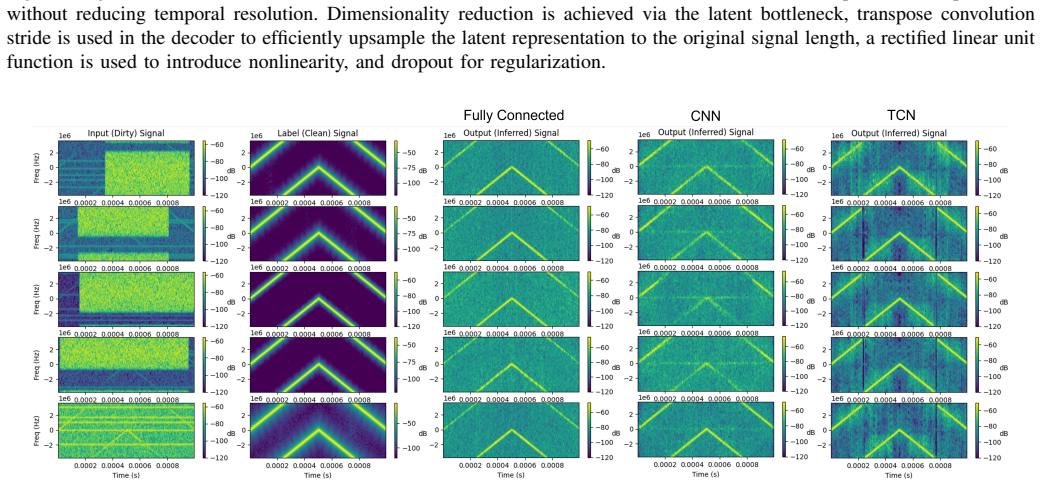
- [Section IV.B and Section V] The TCAE is trained and evaluated on signals generated by the same simulation pipeline, and Figure 4 describes the evaluation set as 'created in a similar way to the training data set.' The manuscript does not state whether the simulation evaluation set is drawn from a held-out portion of the same generator or from a distinct distribution. This overlap can inflate apparent performance. The OTA experiment is the only independent check, and it is limited. Please clarify the train/evaluation data split, quantify the simulation-to-real gap, and consider adding OTA tests with 5G or tone interference and varied SINR to strengthen the external-validity claim.
minor comments (6)
- [Section V, text near Fig. 7] The phrase 'particularly under high-SIR or temporally overlapping interference conditions' appears to be a typo: the surrounding results describe low-SIR, high-interference conditions, so this should likely read 'low-SIR.'
- [Section V, radar parameter description] The text states 'a frequency of 1000 chirps per second'; this should be expressed as a chirp repetition frequency of 1000 Hz, and 'United State Geological Survey' should be 'United States Geological Survey.'
- [Section IV.B and Section IV.A] The training-data size is inconsistent: Section IV.A mentions datasets of 50,000 signals, while Section IV.B says the TCN was trained on 10,000 signals with 1,000 for validation, and later mentions hyperparameter tuning on 50,000 examples. Please clarify which dataset size was used for the final model and how the 50,000-example tuning set relates to the 10,000-example training set.
- [Section II, reference [5]] The sentence beginning 'In [5] industry standards and regulatory guidelines...' is missing a verb and should be revised for clarity.
- [Figure 9] The spectrograms in Figure 9 lack axis labels and colorbar labels; adding them would make the interference bandwidth and suppression effect easier to verify.
- [Table I and Section IV.A] Table I lists six layers but the text describes three encoder and three decoder layers; please clarify the correspondence between Table I rows and the encoder/decoder blocks, and include the number of output channels for each row so the architecture is fully reproducible.
Circularity Check
No circular derivation: the TCN autoencoder claim is empirical and independently checked by over-the-air data; the only self-citations are non-load-bearing.
full rationale
The paper makes no formal derivation that could reduce to its own inputs. The central claim is an empirical comparison: a TCN autoencoder is trained on simulated IQ waveforms with additive tone/QPSK/5G interference and then evaluated on a held-out simulation test set and on independent over-the-air USRP captures. The training objective is L2 reconstruction of clean labels, and the reported altitude RMSE is computed against the true altitude, not against the training labels or any fitted parameter. Thus there is no fitted-input-called-prediction step and no self-definitional equivalence. The two citations to the authors' prior MILCOM paper [1] are used only to say that a CNN/FC autoencoder was explored in preliminary work and that this paper builds on that architecture; neither citation is used to justify the TCN's performance or to forbid alternative approaches. The concern that the LMS baseline may be undertuned (length 32, step 10^-4, clean-chirp reference, no convergence study) is an experimental fairness issue, not a circularity issue: the >85% reduction is an empirical result against a specific baseline, not a quantity derived by construction from the model's own training data. The independent OTA experiment, in which a model trained only on simulated data removes a QPSK interferer occupying 26.7% of the bandwidth, provides a non-circular external check. Overall, the paper's claims are not circular; the simulation-to-real generalization risk is a limitation, not a tautology.
Assumptions & free parameters
free parameters (4)
- latent compression ratio =
128-dim latent from 7500-sample x 2-channel input (approx 0.85% of raw samples; tuned over 1.5%-5%)
- dilation factors and kernel sizes =
dilations [1,2,4], kernels 3-6
- training hyperparameters =
lr=0.001, batch=128, epochs=150
- multipath amplitude modulation =
std 0.3, bandwidth 10% of FMCW BW
assumptions (4)
- standard math FFT/CFAR dechirping chain correctly converts beat frequency to altitude (Section V).
- domain assumption Additive signal model in Eq. (4) (target + interference + clutter + noise) captures real FMCW interference.
- domain assumption Synthetic training distribution (tones, QPSK, 5G waveforms with stated SNR/SIR ranges) is representative of operational interference.
- ad hoc to paper Per-sample normalization of IQ to unit peak amplitude preserves information needed for range estimation.
Cite this review
Pith. "Pith review of Temporal Convolutional Autoencoder for Interference Mitigation in FMCW Radar Altimeters." pith.science (2026). https://pith.science/paper/SK3DRHEL
@misc{pith2026250522783,
  author       = {Pith},
  title        = {Pith review of: Temporal Convolutional Autoencoder for Interference Mitigation in FMCW Radar Altimeters},
  year         = {2026},
  howpublished = {\url{https://pith.science/paper/SK3DRHEL}},
  note         = {Machine review of arXiv:2505.22783}
}
read the original abstract
Reliable altitude estimation with frequency-modulated continuous wave (FMCW) radar altimeters is increasingly a challenge due to in-band interference from modern communication systems. In this paper, we present a temporal convolutional autoencoder (TCAE) that directly processes in-phase and quadrature (IQ) samples to suppress structured interference while preserving signal phase and frequency content for range estimation. The model is trained and initially evaluated within a full radar altimeter simulation chain, then further validated via over-the-air (OTA) experiments using a universal software radio peripheral (USRP)-based testbed. Results show that the TCAE reduces altitude estimation error by more than 85% compared to least mean squares (LMS) adaptive filtering under severe interference conditions, including low signal-to-interference-plus-noise ratio (SINR) and full temporal overlap between interfering and radar signals. Unlike conventional methods, the TCAE maintains phase fidelity and beat structure, enabling accurate range estimation even when interferers occupy more than one-quarter of the radar bandwidth. The implemented TCAE performs mitigation directly on fixed-length IQ windows using a single feed-forward pass and was integrated into the MATLAB/ONNX-based evaluation chain used for both simulation and OTA testing. These findings demonstrate that learned IQ-domain interference mitigation can enhance radar-altimeter resilience under a range of tested interference conditions.
Figures


Figures from the paper (7 more)


Reference graph
Works this paper leans on
-
[1]
S. B. Brown, S. Young, A. Wagenknecht, D. Jakubisin, C. E. Thornton, A. Orndorff, and W. C. Headley, “Aircraft radar altimeter interference mitigation through a cnn-layer only denoising autoencoder architecture,” in Proc. IEEE MILCOM , Oct. 2024
work page 2024
-
[2]
Interference suppression using deep learning: Current approaches and open chal- lenges,
T. Oyedare, V . K. Shah, D. J. Jakubisin, and J. H. Reed, “Interference suppression using deep learning: Current approaches and open chal- lenges,” IEEE Access , vol. 10, pp. 66 238–66 266, 2022
work page 2022
-
[3]
Radar interference mitigation for automated driving: Exploring proac- tive strategies,
C. Aydogdu, M. F. Keskin, G. K. Carvajal, O. Eriksson, H. Hellsten, H. Herbertsson, E. Nilsson, M. Rydstrom, K. Vanas, and H. Wymeersch, “Radar interference mitigation for automated driving: Exploring proac- tive strategies,” IEEE Signal Processing Magazine , vol. 37, no. 4, pp. 72–84, 2020
work page 2020
-
[4]
Assessing 5g radar altimeter interference for realistic instrument landing system approaches,
O. Kenneth, “Assessing 5g radar altimeter interference for realistic instrument landing system approaches,” REMCOM, Tech. Rep., 2022
work page 2022
-
[5]
RTCA, “Assessment of c-band mobile telecommunications interference impact on low range radar altimeter operations,” RTCA, Tech. Rep., 2020
work page 2020
-
[6]
Machine learning-based identification and mitigation of 5g interference for radar altimeters,
A. Amaireh and Y . Zhang, “Machine learning-based identification and mitigation of 5g interference for radar altimeters,” IEEE Access , 2024
work page 2024
-
[7]
J. Rock and Y . Wang, “Radar altimeter coexist design in the 4.2–4.4 ghz band for multistage interference risk mitigation in 5g and beyond,” IEEE Aerospace and Electronic Systems Magazine , vol. 39, no. 10, pp. 4–16, 2024
work page 2024
-
[8]
Autoencoders for training compact deep learning rf classifiers for wireless protocols,
S. Kokalj-Filipovic, R. Miller, and J. Morman, “Autoencoders for training compact deep learning rf classifiers for wireless protocols,” in 2019 IEEE 20th International Workshop on Signal Processing Advances in Wireless Communications (SPA WC), 2019, pp. 1–5
work page 2019
Show all 17 references
-
[9]
Automotive radar interference mitigation using a convolutional autoencoder,
J. Fuchs, A. Dubey, M. L ¨ubke, R. Weigel, and F. Lurz, “Automotive radar interference mitigation using a convolutional autoencoder,” in2020 IEEE International Radar Conference (RADAR) , 2020, pp. 315–320
2020
-
[10]
A dnn autoencoder for automotive radar interference mitigation,
S. Chen, J. Taghia, T. Fei, U. K ¨uhnau, N. Pohl, and R. Martin, “A dnn autoencoder for automotive radar interference mitigation,” in ICASSP 2021 - 2021 IEEE International Conference on Acoustics, Speech and Signal Processing (ICASSP) , 2021, pp. 4065–4069
2021
-
[11]
Temporal convolutional networks: A unified approach to action segmentation,
C. Lea, R. Vidal, A. Reiter, and G. D. Hager, “Temporal convolutional networks: A unified approach to action segmentation,” 2016. [Online]. Available: https://arxiv.org/abs/1608.08242
2016 arXiv
-
[12]
Temporal convolutional network and its application in various sectors,
S. Chauhan, Sehaj, S. Kumar, Siddharth, D. Panwar, and S. Chopra, “Temporal convolutional network and its application in various sectors,” in 2023 3rd Asian Conference on Innovation in Technology (ASIAN- CON), 2023, pp. 1–7
2023
-
[13]
Tcae: Temporal convolutional au- toencoders for time series anomaly detection,
J. Park, Y . Park, and C.-I. Kim, “Tcae: Temporal convolutional au- toencoders for time series anomaly detection,” in 2022 Thirteenth International Conference on Ubiquitous and Future Networks (ICUFN) , 2022, pp. 421–426
2022
-
[14]
Radar spectrum engineering and management: Technical and regulatory issues,
H. Griffiths, L. Cohen, S. Watts, E. Mokole, C. Baker, M. Wicks, and S. Blunt, “Radar spectrum engineering and management: Technical and regulatory issues,” Proceedings of the IEEE , vol. 103, no. 1, pp. 85–102, 2015
2015
-
[15]
Mitigation of automotive radar interference,
F. Uysal and S. Sanka, “Mitigation of automotive radar interference,” in 2018 IEEE Radar Conference (RadarConf18) , 2018, pp. 0405–0410
2018
-
[16]
An empirical evaluation of generic convolutional and recurrent networks for sequence modeling,
S. Bai, J. Z. Kolter, and V . Koltun, “An empirical evaluation of generic convolutional and recurrent networks for sequence modeling,” 2018. [Online]. Available: https://arxiv.org/abs/1803.01271
2018 arXiv
-
[17]
Fmcw radar altimeter simulation,
MathWorks, “Fmcw radar altimeter simulation,” 2024. [Online]. Available: https://www.mathworks.com/help/radar/ug/ fmcw-radar-altimeter-simulation.html
2024
Reviewed August 7, 2026 · model on record in the stance chip above.
Discussion (0). Sign in to comment.