REVIEW 4 major objections 5 minor 56 references
Rhetorical Text-to-Image Generation via Two-layer Diffusion Policy Optimization
T0 review · 4 major / 5 minor · reviewed 2026-08-07 · deepseek-v4-flash
Pith's one-line read Rhet2Pix outperforms GPT-4o and Grok-3 at generating images from rhetorical language.
desk verdict Rhet2Pix is a plausible engineering recipe for steering diffusion models away from literal metaphor vehicles, but its headline numbers are circular: Table 1's metrics appear to be the training rewards, so the SOTA claim over GPT-4o and Grok-3 is unsupported. read the letter →
The pith
A machine-rendered reading of the paper's core claim, the machinery that carries it, and where it could break.
The reading
What carries the argument
The central object is a two-layer Markov decision process. The outer MDP models the staged progression of prompts: the state is the image generated at a stage and the action is the semantic increment added to the prompt; advantages are computed with Generalized Advantage Estimation. The inner MDP models diffusion denoising: the state is the latent $x_t$ with prompt and timestep, the action is the next denoised latent $x_{t-1}$, and the terminal reward is propagated to each step via $\hat{A}^{(j)}_t = \gamma_{\text{denoise}}^t \hat{A}_j$. This discounting is what the paper claims solves reward sparsity, because every adjacent action pair gets a nonzero advantage. Policy updates use a PPO clipped surrogate over shuffled action pairs.
What would settle it
Run a human study where annotators choose which image best captures the figurative meaning of a set of rhetorical prompts, comparing Rhet2Pix against GPT-4o and Grok-3. If annotators do not prefer Rhet2Pix images at a clear rate, or if the reported alignment scores do not predict those choices, the central claim would be refuted.
Extended reading notes
Core claim
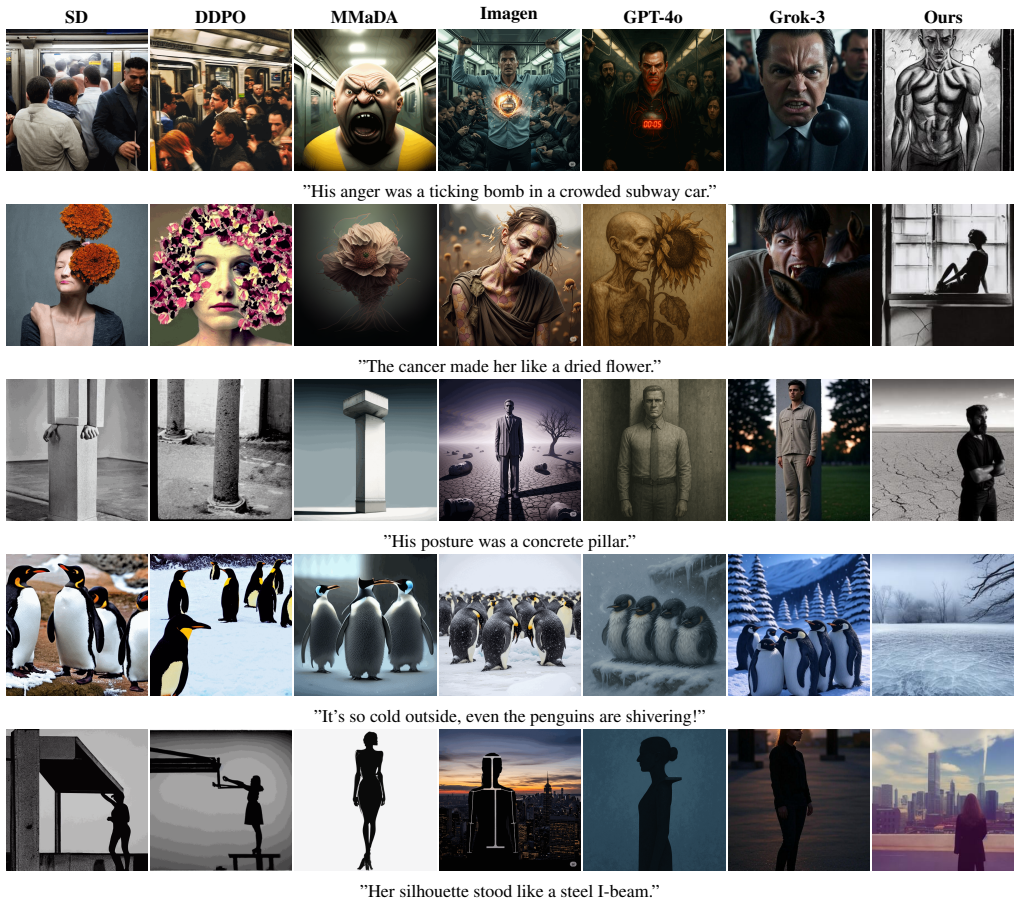
Rhet2Pix establishes that the literal-visual bias in rhetorical image generation can be corrected by separating semantic planning from pixel synthesis. In the outer layer, an LLM extracts key factors (subject, vehicle, theme, emotion) and builds a sequence of staged prompts, each adding context while preserving the subject. In the inner layer, the denoising trajectory of a Stable Diffusion model is optimized with PPO, where each outer-layer advantage is discounted backward across denoising steps so that early actions receive credit for the final rhetorical alignment. A combined reward penalizes the presence of the metaphorical vehicle and rewards staged semantic alignment and aesthetic quality. The paper reports that on its benchmark Rhet2Pix achieves a Sum-alignment of 0.6671 versus 0.4192 for Grok-3, and qualitatively produces images that depict the intended subject rather than the literal vehicle.
Load-bearing premise
The evaluation assumes that the CLIP-similarity scores used to measure alignment are valid measures of rhetorical fidelity, but these scores appear to be the same terms used to train the model, and no human or external benchmark verifies that they correspond to correct metaphorical images.
Editorial extensions
If this is right
- If correct, small diffusion models fine-tuned on rhetorical data can outperform general MLLMs on figurative language without architectural changes.
- The two-layer MDP with discounted rewards could be applied to other long-horizon generation tasks where feedback is only available at the end, such as text-to-video or layout generation.
- The vehicle-penalty reward offers a reusable recipe for preventing literal over-alignment in any task with metaphorical or abstract semantics.
- Because only the final prompt is used at inference, the method adds no extra generation cost, only a fine-tuning cost.
Reading between the lines
- The paper's own limitation note admits that a fundamentally new backbone beyond text-image embedding similarity may be needed; this suggests the gains may be bounded by the CLIP embedding space used for both reward and evaluation.
- A natural extension would be to test Rhet2Pix on other figures of speech such as hyperbole or irony, which may not map to concrete visual subjects as directly as metaphor and simile.
- The reported elemental-alignment advantage for Rhet2Pix (0.4017 vs 0.1741) may partly reflect that the vehicle penalty is hand-tuned on the same distribution, so a distribution shift in rhetorical prompts could erode the gap.
Editorial analysis
A structured set of objections, weighed in public.
Referee Report
Summary. The paper proposes Rhet2Pix, a framework for rhetorical text-to-image generation that formulates the task as a two-layer Markov Decision Process and fine-tunes a Stable Diffusion backbone with a PPO-style policy optimization. In the outer layer, an LLM decomposes a rhetorical prompt into staged sub-prompts whose images are evaluated by a rhetorical reward; in the inner layer, the final reward is discounted backward along the denoising trajectory to address reward sparsity. The paper reports quantitative results in Table 1 claiming that Rhet2Pix outperforms GPT-4o, Grok-3, and several academic baselines on 'semantic-alignment' and 'elemental-alignment' metrics, and provides qualitative examples and ablations.
Significance. If the claims were supported, the paper would make a useful contribution to an underexplored task: generating images that preserve figurative meaning rather than literal vehicle depiction. The paper is also commendable for planning to release code and data. However, the headline quantitative result is not currently supported because the evaluation metrics in Table 1 are not defined independently of the training reward in Section 4.5. The paper's own limitation statement in Appendix C further weakens the validity of CLIP-based alignment as the sole measure of rhetorical fidelity. As a result, the empirical contribution is unverified.
major comments (4)
- [Section 5.2, Table 1] The evaluation metrics are never defined in Section 5.2, and their names ('Semantic-alignment', 'Elemental-alignment') exactly match the reward terms 'staged semantic alignment' and 'elemental alignment' in Section 4.5. The formulas there are CLIP cosine similarities, including the manually tuned vehicle penalty threshold tau. Because Rhet2Pix is trained via PPO to maximize these same quantities, its higher scores on this table are a direct consequence of optimizing the evaluation metric rather than evidence of better rhetorical understanding. The comparison to GPT-4o and Grok-3 is therefore circular. The authors must either define the evaluation metrics as external, independent measures, or replace this table with human evaluation or a standard benchmark (e.g., MetaCLUE or T2I-CompBench) applied to all models under identical conditions.
- [Appendix C] The paper explicitly concedes that fully addressing rhetorical text-to-image generation 'may necessitate a fundamentally new backbone—one that surpasses conventional text-image embedding similarity.' This statement directly contradicts the validity of using CLIP-based embedding similarities as the sole evaluation metric for rhetorical fidelity in Table 1. If the authors believe this limitation statement, then the quantitative evaluation cannot be used to substantiate the claim of outperforming SOTA MLLMs. The paper should either justify how the CLIP metrics capture rhetorical meaning despite this acknowledged limitation, or adopt a more appropriate evaluation protocol.
- [Section 5.3, Figure 5] The ablation study is presented only qualitatively, with a few image examples. The claims that 'scene modeling' and 'reinforcement learning' are crucial for performance are not supported by any quantitative measurement. Without quantitative ablations using the same (independent) evaluation protocol as the main comparison, it is impossible to assess the contribution of each component or to rule out that the observed qualitative differences are due to cherry-picked examples.
- [Section 4.5] The reward function contains several manually set free parameters that are not analyzed: the monotonic weight vector w(j) for staged alignment, the vehicle penalty threshold tau, and the discount factors gamma, lambda, and gamma_denoise. In particular, tau is described as 'manually determined by empirical analysis of CLIP similarity scores'—the same score distribution used in the evaluation table. This creates a risk that the reported improvements reflect tuning of the evaluation-aligned reward rather than a general advance. A sensitivity analysis of these parameters is needed to establish robustness.
minor comments (5)
- [Section 4.3/4.4] The inner-layer MDP defines the action as a_t = x_{t-1}, but Section 4.4 repeatedly refers to 'adjacent action pairs (s_t, s_{t+1})'. This is inconsistent: the transition pair should be (s_t, a_t) or (s_t, s_{t-1}), depending on the time indexing. Please clarify the notation.
- [Algorithm 1] Line 49 defines the critic loss as E[(V_phi(s_t) - Ahat)^2], which is not the standard value loss used in PPO (typically (V_phi(s_t) - (Ahat + V_old(s_t)))^2 or a similar target). This may lead to biased value estimation and could affect the reported training behavior.
- [Section 4.5] The staged semantic alignment reward assumes each prompt P^j_i is decomposed into sub-sentences S^k_i, but the paper does not specify how this decomposition is obtained. A reproducible description (e.g., an LLM prompt or parsing rule) is needed.
- [Table 3] The hyperparameter table describes a ViT-based critic and its architectural components, but the main text does not describe the critic architecture. Consider moving a brief description into the main text or at least referencing the table when the critic is introduced in Section 4.4.
- [Throughout] There are several minor grammatical issues and awkward phrasings (e.g., 'environmental steps' in Figure 8, inconsistent capitalization of 'state-of-the-art'). A careful proofreading pass would improve readability.
Circularity Check
Table 1's Semantic-alignment and Elemental-alignment scores are the paper's own Sec. 4.5 training rewards, so the SOTA claim reduces by construction to reward maximization.
-
fitted input called prediction
[Section 5.2, Table 1 (evaluation) and Section 4.5 'Tailored Reward Mechanism' (training reward)]
"Quantitative evaluation. As reported in Table 1, Rhet2Pix performs consistently well across all alignment evaluation metrics, achieving a clear lead in overall performance."
Table 1's 'Semantic-alignment' and 'Elemental-alignment' columns are not defined in Sec. 5.2, but their names reproduce the reward modules defined in Sec. 4.5: 'staged semantic alignment' (r_stage = Σ_j w_j ⟨v, u_j⟩) and 'elemental alignment' (r_subject = Σ_k ⟨v, f_text(k)/||f_text(k)||⟩, with the manually fit vehicle-penalty threshold τ). Rhet2Pix is trained via PPO (Eq. 3) to maximize exactly these CLIP-cosine rewards, so its Sum-alignment 0.6671 versus Grok-3's 0.4192 is the expected consequence of optimizing the evaluation metric, not evidence of better rhetorical understanding.
full rationale
The paper's RL fine-tuning procedure is a genuine training method, and the qualitative samples provide some visual evidence. However, the central quantitative claim of outperforming GPT-4o and Grok-3 rests on Table 1, whose Semantic-alignment and Elemental-alignment columns coincide, by name and formula, with the staged-semantic and elemental reward terms in Sec. 4.5 that Rhet2Pix was trained to maximize. Because the evaluation metric is the training objective, the reported lead is forced by construction; no independent metric definition, human rating, or external benchmark (e.g., MetaCLUE or T2I-CompBench) is provided. Appendix C warns that conventional text-image embedding similarity may be insufficient for true rhetorical generation, which is precisely the similarity used in both training and evaluation. There is no load-bearing self-citation or imported uniqueness theorem; the circularity is in the evaluation design, not in the training algorithm.
Assumptions & free parameters
free parameters (6)
- vehicle penalty threshold tau
- staged semantic-alignment weights w(j)
- GAE discount factors gamma and lambda
- inner-layer discount gamma_denoise
- number of stages C
- dataset filtering criteria
assumptions (4)
- domain assumption CLIP cosine similarity is a valid proxy for semantic and elemental alignment in reward and evaluation.
- domain assumption GPT-4o generate-verify-retry produces valid key factors and staged prompts.
- ad hoc to paper Later denoising steps matter more than early steps for semantic detail, justifying gamma_denoise weighting.
- ad hoc to paper The reward decomposition into semantic, elemental, and aesthetic terms is complete and correctly balanced.
Cite this review
Pith. "Pith review of Rhetorical Text-to-Image Generation via Two-layer Diffusion Policy Optimization." pith.science (2026). https://pith.science/paper/SIGZTV5X
@misc{pith2026250522792,
  author       = {Pith},
  title        = {Pith review of: Rhetorical Text-to-Image Generation via Two-layer Diffusion Policy Optimization},
  year         = {2026},
  howpublished = {\url{https://pith.science/paper/SIGZTV5X}},
  note         = {Machine review of arXiv:2505.22792}
}
read the original abstract
Generating images from rhetorical languages remains a critical challenge for text-to-image models. Even state-of-the-art (SOTA) multimodal large language models (MLLM) fail to generate images based on the hidden meaning inherent in rhetorical language--despite such content being readily mappable to visual representations by humans. A key limitation is that current models emphasize object-level word embedding alignment, causing metaphorical expressions to steer image generation towards their literal visuals and overlook the intended semantic meaning. To address this, we propose Rhet2Pix, a framework that formulates rhetorical text-to-image generation as a multi-step policy optimization problem, incorporating a two-layer MDP diffusion module. In the outer layer, Rhet2Pix converts the input prompt into incrementally elaborated sub-sentences and executes corresponding image-generation actions, constructing semantically richer visuals. In the inner layer, Rhet2Pix mitigates reward sparsity during image generation by discounting the final reward and optimizing every adjacent action pair along the diffusion denoising trajectory. Extensive experiments demonstrate the effectiveness of Rhet2Pix in rhetorical text-to-image generation. Our model outperforms SOTA MLLMs such as GPT-4o, Grok-3 and leading academic baselines across both qualitative and quantitative evaluations. The code and dataset used in this work are publicly available.
Figures


Figures from the paper (7 more)



Reference graph
Works this paper leans on
-
[1]
, " * write output.state after.block = add.period write newline
ENTRY address archivePrefix author booktitle chapter edition editor eid eprint howpublished institution isbn journal key month note number organization pages publisher school series title type volume year label extra.label sort.label short.list INTEGERS output.state before.all mid.sentence after.sentence after.block FUNCTION init.state.consts #0 'before.a...
-
[2]
write newline
" write newline "" before.all 'output.state := FUNCTION n.dashify 't := "" t empty not t #1 #1 substring "-" = t #1 #2 substring "--" = not "--" * t #2 global.max substring 't := t #1 #1 substring "-" = "-" * t #2 global.max substring 't := while if t #1 #1 substring * t #2 global.max substring 't := if while FUNCTION word.in bbl.in capitalize " " * FUNCT...
-
[3]
Akula, A. R.; Driscoll, B.; Narayana, P.; Changpinyo, S.; Jia, Z.; Damle, S.; Pruthi, G.; Basu, S.; Guibas, L.; Freeman, W. T.; et al. 2023. Metaclue: Towards comprehensive visual metaphors research. In Proceedings of the IEEE/CVF conference on computer vision and pattern recognition, 23201--23211
work page 2023
-
[4]
T.; Yang, Z.; Qi, Z.; Han, J.; Sahoo, S
Arriola, M.; Gokaslan, A.; Chiu, J. T.; Yang, Z.; Qi, Z.; Han, J.; Sahoo, S. S.; and Kuleshov, V. 2025. Block Diffusion: Interpolating Between Autoregressive and Diffusion Language Models. arXiv preprint arXiv:2503.09573
arXiv 2025
-
[5]
Batzolis, G.; Stanczuk, J.; Sch \"o nlieb, C.-B.; and Etmann, C. 2021. Conditional image generation with score-based diffusion models. arXiv preprint arXiv:2111.13606
arXiv 2021
-
[6]
Betker, J.; Goh, G.; Jing, L.; Brooks, T.; Wang, J.; Li, L.; Ouyang, L.; Zhuang, J.; Lee, J.; Guo, Y.; et al. 2023. Improving image generation with better captions. Computer Science. https://cdn. openai. com/papers/dall-e-3. pdf, 2(3): 8
2023
-
[7]
Black, K.; Janner, M.; Du, Y.; Kostrikov, I.; and Levine, S. 2024. Training Diffusion Models with Reinforcement Learning. arXiv:2305.13301
arXiv 2024
-
[8]
Brade, S.; Wang, B.; Sousa, M.; Oore, S.; and Grossman, T. 2023. Promptify: Text-to-image generation through interactive prompt exploration with large language models. In Proceedings of the 36th Annual ACM Symposium on User Interface Software and Technology, 1--14
work page 2023
Show all 56 references
-
[10]
Chakrabarty, T.; Saakyan, A.; Ghosh, D.; and Muresan, S. 2022 b . FLUTE: Figurative Language Understanding through Textual Explanations. arXiv:2205.12404
2022 arXiv
-
[11]
Chakrabarty, T.; Saakyan, A.; Winn, O.; Panagopoulou, A.; Yang, Y.; Apidianaki, M.; and Muresan, S. 2023. I spy a metaphor: Large language models and diffusion models co-create visual metaphors. arXiv preprint arXiv:2305.14724
2023 arXiv
-
[12]
Chakrabarty, T.; Zhang, X.; Muresan, S.; and Peng, N. 2021. MERMAID: Metaphor generation with symbolism and discriminative decoding. arXiv preprint arXiv:2103.06779
2021 arXiv
-
[13]
Dai, D.; Dong, L.; Hao, Y.; Sui, Z.; Chang, B.; and Wei, F. 2021. Knowledge neurons in pretrained transformers. arXiv preprint arXiv:2104.08696
2021 arXiv
-
[14]
Dai, Z.; Asgharivaskasi, A.; Duong, T.; Lin, S.; Tzes, M.-E.; Pappas, G.; and Atanasov, N. 2024. Optimal Scene Graph Planning with Large Language Model Guidance. arXiv:2309.09182
2024 arXiv
-
[15]
Dong, H.; Xiong, W.; Goyal, D.; Zhang, Y.; Chow, W.; Pan, R.; Diao, S.; Zhang, J.; Shum, K.; and Zhang, T. 2023. Raft: Reward ranked finetuning for generative foundation model alignment. arXiv preprint arXiv:2304.06767
2023 arXiv
-
[16]
Fan, Y.; Watkins, O.; Du, Y.; Liu, H.; Ryu, M.; Boutilier, C.; Abbeel, P.; Ghavamzadeh, M.; Lee, K.; and Lee, K. 2023. DPOK: Reinforcement Learning for Fine-tuning Text-to-Image Diffusion Models. arXiv:2305.16381
2023 arXiv
-
[17]
K.; Wang, S.; Lu, Y.; Zhu, M.; Wang, B.; and Chen, W
Feng, Y.; Wang, X.; Wong, K. K.; Wang, S.; Lu, Y.; Zhu, M.; Wang, B.; and Chen, W. 2023. Promptmagician: Interactive prompt engineering for text-to-image creation. IEEE Transactions on Visualization and Computer Graphics, 30(1): 295--305
2023
-
[18]
Gao, J.; Hu, K.; Xu, G.; and Xu, H. 2023. Can pre-trained text-to-image models generate visual goals for reinforcement learning? Advances in Neural Information Processing Systems, 36: 38297--38310
2023
-
[19]
Gong, H.; Gupta, K.; Jain, A.; and Bhat, S. 2020. IlliniMet: Illinois system for metaphor detection with contextual and linguistic information. In Proceedings of the second workshop on figurative language processing, 146--153
2020
-
[20]
Hao, Y.; Chi, Z.; Dong, L.; and Wei, F. 2023. Optimizing prompts for text-to-image generation. Advances in Neural Information Processing Systems, 36: 66923--66939
2023
-
[21]
Ho, J.; Jain, A.; and Abbeel, P. 2020. Denoising diffusion probabilistic models. Advances in neural information processing systems, 33: 6840--6851
2020
-
[22]
J.; Norouzi, M.; and Salimans, T
Ho, J.; Saharia, C.; Chan, W.; Fleet, D. J.; Norouzi, M.; and Salimans, T. 2022. Cascaded diffusion models for high fidelity image generation. Journal of Machine Learning Research, 23(47): 1--33
2022
-
[23]
J.; Shen, Y.; Wallis, P.; Allen-Zhu, Z.; Li, Y.; Wang, S.; Wang, L.; Chen, W.; et al
Hu, E. J.; Shen, Y.; Wallis, P.; Allen-Zhu, Z.; Li, Y.; Wang, S.; Wang, L.; Chen, W.; et al. 2022. Lora: Low-rank adaptation of large language models. ICLR, 1(2): 3
2022
-
[24]
Hu, Z.; Zhang, F.; Chen, L.; Kuang, K.; Li, J.; Gao, K.; Xiao, J.; Wang, X.; and Zhu, W. 2025. Towards Better Alignment: Training Diffusion Models with Reinforcement Learning Against Sparse Rewards. arXiv preprint arXiv:2503.11240
2025 arXiv
-
[25]
Huang, K.; Sun, K.; Xie, E.; Li, Z.; and Liu, X. 2023. T2i-compbench: A comprehensive benchmark for open-world compositional text-to-image generation. Advances in Neural Information Processing Systems, 36: 78723--78747
2023
-
[26]
Jiang, D.; Guo, Z.; Zhang, R.; Zong, Z.; Li, H.; Zhuo, L.; Yan, S.; Heng, P.-A.; and Li, H. 2025. T2I-R1: Reinforcing Image Generation with Collaborative Semantic-level and Token-level CoT. arXiv:2505.00703
2025 arXiv
-
[27]
P.; Littman, M
Kaelbling, L. P.; Littman, M. L.; and Moore, A. W. 1996. Reinforcement Learning: A Survey. arXiv:cs/9605103
1996 arXiv
-
[29]
Lee, K.; Liu, H.; Ryu, M.; Watkins, O.; Du, Y.; Boutilier, C.; Abbeel, P.; Ghavamzadeh, M.; and Gu, S. S. 2023 b . Aligning text-to-image models using human feedback. arXiv preprint arXiv:2302.12192
2023 arXiv
-
[30]
W.; Klebanov, B
Leong, C. W.; Klebanov, B. B.; and Shutova, E. 2018. A report on the 2018 VUA metaphor detection shared task. In Proceedings of the workshop on figurative language processing, 56--66
2018
-
[31]
Liu, V.; and Chilton, L. B. 2022. Design guidelines for prompt engineering text-to-image generative models. In Proceedings of the 2022 CHI conference on human factors in computing systems, 1--23
2022
-
[32]
Mo, W.; Zhang, T.; Bai, Y.; Su, B.; Wen, J.-R.; and Yang, Q. 2024. Dynamic prompt optimizing for text-to-image generation. In Proceedings of the IEEE/CVF Conference on Computer Vision and Pattern Recognition, 26627--26636
2024
-
[33]
P.; Perelman, A.; and et al
OpenAI; Hurst, A.; Lerer, A.; Goucher, A. P.; Perelman, A.; and et al. 2024. GPT-4o System Card. arXiv:2410.21276
2024 arXiv
-
[34]
H.; and Riedel, S
Petroni, F.; Rockt \"a schel, T.; Lewis, P.; Bakhtin, A.; Wu, Y.; Miller, A. H.; and Riedel, S. 2019. Language models as knowledge bases? arXiv preprint arXiv:1909.01066
2019 arXiv
-
[35]
Prabhudesai, M.; Goyal, A.; Pathak, D.; and Fragkiadaki, K. 2024. Aligning Text-to-Image Diffusion Models with Reward Backpropagation. arXiv:2310.03739
2024 arXiv
-
[36]
Prasad, A.; Koller, A.; Hartmann, M.; Clark, P.; Sabharwal, A.; Bansal, M.; and Khot, T. 2024. ADaPT: As-Needed Decomposition and Planning with Language Models. arXiv:2311.05772
2024 arXiv
-
[37]
Ramesh, A.; Pavlov, M.; Goh, G.; Gray, S.; Voss, C.; Radford, A.; Chen, M.; and Sutskever, I. 2021. Zero-shot text-to-image generation. In International conference on machine learning, 8821--8831. Pmlr
2021
-
[38]
Rana, K.; Haviland, J.; Garg, S.; Abou-Chakra, J.; Reid, I.; and Suenderhauf, N. 2023. SayPlan: Grounding Large Language Models using 3D Scene Graphs for Scalable Robot Task Planning. arXiv:2307.06135
2023 arXiv
-
[39]
Z.; Lidard, J.; Ankile, L
Ren, A. Z.; Lidard, J.; Ankile, L. L.; Simeonov, A.; Agrawal, P.; Majumdar, A.; Burchfiel, B.; Dai, H.; and Simchowitz, M. 2024. Diffusion policy policy optimization. arXiv preprint arXiv:2409.00588
2024 arXiv
-
[40]
Rombach, R.; Blattmann, A.; Lorenz, D.; Esser, P.; and Ommer, B. 2022 a . High-Resolution Image Synthesis with Latent Diffusion Models. arXiv:2112.10752
2022 arXiv
-
[41]
Rombach, R.; Blattmann, A.; Lorenz, D.; Esser, P.; and Ommer, B. 2022 b . High-resolution image synthesis with latent diffusion models. In Proceedings of the IEEE/CVF conference on computer vision and pattern recognition, 10684--10695
2022
-
[42]
Ronneberger, O.; Fischer, P.; and Brox, T. 2015. U-Net: Convolutional Networks for Biomedical Image Segmentation. arXiv:1505.04597
2015 arXiv
-
[43]
Saharia, C.; Chan, W.; Saxena, S.; Li, L.; Whang, J.; Denton, E.; Ghasemipour, S. K. S.; Ayan, B. K.; Mahdavi, S. S.; Lopes, R. G.; Salimans, T.; Ho, J.; Fleet, D. J.; and Norouzi, M. 2022. Photorealistic Text-to-Image Diffusion Models with Deep Language Understanding. arXiv:2...
2022 arXiv
-
[44]
Schuhmann, C.; Beaumont, R.; Vencu, R.; Gordon, C.; Wightman, R.; Cherti, M.; Coombes, T.; Katta, A.; Mullis, C.; Wortsman, M.; Schramowski, P.; Kundurthy, S.; Crowson, K.; Schmidt, L.; Kaczmarczyk, R.; and Jitsev, J. 2022. LAION-5B: An open large-scale dataset for training ne...
2022 arXiv
-
[45]
Sohl-Dickstein, J.; Weiss, E.; Maheswaranathan, N.; and Ganguli, S. 2015. Deep unsupervised learning using nonequilibrium thermodynamics. In International conference on machine learning, 2256--2265. pmlr
2015
-
[46]
Song, J.; Meng, C.; and Ermon, S. 2020. Denoising diffusion implicit models. arXiv preprint arXiv:2010.02502
2020 arXiv
-
[47]
Sun, P.; Jiang, Y.; Chen, S.; Zhang, S.; Peng, B.; Luo, P.; and Yuan, Z. 2024. Autoregressive Model Beats Diffusion: Llama for Scalable Image Generation. arXiv:2406.06525
2024 arXiv
-
[48]
Tian, K.; Jiang, Y.; Yuan, Z.; Peng, B.; and Wang, L. 2024. Visual Autoregressive Modeling: Scalable Image Generation via Next-Scale Prediction. arXiv:2404.02905
2024 arXiv
-
[49]
Tsvetkov, Y.; Boytsov, L.; Gershman, A.; Nyberg, E.; and Dyer, C. 2014. Metaphor detection with cross-lingual model transfer. In Proceedings of the 52nd Annual Meeting of the Association for Computational Linguistics (Volume 1: Long Papers), 248--258
2014
-
[50]
Veale, T. 2016. Round up the usual suspects: Knowledge-based metaphor generation. In Proceedings of the Fourth Workshop on Metaphor in NLP, 34--41
2016
-
[51]
Wallace, B.; Dang, M.; Rafailov, R.; Zhou, L.; Lou, A.; Purushwalkam, S.; Ermon, S.; Xiong, C.; Joty, S.; and Naik, N. 2023. Diffusion Model Alignment Using Direct Preference Optimization. arXiv:2311.12908
2023 arXiv
-
[52]
Wang, Z.; Jiang, Y.; Zheng, H.; Wang, P.; He, P.; Wang, Z.; Chen, W.; and Zhou, M. 2023. Patch Diffusion: Faster and More Data-Efficient Training of Diffusion Models. arXiv:2304.12526
2023 arXiv
-
[53]
Xie, Y.; Pan, Z.; Ma, J.; Jie, L.; and Mei, Q. 2023. A prompt log analysis of text-to-image generation systems. In Proceedings of the ACM Web Conference 2023, 3892--3902
2023
-
[54]
Xu, J.; Liu, X.; Wu, Y.; Tong, Y.; Li, Q.; Ding, M.; Tang, J.; and Dong, Y. 2023. ImageReward: Learning and Evaluating Human Preferences for Text-to-Image Generation. arXiv:2304.05977
2023 arXiv
-
[55]
Yang, L.; Tian, Y.; Li, B.; Zhang, X.; Shen, K.; Tong, Y.; and Wang, M. 2025. MMaDA: Multimodal Large Diffusion Language Models. arXiv:2505.15809
2025 arXiv
-
[56]
Yang, L.; Yu, Z.; Meng, C.; Xu, M.; Ermon, S.; and Cui, B. 2024. Mastering Text-to-Image Diffusion: Recaptioning, Planning, and Generating with Multimodal LLMs. arXiv:2401.11708
2024 arXiv
-
[57]
Zhang, C.; Zhang, C.; Zhang, M.; and Kweon, I. S. 2023. Text-to-image diffusion models in generative ai: A survey. arXiv preprint arXiv:2303.07909
2023 arXiv
-
[58]
Zhang, S.; Yang, X.; Feng, Y.; Qin, C.; Chen, C.-C.; Yu, N.; Chen, Z.; Wang, H.; Savarese, S.; Ermon, S.; et al. 2024. Hive: Harnessing human feedback for instructional visual editing. In Proceedings of the IEEE/CVF Conference on Computer Vision and Pattern Recognition, 9026--9036
2024
Reviewed August 7, 2026 · model on record in the stance chip above.
Discussion (0). Sign in to comment.